

Most leads aren’t ready to buy when they first find you. That’s not a problem, it’s an opportunity. The gap between "interested" and "ready to sign" is where lead nurturing best practices separate businesses that grow from those that stall. Yet too many service businesses and law firms treat every lead like it should convert on the first touch, then wonder why their pipeline dries up.
At Client Factory, we build client acquisition systems that don’t just generate leads, they guide those leads through a deliberate, data-driven process until they become paying clients. We’ve spent over 30 years watching what works, and one thing is clear: the nurture sequence matters as much as the ad that brought someone in. Probably more.
This article breaks down nine proven lead nurturing practices that are working right now in 2026. You’ll get actionable workflows, real-world examples, and specific strategies you can apply to move prospects through your funnel faster, without being pushy or burning through your list. Whether you’re starting from scratch or tightening up an existing system, these practices will help you convert more of the leads you’re already paying to acquire.
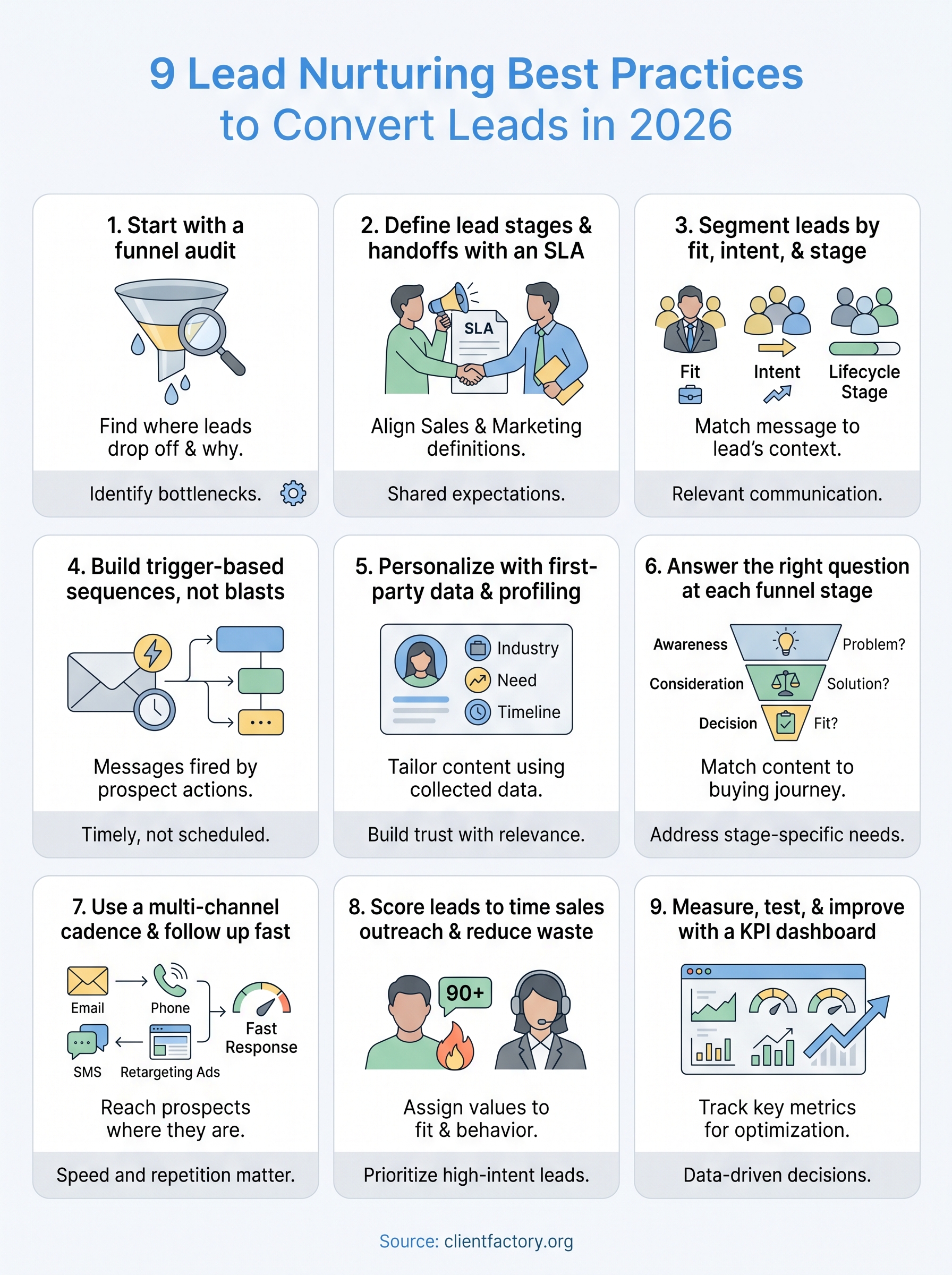
1. Start with a Client Factory funnel audit
You can’t fix a funnel you don’t understand. A funnel audit gives you a clear picture of where leads enter, where they drop off, and what’s blocking conversion. Before you apply any lead nurturing best practices, you need this baseline, because optimizing a broken system just burns budget faster.
Why it works
Most businesses lose leads in predictable places: the gap between an ad click and a landing page, the delay after a form submission, or the complete absence of follow-up after a consultation request. A structured audit forces you to trace every step a prospect takes from first touch to signed contract. When you map the full path, the leak points become obvious and addressable.
Identifying one weak handoff in your funnel can double the number of leads that actually reach your sales team.
Step-by-step workflow
Run your audit in this sequence. Each step builds on the last, so skipping ahead will leave you with incomplete data.
- Map every entry point: list all sources sending leads into your funnel (paid ads, organic search, referrals).
- Track drop-off rates at each stage: use your CRM and analytics platform to find where prospects stop engaging.
- Review response time: measure how long your team takes to follow up after a form submission.
- Identify content gaps: check whether leads at each stage receive relevant, timely communication or nothing at all.
- Document handoffs: confirm that marketing and sales share clear protocols so no lead gets lost between teams.
Recommended tools
Google Analytics 4 is the right starting point for tracking traffic sources and on-site behavior. Pair it with your CRM’s built-in reporting to map lead movement after the first form fill. If you want a faster answer, Client Factory offers a free funnel audit that identifies your biggest client acquisition bottlenecks without requiring you to configure anything yourself.
Metrics and benchmarks
Three numbers matter most when you finish your audit. Lead response time should sit under five minutes for inbound form fills. Stage-to-stage conversion rates tell you exactly which step needs the most attention. Your overall funnel conversion rate from visitor to paying client gives you the single benchmark to measure every other improvement against.
2. Define lead stages and handoffs with a clear SLA
When sales and marketing operate with different definitions of a "qualified lead," leads fall through the cracks and no one is accountable. A service-level agreement (SLA) creates shared language between teams, sets clear response time expectations, and ensures every lead gets handled consistently. Without this structure, even the best lead nurturing best practices won’t stick.
Why it works
When your team doesn’t agree on what a Marketing Qualified Lead (MQL) or Sales Qualified Lead (SQL) looks like, leads get passed too early or held too long and no one owns the outcome. A clear SLA removes that ambiguity and gives every team member a specific action to take at each stage.
A well-defined SLA can cut lead response time in half by eliminating the "whose job is it" delay.
Step-by-step workflow
Defining your lead stages takes less time than you think, and the payoff is immediate. Follow this sequence to build a handoff system your whole team will actually use.
- List your lead stages: MQL, SQL, Opportunity, and Closed are the standard four.
- Write entry criteria for each stage: define the exact signals that move a lead forward.
- Set response time rules: for example, sales contacts every SQL within 24 hours.
- Document handoff owners: name the person responsible for each transition.
Recommended tools
Your CRM is the foundation for enforcing SLAs. Most platforms let you build automated alerts when a lead sits in a stage too long, keeping every handoff visible and on schedule.
Metrics and benchmarks
Track your MQL-to-SQL conversion rate and average time spent in each stage. A healthy funnel moves SQLs to a first sales conversation within one business day.
3. Segment leads by fit, intent, and lifecycle stage
Sending the same message to every lead is one of the fastest ways to lose them. Segmentation lets you match your message to where each prospect actually is, which makes your communication relevant instead of generic. When you apply this to your lead nurturing best practices, you immediately increase the chances that any given email or follow-up lands at the right moment.

Why it works
Leads at different stages have different questions. A prospect who just discovered your firm is not ready for a pricing conversation, and a prospect who already requested a consultation doesn’t need introductory content. Sending the wrong content at the wrong time signals that you don’t understand the buyer, which erodes trust quickly.
Segmented email campaigns generate up to six times higher revenue than non-segmented campaigns, according to research from the Data and Marketing Association.
Step-by-step workflow
Build your segmentation system in three layers to cover the variables that matter most for conversion.
- Fit: Does this lead match your ideal client profile based on industry, company size, or legal need?
- Intent: What action did they take? A content download signals early curiosity; a form fill requesting a consultation signals buying intent.
- Lifecycle stage: Where are they in your funnel? Awareness, consideration, and decision stages each require a different message.
Recommended tools
Most CRM platforms support tag-based or list-based segmentation natively. Use your CRM’s contact properties to store fit and intent data, then build filtered lists that trigger the right sequences automatically.
Metrics and benchmarks
Track engagement rate by segment to confirm your groupings are accurate. If a segment shows low open rates, your entry criteria likely need tightening.
4. Build trigger-based nurture sequences, not blasts
Batch emails sent to your entire list on a fixed schedule are not lead nurturing, they’re interruptions. Trigger-based sequences fire when a prospect takes a specific action, so your message arrives exactly when the lead is already thinking about the topic. This approach sits at the core of effective lead nurturing best practices because it matches timing to intent rather than your team’s convenience.
Why it works
When a prospect downloads a guide or visits your pricing page, they want relevant follow-up right now, not three days later when your scheduled blast goes out. Behavioral triggers create a direct connection between what a lead does and what they receive next, keeping your communication relevant and building momentum toward a sales conversation.
Trigger-based emails reach prospects at peak intent, which is why they consistently outperform broadcast sends on every engagement metric.
Step-by-step workflow
Setting up trigger-based sequences requires mapping actions to outcomes before you write a single email.
- Define your triggers: page visits, form fills, content downloads, link clicks, or consultation requests.
- Write a response sequence per trigger: three to five emails that address what each action signals about buyer intent.
- Set message delays: 24 to 48 hours between sends keeps momentum without overwhelming the prospect.
- Add exit conditions: pull a lead out of the sequence the moment they book a call or convert.
Recommended tools
Your CRM’s native automation builder handles most trigger logic without custom code. Pair it with your email platform to create conditional branches based on whether a lead opens, clicks, or ignores each message.
Metrics and benchmarks
Track open rate, click-through rate, and sequence completion rate for every trigger you build. A strong sequence holds an open rate above 30% and moves at least 15% of leads forward to the next funnel stage.
5. Personalize with first-party data and profiling
Generic messages tell prospects you see them as a number, not a real client. First-party data, which is the information leads give you directly through forms, behavior on your site, and past conversations, lets you send communication tailored to their actual situation. Applied consistently, this is one of the most effective lead nurturing best practices for increasing response rates without increasing ad spend.
Why it works
Personalization works because it reduces the mental friction between receiving a message and acting on it. When a prospect sees their specific legal need or service challenge reflected in your follow-up, they don’t have to work to decide if it’s relevant. You’ve already done that for them, which shortens the path to a booked call significantly.
Prospects are far more likely to respond when your follow-up references what they told you, not what you assume about them.
Step-by-step workflow
Building a personalization system starts with capturing the right data at every touchpoint, then using it consistently across your sequences.
- Add profiling fields to your forms: ask for industry, service need, and timeline at the first form fill.
- Tag contacts in your CRM based on pages visited and content downloaded.
- Write message variants for your top two or three lead profiles so each receives a relevant sequence.
Recommended tools
Your CRM’s contact properties and dynamic content features handle most personalization without custom development. Most major platforms support conditional content blocks that swap messaging based on stored profile data automatically.
Metrics and benchmarks
Track reply rate and conversion rate by profile segment to confirm your personalization is landing. If one segment consistently underperforms, revisit the profile criteria or the message variant assigned to it.
6. Answer the right question at each funnel stage
Your prospects don’t have the same question on day one as they do the week before they sign. Awareness-stage leads want to know if their problem is real, while decision-stage leads want to know if you’re the right fit. Matching your content to the question each stage actually asks is one of the most underused lead nurturing best practices in service businesses today.
Why it works
When your content answers a question the lead isn’t asking yet, they ignore it. Relevance drives action, and you only create relevance by understanding what each stage of your funnel demands. A prospect comparing options doesn’t need a blog post explaining what a law firm does. They need proof that you’ve solved their specific problem before.
Delivering stage-matched content builds credibility at exactly the moment prospects are evaluating their options.
Step-by-step workflow
Map your content to three distinct funnel stages so every prospect receives answers that match where they are right now.
- Awareness: Address the problem directly with educational content, case studies, or a clear explanation of your process.
- Consideration: Provide comparisons, social proof, and specific outcomes you’ve delivered for similar clients.
- Decision: Offer a direct next step, a free consultation, a guarantee, or a clear breakdown of what working with you looks like.
Recommended tools
Your CRM’s automation rules let you assign content to each lifecycle stage automatically based on the tags and triggers you set up in earlier steps.
Metrics and benchmarks
Track content engagement rate by stage to confirm each piece is landing. Low engagement on decision-stage content typically signals that your offer or call-to-action needs sharper positioning.
7. Use a multi-channel cadence and follow up fast
Reaching a lead through a single channel is a gamble. Prospects move across email, SMS, phone, and paid retargeting throughout their day, and showing up only in their inbox means you miss most of those moments. A coordinated multi-channel cadence is one of the lead nurturing best practices that most service businesses skip, but it consistently outperforms single-channel follow-up.

Why it works
Speed and repetition both matter when a new lead arrives. Responding within five minutes dramatically increases your chance of reaching a prospect before their attention shifts elsewhere. Combine that timing with touches across multiple channels, and you stay visible without relying on any single medium to carry the conversation.
A lead contacted within five minutes is far more likely to convert than one reached an hour later, regardless of how strong your offer is.
Step-by-step workflow
Building a multi-channel cadence starts with sequencing your touchpoints so each channel reinforces the last.
- Minutes 1-5: Send an automated email and trigger an immediate SMS follow-up.
- Hour 1: Make a direct phone call while the lead’s interest is still fresh.
- Days 2-3: Follow up with a second email and activate retargeting ads.
Recommended tools
Your CRM’s automation handles call reminders and email sends. Use Google Ads to run retargeting for leads who engaged but didn’t reply.
Add an SMS tool that connects directly to your CRM so every channel fires from one workflow instead of separate platforms.
Metrics and benchmarks
Track first-response time and contact rate for each channel. A strong cadence hits first contact within one hour on over 50% of inbound leads.
8. Score leads to time sales outreach and reduce waste
Sending your sales team after every lead wastes time and burns them out. Lead scoring assigns a numeric value to each prospect based on their fit and behavior, so your team contacts high-intent leads first and lets lower-priority contacts stay in the nurture sequence longer. This is one of the lead nurturing best practices that directly protects your sales capacity.
Why it works
Without a scoring system, your sales team treats a cold prospect the same as someone who just visited your pricing page three times. Prioritizing by score means your reps spend their hours on leads most likely to convert, which shortens your sales cycle and reduces the cost per acquisition significantly.
The right scoring model stops your best salespeople from burning time on leads who aren’t ready to buy.
Step-by-step workflow
Building a lead scoring model takes a single afternoon but changes how your entire team operates from that point forward.
- Assign fit scores: award points for matching your ideal client profile by industry, firm size, or legal need.
- Layer in behavioral scores: add points for high-intent actions like pricing page visits or consultation requests.
- Set a threshold: define the score at which a lead moves from nurture to active sales outreach.
- Review and adjust monthly: recalibrate point values based on which scores actually predict closed deals.
Recommended tools
Your CRM’s native lead scoring features handle this without additional software. Most platforms let you build automated score-based routing rules that notify reps the moment a lead crosses your threshold.
Metrics and benchmarks
Track your score-to-close correlation monthly to confirm your model predicts real outcomes. A well-calibrated system should show higher close rates for high-scored leads compared to those passed over without scoring.
9. Measure, test, and improve with a KPI dashboard
Gut instinct does not scale. A KPI dashboard centralizes your most important nurturing metrics in one place, so you can spot what’s working, cut what isn’t, and make improvements based on real data instead of assumptions. Without consistent measurement, even the best lead nurturing best practices degrade over time because no one catches the drop before it becomes a problem.
Why it works
When your data lives across three platforms and a spreadsheet, no one looks at it regularly and nothing gets fixed until a metric collapses. A single dashboard removes that friction by surfacing the numbers your team needs to act on, in real time, without manual effort.
A dashboard you review weekly catches conversion problems weeks before they show up in your revenue.
Step-by-step workflow
Building your dashboard takes one focused session if you follow a clear sequence.
- Choose four to six KPIs that directly reflect funnel health, not vanity metrics.
- Connect your CRM, ad platforms, and email tool to a single reporting layer.
- Set a weekly review cadence where your team flags any metric outside its target range.
- Run one A/B test per month on your lowest-performing sequence, email subject line, or call-to-action.
Recommended tools
Google Looker Studio connects directly to Google Ads, Analytics 4, and most CRM platforms, making it a strong free option for building a centralized reporting dashboard without extra software cost.
Metrics and benchmarks
Track sequence completion rate, MQL-to-SQL conversion rate, cost per acquired client, and average time to close as your core four. Review them weekly and set clear target ranges so every metric has an owner accountable for improvement.
Your next steps
These nine lead nurturing best practices give you a complete system for moving prospects from first contact to signed client. The key is implementation order. Start with the audit, define your stages, and build your segmentation before you write a single nurture email. Each practice in this list builds on the one before it, so skipping steps creates gaps that cost you leads.
Your funnel already has weak points costing you real conversions. The fastest way to find them is to have someone map them for you with fresh eyes and proven diagnostic methods. Client Factory offers a free funnel audit that identifies exactly where your lead acquisition breaks down and what to fix first. Book your spot today and start converting more of the leads you’re already paying to acquire.