

Most businesses spend heavily on generating leads, but then let those leads sit untouched in a CRM, slowly going cold. The real problem isn’t traffic or ad spend. It’s what happens after someone raises their hand. If you’ve been wondering how to do lead nurturing the right way, you’re asking the exact question that separates businesses that grow from those that stall. Because getting a lead is only half the equation, converting that lead into a paying client takes a deliberate, structured process.
Lead nurturing is the practice of building relationships with prospects over time, guiding them from initial interest to a confident buying decision. Done well, it shortens sales cycles, increases close rates, and makes every dollar you spend on acquisition work harder. Done poorly, or not at all, it means you’re essentially paying to fill a leaky bucket.
At Client Factory, we build client acquisition systems for service businesses and law firms, and nurturing is a core piece of every funnel we design. We’ve seen firsthand how the right follow-up sequence can double or triple conversion rates without increasing ad spend by a single dollar. That experience is baked into everything you’ll read here.
This guide breaks down lead nurturing into clear, actionable steps, from mapping your buyer’s journey and segmenting your audience to crafting messages that actually move people forward. You’ll get strategy frameworks, real examples, and practical tactics you can start implementing immediately, whether you’re building your first nurture sequence or fixing one that isn’t performing.
What lead nurturing is and why it works
Lead nurturing is the deliberate process of building relationships with prospects over time by delivering relevant information and touchpoints that move them closer to a buying decision. It’s not about blasting a list with bulk emails or chasing people with retargeting ads. It’s about showing up with the right message at the right moment, based on where a prospect is in their decision-making process. When you understand how to do lead nurturing correctly, you stop treating leads as names in a database and start treating them as people at a specific stage of awareness.
The difference between a lead and a ready buyer
Not every person who fills out a form or clicks an ad is ready to buy today. Research consistently shows that the majority of leads aren’t sales-ready at the point of first contact, which means the businesses that win aren’t necessarily the ones with the most leads. They’re the ones with a system that keeps those leads engaged until the timing is right. A prospect who isn’t ready now can become a client in 30, 60, or 90 days if you stay relevant and build trust during that window instead of abandoning them after one unanswered follow-up.
The businesses that consistently close more clients aren’t spending more on ads. They’re spending more attention on what happens after the first contact.
Why nurturing works: the psychology behind it
People buy from businesses they trust and recognize. Repeated, valuable contact builds both. Every time a prospect receives something useful from you, whether it’s an educational email, a case study, or a direct check-in, you reinforce that your business understands their problem and can solve it. Familiarity reduces perceived risk, and reducing perceived risk is one of the biggest levers you have in service businesses and legal practices where clients are making high-stakes decisions.
There’s also a timing element that most businesses ignore. The average service buyer consults multiple resources before making a final decision, and nurturing keeps you visible during that entire research phase. Without it, you go dark exactly when a competitor with a stronger follow-up system is staying front and center.
What a nurturing system actually looks like
A working nurture system combines segmented contact lists, automated sequences, and human follow-up triggers into one coordinated process. It isn’t a single email drip campaign running in the background. It’s a layered approach across email, retargeting, and direct outreach, all tied to specific behaviors and signals your leads are sending through their actions in your CRM, on your website, or in response to your content. That behavioral data is what separates a nurture system that converts from one that just looks active.
Step 1. Define your ideal client and funnel stages
Before you build any sequence or pick any tool, you need to know exactly who you’re nurturing and what stages they move through on the way to becoming a client. Without this foundation, you end up sending generic messages to a mixed audience, and generic messages don’t convert. This step is where understanding how to do lead nurturing correctly actually begins.
Build your ideal client profile
Your ideal client profile is more than a demographic description. It captures the specific problems your prospect is trying to solve, the objections they raise, and the outcomes they want. For a law firm, this might mean identifying that your best clients are small business owners facing employment disputes who need fast resolution. For a service business, it could be homeowners in a specific income bracket responding to a particular trigger event.
The sharper your client profile, the more precisely you can write messages that feel personal, even when they’re automated.
To build a useful profile, answer these four questions:
- What is the primary problem this person is trying to solve?
- What objections do they typically raise before buying?
- What outcome do they want, and how do they measure success?
- Are they aware they have a problem, or are they actively comparing solutions?
Map your funnel stages
Once you know who you’re targeting, define the stages that prospect moves through from first contact to signed client. Most service business funnels follow three core stages:

| Stage | What the prospect is doing | Your goal |
|---|---|---|
| Awareness | Researching the problem | Educate and build trust |
| Consideration | Comparing options | Demonstrate your advantage |
| Decision | Ready to commit | Remove friction and close |
Each stage requires a different message type and tone. Sending a hard close offer to someone in the awareness stage pushes them away. Sending purely educational content to someone ready to buy delays the sale unnecessarily.
Step 2. Set up tracking, segmentation, and lead scoring
Knowing who is in your pipeline is not the same as knowing what to do with them. This step is where you build the infrastructure that makes how to do lead nurturing actually work in practice, because without tracking and segmentation, you’re sending the same message to everyone and hoping it lands.
Track behavior, not just contact info
Your CRM should capture what prospects do, not just who they are. Set up tracking for key actions: email opens, link clicks, page visits, form submissions, and any direct replies. These behaviors tell you far more than a name and phone number. Connect your email platform to your CRM so every interaction gets logged automatically against each contact record.
What a lead does after first contact reveals exactly where they are in their decision process, and that signal should drive every message you send next.
Segment your leads by intent and stage
Once tracking is in place, split your contact list into groups based on the funnel stage you mapped in Step 1. Don’t keep everyone in a single list. Use tags or custom fields to label contacts by their source, stage, and level of engagement. A useful starting segmentation looks like this:
| Segment | Definition | Priority |
|---|---|---|
| Cold leads | Opted in but no engagement in 14+ days | Low |
| Warm leads | Opened emails or visited key pages | Medium |
| Hot leads | Clicked pricing, booked a call, or replied | High |
Score leads so you know when to act
Lead scoring assigns point values to specific actions so your team knows when a prospect is ready for direct outreach. Set a threshold, typically 40-50 points, that triggers a sales follow-up task automatically. A simple scoring model:
- Email open: +5 points
- Link click: +10 points
- Pricing page visit: +20 points
- Form submission: +30 points
Keep your scoring model simple at first. You can refine thresholds once you see which behaviors actually predict conversion in your specific business.
Step 3. Create the right messages for each stage
Once your tracking and segmentation are in place, you need to fill each stage with content that fits. This is where most businesses get how to do lead nurturing wrong: they send the same message to every contact regardless of where that person is in their decision process. The message that builds trust in the awareness stage is not the same message that closes a deal in the decision stage, and confusing the two costs you conversions at every level of your funnel.
Match your message type to each stage
Every funnel stage calls for a different content format and call to action. Awareness-stage prospects need education, not pressure. Consideration-stage prospects want proof. Decision-stage prospects need a clear, low-friction path to take action, and anything that adds complexity at that point will cost you the conversion.
| Funnel stage | Message type | Goal | Example CTA |
|---|---|---|---|
| Awareness | Educational email, FAQ, guide | Build credibility | "Read this guide" |
| Consideration | Case study, testimonial, comparison | Reduce doubt | "See how we helped [client type]" |
| Decision | Offer, consultation invite | Convert | "Book your free strategy call" |
Write messages that move people forward
Your message needs to address the specific objection or question a prospect has at that exact stage, not just fill space in their inbox. For a law firm, a consideration-stage email might share a brief case outcome that mirrors the prospect’s situation. For a service business, it could show a before-and-after result with a direct client quote.
The best nurture message doesn’t feel like marketing. It feels like the right answer arriving at the right time.
Keep your emails short and focused on one action per message. A clear subject line, two to three sentences of context, and a single link or reply prompt outperforms a long newsletter every time. Write each message to serve the reader first, and the conversion will follow naturally.
Step 4. Build nurture sequences across key channels
Having the right message means nothing if it never reaches your prospect at the right time. Understanding how to do lead nurturing across multiple channels is what separates a fragmented follow-up effort from a coordinated system that keeps prospects engaged. The goal here is to build sequences that work together, not in isolation, so every channel reinforces the others.
Choose your channels strategically
Your primary channel should be email, because it gives you direct access to your prospect’s inbox without depending on algorithms or ad budgets. Pair it with retargeting ads on platforms like Google or Facebook to reinforce your message visually between emails. For high-value prospects, add a direct SMS or personal phone outreach step at the point where your lead scoring signals readiness.
Don’t spread yourself across every available channel. Pick two or three that match where your prospects actually spend time, and execute those well.
Build your sequences with clear timing
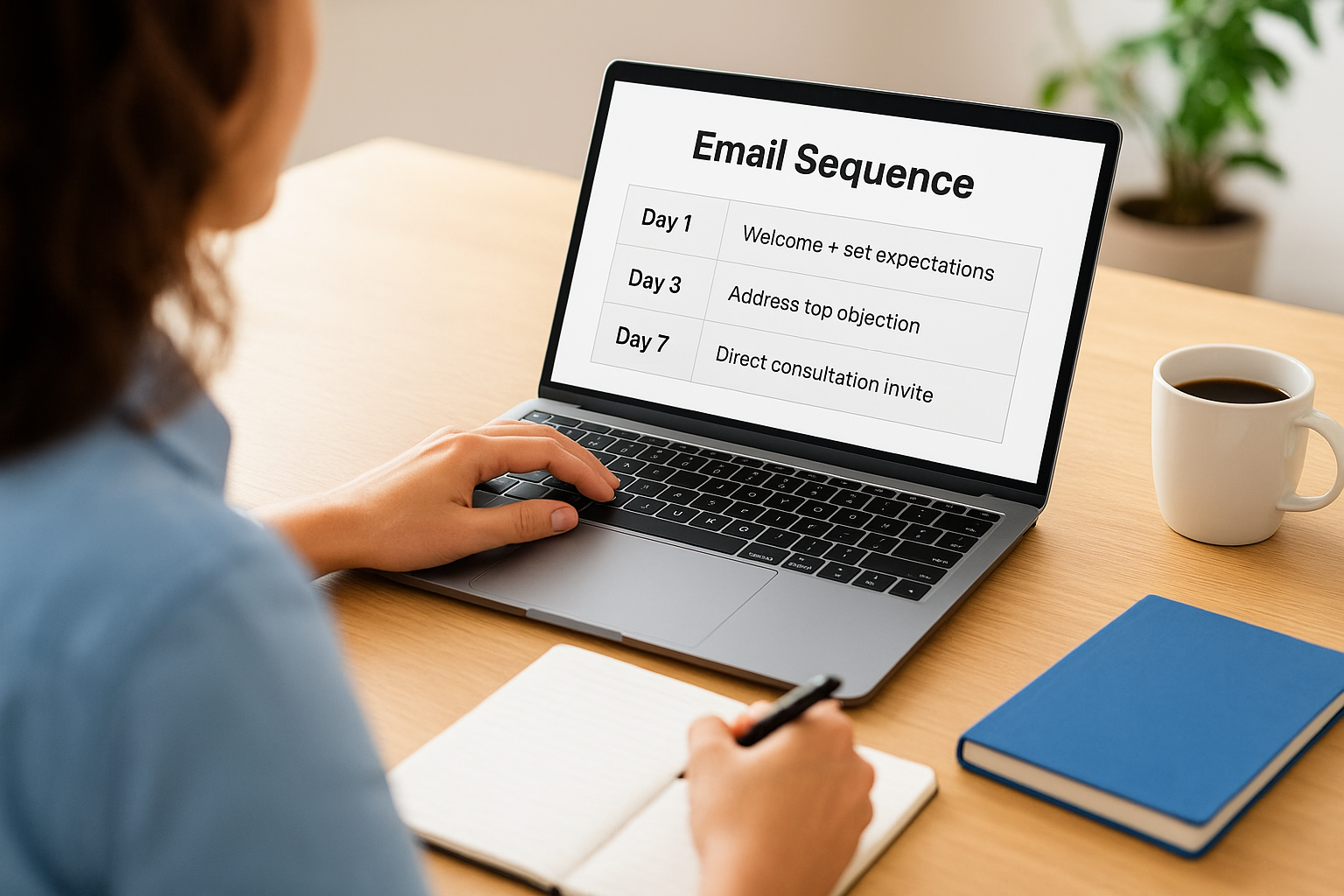
Each sequence should have a defined start trigger, a fixed cadence, and an exit condition so contacts don’t receive messages indefinitely. A basic three-stage email sequence for a service business looks like this:
| Day | Email focus | CTA |
|---|---|---|
| Day 1 | Welcome + set expectations | Read your free guide |
| Day 3 | Address top objection | See a client result |
| Day 7 | Direct consultation invite | Book a 20-minute call |
Space your emails at least two to three days apart to avoid overwhelming the prospect. Set your exit condition as either a booked call, a direct reply, or 30 days of zero engagement. When someone exits due to inactivity, move them to a low-frequency re-engagement sequence rather than removing them entirely. One well-timed message can recover leads you would have otherwise written off.
Step 5. Follow up fast and align with sales
Speed and coordination are where understanding how to do lead nurturing translates directly into revenue. You can have a perfectly structured email sequence and a well-scored lead list, but if your sales team waits 48 hours to follow up on a hot prospect, your system is leaking at the most valuable point. Every hour of delay after a prospect signals buying intent reduces your chance of converting them.
Respond within the first hour
When a lead hits your scoring threshold or takes a high-intent action like booking a call or visiting your pricing page, that prospect needs contact within 60 minutes. Studies from sources like Harvard Business Review show that response speed is one of the strongest predictors of conversion, especially in high-consideration service purchases where the prospect is evaluating multiple options at the same time.
The prospect who books a call on Monday morning and hears nothing until Tuesday afternoon has often already talked to your competitor.
Set up an automated CRM task that fires immediately when a lead crosses your scoring threshold. Assign it to a specific team member with a due-date of same-day. The initial outreach doesn’t need to be long. A two-line email or a brief phone call is enough to confirm the connection and schedule the next step.
Align your sales team with the nurture sequence
Your sales team should know exactly what content a prospect has already received before picking up the phone. If a lead just read a case study about your work with law firms, that context belongs in the first conversation. Brief your team using a simple handoff note template:
| Field | What to include |
|---|---|
| Lead source | Where the prospect entered the funnel |
| Stage reached | Last sequence email received |
| Key action taken | Pricing visit, form fill, or reply |
| Suggested opener | Reference the content they engaged with |
Consistency between your nurture content and your sales conversation builds trust instantly and removes the awkward reset that happens when sales and marketing operate in silos.
Step 6. Measure results and improve the system
A nurture system that you never review is a system that slowly stops working. Measuring the right metrics tells you exactly where prospects drop off and what changes will recover those conversions. Knowing how to do lead nurturing isn’t just about building the system once. It’s about treating it as a process you improve continuously based on what the data shows.
Track the metrics that actually matter
Focus on the numbers that connect directly to revenue, not vanity metrics like total emails sent. These five metrics give you a complete picture of where your nurture system performs and where it breaks down:
| Metric | What it tells you | Target benchmark |
|---|---|---|
| Open rate | Subject line and list quality | 30%+ for service businesses |
| Click-through rate | Message relevance and CTA clarity | 3-5% per email |
| Lead-to-appointment rate | Sequence effectiveness | 10-20% of nurtured leads |
| Appointment-to-close rate | Sales alignment and qualification | 30-50% depending on service |
| Time to conversion | Sequence length optimization | Shorten by 20% per quarter |
The metric most businesses ignore is time to conversion. Shortening it by even one week across your pipeline compounds into significant revenue gains over a full year.
Run a monthly review cycle
Set a fixed review date each month to audit your sequence performance. Pull your CRM data, compare your metrics against the targets above, and identify the single weakest point in the funnel. Fix that one thing before touching anything else. Changing too many variables at once makes it impossible to know what actually moved the needle.
Use this simple review template each month:
- Which email in the sequence has the lowest click-through rate?
- Where do the most leads drop out of the pipeline?
- Which segment converts fastest, and what can you replicate?
- Did your response time stay under 60 minutes for hot leads?
Small, consistent improvements to a working system beat a full rebuild every time.
Next steps
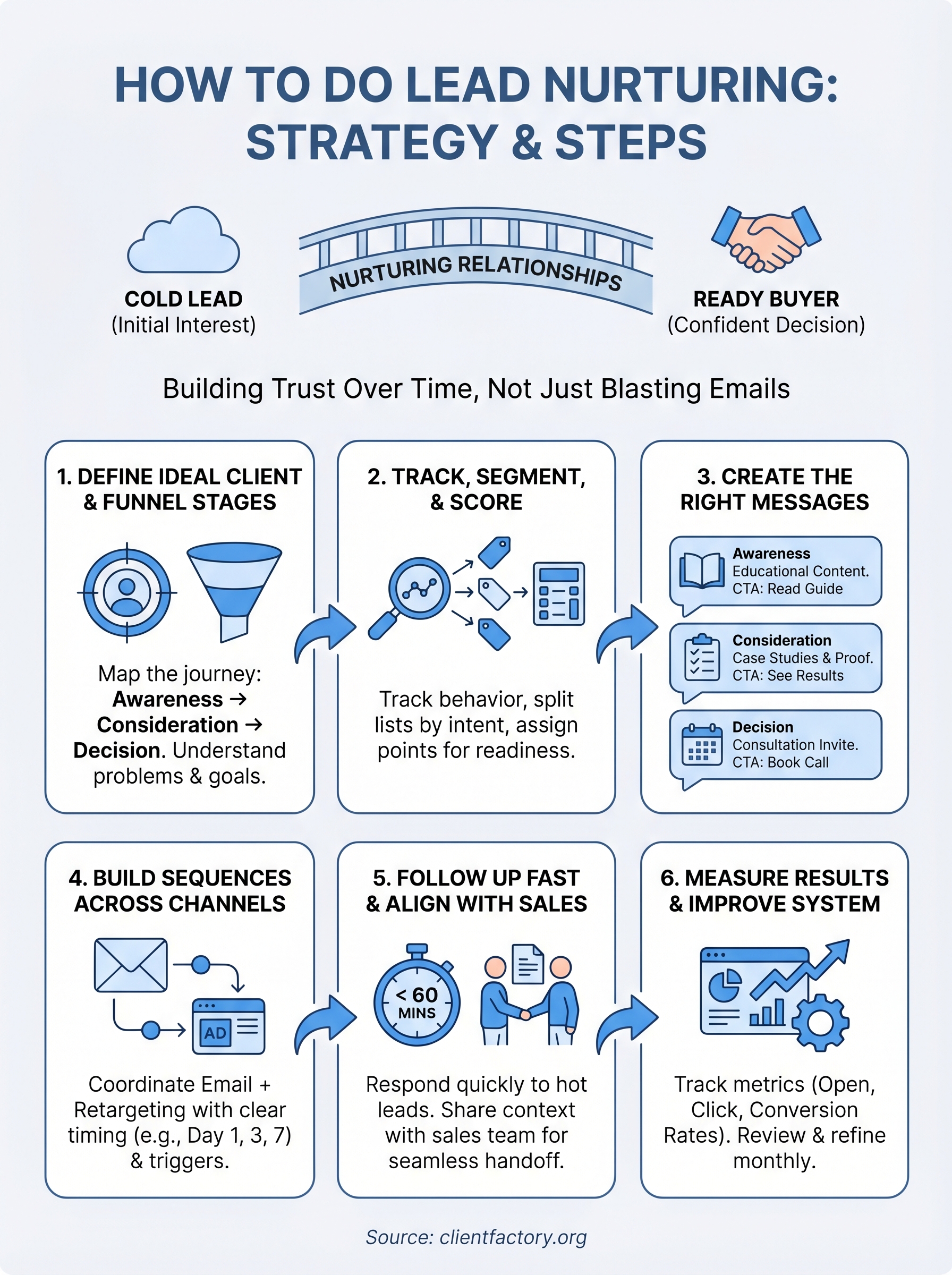
You now have a complete framework for how to do lead nurturing that covers every stage from defining your ideal client to running monthly performance reviews. The steps in this guide build on each other, so start with Step 1 before touching your email platform or ad retargeting. Get your client profile and funnel stages documented first, then layer in your tracking, scoring, and sequences.
Most businesses that struggle with lead nurturing aren’t missing tools. They’re missing a coordinated system that connects the right message to the right prospect at the right time. If your current funnel isn’t converting the way it should, the problem is almost always in the gaps between steps, not the steps themselves.
If you want a clear picture of exactly where your funnel is losing clients, book a free conversion audit and we’ll walk through your acquisition process and show you where to focus first.