
Most businesses treat copywriting like decoration. They slap some clever headlines on a landing page, sprinkle in a few buzzwords, and wonder why nobody clicks the button. But if you’ve ever asked what is conversion copywriting, you’re already thinking differently. You’re asking about the discipline where every word earns its place, not because it sounds good, but because research and behavioral science prove it moves people to act.
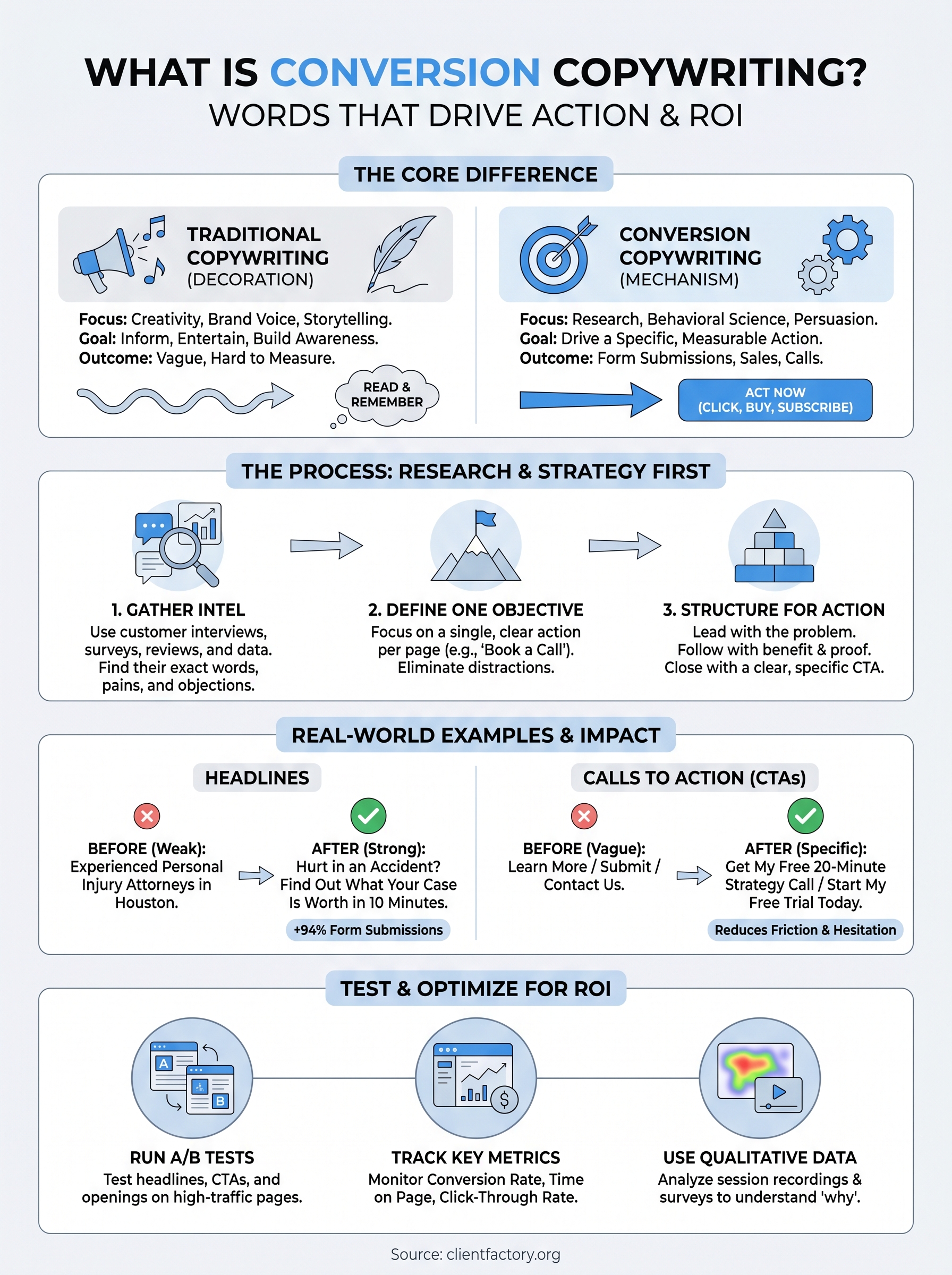
Conversion copywriting isn’t about being witty or literary. It’s about writing that produces a measurable outcome: a form submission, a phone call, a purchase. It replaces gut feelings with customer research, A/B testing, and persuasion frameworks. The difference between this and traditional copywriting is the same difference between guessing and knowing, and that gap shows up directly in your revenue.
At Client Factory, we build client acquisition systems for service businesses and law firms, and conversion copy sits at the core of every funnel we create. We’ve seen firsthand how swapping a single headline can double a page’s lead volume, and how research-backed copy consistently outperforms the "sounds-about-right" alternative. That experience is baked into everything you’ll read here.
This article breaks down exactly how conversion copywriting works, what separates it from standard copy, and real examples that drive ROI. Whether you’re writing your own pages or evaluating an agency’s work, you’ll walk away knowing what to look for, and what to fix.
Why conversion copywriting matters for ROI
If you’re spending money on ads, SEO, or content, your copy is either pulling its weight or bleeding your budget. Conversion copywriting sits at the intersection of your marketing investment and your revenue, and it’s the single variable most businesses overlook. When you understand what is conversion copywriting, you start to see that the words on your landing pages, emails, and ads aren’t decoration. They’re the mechanism that turns an interested visitor into a paying client.
Every business measures ROI differently, but the math runs through the same checkpoint: how many visitors take the action you want. That number is your conversion rate. Copy doesn’t just influence it; copy essentially determines it. Bad copy produces a low conversion rate, which means your ad spend, your SEO investment, and your team’s time all generate weaker returns than they should.
The cost of copy that doesn’t convert
Most businesses focus on traffic volume and ignore conversion rate. That’s a costly order of priorities. If your page converts at 1% and you’re paying $10 per click, you’re spending $1,000 to acquire one lead. Fix the copy to convert at 3% and that same lead costs you $333. Nothing else changed: not the ad platform, not the audience, not the budget. The only change was the copy.
The fastest way to cut your cost per acquisition is to fix your copy before you spend another dollar on traffic.
How copy affects every stage of the funnel
Conversion copy isn’t limited to landing pages. It operates at every touchpoint in your funnel, from the first ad headline a prospect reads to the follow-up email they receive after filling out a form. Each piece of copy either advances the prospect or stalls them. A weak subject line kills your email open rate. A vague call-to-action on your service page leaves visitors wondering what to do next.

Funnel-stage copy compounds fast. A 10% improvement in open rates, combined with a 15% lift in landing page conversions, produces a significantly larger pipeline without any increase in ad spend. Each stage multiplies the effect of the stage before it, so a fix early in the funnel pays off at every stage downstream.
Why data beats instinct in conversion copy
Writing based on what you think sounds good is a common trap, and it’s one that even experienced marketers fall into. Customer research and testing consistently outperform instinct. When copy is grounded in actual language your prospects use, actual objections they raise, and actual outcomes they care about, it resonates in a way that gut-feel copy never does.
The proof lives in the numbers. A/B tests on headlines routinely reveal conversion rate swings of 30 to 50 percent between two versions that look nearly identical to an untrained eye. A word change in a headline, a shift in the opening sentence, or a rewritten button label can each move your results in a meaningful direction. That’s not a minor editing exercise; that’s revenue sitting on the table waiting to be claimed.
How conversion copywriting differs from other writing
When you ask what is conversion copywriting, the clearest way to understand it is by comparing it to other forms of writing. Brand copywriting builds awareness and identity. Journalism informs. Content marketing educates over time. Conversion copywriting does something different: it drives a single, specific action right now. The entire structure, tone, and word choice serve that one outcome.
The goal is different from the start
Most writing aims to inform, entertain, or build a relationship. Conversion copy has a sharper, more immediate purpose: it moves the reader from interest to action within a single session. A blog post can build authority over weeks. A conversion-focused landing page needs to produce a result the first time someone reads it, or that visitor is gone.
This distinction shapes every decision you make on the page. You’re not writing to be read and remembered. You’re writing to be read and acted on. That changes what you lead with, how long you write, and how you close.
The moment you treat your landing page like a content piece, you’ve already lost the conversion.
Tone and structure follow function
Traditional copywriting often prioritizes creativity, brand voice, or storytelling for its own sake. Conversion copy uses all of those tools, but only in service of the action you want the reader to take. A clever headline works only if it also communicates a clear benefit and keeps the reader moving forward.
Structure follows the same logic. You use short sentences and direct language because friction costs you conversions. You place your most important point first because most visitors scan before they read. You remove anything that doesn’t serve the action, including decorative language and vague value statements.
It’s rooted in the reader, not the writer
Brand-driven copy often starts with what the company wants to say. Conversion copy starts with what the reader needs to hear. That means grounding every line in the actual concerns, desires, and objections of your specific audience. What do they fear? What outcome are they hoping for? What would make them hesitate?
Writing from that starting point produces copy that feels different to the reader. It sounds less like a pitch and more like someone who already understands their situation, and that shift in orientation is what separates conversion copy from most of what businesses actually publish.
What goes into conversion copy: research and strategy
When most people ask what is conversion copywriting, they picture the writing itself. But the writing is actually the last step. Before you type a single headline, you need a foundation built on customer research and strategic decisions that tell you exactly what to say and to whom. Skip that foundation and your copy is guesswork dressed up in good sentences.
Start with your customer’s exact words
The most powerful copy doesn’t come from your imagination. It comes from your customers’ actual language. That means reading reviews, mining support tickets, studying sales call transcripts, and paying close attention to how prospects describe their problems. When someone writes "I wasted three months on agencies that never delivered results," that phrase is more persuasive than anything you’d invent at your desk.
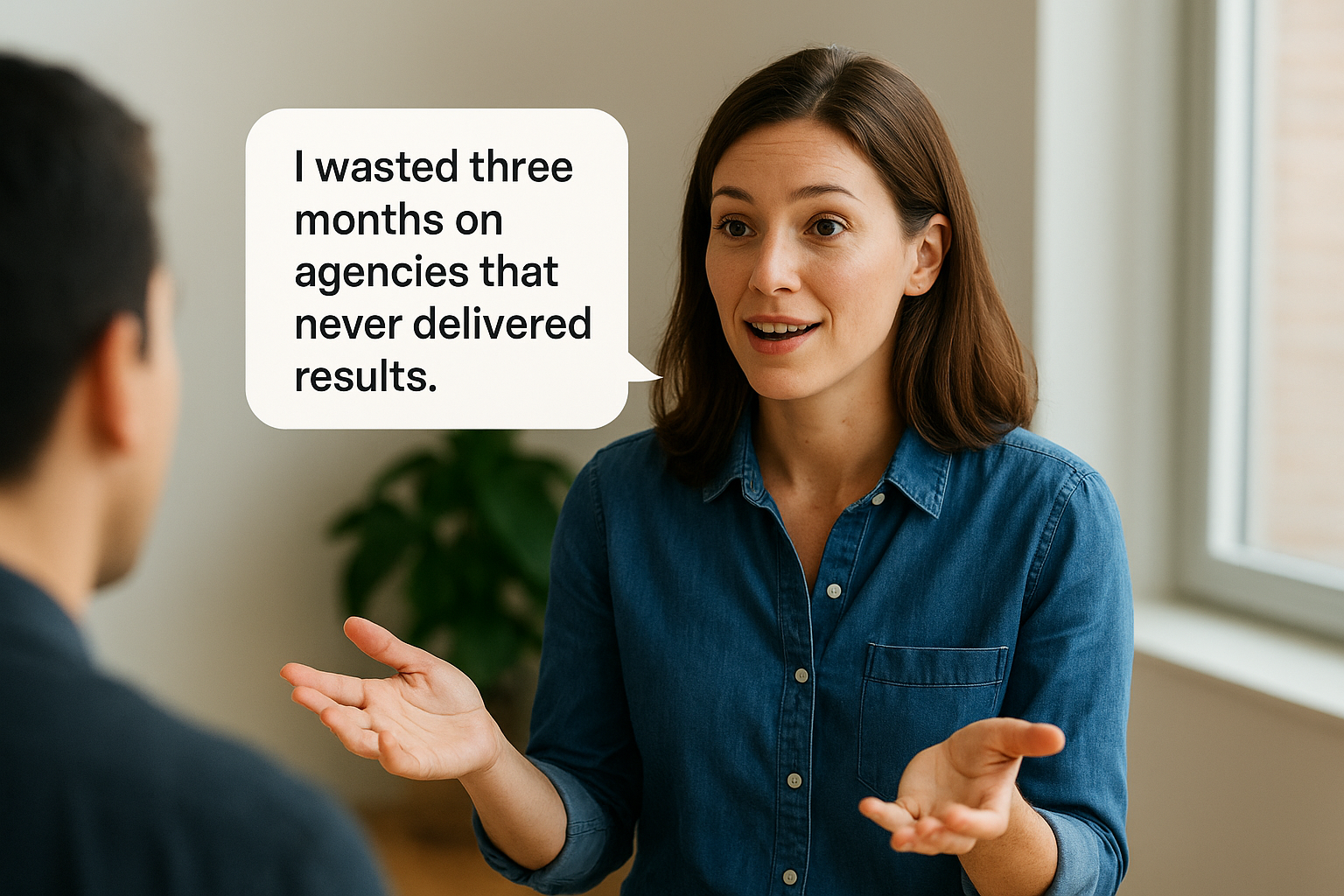
The words your customers use to describe their pain are the same words that will stop them mid-scroll on your landing page.
Customer interviews and surveys extend this further. When you ask someone to walk you through their decision-making process, you learn what nearly pushed them away and what finally made them act. That intelligence gets built directly into your copy as objection handling, benefit framing, and proof points.
Define the one action you want the reader to take
Every piece of conversion copy needs a single, clear objective. Are you driving a form submission, a call booking, a download? Ambiguity kills conversions. When a page asks visitors to do three things at once, most of them do none. Before you write, you define one desired action and build every sentence around making that action feel obvious and easy.
Match the message to where the reader is
A visitor reading a cold ad knows nothing about you. A visitor on your pricing page is close to a decision. These two people need entirely different copy, even if you’re selling the same service. The research phase includes mapping your funnel stages and identifying what concern, objection, or desire is dominant at each step.
Awareness-stage copy introduces the problem and hints at a solution. Decision-stage copy removes the last barriers to action. When your message matches the reader’s current state of mind, the copy feels less like persuasion and more like a natural next step.
How to write conversion copy step by step
Understanding what is conversion copywriting is one thing; writing it is another. The process follows a structured sequence where each step builds on the last. Skip a step and you’re guessing. Follow the sequence and your copy has a research-backed foundation that gives you something concrete to test and improve over time.
Step 1: Lock in your one objective
Before you write a word, know exactly what action you want the reader to take. A single, clear objective keeps every sentence pointing in the same direction. If you’re writing a landing page for a free consultation, that booking is the only goal. Remove any link, offer, or navigation item that pulls attention away from it.
Write your objective as one sentence: "This page exists to get the visitor to book a call." Every headline, subhead, and body paragraph should serve that sentence, or it has no place on the page.
Step 2: Lead with the reader’s problem
Your opening line needs to connect with the specific pain or desire your reader showed up with. Skip the company history and the brand values. Start with what they’re experiencing right now. If your research shows that your audience is frustrated by wasted ad spend with nothing to show for it, your first line should reflect that frustration back at them in plain language.
The reader decides in seconds whether you understand their problem. Your opening is your only chance to prove that you do.
A problem-first opening creates immediate relevance, and relevance is what keeps someone reading past the first paragraph instead of clicking away.
Step 3: Move from benefit to proof to action
Once you have the reader’s attention, walk them through a deliberate sequence. Lead with the primary benefit your service or offer delivers, stated in specific, concrete terms. Follow that benefit with proof: a client result, a measurable outcome, or a before-and-after comparison that shows the transformation is real. Then close with a call to action that tells the reader exactly what to do next and what happens when they do it.
Vague calls to action like "learn more" or "get in touch" slow people down because they leave the next step undefined. "Book your free 20-minute call" gives the reader a concrete, bounded commitment that feels easy to accept.
Examples of conversion copy in the real world
Seeing what is conversion copywriting in action is the fastest way to internalize how it works. Real-world examples cut through theory and show you the specific levers that move conversion rates in measurable ways. The changes are often small in appearance but significant in outcome. You don’t need to rewrite your entire site to see results. You need to change the right words in the right places, at the right moments in your funnel.
A single headline change on a high-traffic page can produce more revenue than months of additional ad spend.
The headline that reversed a page’s performance
A personal injury law firm running paid ads had a landing page headline that read "Experienced Personal Injury Attorneys in Houston." It described the firm. It said nothing about the client’s situation. Changing it to "Hurt in an Accident? Find Out What Your Case Is Worth in 10 Minutes" named the visitor’s exact circumstance and offered a specific, low-commitment outcome. Form submissions increased by 94% with no change in ad spend or targeting.
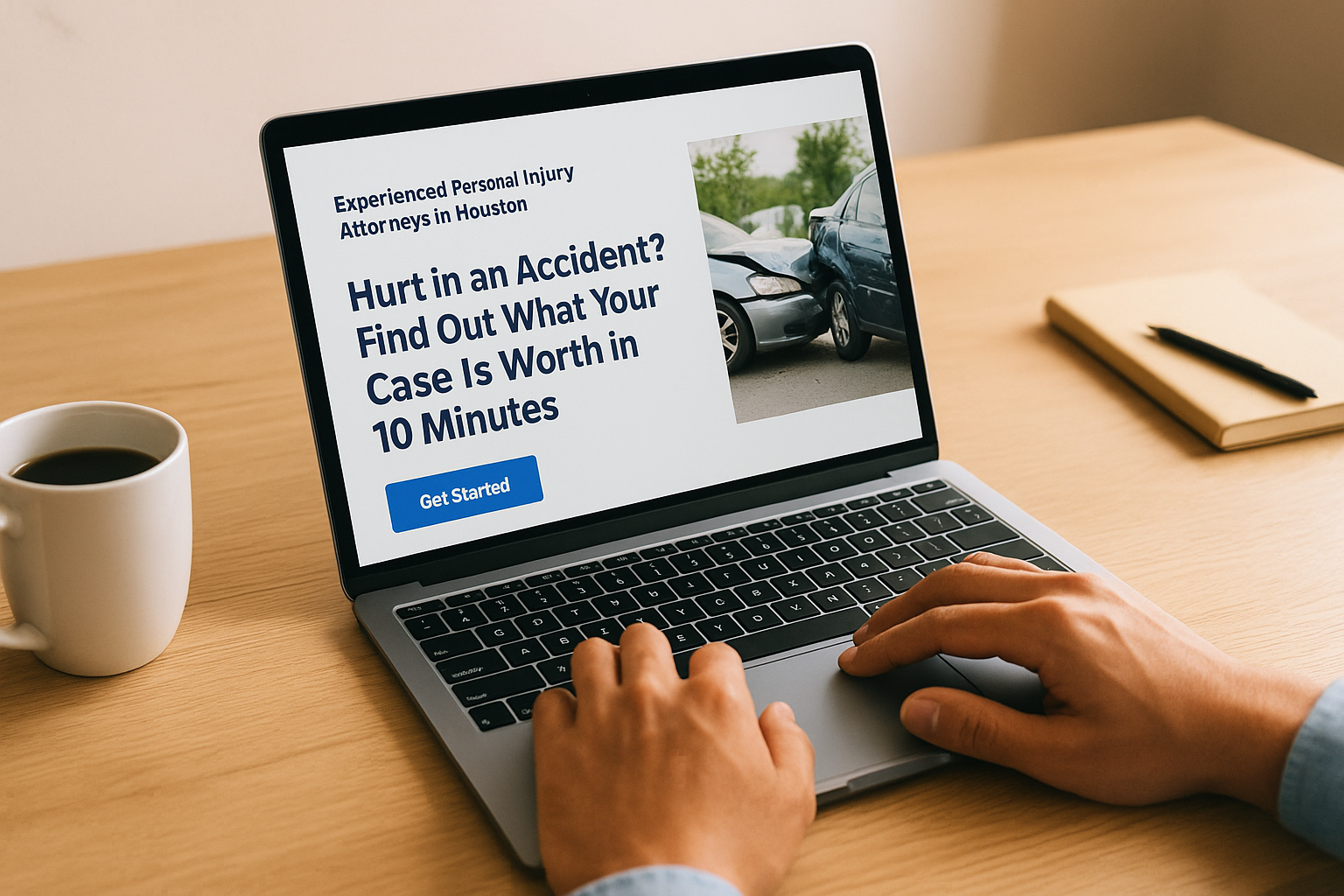
The traffic was already there. The copy was the only obstacle standing between those visitors and the intake form. That’s what separates conversion copy from standard brand copy: one describes you, the other speaks directly to the person reading it and tells them what happens next.
The subject line that changed what people opened
Service businesses often treat email subject lines as an afterthought. One company was sending campaigns with subject lines like "Our Latest Updates" and "New Services Available." Open rates sat at 11%. Switching to subject lines that named a specific problem, such as "Still losing clients to competitors with better-looking websites?", pushed open rates to 28%. The audience didn’t change, and neither did the list.
The only variable was the specificity and relevance of the first line the reader encountered. That’s the mechanism behind high-performing subject lines: they reflect a problem the reader already has, which makes ignoring them harder. Button copy follows the same pattern. Changing a button from "Get Started" to "Start My Free Trial Today" uses first-person language and removes ambiguity about what the click delivers, which eliminates the brief hesitation that vague labels create at the final step of your funnel.
How to test and improve conversion copy
Writing good conversion copy is an iterative process. Once you understand what is conversion copywriting, the next step is building a system that tells you whether your copy is working and where to push harder. Testing removes opinion from the equation and replaces it with data you can act on.
Run A/B tests on your highest-traffic pages
Start with the pages that get the most traffic because those give you statistically significant results faster. An A/B test pits two versions of a page, headline, or button against each other with real visitors. You change one element at a time so you know exactly what caused any shift in conversions.
The test that teaches you the most is the one you run on the element that carries the most weight: your headline.
Your headline, your primary CTA button, and your opening paragraph are the three elements worth testing first. Each one sits at a critical decision point for the reader. A stronger headline keeps more visitors on the page; a clearer button removes hesitation at the moment of action.
Track the metrics that actually matter
Conversion rate is the obvious number to watch, but it doesn’t tell the whole story. Time on page, scroll depth, and click-through rate on your CTA each reveal a different breakdown point. If visitors spend 10 seconds on a page and leave, your opening paragraph isn’t holding them. If they scroll to the bottom but don’t click, your call to action needs work.
Set up goal tracking in your analytics tool before you run any test so you have a clean baseline to measure against. Without a baseline, you have no reference point for what a change actually moved. Numbers mean nothing in isolation; they matter when compared to a controlled prior period.
Use qualitative data to guide your next test
Numbers tell you that something is broken. Qualitative data tells you why. Session recordings, heatmaps, and short exit surveys reveal where visitors hesitate, what they ignore, and what language they use when they describe their problem. That information feeds directly into your next round of copy changes.
When a visitor lands on a pricing page and never scrolls past the first section, your most important proof points are probably buried too far down. Qualitative tools like session recordings give you a visual map of where attention drops, so you stop guessing and start fixing the right element.
Common mistakes to avoid
Even when you understand what is conversion copywriting, it’s easy to fall into patterns that undercut your results. The most damaging mistakes aren’t technical. They’re habits rooted in how most businesses default to writing, and recognizing them is the first step toward fixing them.
Writing for the company instead of the customer
The most common conversion copy mistake is leading with your company’s credentials, history, or mission before addressing what the reader actually cares about. Visitors land on your page with a specific problem. When the first thing they read is a paragraph about your founding year or your award-winning team, most of them leave before they see anything relevant.
Every opening line should connect to the reader’s situation, not your backstory. Your experience and credentials matter, but they belong lower on the page as supporting proof after you’ve already established that you understand the reader’s problem.
Credentials that appear before relevance feel like interruptions. Credentials that appear after relevance feel like reassurance.
Ignoring message-to-market match
Sending the same copy to every audience at every stage of your funnel is a common way to suppress conversions without realizing why. A visitor clicking a cold ad and a visitor who already downloaded your guide and returned to your pricing page are two completely different people in terms of what they need to hear. Cold traffic needs problem validation and a low-commitment next step. Warm traffic needs objection removal and a clear path to action.
Treating your funnel as one audience creates copy that’s too cautious for people ready to decide and too aggressive for people who just found you. Match your message to the reader’s current mindset, and your conversion rates reflect that precision.
Letting weak calls to action lose the sale
A weak CTA is one of the most preventable conversion killers. Vague labels like "submit," "click here," or "learn more" leave the reader uncertain about what they’re agreeing to and what happens next. Specificity removes that hesitation.
Strong CTAs name the action, state the outcome, and signal what the commitment actually involves. "Get My Free 20-Minute Strategy Call" outperforms "Contact Us" not because it’s longer but because it answers every question the reader has at the moment they’re deciding whether to act. Remove the ambiguity and you remove the friction that stops conversions.
Next steps
You now have a clear picture of what is conversion copywriting: a research-driven discipline where every word serves a single measurable action. The frameworks, examples, and testing methods in this article give you a direct path from weak, passive copy to pages that generate leads and revenue consistently. The gap between knowing and doing is where most businesses stall, and it typically costs them far more in wasted ad spend than they realize.
Applying these principles takes time, but the returns compound fast. Start with your highest-traffic landing page, test your headline, and track what moves. If you want a faster path to results, our team can identify exactly where your copy and funnel are leaking conversions. Book a free conversion audit call and walk away with a concrete list of fixes you can act on immediately.