


Every business needs customers. That much is obvious. But the process of actually finding those customers, attracting them, earning their attention, and moving them toward a buying decision, is where most businesses hit a wall. That’s lead generation explained at its core: the system you use to turn strangers into people who genuinely want to hear from you. Whether you run a law firm, a consulting practice, or any other service business, understanding this process is non-negotiable if you want predictable growth.
The problem is, lead generation gets thrown around as a buzzword without much substance behind it. People hear the term, nod along, and still have no idea what it actually looks like in practice. What counts as a lead? How do you attract the right ones? And more importantly, how do you build a system that keeps them coming, not just once, but consistently?
At Client Factory, we build client acquisition systems for service businesses and law firms every day. We’ve spent over 30 years refining what works and cutting what doesn’t. This article breaks down lead generation from the ground up, how the process works, the strategies behind it, and why it matters so much to your bottom line. If you’ve been running on referrals and hoping for the best, it’s time to understand what a real lead generation engine looks like.
Why lead generation matters for growth
Most businesses start by relying on word-of-mouth. A friend recommends you, a past client sends someone your way, and for a while, that feels like enough. The reality is that referrals are unpredictable, and building a business on unpredictable income is a fragile strategy. When the referrals slow down, and they always do at some point, you have no system to fall back on. That’s the core reason why lead generation matters: it replaces hope with a repeatable process.
The cost of running on referrals alone
Referrals feel free, but they carry a hidden cost. Every month you spend waiting on word-of-mouth is a month you’re not building a scalable, controllable pipeline. You can’t decide how many referrals you get, you can’t target the type of clients you want, and you can’t predict your revenue three months out. Businesses that grow consistently are the ones that build intentional systems for attracting new prospects rather than waiting for them to show up.
There’s also a quality issue. Referral clients come with varying needs, budgets, and expectations. When you run a proper lead generation system, you define exactly who you want to attract and build campaigns designed to reach that specific person. The result is a pipeline filled with qualified prospects who actually need what you offer and are closer to making a decision.
Predictable growth requires a predictable source of new business, and that only comes from a lead generation system you control.
What consistent lead flow does for your revenue
Revenue predictability changes how you run your business. When you know roughly how many leads are coming in each week, you can plan hiring, manage capacity, set realistic revenue goals, and make smarter decisions about where to invest. Without that data, you’re guessing, and guessing with your finances is expensive.
Lead generation explained properly is not just about getting more contacts into a spreadsheet. It’s about feeding your sales process with qualified opportunities on a regular basis. A healthy lead flow means you, or your team, is always talking to someone new. When that flow dries up, your pipeline shrinks, and then your revenue follows shortly after.
Why service businesses feel this pressure more
Product businesses can place an item on a shelf and let it sell at scale. Service businesses depend on ongoing client relationships, which means you constantly need new clients to replace the ones who finish their engagement, resolve their case, or move on. The cycle is relentless, and it doesn’t pause just because business is good right now.
Law firms, consulting practices, and other service providers deal with a finite client lifespan on most engagements. A personal injury firm resolves a case and that client relationship ends. A marketing agency finishes a project and the client may not renew. This is exactly why having a lead generation system running in the background at all times is not optional for service businesses; it’s how you stay in business long-term.
The businesses that feel the most growth pressure are often the ones who are excellent at delivering their service but haven’t built an engine for attracting new clients. Skill in your craft does not automatically translate into visibility, and visibility without a system for capturing and nurturing interest does not translate into revenue. That gap is exactly what a well-built lead generation strategy is designed to close.
How lead generation works step by step
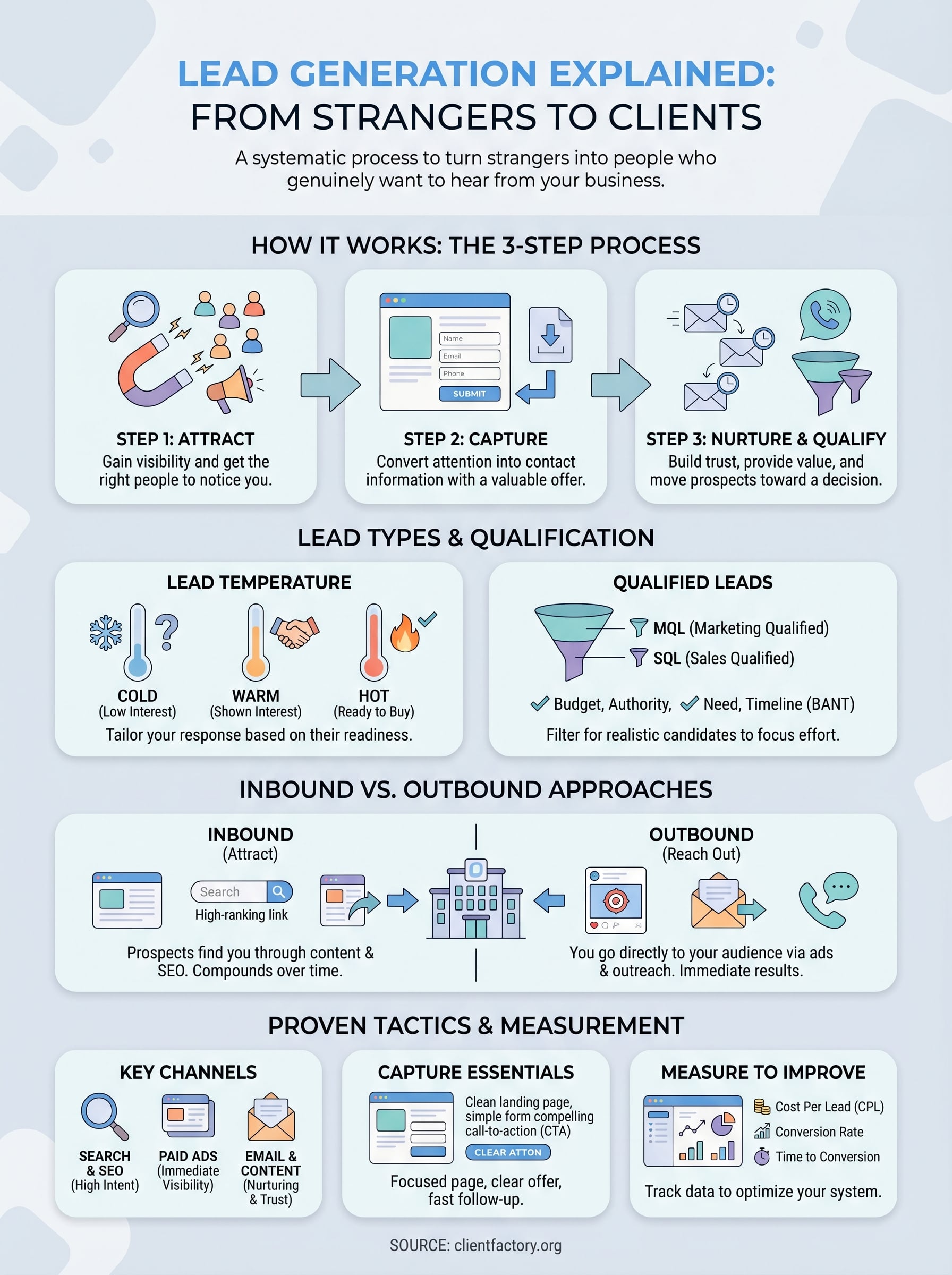
Lead generation explained as a concept makes far more sense when you see it as a sequential process rather than a single action. Most people assume it’s just about getting people to call or fill out a form, but the reality is more structured. Every lead passes through a series of stages before they’re ready to become a paying client, and understanding each of those stages is what separates businesses with a reliable pipeline from those scrambling for their next client every month. When you understand the full sequence, you can pinpoint exactly where your current efforts are breaking down.
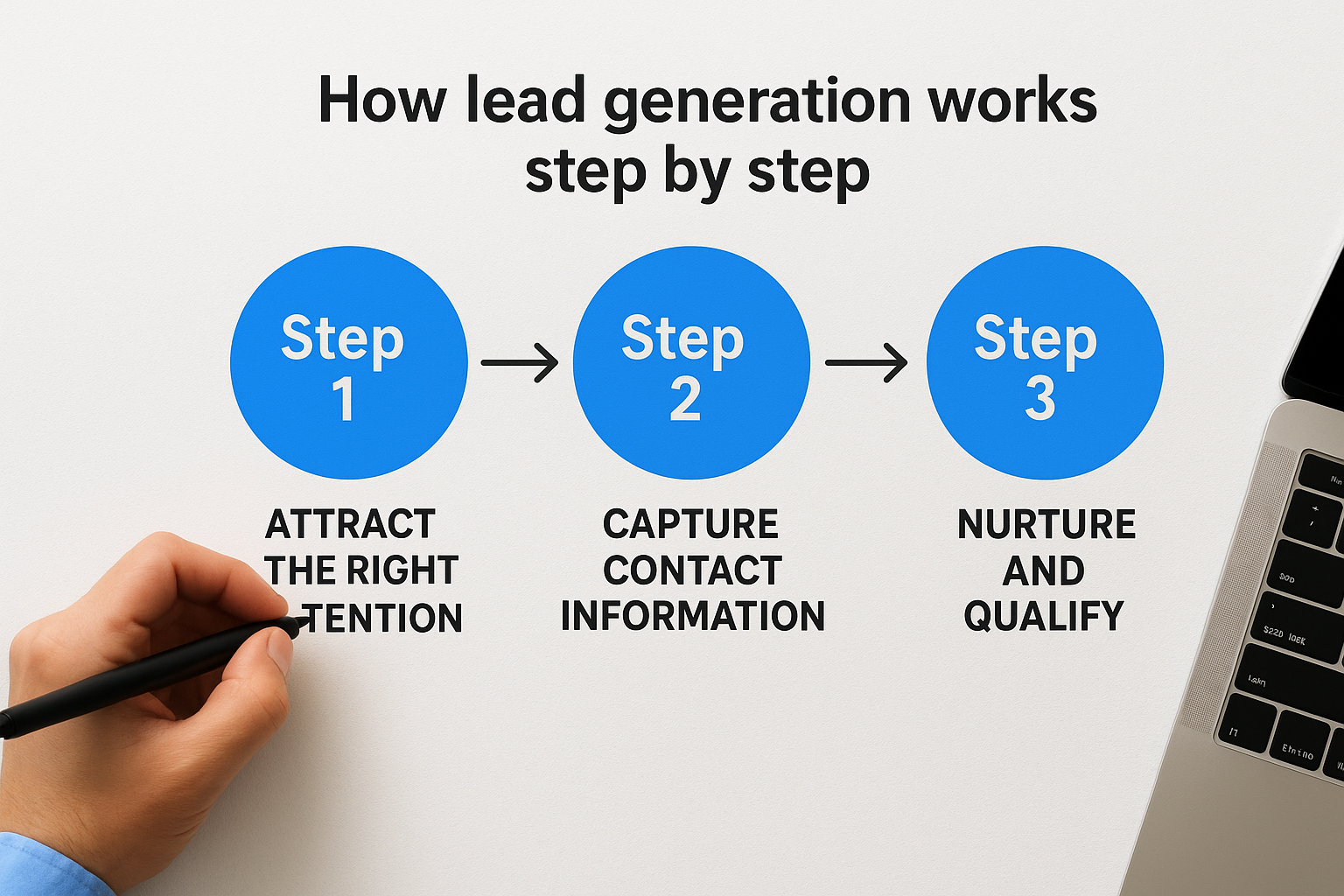
Step 1: Attract the right attention
The process starts with visibility. You need to put your message in front of people who have a specific problem you can solve, at the moment they’re most likely to respond. That might mean running a paid ad on Google, publishing content that ranks in search, or appearing on a platform where your target audience spends time. The method matters less than the outcome: getting the right person to notice you. If your message reaches people who have no need for your service, the rest of the process falls apart before it even starts.
Step 2: Capture contact information
Once someone finds you, the next step is converting that attention into a contact. This typically happens through a landing page, a form, a phone call, or a live chat interaction. You offer something of value, a free consultation, a downloadable resource, or a case evaluation, and in exchange, the person gives you permission to follow up. This is the moment a visitor becomes a lead, and it’s exactly where many businesses lose people by asking for too much too soon or offering something too vague to be worth responding to.
The quality of what you offer at this stage directly determines the quality of the leads you collect.
Step 3: Nurture and qualify
Getting a contact is not the same as getting a client. After someone enters your pipeline, you need to follow up consistently, provide value, and build enough trust to move them toward a decision. Not every lead is ready to buy right away, and that’s completely normal. Email sequences, phone outreach, and retargeting ads all serve this purpose. Your job is to stay relevant and genuinely useful until the prospect is ready to take the next step, while filtering out anyone who was never a realistic fit so you protect your time and resources.
Lead types and qualification basics
Not all leads are equal, and treating them as if they are is one of the most common mistakes service businesses make. Lead generation explained in full means understanding not just how to attract people, but how to categorize and prioritize them based on where they are in their decision-making process. When you know what type of lead you’re dealing with, you can respond in a way that actually matches their readiness, rather than pitching too hard too early or letting a hot prospect go cold while you wait.
Cold, warm, and hot leads
The simplest way to think about leads is on a temperature scale. Cold leads are people who fit your target profile but haven’t shown any specific interest in your service yet. They may have seen an ad or stumbled across your content, but they haven’t raised their hand. Warm leads have taken some kind of action, like filling out a form, downloading a resource, or engaging with your content, which signals genuine interest. Hot leads are actively looking for a solution, often requesting a consultation or asking directly about pricing.
Understanding where a lead sits on this scale helps you allocate your follow-up effort appropriately. Spending hours chasing a cold lead who has no immediate need is a poor use of your time, while letting a hot lead sit uncontacted for 24 hours can cost you the deal entirely.
The faster you respond to a hot lead, the higher your chances of converting them into a paying client.
What makes a lead qualified
A qualified lead is someone who meets a specific set of criteria that makes them a realistic candidate for your service. Most businesses use two basic frameworks: Marketing Qualified Leads (MQLs), who have shown enough interest to warrant further marketing attention, and Sales Qualified Leads (SQLs), who are ready for a direct sales conversation. The criteria you use will depend on your business, but common filters include budget, decision-making authority, a clear need, and a relevant timeline.
Building a simple qualification process into your intake keeps your pipeline clean and focused. When you consistently filter for the right criteria, your team spends its time on prospects who are actually likely to convert, which improves your close rate and protects your revenue from the distraction of leads that were never a realistic fit.
Inbound vs outbound lead generation
When people talk about lead generation explained in practice, one of the first distinctions they need to understand is the difference between inbound and outbound approaches. Both methods can fill your pipeline, but they work through completely different mechanisms and suit different stages of business growth. Knowing which one fits your current situation, or how to combine them, separates businesses that grow efficiently from those that waste budget on the wrong approach.
What inbound lead generation looks like
Inbound lead generation is the process of attracting prospects to you by creating content, resources, or experiences that pull people in based on their own interest. When someone searches for a specific legal question and finds your blog post, or downloads your free guide to understanding their rights, they came to you first. That changes the dynamic entirely. Inbound leads tend to be more informed and often closer to making a decision because they initiated the interaction.
The appeal of inbound is clear: you build assets once, like a well-ranked article or an optimized landing page, and they keep generating interest over time. The tradeoff is time. Building an inbound engine through SEO and content marketing takes months before it produces consistent results, which makes it a better long-term play than an immediate fix.
What outbound lead generation looks like
Outbound reverses the flow. Instead of waiting for people to find you, you go directly to your target audience through paid ads, cold outreach, direct mail, or phone calls. You define who you want to reach, place a message in front of them, and bring them into your funnel. This approach gives you speed and control that inbound simply cannot match in the early stages.
Outbound is the accelerator; inbound is the engine you build while the accelerator is running.
Running outbound requires consistent investment. When you stop running ads or sending outreach, the new leads stop coming. That’s why leaning entirely on outbound without building inbound assets creates a risky long-term dependency on paid spend.
How to use both together
Combining both approaches gives you the most resilient client acquisition system. Outbound generates leads now while inbound compounds over time. You run paid ads to drive immediate traffic and fill your calendar, while simultaneously building content and SEO assets that reduce your paid media dependency down the road. Running both in parallel gives you stability and scale at the same time.
Proven lead gen tactics by channel
Understanding lead generation explained as a process is only half the battle. The other half is knowing which specific tactics actually work for reaching your audience, depending on where they spend their time and how they search for solutions. Different channels serve different purposes, and picking the right mix depends on your budget, timeline, and the type of client you want to attract.
Search and SEO
Organic search is one of the highest-intent channels available. When someone types "personal injury lawyer in Chicago" or "marketing agency for small businesses," they already have a specific need. Ranking for those searches puts your business directly in front of people who are actively looking for what you offer, which is a fundamentally different dynamic than interrupting someone with an ad.
Building a strong SEO foundation means optimizing your website pages, creating content that answers real questions your prospects ask, and earning authority through consistent publishing. Results take time, but the compounding return on well-executed SEO makes it one of the most cost-efficient long-term lead sources you can build for your business.
Search traffic converts at a higher rate than most paid channels because the user initiated the search themselves.
Paid advertising
Paid ads give you immediate visibility without waiting months for organic rankings to develop. Google Ads let you target people searching for exactly what you offer right now. Facebook and YouTube ads allow you to reach specific demographics, behaviors, and interests, which makes them powerful for connecting with people who fit your ideal client profile even before they start searching.
The key to paid advertising is matching your message to your audience’s intent. A person actively searching for a lawyer needs a different message than someone who just encountered a general awareness video. Aligning your ad creative with where the prospect sits in their decision process is what separates campaigns that generate qualified leads from campaigns that drain your budget without results.
Email and content marketing
Email consistently delivers one of the highest ROI figures of any lead nurturing channel. Once someone enters your pipeline, a well-structured email sequence keeps your business visible, builds trust, and moves prospects toward a decision at their own pace. Regular content, whether blog posts, guides, or case studies, also positions your business as a credible resource that prospects return to when they are finally ready to act.
Lead capture and conversion essentials
Attracting traffic is only part of the equation. Lead generation explained completely includes what happens the moment someone lands on your page or contacts your business. Converting that attention into an actual lead requires a deliberate setup, not a generic contact form buried at the bottom of your website. Every element of your capture process either moves someone closer to giving you their information or pushes them away, and most businesses underestimate how much small details affect the final outcome.
What makes a landing page convert
Your landing page has one job: get the visitor to take a specific action. That means removing distractions, keeping your copy focused on the prospect’s problem, and making the value of responding clear before they scroll halfway down the page. A page that tries to explain everything you do, showcase your full service history, and collect contact details all at once will do none of those things well.

The offer you place on the page matters just as much as the design itself. A free case evaluation for a law firm, a no-cost funnel audit for a marketing client, or a downloadable checklist relevant to their situation all carry a clear, immediate benefit. When your offer speaks directly to a pain the prospect is already feeling, your conversion rate improves without any increase in ad spend. Keep your form short, ask only for what you genuinely need to follow up, and give people a specific, compelling reason to act right now rather than closing the tab and moving on.
Following up fast and consistently
Speed matters more than most businesses realize. Responding to a new lead within the first few minutes dramatically increases your chances of making contact, compared to waiting even an hour. When someone fills out a form or submits a request, they are in an active decision-making state. The longer you wait, the more likely they are to contact a competitor or simply move on.
The lead who does not hear back from you quickly often becomes the client of whoever responded first.
A structured follow-up sequence keeps your business visible to prospects who are not ready to commit right away. Use a combination of phone calls, automated emails, and SMS touchpoints spaced across the first few days after someone enters your pipeline. Consistent, respectful follow-up signals professionalism and keeps your business in serious consideration until the prospect is ready to make a decision.
Measuring and improving lead generation
Running a lead generation system without measuring it is like driving without a dashboard. You might be moving, but you have no idea how fast, how efficiently, or in which direction you’re drifting. Tracking the right numbers gives you the ability to make specific improvements rather than guessing at what’s not working. Lead generation explained fully always includes measurement, because a system you can’t evaluate is a system you can’t scale.
The metrics that actually matter
Not every number in your analytics dashboard deserves equal attention. The metrics that drive real decisions are cost per lead (CPL), which tells you how much you spend to acquire each new contact, lead-to-client conversion rate, which shows how effectively your sales process turns prospects into paying clients, and time to conversion, which measures how long a lead takes to move through your pipeline. Tracking these three together gives you a clear picture of where your funnel works and where it leaks.
Your traffic-to-lead conversion rate also deserves close attention. If you’re driving significant traffic to a landing page but your form completions are low, the problem is in your offer or your page copy, not your ad targeting. Separating each stage of the funnel into its own metric lets you isolate the specific point where performance drops and address it directly rather than overhauling everything at once.
Fixing the right problem in the right place is always more efficient than running a broader overhaul and hoping something improves.
How to use data to improve results
Once you have your numbers, the goal is to establish a consistent testing habit rather than a one-time review. Run a single variable change at a time, whether it’s your ad headline, your landing page offer, or your follow-up sequence, and measure the impact before moving to the next adjustment. Changing multiple elements simultaneously makes it impossible to know which change actually drove the improvement.
Setting a regular review cadence, whether weekly or monthly depending on your lead volume, keeps your system from drifting toward underperformance without notice. Leads will cost more during certain times of year, conversion rates will shift as your market changes, and your follow-up process will need refinement as you learn more about what your best clients respond to. Consistent measurement turns those shifts into opportunities rather than surprises that catch you short on revenue.
Next steps
This article has covered lead generation explained from the ground up, including how the process works, the difference between inbound and outbound approaches, the tactics that produce results across key channels, and how to measure what matters. You now have a clear picture of what a real lead generation system looks like and where most businesses fall short when building one.
The next move is putting this into practice. Knowing the framework is a starting point, but applying it to your specific business, your audience, your offers, and your sales process, is where the real work begins. A targeted, well-structured lead generation system does not appear overnight, but every improvement you make compounds over time.
If you want an expert set of eyes on your current client acquisition setup, book a free funnel audit and we will show you exactly where your pipeline is leaking and how to fix it.