
You can drive all the traffic in the world to a landing page, but if the words on that page don’t move people to act, you’re burning money. That’s the core problem conversion copywriting for beginners aims to solve, learning how to write copy that doesn’t just sound good, but gets people to do something specific: click, sign up, buy, or book a call.
Most business owners and marketers know they need better copy. They can feel it when a page isn’t working. But the gap between "this isn’t converting" and "here’s exactly how to fix it" is where people get stuck. The good news? Conversion copywriting isn’t some mysterious talent you’re born with. It’s a skill built on proven frameworks, research, and a clear understanding of what your audience actually needs to hear before they’ll take action. And you can start learning it right now, even with zero experience.
At Client Factory, we build client acquisition funnels for service businesses and law firms, and every high-performing funnel we create runs on strong conversion copy. It’s the engine behind the ads, the landing pages, and the emails that turn clicks into clients. This guide walks you through the fundamentals we rely on daily: what conversion copywriting is, the frameworks that work, and a step-by-step process you can follow to start writing copy that actually converts.
What conversion copywriting is and isn’t
Conversion copywriting is writing with one specific outcome in mind: getting the reader to take a defined action. That action could be clicking a button, filling out a form, booking a call, or making a purchase. Every sentence you write serves that goal, and if a line doesn’t move the reader closer to that action, it doesn’t belong on the page. Understanding this core principle is what separates conversion copy from every other type of writing you’ve encountered.
What conversion copywriting actually is
Conversion copywriting is built on psychology, research, and structure, not on creativity or clever phrasing. You’re not trying to win a writing award. You’re trying to understand what your reader already thinks, fears, and wants, and then write words that bridge the gap between where they are right now and the action you want them to take. The best conversion copy often sounds simple, even plain, because it speaks directly to a specific person about a specific problem they already recognize.
The most effective conversion copy sounds like it was written for one person, not a crowd.
When you work through conversion copywriting for beginners material, you’ll notice the same core elements appear repeatedly: a clear headline, a focused value proposition, social proof, and a strong call to action. These aren’t arbitrary choices. Each element answers a question the reader is silently asking in sequence: "What is this?" "Why should I care?" "Can I trust this?" "What do I do next?" Your copy answers those questions in the right order, removing hesitation at each step. The structure does much of the heavy lifting before a single word of "creative" writing kicks in.
What conversion copywriting is not
Conversion copywriting is not brand copywriting or content marketing, even though people often confuse the three. Brand copy builds awareness and shapes perception over time. Content marketing educates and attracts an audience. Both have real value, but neither has a single, measurable conversion goal attached to it. Conversion copy is accountable in a way that other writing isn’t. You can test it, measure it, and know with data whether it worked or failed.
It’s also not about manipulating people or relying on high-pressure tactics. Good conversion copy works because it’s honest and relevant, not because it tricks someone into clicking. You match the right message to the right person at the right moment in their decision process. If someone isn’t ready to act, no amount of clever writing will force them. But if they’re ready and your copy is clear, specific, and trustworthy, they’ll move forward without friction.
Here’s a quick comparison to make the distinction concrete:
| Type of Writing | Primary Goal | How You Measure Success |
|---|---|---|
| Conversion copy | Drive a specific action | Click-through rate, form submissions, purchases |
| Brand copy | Build awareness and identity | Reach, recall, sentiment |
| Content marketing | Educate and attract an audience | Traffic, time on page, return visits |
| Long-form sales copy | Close a sale directly | Revenue, conversion rate |
Each type has its place in a full marketing system, but when you’re writing a landing page, an ad, or an email designed to get someone to do something specific, you’re in conversion copywriting territory. Keeping that distinction clear helps you make better decisions about tone, length, and structure every time you sit down to write.
Step 1. Set one clear conversion goal
Before you write a single word of copy, you need to know exactly what action you want the reader to take. This sounds obvious, but it’s where most beginners go wrong. They write a page that asks readers to "learn more," "get in touch," "follow us on social media," and "download this guide," all at once. When you give people multiple directions, they often pick none. Every page should have one primary goal, and your entire copy structure should funnel the reader toward that single action.
The more options you give a reader on one page, the lower your conversion rate will be.
Why one goal matters
Splitting your copy across multiple calls to action divides the reader’s attention and weakens each individual message. When you focus on one conversion goal, every headline, subheading, and body sentence can do a specific job: move the reader one step closer to that action. This is a foundational principle you’ll find throughout conversion copywriting for beginners resources, and it holds true whether you’re writing a paid search landing page, a free consultation sign-up form, or a trial offer email. A focused page converts; a scattered page confuses.
How to define your conversion goal
Start by answering one question: what is the single most valuable action this reader can take right now? Not eventually, not as part of a longer sequence, but right now on this specific page. Write it out as a concrete, measurable action. Use the template below to lock it in before you start drafting:
Page: [Name or URL of the page]
Primary action: [One verb + what the reader does]
Success metric: [How you measure completion]
Secondary actions: [None, or removed from the page]
Filled-in example:
Page: Free consultation landing page
Primary action: Visitor submits the contact form
Success metric: Form submission rate
Secondary actions: None (removed blog links, nav bar, and social icons)
Once you have this defined, audit every element on the page against it. Navigation menus, outbound links, and extra CTAs all pull attention away from your primary goal. Remove or minimize anything that doesn’t serve the one action you want. This step takes about ten minutes and immediately sharpens your copy direction before you write a single headline.
Step 2. Research your audience with voice of customer data
Strong conversion copy doesn’t start with writing; it starts with listening. Voice of customer (VoC) data is the exact language your potential clients use to describe their problems, goals, and hesitations. When you use their own words in your copy, readers feel like you truly understand them, and that recognition builds the trust they need before they’ll take action. Skip this step and you’ll write copy that sounds professional but doesn’t actually connect with anyone.

The fastest way to write copy that converts is to use the words your audience already uses to describe their own problem.
Where to find VoC data
You don’t need expensive research tools to gather useful voice of customer data. Reviews on Google, Amazon, or industry-specific platforms are full of unfiltered language from real buyers. Study competitor reviews, especially the three- and four-star ones, since those tend to contain the most specific detail about what people wanted versus what they actually got. Support tickets, intake forms, and sales call recordings from your own business are equally valuable because they capture the exact questions and objections prospects raise before they decide to move forward.
Here are the most accessible VoC sources for beginners:
- Google Business reviews (yours and competitors’)
- Reddit threads where your audience discusses their problems
- Intake form responses and client emails
- Post-service or post-purchase surveys
- Sales call notes or transcripts
How to extract usable copy from your research
Once you have raw data, look for repeated phrases and patterns, not one-off comments. When multiple people describe the same frustration using similar language, that’s a strong signal. Highlight those phrases and sort them into three buckets: pain points (what frustrates them), desired outcomes (what they want to be true), and objections (what holds them back from acting). This sorting exercise is one of the most practical skills covered in conversion copywriting for beginners material because it removes guesswork entirely from your headlines and body copy.
Use this template to organize what you collect before you write:
Pain points:
- "[Exact quote from customer or review]"
- "[Exact quote from customer or review]"

Desired outcomes:
- "[Exact quote from customer or review]"
- "[Exact quote from customer or review]"

Objections:
- "[Exact quote from customer or review]"
- "[Exact quote from customer or review]"
Fill this in completely before drafting any copy. Your strongest headlines will come directly from the pain points column, written almost exactly as your audience already phrases them.
Step 3. Build your message map and information hierarchy
Now that you have audience research in hand, you need to organize your key messages before you start writing. A message map is a simple document that connects your audience’s pain points and desired outcomes to the specific claims your copy will make. Without this step, you’ll write paragraphs that feel disconnected, or you’ll bury your strongest argument below the fold. Message mapping forces you to decide what matters most before a single word of draft copy exists.
What a message map is
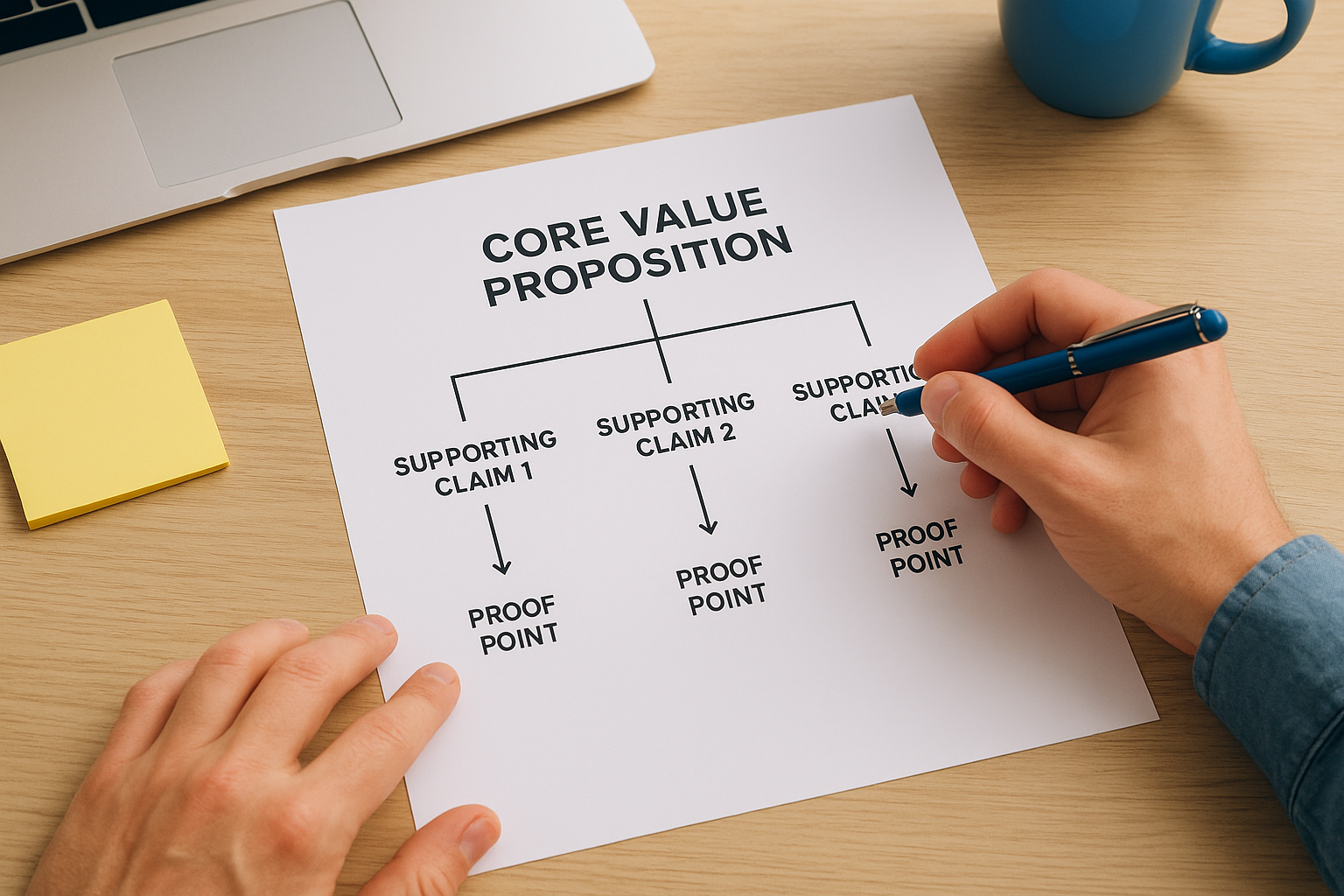
A message map is a one-page reference document that lists your core value proposition at the top, followed by the two or three supporting claims that prove it, and then the evidence or proof points that back up each claim. Think of it as an outline built from your VoC research rather than from guesswork. Every piece of copy you write later traces back to a row on this map, which keeps your page focused and your messaging consistent across headlines, subheadings, and body text.
Your message map is the skeleton of your page. Build it first, then put flesh on the bones.
Here is a simple template to fill in before you draft:
Core value proposition:
"[One sentence: what you do, for whom, and what outcome you deliver]"

Supporting claim 1: [Benefit or differentiator]
  Proof point: [Stat, case study, testimonial, or feature]

Supporting claim 2: [Benefit or differentiator]
  Proof point: [Stat, case study, testimonial, or feature]

Supporting claim 3: [Benefit or differentiator]
  Proof point: [Stat, case study, testimonial, or feature]
How to sequence your information hierarchy
Once your message map is complete, you need to order those messages by reader urgency. The reader arrives with a specific question in mind, and your page needs to answer it immediately. Lead with the pain point or desired outcome that matches why they clicked, then introduce your claim, then deliver proof. This sequence mirrors how conversion copywriting for beginners frameworks like AIDA (Attention, Interest, Desire, Action) are structured, because it aligns with how people naturally process new information before they decide to trust and act.
Place your highest-priority claim in the hero section of the page, above the fold, where every visitor sees it without scrolling. Save supporting claims and proof for the sections below. Prioritize ruthlessly: if a message doesn’t connect directly to your one conversion goal, move it down or cut it entirely.
Step 4. Draft and edit copy that drives action
With your message map and information hierarchy ready, you can start writing. The goal of your first draft is simply to get your messages on the page in the right order. Most beginners stall at this stage because they try to write and edit at the same time, which slows everything down and produces weaker copy overall. Separate the two tasks completely: draft without stopping, then edit in a second pass. This approach is faster and produces better results than trying to perfect each sentence before moving to the next.
Write your first draft from the message map
Open your message map and begin with the headline. Pull the top pain point from your VoC research and write a headline that names it directly. Specific language outperforms clever language every time. If your audience’s top frustration is getting traffic with no leads, your headline draft might read: "Getting Traffic But No Leads? Here’s Where Your Funnel Is Leaking." Work through each row of your message map in sequence, writing one short section per claim. This method keeps your copy anchored to real audience language and prevents the common beginner mistake of writing from assumptions.
Your draft exists to be edited, not admired. Get the message down first, then make it sharp.
Use this template as your starting structure each time you sit down to draft:
Headline: [Pain point or desired outcome in the reader's words]
Subheadline: [Supporting claim + who it's for]

Body section 1: [Problem acknowledgment, 2-3 sentences]
Body section 2: [Your solution and how it works, 3-4 sentences]
Body section 3: [Proof point, 1-2 sentences]

CTA: [One action + the specific benefit of taking it]
Edit for clarity, not length
Once your draft is complete, your editing job is to remove anything that doesn’t serve the conversion goal you defined in Step 1. Read each sentence and ask one question: "Does this move the reader closer to the action?" If the answer is no, cut the sentence or rewrite it so it does. This single filter handles most of the editing work you need to do in conversion copywriting for beginners without requiring advanced skill. After cutting unnecessary lines, read the entire page out loud. Any sentence that sounds awkward when spoken is usually too long, too passive, or too vague, and those are exactly the three problems worth fixing before you move to the next step.
Step 5. Write CTAs, add proof, and reduce friction
Your draft copy is in place. Now you need to sharpen the three elements that most directly determine whether a reader converts: your call to action, your proof elements, and the friction points that silently kill conversions before they happen. Each of these works together, and neglecting any one of them is enough to drag your conversion rate down regardless of how strong your headline is.

How to write CTAs that get clicks
A weak CTA is one of the most common mistakes covered in conversion copywriting for beginners resources, and it’s also one of the easiest to fix. Most beginners default to generic phrases like "Submit" or "Click Here," which tell the reader nothing about what happens next. Replace vague button text with a specific benefit: instead of "Get Started," write "Book My Free Consultation" or "Send Me the Audit." The reader should be able to read your CTA and understand exactly what they receive when they click.
Specific CTAs consistently outperform generic ones because they reduce uncertainty at the moment of decision.
Use this template to rewrite any CTA before publishing:
Weak CTA:   [Generic action word]
Strong CTA: [Verb] + [What the reader gets] + [Optional: qualifier]

Example:
Weak CTA:   "Submit"
Strong CTA: "Get My Free Funnel Audit"

Example:
Weak CTA:   "Learn More"
Strong CTA: "Show Me How It Works"
Add proof that removes doubt
Social proof answers the silent question every reader asks: "Has this worked for someone like me?" Place proof closest to the point where hesitation is highest, which is usually right above or below your primary CTA. Testimonials work best when they reference a specific result and a recognizable situation, not vague praise. "Client Factory helped us grow" is forgettable. "We went from 12 leads per month to 47 in six weeks" gives the reader something concrete to hold onto.
Reduce friction before the click
Friction is anything that makes the reader pause, hesitate, or second-guess taking action. Long forms, unclear privacy policies, and unexpected commitments all create friction at the worst possible moment. Audit your page for these three friction types: form length (cut every field you don’t actually need), commitment language (replace "Sign a Contract" with "Start Your Free Review"), and risk signals (add a one-line reassurance near your CTA, such as "No credit card required. No obligation."). Removing friction takes less than an hour and often produces an immediate lift in conversions without changing a single headline.
Step 6. Validate, measure, and iterate with tests
Writing strong copy is not a one-time event. Even experienced writers will tell you that the first version of a page is a hypothesis, not a final answer. Your job in this step is to confirm whether your copy is actually working by measuring the right numbers and running structured tests that produce usable data. This is where conversion copywriting for beginners moves from theory into a repeatable improvement loop you can run indefinitely.
The copy you write today is the baseline. Every test you run is a chance to beat it.
What to test first
Start with the single element that has the biggest impact on whether a visitor keeps reading or leaves: your headline. A visitor who doesn’t engage with your headline never reads your body copy or reaches your CTA. Set up an A/B test by writing two headline variants, keeping everything else on the page identical. Run each variant until you have at least 100 conversions per version before drawing any conclusions. Calling a winner on small sample sizes is one of the most common testing mistakes beginners make.
After your headline, test these elements in this order of priority:
- Primary CTA button text (specific benefit language vs. your current version)
- Hero section subheadline (problem-focused vs. outcome-focused framing)
- Form length (three fields vs. five fields)
- Proof placement (testimonial above CTA vs. below CTA)
How to read your results and act on them
When a test completes, you need to record what changed, what you measured, and what you found, so you build institutional knowledge rather than just a collection of random results. Use this log template after every test:
Test name: [Page + element tested]
Hypothesis: [What you expected to happen and why]
Variant A: [Control description]
Variant B: [Challenger description]
Sample size: [Visitors per variant]
Result: [Conversion rate A vs. B]
Winner: [A / B / No significant difference]
Next action: [Ship winner / Run follow-up test / Revisit hypothesis]
Repeat this process monthly on your highest-traffic pages. Compounding small improvements across headline, CTA, and proof elements adds up to meaningful conversion rate gains over a quarter without requiring a full page redesign. Measure, document, apply, repeat.
Next Steps
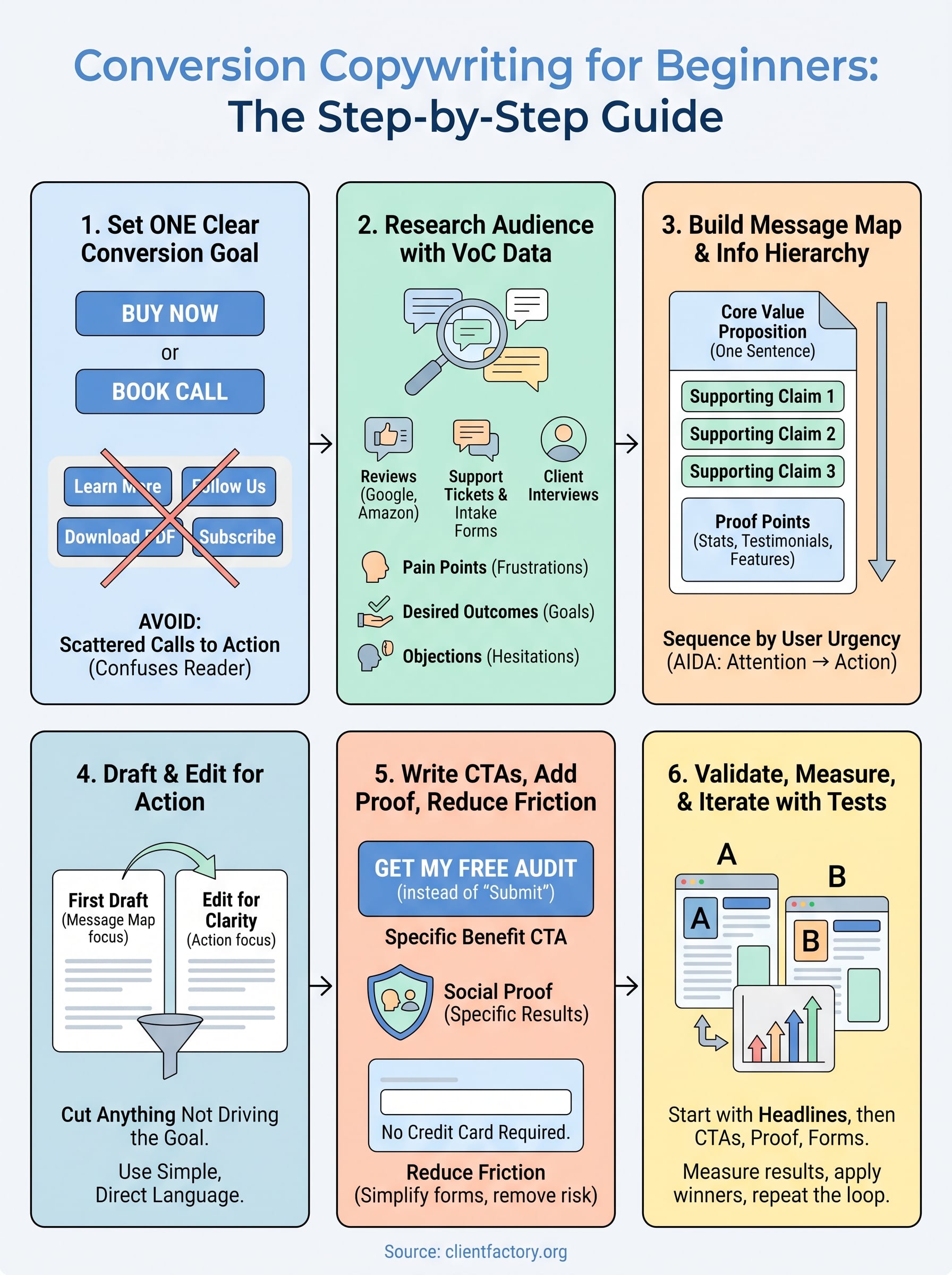
You now have a complete foundation in conversion copywriting for beginners: a clear goal, audience research, a message map, a draft process, tested CTAs with proof, and a measurement loop. Each step builds on the last, and the fastest way to improve is to pick one page and work through the entire process right now, not after reading three more guides.
Start small and stay focused. Take your highest-traffic page, apply Steps 1 through 6 in sequence, and measure what changes after two weeks. Real improvement comes from running the process repeatedly, not from knowing it in theory. Document what you test, ship the winners, and keep iterating.
When you’re ready to see how a professionally built funnel applies these principles at scale, book a free conversion audit and we’ll show you exactly where your current copy is leaving conversions on the table.