
Choosing the right enterprise marketing automation platform can make or break how effectively your organization converts demand into revenue. At scale, the stakes are higher, more channels, more data, more complexity, and far less room for guesswork. The wrong platform doesn’t just waste budget; it creates bottlenecks that slow down your entire client acquisition pipeline.
At Client Factory, we build and optimize marketing funnels for service businesses and law firms every day. That work puts us face-to-face with these platforms constantly, configuring them, stress-testing them, and seeing exactly where they deliver or fall short. We know which ones actually perform under pressure and which ones just look good in a demo. That hands-on experience shaped every recommendation in this guide.
This article breaks down 12 of the best enterprise marketing automation platforms available right now, covering what each one does well, where it struggles, and what type of organization it fits best. Whether you’re evaluating your first enterprise-grade solution or replacing one that isn’t pulling its weight, you’ll find a clear, honest comparison here.
No filler, no recycled feature lists. Just practical analysis based on real-world usage and results, so you can make a decision that actually moves the needle for your business.
1. Client Factory
Client Factory is a U.S.-based digital marketing agency that specializes in client acquisition and demand generation for service businesses and law firms. Rather than selling a software subscription, they build and manage custom marketing funnels designed to convert paid traffic and organic leads into paying clients consistently and at scale.

What it does best at enterprise scale
Client Factory’s core strength is tailoring every component of the acquisition funnel to your specific market, audience, and growth targets. At scale, that means building high-volume lead systems that maintain the personalization needed to actually convert without requiring your team to manually oversee dozens of disconnected tools.
Service businesses and law firms operating at enterprise level often hit a point where generic automation stops delivering results. Client Factory addresses that with performance-first funnel design that treats each touchpoint as a measurable step toward a signed client rather than just a marketing metric.
Standout automation and journey features
Client Factory deploys conversational AI agents, including their in-house assistant Susan, to engage prospects immediately when they land on your pages. That instant engagement captures intent while it’s strongest, a measurable advantage over static lead forms with delayed manual follow-up.
Immediate AI-driven prospect engagement reduces lead drop-off during the critical first minutes of contact.
Their paid advertising management across Google, Facebook, and YouTube feeds directly into automated nurture sequences, so your budget works harder and your team spends less time manually qualifying cold leads.
Data and integrations
Every campaign decision at Client Factory ties back to analytics-driven conversion data. They run ongoing conversion audits to identify friction points in the funnel and use that insight to continuously refine performance across every stage of the acquisition process.
Their systems connect with your existing marketing and CRM tools, reducing the disruption that typically comes with adopting a new enterprise marketing automation platform. The outcome is a cohesive data layer that feeds clear, actionable reporting directly to your decision-makers.
Governance, security, and compliance
Client Factory operates with a fully U.S.-based team, which carries weight for organizations working under strict data handling and privacy requirements. Their client work follows industry standards for lead management and data privacy, an area that grows more critical as regulations around customer data continue to tighten.
For law firms especially, compliance with client communication rules is non-negotiable. Client Factory’s direct experience in the legal industry means they understand those constraints and build automation workflows that stay within them rather than creating new compliance risks.
Pricing and contract notes
Client Factory does not publish flat-rate pricing publicly. Engagements are scoped to your specific business needs, with the investment scaling to match the complexity of your funnel and your target lead volume. They offer a free conversion audit as an entry point, giving you a concrete look at exactly where your current acquisition process is losing leads before you commit to a full engagement.
2. Braze
Braze is a customer engagement platform built for real-time, cross-channel communication at scale. Originally focused on mobile-first messaging, it has expanded into a full enterprise marketing automation platform used by consumer brands, media companies, and fintech organizations that need to reach millions of users across email, push, SMS, and in-app channels simultaneously.
What it does best at enterprise scale
Braze excels at high-volume, real-time messaging across mobile push, email, SMS, in-app, and web channels from a single platform. For enterprises managing large, active user bases, its ability to process behavioral data instantly and trigger relevant messages without delay sets it apart from platforms still running on batch-processing architecture.
Standout automation and journey features
Canvas Flow, Braze’s visual journey builder, lets your team design complex, branching user journeys with logic based on live behavior, attributes, and events. You can build sequences that adapt in real time as users take different actions, making the automation feel far more responsive than traditional campaign tools that rely on scheduled sends.
Braze’s real-time triggering capability means your automated messages reach users at the exact moment their behavior signals intent, not hours later.
Data and integrations
Braze connects natively with major data warehouses and CDPs, including Snowflake, Segment, and mParticle, so your team can push rich user data into the platform without heavy custom engineering. Their Currents data streaming product sends engagement data back into your warehouse in near real time, keeping your broader data ecosystem accurate and up to date.
Governance, security, and compliance
Braze holds SOC 2 Type II certification and supports GDPR and CCPA compliance requirements out of the box. Their permission system allows you to control team-level access across workspaces, which matters when multiple departments or regional teams share the same platform instance without stepping on each other’s campaigns.
Pricing and contract notes
Braze uses custom enterprise pricing based on monthly active users and the channels you activate. Contracts typically run on an annual basis, and costs scale significantly as your user base grows. Contact their sales team directly to get accurate numbers for your specific volume and channel mix.
3. Salesforce Marketing Cloud
Salesforce Marketing Cloud is one of the most widely deployed enterprise marketing automation platform options in the market. It serves large organizations across retail, financial services, healthcare, and B2B sectors that need to orchestrate complex, multi-channel campaigns across a unified customer record.
What it does best at enterprise scale
Salesforce Marketing Cloud’s biggest advantage at enterprise scale is its deep native connection to Salesforce CRM. When your sales and marketing data live in the same ecosystem, your teams can align campaigns directly to pipeline activity, account stages, and revenue outcomes without building custom integrations or managing data syncs manually.
Standout automation and journey features
Journey Builder gives your marketing team a drag-and-drop canvas for designing automated sequences across email, SMS, push notifications, and advertising channels. You can trigger journeys based on CRM data, behavioral signals, or external events, which means your automated outreach responds to what customers actually do rather than just what you scheduled.
Journey Builder’s ability to pull live CRM data into decision splits makes it one of the more powerful tools for aligning marketing automation with active sales cycles.
Data and integrations
Marketing Cloud connects directly with Salesforce Data Cloud (formerly known as Genie) to unify customer data across sources and resolve identities at scale. For organizations already running Salesforce Sales Cloud or Service Cloud, that connection gives your team a complete customer view without rebuilding your data architecture from the ground up.
Governance, security, and compliance
Salesforce maintains SOC 2 Type II, ISO 27001, and FedRAMP certifications, covering a wide range of enterprise security requirements. Their role-based permissions system lets you control access at a granular level across business units, which matters when multiple regional or departmental teams share a single org instance.
Pricing and contract notes
Salesforce Marketing Cloud pricing is module-based and negotiated directly with their sales team. Costs scale by contact volume, channels activated, and add-ons like Data Cloud or Advertising Studio. Expect annual contracts with significant investment at full enterprise configuration.
4. Adobe Experience Cloud
Adobe Experience Cloud is a comprehensive suite of enterprise marketing tools built for large organizations that need to manage content, data, and campaign delivery across complex digital ecosystems. It serves enterprise teams in retail, financial services, media, and B2B sectors that demand a fully integrated marketing and analytics stack under one vendor roof.
What it does best at enterprise scale
Adobe Experience Cloud’s core advantage is its breadth across the full customer lifecycle, from content creation and delivery through to analytics and personalization. For large organizations running multiple brands or regional operations, having content management, campaign orchestration, and real-time analytics inside a unified platform removes a significant amount of the coordination overhead that comes with stitching together separate tools.
Standout automation and journey features
Adobe Journey Optimizer lets your team build and execute real-time, cross-channel customer journeys using behavioral data, scheduled campaigns, and AI-driven decisioning through Adobe Sensei. You can design sequences that adapt based on live customer signals, which makes this a capable enterprise marketing automation platform for organizations that need personalization to scale without adding manual work.
Adobe Sensei’s AI layer applies machine learning to audience segmentation and content optimization, reducing the time your team spends on manual analysis and campaign adjustments.
Data and integrations
Adobe Experience Platform sits at the center of the suite, serving as a real-time customer data platform that unifies profiles across every touchpoint. Your team gets a single, continuously updated customer record that feeds segmentation, journey triggers, and analytics without requiring data to move between separate systems. Adobe also connects with major enterprise data warehouses and third-party tools through a broad set of pre-built connectors.
Governance, security, and compliance
Adobe Experience Cloud supports GDPR, CCPA, and HIPAA compliance requirements, along with SOC 2 certification. Their built-in data governance tools let your team apply usage labels and policy enforcement directly to data fields, which gives you control over how customer data flows across the platform without relying entirely on manual processes.
Pricing and contract notes
Adobe Experience Cloud pricing is negotiated directly with Adobe’s enterprise sales team and varies based on the specific products you activate within the suite. Contracts are annual and custom-scoped, with costs reflecting your traffic volume, data scale, and the number of applications included in your agreement.
5. Adobe Marketo Engage
Adobe Marketo Engage is a B2B-focused marketing automation platform within the Adobe ecosystem, built for organizations managing complex lead lifecycles, account-based marketing programs, and multi-touch revenue attribution at scale. It serves enterprise marketing and demand generation teams in technology, manufacturing, healthcare, and financial services that run long, multi-stage sales cycles with multiple decision-makers involved.
What it does best at enterprise scale
Marketo Engage is purpose-built for B2B demand generation at enterprise scale, giving your team deep control over lead scoring, nurturing, and qualification across large contact databases. Its strength is in aligning marketing activity directly to pipeline and revenue outcomes, which makes it a reliable choice when your sales cycle spans multiple stakeholders and extended decision timelines.
Standout automation and journey features
Marketo’s Smart Campaigns let your team build trigger-based and batch automation using behavioral and demographic filters across your entire database. You can design targeted sequences that respond to specific actions like form fills, page visits, or email engagement, then route leads to the right sales rep or nurture track automatically without manual intervention.
Marketo’s lead scoring engine lets you weight dozens of behavioral and firmographic signals, giving your sales team a consistently ranked pipeline rather than a raw list of contacts.
Data and integrations
Marketo Engage connects natively with Salesforce and Microsoft Dynamics CRM, keeping your marketing and sales data synchronized without manual exports or fragile middleware. Your team can also extend it into the broader Adobe Experience Platform for organizations that want unified data across the full Adobe suite.
Governance, security, and compliance
Marketo supports SOC 2 Type II certification and includes role-based access controls to manage permissions across large marketing teams. Your administrators can configure workspace-level restrictions that keep different business units or regional teams from accessing data outside their designated scope.
Pricing and contract notes
Adobe Marketo Engage pricing is custom and negotiated annually through Adobe’s enterprise sales team. Costs scale based on your database size and the feature tiers you activate, so budget for significant investment if you run a large contact database with advanced analytics and ABM features enabled.
6. Oracle Eloqua
Oracle Eloqua is a B2B marketing automation platform built for large enterprises running complex, multi-touch demand generation programs. Organizations in technology, manufacturing, and financial services use it to manage sophisticated lead management workflows across long sales cycles that involve multiple stakeholders and extended decision timelines.
What it does best at enterprise scale
Eloqua’s core strength at enterprise scale is its granular campaign control and audience segmentation, which lets your team build highly targeted programs without sacrificing operational oversight. As an enterprise marketing automation platform, it handles large contact databases well and gives your marketing operations team precise control over how leads move through each stage of the funnel.
Standout automation and journey features
Eloqua’s Campaign Canvas gives your team a visual interface for building multi-step, trigger-based campaign workflows across email, landing pages, and forms. You can design branching logic that responds to specific prospect behaviors, routing contacts into different tracks based on engagement signals and lead scoring thresholds without manual review.
Eloqua’s lead scoring framework lets you apply both behavioral and profile-based rules simultaneously, giving your sales team a more accurate picture of where each prospect actually sits in the buying process.
Data and integrations
Eloqua connects directly with Salesforce, Microsoft Dynamics, and Oracle CX Sales, keeping your marketing pipeline data synchronized with your CRM in both directions. Your team can also extend its data layer through the Oracle AppCloud marketplace, which offers a range of pre-built integrations for third-party tools across analytics, advertising, and data enrichment.
Governance, security, and compliance
Oracle Eloqua supports SOC 2 Type II certification and includes role-based access controls that let your administrators restrict permissions across teams, regions, and business units. For organizations operating in regulated industries, Oracle’s broader infrastructure security standards provide an additional layer of assurance around how your customer data is stored and processed.
Pricing and contract notes
Oracle Eloqua pricing is custom-scoped and negotiated annually through Oracle’s enterprise sales team. Costs reflect your database size, feature tier, and the level of platform support included in your agreement.
7. SAP Emarsys
SAP Emarsys is a customer engagement platform built for B2C organizations in retail, e-commerce, and consumer goods that need to run highly personalized, cross-channel campaigns at scale. Its tight integration with the SAP ecosystem makes it a natural fit for enterprise teams already running SAP Commerce Cloud or SAP Customer Data Cloud as part of their broader technology stack.
What it does best at enterprise scale
Emarsys delivers its strongest results for retail and e-commerce enterprises managing large customer databases and frequent promotional campaigns. Its pre-built industry-specific tactics and automation templates cut down the time your team spends configuring campaigns from scratch, which becomes a real operational advantage when you’re coordinating dozens of programs across multiple markets simultaneously.
Standout automation and journey features
Emarsys gives your team an AI-powered automation engine that uses predictive scoring to identify the right channel, timing, and message for each individual contact. You can build triggered programs that respond to purchase behavior, browsing activity, and engagement history, making this a capable enterprise marketing automation platform for teams that need personalization to scale without adding headcount.
Emarsys’s pre-built omnichannel tactics let your team launch sophisticated automation programs in days rather than weeks, using templates designed specifically for retail and e-commerce scenarios.
Data and integrations
Emarsys connects natively with SAP Commerce Cloud and SAP Customer Data Cloud, which gives organizations running the full SAP stack a unified customer data layer without custom integration work. Your team can also connect it with third-party e-commerce platforms and data sources through its open API, so you’re not locked in if parts of your stack sit outside the SAP ecosystem.
Governance, security, and compliance
Emarsys supports GDPR and CCPA compliance requirements and includes consent management tools that let your team control how customer data is captured and used across campaigns. SAP’s broader enterprise security infrastructure backs the platform, covering data residency and access controls at the organizational level.
Pricing and contract notes
SAP Emarsys uses custom enterprise pricing negotiated through SAP’s sales team. Costs scale based on your contact database size and the channels you activate, with annual contracts being standard at the enterprise tier.
8. HubSpot Marketing Hub Enterprise
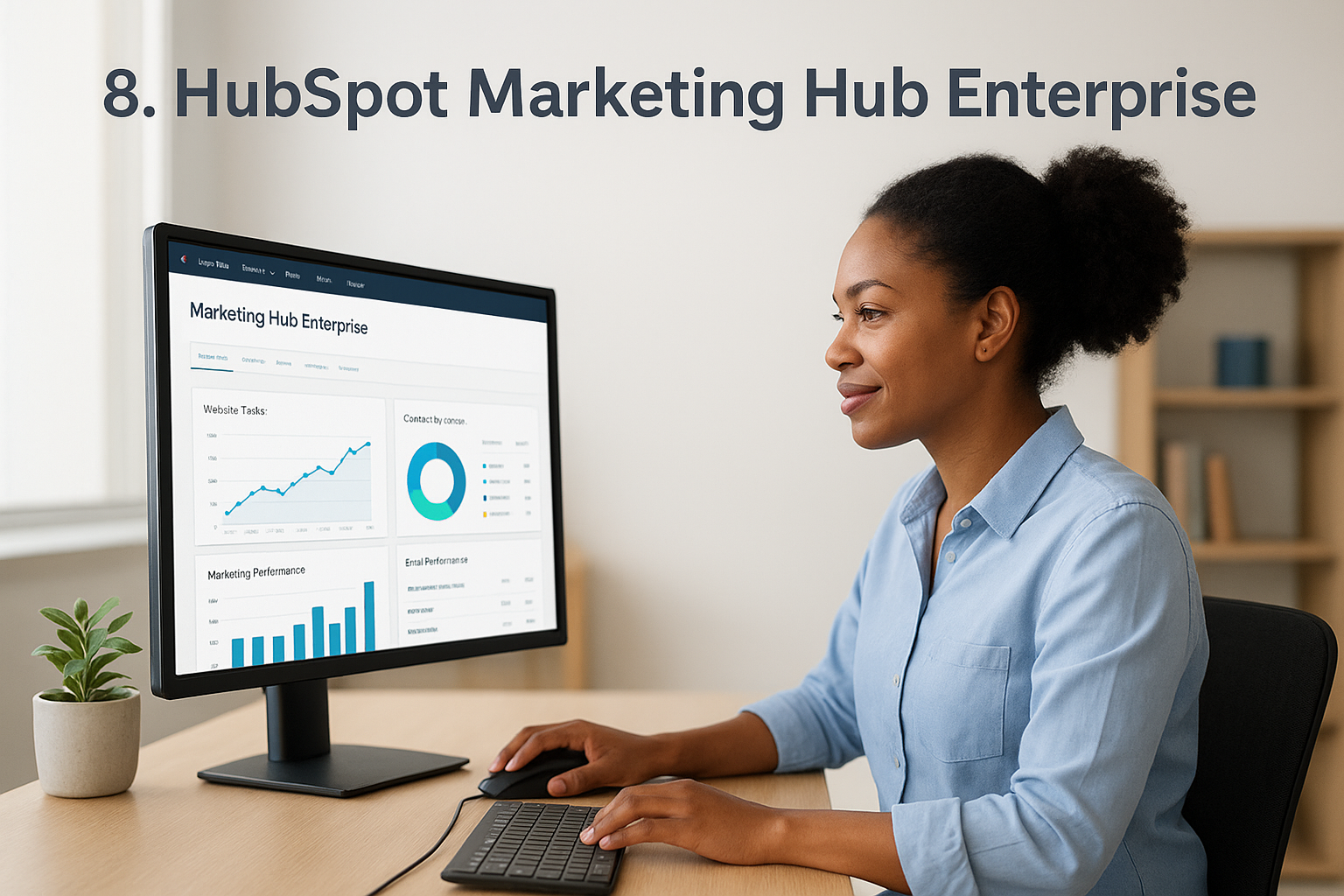
HubSpot Marketing Hub Enterprise is a marketing automation platform built for mid-to-large organizations that want a powerful, centralized system without the implementation complexity that typically comes with enterprise software. It serves companies in professional services, SaaS, and B2B sectors that need robust automation, advanced reporting, and tight CRM alignment inside a single platform.
What it does best at enterprise scale
HubSpot Marketing Hub Enterprise stands out as an enterprise marketing automation platform for teams that prioritize ease of use alongside serious functionality. Your marketing operations team can build and manage complex programs without leaning heavily on developers, which reduces the gap between strategy and execution that slows down larger marketing departments.
Standout automation and journey features
HubSpot’s custom behavioral events let you trigger automation based on specific actions users take on your website or product, going well beyond simple email opens or form fills. Your team can build multi-step workflows that respond to those signals in real time, routing contacts into targeted sequences or sales queues based on exactly where they are in the buying process.
HubSpot’s native CRM connection means your automated workflows pull live sales data directly into campaign logic, keeping marketing and sales aligned without manual syncing.
Data and integrations
HubSpot connects with over 1,500 tools through its App Marketplace, covering CRM, data enrichment, analytics, and advertising platforms. Your team also gets custom reporting dashboards that pull data across contacts, campaigns, and revenue, giving you a clear picture of how marketing activity translates to pipeline and closed business.
Governance, security, and compliance
HubSpot Marketing Hub Enterprise includes single sign-on, field-level permissions, and partitioning to separate data across teams or business units. The platform holds SOC 2 Type II certification and supports GDPR compliance requirements, covering the baseline security and data handling standards most enterprise organizations require.
Pricing and contract notes
HubSpot Marketing Hub Enterprise starts at $3,600 per month, billed annually. Costs increase with your contact database size and the number of additional seats your team requires.
9. Iterable
Iterable is a cross-channel marketing platform designed for consumer brands that need to deliver personalized messaging across email, SMS, push, and in-app channels at scale. It serves companies in media, retail, and subscription businesses that run high-frequency communication programs requiring flexible audience segmentation and responsive automation.
What it does best at enterprise scale
Iterable’s primary strength as an enterprise marketing automation platform is its ability to handle large, event-driven messaging programs without forcing your team into a rigid workflow structure. You can build campaigns around real-time behavioral data, letting your team move quickly when user signals change rather than waiting on static scheduled sends. Its flexible data model accepts custom event and user attributes without requiring heavy data engineering work upfront.
Standout automation and journey features
Iterable’s Workflow Studio gives your team a visual canvas for building multi-step journeys that trigger based on user events, time delays, or audience filter conditions. You can layer branching logic across channels within a single workflow, which keeps your campaign architecture clean rather than splitting logic across separate tools or team handoffs.
Iterable’s event-based triggering lets you fire messages the moment a user completes a specific action, cutting the lag between intent and response.
Data and integrations
Iterable connects with major data warehouses, CDPs, and analytics platforms including Segment, Snowflake, and Amplitude. Your team can push custom user and event data into the platform via its open API or through pre-built catalog integrations, keeping your contact profiles current without manual imports.
Governance, security, and compliance
Iterable holds SOC 2 Type II certification and supports GDPR and CCPA compliance requirements. Your administrators can set role-based access controls to manage permissions across teams, restricting data visibility where your organization requires it.
Pricing and contract notes
Iterable uses custom annual pricing based on your message volume and the channels your team activates. Contact their sales team directly for accurate figures tied to your specific usage requirements and contract terms.
10. Customer.io
Customer.io is a behavioral messaging platform used by SaaS companies, subscription businesses, and digital-first brands that need precise control over how and when they communicate with users based on real-time data. It occupies a middle ground between lightweight email tools and heavy enterprise suites, making it a strong fit for technical marketing teams that want flexibility without excessive platform overhead.
What it does best at enterprise scale
Customer.io performs well for organizations that need to send event-driven messages at high volume across email, SMS, push, and in-app channels without managing multiple disconnected tools. Its strength as an enterprise marketing automation platform lies in how cleanly it handles custom data attributes and event tracking, letting your team build audience segments and triggers based on exactly what users do rather than approximations.
Standout automation and journey features
Customer.io’s Visual Workflow Builder gives your team a clear canvas for building multi-step journeys triggered by user events, time conditions, or attribute changes. You can branch logic across channels within a single workflow, which keeps your campaign architecture manageable as your programs grow in complexity.
Customer.io’s data-first design means your team can query and segment your contact database using behavioral and attribute-based filters with significantly more flexibility than most comparable platforms allow.
Data and integrations
Customer.io accepts custom event and attribute data through its REST API and connects with major data platforms including Segment, Snowflake, and Amplitude. Your team can push granular user-level data into the platform without heavy engineering work, keeping contact profiles accurate and current as your product and marketing data evolves.
Governance, security, and compliance
Customer.io holds SOC 2 Type II certification and supports GDPR and CCPA compliance requirements. Your administrators can configure role-based access permissions to control which team members can view or modify specific data, campaigns, or workspace settings.
Pricing and contract notes
Customer.io offers tiered pricing based on monthly message volume, with an enterprise tier available for high-volume senders that need dedicated support and advanced security features. Pricing details are available directly through their sales team for larger custom agreements.
11. Klaviyo
Klaviyo is a marketing automation and data platform built primarily for e-commerce and direct-to-consumer brands that want to drive revenue through email and SMS. It has grown from a straightforward email tool into a platform capable of handling significant scale, particularly for retail and online businesses running high-frequency campaigns tied directly to purchase behavior and product data.

What it does best at enterprise scale
Klaviyo’s core advantage at scale is its native connection to e-commerce platforms like Shopify, BigCommerce, and WooCommerce, which lets your team work with real-time purchase, browsing, and product data without custom integration work. For brands running large product catalogs and active buyer databases, that depth of e-commerce context makes segmentation and personalization significantly more precise than what most general-purpose platforms deliver.
Your team can build audiences based on granular purchase history, predicted lifetime value, and churn risk, which gives you targeting precision that goes well beyond basic demographic filters. As an enterprise marketing automation platform, Klaviyo fits best when your revenue is tightly tied to repeat purchase behavior.
Standout automation and journey features
Klaviyo’s flow builder lets your team design trigger-based automation sequences that fire on specific actions like abandoned carts, post-purchase windows, or browse abandonment events. You can layer conditional splits and time delays within a single flow, keeping your campaign logic in one place rather than spread across disconnected tools.
Klaviyo’s predictive analytics layer surfaces expected next order dates and lifetime value estimates, letting your team trigger campaigns based on where customers are in their buying cycle rather than just what they’ve done most recently.
Data and integrations
Klaviyo connects with over 350 pre-built integrations covering e-commerce, loyalty, reviews, and customer data tools. Its built-in CDP functionality unifies customer profiles across those sources, giving your team a complete behavioral record for every contact.
Governance, security, and compliance
Klaviyo holds SOC 2 Type II certification and supports GDPR and CCPA compliance. Your administrators can configure role-based permissions to manage access across team members and data sets.
Pricing and contract notes
Klaviyo uses tiered pricing based on contact count and message volume, with plans scaling from small lists to large enterprise databases. Enterprise-level pricing is available through direct negotiation with their sales team.
12. ActiveCampaign
ActiveCampaign is a marketing automation and CRM platform used by small and mid-market businesses that want deep automation capabilities without the pricing and complexity of a full enterprise suite. It serves teams in professional services, e-commerce, and SaaS that need email marketing, behavioral automation, and sales pipeline management inside a single connected system.
What it does best at enterprise scale
ActiveCampaign’s core strength is making sophisticated automation accessible to teams that don’t have dedicated marketing operations engineers on staff. For growing organizations that need more than basic email sequencing but aren’t ready to commit to the cost and configuration demands of a top-tier enterprise marketing automation platform, ActiveCampaign delivers a strong middle ground. Your team can build complex, branching automation programs without writing custom code or filing IT tickets to move forward.
Standout automation and journey features
ActiveCampaign’s visual automation builder lets your team design multi-step, trigger-based journeys using conditions built on email engagement, site visits, CRM stage changes, and custom events. You can split contacts into different tracks based on specific behavioral signals, keeping your messaging relevant without manually managing separate campaigns for each audience segment.
ActiveCampaign’s combination of CRM and automation in one interface removes the handoff friction that slows down follow-up when leads change status in the pipeline.
Data and integrations
ActiveCampaign connects with over 900 third-party tools through native integrations, covering e-commerce, scheduling, payment, and analytics platforms. Your team can also push custom event data into the platform through its open API, keeping contact records current as your users take actions across your product or website.
Governance, security, and compliance
ActiveCampaign holds SOC 2 Type II certification and supports GDPR and CCPA compliance requirements. Your administrators can apply role-based permissions to control what each team member can access or modify within the account.
Pricing and contract notes
ActiveCampaign offers tiered pricing based on contact count, with an enterprise plan available that includes custom reporting, dedicated support, and SSO. Pricing scales as your database grows, so review your projected contact volume before committing to an annual agreement.
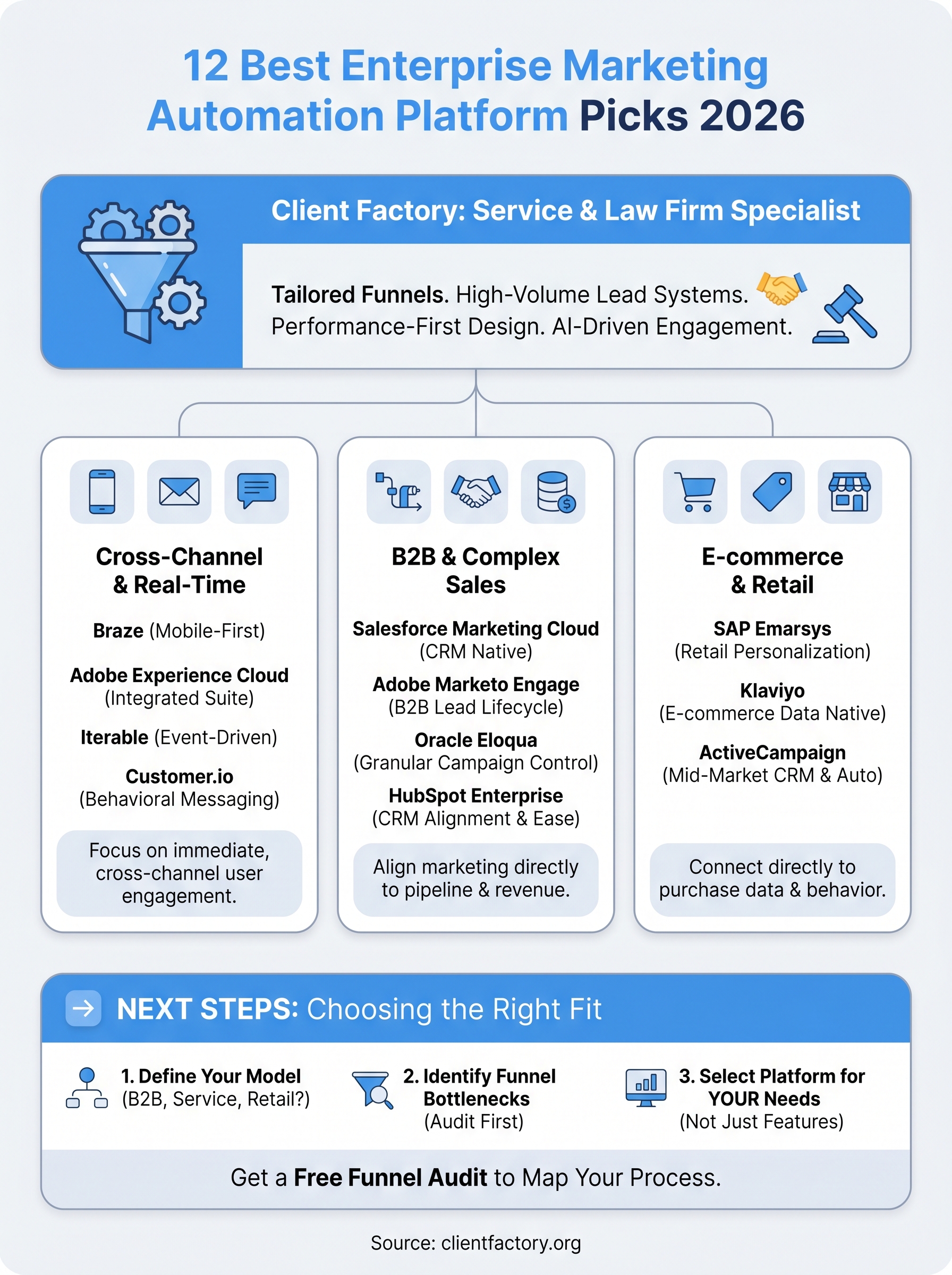
Next Steps
Every platform on this list handles marketing automation differently, and the right choice depends entirely on your business model, team structure, and growth targets. If you run a service business or law firm, you don’t need the most complex enterprise marketing automation platform available. You need a system designed to turn qualified traffic into paying clients consistently, without unnecessary overhead.
Before you invest time evaluating software, get clear on where your current funnel is actually losing leads. Most organizations have fixable conversion problems they haven’t identified yet, and solving those first makes every platform perform better regardless of how sophisticated its feature set looks on paper.
Client Factory offers a free funnel audit that maps exactly where your acquisition process breaks down and what it takes to fix it. Book your conversion audit and walk away with a clear, actionable picture of your next move.