

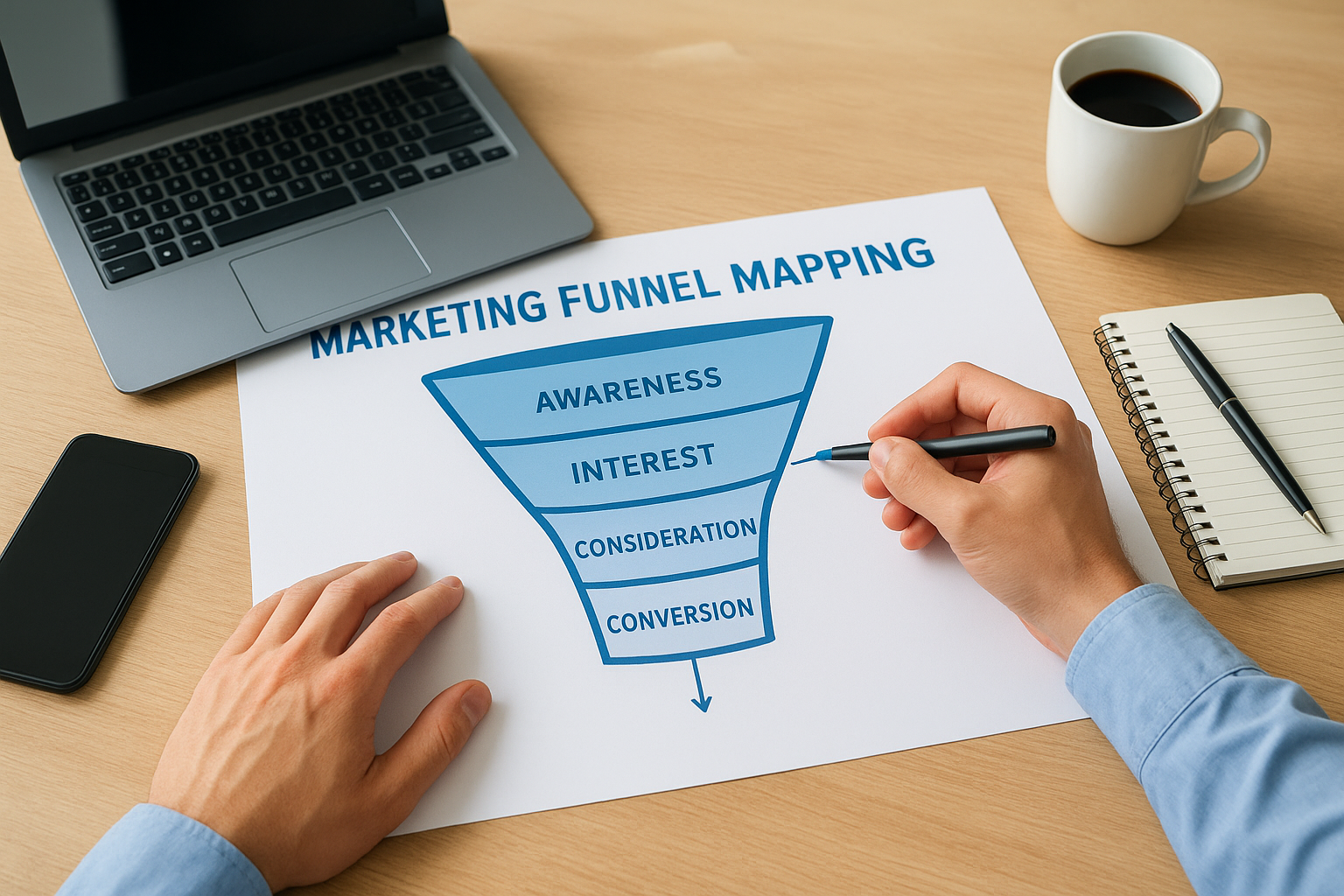
Most businesses have some version of a funnel, ads, landing pages, emails, follow-ups. But few have actually sat down and mapped the whole thing out. That’s where marketing funnel mapping comes in: the process of visually documenting every step a buyer takes from first click to signed contract. Without it, you’re essentially guessing where prospects drop off and why.
At Client Factory, we build client acquisition funnels for service businesses and law firms every day. And the single most common problem we see? Disconnected stages, traffic campaigns pointing to pages that don’t match the buyer’s mindset, follow-up sequences that fire too late, and conversion points buried where nobody looks. A clear funnel map exposes all of it before you spend another dollar on ads. It’s the diagnostic step most teams skip, and it costs them.
This guide walks you through exactly how to create a marketing funnel map from scratch, including the frameworks, real examples, and software tools that make the process straightforward. Whether you’re documenting an existing funnel or building a new one, you’ll leave with a repeatable method to visualize your entire buyer journey and spot the gaps that are bleeding leads.
What marketing funnel mapping is and why it works
A marketing funnel is a model. A marketing funnel map is a working document. The model tells you that buyers move from awareness to consideration to decision. The map shows you exactly how your specific buyers move through those stages, which channels they use, what content they consume, where they stall, and what finally pushes them to act. Marketing funnel mapping is the process of building that document, turning a theoretical structure into a visual blueprint of your actual buyer journey.
A funnel model describes what should happen. A funnel map shows what actually happens in your business.
The map itself can take many forms, from a simple spreadsheet to a visual diagram in a whiteboard tool. What matters is that it captures every stage, every touchpoint, and every conversion point in sequence, with the people, content, and metrics attached to each one. When you finish a proper map, you can point to any stage and immediately answer: who is the buyer here, what do they need, what does our system do for them, and how do we measure it?
The difference between a funnel and a funnel map
Most marketing teams think about funnels in broad strokes: run ads, get traffic, convert leads. That thinking leaves critical gaps between stages that silently kill conversions. A funnel map forces you to zoom in. It documents not just the stages but the transitions, the specific actions a buyer takes to move from one stage to the next, and the specific actions your system takes to guide them there.
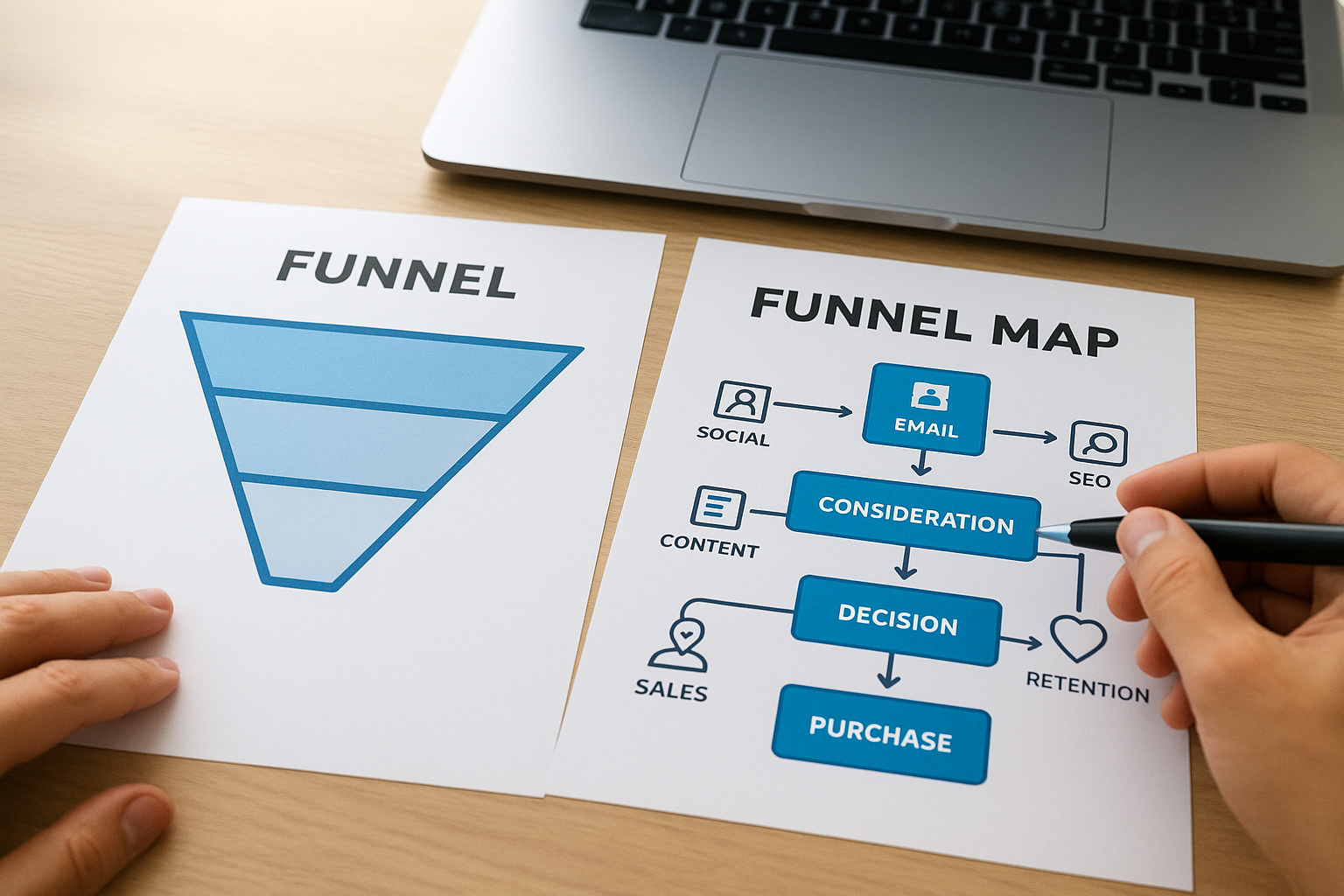
Here is what a funnel map captures that a generic funnel model does not:
- Touchpoints by channel: email, paid ad, organic search, phone call, retargeting ad
- Content assets at each stage: landing page, case study, pricing page, proposal template
- Conversion triggers: the specific event or action that moves a lead to the next stage
- Owners and handoffs: who on your team is responsible at each step
- Drop-off points: where leads go quiet and which follow-up sequence fires in response
Why most funnels fail without a map
Without a map, you operate on assumptions. You assume your ad traffic lands on a page that matches buyer intent. You assume your email sequence fires at the right time. You assume your sales team picks up leads before they go cold. These assumptions are expensive when they’re wrong, and most of the time, at least one of them is.
Mapping your funnel forces every assumption into the open. When you write down that a Google Ads click lands on a general homepage, you immediately see the mismatch in intent. When you draw out your follow-up sequence and realize it sends a pricing email on day one before any trust has been built, the fix becomes obvious. The map does not solve your problems automatically, but it makes every problem visible and specific, and that is the only reliable starting point for fixing them.
Step 1. Pick the right funnel model for your business
The funnel model you choose shapes everything that follows in your marketing funnel mapping process. Different businesses have buyers who move through radically different decision cycles. A law firm where a client needs to trust you before signing a retainer operates nothing like an e-commerce store with a one-click checkout. Before you draw a single stage, decide which model actually matches how your buyers make decisions, not which model looks best on a slide.
The three most common funnel models
Three models cover the vast majority of service and product businesses. Each one organizes the buyer journey differently, and picking the wrong one means your map will miss stages that matter most to your specific audience.
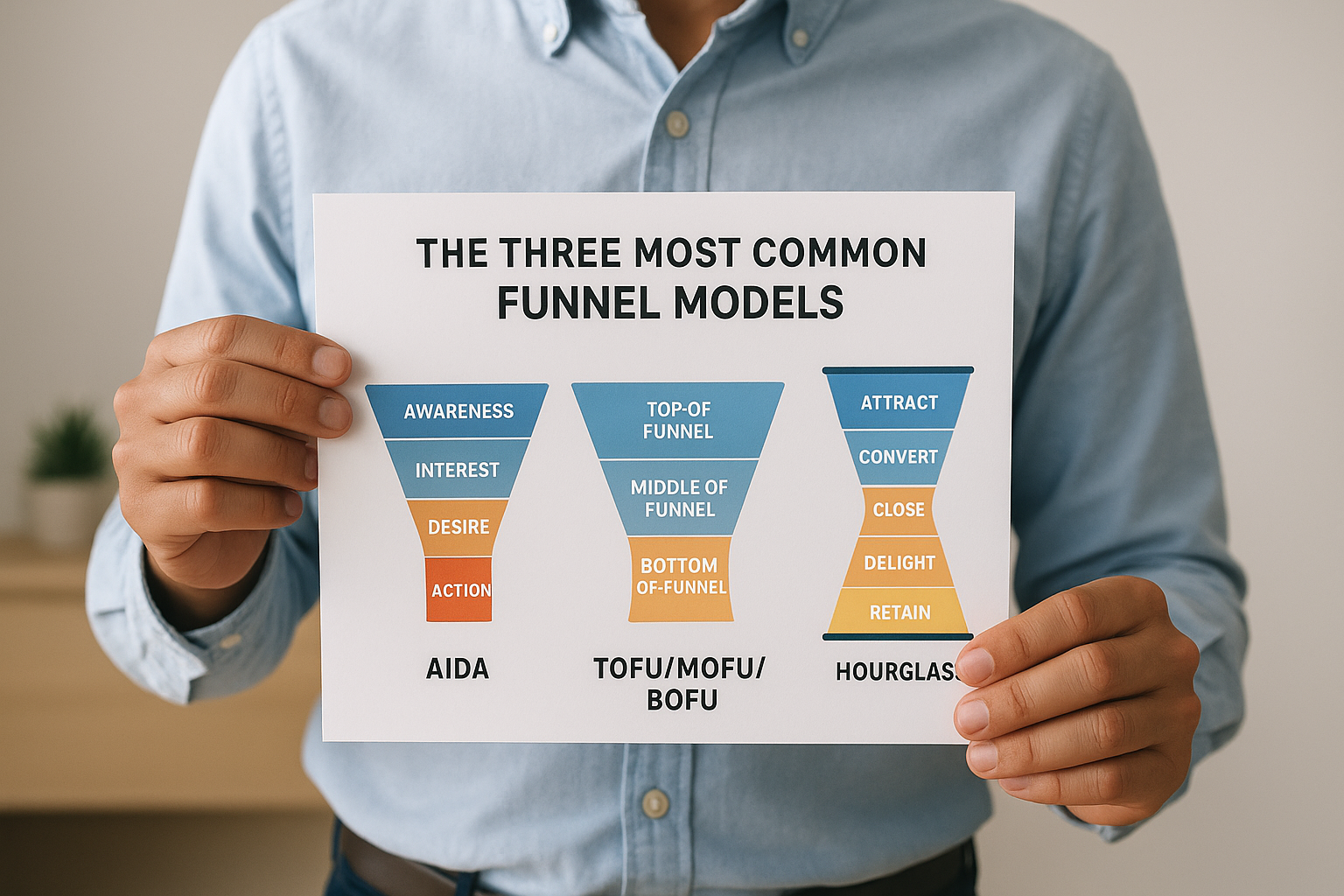
| Model | Best For | Core Stages |
|---|---|---|
| AIDA | Direct response, simple purchases | Awareness, Interest, Desire, Action |
| TOFU/MOFU/BOFU | Content marketing, SEO-driven inbound | Top of Funnel, Middle of Funnel, Bottom of Funnel |
| Hourglass | Service businesses, law firms, agencies | Attract, Convert, Close, Delight, Retain, Refer |
AIDA works well when your buyer’s decision cycle is short and the purchase does not require heavy trust-building. TOFU/MOFU/BOFU fits businesses where buyers self-educate through content before they ever contact you. The Hourglass model is the most relevant for service businesses because it extends past the sale into retention and referral, which is where most service revenue actually comes from.
How to match the model to your business type
Start by asking one question: where does your revenue come from? If most of your clients come from referrals and repeat business, use the Hourglass. Your map needs to cover the post-sale experience just as thoroughly as the acquisition stages. If you run paid campaigns with a clear offer and a short sales cycle, AIDA gives you a clean structure with no unnecessary stages to complicate the map.
The right model is the one that reflects where your revenue actually comes from, not the one you learned first.
For service businesses and law firms specifically, the Hourglass model almost always wins. A new client who gets an exceptional experience and refers two colleagues is worth three times what the acquisition cost. Your funnel map should capture every stage of that full cycle, from the first ad impression to the referral conversation, or you will consistently undervalue and underinvest in the stages that compound over time.
Step 2. Gather the inputs you need before you map
Jumping into marketing funnel mapping without the right inputs is like drawing directions to a place you have never been. You will produce something that looks organized but does not reflect how your buyers actually move. Before you open any tool or sketch a single stage, collect the raw material that turns your map from a set of assumptions into an accurate picture of your real buyer journey.
What data to pull first
Your first stop is your analytics platform. Pull traffic data by channel, page-level engagement, and exit rates for every page currently in your funnel. If you use Google Analytics, export the user flow report to see where visitors enter, where they stall, and where they leave. Pair that with your CRM data: lead source, stage-by-stage conversion rates, average time between stages, and close rates by lead type. Together, these two sources tell you what your funnel is actually doing numerically before you map it visually.
Gather data on what your funnel currently does before you decide what it should do.
Beyond analytics and CRM, collect the following before you begin:
- All existing content assets: landing pages, emails, ads, case studies, and proposal templates
- Current ad targeting settings by campaign and channel
- Lead response time logs: how fast your team contacts a prospect after a form submission
- Closed and lost deal notes: the reasons clients chose you or chose someone else
- Churn or cancellation records: patterns that reveal where the post-sale experience breaks down
What to ask your sales and service team
Your sales and service team operates inside the funnel every single day. They know things your analytics will never surface, like which objection comes up on every discovery call or which follow-up email makes prospects go cold. Before you lock in your inputs, run a short structured interview with the people who handle leads and clients directly. Ask them these specific questions:
- What do prospects ask most before they decide to move forward?
- At what point do qualified leads most often go quiet?
- What separates a serious prospect from one who wastes your team’s time?
- Which step in the process creates the most friction for new clients after they sign?
Write the answers down verbatim. These responses become the qualitative layer of your funnel map, the context that raw data alone will never give you.
Step 3. Define buyer personas and desired outcomes
A marketing funnel map without clearly defined personas is just a diagram of steps. The persona is what transforms each stage from a generic label into a specific set of decisions about content, messaging, and timing. When you know exactly who you are guiding through the funnel, you can define what they need to hear, what objections they carry, and what outcome they need to reach before they move forward. Without that clarity, every stage of your map rests on assumptions.
How to build a persona that actually helps your map
Most persona templates collect demographic details that never influence a single marketing decision. For marketing funnel mapping, you need a persona built around buying behavior, not age ranges and job titles. The goal is to understand how this specific buyer evaluates options, what makes them hesitate, and what finally convinces them to act.
The only persona worth building is one that changes how you write, design, or sequence something in your funnel.
Use this template for each persona you define:
| Field | What to Document |
|---|---|
| Role and situation | Who they are and the specific problem pushing them to find a solution |
| Primary goal | The outcome they want from working with you |
| Key objections | The 2-3 reasons they hesitate before committing |
| Information sources | Where they research before making a contact decision |
| Decision trigger | The specific event or pain point that pushed them to act now |
Fill this out using the closed-deal notes and sales team interviews you collected in Step 2. If you serve three distinct buyer types, build three separate personas. Your funnel map may branch at specific stages for each one, and that branching should be visible on the map itself.
Defining the desired outcome at each stage
Every stage in your funnel needs a defined outcome for the buyer, not just a conversion goal for your business. The distinction matters more than most teams realize. Your business wants a form submission at the landing page stage. Your buyer wants to feel confident they are in the right place before they give you their contact information. When you map the buyer’s desired outcome alongside your conversion goal at each stage, you close the gap between what you deliver and what they actually need.
For each stage in your funnel, write two lines: what your system does and what the buyer should feel or know as a result. A law firm running paid ads might map its landing page stage as: "System delivers a focused practice area page with a strong proof point. Buyer confirms this firm handles their type of case and sees evidence that others in their situation got results." That two-line format keeps every stage of your map grounded in reality.
Step 4. List every touchpoint across channels
A touchpoint is any moment your business and a potential client make contact, whether that contact happens on a paid ad, a search result, an email, a phone call, or a follow-up text. Most teams underestimate how many touchpoints they already have, and the gaps they find during this step of marketing funnel mapping are almost always where leads quietly disappear. Your job here is to write down every single one, across every channel, in the order a buyer would encounter them.
How to inventory your touchpoints systematically
Start by moving through each channel your business uses and listing every interaction point within it. Do not edit or rank them yet. Just capture everything that exists right now, including the things you built years ago and rarely think about. A Google Business Profile with a contact button is a touchpoint. An automated reply to a contact form submission is a touchpoint. The voicemail greeting on your intake line is a touchpoint.
If a buyer could encounter it before, during, or right after their first contact with you, it belongs on your list.
Work through your channels in this order to avoid missing anything:
- Paid advertising: Google Ads, Facebook/Meta Ads, YouTube pre-roll, retargeting banners
- Organic search: blog posts, service pages, landing pages, Google Business Profile
- Social media: organic posts, direct messages, comment replies, profile links
- Email: cold outreach, lead nurture sequences, confirmation emails, appointment reminders
- Phone and text: intake calls, voicemail, SMS follow-ups, scheduled callback flows
- Referral and offline: referral partner introductions, review platforms, in-person events
List each touchpoint, the channel it lives on, and whether it is automated or handled by a person. That last detail matters when you assign owners in Step 6.
Matching touchpoints to buyer stages
Once your full inventory is on paper, assign each touchpoint to the funnel stage it serves. Some touchpoints will serve multiple stages, and that is worth flagging. A case study page, for example, might serve both consideration and decision-stage buyers depending on how they find it. Use a simple three-column table with columns for touchpoint name, channel, and funnel stage to keep everything organized. This table becomes the raw input for your first draft in the next step.
Step 5. Build the first draft of your funnel map
Now that you have your touchpoint inventory and your persona definitions in place, you are ready to put the actual map together. The goal at this stage is not perfection. Your first draft exists to get everything out of your head and into a single visible structure so you can see the full buyer journey as one connected system. Keep the format simple and move fast. You will refine the details in the steps that follow.
Start with a row-per-stage table format
The fastest way to build your first draft during the marketing funnel mapping process is a row-per-stage table. This format forces you to document each stage in parallel columns, which immediately exposes gaps when a cell stays empty. Open a spreadsheet or a table in any doc tool and build the following columns:
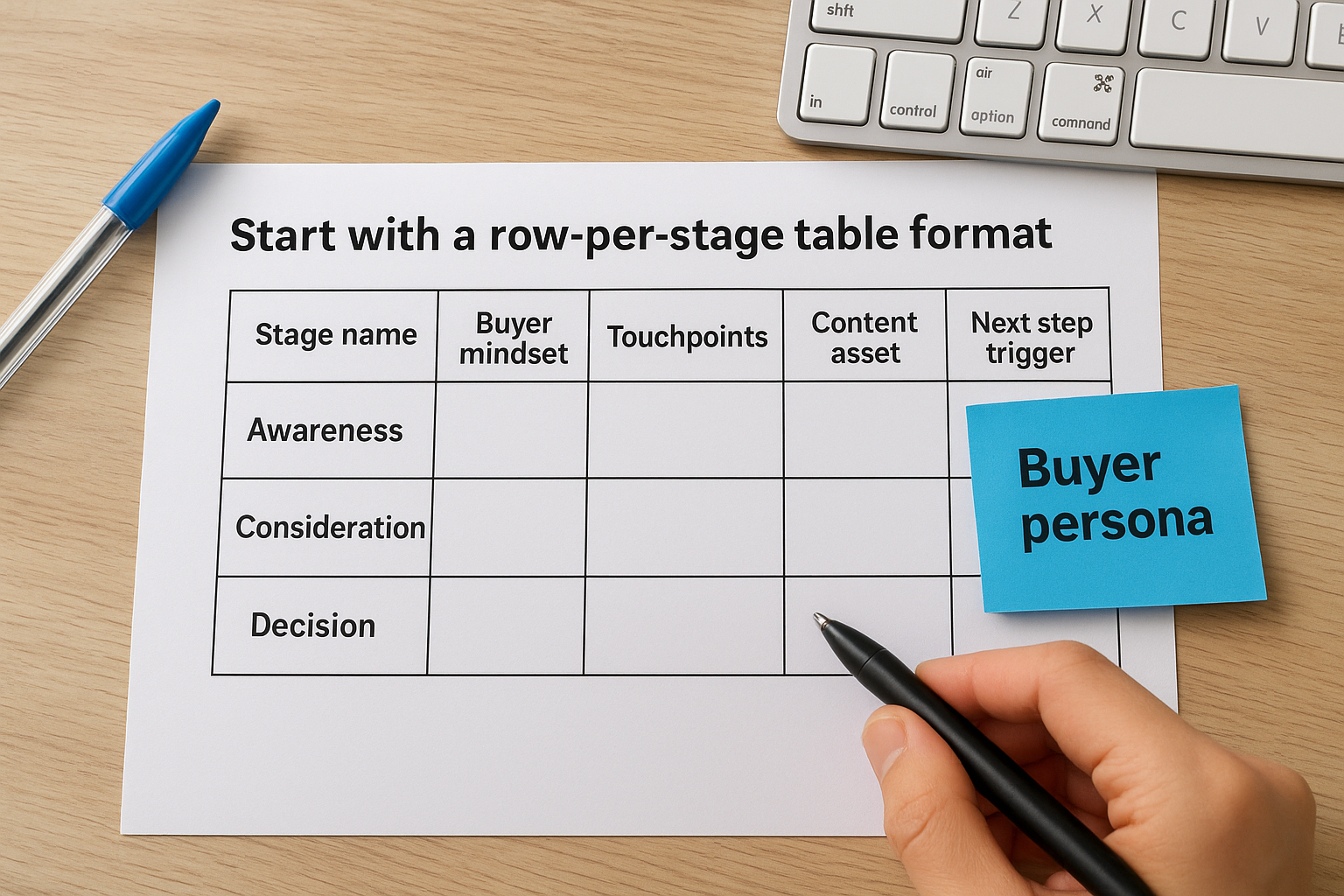
| Column | What Goes There |
|---|---|
| Stage name | The label for this phase (e.g., Awareness, Consideration, Decision) |
| Buyer mindset | What the buyer is thinking or feeling at this point |
| Touchpoints | Every channel or asset they encounter here |
| Content asset | The specific page, email, ad, or resource in play |
| Next step trigger | The action that moves them to the next stage |
Fill one row per stage using the inputs from Steps 2 through 4. If a row has empty cells in the touchpoint or content column, that is a gap in your funnel, and you should mark it rather than skip it. The gaps are exactly what you are looking for.
An empty cell on your draft map is not a formatting problem. It is a revenue problem waiting to be fixed.
Connect the stages into a linear flow
Once your table is complete, translate it into a linear visual flow. Arrange each stage left to right or top to bottom with an arrow connecting each one. You do not need specialized software at this point. A whiteboard sketch, a slide in Google Slides, or a simple diagram on paper works fine for a first draft. The goal is to confirm that the sequence makes sense and that no stage floats in isolation without a clear path leading into it and out of it.
Write the buyer persona label above the flow so everyone reading the map knows exactly whose journey you are documenting. If you defined multiple personas in Step 3, create a separate flow for each one rather than cramming them into a single diagram.
Step 6. Add conversion goals, handoffs, and owners
Your funnel map now shows the stages, touchpoints, and buyer journey in sequence. The next step in marketing funnel mapping is to add the operational layer: one clear conversion goal per stage, the handoff points where responsibility shifts between people or systems, and a named owner for every step. Without this layer, your map is a reference document. With it, your map becomes an accountability system that drives action.
Set one conversion goal per stage
Every stage in your funnel should have exactly one conversion goal. A stage with two goals creates confusion about which action to optimize for. A stage with no goal creates a gap where leads can sit indefinitely without triggering any follow-up. Write the goal as a specific, observable action the buyer takes to exit that stage and enter the next one.
One conversion goal per stage forces clarity. Ambiguity in your map becomes ambiguity in your results.
Use the format below to document goals for each stage. Fill in the goal as an action the buyer completes, not a business outcome you hope for.
| Stage | Conversion Goal |
|---|---|
| Awareness | Clicks ad or organic result to landing page |
| Consideration | Submits contact form or calls intake line |
| Decision | Completes consultation and receives proposal |
| Close | Signs agreement and submits payment |
| Retain | Completes onboarding and hits first milestone |
Document handoffs and assign owners
A handoff is the moment responsibility for a lead shifts from one system or person to another, for example, from your ad campaign to your landing page, or from your CRM automation to your intake coordinator. Handoffs are the most common failure points in service business funnels because nobody claims the lead in the transition. Your map needs to name the handoff explicitly and assign a single owner to receive it.
For each handoff in your funnel, document three things: who sends the lead, who receives it, and the maximum acceptable time between the trigger and the response. A contact form submission, for instance, might pass from your CRM automation to your intake coordinator with a required response time of under five minutes during business hours. Write that directly on your map so there is no room for misinterpretation. When every handoff has a named receiver and a time standard attached to it, leads stop falling through the cracks between stages.
Step 7. Attach metrics and tracking to each stage
Your funnel map now has stages, touchpoints, conversion goals, and owners. The final layer that makes marketing funnel mapping actionable is measurement. Without a defined metric for each stage, you cannot tell whether a stage is performing or failing, and you cannot prioritize where to focus your improvement effort. Every stage needs one primary metric that tells you whether the stage is doing its job, and a tracking mechanism already in place before leads start flowing through.
Choose one primary metric per stage
Picking one metric per stage sounds simple, but most teams default to tracking everything and acting on nothing. The single metric you assign to each stage should directly reflect whether buyers are moving forward, not whether your team is staying busy. Assign metrics that measure buyer behavior, not internal activity.
The metric you track at each stage determines what your team optimizes for, so choose it based on buyer movement, not vanity numbers.
Use the table below as a starting template. Adjust the specific numbers to match your industry benchmarks, but keep the metric structure as is.
| Stage | Primary Metric | Benchmark to Watch |
|---|---|---|
| Awareness | Click-through rate on ads or organic | Above 2% for paid search |
| Consideration | Landing page conversion rate | Above 5% for service businesses |
| Decision | Consultation booking rate | Above 30% of qualified leads |
| Close | Proposal-to-signed rate | Above 50% for warm leads |
| Retain | 90-day client retention rate | Above 85% for service businesses |
Set up tracking before leads enter each stage
Defining metrics on paper does nothing if your tracking is not configured before a lead reaches that stage. For each stage, confirm that the event or conversion is firing correctly in your analytics platform. If your consideration stage conversion goal is a form submission, verify that your Google Analytics goal or GA4 conversion event is recording every submission, not just page views of the thank-you page. A misfiring conversion event will make a healthy stage look broken and send you chasing a problem that does not exist.
For each stage metric on your map, document the tracking method alongside it: the platform it lives in, the event name, and the person responsible for confirming accuracy on a monthly basis. That single addition turns your funnel map from a static diagram into a live measurement system your team can trust.
Step 8. Find leaks and fix the path forward
With metrics attached and tracking confirmed, your marketing funnel mapping process reaches its most valuable moment: finding exactly where leads exit without converting. A funnel leak is any stage where your conversion rate falls below your benchmark or where the volume of leads entering does not match the volume exiting into the next stage. You now have everything you need to find these gaps systematically rather than guessing your way toward a fix.
How to identify where leads drop off
Pull your stage-by-stage conversion data and compare each metric against the benchmarks you set in Step 7. Start from the top of your funnel and move downward. The first stage where your actual rate drops significantly below the target is your primary leak. Mark it on your map before you look at anything else. Fixing a leak near the top of your funnel has a compounding effect: every lead you retain at that stage flows through every stage below it.
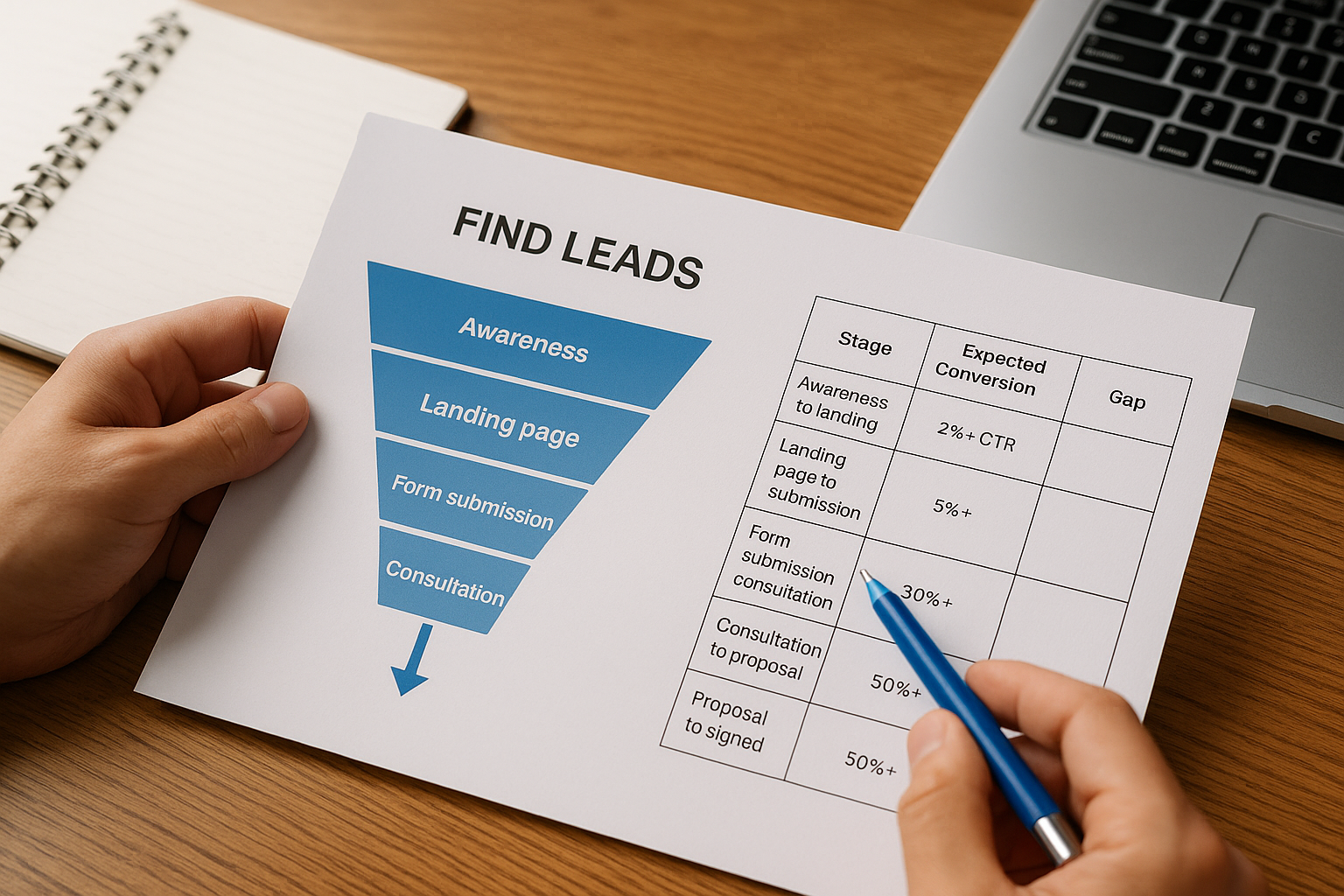
Use this template to run your leak analysis across all stages:
| Stage | Expected Conversion Rate | Actual Conversion Rate | Gap | Priority |
|---|---|---|---|---|
| Awareness to landing page | 2%+ CTR | Record actual | Calculate difference | High if gap is over 1% |
| Landing page to form submission | 5%+ | Record actual | Calculate difference | High if gap is over 2% |
| Form submission to consultation | 30%+ | Record actual | Calculate difference | High if gap is over 10% |
| Consultation to proposal | 50%+ | Record actual | Calculate difference | High if gap is over 15% |
| Proposal to signed | 50%+ | Record actual | Calculate difference | High if gap is over 15% |
Fix one leak at a time, starting at the highest stage with the largest gap, so you can measure the impact of each change in isolation.
How to prioritize fixes and take action
Once you identify your primary leak stage, diagnose the cause before you change anything. A low landing page conversion rate could mean your ad traffic is mismatched to the page offer, your headline is unclear, or your call to action is buried below the fold. Pull your heatmap data if you have it, review the buyer mindset you documented for that stage, and cross-reference the sales team input from Step 2. The cause almost always connects back to something your data or your team already told you.
Write your fix as a specific one-sentence action with a named owner and a completion date. For example: "Rewrite the landing page headline to match the exact search term driving the most paid traffic, owned by the copy lead, due within five business days." Vague improvement plans do not get executed. Specific ones do, and your funnel map is the place to track them until they are live and measured.
Step 9. Choose tools and formats for your map
The tool you use for marketing funnel mapping matters far less than getting the map built and used. That said, the wrong format creates friction: a diagram that nobody can update, a spreadsheet too complicated to read at a glance, or a file that lives on one person’s laptop and never gets shared. Pick the format that fits your team’s workflow and your map’s purpose before you commit to building inside any specific tool.
Spreadsheet and table formats
A spreadsheet works best when your primary goal is operational clarity rather than visual presentation. It lets you sort by stage, filter by owner, and update conversion metrics in the same file where the map lives. Use Google Sheets or Excel and set up one row per stage with the columns you built in Steps 5 through 7. The table below shows the minimum column structure you need:
| Column | Purpose |
|---|---|
| Stage name | Labels the phase in the buyer journey |
| Buyer mindset | Documents what the buyer thinks and feels |
| Touchpoints | Lists every channel and asset in this stage |
| Conversion goal | Defines the one action that ends the stage |
| Owner | Names the person responsible |
| Primary metric | Tracks whether the stage performs |
Color-code rows by funnel stage so anyone reading the file can orient themselves in under five seconds. Use red to flag stages where actual conversion rates fall below benchmark, green for stages performing at or above target. This turns your spreadsheet into a live dashboard without adding any complexity.
Your map should be readable in under a minute by someone who did not build it.
Visual diagramming tools
A visual diagram works best when you need to present the funnel to stakeholders or communicate it across a team that processes information better as pictures than tables. Tools like Google Slides, Miro, or Lucidchart handle this format well. Draw each stage as a labeled box, connect them with arrows, and add a small annotation below each box with the conversion goal and primary metric. Keep the visual map one page. If it requires scrolling, it is too detailed for its format and belongs back in a spreadsheet.
Maintain both a spreadsheet version and a visual version if your team uses each format for different purposes. Link them in the same shared folder so updates to one prompt updates to the other.
Wrap it up and put the map to work
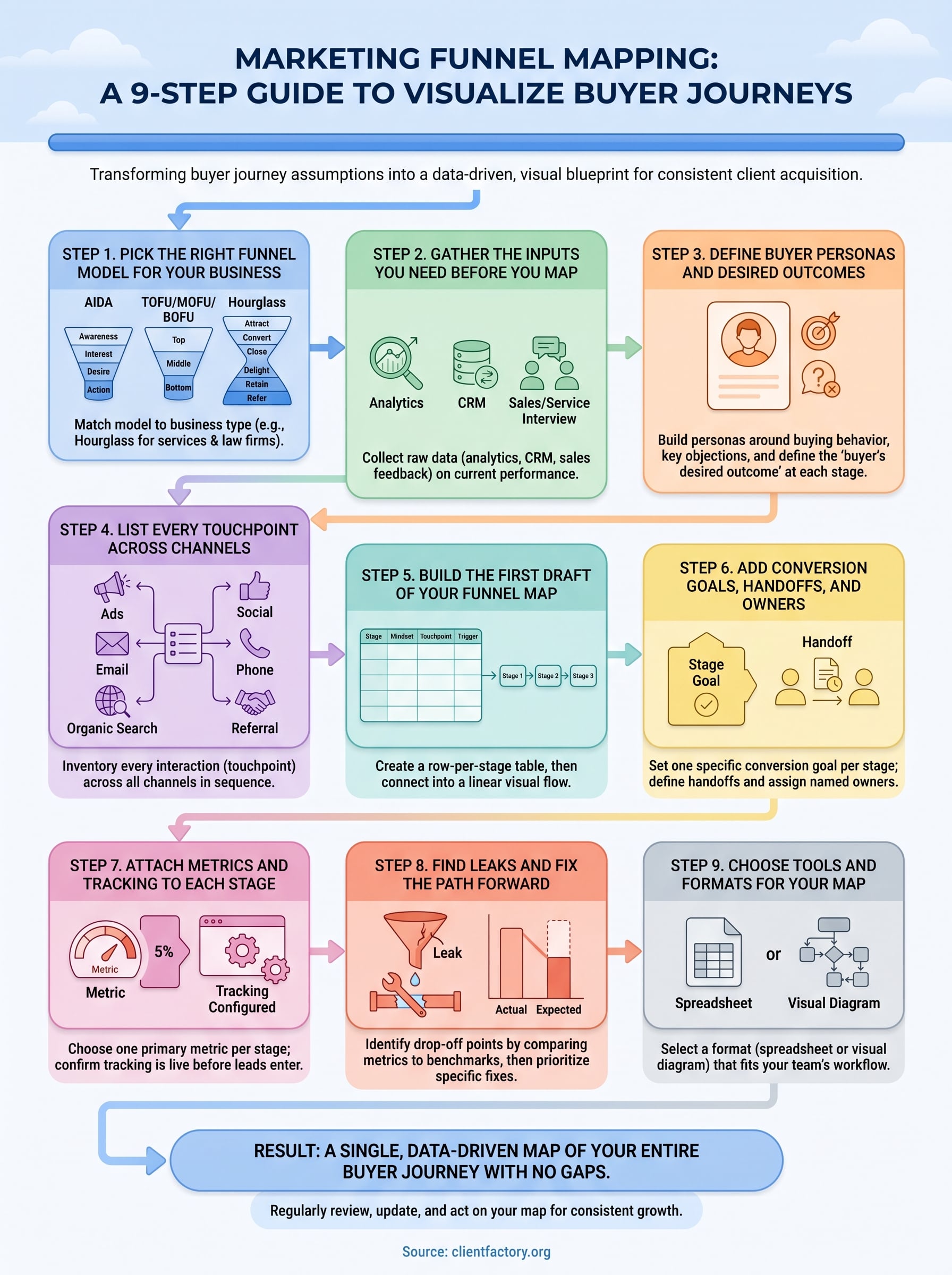
Marketing funnel mapping is not a one-time exercise. You now have a repeatable nine-step process: pick the right model, gather real data, define your personas, list every touchpoint, draft the map, assign owners, attach metrics, fix leaks, and choose the right format. Each step builds on the last, and the result is a single document that shows your entire buyer journey with no gaps and no guesswork.
Put your map in front of your team this week. Share it, review the conversion metrics monthly, and update the map every time you change a stage, add a channel, or identify a new drop-off point. A funnel map that collects dust solves nothing. One that your team actively uses becomes the clearest path to consistent client acquisition. If you want expert eyes on your funnel before you go further, book a free conversion audit and we will show you exactly where to start.