
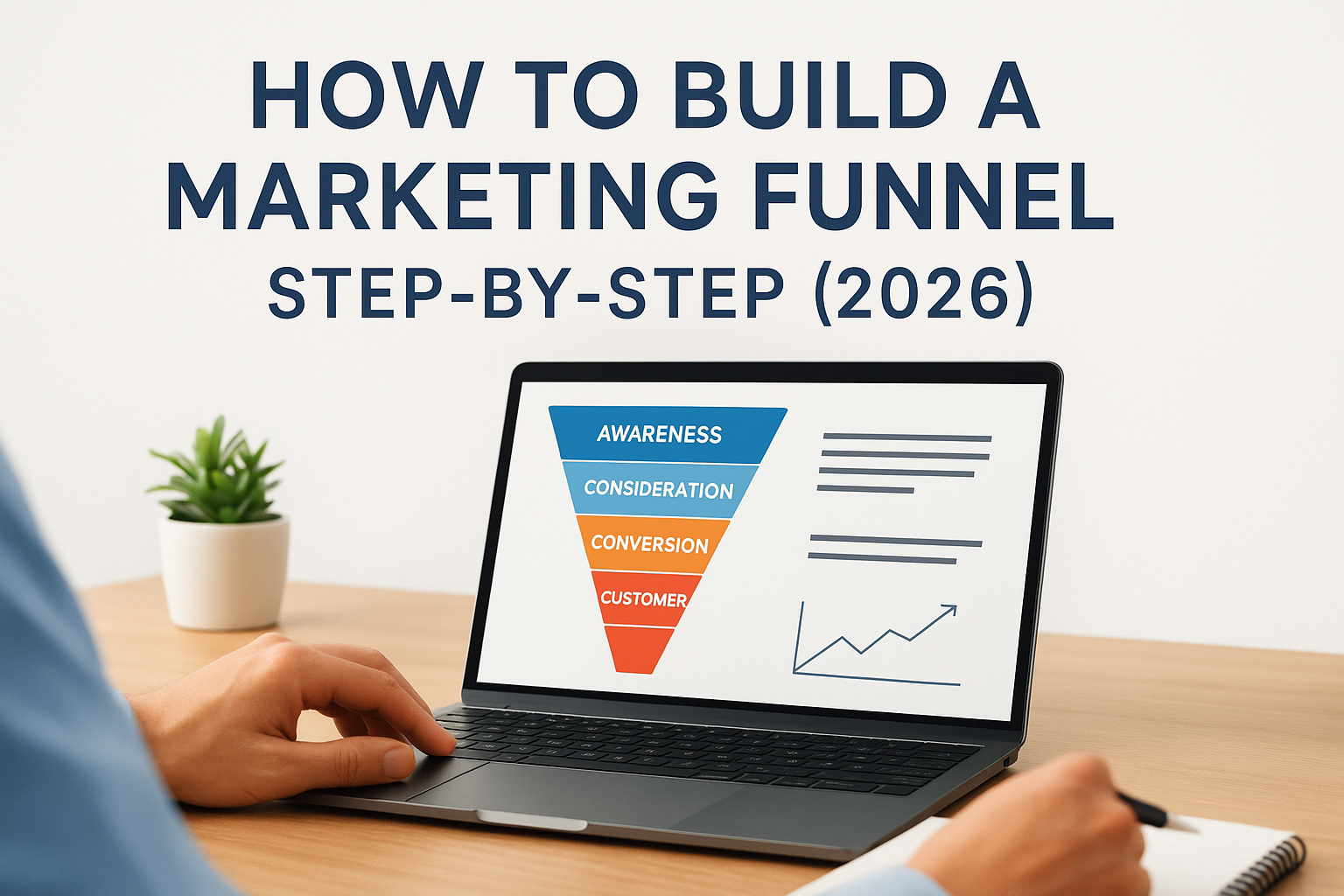
Most businesses don’t have a traffic problem, they have a conversion problem. You’re spending money on ads, posting content, maybe even ranking on Google. But if there’s no system in place to move people from "just browsing" to "ready to buy," that effort leaks revenue at every stage. That’s exactly why knowing how to build a marketing funnel matters more than almost any other skill in digital marketing.
A marketing funnel gives your business structure. It maps out the journey a prospect takes, from first hearing about you, to evaluating what you offer, to finally becoming a paying client. Without it, you’re relying on hope. With it, you have a repeatable process that turns strangers into leads and leads into clients. And when you layer in data and optimization, the results compound over time.
At Client Factory, we build client acquisition funnels for service businesses and law firms every day. We’ve seen what works, what doesn’t, and where most businesses get stuck. This guide pulls from that experience to give you a clear, step-by-step framework for building a marketing funnel that actually converts, from defining your stages and crafting offers to choosing the right channels and measuring what matters. Whether you’re starting from scratch or rebuilding something that isn’t performing, you’ll walk away with a practical blueprint you can implement right away.
What a marketing funnel is in 2026
A marketing funnel is a structured sequence of steps that moves a prospect from their first point of contact with your business to the moment they become a paying client. The name comes from the shape: you start with a wide pool of potential buyers at the top, and as people move through each stage, the pool narrows until only the people who convert remain. This model is the foundation of knowing how to build a marketing funnel that generates consistent, predictable revenue rather than random results.
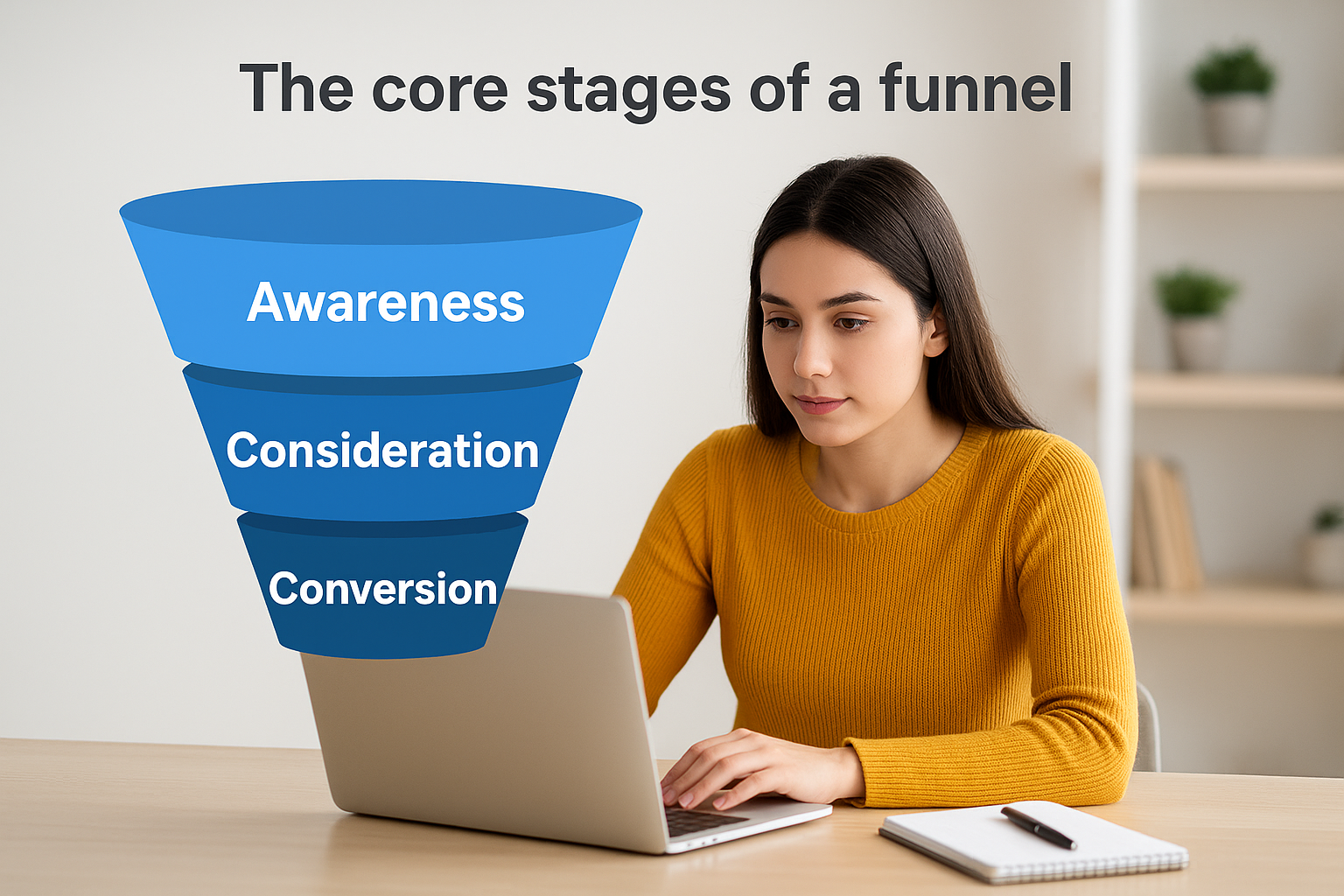
The core stages of a funnel
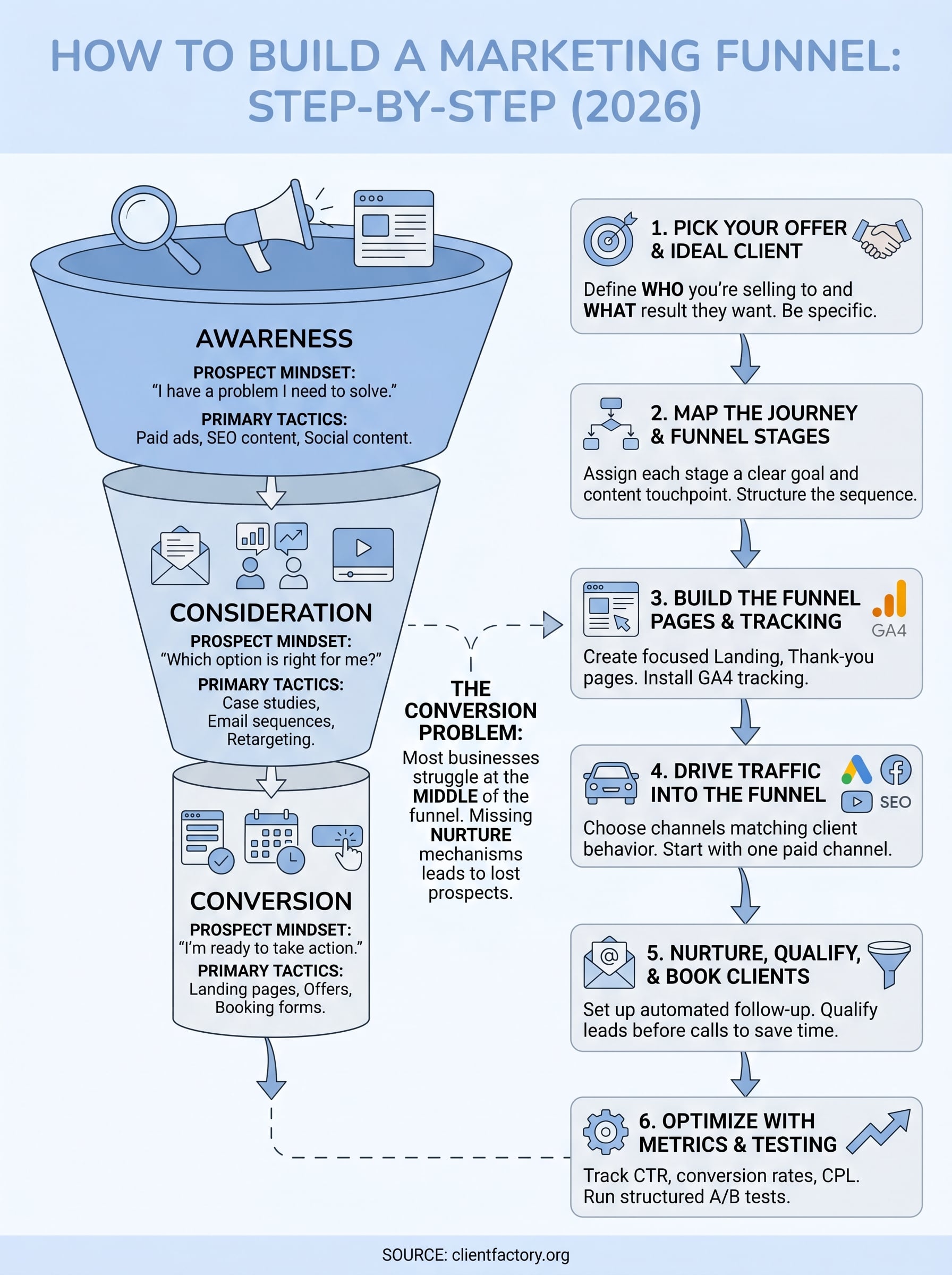
Most funnels follow three primary stages, and each one plays a distinct role in the conversion process. Awareness is where someone first discovers your business, through a Google search, a paid ad, or a piece of content. Consideration is where they evaluate whether you’re the right fit, by reading case studies, watching videos, or comparing your offer against competitors. Conversion is where they take action, book a call, fill out a form, or purchase directly. Every tactic you use in your marketing should map to one of these three stages.
Here’s a breakdown of each stage, what the prospect is thinking at that moment, and which tactics perform best:
| Funnel Stage | Prospect Mindset | Primary Tactics |
|---|---|---|
| Awareness (Top) | "I have a problem I need to solve" | Paid ads, SEO content, social content |
| Consideration (Middle) | "Which option is right for me?" | Case studies, email sequences, retargeting |
| Conversion (Bottom) | "I’m ready to take action" | Landing pages, offers, booking forms |
Where most businesses get stuck
Most businesses struggle at the middle of the funnel. They do a decent job of driving awareness through ads or content, and they have some kind of contact form or landing page at the bottom. But there’s nothing in between to educate, build trust, or handle objections. Prospects land on a page, feel unsure, and leave. Without a nurture mechanism connecting the top to the bottom, you’re depending on a cold prospect to make a high-trust decision on the first visit, and that almost never happens.
What’s different about funnels in 2026
The core stages haven’t changed, but how buyers move through them has shifted significantly. In 2026, prospects rarely follow a clean, linear path from awareness to purchase. They bounce between channels, read third-party reviews, watch comparison videos, and research on multiple devices before they ever reach out. This means your funnel can’t exist as a single page or one email sequence. It needs to be a connected system that tracks and responds to behavior across touchpoints.
Your funnel is only as strong as its weakest stage. A strong landing page won’t save you if your follow-up is slow or your offer doesn’t match what your ideal client actually wants.
AI-powered tools now play a central role in this. Automated follow-up sequences, chatbot-driven qualification, and predictive lead scoring let you respond to prospect behavior in real time. For service businesses and law firms especially, speed to response is one of the biggest conversion factors. Businesses winning in 2026 treat their funnel as a living system they measure, test, and improve continuously.
Step 1. Pick your offer and ideal client
Before you build a single page or write a single ad, you need two things locked in: what you’re selling and who you’re selling it to. Skipping this step is the most common reason funnels fail to convert. If your funnel tries to speak to everyone, it resonates with no one, and your cost per acquisition will reflect that across every stage of the process.
Define your ideal client first
Your funnel’s messaging, targeting, and structure all depend on who you’re trying to reach. The more specific you are, the better your funnel performs. Start by identifying the single type of client you can deliver the best results for, not every possible buyer in your category. A personal injury law firm targeting auto accident victims in Dallas will always outperform one vaguely targeting "anyone who needs a lawyer."
Use these questions to sharpen your ideal client profile before you touch anything else:
- Who has the most urgent problem your offer solves right now?
- What does that person search for when they’re looking for a solution?
- What objections or hesitations do they have before they commit?
- Where do they spend time online, and what content do they consume?
- What specific outcome do they want, not just the service they think they need?
Build your offer around a specific outcome
Once you know who you’re targeting, the next step is building an offer that speaks directly to the result they want. Vague offers don’t convert. Something like "digital marketing services" gives a prospect nothing to grab onto. Something like "10 qualified consultations per month for estate planning attorneys" gives them a reason to keep reading. That specificity is what gives your entire funnel a clear direction and makes every stage easier to write and test.
Your offer is the spine of your funnel. Every stage from awareness to conversion should connect back to the specific promise you’re making to your ideal client.
When learning how to build a marketing funnel, most people rush to choose channels before they’ve nailed their offer. That’s backwards. A strong offer on a simple funnel will outperform a weak offer on a technically polished one every time. Write your offer in one sentence that includes a clear deliverable, a defined audience, and a realistic timeframe before you move to the next step.
Step 2. Map the journey and funnel stages
Once your offer and ideal client are defined, you need to map out exactly how a prospect moves through your funnel from first contact to becoming a paying client. This is where you translate your offer into a structured sequence of stages, each with a clear job to do. Skipping this step is how businesses end up with a collection of disconnected pages and ads that don’t work together.
Assign each stage a clear goal
Every stage in your funnel needs one primary objective, not three. The awareness stage exists to get the right people to notice you. The consideration stage exists to build enough trust that they stay engaged. The conversion stage exists to get them to take one specific action, whether that’s booking a call or submitting a form. When you understand how to build a marketing funnel that converts, you design each stage to hand the prospect smoothly to the next one.
If each stage isn’t actively moving people forward, it’s losing them.
Use this template to define each stage before you build anything:
| Funnel Stage | Primary Goal | One Action You Want Them to Take |
|---|---|---|
| Awareness | Attract the right prospect | Click an ad or read a piece of content |
| Consideration | Build trust and handle objections | Download a resource or watch a case study |
| Conversion | Get them to commit | Book a call or submit a contact form |
Build a stage-by-stage content map
With your goals defined, you need to decide what content or touchpoint belongs at each stage. For awareness, this might be a targeted Google ad or a blog post built around a high-intent search term. For consideration, it’s typically a follow-up email sequence, a retargeting ad with social proof, or a detailed case study. For conversion, it’s a focused landing page with a single call to action and no distractions.
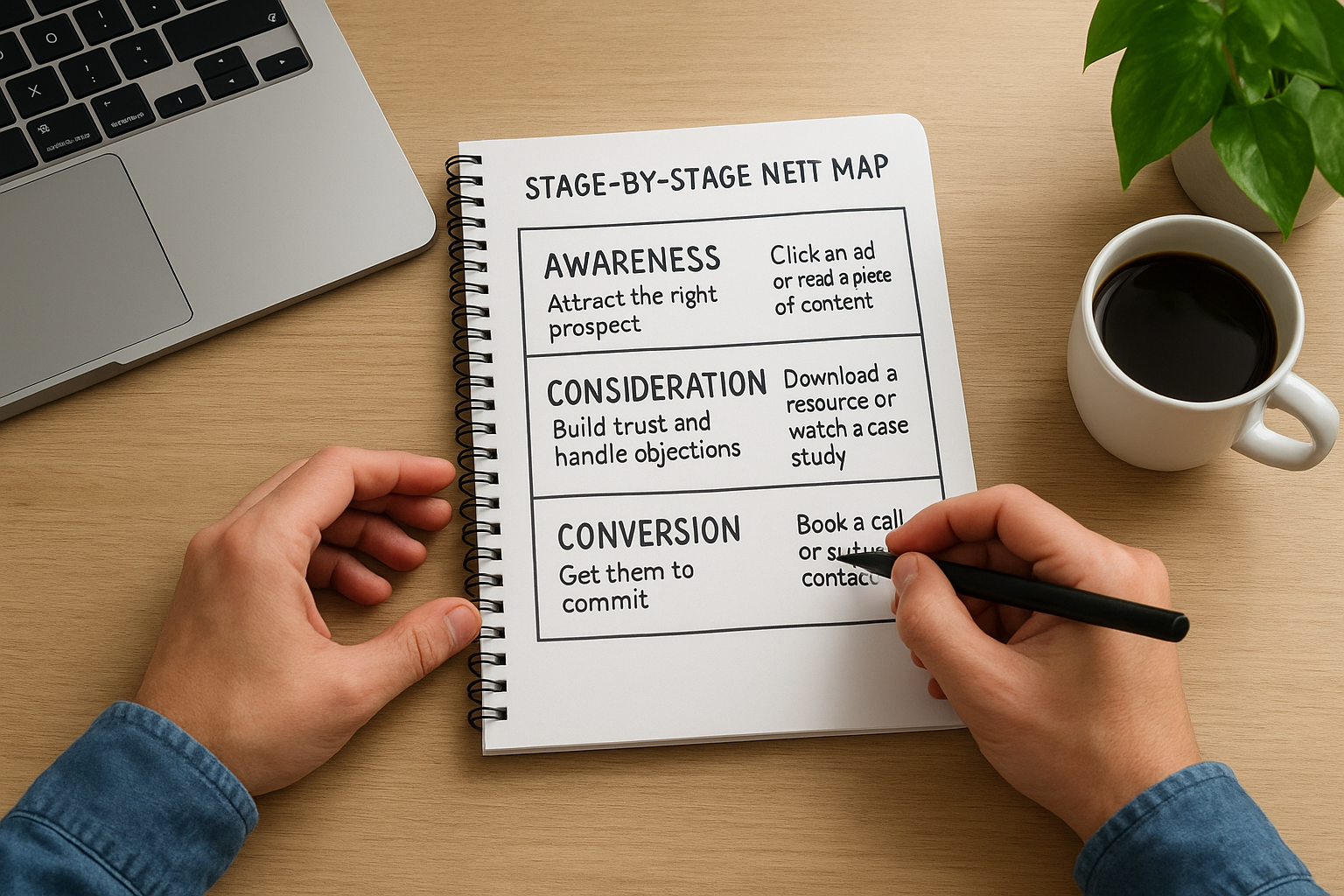
Write out each stage in a simple document and list the specific content piece, the channel it lives on, and the action you want the prospect to take next. This map becomes your blueprint for Step 3, where you build the actual pages and set up tracking. Without this map, you’re building pages without knowing what role they play in the larger system.
Step 3. Build the funnel pages and tracking
With your funnel map in hand, you’re ready to build the actual pages and connect the data infrastructure that tells you what’s working. This is where many business owners either over-engineer the build or skip tracking entirely, and both approaches cost you conversions at every stage. You need simple, purpose-built pages and clean measurement in place before a single prospect enters your funnel.
Build the core pages
Your funnel needs a minimum of three pages: a landing page as your traffic entry point, a thank-you or confirmation page after a form submission, and optionally a lead magnet delivery page if you’re offering a downloadable resource. Keep each page focused on one action only. Remove navigation menus, reduce exit points, and write every headline around the specific outcome your ideal client wants. Here’s a landing page structure that consistently works for service businesses and law firms:
- Headline: State the specific outcome ("Get 10 booked consultations per month")
- Subheadline: Address the main objection or briefly explain how it works
- Social proof: One or two short client results that include specific numbers
- Call to action: One button or form, placed above the fold and repeated at the bottom of the page
The page that receives the most traffic should also receive the most attention in your copy and design. A weak headline on a strong offer will still kill your conversion rate.
Set up tracking before you launch
Tracking is non-negotiable if you want to understand how to build a marketing funnel that improves over time. Before you send any traffic to your pages, install Google Analytics 4 and configure conversion events for every key action: form submissions, button clicks, and booking completions. Without this data, you have no way to identify which pages convert and where prospects drop off.
Connect your thank-you page URL as a destination goal in GA4 so every completed form registers as a conversion automatically. If you’re running paid ads, link your ad platform to GA4 and enable enhanced conversions to capture data that standard pixel tracking misses. Then build a simple reporting view that surfaces sessions, conversion rate, and cost per lead in one place. Those three numbers, reviewed weekly, will drive every optimization decision you make in Step 6.
Step 4. Drive traffic into the funnel
With your pages built and tracking in place, you’re ready to send real prospects into your funnel. The most common mistake at this stage is choosing traffic channels based on what’s trendy rather than where your ideal client actually spends time and makes buying decisions. Every dollar you invest in traffic should connect directly to the audience profile you defined in Step 1, or you’ll end up paying for clicks that never had any intention of converting.
Choose your channels based on where your clients already are
Before you run a single ad or publish a piece of content, match each channel to the funnel stage it serves best. Google Search Ads captures buyers with high intent who are actively searching for a solution right now. Facebook and YouTube ads work better for building awareness with cold audiences who match your ideal client profile but haven’t encountered your business yet. SEO-driven content attracts prospects over time through high-intent search queries. Use this channel map as your starting point:
| Channel | Best Funnel Stage | Ideal For |
|---|---|---|
| Google Search Ads | Conversion | High-intent buyers actively searching |
| Facebook/Instagram Ads | Awareness | Cold audiences matching your client profile |
| YouTube Ads | Awareness/Consideration | Trust-building through video |
| SEO Content | Awareness/Consideration | Long-term organic lead flow |
| Email Retargeting | Consideration | Re-engaging warm prospects |
Start with one paid channel before you expand
One of the most actionable rules in understanding how to build a marketing funnel that generates real leads is to resist splitting your budget across multiple platforms at launch. Pick one paid channel from the map above, run it until you collect at least 200 to 300 clicks, and evaluate performance before you scale or shift. For most service businesses and law firms, Google Search Ads is the right starting point because you’re meeting buyers at the exact moment they’re already searching for a solution.
Don’t drive cold traffic to a landing page you haven’t tested yet. Validate your page with a small initial spend before you commit serious budget.
Once your first channel delivers a consistent cost per lead, layer in a secondary channel like retargeting or SEO content to reinforce the funnel and bring your overall acquisition cost down over time.
Step 5. Nurture, qualify, and book clients
Getting a prospect into your funnel is only half the job. The majority of leads who opt in are not ready to buy on day one, and if you don’t have a system to stay in front of them and build trust over time, they’ll move on to a competitor who does. This step covers how to nurture, qualify, and convert those leads into booked clients without requiring you to manually chase every inquiry.
Set up an automated follow-up sequence
Your follow-up sequence is the engine that moves warm prospects from consideration to conversion. Within the first 5 minutes of a lead opting in, send an automated email that delivers on whatever you promised (a resource, a confirmation, or next steps) and introduces who you are. Then follow up over the next 7 to 10 days with a short sequence that addresses the most common objections your ideal clients have before they commit.

Here’s a simple 5-email nurture sequence template for service businesses:
- Email 1 (Day 0): Deliver the resource or confirmation + introduce your business in two sentences
- Email 2 (Day 2): Share a specific client result with numbers ("We helped a personal injury firm go from 4 to 22 booked consultations in 60 days")
- Email 3 (Day 4): Address the most common objection your prospects raise ("How long does it take to see results?")
- Email 4 (Day 6): Share a short testimonial or case study that demonstrates a real outcome
- Email 5 (Day 9): Direct ask with a clear call to action to book a call or consultation
Qualify leads before the call
Not every lead deserves a sales call, and protecting your team’s time is part of building a funnel that scales. Add a short intake form to your booking page with 3 to 5 qualifying questions that filter out poor-fit prospects before they get on your calendar. Ask about budget range, timeline, and the specific problem they need solved.
A qualified booking is worth ten times more than a filled calendar. Filtering bad-fit leads at this stage saves time and improves your close rate on every call that does happen.
Understanding how to build a marketing funnel means recognizing that the follow-up system is where most of your revenue gets made or lost. The businesses that consistently close the most clients are rarely the ones with the best ads; they’re the ones with the most relevant and timely follow-up process.
Step 6. Optimize with metrics and testing
Building the funnel is only the beginning. Optimization is where the return on investment compounds, and the businesses that consistently outperform their competitors are the ones that treat their funnel as something to improve every week, not something to set up once and leave. Understanding how to build a marketing funnel that keeps getting better requires you to measure the right numbers and make decisions based on data, not assumptions.
Track the three numbers that matter most
Every funnel produces dozens of data points, but most of them are noise. Focus on three core metrics to start: your click-through rate on traffic sources, your landing page conversion rate, and your cost per qualified lead. These three numbers tell you exactly where the funnel is healthy and where it’s leaking revenue.
| Metric | What It Tells You | Healthy Benchmark (Service Businesses) |
|---|---|---|
| Click-through rate (CTR) | Whether your ad or content grabs attention | 3-6% for Google Search Ads |
| Landing page conversion rate | Whether your page turns visitors into leads | 10-20% for warm traffic |
| Cost per qualified lead | Whether your funnel is profitable at scale | Varies by industry and offer value |
Review these three numbers every week without exception. If your CTR is strong but your conversion rate is low, the problem is on the page. If your conversion rate is strong but your cost per lead is too high, the problem is in your targeting or your bid strategy.
Run structured tests to improve each stage
Once you identify a weak stage, test one change at a time so you know exactly what moved the needle. Changing your headline, your offer, and your button text simultaneously tells you nothing useful. Pick the element most likely to affect the outcome and give it at least 200 to 300 visits before you draw any conclusions.
The fastest way to improve a funnel is to find the stage with the highest drop-off rate and fix only that before moving to the next problem.
Start your testing with the headline on your landing page, since it influences every decision a visitor makes after that point. From there, test your call-to-action copy, your social proof, and the structure of your intake form in that order. Small, consistent improvements at each stage stack up into a significantly lower cost per client over time.
Next steps
You now have a complete framework for how to build a marketing funnel that moves prospects from first contact to booked client. Every step in this guide connects to the next: your offer informs your messaging, your messaging shapes your pages, your pages feed your traffic strategy, and your metrics tell you exactly where to improve. None of these steps work in isolation, so resist the urge to implement only the pieces that feel comfortable and skip the rest.
Start with Step 1 today. Write your offer in one sentence, define your ideal client, and build from there. The businesses that see the fastest results are the ones that execute quickly and refine based on real data, not the ones that wait until everything feels perfect before launching.
If you want a second set of eyes on your current setup, book a free funnel audit and we’ll show you exactly where your funnel is leaking revenue.