
You’re spending money on clicks. The question is whether your PPC landing page design is turning those clicks into actual clients, or just burning through your ad budget. A well-designed landing page can double or triple your conversion rate without touching your ad spend. A bad one? It makes every dollar you put into Google or Facebook Ads work against you.
At Client Factory, we build and optimize landing pages for service businesses and law firms every day. We’ve seen what works, what flops, and what separates a page that converts at 2% from one that pulls 10%+. The patterns are clear once you know what to look for.
So instead of guessing, we pulled together nine real PPC landing page examples that are earning their keep right now in 2026. For each one, we’ll break down exactly why it works, the layout choices, the copy structure, the trust signals, so you can steal what’s useful and apply it to your own campaigns. Whether you’re redesigning an existing page or starting from scratch, this is your shortcut to higher-converting paid traffic.
1. Client Factory free funnel audit landing page
The Client Factory free funnel audit page is one of the clearest examples of a low-friction offer paired with a high-intent paid traffic audience. It targets business owners and law firm partners who are already spending on ads but not seeing results they can point to.
What the page is designed to convert
This page converts cold and warm PPC traffic into booked audit calls. The offer is a free, no-obligation review of your current client acquisition funnel. That low-commitment entry point makes it easy for hesitant visitors to say yes without feeling like they’re walking into a sales pitch.
Layout and above-the-fold structure
The above-the-fold section leads with a benefit-driven headline that speaks directly to the pain point: ad spend that isn’t producing clients. The layout stays clean, with a single column on mobile and a two-column split on desktop, pairing the core value proposition with a short intake form. Nothing on the page competes with that primary message, which keeps the visitor’s attention exactly where it needs to be.
CTA, form, and friction reducers
The call-to-action button uses action-specific language rather than a generic "Submit" or "Contact Us." The form collects only the minimum information needed to qualify the lead, which keeps friction low. A short reassurance line directly below the button addresses the most common objection: that the audit is free with no obligation attached.
Cutting your form down to only the essential fields can lift conversions by 20% or more on a paid traffic page.
Trust elements that fit service businesses and law firms
Below the fold, the page reinforces credibility with specific client outcomes rather than vague praise. For law firms and service businesses, that specificity matters. Visitors want to see that the agency has worked with businesses like theirs and produced numbers they can verify, not just polished quotes.
What to copy for your own campaigns
The most transferable element of this ppc landing page design is how the offer gets framed. Positioning the conversion as a free diagnostic rather than a sales call removes the psychological barrier that kills most paid traffic pages. Combine that with a short form, a direct CTA, and outcome-specific social proof, and you have a replicable structure that works across nearly every service-based industry.
2. Mailchimp landing pages product-led PPC page
Mailchimp runs PPC campaigns that send visitors to product-specific landing pages built around a single feature. These pages sit at the intersection of education and conversion, giving visitors just enough context to act without burying them in information they don’t need yet.
What the page is designed to convert
This page targets small business owners and marketing teams searching for email marketing tools. The goal is a free account signup, and every element on the page pushes toward that single action without branching into other offers or distractions.
Layout and above-the-fold structure
The page leads with a clean, feature-specific headline followed by a short subheading that spells out the benefit. Mailchimp uses a minimal layout with generous white space, so the visitor’s eye goes straight to the signup form without competing elements pulling attention away.
CTA, form, and friction reducers
Your CTA button sits above the fold and uses first-person language that reinforces a sense of ownership. The form asks for an email address only, which dramatically reduces the friction between initial interest and completed signup.
Reducing your form to a single field can increase submission rates by 50% or more on a cold traffic page.
Trust elements that fit service businesses and law firms
Mailchimp places customer counts and recognizable brand logos near the form to reinforce credibility fast. For service businesses, this principle translates directly: a specific number tied to real results carries more weight than a polished but vague testimonial.
What to copy for your own campaigns
The most useful principle in this ppc landing page design is matching the page to the exact feature your ad promised. Lead with that specific benefit, strip out anything unrelated, and let the stripped-down offer do the heavy lifting.
3. Uber request-a-ride action-first page
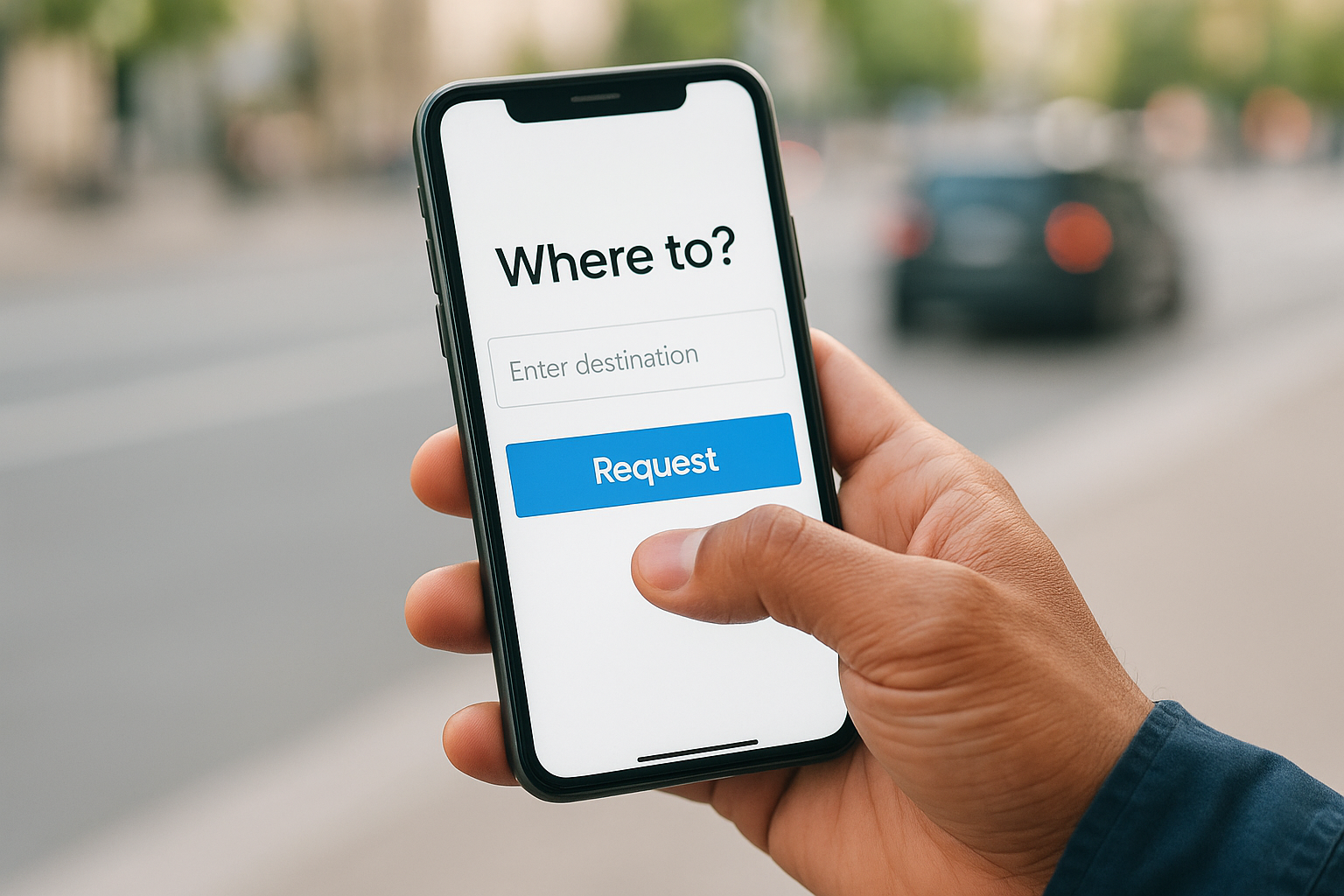
Uber’s PPC landing pages are built around a single, immediate action: entering a destination and requesting a ride. There’s no storytelling, no feature list, and no lengthy explanation. The page assumes the visitor already knows what Uber does and focuses entirely on getting them to act.
What the page is designed to convert
This page converts paid traffic from location-based and intent-driven searches into app downloads or ride requests. The target visitor is someone ready to move right now, and the page matches that urgency by putting the action front and center without any warm-up content.
Layout and above-the-fold structure
Uber strips the layout down to its bare minimum. The above-the-fold section contains only the input field, a headline, and a CTA button. Nothing below the fold competes for attention before the visitor has made their first move. That discipline is what makes the page work.
CTA, form, and friction reducers
The input field functions as both the form and the CTA in one step. Visitors type their destination, which signals intent and begins the conversion process simultaneously. That design choice removes the psychological gap between deciding to act and actually acting.
When your form and your CTA are the same element, you cut the number of decisions your visitor has to make in half.
Trust elements that fit service businesses and law firms
Uber relies on brand recognition rather than explicit social proof on this page. For service businesses without that recognition, you need to replace it with specific outcome data or verifiable client counts placed close to the action field.
What to copy for your own campaigns
The core principle in this ppc landing page design is leading with the action instead of the explanation. If your visitor arrives with high intent, put the form or booking step first and let the supporting content do cleanup below the fold.
4. Aura guided meditation signup page
Aura’s PPC landing pages target high-intent searchers looking for guided meditation or stress relief apps. The page converts paid mobile and desktop traffic into free trial signups by using a calm, visually simple design that mirrors the product experience before the visitor even downloads anything.
What the page is designed to convert
This page converts cold paid traffic from mental wellness searches into free trial registrations. Aura leads with a personalization quiz prompt that makes the signup feel less like a transaction and more like a tailored recommendation.
Layout and above-the-fold structure
The above-the-fold section pairs a benefit-driven headline with a soft color palette that signals calm immediately. The layout uses a single centered column with no sidebars or competing links, keeping the visitor’s focus locked on the one action available.
CTA, form, and friction reducers
Aura replaces a standard form with a short quiz flow, which lowers perceived commitment significantly. Each step collects one piece of information, so the visitor never faces a long form all at once.
Breaking a multi-field form into a step-by-step flow can increase completion rates by 30% or more on a paid traffic page.
Trust elements that fit service businesses and law firms
Service businesses can learn from how Aura places star ratings and user review counts directly near the CTA to reinforce credibility fast. Apply the same principle by placing a specific client result or verified review count right next to your intake form.
What to copy for your own campaigns
The most transferable element of this ppc landing page design is the quiz-style intake flow. If your service business asks several qualifying questions before booking a consultation, structuring those as a step-by-step sequence dramatically reduces the friction that kills most paid traffic pages.
5. Enhancv template preview and signup page
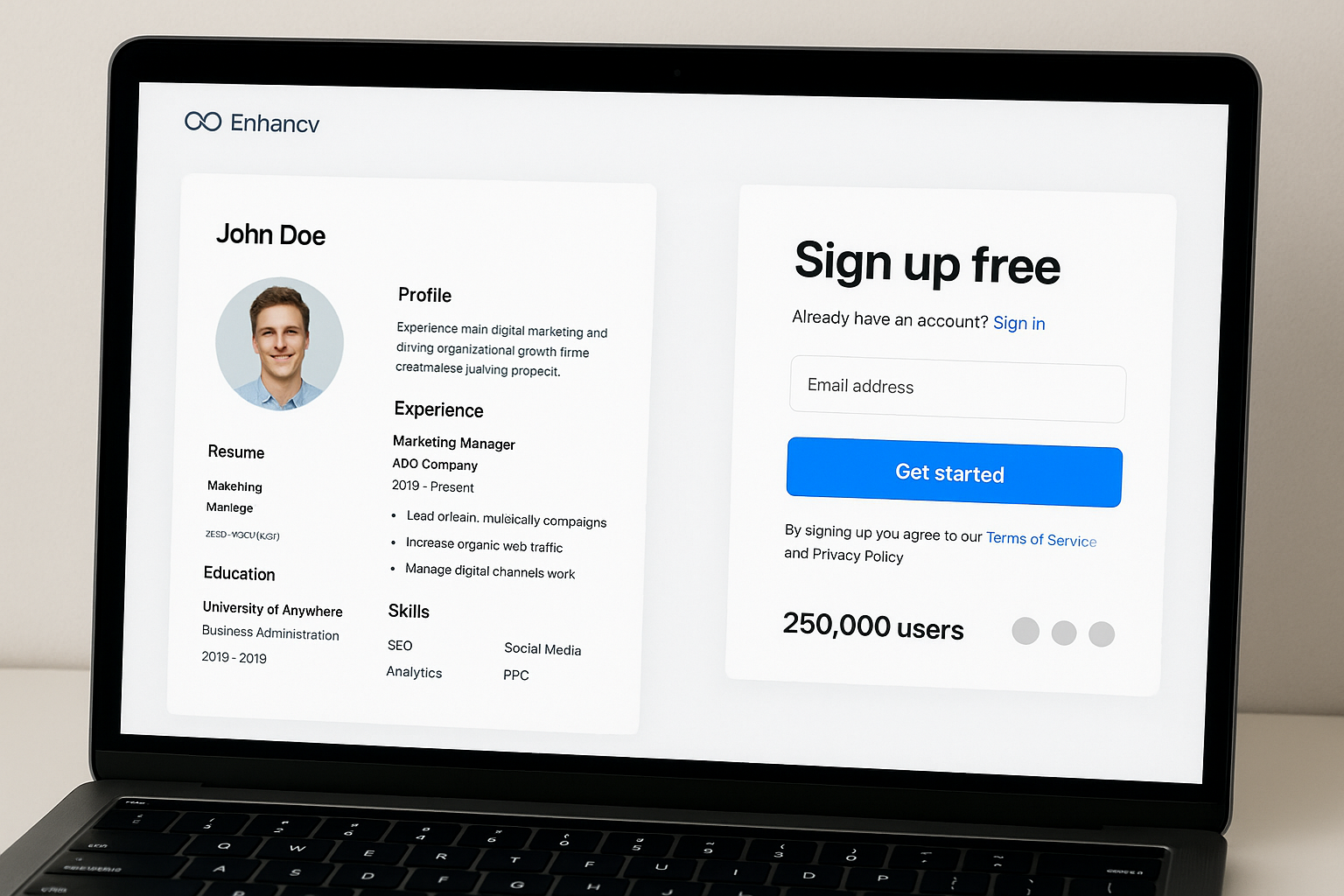
Enhancv runs PPC campaigns that drop visitors directly into a live resume template preview, letting them interact with the product before they ever create an account. That sample-first approach is a masterclass in reducing signup hesitation.
What the page is designed to convert
This page converts paid search traffic from job seekers into free account registrations. The strategy is to let the visitor experience the product value immediately so the signup feels like a natural next step rather than a gamble.
Layout and above-the-fold structure
The above-the-fold section fills the screen with a live, editable template preview alongside a minimal signup panel. The layout makes the product the hero, so the visitor understands exactly what they’re getting before they commit a single piece of information.
CTA, form, and friction reducers
The CTA button appears at the exact moment a visitor tries to save or export their preview. That timing-based trigger converts action into intent in a way that a static form never could. The form itself asks only for an email address, keeping the path to completion as short as possible.
Letting visitors interact with your product before asking for their information shifts the psychological frame from "sign up" to "save your progress."
Trust elements that fit service businesses and law firms
Enhancv places user count data and recognizable publication logos near the signup panel. Service businesses can replicate this directly by placing a specific client result or named case study right next to the intake form.
What to copy for your own campaigns
The most transferable principle in this ppc landing page design is the preview-first structure. If your service offers a free audit, assessment, or consultation, give visitors a taste of the output before you ask for their contact details.
6. Snappr fast booking PPC page
Snappr runs paid campaigns targeting businesses and professionals who need photography services booked fast. The page is built around speed and simplicity, making it a strong example of a service booking ppc landing page design that converts high-intent paid traffic efficiently.
What the page is designed to convert
This page converts paid search visitors into confirmed photography bookings. Snappr targets people who already know they need a photographer and want the fastest path from search to a scheduled shoot. The page removes every possible detour between that intent and the booking confirmation.
Layout and above-the-fold structure
Snappr leads above the fold with a location and service input field, so visitors can start the booking process immediately without scrolling. The layout pairs those inputs with a concise value statement that confirms the service and sets clear expectations on pricing and turnaround time.
CTA, form, and friction reducers
The CTA button activates immediately after the visitor selects their service type and location, tying the action directly to their input rather than sitting as a static button they have to find. That design makes the conversion feel like a natural next step rather than a separate decision.
When your CTA responds to visitor input rather than sitting passively on the page, you close the gap between interest and action significantly.
Trust elements that fit service businesses and law firms
Snappr places verified review counts and photographer portfolio thumbnails near the booking form to reduce hesitation. Service businesses can apply the same principle by positioning specific client outcomes or a named case study directly beside their intake form.
What to copy for your own campaigns
The strongest element in Snappr’s approach is tying the CTA trigger to the visitor’s own input. If your service includes a quote calculator, a scheduling tool, or a service selector, treat that interaction itself as the conversion moment rather than relying on a separate static button downstream.
7. Service Today emergency service booking page
Service Today runs paid campaigns targeting homeowners facing urgent repair needs, including HVAC failures, plumbing emergencies, and electrical problems. Their landing page is purpose-built to capture visitors who are under pressure and need to book fast, reliable service without wading through multiple pages or long decision flows.
What the page is designed to convert
This page converts high-intent paid search traffic into booked same-day or next-day service appointments. Visitors arriving from emergency-related search terms are already committed to solving a problem right now, and the page matches that urgency without adding unnecessary friction.
Layout and above-the-fold structure
The above-the-fold section leads with a headline that confirms availability and speed, so visitors know immediately they’ve landed in the right place. A phone number and booking button sit prominently at the top, giving visitors two fast paths to conversion without forcing them to scroll first.
CTA, form, and friction reducers
Service Today uses a click-to-call button as the primary CTA, which is the right call for emergency-intent traffic. Phone conversions close faster than form submissions when urgency is the driver, and placing that button above the fold eliminates every unnecessary step between the search and the call.
For emergency service searches, a click-to-call CTA consistently outperforms a standard form submission as the primary conversion path.
Trust elements that fit service businesses and law firms
The page places license numbers, response time guarantees, and verified review scores near the booking options. That combination directly addresses the two fears driving hesitation: quality and speed.
What to copy for your own campaigns
The most replicable element of this ppc landing page design is treating the phone number as a primary CTA rather than a footer detail. If your service business handles urgent requests, make that call action impossible to miss above the fold.
8. MonkeyLearn demo request and explainer page
MonkeyLearn runs PPC campaigns targeting technical buyers and business decision-makers searching for text analysis and machine learning tools. Their landing page pairs product education with a clear demo request path, making it one of the stronger examples of a considered-purchase ppc landing page design built for longer sales cycles.
What the page is designed to convert
This page converts paid search traffic into booked product demos. MonkeyLearn targets buyers who need to see the tool in action before they commit, so the page blends just enough explanation with a frictionless demo request to move that audience forward without overwhelming them.
Layout and above-the-fold structure
The above-the-fold section leads with a specific capability headline and a short product description that tells visitors exactly what they get. MonkeyLearn keeps the layout clean and two-column, pairing the explainer content on one side with the demo request form on the other, so both can be seen simultaneously without scrolling.
CTA, form, and friction reducers
The demo request form asks for only a name, email address, and company size, keeping the barrier to entry low for a considered purchase. The CTA button copy focuses on what the visitor receives rather than what they’re submitting.
Framing your CTA around the value the visitor gets rather than the action they take consistently lifts conversion rates on demo request pages.
Trust elements that fit service businesses and law firms
MonkeyLearn places recognizable client logos and specific use-case examples near the form. Your service business can apply this directly by positioning a named client result beside your intake form.
What to copy for your own campaigns
The most transferable principle here is the side-by-side layout that keeps the form visible while the visitor reads the explanation. If your service requires some education before a prospect books, that dual-column structure lets you deliver both without forcing a choice between content and conversion.
9. Law firm click-to-call consultation page
Law firm PPC landing pages built around a click-to-call CTA represent one of the most direct conversion models in paid search. When someone searches for a personal injury attorney or a criminal defense lawyer, they are rarely browsing. They are ready to speak with someone right now, and the page needs to make that call happen without adding a single unnecessary step.
What the page is designed to convert
This page converts high-intent paid search traffic from legal queries into booked phone consultations. The visitor has a specific legal problem and is actively seeking representation, which means every element on the page should accelerate the path to a phone call rather than slow it down.
Layout and above-the-fold structure
The above-the-fold section leads with a practice-area-specific headline that mirrors the search term exactly. A large, tappable phone number sits directly below that headline, giving mobile visitors a one-tap conversion path without requiring any scrolling.
CTA, form, and friction reducers
The primary CTA is a click-to-call button that dominates the above-the-fold area. A short secondary form captures leads from visitors who prefer not to call immediately, giving your campaign two conversion paths without cluttering the layout.
Running a click-to-call button alongside a short backup form consistently increases total lead volume for law firm paid search campaigns.
Trust elements that fit service businesses and law firms
The page places bar admission credentials, named case results, and verified review scores near both conversion paths, directly addressing the credibility questions a prospective client carries before picking up the phone.
What to copy for your own campaigns
The strongest principle in this ppc landing page design is treating your phone number as the hero element rather than a contact detail buried in the header. Make it large, make it tappable, and position it exactly where the visitor’s eye lands first.
Next Steps
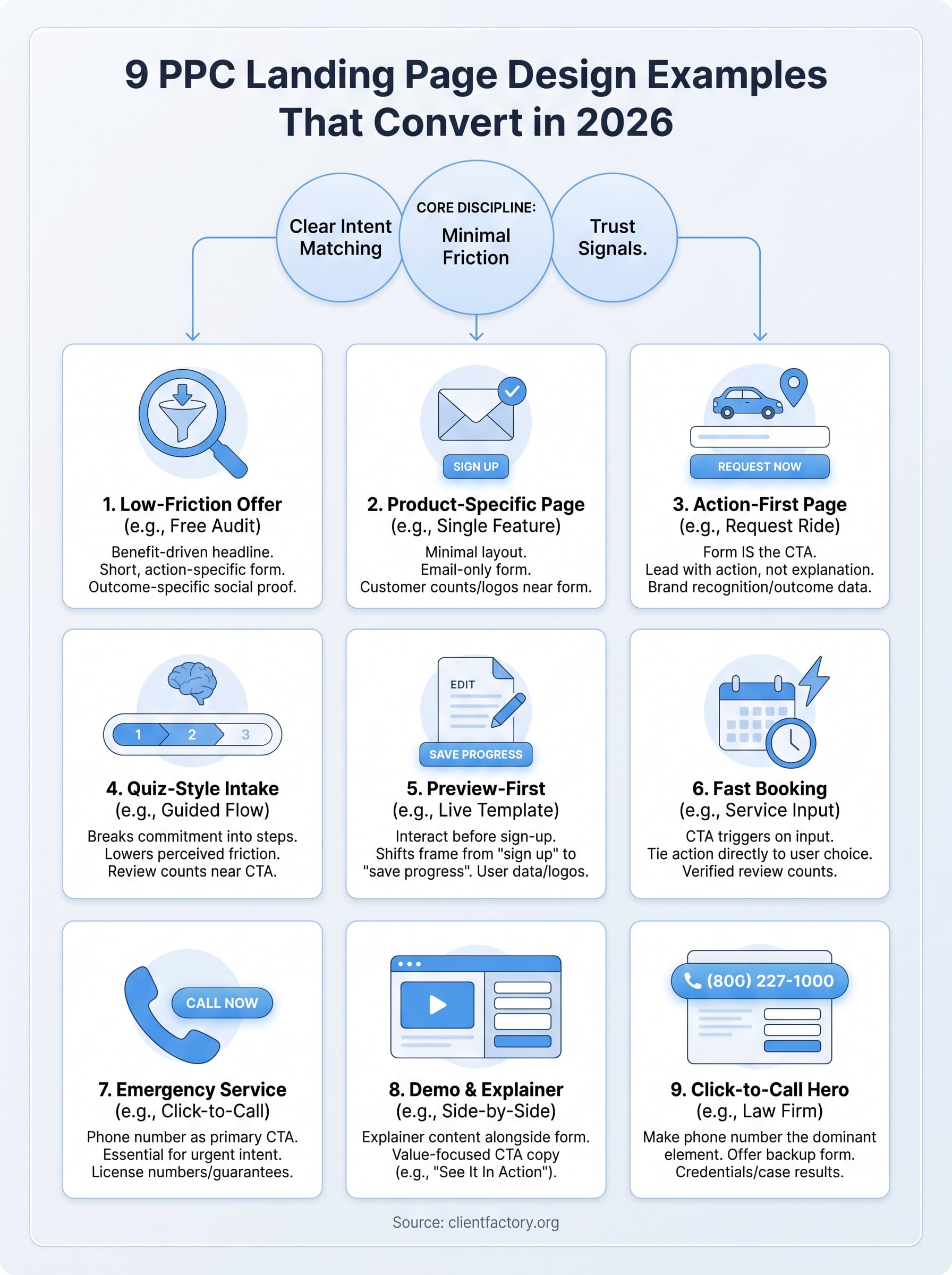
Every example in this list shares the same core discipline: clear intent matching, minimal friction, and trust signals placed exactly where the visitor needs them. That combination is what separates a ppc landing page design that earns its ad spend from one that quietly drains it. You now have nine real patterns you can study, adapt, and apply to your own paid campaigns.
Knowing what good looks like is a strong start. Knowing what’s actually broken on your current funnel is where the real gains come from. Your page might have one structural issue costing you half your conversions, and that fix takes far less time than rebuilding from scratch.
If you want a direct look at what’s holding your paid traffic back, book a free funnel audit with Client Factory and we will walk through your current setup and show you exactly where to focus first.