
Most B2B marketing teams generate plenty of activity at the top of the funnel, clicks, impressions, maybe even a spike in leads, but struggle to connect that activity to actual revenue. The disconnect usually isn’t a traffic problem. It’s a strategy problem. Without a full funnel demand generation framework, you end up with campaigns that create awareness nobody acts on, or bottom-funnel pushes that burn budget chasing people who aren’t ready to buy.
The fix isn’t more content or a bigger ad spend. It’s building a system where every stage of the buyer’s journey, from first touch to signed contract, works together. That means aligning your messaging, channels, and conversion points so prospects move forward with intent, not just interest. When you get this right, lead quality goes up, sales cycles shorten, and your marketing spend starts producing predictable, measurable returns.
At Client Factory, we build these systems for service businesses and law firms every day. Our demand generation strategies are designed to turn clicks into clients, not just fill a pipeline with names that go nowhere. This guide breaks down the exact framework we use, step by step, so you can map out a full funnel approach that drives real growth. Whether you’re starting from scratch or fixing a funnel that leaks, you’ll walk away with a clear, actionable plan you can put to work immediately.
What full funnel demand generation means
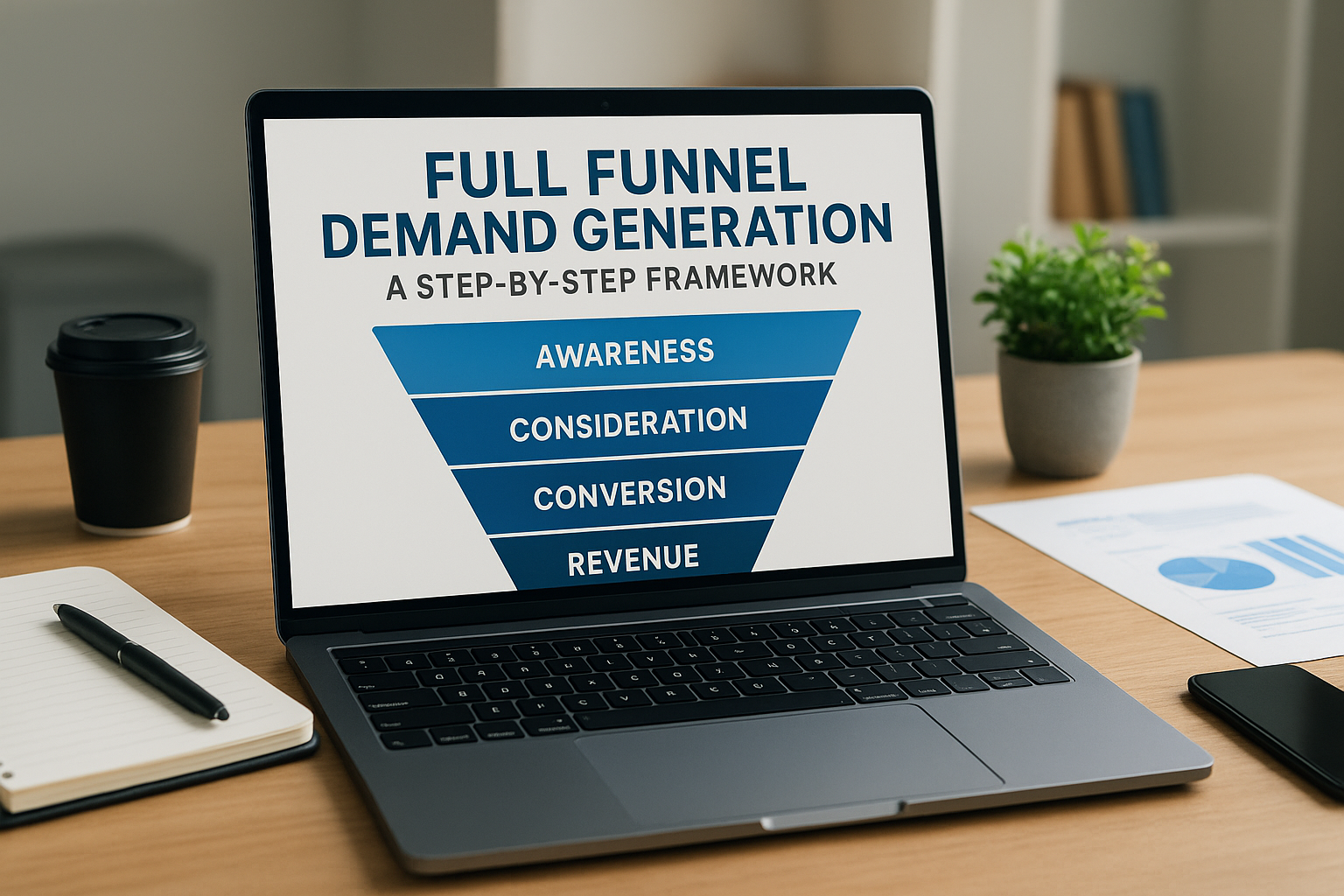
Full funnel demand generation is the practice of running coordinated marketing across every stage of the buyer journey, from the moment someone first encounters your brand to the moment they become a paying client. Most teams treat demand generation as a top-of-funnel activity, running ads or publishing content to build awareness, and then hoping prospects find their way to a sales conversation. That approach leaves massive gaps. A full funnel strategy closes those gaps by treating awareness, consideration, and conversion as one connected system rather than three separate efforts with three separate budgets.
Notice the word "demand." You’re not just capturing people who are already searching for your solution. You’re actively building the desire for it. That means educating buyers who don’t yet know they have a problem, warming up prospects who are weighing their options, and converting those who are ready to act. Each stage requires different messaging, different channels, and different success metrics, which is why a disconnected approach consistently underperforms.
A full funnel demand generation approach treats every stage of the buyer journey as part of one connected revenue system, not a set of isolated campaigns running in parallel.
How the funnel breaks down
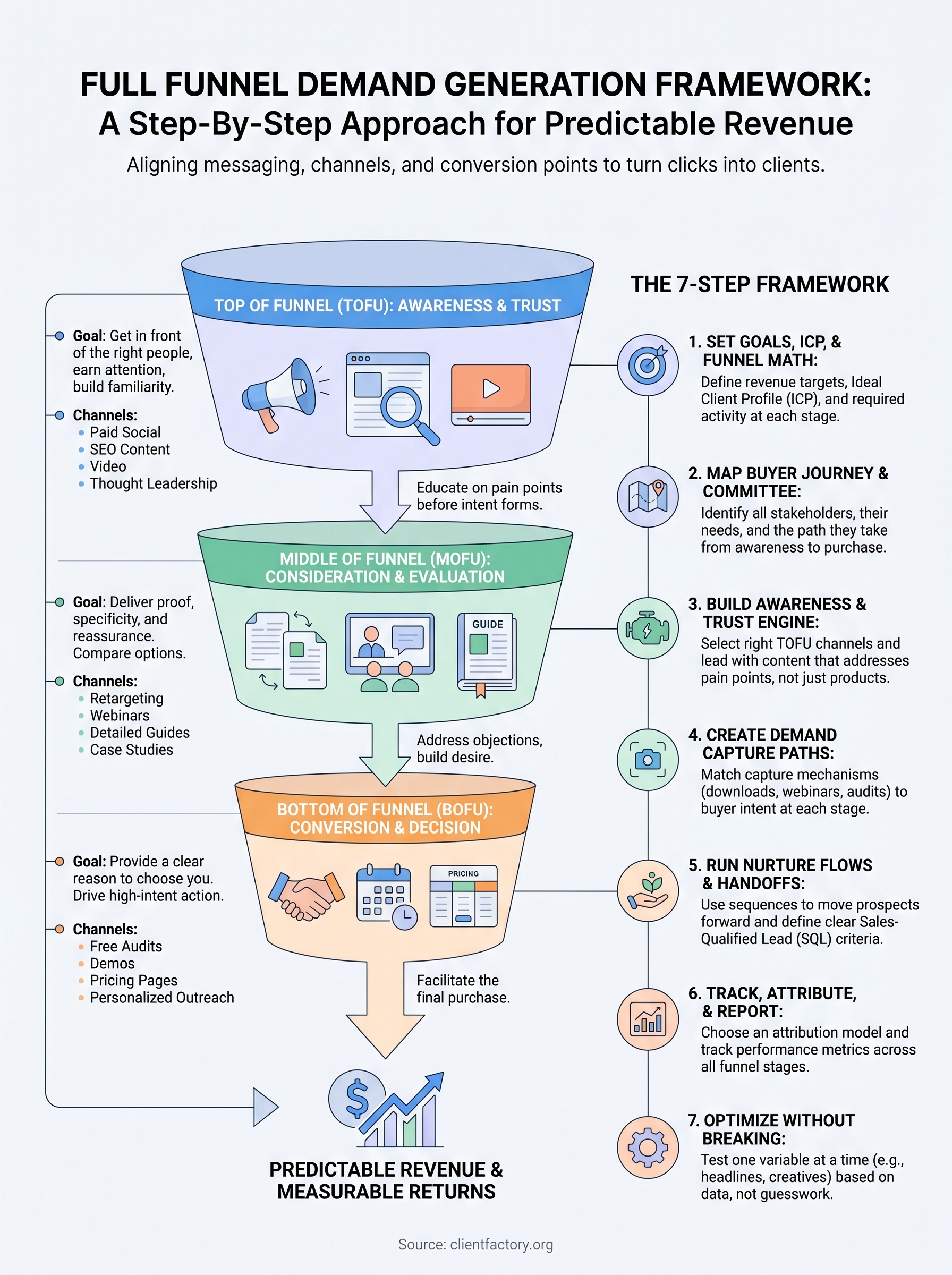
The funnel has three core zones, and each one has a distinct job to do for your business.
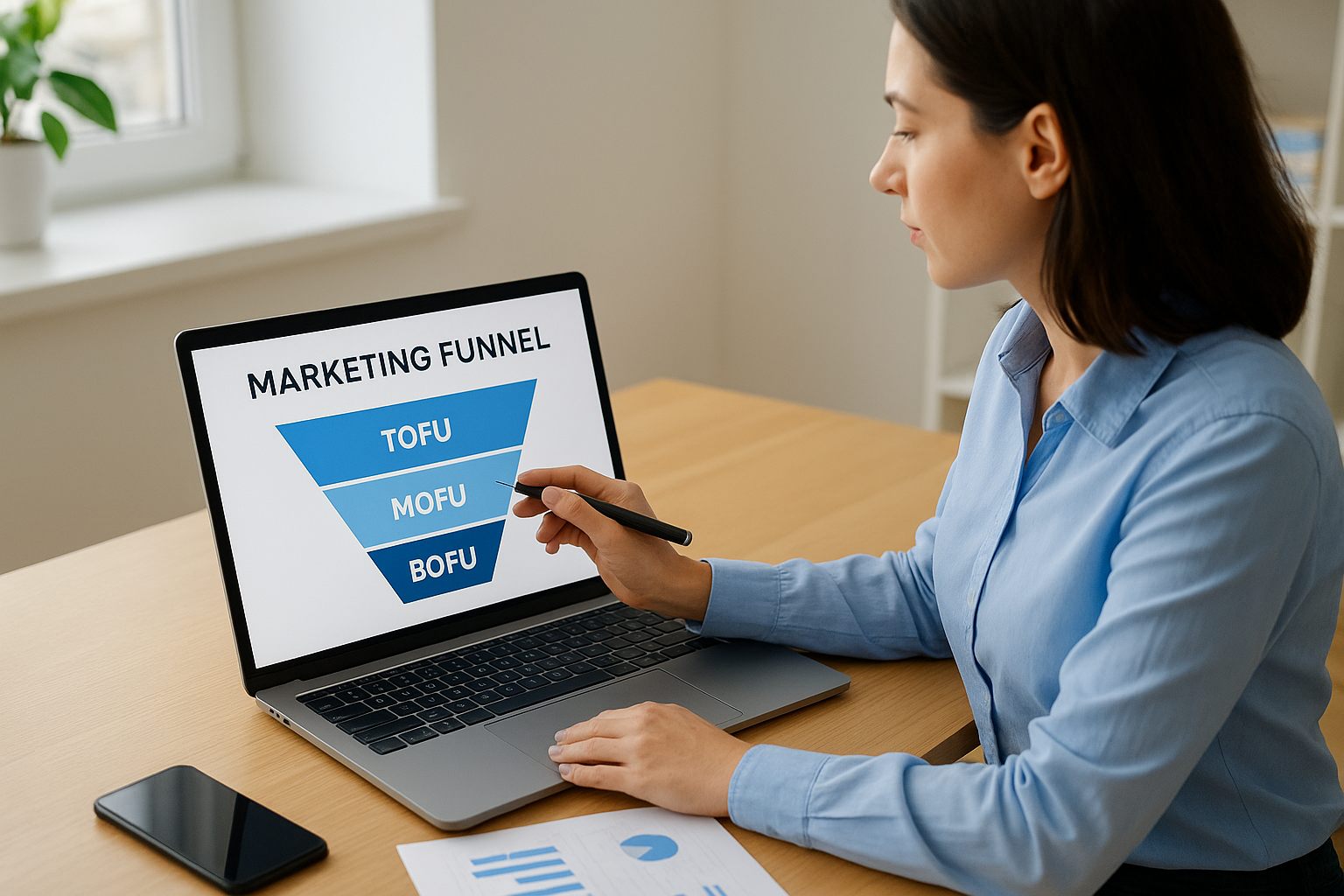
Top of funnel (TOFU) is where you build awareness and start earning trust. Your goal here isn’t to sell. It’s to get in front of the right people and give them something valuable enough that they remember you when the need arises. Paid social, SEO-driven content, video, and thought leadership all belong at this stage because they reach buyers before intent has formed.
Middle of funnel (MOFU) is where buyers evaluate whether your solution fits their specific situation. They’re comparing options, reading case studies, and looking for evidence that you can solve their problem. Your job at this stage is to deliver proof, specificity, and reassurance through retargeting campaigns, webinars, detailed guides, and direct comparisons that move prospects closer to a decision.
Bottom of funnel (BOFU) is where intent is high and the decision is close. Prospects here need a clear reason to choose you over the alternative. Conversion-focused assets like free audits, demos, pricing pages, and personalized outreach from your sales team belong at this stage because they meet high-intent buyers exactly where they are.
Why demand generation is not the same as lead generation
Lead generation focuses on collecting contact information. Demand generation focuses on building the conditions that make someone want to convert in the first place. If you only run lead generation, you end up with lists of names who barely remember filling out your form. Running demand generation without any capture mechanisms means you build awareness that never turns into revenue.
Effective programs do both. They use demand generation tactics to create genuine interest across every funnel stage, and they use lead capture and nurture systems to move that interest toward a sales conversation. That combination is what separates a real full funnel strategy from a collection of disconnected tactics that look busy but produce unpredictable results.
Step 1. Set your goals, ICP, and funnel math
Before you build a single campaign, you need three things locked in: a clear revenue target, a precise ideal client profile (ICP), and the funnel math that connects both. Without this foundation, your full funnel demand generation program runs on guesswork. You’ll attract the wrong people, optimize for the wrong metrics, and wonder why leads never convert.
Define your ideal client profile
Your ICP is the specific type of buyer your program is built around. Not "small businesses" or "law firms," but a tight profile that includes company size, industry, decision-maker role, budget range, and the specific trigger that makes them ready to buy. The sharper your ICP, the more precisely you can target, message, and convert at every funnel stage.
The tighter your ICP definition, the less budget you waste reaching people who were never going to buy.
Use this template to document yours:
| ICP Attribute | Your Answer |
|---|---|
| Industry | e.g., Personal injury law |
| Company size | e.g., 5–25 employees |
| Decision-maker title | e.g., Managing partner |
| Annual revenue | e.g., $1M–$5M |
| Primary pain point | e.g., Low qualified lead volume |
| Buying trigger | e.g., Just ran a failed ad campaign |
Run the funnel math
Once you have your ICP and revenue goal defined, work backwards through your funnel to figure out how much activity you need at each stage. This process turns abstract targets into concrete input numbers you can actually plan campaigns around.
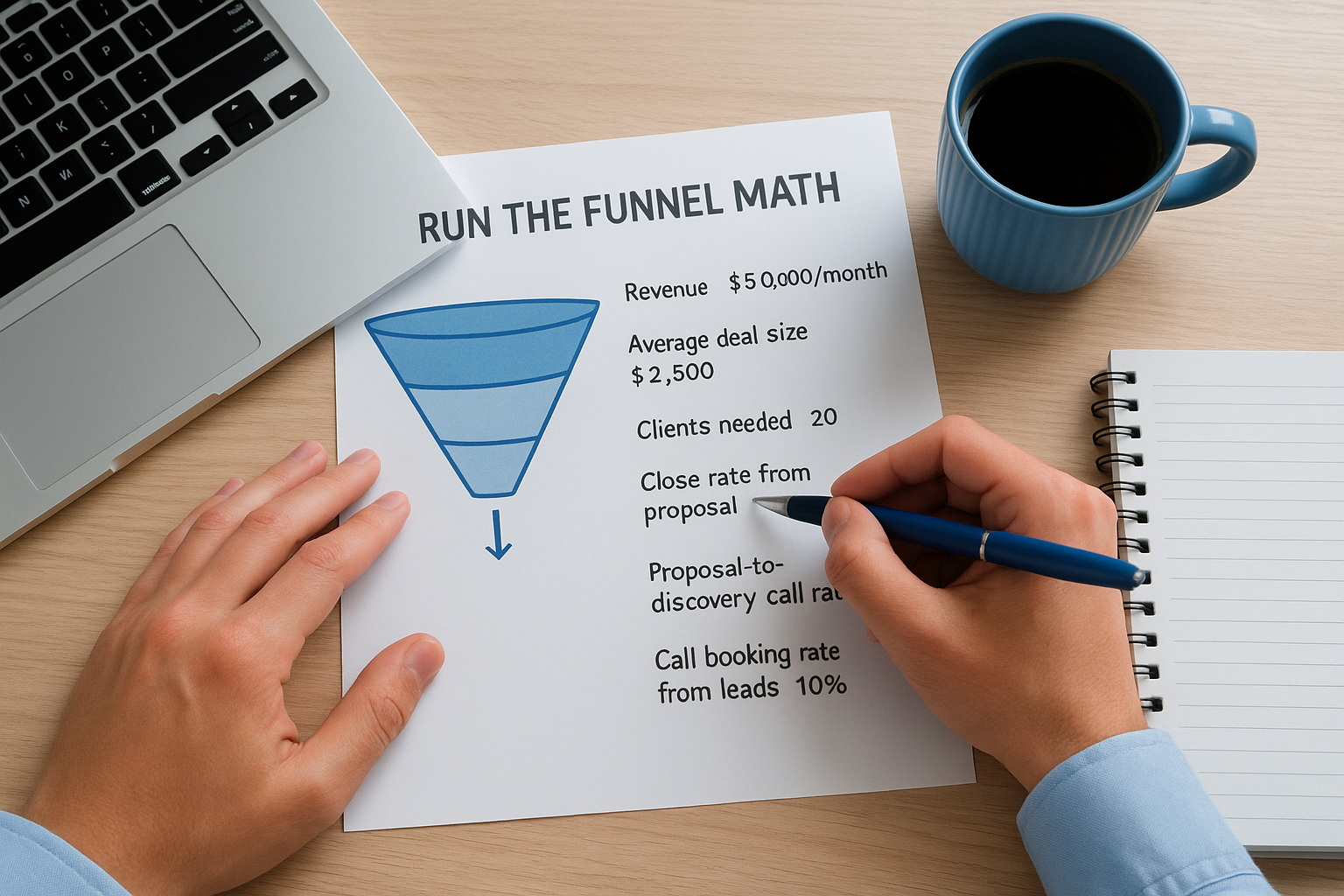
Here is a simple example:
- Revenue goal: $50,000/month
- Average deal size: $2,500
- Clients needed: 20
- Close rate from proposal: 40%, so you need 50 proposals
- Proposal-to-discovery call rate: 50%, so you need 100 discovery calls
- Call booking rate from leads: 10%, so you need 1,000 leads per month
Now you know exactly how many leads your campaigns must produce each month. That number tells you whether your current channel mix and budget are even capable of hitting your target before you spend a single dollar.
Step 2. Map the buyer journey and buying committee
Most full funnel demand generation programs fail at this step because they assume one person makes the buying decision. In B2B, that’s rarely true. Before you build any campaigns, you need a clear map of who is involved in the decision and what each person needs to move forward. Skipping this step means you’ll create content that resonates with one stakeholder while ignoring the three others who can stall or kill the deal.
Identify every stakeholder in the decision
Start by listing every role that touches the purchase decision for your ICP. Each stakeholder has different motivations, different objections, and different information needs. Your messaging and content must speak to all of them at the right funnel stage.
The person who fills out your form and the person who signs the contract are often two completely different people, and your funnel needs to serve both.
Use this template to map your buying committee:
| Stakeholder Role | Primary Goal | Main Concern | Key Content Type |
|---|---|---|---|
| Champion (e.g., Marketing Manager) | Prove internal ROI | Will this work? | Case studies, how-to guides |
| Economic Buyer (e.g., CEO or Partner) | Protect budget | Is this worth the spend? | ROI calculators, outcome data |
| Gatekeeper (e.g., Office Manager) | Reduce friction | Is this vendor reliable? | Reviews, testimonials |
| End User (e.g., Sales Team) | Simplify their work | Is this easy to use? | Demos, walkthroughs |
Trace the path each stakeholder takes
Once you know who is in the room, trace the actual steps each person takes from first awareness to final approval. Map out where they spend time online, what questions they ask at each stage, and where they typically get stuck. This gives you a realistic picture of where your funnel has gaps and what content or touchpoints you need to fill them.
Document each stage with a simple journey map: the trigger that starts the search, the channels they use to research, the objections they raise during evaluation, and the final push that closes the deal. This becomes your content and campaign brief for every stage you build in the steps ahead.
Step 3. Build your awareness and trust engine
Awareness is where your full funnel demand generation system makes its first impression, and first impressions determine whether a prospect ever reaches the middle or bottom of your funnel. Your goal at this stage is not to generate immediate leads. Your goal is to reach your ICP consistently and give them enough value that they start associating your brand with the answer to their problem.
Choose the right TOFU channels for your ICP
Not every channel belongs in your awareness mix. The right choice depends on where your ICP spends their time and what format they engage with most. A managing partner at a law firm responds differently than a marketing manager at a mid-size agency. Pick two or three channels you can execute well rather than spreading budget thin across six.
Owning two channels with consistent, high-quality content beats a scattered presence across five channels you can’t properly maintain.
Use this channel selection guide based on ICP type:
| ICP Type | Recommended TOFU Channels | Content Format |
|---|---|---|
| Law firm decision-makers | Google Search, LinkedIn, YouTube | Long-form SEO, short video, thought leadership |
| Service business owners | Facebook/Instagram, Google Search | Educational video, how-to guides, paid social |
| B2B marketing managers | LinkedIn, industry newsletters, podcast ads | Data-driven posts, case study previews, audio |
Lead with content that earns attention
Content at the top of the funnel should address the problems your ICP faces before they know your solution exists. That means writing about pain points, not products. A personal injury firm doesn’t want to read about ad platforms. They want to understand why their phone stops ringing after a competitor enters the market. When you speak to that specific frustration, you earn attention and credibility at the same time.
Pair your organic content with paid promotion to accelerate reach. Take your best-performing organic posts or articles and put budget behind them on the channels where your ICP is active. This shortens the time it takes to build brand familiarity and ensures your message reaches cold audiences who would never find you through search alone.
Step 4. Create demand capture paths that convert
Awareness and trust mean nothing if your funnel has no clear path for capturing demand. This is where most full funnel demand generation programs leave money on the table. You’ve spent budget getting the right people to pay attention, and then you send them to a generic homepage with no obvious next step. Your capture mechanisms need to match the intent level of the prospect and make the conversion as easy as possible.
The best capture path is the one your ICP would complete without hesitation, not the one that looks impressive on a slide deck.
Match your capture mechanism to buyer intent
Not every prospect is ready to book a call. Your capture options should reflect where in the funnel they are and what level of commitment feels reasonable to them at that moment. Offering a free audit to someone who just watched a 30-second awareness video is too aggressive. Offering a content download to someone who has visited your pricing page three times is a missed opportunity.

Use this framework to align your capture mechanism to intent level:
| Funnel Stage | Intent Level | Capture Mechanism |
|---|---|---|
| Top of funnel | Low | Content download, newsletter opt-in, quiz |
| Middle of funnel | Medium | Webinar registration, case study access, email course |
| Bottom of funnel | High | Free audit, strategy call, demo request |
Build landing pages that remove friction
Each capture mechanism needs a dedicated landing page built around one single action. Remove navigation links, competing offers, and anything else that pulls attention away from the conversion goal. Your page should answer three questions immediately: what you get, who it’s for, and what happens next. If a visitor has to scroll to figure out any of those answers, your conversion rate will show it.
Keep your form short. For high-intent offers like a free audit, first name, email, and one qualifying question is enough to start the conversation. You can gather more information during the call. Longer forms reduce completions without meaningfully improving lead quality at this stage.
Step 5. Run nurture flows and sales handoffs
Most full funnel demand generation programs treat lead capture as the finish line. It isn’t. The majority of leads who enter your funnel aren’t ready to buy on the day they convert. Without a structured nurture sequence, those leads go cold while your sales team focuses on the small percentage that raised their hand immediately. A well-built nurture flow keeps your brand relevant across the weeks or months it takes a prospect to make a final decision.
Build a nurture sequence that moves prospects forward
Your nurture flow should map directly to the funnel stages you defined in Step 2. Early-stage leads need educational content that deepens trust, not a hard sales pitch. Mid-stage leads need social proof and specifics that address their objections. Late-stage leads need a direct, low-friction call to action that makes the next step obvious.
The job of a nurture sequence is not to sell on every email. It’s to stay present, build credibility, and create the conditions that make a prospect ready to say yes.
Use this email sequence structure as your starting template:
| Email # | Timing | Goal | Content Type |
|---|---|---|---|
| 1 | Day 0 (immediate) | Deliver the offer | Asset delivery + brief intro |
| 2 | Day 3 | Build credibility | Client result or case study |
| 3 | Day 7 | Address objection | FAQ or comparison content |
| 4 | Day 12 | Deepen relevance | Educational guide or video |
| 5 | Day 18 | Drive conversion | Free audit or call offer |
Define the criteria for a qualified sales handoff
Handing leads to your sales team too early wastes their time and damages the buyer’s experience. Define a minimum threshold for handoff readiness based on engagement signals: email opens, page visits, content downloads, or a direct response to a call-to-action. Document this threshold so both marketing and sales operate on the same definition of a sales-qualified lead (SQL).
Align on a shared handoff process using a simple internal brief that includes the lead’s ICP fit, the content they engaged with, and the objections they raised. This gives your sales team context before the first conversation and significantly improves close rates.
Step 6. Track, attribute, and report full-funnel results
Without measurement, your full funnel demand generation program is running blind. You may see leads coming in, but if you can’t connect those leads to revenue, you have no reliable way to know which channels are working, which stages are leaking, and where to invest next. Tracking and attribution aren’t optional steps you add after the system is running. They’re part of the foundation.
Choose your attribution model
Your attribution model determines how you assign credit to the touchpoints that drive conversions. Each model tells a different story, so pick one that reflects how your buyers actually move through your funnel rather than the one that makes your campaigns look best.
Use this comparison to select the right model for your program:
| Attribution Model | How Credit Is Assigned | Best For |
|---|---|---|
| First touch | 100% credit to the first interaction | Measuring top-of-funnel reach |
| Last touch | 100% credit to the final interaction | Measuring conversion triggers |
| Linear | Equal credit across all touchpoints | Understanding full journey contribution |
| Time decay | More credit to touches closer to conversion | B2B programs with long sales cycles |
For most service businesses with multi-touch buyer journeys, a linear or time-decay model gives you a more accurate picture than first or last touch alone.
Build a reporting dashboard that covers all stages
Your reporting dashboard should show performance at every funnel stage, not just total leads or total revenue. If you only track conversions, you miss the early warning signs that a stage is breaking down before it impacts your bottom line.
At minimum, track these metrics by stage each week:
- TOFU: Impressions, reach, content engagement rate, new email subscribers
- MOFU: Return visitor rate, webinar attendees, content download completions
- BOFU: Leads generated, discovery calls booked, proposals sent, close rate
Set a weekly review cadence where you walk through each layer of the funnel, flag any stage where numbers dropped week over week, and form one hypothesis about why before changing anything.
Step 7. Optimize the system without breaking it
A working full funnel demand generation system is fragile in one specific way: it breaks when you change too many things at once. Once your funnel is generating consistent results, your job shifts from building to improving, and that requires a disciplined, methodical approach rather than reactive changes driven by a bad week of numbers.
Test one variable at a time
The fastest way to destroy your ability to learn from your funnel is to run simultaneous changes across multiple stages. If you update your landing page copy, swap your ad creative, and shorten your nurture sequence all in the same week, you have no idea which change moved the needle. Pick one variable per test cycle, let it run long enough to collect statistically meaningful data, and only then move to the next variable.
Optimization without isolation is just guessing with extra steps.
Use this testing priority order to structure your optimization calendar:
| Priority | Test Area | Variable to Test First |
|---|---|---|
| 1 | Landing page | Headline and primary CTA copy |
| 2 | Paid ads | Creative format (image vs. video) |
| 3 | Email nurture | Subject line and send timing |
| 4 | Sales handoff | SQL threshold and handoff brief format |
Know when to hold and when to change
Not every dip in performance signals a broken stage. Seasonal patterns, budget fluctuations, and external market shifts can all cause short-term drops that self-correct within two to three weeks. Before you change anything, check whether the drop is isolated to one stage or affecting the entire funnel. A single-stage dip usually points to a specific content or messaging issue. A full-funnel drop often points to a targeting or budget problem.
Set a clear rule for your team: no changes get made based on fewer than two consecutive weeks of declining data in the same metric. This prevents you from optimizing against noise and keeps your system stable enough to produce the reliable, compounding results that a well-built funnel is designed to deliver.
Mistakes that kill full-funnel performance
Even a well-designed full funnel demand generation strategy breaks down when certain patterns go unchecked. These mistakes rarely announce themselves loudly. They show up as slow leaks: rising cost per lead, stalling conversion rates, and a growing gap between the number of leads marketing reports and the revenue sales actually closes.
Treating funnel stages as separate campaigns
This is the most common and most costly mistake. When TOFU, MOFU, and BOFU operate as separate budgets with separate goals and separate teams, your messaging becomes inconsistent and your attribution becomes unreliable. A prospect who sees a top-of-funnel ad and then encounters a completely different value proposition on a retargeting ad gets confused, not converted. Every stage of your funnel should reinforce the same core message and proof points, just at different levels of depth and specificity.
A funnel that sends different messages at different stages doesn’t build trust. It creates doubt.
Optimizing for volume instead of fit
Chasing lead volume feels productive, but it destroys sales team efficiency and inflates your cost per acquisition. When your capture mechanisms are too broad, you fill the pipeline with prospects who were never a realistic fit for your offer. Your sales team wastes time on low-quality calls, your close rate drops, and leadership pulls budget from the campaigns that were actually working. Instead, tighten your targeting criteria and measure lead quality alongside lead quantity from day one.
Watch for these warning signs that volume is masking a fit problem:
- Discovery call show rates below 50%
- Proposals sent to leads who can’t afford your minimum engagement
- Sales team flagging leads as unqualified more than once per week
- Low conversion rates despite high lead numbers
Skipping the sales-marketing alignment conversation
Your nurture flow and handoff process only work if sales and marketing agree on what a qualified lead looks like. Without a shared definition, marketing passes leads too early, sales ignores them, and both teams blame each other for missed revenue targets. Schedule a monthly alignment meeting where both sides review lead quality data, adjust the SQL threshold if needed, and close the feedback loop together.
Bring it all together
Full funnel demand generation is not a single campaign or a quarterly project. It’s a system you build once, maintain consistently, and improve over time. Every step in this framework connects directly to the next: your ICP defines your targeting, your funnel math sets your benchmarks, your buyer journey shapes your content, and your attribution data tells you what to fix. Remove any piece and the system starts leaking.
Start with the foundation. Lock in your goals and ICP before you build anything else. Then add each layer deliberately, test one variable at a time, and keep sales and marketing aligned on the same definitions. You don’t need a perfect funnel on day one. You need one that runs, one you can measure, and one you can improve.
If you want a second set of eyes on your current setup, book a free funnel audit and we’ll identify exactly where your funnel leaks revenue and what to do about it.