


Hiring an agency or vendor to fill your pipeline sounds great, until you realize lead generation services pricing varies wildly depending on the model, the channel, and how "qualified" a lead actually is. One agency quotes you $2,000 a month. Another wants $15,000. A third charges per lead but can’t tell you what counts as one. Without a clear framework for comparing costs, you’re essentially buying blind.
That’s a problem we see constantly at Client Factory. Service businesses and law firms come to us after burning through budgets with vendors who couldn’t explain their own pricing, let alone justify it with results. Having spent over 30 years building data-driven client acquisition systems, we know exactly where pricing breaks down, and where it delivers real ROI. So we put this guide together to give you the clarity most agencies won’t.
Below, you’ll find a full breakdown of common pricing models (retainers, pay-per-lead, performance-based, and hybrids), current industry benchmarks for cost-per-lead, and the factors that push costs up or down. Whether you’re evaluating your first outsourced partner or renegotiating with a current one, this article gives you the numbers and context you need to make a smart call.
What lead generation services pricing includes
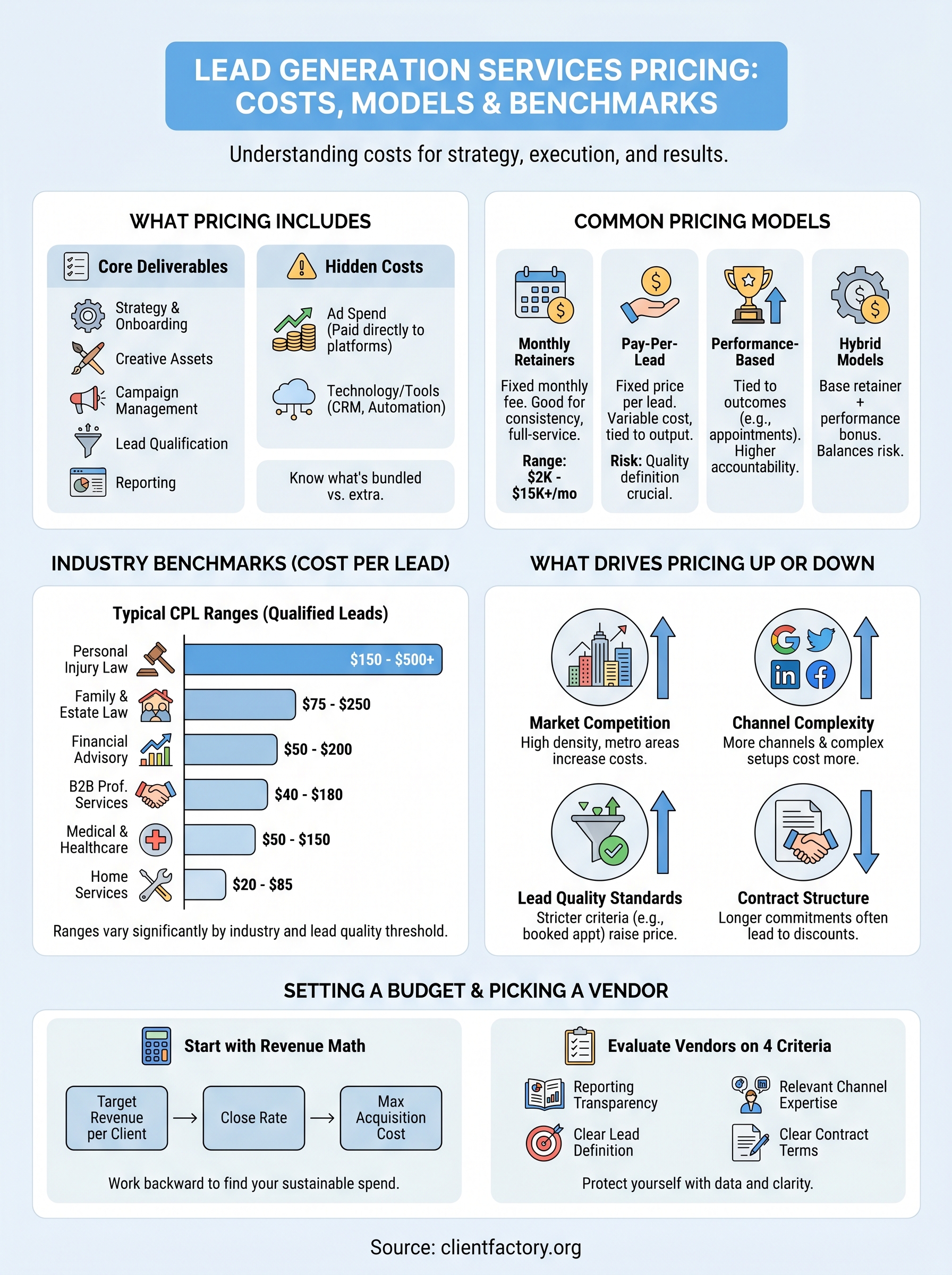
Lead generation services pricing is not a single line item. When an agency gives you a quote, that number typically bundles together strategy development, campaign execution, and some form of reporting or optimization. Understanding exactly what’s inside that number, and what’s been left out, is the first step to comparing vendors fairly.
The core deliverables agencies charge for
Most lead generation engagements cover a defined set of activities, and knowing them helps you spot gaps in a proposal before you sign. Campaign setup and creative production usually consume a significant chunk of initial fees, since building ad copy, landing pages, and targeting structures takes real time. On an ongoing basis, agencies bill for channel management (running ads on Google, Meta, or LinkedIn), audience research, and the labor to monitor and adjust campaigns week over week.
Here’s what a standard engagement typically bundles:
- Strategy and onboarding: market research, ideal client profile definition, funnel mapping
- Creative assets: ad copy, graphics, landing pages, lead magnets
- Campaign management: bid adjustments, A/B testing, budget pacing
- Lead qualification: filtering raw inquiries against your defined criteria
- Reporting: weekly or monthly performance dashboards
If a proposal doesn’t clearly separate setup fees from ongoing management fees, ask the vendor to break it out before you sign anything.
The hidden costs most buyers miss
Even a detailed proposal can leave out expenses that hit your invoice later. Ad spend is the most common gap: many agencies quote a management fee but exclude the actual budget you’ll push through Google or Meta, which often runs $1,500 to $10,000 per month on top of the retainer. You pay the platforms directly while the agency takes a percentage of that spend, a flat fee, or both.
Technology and tools add another layer. CRM integrations, call tracking software, lead scoring platforms, and marketing automation tools frequently come with their own licensing costs. Some agencies absorb these into their fee; others pass them through at retail or with a markup. Before you finalize a budget, ask for a full technology stack list and confirm who bears each cost.
What "qualified" means and why it affects your price
Not all leads are equal, and lead generation services pricing reflects that directly. A raw lead is simply someone who filled out a form or clicked an ad. A sales-qualified lead (SQL) has been screened against criteria like budget, timeline, and service fit, and that screening costs more to produce. The more filtering that happens before a lead reaches your team, the higher the price per lead and often the higher the monthly retainer.
That distinction matters especially for service businesses and law firms where a single new client can be worth tens of thousands of dollars. Paying $300 per SQL in a personal injury practice makes sense if even one in ten converts and each case carries a significant settlement value. Paying $300 per raw lead that hasn’t been screened for case type or geography almost never does. Before comparing any quotes, align with every vendor on exactly what threshold a lead must clear to count as delivered, because that definition shapes the entire value equation.
Pricing models you will see and when they fit
Lead generation services pricing breaks into four main structures: monthly retainers, pay-per-lead, performance-based fees, and hybrid arrangements. Each model shifts risk differently between you and the vendor. Knowing which one fits your situation saves you from overpaying for flexibility you don’t need or locking into a structure that punishes your vendor for actually delivering.
Monthly retainers
A retainer means you pay a fixed monthly fee regardless of how many leads come in. Agencies charge this because they’re committing labor, tools, and strategy time to your account every month. Retainers typically run from $2,000 to $15,000 per month for small to mid-sized service businesses, depending on channel complexity and campaign scope.
This model fits best when you need a full-service team managing multiple channels and you want consistent budget forecasting. The downside is that a flat fee gives the agency no direct financial incentive to push harder in slow months, so you need clear performance expectations written into the contract before anything goes live.
Pay-per-lead
With this model, you pay a fixed price for each lead delivered, usually after it clears a basic qualification threshold. You’re essentially buying a unit of pipeline rather than renting an agency team, and prices vary significantly by industry and lead quality tier.
The risk here is definition drift: if you and the vendor don’t agree upfront on what a qualified lead looks like, you’ll end up paying for contacts that never convert.
Pay-per-lead works well when your cost-per-acquisition math is tight and you need variable costs tied directly to output. Law firms and specialty service providers often prefer this model because it connects spend directly to lead volume. The tradeoff is that vendors focused on hitting a lead count can sacrifice quality to protect their margin.
Performance-based and hybrid models
Performance-based pricing ties some or all of the agency fee to a specific outcome, such as booked appointments or signed clients. Hybrid models split the fee into a lower base retainer plus a performance bonus, which balances predictability for the agency with accountability to you.
These models suit situations where you have a clear conversion event to track and the technology in place to attribute it accurately. They require a higher level of trust and data sharing between both parties, but when structured well, they align the agency and your business around the same goal: turning leads into actual revenue rather than just impressions or form fills.
Benchmarks for cost per lead and monthly fees
Before you can judge whether a vendor’s quote is reasonable, you need a baseline to compare it against. Lead generation services pricing varies significantly by industry, channel, and lead quality tier, so the number a competitor pays in a completely different vertical tells you almost nothing. The benchmarks below give you a grounded starting point for evaluating quotes in service businesses and legal practices.
Cost per lead by industry
Industry is the single biggest driver of what one lead costs. High-ticket, high-competition verticals pay more per lead because the downstream value of a single client justifies the higher acquisition cost. A personal injury attorney who closes one case out of ten leads at significant case value can afford to spend far more per lead than a landscaping company working on thin margins.

Here are current ranges across common service categories:
| Industry | Cost Per Lead (Typical Range) |
|---|---|
| Personal injury law | $150 to $500+ |
| Family and estate law | $75 to $250 |
| Home services (HVAC, plumbing) | $20 to $85 |
| Financial advisory | $50 to $200 |
| B2B professional services | $40 to $180 |
| Medical and healthcare | $50 to $150 |
These are ranges for qualified leads, not raw form fills. If a vendor quotes you at the low end of your industry range, confirm exactly what qualification criteria they apply before assuming it’s a deal.
Monthly retainer ranges
Retainer fees follow a similar pattern. Smaller campaigns with a single channel (say, Google Ads only) often run $2,000 to $4,000 per month. Multi-channel engagements covering paid search, paid social, SEO, and conversion rate optimization regularly land between $6,000 and $15,000 monthly for small to mid-sized service businesses.
Law firms operating in competitive metro markets frequently see quotes above $10,000 per month because campaign complexity and cost-per-click rates in legal categories are among the highest across all industries. That figure excludes ad spend, which in competitive legal markets can run an additional $5,000 to $20,000 per month pushed directly to the ad platforms.
The most useful benchmark is not an industry average but your own target cost-per-acquisition. Work backward from the revenue value of a typical new client, set a maximum acceptable acquisition cost, and then filter vendor quotes through that lens. Any retainer or per-lead fee that keeps you inside that threshold deserves further evaluation. Any quote that blows past it needs a clear explanation before you move forward.
What drives pricing up or down
Lead generation services pricing does not move randomly. Specific, identifiable factors push costs higher or pull them lower, and understanding each one lets you make smarter decisions before you commit to a vendor or a budget. Most of the variation comes down to four core variables: market competition, channel selection, lead quality standards, and contract structure.
Competition in your geographic market
Where you operate has a direct impact on what you pay. Highly competitive metro areas like New York, Los Angeles, and Chicago drive up the cost of paid search and social ads simply because more businesses are bidding on the same keywords and audience segments. A personal injury firm in a mid-sized city may pay $80 per click on Google. That same click in a major market can cost $200 or more.
If your primary service area spans multiple competitive cities, expect your blended cost per lead to run noticeably higher than single-market benchmarks suggest.
Local market density also affects agency fees, since more competitive campaigns require more hands-on management, more aggressive creative testing, and faster optimization cycles.
Channel selection and campaign complexity
The channels you run through shape your costs as much as the market does. Paid search campaigns on Google consistently produce higher-intent leads but also carry higher cost-per-click rates compared to paid social. LinkedIn campaigns targeting B2B decision-makers cost more per click than Facebook but often deliver stronger lead quality for professional services. SEO, by contrast, requires a longer runway before it generates consistent volume, which affects how agencies structure their fees during the ramp-up period.
Running multiple channels simultaneously adds coordination complexity, which means more agency labor and a higher monthly retainer. A single-channel Google Ads campaign is less expensive to manage than a four-channel program combining paid search, paid social, retargeting, and content-driven SEO.
Lead quality requirements and qualification depth
The stricter your definition of a qualified lead, the more your vendor has to invest in filtering and verification before delivering it to your sales team. Requiring a verified phone number, a confirmed budget range, and a booked appointment costs significantly more to produce than a raw form submission. Agencies price that labor into either a higher per-lead rate or a larger monthly retainer.
Contract length also moves the number in your favor. Vendors often discount retainer fees by 10 to 20 percent for six or twelve-month commitments because it reduces their client acquisition overhead and gives their team a longer optimization window to demonstrate results.
How to set a budget and pick a vendor
Setting a budget before you talk to any vendor is the single most important thing you can do to protect yourself during the sales process. Lead generation services pricing is structured to fill whatever budget you bring, so walking in without a ceiling almost always results in overspending. Start with what you know: the average revenue value of a new client, your current close rate, and the number of new clients you need each month to hit your growth target. Those three numbers tell you exactly how much you can afford to spend per acquired client, which becomes your anchor for every conversation.
Start with your revenue math
Work backward from your target cost-per-acquisition to set a realistic budget range before you request any quotes. If a new client is worth $5,000 in revenue and you close one in five qualified leads, your maximum acquisition cost is roughly $1,000 before you break even on the marketing spend alone. Factor in your profit margin, and a sustainable acquisition cost likely lands closer to $400 to $600 for that scenario.

Never let a vendor define your budget ceiling for you. That number should come from your own revenue model, not from their pricing sheet.
Once you have that ceiling, you can evaluate whether a retainer plus ad spend fits inside it at your expected lead volume. If the math does not close, either the vendor’s pricing is wrong for your business or your close rate needs work before you invest more in lead generation.
Evaluate vendors on four criteria
Picking the right vendor requires more than comparing monthly fees. The four criteria that matter most are transparency in reporting, lead qualification standards, channel expertise specific to your industry, and the clarity of their contract terms.
Ask every vendor to show you a live reporting dashboard from a current client in a comparable industry. Agencies that produce results share data openly; those that don’t tend to bury performance behind vague summaries. Confirm exactly how they define a qualified lead, because that definition directly determines the value of everything they deliver.
Check whether their core channel experience matches your target audience. A vendor who specializes in e-commerce paid social is not the right partner for a law firm that needs high-intent Google search leads. Relevant experience shortens the learning curve and reduces the wasted spend that typically accompanies the first 60 to 90 days of any new engagement.
What to do next
You now have a complete picture of lead generation services pricing: what it includes, how the major models work, what benchmarks to use as a reference point, and which factors move costs in either direction. More importantly, you have a framework to evaluate any vendor quote on your own terms rather than accepting whatever number lands in your inbox.
The next move is to run the math for your own business. Calculate your target cost-per-acquisition, identify the channels that match your audience, and write down exactly what a qualified lead means to you before you speak to anyone. That preparation alone will save you from the most common and costly mistakes buyers make during vendor selection.
If you want a second set of eyes on your current funnel or acquisition costs, book a free conversion audit and we will walk through the numbers with you directly.