
You’ve probably heard that email is dead. It’s not. Email marketing consistently delivers one of the highest ROIs in digital marketing, around $36 for every $1 spent, according to Litmus. So if you’re asking what is email marketing and whether it still matters for growing your business, the short answer is: absolutely.
At its core, email marketing is the practice of sending targeted messages to a list of subscribers who’ve opted in to hear from you. It’s how service businesses and law firms nurture leads, stay top of mind, and turn prospects into paying clients. At Client Factory, we see it every day, firms that pair strong acquisition funnels with strategic email campaigns close more deals, faster.
But knowing the definition is just the starting point. This guide breaks down the major types of email campaigns, the specific benefits they offer, and the best practices that separate emails people actually read from the ones that rot in spam folders. Whether you’re building your first list or refining an existing strategy, you’ll walk away with a clear, actionable understanding of how email marketing fits into your client acquisition engine.
Why email marketing still works in 2026
Social media platforms change their algorithms. Ad costs keep rising. But email remains one of the few direct communication channels you actually own. When someone joins your list, you don’t need to pay a platform to reach them, and no algorithm decides whether they see your message. That level of control is rare in digital marketing, and it’s a big reason why businesses keep investing in email even as newer channels emerge.
You own the channel
Understanding what is email marketing also means understanding why the medium itself is so durable. Every major social platform carries the same risk: the rules can change overnight, and your reach can drop without warning. Email removes that dependency entirely, and your list is an asset that belongs to your business, not to a third-party platform with its own priorities.
The moment you build an email list, you’ve built a direct line to your audience that no platform update can take away.
Your subscribers chose to hear from you. That opt-in creates a level of trust and intentional engagement that cold advertising simply can’t replicate. For service businesses and law firms, this trust is especially valuable because prospects rarely hire after a single touchpoint. They need repeated exposure to your expertise before they’re ready to make a decision.
The numbers back it up
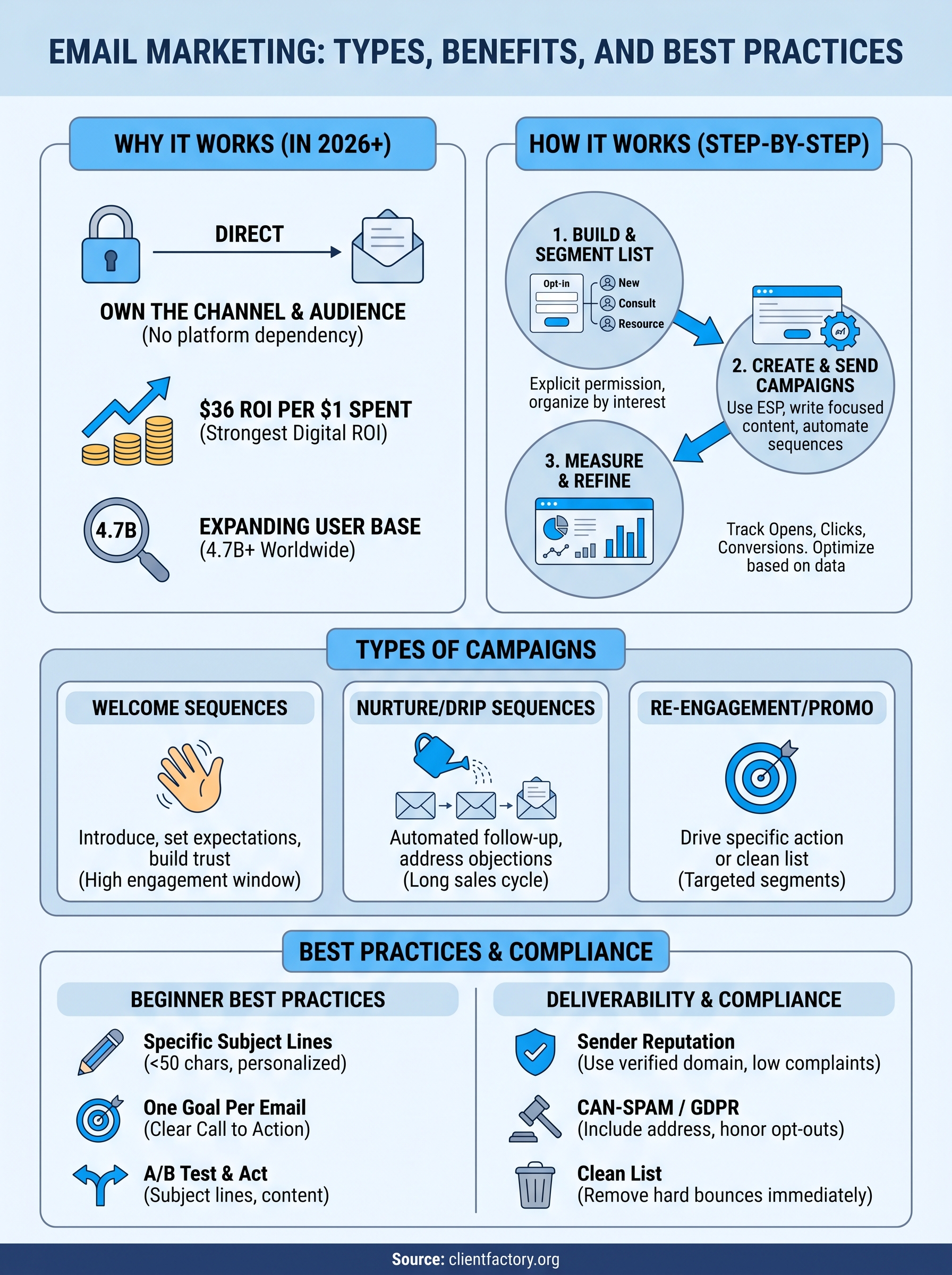
Email marketing is not a legacy tactic that marketers hold onto out of habit. The return on investment remains consistently strong, with Litmus reporting an average of around $36 returned for every $1 spent. That figure outpaces nearly every other digital channel, including paid social and display advertising.
Beyond ROI, email usage itself keeps expanding. Statista projects over 4.7 billion email users worldwide by 2026. That’s not a shrinking audience, and it spans demographics that other channels struggle to reach consistently, including older professionals, executives, and high-income decision-makers who don’t scroll Instagram but do check their inbox every morning.
Email fits every stage of the client journey
One of the most practical advantages of email is its flexibility across your entire acquisition funnel. A new lead who downloads a resource can enter an automated welcome sequence immediately. A prospect who went quiet after a consultation can receive a re-engagement campaign a few weeks later. A client who just finished working with you can get a referral request at exactly the right moment. Each of these touchpoints costs you nothing extra beyond the time to set them up.
This adaptability sets email apart from paid advertising, which typically focuses on the top of the funnel. Email lets you nurture leads over weeks or months without paying for each individual interaction. For service businesses where the sales cycle is long and trust-dependent, that’s a significant operational and financial advantage.
The combination of ownership, reach, ROI, and funnel flexibility is why email marketing has remained a core client acquisition strategy year after year. Social platforms will keep shifting, ad costs will keep climbing, and businesses that build and maintain their lists with intention will keep generating returns that other channels struggle to match.
How email marketing works step by step
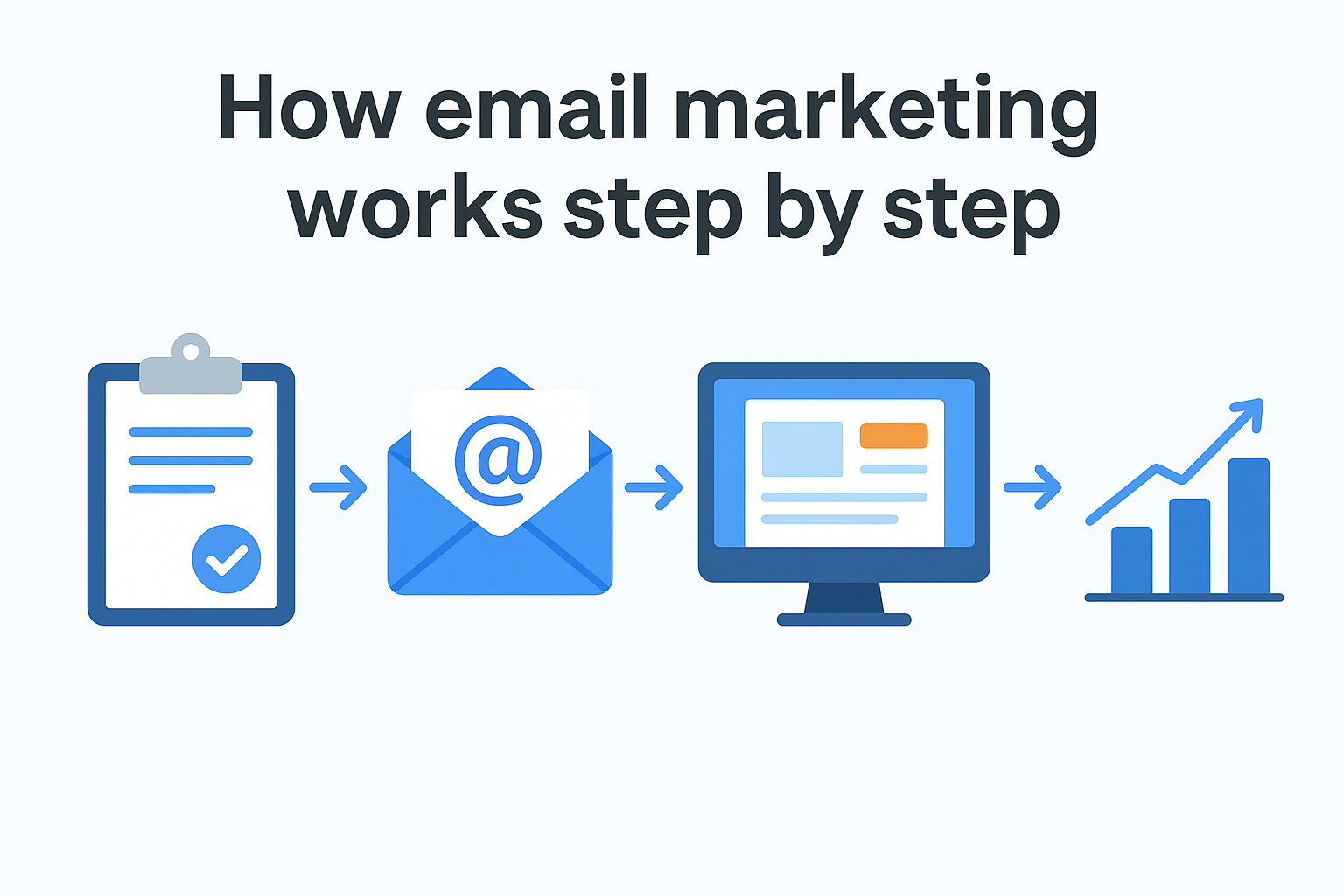
Understanding what is email marketing is easier when you see it as a repeatable system rather than a one-off activity. Every effective email program runs on the same core mechanics: you collect subscribers, send them relevant messages, and use the data from each send to improve the next one. Breaking that down into clear steps makes it much easier to get started without feeling overwhelmed.
Build and grow your list
Before you send a single email, you need subscribers who have given you explicit permission to contact them. That permission typically comes through an opt-in form on your website, a landing page tied to a lead magnet, or a sign-up prompt during a consultation booking. Never purchase a list, because cold contacts who didn’t ask to hear from you will ignore your messages, damage your sender reputation, and expose you to compliance risks.
Once people join your list, segment them from the start. Group subscribers by where they came from, what they expressed interest in, or where they are in the buying process. A prospect who requested a free consultation needs different messaging than someone who just downloaded a general guide.
Create and send your campaigns
With your list in place, you build your campaign inside an email service provider (ESP). You write the message, set the subject line, choose which segment receives it, and schedule the send.
Most platforms also let you set up automated sequences that trigger based on subscriber behavior, such as a welcome series that fires the moment someone joins your list. This automation separates occasional email blasts from a client acquisition system that runs without constant input from you.
The businesses that get the most from email are the ones that set up their sequences once and let them work in the background while they focus on delivering their service.
Measure and refine your results
After each send, your ESP shows you open rates, click rates, and conversions. Each send generates data you can act on immediately, which is what makes email one of the fastest channels to optimize over time. Here are the three core metrics to watch first:
- Open rate: signals whether your subject line is working
- Click rate: shows if your content drives action
- Conversion rate: tracks how many recipients completed a goal
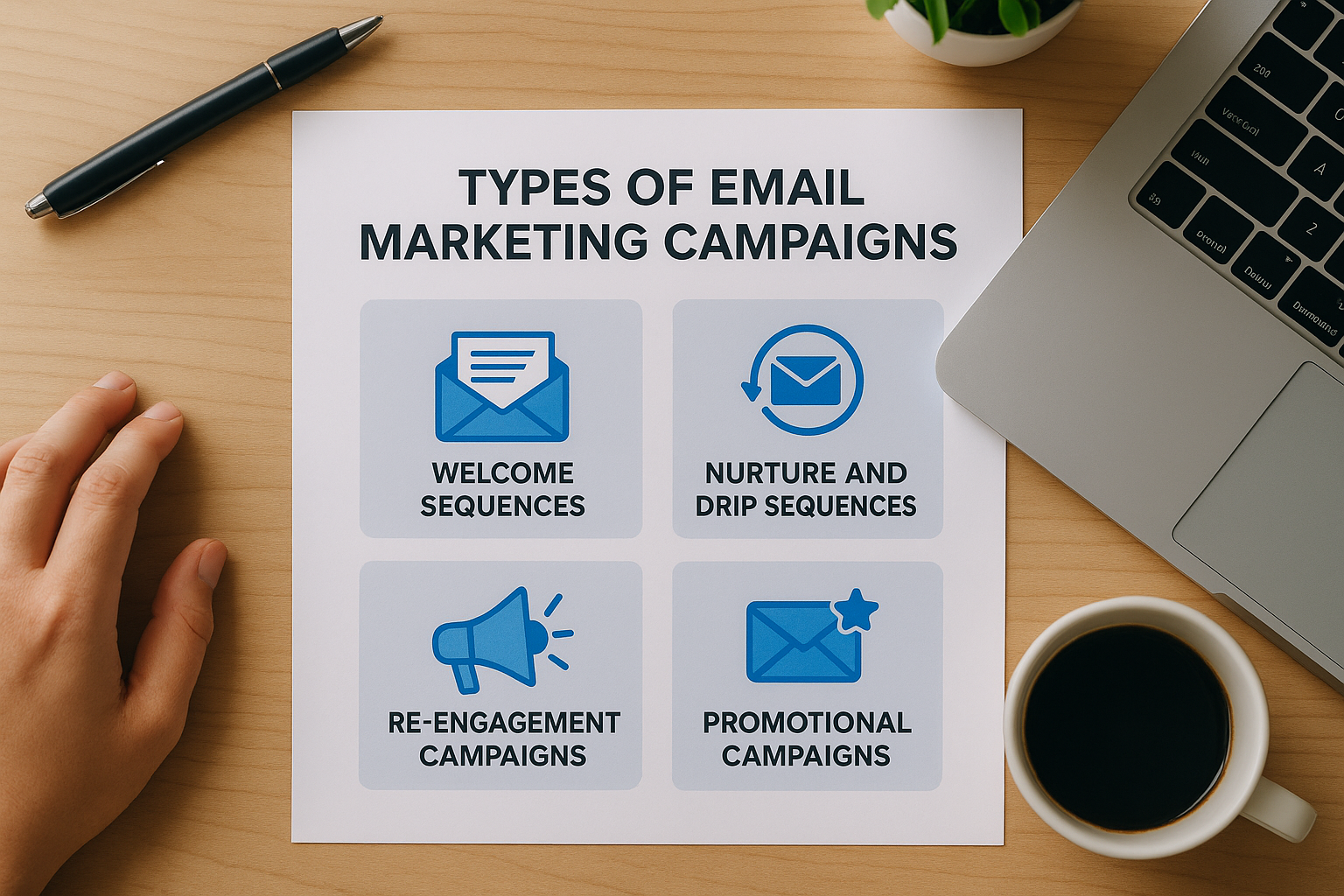
Types of email marketing campaigns
When you study what is email marketing in practice, you quickly realize that not all emails serve the same purpose. Each type of campaign targets a different moment in the client relationship, and knowing which type to use at which moment is what turns a scattered email habit into a structured, client-generating system.
Welcome sequences
A welcome sequence is the first series of emails a new subscriber receives immediately after joining your list. This is your highest-engagement window because people are most interested in you right after they opt in. Use these early emails to introduce your business, set expectations for what they’ll receive, and deliver any resource you promised during sign-up.
For service businesses and law firms, a three-to-five email welcome sequence does something paid advertising cannot: it builds familiarity and trust before you ever ask for anything. By the time you make an offer, prospects already know who you are and why you’re worth their time.
Nurture and drip sequences
A drip sequence is a pre-written series of emails triggered by a subscriber’s behavior or status in your funnel. A prospect who requests a consultation might enter a five-email sequence that addresses common objections, shares relevant results, and closes with a direct call to action. These sequences run automatically, which means your follow-up runs even when you’re focused on client delivery.
The businesses that scale fastest with email are the ones that automate their nurture sequences and let those sequences close the gap between interest and decision.
Newsletters are a related type with a slightly different goal. Rather than guiding someone toward a single action, a regular newsletter keeps your audience engaged over time by delivering insights, case studies, or updates that reinforce your expertise. Sent consistently, it keeps your business at the front of mind so that when a subscriber is finally ready to hire someone, you’re the obvious first call.
Re-engagement and promotional campaigns
Promotional campaigns have a single, explicit goal: get a specific segment of your list to take a defined action, such as booking a call or claiming an offer. These work best when sent to subscribers who have already shown interest rather than your full list.
Re-engagement campaigns take the opposite approach. They target contacts who have gone quiet, typically for 60 to 90 days, with a short sequence designed to revive the relationship or confirm that the contact no longer belongs on your list. Cleaning your list this way protects your deliverability and keeps your engagement metrics accurate.
Best practices for beginners that drive results
When you first work through what is email marketing and decide to put it into practice, the gap between sending emails and sending emails that actually convert comes down to a small set of repeatable habits. Getting these fundamentals right from the start saves you months of troubleshooting later and sets a foundation that scales as your list grows.
Write subject lines people actually open
Your subject line determines whether everything else you wrote gets read or ignored. Most recipients decide whether to open an email in under two seconds, so your subject line needs to be specific, relevant, and honest about what’s inside. Avoid vague lines like "Important update" or "Check this out." Instead, write something that speaks directly to the reader’s situation, like "Still thinking about hiring a lawyer? Read this first."
A weak subject line wastes every hour you put into writing the email itself, so treat it as its own creative task, not an afterthought.
Keep subject lines under 50 characters so they display fully on mobile. Personalization, such as using the subscriber’s first name or referencing a specific action they took, consistently improves open rates across industries.
Focus on one goal per email
Every email you send should have a single, clear action you want the reader to take. Whether that’s booking a call, reading a case study, or replying to a question, having one goal keeps your message focused and makes it far easier to measure what’s working. When you ask subscribers to do three things at once, most of them do nothing.
Write your call to action early in the email, not just at the bottom. Many readers skim rather than read top to bottom, so placing your ask in the first few lines, and then repeating it at the end, increases the chance they actually follow through.
Test consistently and act on what you learn
Send the same email with two different subject lines to small segments of your list and track which one drives more opens before sending to everyone else. This A/B testing habit compounds over time. Every insight you gain from one campaign makes the next one sharper. Start with one variable at a time so your results are clear enough to act on.
Deliverability and compliance basics
Part of understanding what is email marketing means understanding that writing a great email is only half the battle. If your message lands in the spam folder, none of your strategy matters. Deliverability is the technical foundation your entire email program sits on, and compliance protects your business from legal exposure that can become expensive fast.
Keep your sender reputation clean
Internet service providers evaluate your sender reputation every time you hit send. They look at how many people open your emails, how many mark them as spam, and how often your messages bounce. A poor reputation pushes your emails toward junk folders automatically, regardless of how valuable your content is.
Your sender reputation is like a credit score for your email program. Build it carefully and protect it consistently.
Use a verified sending domain by setting up SPF, DKIM, and DMARC records through your domain provider. These technical settings confirm to inbox providers that you are who you say you are, which significantly reduces the chance your emails get flagged as suspicious. Most email service providers walk you through this setup, and it takes under an hour to complete.
Remove hard bounces immediately after each send. Sending repeatedly to invalid addresses signals poor list hygiene to inbox providers and damages your standing over time. Also keep your spam complaint rate below 0.1 percent. If complaints climb above that threshold, your deliverability will drop across the board.
Stay compliant with email law
Two laws govern most of the email marketing you will do as a U.S.-based business. The CAN-SPAM Act sets rules for commercial email in the United States, including requirements to include your physical mailing address in every email, honor unsubscribe requests within 10 business days, and avoid deceptive subject lines. The FTC’s CAN-SPAM guidance covers the full requirements clearly.
If any of your subscribers are based in the European Union or United Kingdom, GDPR applies to your email practices as well, including how you collect consent and store subscriber data. Non-compliance carries real financial penalties, so confirm your opt-in process documents explicit consent rather than relying on pre-checked boxes or assumed permission.
Metrics to track and improve over time
Once you understand what is email marketing and have campaigns running, the numbers your email service provider shows you after each send are not just data points. They are direct feedback on what to fix next, and reviewing them after every campaign is what separates businesses that plateau at mediocre results from those that steadily improve their client acquisition performance over time.
Core engagement metrics
Open rate measures the percentage of subscribers who opened your email, and it tells you directly whether your subject lines are working. Industry averages vary by sector, but if your open rate sits below 20 percent consistently, your subject lines need attention before anything else. Click-through rate (CTR) measures how many openers clicked a link inside your email, which tells you whether your content and call to action are compelling enough to drive action.
Conversion rate goes one level deeper. It tracks how many recipients completed the specific goal you set for that email, whether that was booking a call, filling out a form, or downloading a resource. This metric connects your email activity directly to business outcomes and is the number that ultimately tells you whether your email program is generating clients or just generating opens.
Tracking open rate and click rate without tracking conversion rate is like measuring how many people walked into your office without checking how many hired you.
Revenue and list health metrics
Unsubscribe rate signals how relevant your content is to the people receiving it. A sudden spike after a specific campaign usually means the message was off-target for that segment. Bounce rate divides into hard bounces, which are permanent delivery failures from invalid addresses, and soft bounces, which are temporary failures. Remove hard bounces from your list immediately after each send to protect your sender reputation.
List growth rate tracks how fast your subscriber count is expanding after accounting for unsubscribes and removals. A shrinking or stagnant list signals a problem at the top of your acquisition funnel, whether that’s a weak lead magnet, low website traffic, or opt-in forms buried where visitors can’t find them. Review this metric monthly and treat it as a signal about the health of your entire client acquisition system, not just your email program.
Next steps
Now you know what is email marketing and exactly how to use it to grow your client base. You have the framework for building a list, running campaigns, staying compliant, and measuring what matters. The next move is to put it into practice, starting with the simplest possible step: choosing an email service provider and setting up your first opt-in form this week.
From there, write a three-email welcome sequence before you do anything else. Those first automated emails will do more for your conversion rate than any single broadcast you send later. Once that sequence is live, layer in a nurture campaign for prospects who go quiet after an initial inquiry.
If you want expert help building the full client acquisition system around your email strategy, including your funnel, paid traffic, and conversion points, book a free funnel audit with Client Factory and we’ll show you exactly where to start.