

Most businesses chase leads the wrong way. They push products at people who barely know they exist, hoping something sticks. This approach burns budgets and frustrates sales teams.
Demand generation takes a different path. It’s about creating awareness and interest in your solution before you ask for anything in return. Instead of interrupting buyers with sales pitches, you educate them, solve their problems, and position your business as the obvious choice when they’re ready to buy. Think of it as building an audience that actually wants to hear from you.
This guide breaks down everything you need to know about demand generation for B2B companies. You’ll learn why it matters more than traditional lead gen tactics, how to build a strategy that fills your pipeline with qualified prospects, and which tactics deliver real results. We’ll also cover how to measure success and show you practical examples from service businesses and law firms that prove demand generation works. By the end, you’ll have a clear roadmap to turn strangers into customers without the pushy sales tactics that make everyone uncomfortable.
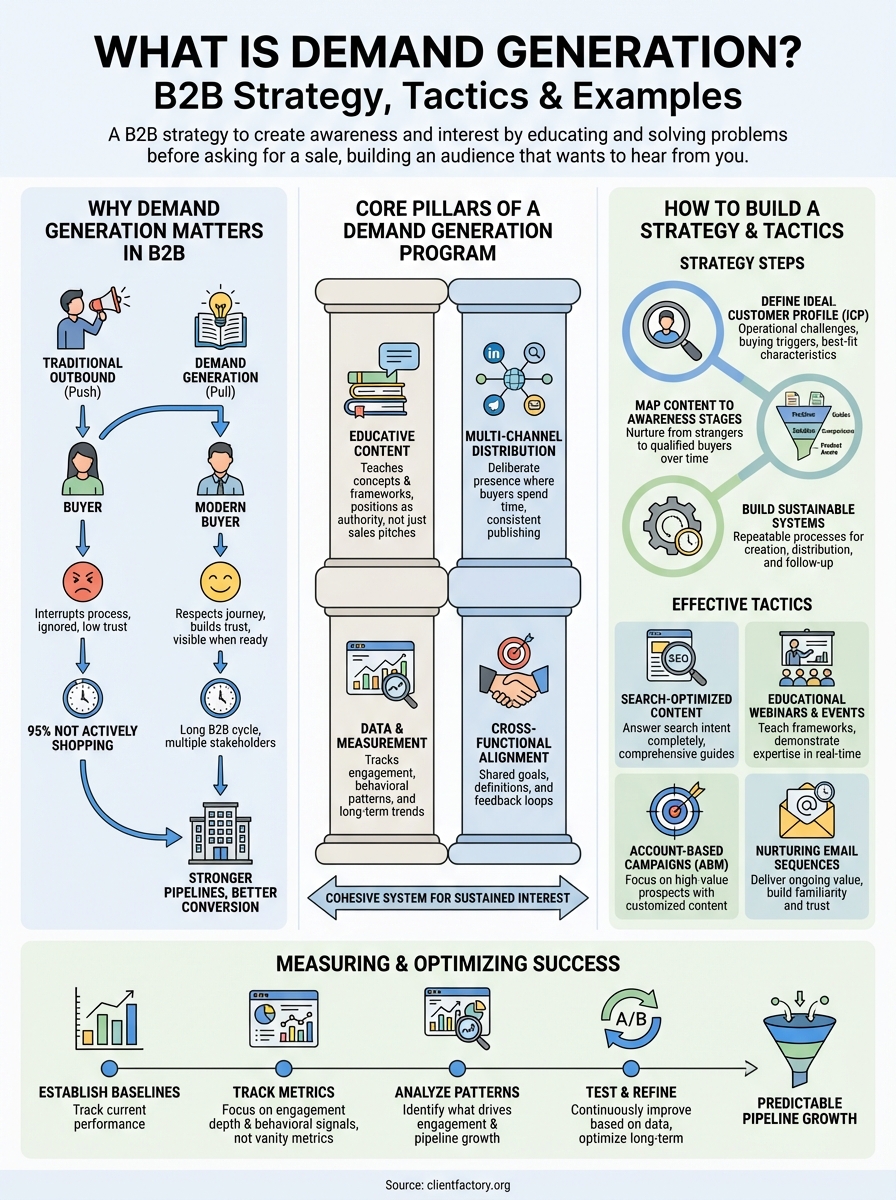
Why demand generation matters in B2B
Your buyers don’t want to be sold to anymore. They research solutions independently, consume content on their own terms, and make decisions long before they talk to sales. Traditional outbound tactics interrupt this process, pushing your message at people who aren’t ready to listen. Demand generation respects how modern B2B buyers actually behave by meeting them where they are with information they need.
The B2B buying cycle demands a different approach
B2B purchase decisions involve multiple stakeholders and lengthy evaluation periods. Your potential clients compare dozens of options, read reviews, watch demos, and build internal consensus before signing anything. When you focus only on capturing leads, you miss the 95% of your market that isn’t actively shopping right now. Demand generation keeps your business visible and valuable throughout this extended cycle, so when your ideal customer finally enters buying mode, they already know and trust you.

The companies that invest in educating their audience before asking for contact information build stronger pipelines with better conversion rates.
Service businesses face unique client acquisition challenges
You can’t demonstrate your expertise with a product photo or a feature list. Your value lives in your knowledge, process, and results, which makes the buying decision more complex and personal. Understanding what is demand generation becomes critical here because you need to prove your capabilities through content before prospects will even consider a consultation. Law firms explaining regulatory changes, consulting agencies sharing strategic frameworks, and agencies publishing case studies all use demand generation to establish credibility without being pushy.
Sales and marketing alignment improves when you focus on demand
When marketing generates awareness and education while sales converts ready buyers, both teams win. Marketing stops delivering junk leads that waste everyone’s time. Sales receives prospects who already understand your value proposition and fit your ideal client profile. This alignment happens naturally when you build demand generation programs that filter out poor-fit prospects early and nurture the right ones until they’re genuinely ready to buy.
How to build a demand generation strategy
Building a demand generation strategy starts with understanding who you serve and what problems keep them awake at night. You need a structured approach that connects your expertise to buyer needs across every stage of their journey. This isn’t about launching random campaigns and hoping for results. Your strategy must align your content, channels, and messaging to create sustained interest in your solution before prospects ever consider buying.
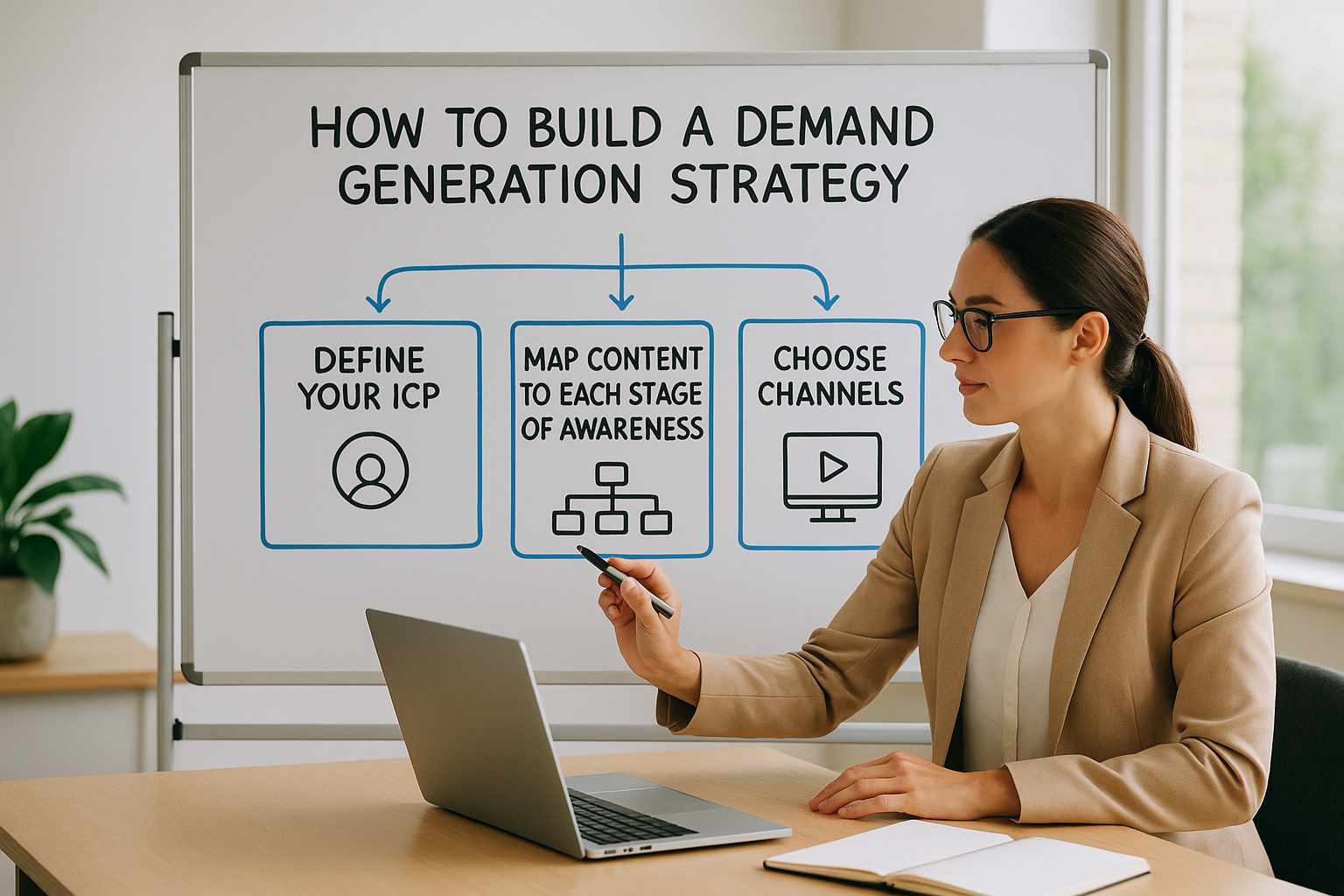
Define your ideal customer profile first
You can’t generate demand effectively if you’re targeting everyone. Start by documenting specific characteristics of clients who get the best results from your service. Include firmographic details like company size, industry, and revenue, but go deeper into their operational challenges, decision-making processes, and buying triggers. Law firms should identify the types of cases that match their expertise and capacity, while consulting firms need clarity on which business problems they solve better than competitors.
Your ICP becomes the filter for every marketing decision. When you know exactly who you’re speaking to, your content resonates more powerfully and your campaigns stop wasting budget on poor-fit prospects.
Map content to each stage of awareness
Your prospects move through distinct phases before they’re ready to buy. At the problem-aware stage, they know something’s wrong but haven’t identified solutions yet. Create content that names their pain points and educates them about root causes. Solution-aware prospects understand what types of help exist and compare different approaches. Provide framework content, methodology explanations, and comparison guides here. When they reach the product-aware stage, share case studies, client testimonials, and detailed service information.
The biggest mistake in demand generation is creating only bottom-of-funnel content that targets people ready to buy today.
Map specific content pieces to each awareness level so you nurture prospects from complete strangers to qualified buyers over time. This approach answers what is demand generation at its core: building relationships through education.
Choose channels where your buyers actually spend time
Stop spreading your efforts across every possible platform. Research where your ideal customers consume professional content and focus there first. B2B service buyers often discover solutions through LinkedIn, industry publications, search engines, and professional communities. Law firms might prioritize local search and referral networks, while consulting agencies could focus on thought leadership platforms and speaking opportunities.
Test channels systematically rather than guessing. Start with two or three primary channels, measure results, then expand what works. Your channel strategy should match where prospects look for information at different awareness stages.
Build systems that sustain your efforts
One-off campaigns don’t create lasting demand. You need repeatable processes for content creation, distribution, and follow-up that work without constant intervention. Set up content calendars that publish consistently, automation that nurtures leads appropriately, and measurement frameworks that show what drives real pipeline growth. Your demand generation strategy succeeds when it runs reliably week after week, building momentum that compounds over time rather than spiking and disappearing.
Demand generation vs lead generation
Most marketers confuse these terms or use them interchangeably, but they represent fundamentally different approaches to customer acquisition. Lead generation focuses on capturing contact information from people who show interest right now. Demand generation builds awareness and interest across your entire addressable market, including prospects who won’t buy for months or years. When you understand this distinction, you stop wasting resources chasing unqualified contacts and start building a sustainable pipeline.
Lead generation targets immediate capture
Lead generation tactics center on collecting names and emails as quickly as possible. You create gated content like whitepapers or webinars, run paid ads to landing pages with forms, and measure success by the number of contacts entering your database. This approach works when prospects already know they need your solution and actively search for providers. The problem appears when you apply lead gen tactics too early in the buyer journey. Forcing strangers to fill out forms before they trust you creates friction that drives away good prospects.
Lead generation answers “how many contacts did we get” while demand generation asks “how many people know we exist and value what we teach.”
Demand generation prioritizes education and trust
Understanding what is demand generation means recognizing that most of your potential market isn’t ready to buy today. Your strategy should focus on teaching prospects about problems they face, frameworks for solving those problems, and insights they can’t find elsewhere. You share valuable content freely without gates, appear consistently where your audience spends time, and demonstrate expertise through generosity rather than holding information hostage. Law firms that publish guides about legal processes, consultants who share frameworks publicly, and agencies that teach marketing fundamentals all practice demand generation correctly.
Both strategies work together in your funnel
You don’t choose between demand generation and lead generation. Demand generation fills the top of your funnel with aware, educated prospects who understand your value. Lead generation converts those warmed prospects into contacts when they’re ready for conversations. Service businesses that excel at client acquisition use demand tactics to build audiences and reputation, then deploy targeted lead capture mechanisms for prospects showing buying intent. The sequence matters: generate demand first, capture leads second.
Core pillars of a demand generation program
Every successful demand generation program rests on four foundational elements that work together to create sustained interest in your business. You can’t skip any of these pillars without weakening your entire approach. Strong programs integrate content, distribution, measurement, and teamwork into a cohesive system that consistently attracts and educates prospects. When you understand what is demand generation at this structural level, you stop treating it as a collection of random tactics and start building an engine that produces predictable results.
Content that educates rather than sells
Your content serves as the primary vehicle for building relationships with prospects who don’t know you yet. Focus on teaching valuable concepts, frameworks, and insights that help your audience solve problems independently. Law firms should explain legal processes and common pitfalls instead of only promoting their services. Consulting agencies need to share strategic thinking and industry analysis rather than just case studies. Educational content positions your business as a trusted authority while gated promotional materials trigger skepticism and resistance.

Create a content library that addresses questions at every awareness stage, from broad problem identification to specific solution comparison. You need blog posts, videos, guides, webinars, and interactive tools that prospects can access freely. Quality matters more than quantity, so invest in thorough, accurate content that demonstrates real expertise.
Multi-channel distribution
Creating excellent content accomplishes nothing if your target audience never sees it. You need deliberate distribution strategies across multiple platforms where your ideal customers spend time professionally. Service businesses should prioritize search engine visibility, LinkedIn presence, email newsletters, and strategic partnerships. Relying on a single channel creates fragility because algorithm changes or platform shifts can destroy your reach overnight.
Distribution strategy determines whether your demand generation investment builds long-term assets or produces temporary spikes that disappear.
Test channels systematically to discover which ones deliver qualified traffic and engagement from your ideal customer profile. Consistent presence matters more than viral moments, so establish repeatable publishing schedules you can maintain long-term.
Data and measurement systems
You can’t optimize what you don’t measure. Build tracking mechanisms that show which content pieces drive awareness, engagement, and eventual conversions across your buyer journey. Monitor metrics like content consumption patterns, return visitor rates, and the path prospects take from first touch to qualified opportunity. Attribution models help you understand which activities contribute to pipeline growth versus those that waste resources.
Demand generation produces results over weeks and months rather than days, so your measurement approach needs to capture long-term trends and patterns instead of obsessing over daily fluctuations.
Cross-functional team alignment
Demand generation fails when marketing works in isolation from sales and customer success teams. You need shared definitions of ideal customers, qualified prospects, and buying signals that keep everyone moving toward the same goals. Marketing should gather insights from customer-facing teams about common objections, competitor positioning, and successful client profiles. Sales teams must provide feedback on lead quality and conversion barriers so marketing can refine targeting and messaging accordingly.
Effective B2B demand generation tactics
Tactics translate your strategy into actual activities that reach prospects and build relationships. You need specific approaches that consistently deliver value to your target audience while demonstrating your expertise. The tactics that work best combine educational content with strategic distribution, creating touchpoints that move prospects from unaware to engaged. Service businesses and law firms succeed when they choose tactics that match their audience’s preferences and their own capacity to execute consistently.
Create problem-focused content that ranks in search
Search engines remain the primary research tool for B2B buyers investigating solutions. Build a content library that targets search queries your ideal customers actually use when exploring problems you solve. Law firms should create articles about specific legal situations, procedural requirements, and common mistakes people make. Consulting agencies need content that addresses strategic challenges, operational inefficiencies, and industry-specific obstacles. Each piece should satisfy search intent completely so readers find everything they need without clicking away to competitors.
Focus on long-form, comprehensive content that goes deeper than surface-level advice. When you answer what is demand generation through search-optimized content, you capture attention from prospects at the problem-aware stage who don’t yet know your business exists. Update existing content regularly to maintain rankings and relevance rather than constantly creating new pieces that compete with your own pages.
Host webinars and virtual events that teach frameworks
Live educational sessions let you demonstrate expertise while building direct relationships with engaged prospects. Structure your webinars around valuable frameworks, processes, or methodologies that attendees can apply immediately to their situations. Avoid product pitches disguised as education because audiences recognize and resent that bait-and-switch approach. Recording and repurposing webinar content extends the value of your preparation effort across multiple channels and formats.
Educational events build trust faster than any other tactic because prospects experience your expertise in real time rather than consuming static content.
Promote webinars through your email list, social channels, and partnerships with complementary businesses. Follow up with attendees by sharing additional resources that continue the conversation without pushing immediate sales meetings.
Develop targeted account-based campaigns
Account-based marketing focuses your efforts on specific high-value prospects rather than broadcasting to everyone. Identify companies that match your ideal customer profile perfectly, then create customized content and outreach sequences that address their particular situations. Research each target account thoroughly to understand their challenges, competitive position, and likely decision-making process. Law firms can target specific companies facing regulatory changes while consulting agencies pursue organizations undergoing transformation initiatives.
Coordinate content, advertising, and direct outreach to create multiple touchpoints with key stakeholders at target accounts. This concentrated approach generates better returns than spreading budget across massive audiences when you serve clients with high lifetime value.
Build email sequences that nurture long-term relationships
Email remains the most effective channel for maintaining ongoing communication with prospects who aren’t ready to buy yet. Create automated sequences that deliver educational content over weeks or months, gradually building familiarity and trust. Each message should provide standalone value rather than serving as a transparent excuse to stay in someone’s inbox. Segment your email lists based on interests, awareness levels, and engagement patterns so you send relevant information to each group.
Track which content pieces drive the most engagement and which topics correlate with eventual conversions. Use these insights to refine your sequences and focus on themes that resonate with prospects who ultimately become clients.
Measuring and optimizing demand generation
Tracking the right metrics separates successful demand generation programs from expensive experiments that waste resources. You need clear visibility into which activities drive awareness, engagement, and eventual revenue rather than vanity metrics that make reports look good but don’t predict business growth. The challenge lies in measuring activities that create value over months instead of immediate conversions, so your measurement framework must capture long-term patterns across multiple touchpoints. Start by establishing baselines for your current performance, then track changes as you test new tactics and refine your approach.
Track metrics that predict pipeline growth
Stop obsessing over website traffic and social media followers. Focus instead on engagement depth and behavioral indicators that signal genuine interest in your expertise. Monitor metrics like return visitor rates, content consumption patterns across multiple pieces, email open and click rates on educational sequences, and webinar attendance from target accounts. Qualified opportunity creation rates matter more than raw lead volume because demand generation aims to fill your pipeline with prospects who actually fit your ideal customer profile and show buying intent.

Calculate your customer acquisition cost by channel to understand which tactics deliver the best return on your investment. Track how long prospects typically engage with your content before requesting consultations or demos. These metrics reveal whether your demand generation approach successfully nurtures relationships or pushes people away with premature sales pressure.
Successful measurement connects content engagement patterns to eventual revenue so you invest more in tactics that work and cut activities that drain resources.
Test and refine based on data patterns
Review your analytics monthly to identify content pieces that drive the most engagement and topics that resonate with your ideal customers. Double down on formats and subjects that attract qualified attention while eliminating those that consume resources without results. Run A/B tests on headlines, content formats, distribution channels, and call-to-action approaches to systematically improve performance rather than guessing what might work better.
Pay attention to drop-off points in your buyer journey. Where do prospects stop engaging with your content? Which awareness stage creates the biggest bottleneck in moving people toward buying conversations? Use these insights to create targeted content that addresses gaps in your current library and smooths the path from stranger to qualified prospect. Understanding what is demand generation through measurement means recognizing that optimization never ends because markets shift, buyer preferences evolve, and competitors adapt their approaches constantly.
Demand generation for service businesses and law firms
Service businesses and law firms face unique challenges when applying demand generation principles because you can’t showcase your value through physical products or simple feature lists. Your expertise, methodology, and track record represent your entire offering, which requires prospects to trust you before they understand what makes your service worth the investment. The intangible nature of professional services demands a demand generation approach that demonstrates competence while building relationships with people who won’t need your help for months or years.
Demonstrate expertise through educational content
You need to prove your capabilities before prospects will consider paying for them. Create content that showcases your depth of knowledge about the specific problems your ideal clients face. Law firms should publish guides about navigating complex legal processes, explaining recent regulatory changes, and identifying common mistakes that create liability. Consulting agencies and professional service providers benefit from sharing strategic frameworks, industry analysis, and diagnostic tools that help prospects assess their own situations. When you teach valuable concepts freely, you position your business as the logical choice when prospects finally need paid assistance.
Educational generosity builds more trust than any sales pitch because prospects experience your expertise directly through the value you provide.
Your content library should address questions at every stage of client sophistication, from those just recognizing they have a problem to those comparing specific service providers. Answer what is demand generation for your practice by creating resources that move prospects from complete strangers to informed buyers who already respect your expertise.
Build referral networks that amplify your reach
Professional services rely heavily on referrals because buyers need social proof before trusting someone with important legal, financial, or strategic matters. Develop relationships with complementary service providers who serve the same clients at different points in their journey. Law firms can partner with accountants, financial advisors, and business consultants who encounter clients needing legal services. Share your educational content with these referral partners so they can distribute it to their audiences, expanding your reach without paid advertising. Create a systematic process for nurturing these relationships through regular communication, reciprocal referrals, and joint educational events that benefit both audiences.
Key takeaways on demand generation
You now understand what is demand generation and how it differs from pushing sales messages at unprepared prospects. This approach builds trust through education, creates awareness across your entire addressable market, and fills your pipeline with qualified buyers who already understand your value. The strategy works because it respects how modern B2B buyers research solutions independently and make decisions over extended periods. Service businesses and law firms benefit most when they demonstrate expertise freely and establish authority before prospects need immediate help.
Your success depends on consistent execution across the right channels with content that genuinely helps your audience. Track metrics that predict pipeline growth rather than vanity numbers, and refine your approach based on what actually drives conversations with qualified prospects. Ready to transform your client acquisition system? Client Factory builds demand generation programs that turn your expertise into a steady stream of qualified leads through AI-powered, data-driven strategies designed specifically for service businesses.