

Every marketing dollar you spend should reach people who actually need your service. But if you’re advertising to everyone, you’re effectively advertising to no one. That’s where audience targeting comes in.
Audience targeting is the practice of dividing your potential customers into specific groups based on characteristics like demographics, interests, behaviors, and purchase intent. Instead of casting a wide net and hoping for the best, you focus your marketing budget on the segments most likely to convert into paying clients.
This guide breaks down everything you need to know about audience targeting. You’ll learn why it matters for your marketing success, how to implement it across different ad platforms, the main types you can use, real examples that work, and mistakes that waste your budget. By the end, you’ll have a clear roadmap to reach the right people at the right time with messages that actually resonate.
Why audience targeting matters in marketing
Generic marketing campaigns drain your budget faster than a leaky faucet. When you understand what is audience targeting and apply it correctly, you transform how efficiently your marketing dollars work. Targeted campaigns consistently outperform broad approaches because they reach people who already have a need for your service. Research shows that 91% of consumers prefer brands that provide personalized offers and recommendations, which makes audience targeting not just a nice-to-have but essential for staying competitive in your market.
Higher ROI from every marketing dollar
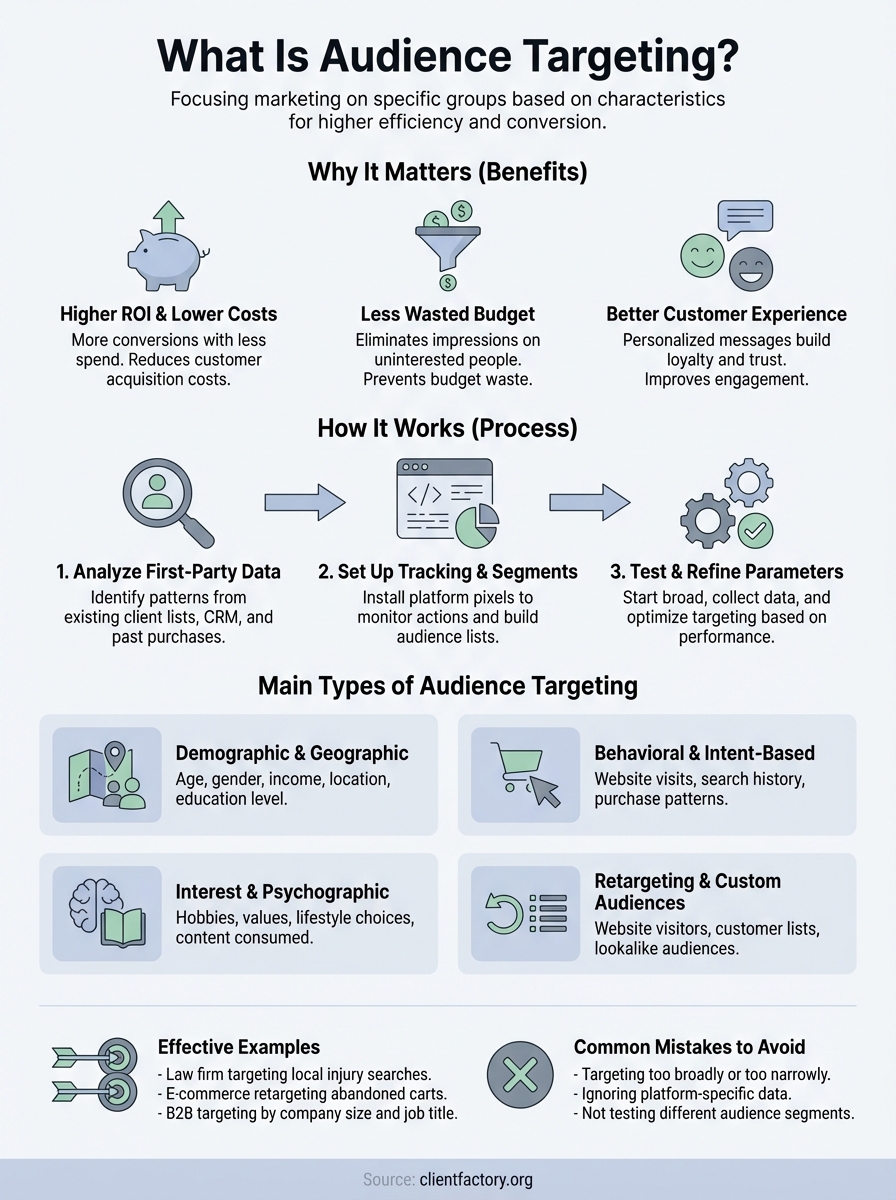
You get more conversions with less spend when you focus on qualified prospects. Targeted advertising reduces customer acquisition costs by eliminating impressions wasted on people who will never buy from you. Service businesses that segment their audiences see conversion rates improve by 50% or more compared to generic campaigns. Your ads reach people actively searching for solutions you provide, which means each click carries genuine buying intent instead of casual curiosity.
Personalized marketing delivers five to eight times the ROI on marketing spend compared to generic campaigns.
Less wasted budget on uninterested viewers
Every impression shown to the wrong person costs you money. Audience targeting prevents budget waste by filtering out demographics, locations, and interest groups that don’t match your ideal client profile. Law firms targeting local clients don’t need to pay for clicks from people three states away. Platform algorithms work more efficiently when you define clear audience parameters, which improves your ad quality scores and lowers your cost per click across Google, Facebook, and other networks.
Better customer experience leads to loyalty
People appreciate relevant messages that address their specific needs. Targeted campaigns create positive brand experiences because your ads show up when prospects need your help most. You build trust faster when your messaging demonstrates understanding of their challenges. 72% of consumers only engage with personalized marketing messages, which means generic outreach actively pushes potential clients toward competitors who speak directly to their situation.
How to use audience targeting in your campaigns
Implementing audience targeting requires a systematic approach that builds on your existing customer data and refines through continuous testing. You don’t need complicated tools or massive budgets to start, but you do need clarity about who your best customers are and where they spend time online. The process follows three core steps that work across every platform from Google Ads to Facebook to LinkedIn. Each step builds on the previous one, creating increasingly precise campaigns that deliver better results over time.
Start with first-party data from your business
Your existing customers hold the blueprint for finding more customers just like them. You should analyze your client list to identify common patterns in demographics, location, industry, company size, or specific problems they needed solved. This first-party data proves more valuable than any purchased list because it reflects real buying behavior from people who already trust you. CRM systems, email lists, and past purchaser data form the foundation of effective audience targeting.
Look at your best clients specifically, not just everyone who ever bought from you. High-value customers share characteristics that separate them from one-time buyers or difficult clients who consumed resources without providing profit. You can upload these customer lists directly to platforms like Google Ads and Facebook, which then find similar users through lookalike or similar audience features. This approach scales your reach while maintaining relevance because algorithms identify patterns you might miss manually.
Set up tracking and audience segments
Platform pixels and conversion tracking connect your website activity to ad performance. You need to install tracking codes from each advertising platform you use so they can monitor which visitors came from your ads and what actions they took afterward. Google Analytics, Facebook Pixel, and LinkedIn Insight Tag collect behavioral data that reveals what is audience targeting actually accomplishing for your business. Without proper tracking, you’re flying blind and can’t determine which audience segments produce results.

Build audience lists based on specific behaviors visitors demonstrate on your site. Retargeting audiences should include people who viewed service pages but didn’t complete contact forms, visited pricing information, spent significant time reading content, or abandoned mid-funnel actions. Create separate segments for each behavior because someone who viewed three service pages shows higher intent than someone who only read one blog post. Platform algorithms optimize delivery better when you provide clear signals about which audiences matter most to your business goals.
Proper tracking transforms raw traffic data into actionable audience insights that improve every campaign you run.
Test and refine your targeting parameters
Launch campaigns with broader targeting first, then narrow based on performance data. You want enough initial reach to gather statistically significant results before making dramatic changes to audience parameters. Run campaigns for at least two weeks and 500 clicks minimum before deciding which segments work. Performance metrics reveal which demographics, interests, and behaviors actually convert instead of just generating cheap clicks that waste budget.
Adjust your targeting by excluding poor performers and doubling down on winners. You should regularly review conversion rates by age group, location, device type, and interest categories to spot patterns in your data. Remove audience segments that cost more to acquire than their lifetime value justifies. Successful targeting evolves continuously as you learn more about your ideal customer profile through real campaign data rather than assumptions about who should be interested in your services.
Main types of audience targeting
Different targeting methods serve different campaign goals and stages of the customer journey. You can combine multiple targeting types within single campaigns to create highly specific audience segments that match your ideal client profile. Understanding what is audience targeting across various dimensions lets you choose the right approach for each marketing objective. Platforms like Google Ads and Facebook offer all these targeting options, though they may use different names or organize them in various menu structures within their interfaces.
Demographic and geographic targeting
Age, gender, income, education level, and location form the foundation of most targeting strategies. You narrow your audience by selecting specific demographic ranges that match who typically buys your services. Law firms targeting estate planning clients might focus on ages 55-75 with household incomes above $100,000, while personal injury attorneys need broader demographic reach within specific geographic regions. Location targeting becomes critical for service businesses that operate in defined areas since you only pay for ads shown to people who can actually become clients.

Geographic parameters range from entire countries down to zip codes or radius targeting around specific addresses. You should set location targeting based on where you actually provide services, not where you wish you could expand someday. Service radius matters more than state boundaries for most local businesses. Mobile location data makes geographic targeting more precise because platforms can serve ads to people currently in your target area, not just those who list it as their home address.
Behavioral and intent-based targeting
Actions people take online reveal their readiness to buy more accurately than demographics alone. Behavioral targeting tracks website visits, content consumed, products viewed, and past purchases to identify high-intent prospects. Someone who searched for “business attorney near me” three times this week shows stronger buying intent than someone who casually browsed legal articles months ago. Platforms analyze billions of behavioral signals to predict which users will most likely convert based on their digital footprint.
Purchase behavior and search history create powerful intent-based segments. You can target people actively researching solutions in your category, those who recently purchased related services, or users who engage frequently with content about problems you solve. In-market audiences on Google identify people currently shopping for specific services based on their search patterns and site visits. Intent signals let you reach prospects at the exact moment they need your help rather than interrupting them during unrelated activities.
Behavioral data transforms audience targeting from guessing about demographics to responding to actual buying signals.
Interest and psychographic targeting
People’s hobbies, values, lifestyle choices, and attitudes define interest-based audience segments. You reach users based on topics they follow, pages they like, content they engage with, and communities they join online. A financial advisor might target people interested in retirement planning, investment news, and wealth management content rather than just targeting high earners broadly. Interest targeting works particularly well for top-of-funnel awareness campaigns when you want to introduce your brand to people who haven’t heard of you yet.
Psychographic factors dig deeper than simple interests to understand motivations and values. Platform algorithms analyze the types of content users consume to infer their attitudes, beliefs, and priorities. You can target environmentally conscious consumers, budget-focused shoppers, early technology adopters, or luxury preference segments. These psychological profiles help craft messaging that resonates emotionally rather than just matching surface-level interests.
Retargeting and custom audiences
Website visitors who didn’t convert represent your warmest prospects outside existing clients. Retargeting shows ads to people who already interacted with your business but haven’t taken your desired action yet. These audiences convert at much higher rates than cold traffic because they already know your brand and demonstrated initial interest. You should create separate retargeting campaigns for different pages visited or actions taken since each behavior indicates different levels of buying intent.
Custom audiences built from your customer lists or email subscribers let you stay connected with people you already know. You upload contact information to advertising platforms, which match it to user accounts and show your ads to those specific people. Lookalike audiences expand your reach by finding new users who share characteristics with your best customers. This approach scales proven success patterns rather than testing random new segments hoping to find buyers.
Examples of effective audience targeting
Real-world applications demonstrate how what is audience targeting accomplishes in practice across different industries and campaign goals. These examples show specific combinations of targeting methods that deliver measurable results rather than theoretical approaches. You can adapt these proven strategies to your own business by identifying which patterns match your customer acquisition challenges. Each example illustrates how layering multiple targeting types creates more precise audience segments that convert at higher rates than single-dimension targeting alone.
Law firm targeting local injury victims
Personal injury attorneys achieve strong results by combining geographic radius targeting with behavioral signals and life events. You can target people within 25 miles of your office who recently searched for terms like “car accident lawyer” or “slip and fall attorney” on Google. Adding demographic layers such as adults aged 25-65 increases relevance since most injury clients fall within this range. Platforms like Facebook let you layer recent life events such as “recently moved” or “new job” that might correlate with circumstances leading to injuries.

Retargeting sequences nurture prospects who visited your case evaluation pages but didn’t submit contact forms. You show follow-up ads emphasizing free consultations, client testimonials, and results achieved for similar cases. Sequential messaging moves from awareness to urgency over seven to ten days. This layered approach typically reduces cost per consultation by 40-60% compared to broad “attorney near me” campaigns that ignore behavioral intent signals.
E-commerce retargeting abandoned carts
Online retailers recover lost sales by targeting shoppers who added products to carts but didn’t complete checkout. You create audience segments based on cart value thresholds since high-value abandoners justify higher retargeting budgets than low-value ones. Dynamic product ads show the exact items people left behind, which triggers memory and removes friction from the purchase decision. Time-based sequencing delivers escalating incentives like free shipping after 24 hours and percentage discounts after 48 hours to convert hesitant buyers.
Cart abandonment retargeting converts 10-30% of lost shoppers into customers when properly sequenced with relevant incentives.
B2B targeting by company characteristics
Software companies reach qualified leads by targeting specific company sizes, industries, and job titles on LinkedIn. You can show ads exclusively to marketing directors at companies with 50-500 employees in healthcare, manufacturing, or professional services sectors. Adding behavioral targeting for people who visited competitor websites or engaged with industry content increases conversion likelihood. Account-based marketing strategies take this further by uploading lists of specific target companies and serving personalized ads to decision-makers at those organizations.
Common audience targeting mistakes to avoid
Even marketers who understand what is audience targeting means still make costly errors during implementation. You waste budget and miss opportunities when you repeat these common targeting mistakes that drain performance from otherwise solid campaigns. Recognizing these pitfalls before they hurt your results saves money and accelerates your path to profitable audience segments. Each mistake outlined below has specific fixes you can apply immediately to improve campaign performance.
Targeting too broadly or too narrowly
Campaigns fail when you set audience parameters at either extreme of the specificity spectrum. Broad targeting dilutes your message across people who will never buy while eating through budget on irrelevant clicks. Service businesses targeting “all adults 18-65” essentially target nobody because the segment lacks cohesion around shared needs or interests. Overly narrow targeting creates the opposite problem by restricting your reach so severely that algorithms can’t gather enough data to optimize delivery or you exhaust your tiny audience within days.
You should start with moderately specific targeting that balances reach with relevance. Test audience sizes between 50,000 and 500,000 people initially, then expand winners or narrow losers based on performance data. Platform recommendations for minimum audience size exist for good reason since smaller segments prevent effective optimization. Your sweet spot lies where audience definition clearly matches your ideal client without creating such a small pool that you can’t scale successful campaigns.
Ignoring platform-specific data
Each advertising platform collects unique behavioral signals you should leverage instead of using identical targeting everywhere. Google captures search intent while Facebook tracks social engagement and interests, which means the same person appears differently across platforms. You miss conversion opportunities when you ignore these platform-specific insights. Conversion data from one platform should inform but not dictate targeting on other channels since user behavior varies by context and platform purpose.
Platform algorithms know more about user behavior within their ecosystems than you can learn from external data sources.
Not testing different segments
Assumptions about your ideal customer often prove wrong when tested against real campaign data. You need to run controlled tests comparing different demographic ranges, interest combinations, and behavioral triggers to discover which segments actually convert. Many businesses assume younger audiences prefer their services when data reveals older segments buy more frequently at higher values. Systematic testing reveals unexpected high-performers that you would have missed by relying solely on intuition or industry stereotypes.
Key takeaways
Understanding what is audience targeting means for your business transforms how effectively you spend marketing dollars. You reach qualified prospects instead of wasting budget on people who will never buy when you segment audiences by demographics, behaviors, interests, and intent signals. Start with your existing customer data to identify patterns, implement proper tracking across platforms, and test different segments systematically. Your campaigns will deliver higher conversion rates and lower acquisition costs as you refine targeting based on real performance data rather than assumptions.
Avoid the common mistakes of targeting too broadly or too narrowly, ignoring platform-specific insights, and failing to test multiple audience segments. Each platform collects unique behavioral signals you should leverage to improve campaign performance. Ready to transform your client acquisition strategy with data-driven audience targeting? Client Factory specializes in building optimized marketing funnels that convert qualified prospects into paying clients through precise targeting and proven strategies.