

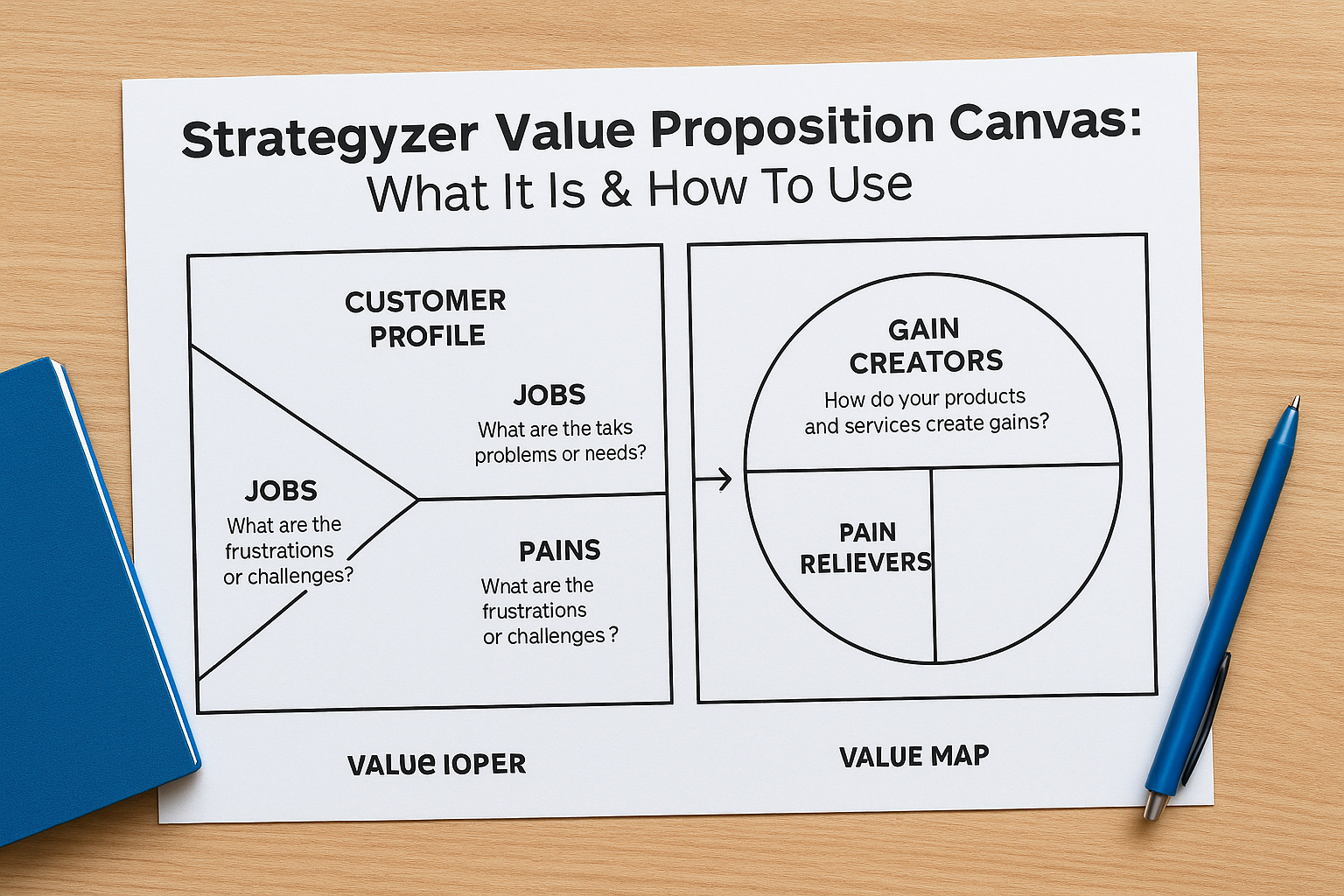
Most businesses struggle to articulate why customers should choose them over competitors. They know their product is good, but translating that into messaging that resonates? That’s where things fall apart. The Strategyzer Value Proposition Canvas solves this problem by giving you a structured framework to map exactly what your customers need and how your offer delivers it.
At Client Factory, we’ve seen firsthand how a clear value proposition transforms marketing performance. When your messaging aligns with what customers actually want, your funnels convert better, your ads cost less, and your sales conversations become easier.
This guide covers everything you need to know: what the Value Proposition Canvas is, how to fill it out step by step, and where to download the official template. Whether you’re launching a new service or refining an existing offer, you’ll walk away with a tool that clarifies your market positioning and strengthens your client acquisition strategy.
What the Strategyzer Value Proposition Canvas is
The Strategyzer Value Proposition Canvas is a visual tool that helps you design products and services around what your customers actually need. Created by Alex Osterwalder and his team at Strategyzer, this framework breaks down the relationship between what you sell and who buys it into two interconnected parts: the customer profile and the value map. You use it to ensure your offer solves real problems rather than imagined ones.
Unlike traditional marketing exercises that start with features and benefits, the canvas forces you to begin with the customer. You map their jobs, pains, and gains first, then design your offering to match. This approach prevents the common mistake of building something you assume people want, only to discover they don’t care about those features at all.
The canvas gives you a structured way to test whether your product and your market actually fit together before you spend money proving they don’t.
The two-sided framework
The canvas divides into two distinct halves that mirror each other. On the right side, you have the customer profile, which captures everything about your target customer’s world. On the left side sits the value map, which describes how your product or service creates value for that customer. Your goal is to make these two sides align perfectly.
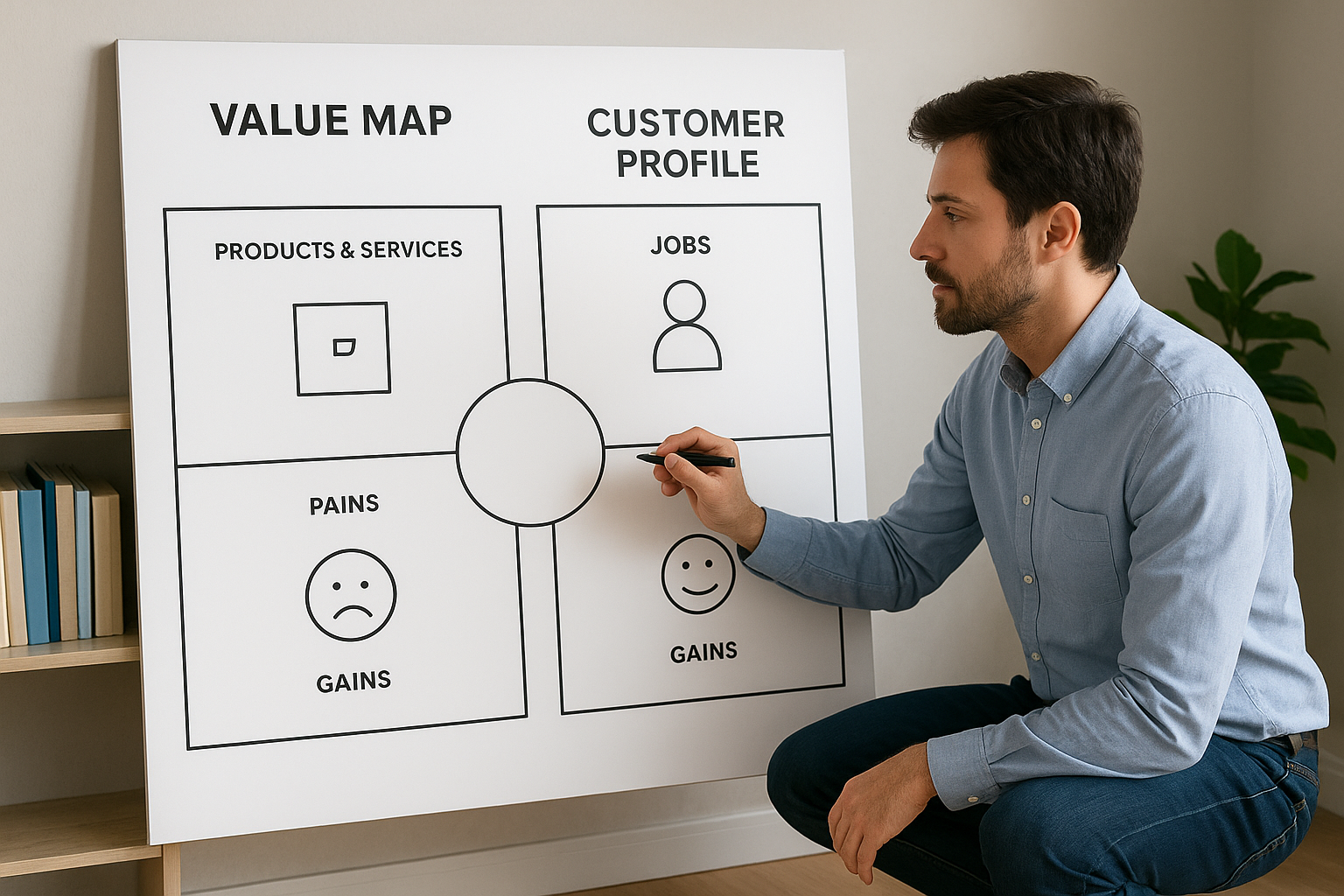
This mirroring structure makes gaps obvious. When you can’t connect a feature on your value map to a specific customer pain or gain, you’ve identified wasted effort. Conversely, when you spot a customer pain with no matching pain reliever in your offer, you’ve found an opportunity to strengthen your positioning. The visual layout makes these insights immediate rather than theoretical.
Origins and purpose
Alex Osterwalder designed the strategyzer value proposition canvas as a plug-in tool for the Business Model Canvas, another framework he created. While the Business Model Canvas maps your entire business model, the Value Proposition Canvas zooms in on the relationship between your offer and your customer segment. It evolved from his doctoral research and years of consulting with companies that struggled to articulate their value clearly.
The canvas emerged because businesses kept making the same mistake: they talked about themselves instead of addressing customer needs. Osterwalder wanted a simple, visual method that anyone could use to shift their perspective from product-centric to customer-centric thinking. The result is a one-page tool that forces this mental shift through its structure alone.
What makes it different from other frameworks
Most value proposition exercises end with vague statements like “we provide quality service.” The Strategyzer canvas prevents this by requiring specific, granular details about customer jobs, pains, and gains. You can’t fill it out properly without doing real customer research or at least articulating concrete assumptions you need to test.
The canvas also integrates directly into your client acquisition strategy. Once you complete it, you have the raw material for ad copy, landing pages, sales scripts, and positioning statements. Everything you write becomes more targeted because you’ve already mapped exactly what your customers care about and how you address it. This makes your marketing more efficient and your conversion rates higher.
Why the canvas matters for product-market fit
You can’t achieve product-market fit by guessing what customers want. The strategyzer value proposition canvas forces you to test whether your assumptions align with reality before you invest in building, marketing, or scaling. Most businesses skip this step and wonder why their conversion rates stay low despite increasing ad spend. The canvas prevents this waste by making you articulate specific customer problems and verify that your solution addresses them.
Product-market fit happens when your offer solves a problem customers care about enough to pay for. The canvas gives you a visual method to assess this alignment at a glance. When you can draw clear lines between customer pains and your pain relievers, between customer gains and your gain creators, you’ve found fit. When those connections feel forced or vague, you haven’t. This clarity saves you from launching campaigns that were doomed from the start.
The canvas turns product-market fit from an abstract goal into something you can measure and improve systematically.
Validates assumptions before you spend money
Every business operates on assumptions about what customers need and whether their product delivers it. The canvas exposes these assumptions by requiring you to write them down explicitly. Once visible, you can test them through customer interviews, surveys, or small experiments rather than betting your entire marketing budget on ideas you’ve never validated.
This validation process catches expensive mistakes early. You might discover that the feature you planned to highlight in all your ads actually solves a problem customers don’t have. Or you might find that your target audience cares deeply about a pain point you hadn’t considered addressing. Both insights change how you position your offer and where you allocate resources.
Identifies gaps in your current offer
Filling out the canvas reveals where your value proposition falls short. When you map customer pains and gains but can’t identify corresponding elements in your product or service, you’ve found a competitive vulnerability. Your competitors may already address these gaps, or you’ve stumbled onto an opportunity to differentiate yourself.
These gaps also explain why your marketing messaging might feel weak. If you can’t connect your features to specific customer outcomes, your copy becomes generic. The canvas shows you exactly where to strengthen your positioning by highlighting which customer needs remain unmet by your current offer.
How the canvas works: customer profile and value map
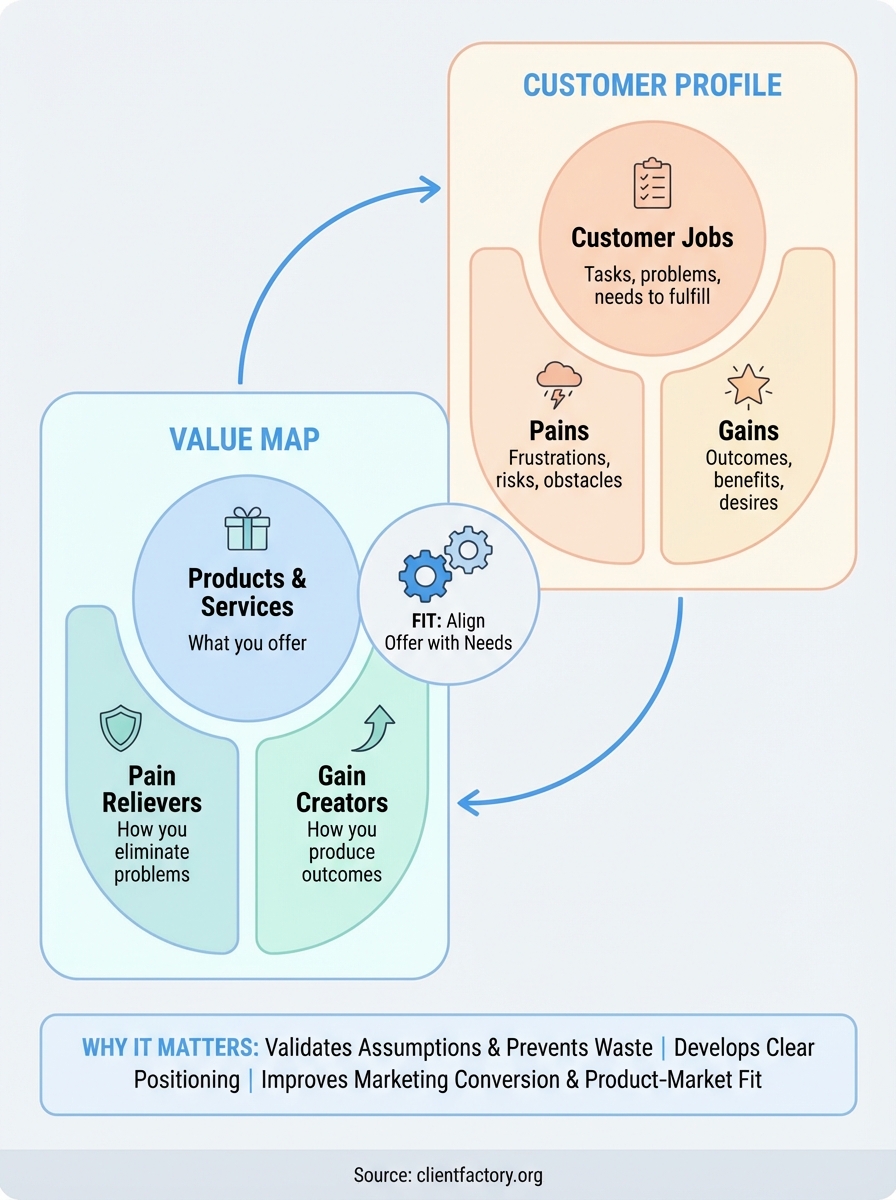
The strategyzer value proposition canvas operates through two interconnected sections that force you to think about your customer before your product. The right side maps your customer segment in detail, while the left side describes your value proposition. You fill out the customer profile first, then design your value map to match what you discovered about your customer’s world.
The customer profile side
The customer profile breaks down into three components that capture your target customer’s reality. Customer jobs describe the tasks they’re trying to complete, problems they’re solving, or needs they’re satisfying. These can be functional (specific tasks), social (how they want to be perceived), or emotional (feelings they want to achieve). You list everything your customer is trying to do in their work or life that relates to your offer.
Pains represent the negative outcomes, risks, and obstacles your customers experience before, during, or after completing their jobs. These include frustrations, undesired costs, negative emotions, and unwanted situations. You capture everything that annoys them, blocks them, or makes their jobs harder. The more specific you get, the better your messaging becomes later.
Gains describe the positive outcomes and benefits your customers want. These include required outcomes, expected benefits, desires, and wishes. You map what would make their job easier, what would delight them, and what outcomes would exceed their expectations. Gains range from functional utility to emotional satisfaction and social impact.
The value map side
The value map mirrors the customer profile structure exactly. Products and services lists everything you offer that helps customers complete jobs or satisfy needs. You include both tangible deliverables and supporting services. This section forces you to inventory what you actually provide rather than what you wish you provided.
Pain relievers describe how your products and services eliminate or reduce customer pains. You connect specific features to specific problems your customers face. If you can’t draw this connection clearly, that feature probably doesn’t matter to customers.
The magic happens when you can draw direct lines from your pain relievers to customer pains and from your gain creators to customer gains.
Gain creators explain how your offer produces outcomes and benefits customers want. You detail which features deliver expected results, exceed expectations, or create pleasant surprises. Strong gain creators address both functional requirements and emotional desires your customers have.
How to fill it out step by step
You always start with the customer side of the strategyzer value proposition canvas before touching your value map. This sequence prevents you from shoehorning customer needs into features you’ve already decided to build. Grab the official Strategyzer template and work through each section systematically rather than jumping around.
Start with customer jobs
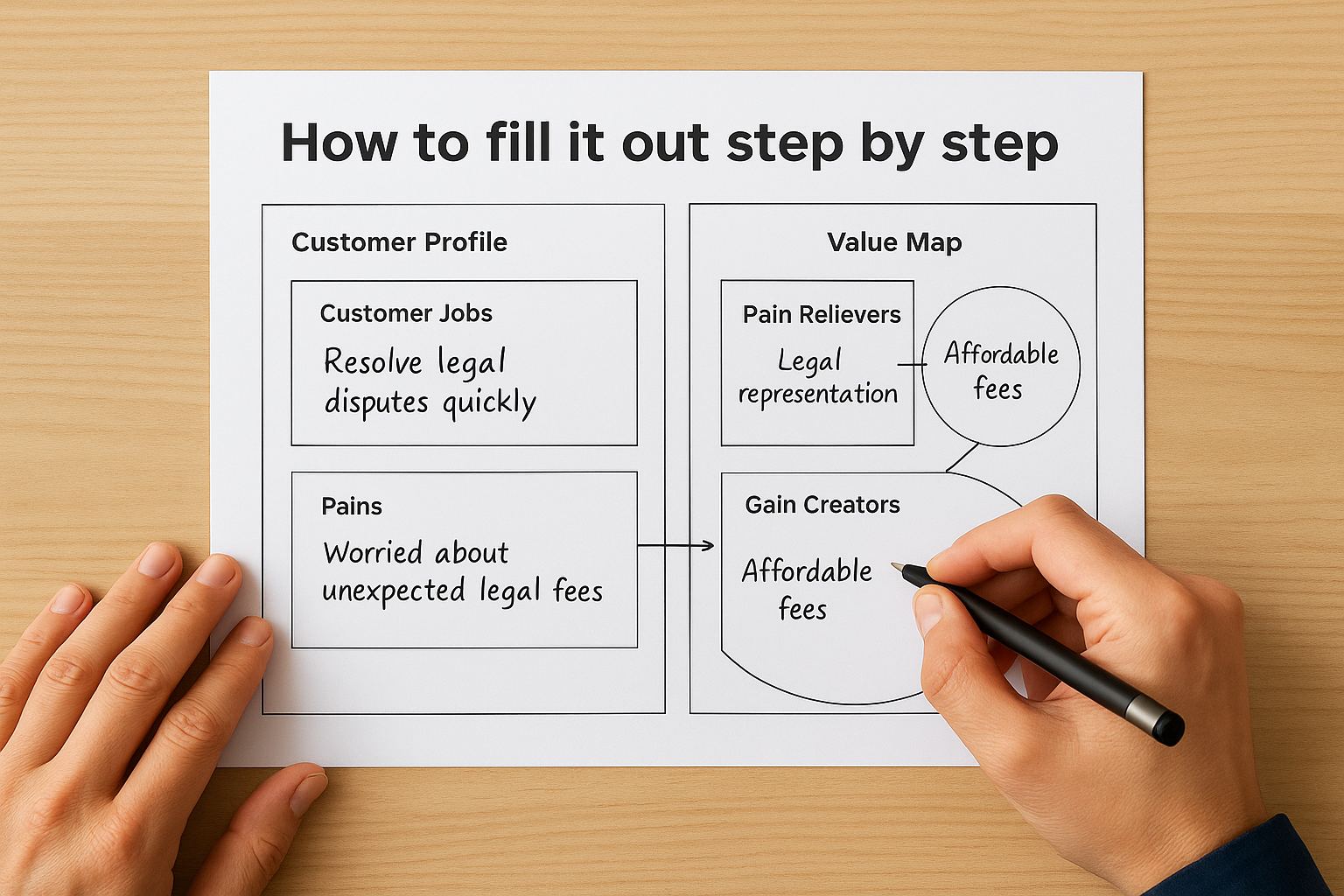
List every task, problem, or need your target customer segment deals with that relates to your offer. Write functional jobs first (tasks they need to complete), then add social jobs (how they want to appear to others) and emotional jobs (how they want to feel). For a law firm, functional jobs might include “resolve legal disputes quickly” while emotional jobs could be “feel confident about legal protection.” You need at least five to ten jobs to capture the full picture.
Map pains and gains
Document everything that frustrates your customers about completing their jobs. Pains include obstacles, risks, and negative emotions they experience before, during, or after trying to accomplish their tasks. Then flip to gains and capture the outcomes they want, benefits they expect, and results that would delight them. Concrete details matter more than vague statements here. “Worried about unexpected legal fees” beats “wants good value.”
The more specific your customer insights, the sharper your marketing becomes.
Build your value map
Now shift to the left side and list your actual products and services. Connect each offering to specific customer jobs you identified earlier. Don’t invent features you might add someday. Stick to what you deliver today. This honesty reveals where your offer falls short and where it excels.
Define pain relievers and gain creators
Match your features to customer pains and gains explicitly. Pain relievers explain how you eliminate or reduce problems your customers face. Gain creators describe how you produce outcomes they want. Draw literal lines between elements on both sides of the canvas if that helps you see connections. When you can’t connect a feature to a customer need, you’ve found either wasted effort or unclear positioning.
Test for fit
Step back and evaluate whether your value map addresses the most important pains and gains from your customer profile. Perfect alignment means your offer solves problems customers care about most. Gaps indicate opportunities to strengthen your positioning or adjust your service delivery. You achieve product-market fit when customers recognize your value proposition immediately because it speaks directly to their experience.
Examples for service businesses and law firms
You understand the framework better when you see it applied to real situations. Service businesses and law firms benefit enormously from the strategyzer value proposition canvas because their value often feels intangible to customers. Concrete examples show you exactly how to map customer needs and position your services to address them. These scenarios demonstrate how the canvas translates abstract concepts into actionable marketing insights.

Family law firm serving divorcing clients
A family law practice identifies customer jobs that include “finalize divorce quickly,” “protect assets during separation,” and “minimize emotional stress on children.” Their customers experience pains like “fear of losing custody,” “uncertainty about legal costs,” and “overwhelming paperwork and deadlines.” The gains they want include “clear communication from their attorney,” “fair division of assets,” and “reduced conflict with ex-spouse.”
On the value map side, this firm lists products and services like divorce mediation, custody arrangement planning, and asset division strategy. Their pain relievers address specific fears by offering flat-fee pricing (eliminates cost uncertainty), dedicated client portals (reduces paperwork confusion), and child-focused mediation (minimizes stress on kids). Gain creators include weekly case updates (delivers clear communication), collaborative divorce options (reduces conflict), and expedited filing services (completes divorce faster). You see immediately how each service element connects to a specific customer need rather than generic legal expertise.
When you map your services against real customer pains and gains, your positioning becomes obvious rather than invented.
Digital marketing agency targeting service businesses
A marketing agency helping service businesses acquire clients maps customer jobs like “generate qualified leads consistently,” “convert website visitors into clients,” and “prove marketing ROI to stakeholders.” Their customers face pains including “wasted ad spend on unqualified clicks,” “confusing marketing metrics,” and “difficulty tracking leads through the sales process.” They want gains such as “predictable monthly lead flow,” “higher conversion rates from existing traffic,” and “clear dashboard showing cost per client.”
The agency’s products and services include conversion funnel optimization, paid advertising management, and analytics setup. Pain relievers target wasted spend through audience research and A/B testing, eliminate metric confusion with custom dashboards, and solve tracking problems through proper CRM integration. Their gain creators deliver predictable leads via retargeting campaigns, improve conversions through landing page optimization, and provide ROI clarity with attributed revenue tracking. This mapping transforms how they describe their services because every feature now solves a documented problem clients actually have.
Best practices and mistakes to avoid
Your strategyzer value proposition canvas only works when you fill it out honestly and specifically. Most businesses sabotage their results by rushing through the process or treating it like a marketing exercise rather than a discovery tool. You need to approach the canvas with genuine curiosity about your customers instead of trying to validate what you already believe. The difference between a useful canvas and a waste of time comes down to how rigorously you follow proven practices and avoid predictable traps.
Common mistakes that weaken your canvas
The biggest mistake you can make is filling out the canvas alone in your office. Customer insights come from customers, not from your assumptions about what they think. When you skip interviews, surveys, or direct conversations, you end up projecting your own beliefs onto your customer profile. This creates a canvas that confirms your biases rather than revealing truth about your market.
Another failure point happens when you stay too vague with your language. Writing “customers want quality service” or “businesses need better results” tells you nothing useful. Specific pains beat generic complaints every time. Your customers don’t say “I want quality,” they say “I’m frustrated when vendors don’t respond to emails for three days” or “I waste two hours weekly reconciling conflicting reports.” The more concrete your customer profile, the sharper your messaging becomes.
Vague customer insights produce vague marketing that converts poorly.
You also damage your canvas when you list features you plan to build instead of services you deliver today. The canvas maps your current value proposition, not your future roadmap. Mixing what you offer now with what you might offer later creates confusion about where you actually stand in the market. Save future features for a separate planning document.
Best practices for better results
Start by interviewing at least five to ten customers before you touch the canvas. Record their exact words when they describe problems, frustrations, and desired outcomes. This language becomes your marketing copy later, so you want their authentic voice rather than your interpretation of it. You capture insights you’d never guess sitting at your desk.
Update your canvas quarterly as you learn more about your customers and refine your offer. Markets shift and customer needs evolve, so treating the canvas as a one-time exercise leaves you with outdated positioning. Regular updates keep your value proposition aligned with current customer reality and help you spot emerging opportunities before competitors do.
Next steps
The strategyzer value proposition canvas gives you a proven framework to align your offer with customer needs. You’ve learned how to map customer jobs, pains, and gains, then build a value map that addresses each element systematically. Download the official template from Strategyzer and block out two hours to complete your first draft. You won’t get it perfect immediately, but you’ll spot gaps in your positioning that explain why your marketing underperforms.
Schedule customer interviews within the next week to validate your assumptions. Talk to at least five current clients and ask them to describe their problems in their own words. Record these conversations and use their language to refine your canvas. The insights you gain will transform how you write ads, design landing pages, and structure sales conversations.
Your value proposition becomes your competitive advantage when you execute it consistently across every customer touchpoint. If you need help turning your refined value proposition into a high-converting client acquisition system, Client Factory specializes in building data-driven funnels that transform clicks into paying clients.