
You’ve got a great service. Maybe you’re a law firm that wins cases, or a service business with five-star reviews stacked to the ceiling. But none of that matters if the right people never find you. That’s where paid advertising for beginners comes in, it’s the fastest way to put your business in front of people who are actively looking for what you offer.
Unlike SEO or word-of-mouth, paid ads give you control over who sees your message, when they see it, and where they see it. You set the budget. You pick the audience. You measure every dollar. But here’s the catch: without understanding the fundamentals, it’s easy to burn through cash with nothing to show for it. The difference between a profitable campaign and an expensive mistake often comes down to how well you understand the mechanics before you hit “publish.”
At Client Factory, we’ve managed paid advertising campaigns across Google, Facebook, and YouTube for service businesses and law firms for over 30 years combined. We’ve seen what works, what wastes money, and what actually moves the needle on client acquisition. This guide distills that experience into a clear, actionable starting point, covering how ad auctions work, what platforms to consider, how to set up your first campaign, and how to avoid the rookie mistakes that drain budgets fast.
Why paid advertising matters for growth
Most business owners assume that if they build a great service, clients will naturally find them. But in a competitive market, waiting for organic traffic to grow your client base is a slow, unpredictable strategy. Paid advertising puts you in front of the right audience on your timeline, not the search engine’s. Understanding why it matters is the first step toward using it well.
The limits of relying on organic alone
Organic search, social posts, and referrals all have real value. But they share one major weakness: you don’t control the pace. SEO can take six to twelve months to show meaningful results, and algorithm changes can erase rankings you spent months building. Social media organic reach has dropped sharply across most platforms, meaning your posts may reach only a fraction of your followers without a paid boost behind them.
For any business that needs to generate clients consistently and predictably, organic alone rarely cuts it. Paid advertising fills that gap by giving you a reliable, controllable channel that delivers measurable results on a timeline you set, not one that depends on platform algorithms or how many people happen to share your content this week.
Paid advertising doesn’t replace organic growth. It gives you a lever you can pull immediately while your long-term channels build momentum.
Speed and scale that organic channels can’t match
When you launch a paid campaign, results start coming in within hours, not months. You can test different messages, audiences, and offers in real time and cut what isn’t working before it does serious damage to your budget. That fast feedback loop is one of the most powerful things paid advertising offers, especially when you’re still learning what resonates with your specific audience.
Scale is the other major advantage. Once you find a campaign that converts reliably, you can increase your budget and reach more people without starting from scratch. That’s almost impossible to replicate with organic channels, where doubling your content output rarely doubles your results. With paid ads, the relationship between investment and output is far more direct and controllable.
Precision targeting that reaches actual buyers
One of the biggest misconceptions people carry into paid advertising for beginners is that you’re blasting your message at everyone and hoping someone bites. That’s not how modern paid advertising works. Platforms like Google Ads and Meta’s advertising platform let you narrow your audience by location, age, household income, job title, search intent, past browsing behavior, and much more.
That level of targeting means your ad budget goes toward people who are already looking for what you offer, not random visitors who will never convert. For a law firm targeting personal injury clients in a specific metro area, or a home services company reaching homeowners within a ten-mile radius, this precision separates a profitable campaign from an expensive guessing game. You’re buying direct access to motivated buyers, which is something no organic strategy can replicate on demand.
When you combine speed, scale, and targeting precision, paid advertising becomes one of the most effective growth levers available to service businesses and law firms. The key is knowing how to use it correctly from the start.
How paid ads work behind the scenes
Before you spend a single dollar, you need to understand what actually happens between clicking “publish” on an ad and having it show up in front of a potential client. Most people new to paid advertising for beginners assume the highest bidder always wins the top spot. The reality is more nuanced, and understanding it gives you a real advantage from day one.
The auction that runs every time someone searches
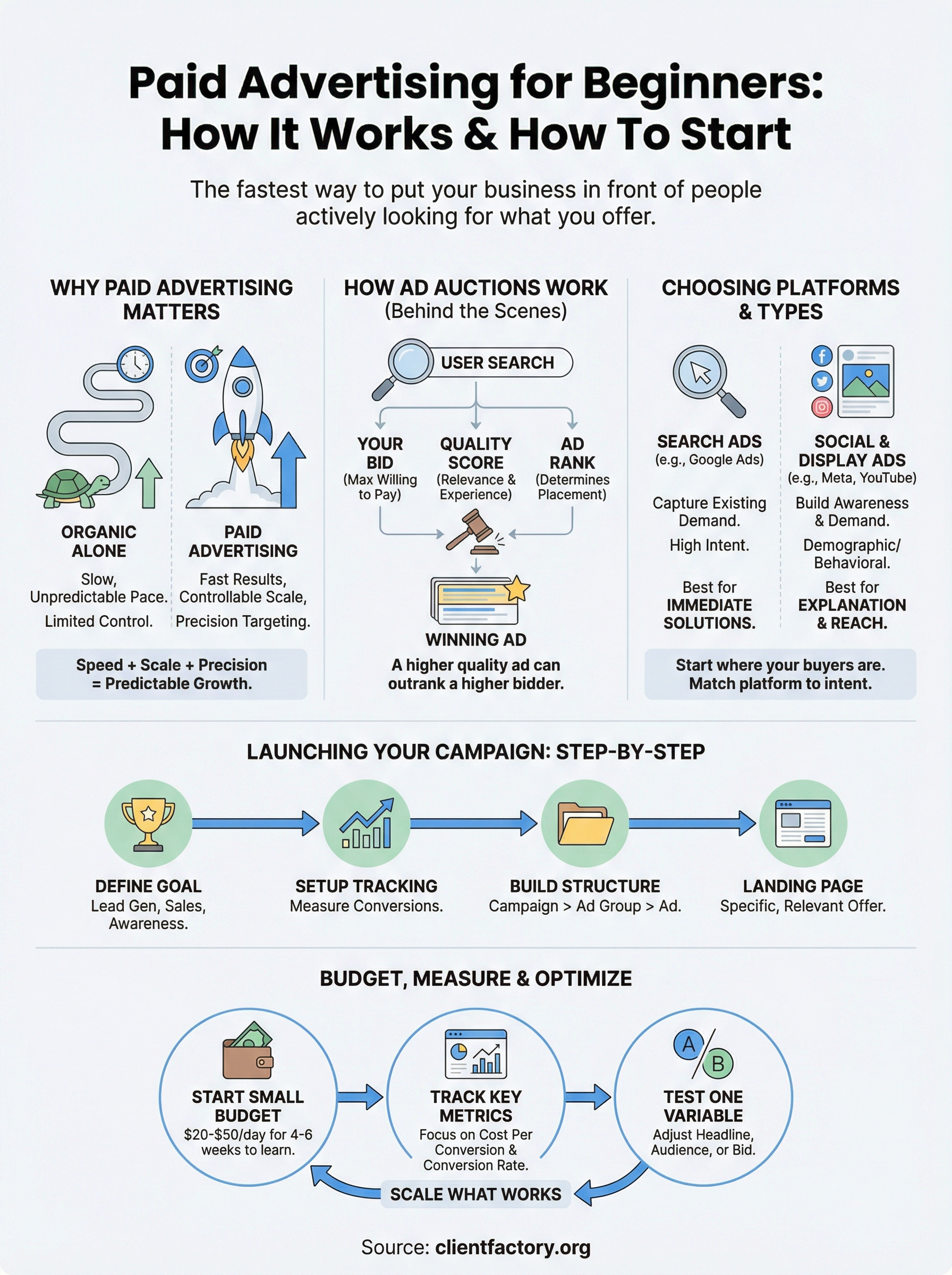
Every time a user types a search query or loads a webpage, an automated auction runs in milliseconds to determine which ads appear and in what order. On Google, this happens billions of times a day. You submit a maximum bid, which is the most you’re willing to pay per click, and Google combines that bid with other factors to calculate your Ad Rank, the score that determines your placement in results.

Your bid matters, but it’s not the only thing that determines whether your ad wins the auction.
Ad Rank also factors in your expected click-through rate, your ad relevance to the search query, and the quality of the landing page users reach after clicking. This means a well-crafted, relevant ad can outrank a competitor who bids more, simply because your ad is a better match for what the user is actually looking for.
How quality score affects what you pay
Google assigns each of your keywords a Quality Score on a scale of one to ten, based on three things: your expected click-through rate, the relevance of your ad copy to that keyword, and the experience users have when they land on your page. A higher Quality Score lowers the actual cost per click you pay and improves your placement in results.
This is why two advertisers with the same budget can get very different results from the same platform. An advertiser with a Quality Score of eight will pay less per click and earn better placement than a competitor with a score of four. When you understand this mechanic, you stop chasing bids and start focusing on ad relevance and landing page quality, which is where real, lasting efficiency gains come from.
How to pick the right ad types and platforms
Not every platform fits every business, and choosing the wrong one is one of the most common ways beginners waste their first ad budget. Before you set up an account and start spending, you need to understand what each major ad type does and which platforms align with how your target clients actually behave online.
Search ads, display ads, and social ads explained
Search ads appear when someone types a specific query into a search engine. On Google Ads, your ad shows up at the top of results when someone searches for a term you’re bidding on. This is the highest-intent ad format available, because you’re reaching people who are actively looking for a solution at that exact moment. For service businesses and law firms, search ads almost always deserve a place in your strategy.
Display ads work differently. Instead of targeting search behavior, display ads appear as banner images across websites, apps, and YouTube. They’re better for building awareness than capturing immediate demand, which makes them a smarter choice once you’ve built a baseline understanding of paid advertising for beginners and want to scale your reach beyond people who are already searching for your service.
Search ads capture existing demand. Display and social ads help you create it.
Matching the platform to your business type
Social ads on platforms like Meta let you target people based on demographic and behavioral signals rather than search intent. This works well when your offer needs some explanation or when you’re trying to reach a specific audience profile, like homeowners in a particular income bracket or business owners in a specific industry. The tradeoff is that these users aren’t searching for you, so your ad needs to stop their scroll and make a compelling case quickly.
A simple way to choose your starting platform: if your potential clients are already searching for what you offer, start with Google search ads. If you need to introduce them to a problem or solution they haven’t looked up yet, begin with social ads on Meta. Most businesses eventually use both, but starting on the platform that matches your buyer’s current awareness level gives you the fastest path to real results.
How to set goals, tracking, and landing pages
Running paid ads without defined goals is like driving without a destination. Before you touch any ad platform settings, you need to know what a successful outcome looks like for your specific business and how you plan to measure it. Most beginners skip this step and end up with data they can’t act on.
Define your campaign goal before you spend anything
Your campaign goal shapes every decision that follows, from which platform you use to how you write your ad copy. The three most common goals for service businesses are lead generation (capturing contact information from potential clients), direct conversions (getting someone to book a call or fill out a form), and brand awareness (reaching a large audience to build recognition over time). Pick one primary goal per campaign, not all three at once, because trying to optimize for multiple outcomes at the same time produces results that are mediocre and hard to interpret.
A single, clearly defined goal gives your campaign a measurable standard to hit and makes optimization far simpler.
Set up conversion tracking from day one
Conversion tracking tells you which specific ads, keywords, and audiences are driving real results versus which ones are draining your budget quietly. On Google Ads, you set this up by placing a small piece of code on your confirmation page, the page someone sees after submitting a form or completing a booking. Google’s conversion tracking guide covers the exact setup steps for each scenario.
For anyone serious about paid advertising for beginners, getting conversion tracking live before the first campaign launches is non-negotiable. Without it, you might see clicks and assume the campaign is working, only to realize later that none of those clicks became actual paying clients.
Build landing pages that match your ad’s promise
Your landing page is where clicks either convert into clients or disappear entirely. A common mistake is sending traffic to a general homepage that doesn’t match the specific offer in the ad. When someone clicks an ad about a free consultation and lands on a generic homepage, the disconnect breaks trust immediately and they leave.
Build a dedicated landing page for each campaign that mirrors the ad’s exact message, includes one clear call to action, and removes navigation links that pull visitors away before they convert.
How to launch your first campaign step by step
With your goals defined, tracking in place, and a landing page ready, you can move forward with building the actual campaign. The order you follow matters more than most beginners expect, because each layer of your campaign structure depends on the decisions made in the layer before it. Rushing through this process is one of the most reliable ways to burn through your first budget without learning anything useful.
Build your campaign structure first
Every Google Ads campaign breaks down into three levels: the campaign level (where you set your budget, bidding strategy, and target network), the ad group level (where you cluster related keywords together), and the ad level (where your copy lives). Keeping this hierarchy clean from the start makes optimization far easier later. A common mistake among people new to paid advertising for beginners is dumping all their keywords into a single ad group, which makes it almost impossible to write relevant ads for each specific search term.
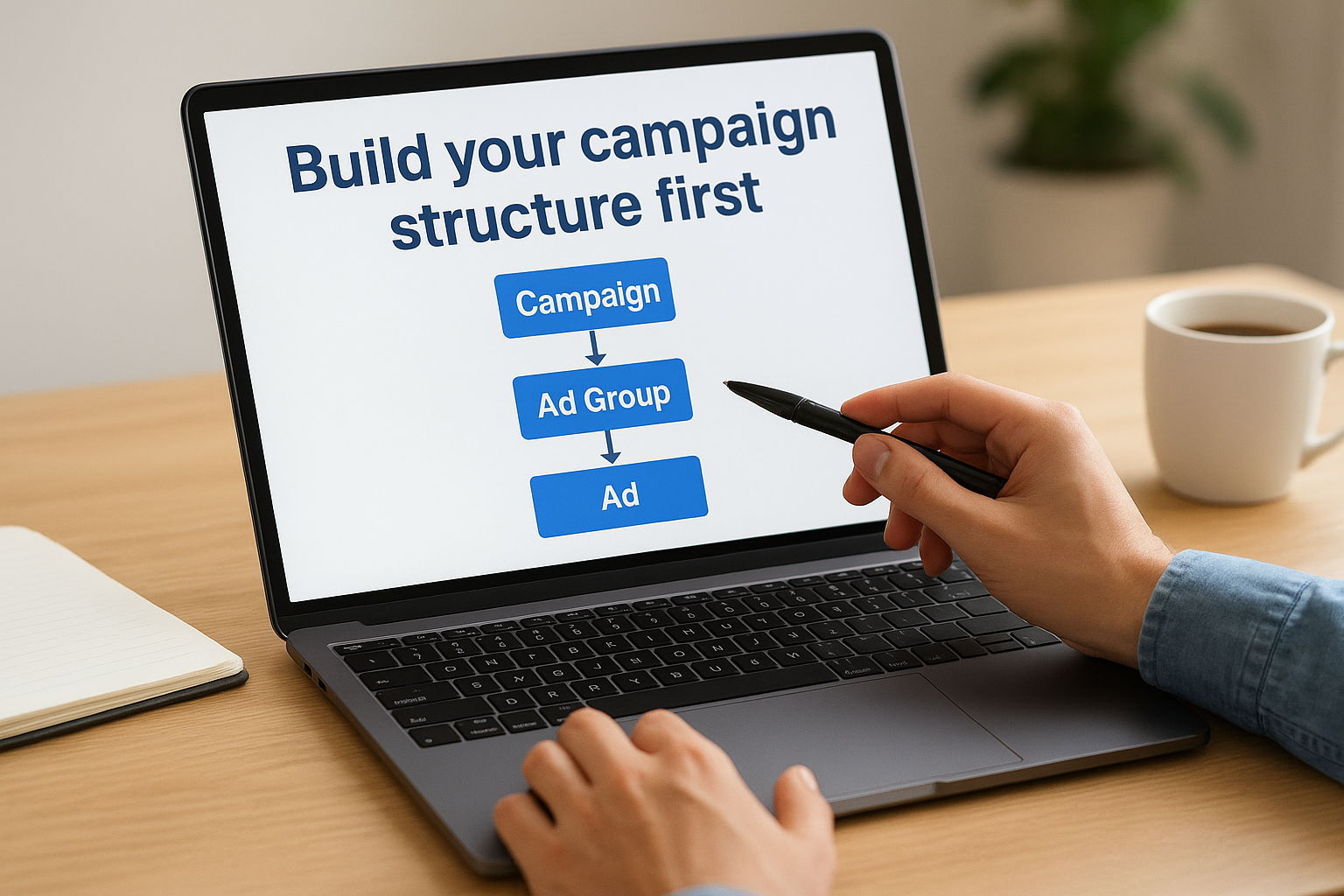
Start with a tight, focused structure to keep your data clean and your ads relevant:
- Set your daily budget at the campaign level
- Group keywords by search intent, not just topic
- Write separate ads for each ad group so copy matches the keyword closely
- Use at least two ad variations per group to run a basic test from launch
Write ad copy that earns the click
Your headline carries the most weight in the entire ad. Most users decide in under three seconds whether to click or keep scrolling, so your headline needs to match what they searched for and signal immediately that you have the answer they want. Mirror the language your potential clients actually use, not the internal terms or industry phrases they would never type into a search bar.
The strongest ad copy starts with the customer’s problem, not your business’s credentials.
Your description lines should reinforce the headline, highlight one specific benefit, and close with a direct action. “Get a free consultation today” consistently outperforms “Learn more” because it tells the reader exactly what happens next and removes hesitation before they click. Keep it simple, specific, and focused on what the reader gains.
How to budget, measure ROI, and optimize
Setting a budget without understanding your numbers first is one of the most common mistakes in paid advertising for beginners. Your starting budget should be small enough to protect your cash flow if the first tests fail, but large enough to generate real data before you draw conclusions. As a practical baseline, plan to collect at least 50 to 100 clicks per ad group over a full month before deciding whether a campaign is working or needs to be cut.
Set a starting budget you can learn from
Most beginners set a daily budget so low that campaigns never leave the learning phase, then pull the plug after two weeks and conclude that paid advertising doesn’t work. Give your campaigns four to six weeks at a consistent daily spend before making structural changes. Starting with a daily budget between $20 and $50 on a single focused campaign gives platforms like Google Ads enough signal to optimize delivery without exposing you to significant financial risk while you’re still learning.
Track the metrics that actually matter
Clicks and impressions are the numbers most beginners watch, but they tell you almost nothing about whether your campaign is generating revenue. Focus on cost per conversion, which is your total spend divided by the number of qualified leads or bookings you received. Pair that number with your average client lifetime value, and you’ll know in clear terms whether each campaign is returning a profit or running at a loss.
If your cost per conversion stays below your average client value, you have a campaign worth scaling.
Your conversion rate, the percentage of clicks that become actual leads, reveals whether your landing page is doing its job. A strong click-through rate paired with a low conversion rate almost always points to a landing page issue, not an ad problem.
Adjust one variable at a time
Optimization only produces reliable data when you change a single variable and let results accumulate before drawing conclusions. Test one headline, wait for enough clicks to matter, then evaluate. Changing your headline, audience, and bid strategy at the same time makes it impossible to know which adjustment actually moved the needle. Disciplined, methodical testing is what separates advertisers who build profitable campaigns from those who keep starting over.
A simple plan to move forward
You now have a complete foundation for paid advertising for beginners: how auctions work, which platforms fit which goals, how to structure campaigns, and how to measure what actually matters. The gap between knowing this and profiting from it comes down to one thing: taking deliberate action instead of waiting until everything feels perfect.
Start small. Pick one platform that matches where your buyers are right now, build one focused campaign, and run it long enough to collect real data. Keep your ad groups tight, your landing page specific, and your conversion tracking live before you spend a single dollar. Cut what doesn’t work quickly, scale what does slowly, and change one variable at a time so your results mean something.
If you want expert eyes on your funnel before you invest, book a free conversion audit and we’ll show you exactly where your campaigns should start.