

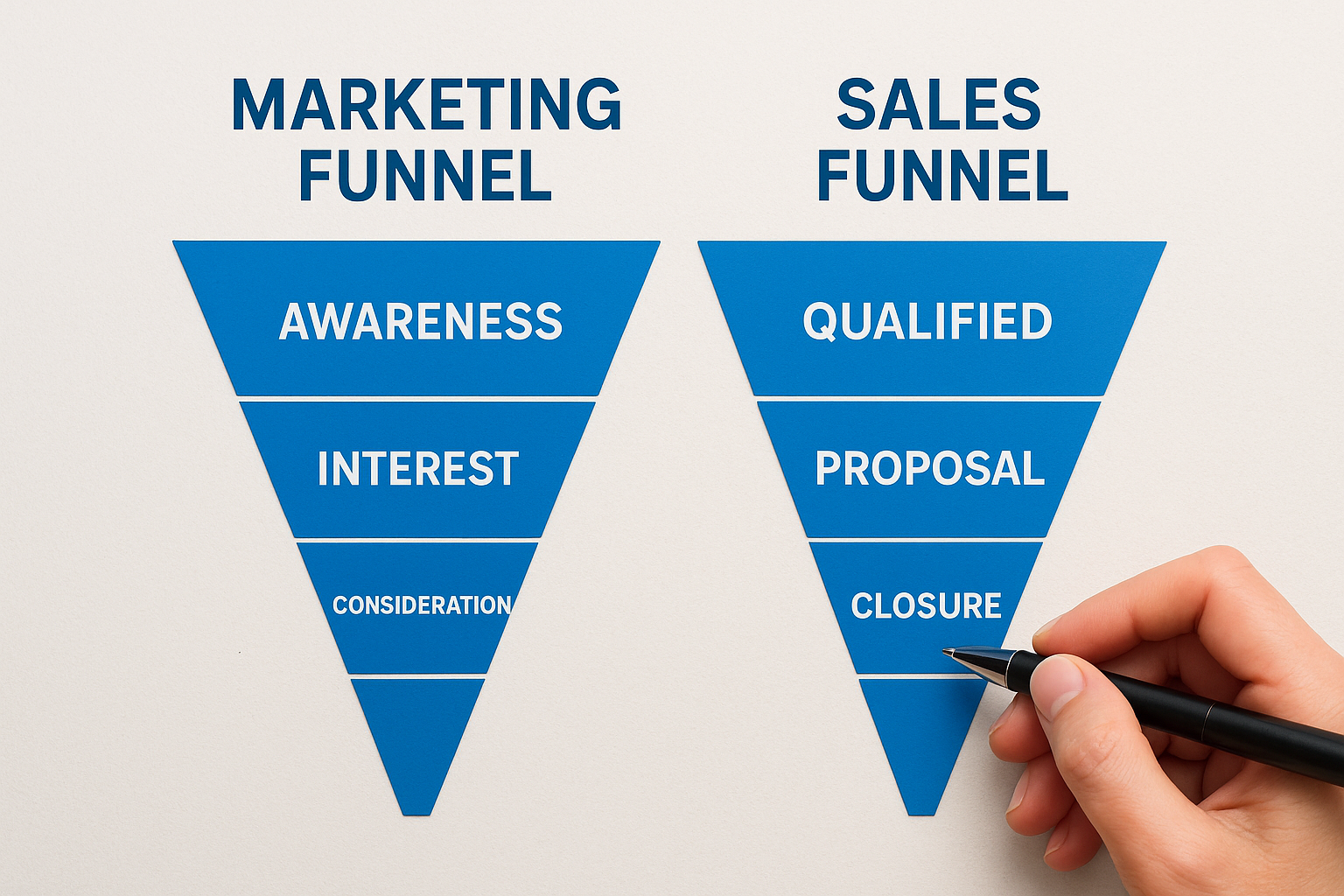
You’ve probably heard both terms thrown around, sometimes interchangeably. But understanding the marketing funnel vs sales funnel distinction can mean the difference between a strategy that converts and one that leaks leads at every stage.
Here’s the reality: these aren’t the same thing. A marketing funnel focuses on attracting and nurturing prospects, while a sales funnel is about closing deals. When you treat them as identical, you create gaps in your customer journey, and potential clients slip through the cracks.
At Client Factory, we build client acquisition systems that connect both funnels seamlessly for service businesses and law firms. This article breaks down how each funnel works, where they overlap, and how to use both effectively to turn more prospects into paying clients.
Why the distinction matters for growth
When you blur the line between marketing and sales funnels, you create disconnects that cost you clients. Your marketing team generates leads, but your sales team complains about quality. Your sales team needs more prospects, but marketing insists they’re delivering. This misalignment directly impacts your bottom line because each funnel requires different metrics, tools, and approaches to succeed.
Where revenue leaks happen
You lose potential clients at three critical points. First, when marketing hands off unqualified leads that waste your sales team’s time. Second, when sales receives qualified leads but lacks the context marketing provided during nurturing. Third, when neither team tracks the complete customer journey, leaving you blind to which touchpoints actually convert.
Consider a law firm that generates 200 leads monthly through content marketing. If only 20 convert into consultations, you need to know whether the problem lives in marketing (wrong audience) or sales (poor follow-up). The marketing funnel vs sales funnel distinction gives you that clarity. Without it, you’re guessing at solutions instead of fixing real problems.
Understanding where prospects drop off lets you plug specific leaks instead of overhauling your entire system.
How clarity drives efficiency
When you recognize these as separate but connected systems, you can optimize each independently. Your marketing funnel focuses on awareness, education, and qualification. Your sales funnel concentrates on evaluation, decision-making, and closing. Each requires different content, timing, and skills.
This separation also clarifies accountability. Marketing owns lead volume and quality metrics. Sales owns conversion rates and deal velocity. Both teams can then improve their specific areas without stepping on each other’s toes or creating conflicting strategies that confuse prospects.
Your growth accelerates when both funnels work in sync. Marketing delivers qualified prospects who understand your value. Sales receives context about each lead’s journey and pain points. The handoff becomes smooth, and your conversion rates climb because you’re addressing the right concerns at the right time.
What a marketing funnel is
A marketing funnel maps the journey prospects take from first hearing about your business to becoming qualified leads ready for sales. It focuses on building awareness, educating potential clients, and filtering out people who aren’t a good fit. Your marketing funnel typically includes top-of-funnel content like blog posts, social media, and ads that attract attention, then middle-funnel resources like case studies and webinars that build trust.
The stages that attract and qualify
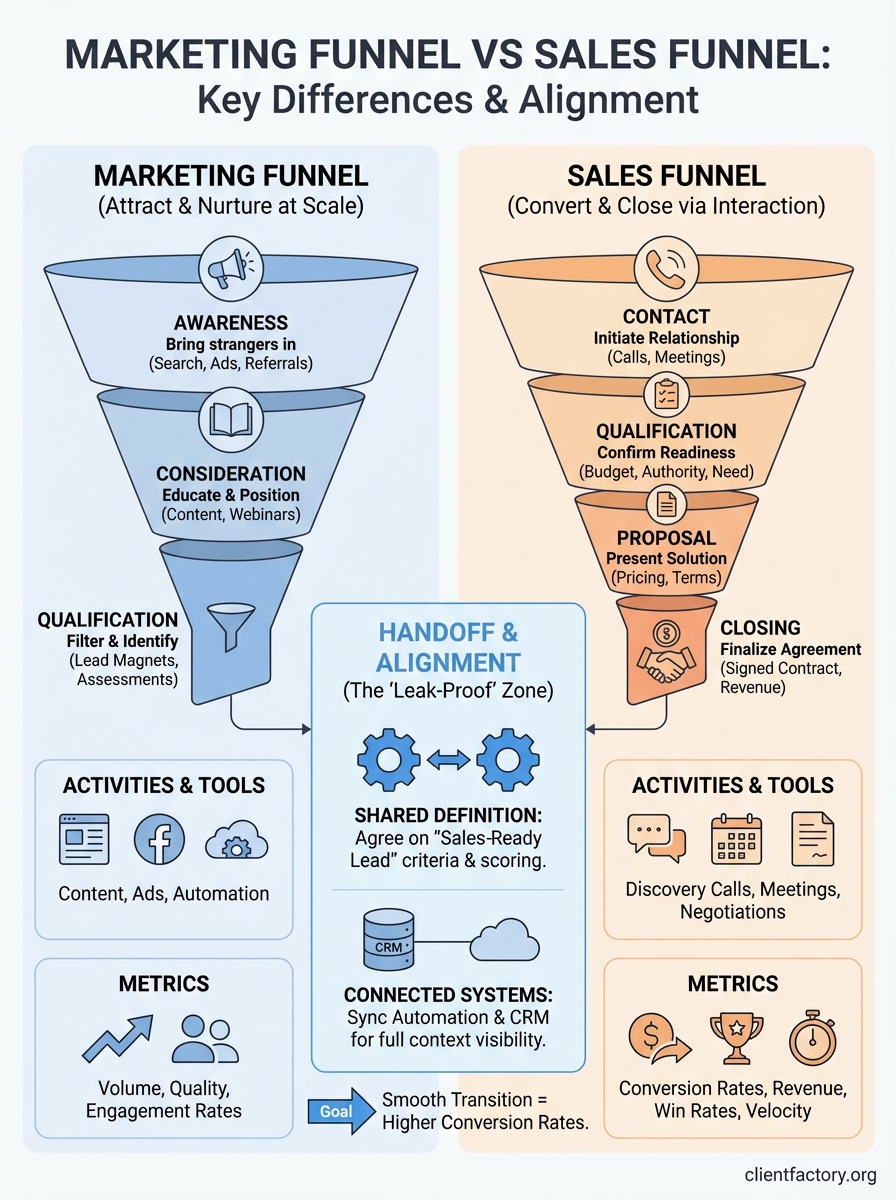
Your marketing funnel operates in three distinct phases. Awareness brings strangers to your digital properties through search, ads, or referrals. Consideration provides educational content that addresses their problems and positions your solution. Qualification separates serious prospects from casual browsers through lead magnets, consultations, or assessment tools.

Each stage requires different content types. Top-of-funnel pieces cast a wide net with general educational value. Middle stages deliver specific insights about your approach and results. Bottom stages offer direct engagement opportunities where prospects self-identify their readiness. The marketing funnel vs sales funnel difference becomes clear here: marketing qualifies interest, sales converts that interest into revenue.
Your marketing funnel succeeds when it delivers prospects who already understand your value and want to move forward.
The measurement focuses on volume and quality like traffic, engagement rates, and lead generation. You’re not tracking closed deals yet. That comes later in the sales funnel.
What a sales funnel is
A sales funnel tracks the direct path from qualified lead to closed deal. Unlike the marketing funnel that casts a wide net, your sales funnel works with prospects who already expressed interest and meet your qualification criteria. This funnel focuses on conversion activities like discovery calls, proposals, negotiations, and closing. Your sales team uses this framework to move ready-to-buy prospects through decision-making stages until they become paying clients.
The stages that convert prospects
Your sales funnel operates through four focused stages. Contact initiates the relationship with a qualified lead through a call, meeting, or consultation. Qualification confirms the prospect has the budget, authority, need, and timeline to buy. Proposal presents your solution with specific pricing and terms. Closing finalizes the agreement and collects payment.
Each stage requires direct human interaction and relationship building. Your sales team addresses specific objections, demonstrates value through personalized examples, and adapts the pitch based on each prospect’s unique situation. The marketing funnel vs sales funnel contrast becomes obvious here: marketing educates many, sales persuades individuals to commit.
Your sales funnel succeeds when it converts qualified interest into signed contracts and revenue.
Success metrics shift to conversion rates between stages, deal velocity, average contract value, and closed revenue. You’re measuring actual business outcomes, not just engagement or lead volume. Every interaction in this funnel directly impacts whether someone becomes a client or walks away.
Key differences and where they overlap
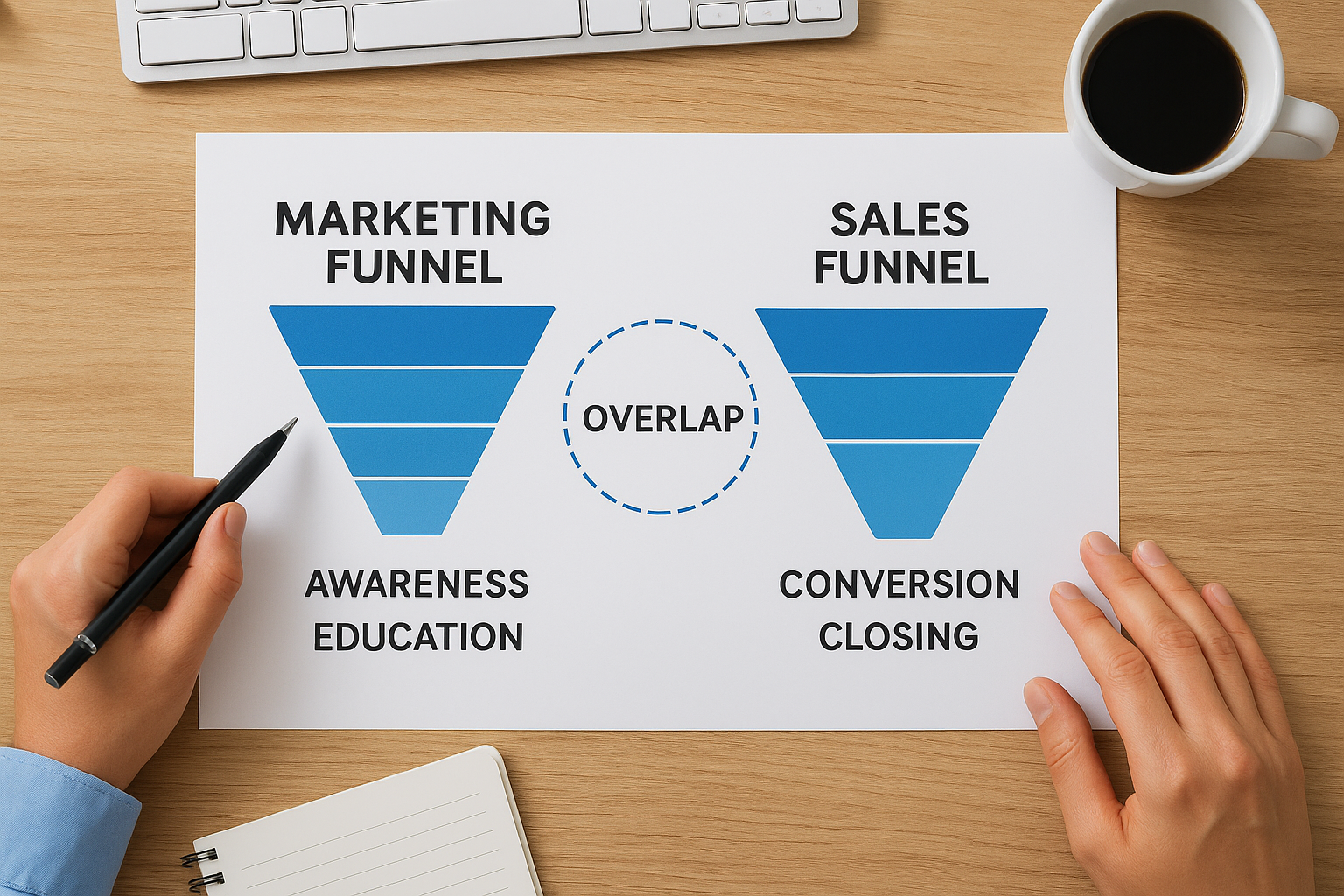
The marketing funnel vs sales funnel debate centers on ownership, objectives, and metrics. Your marketing funnel focuses on awareness and education using content, ads, and automation to attract many prospects. Your sales funnel concentrates on conversion and closing through personal interactions, demonstrations, and negotiations with fewer, qualified leads. Marketing measures engagement and lead quality. Sales tracks deal size and win rates.
The fundamental split
Your marketing team works at scale with broad messaging designed to resonate with multiple audience segments. They succeed by generating volume while filtering prospects through educational content. Your sales team operates one-on-one with customized approaches tailored to individual needs and objections. They succeed by converting specific opportunities into signed contracts with predictable revenue.
Budget allocation reflects this division. Marketing invests in tools and content like automation platforms, ad spend, and asset creation. Sales invests in people and relationships through team members, CRM systems, and personal development. Neither can replace the other because they solve different problems at different stages.
Your prospects need both funnels working together to move from stranger to satisfied client.
The handoff zone
The overlap happens at lead qualification. Marketing identifies prospects showing buying signals. Sales confirms those signals translate into genuine opportunities. This shared territory requires clear definitions of what makes a lead ready for sales attention. Without agreement here, you get either overwhelmed sales teams or stalled prospects who never receive follow-up.
Both funnels also share customer intelligence. Marketing learns which messages resonate. Sales discovers which objections block deals. When you connect these insights, both systems improve and your conversion rates climb across the entire journey.
How to align both funnels in practice
The marketing funnel vs sales funnel distinction only matters when both systems work together. You align them by creating shared definitions, establishing clear handoff points, and maintaining open communication between teams. Start by defining what qualifies a lead for sales attention, then build processes that ensure smooth transitions without prospects falling through gaps.
Define qualification criteria together
Your marketing and sales teams need to agree on lead scoring before you can align funnels. Sit both teams down and establish what actions signal buying readiness, like downloading a pricing guide, requesting a consultation, or engaging with multiple pieces of content. Document these criteria in your CRM so everyone uses the same standards.
Build a service level agreement between teams that specifies response times, follow-up protocols, and feedback loops. Marketing commits to delivering X number of qualified leads monthly. Sales commits to contacting each lead within Y hours and reporting back on lead quality. This mutual accountability prevents finger-pointing and improves both funnels over time.
Alignment happens when both teams share responsibility for the complete customer journey, not just their individual stages.
Create visibility across systems
Connect your marketing automation platform to your CRM so sales sees every touchpoint a prospect engaged with before becoming a lead. This context helps sales personalize outreach and address concerns that marketing content already surfaced. Marketing gains insight into which leads convert, letting them refine targeting and messaging to attract better prospects from the start.
Putting it all together
Understanding the marketing funnel vs sales funnel distinction transforms how you approach client acquisition. Your marketing funnel attracts and educates prospects at scale while your sales funnel converts qualified leads into paying clients. Both require different strategies, metrics, and teams, but they must work together seamlessly to maximize your conversion rates.
You stop wasting resources when you recognize which problems belong to marketing and which belong to sales. Marketing improves lead quality through better targeting and content. Sales shortens deal cycles by receiving qualified prospects with complete context. The handoff between funnels becomes your competitive advantage instead of a weak point where clients disappear.
Client Factory specializes in building connected acquisition systems that align both funnels for service businesses and law firms. Schedule a conversion audit to identify where your funnels leak prospects and discover specific fixes that increase your client conversion rates.