
You’re spending money on ads, posting on social media, maybe even running email campaigns, but leads keep slipping away before they become paying clients. The problem isn’t your effort. It’s that you don’t have a clear path guiding prospects from first click to signed contract. That’s exactly what a marketing funnel explained in practical terms can solve.
A marketing funnel maps out each stage a potential customer moves through, from discovering your business to making a purchase decision. Understanding these stages gives you control over your lead generation instead of hoping people figure out how to buy from you. When you know where prospects drop off, you can plug the leaks and turn more browsers into buyers.
At Client Factory, we’ve built client acquisition systems for service businesses and law firms for over 30 years. We’ve seen firsthand how a well-structured funnel transforms scattered marketing efforts into a predictable flow of qualified leads. This article breaks down each funnel stage, the tactics that actually work, and real examples you can apply to your business. By the end, you’ll have a clear framework for building or fixing your marketing funnel, so your next campaign actually converts.
Why marketing funnels matter for service businesses
Service businesses operate differently from product companies. You can’t add your legal services or consulting expertise to a shopping cart. Prospects need multiple touchpoints before they trust you with their biggest problems, and that journey takes time. Without a marketing funnel, you’re basically hoping someone sees your ad, immediately decides you’re credible, and calls you right then. That rarely happens in professional services where buying decisions involve risk, budget approval, and emotional trust.
What happens without a defined funnel
Your marketing budget disappears into scattered campaigns that never connect. You run Facebook ads that send people to your homepage, but your homepage wasn’t built to convert cold traffic. Someone clicks your ad, lands on a generic page about your company, then leaves because they’re not ready to schedule a consultation with a stranger. You’ve paid for that click and got nothing back except another wasted ad dollar.
The lack of a funnel means you can’t identify where prospects actually drop off. Maybe your landing page gets traffic but nobody fills out the contact form. Or perhaps people book discovery calls but never show up. Without tracking each stage, you keep throwing money at the top of an invisible funnel while leads leak out the bottom. Your sales team complains about bad leads, your marketing team claims they’re driving traffic, and nobody can pinpoint what’s actually broken because you’re measuring inputs instead of outcomes.
Service businesses without a funnel waste an average of 68% of their marketing budget on prospects who were never qualified to begin with.
The ROI difference a funnel creates
A properly structured funnel transforms how you acquire clients. Instead of hoping prospects remember you when they’re ready to buy, you nurture them through a planned sequence that builds trust at each stage. When someone downloads your free guide, you follow up with educational emails that address their specific concerns. By the time they book a call, they already see you as the expert who understands their problem better than competitors.
The financial impact becomes obvious when you can track conversion rates at each stage. You discover that 40% of people who attend your webinar book a consultation, while only 8% convert from your generic contact form. That insight alone tells you where to allocate budget. You stop wasting money on tactics that don’t move prospects forward and double down on what actually works. Your cost per client drops while your close rate climbs because you’re only spending time with qualified leads who’ve already been educated through your funnel content.
Marketing funnel stages and what to do in each
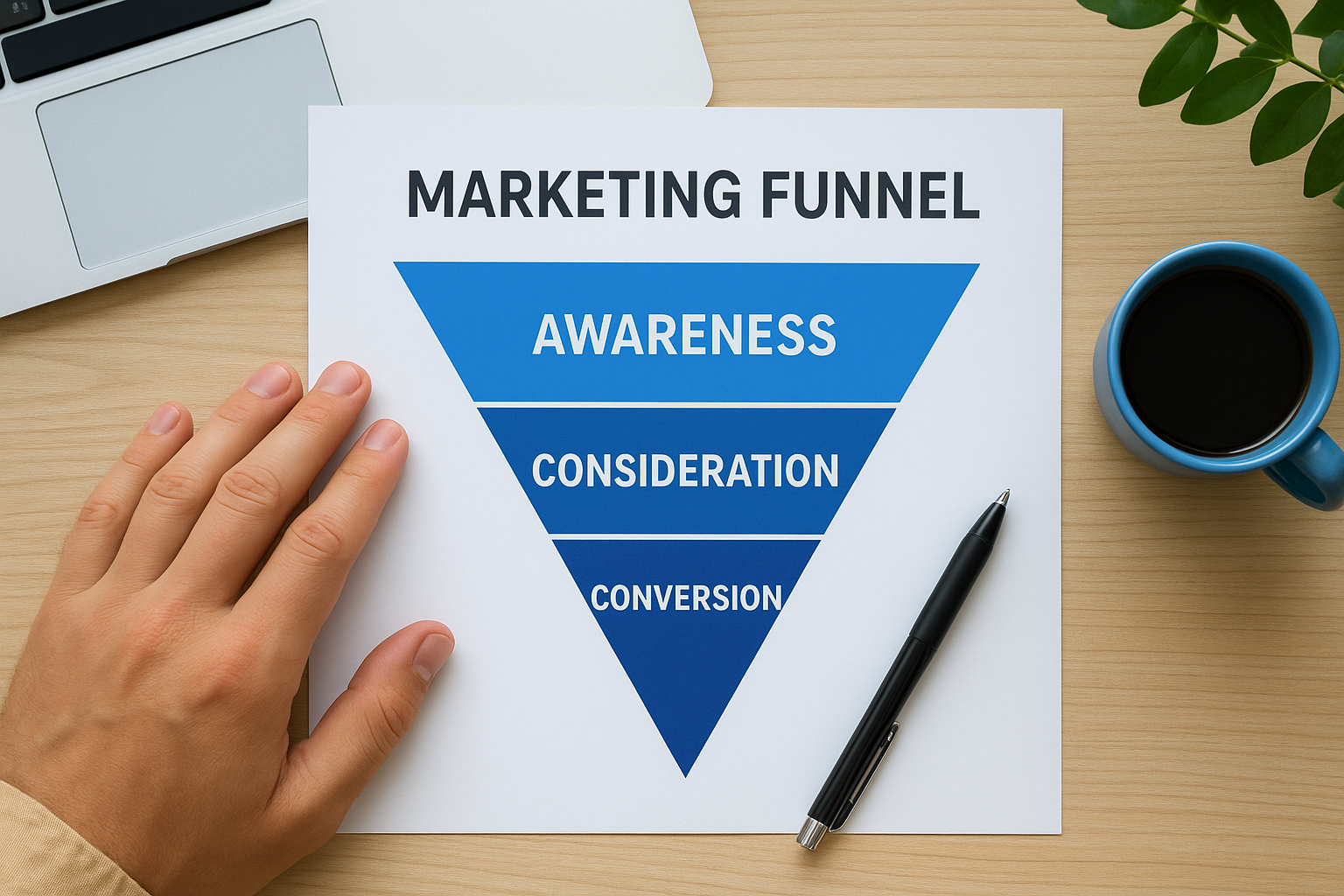
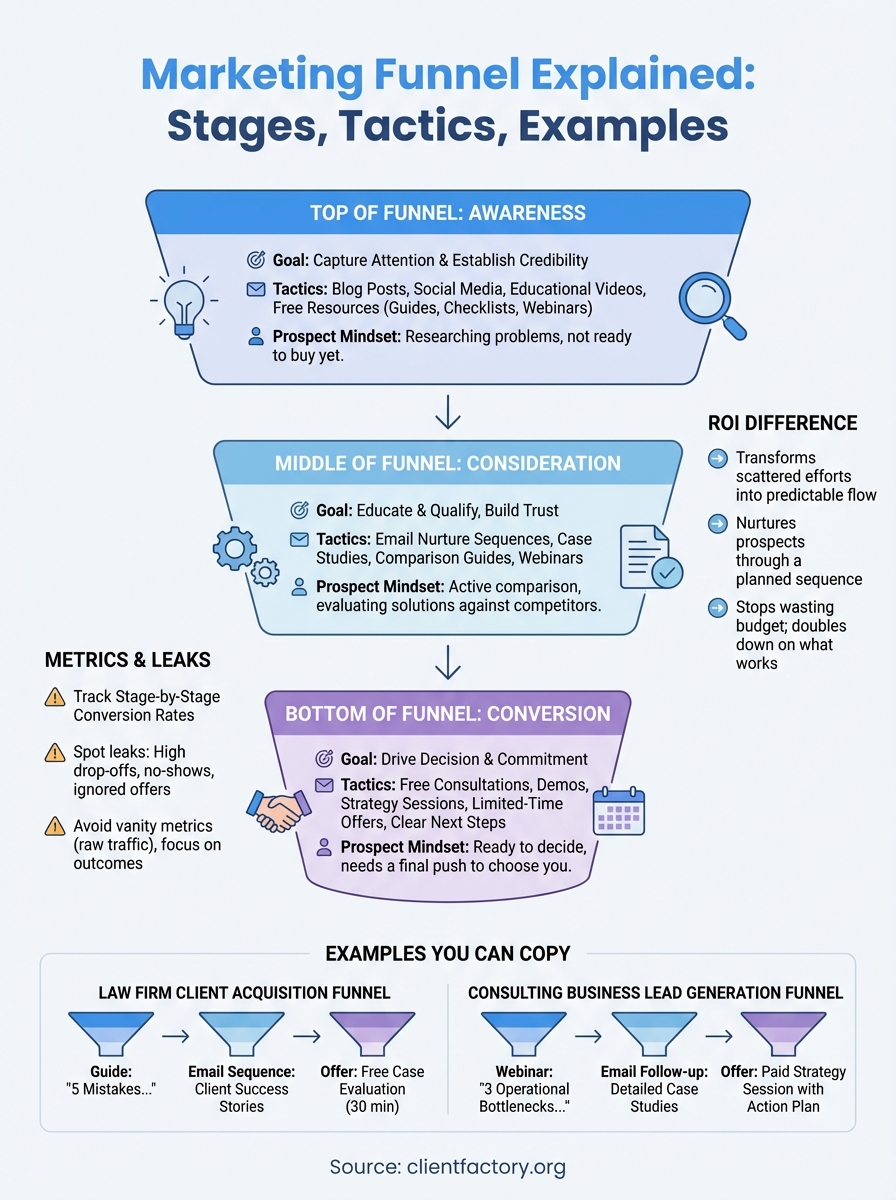
The standard marketing funnel explained typically includes three main stages, though some models break it into more granular steps. Each stage represents a different level of awareness and requires specific tactics matched to where prospects are in their buying journey. Understanding what prospects need at each point lets you deliver the right message at the right time instead of pushing for a sale too early.

Top of funnel: awareness
At the awareness stage, prospects don’t know you exist yet. They might recognize they have a problem, or they’re just starting to research solutions. Your job here is to capture attention with content that addresses their pain points without asking for anything in return. Blog posts, social media content, and educational videos work well because they provide immediate value without requiring commitment.
You’re not selling yet. You’re establishing credibility by demonstrating you understand the challenge they’re facing. Free resources like checklists, guides, or webinars give prospects a reason to hand over their email address, moving them from anonymous visitor to trackable lead.
Middle of funnel: consideration
Prospects in the consideration stage know their problem and are actively comparing solutions. They’ve moved past basic research and want to understand how your approach differs from competitors. Email nurture sequences, case studies, and comparison guides help educate them on your methodology while building trust through proof of results.
Middle-of-funnel prospects need education and proof before they’re ready for a sales conversation, not another generic pitch.
Bottom of funnel: conversion
At the bottom, prospects are ready to make a decision. They’ve narrowed their options and need a final push to choose you. Free consultations, demos, strategy sessions, or limited-time offers give them the confidence to commit. Your messaging shifts from education to addressing specific objections and making the next step crystal clear.
Tactics that move leads down the funnel
Moving prospects from one stage to the next requires specific tactics matched to their readiness level. You can’t use the same approach for someone who just discovered you compared to someone evaluating your services against competitors. Strategic alignment between funnel stage and tactic determines whether leads progress or disappear, and most businesses fail because they apply bottom-of-funnel pressure to top-of-funnel prospects who aren’t ready.
Content that educates and qualifies
Educational content serves double duty in your funnel. It provides genuine value that builds trust while simultaneously revealing which prospects are serious about solving their problem. When someone downloads your comprehensive guide on choosing a service provider, they’re signaling active interest beyond casual browsing. Your follow-up content should deepen their understanding while subtly positioning your methodology as the superior approach.
Email sequences work best when they address specific objections at each stage. A prospect who just joined your list needs different information than someone who attended your webinar. Segment your audience based on their actions and deliver content that moves them forward rather than repeating the same generic message to everyone.
The most effective funnel content answers the exact question your prospect needs answered to reach their next decision point.
Retargeting and follow-up sequences
Prospects rarely buy on first contact, especially in service businesses where decisions involve significant investment and risk. Retargeting ads keep your brand visible while prospects research alternatives, and properly sequenced follow-ups prevent interested leads from going cold. Your retargeting strategy should change messaging based on what stage someone entered your funnel, showing consideration-stage content to awareness visitors and conversion-focused offers to those who viewed your pricing page.
Offers matched to readiness
The offer you present must match where prospects are in their journey. Top-of-funnel visitors need low-commitment resources like free guides or webinars. Middle-stage prospects respond to case studies and strategy sessions. Bottom-funnel leads want clear next steps with minimal friction, like booking a consultation or starting a trial.
Marketing funnel examples you can copy
Real marketing funnel examples help you stop guessing and start implementing proven frameworks that already work in service businesses. Instead of building from scratch, you adapt structures that have generated actual clients for companies similar to yours. These examples show exactly what content to create, which offers to present, and how to structure your follow-up at each stage.
Law firm client acquisition funnel
Personal injury attorneys face long sales cycles and prospects who contact multiple firms before deciding. A high-converting funnel starts with educational content like “5 Mistakes That Destroy Your Personal Injury Case” as a free guide. When someone downloads it, they enter an email sequence that shares client success stories and explains your firm’s process over five days. The sequence includes retargeting ads showing video testimonials to prospects who opened emails but didn’t book.

Mid-funnel content addresses specific questions like “How long does a personal injury case take?” through blog posts and videos that position your approach as more thorough than competitors rushing settlements. The bottom-funnel offer is a free case evaluation with a specific time commitment of 30 minutes, removing uncertainty about what happens when they call.
The most effective law firm funnels educate prospects on what makes a strong case before asking them to schedule a consultation.
Consulting business lead generation funnel
Management consultants compete on expertise that’s difficult to demonstrate without working together. Your awareness-stage asset could be a webinar titled “3 Operational Bottlenecks Costing You Six Figures Annually” that attracts business owners recognizing these symptoms. Attendees receive a diagnostic worksheet that helps them quantify their specific problem, making the pain more concrete.
Follow-up emails share case studies showing how you’ve solved similar challenges, with detailed before-and-after metrics. Your conversion offer is a paid strategy session where you analyze their business and provide a custom action plan they can implement themselves or hire you to execute.
Metrics to track and how to spot leaks
You can’t fix what you don’t measure, and most service businesses track vanity metrics like website traffic while ignoring the numbers that actually reveal funnel performance. Raw traffic means nothing if visitors disappear before converting. What matters is understanding conversion rates between stages and identifying exactly where prospects drop off. When you track the right metrics, you spot problems before they drain your marketing budget and can make data-driven decisions about where to focus improvement efforts.
Conversion rates at each stage
Track the percentage of prospects moving from awareness to consideration, then consideration to conversion. If 1,000 people download your lead magnet but only 50 book consultations, your consideration stage has a 5% conversion rate that needs work. Compare these rates against industry benchmarks and your historical data to identify underperforming stages. Your email open rates and click-through rates reveal whether your nurture content actually engages prospects, while landing page conversion rates show if your offers match what visitors want.
Funnel leaks become obvious when you track stage-by-stage conversion rates instead of just counting total leads generated.
Warning signs your funnel is broken
High drop-off rates between stages signal specific problems you can fix. When 40% of consultation bookings result in no-shows, your qualification process isn’t filtering serious prospects from tire-kickers. If people visit your pricing page but never request quotes, your prices might be unclear or your value proposition isn’t strong enough to justify the cost. Look for sudden drops in conversion rates that indicate broken links, confusing forms, or messaging mismatches between your ads and landing pages. Long gaps between funnel stages, like prospects waiting weeks between downloading content and booking calls, suggest your follow-up sequence lacks urgency or doesn’t address the right objections at the right time.
Next steps
You now understand how a marketing funnel explained in practical terms transforms scattered campaigns into predictable client acquisition. The stages from awareness through conversion give you a framework for matching content to readiness, while tracking metrics reveals exactly where prospects drop off. Service businesses that implement these strategies stop wasting budget on tactics that never convert and start building relationships that turn leads into long-term clients.
Your immediate action should focus on mapping your existing marketing activities to funnel stages. Identify which stage has the lowest conversion rate and fix that bottleneck first. Most service businesses discover their consideration stage lacks nurture content, leaving prospects to research competitors while they wait for someone to follow up. When you plug those leaks, your entire funnel performs better without increasing ad spend.
If you need an objective assessment of where your funnel breaks down, book a free conversion audit with our team. We’ll identify your biggest opportunities and show you exactly what to fix first.