

Your sales team spends hours chasing leads that never convert while qualified prospects slip through the cracks. Without a systematic way to prioritize, you waste time on tire kickers and miss real opportunities. Lead scoring software solves this by automatically ranking prospects based on their behavior, demographics, and engagement so your team focuses on leads most likely to buy.
This guide breaks down the 10 best lead scoring tools available right now. You’ll see how each platform approaches scoring, what types of businesses they serve best, and how they integrate with your existing tech stack. Whether you need AI powered predictions or simple rule based scoring, you’ll find a solution that matches your needs and budget.
1. Client Factory
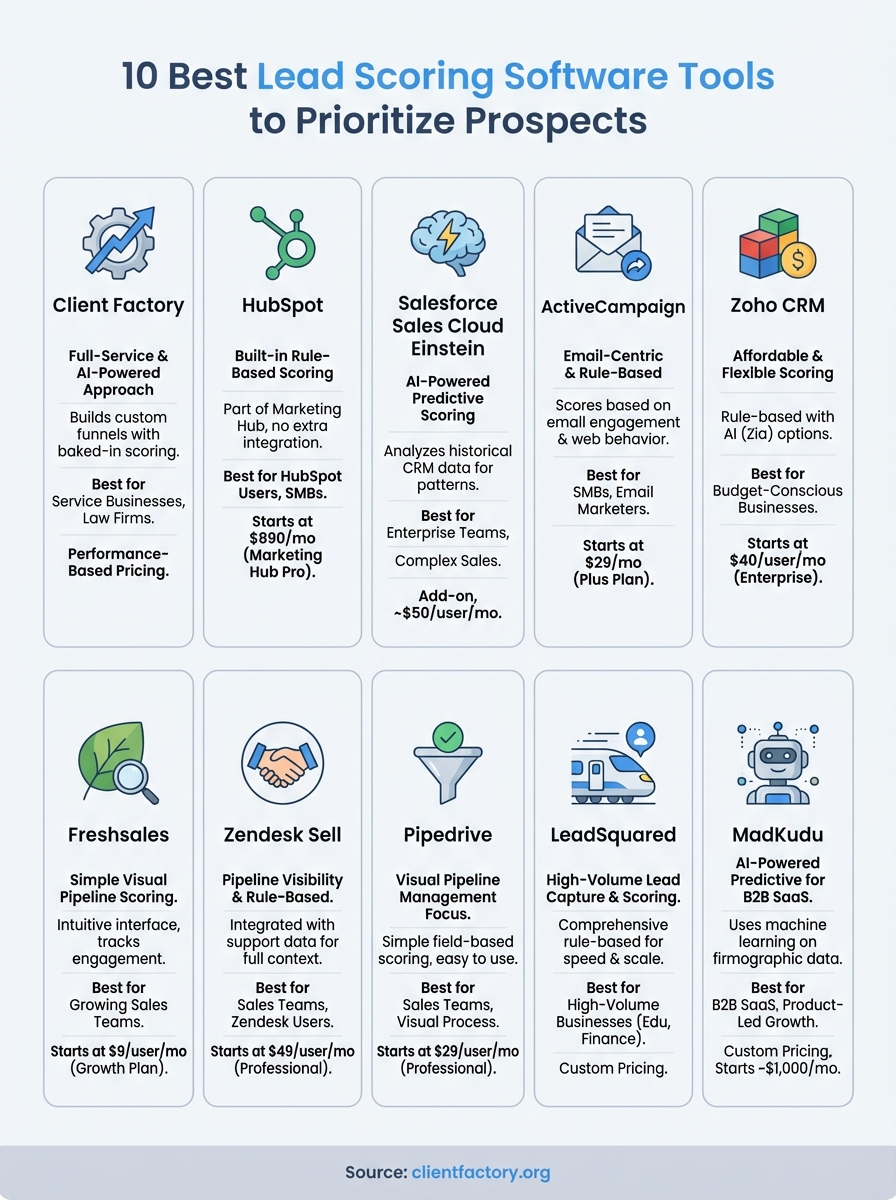
Client Factory takes a full-service approach to lead prioritization that goes beyond traditional scoring software. Rather than giving you another tool to manage, their team builds custom acquisition funnels with scoring models baked directly into your client generation system. You get data driven strategies that identify your highest value prospects while their AI powered systems automate the qualification process from first click to booked consultation.
Lead scoring approach
Client Factory combines behavioral tracking with conversion analytics to score leads across your entire funnel. Their team analyzes how prospects interact with your ads, landing pages, and content to assign values based on actual conversion patterns from your past clients. The scoring adapts as they gather more data about which actions predict closed deals in your specific business.
Their approach integrates predictive analytics that factors in both explicit data (form submissions, contact information) and implicit signals (page visits, time on site, ad engagement). You receive a constantly refined scoring model that reflects real world performance rather than generic industry assumptions.
“Client Factory’s scoring system prioritizes leads who match your ideal client profile based on actual conversion data, not just engagement metrics.”
Best fit
Service businesses and law firms benefit most from Client Factory’s model because their team understands the longer sales cycles and higher transaction values in these industries. You need someone who can distinguish between casual browsers and serious prospects ready to hire, which requires industry specific expertise that generic lead scoring software lacks.
Small to mid-sized firms without dedicated marketing teams gain the most value. Client Factory handles the technical implementation and ongoing optimization so you focus on closing deals instead of configuring scoring rules.
Key integrations and setup
Client Factory builds your client acquisition system from the ground up, integrating with major advertising platforms like Google Ads, Facebook, and YouTube. Their team handles all technical setup including CRM configuration, tracking implementation, and funnel development. You provide access to your existing tools and they connect everything into a unified scoring system.
Pricing and engagement model
Client Factory operates on a performance focused basis rather than flat software fees. You start with a free conversion audit where their team identifies gaps in your current funnel. Pricing structures vary based on your business size and growth goals, with ongoing management included. Contact their team directly to discuss custom engagement models aligned with your client acquisition targets.
2. HubSpot
HubSpot offers built-in lead scoring as part of its Marketing Hub platform, making it one of the most accessible options for businesses already using its CRM. You create custom scoring criteria based on both demographic information and behavioral data without needing third-party integrations. The platform automatically updates scores as leads interact with your content, emails, and website, giving your sales team real-time visibility into prospect readiness.
Lead scoring approach
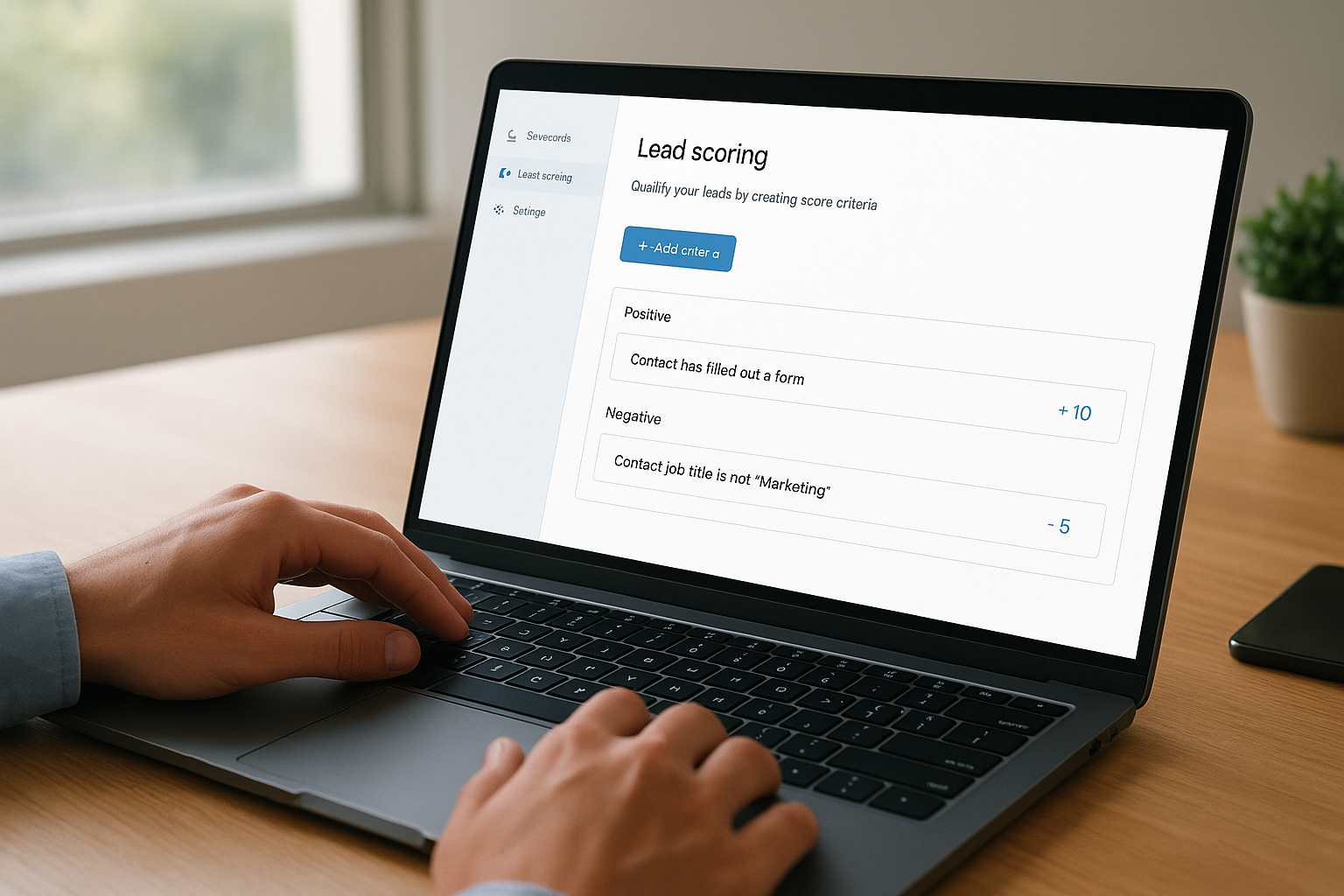
HubSpot uses rule-based scoring that you configure based on positive and negative attributes. You assign point values to actions like email opens, form submissions, and page visits while deducting points for negative signals like job titles outside your target market. The platform tracks contact properties and engagement metrics to calculate scores that update automatically as new data flows into your CRM.
Best fit
Marketing teams that already use HubSpot’s ecosystem gain the most value since scoring integrates natively with their email campaigns, landing pages, and workflows. You avoid the complexity of connecting separate lead scoring software to your existing tools. Small to medium businesses with straightforward scoring needs benefit from the intuitive interface and pre-built templates.
“HubSpot’s scoring works best when you have clear definitions of your ideal customer profile and can map those attributes to point values.”
Key integrations and setup
HubSpot’s scoring connects directly to its Sales Hub and Service Hub products, plus hundreds of third-party apps through its marketplace. You access scoring features through the Marketing Hub Professional tier or higher. Setup involves defining your scoring criteria in the lead scoring tool, then creating automated workflows that trigger actions based on score thresholds.
Pricing and plans
HubSpot charges $890 per month for Marketing Hub Professional (billed annually) which includes basic lead scoring. Marketing Hub Enterprise at $3,600 per month adds predictive lead scoring powered by machine learning. The platform requires annual commitments with additional costs for contacts above your tier limits.
3. Salesforce Sales Cloud Einstein
Salesforce Sales Cloud Einstein brings AI powered predictions directly into your CRM workflow without requiring separate lead scoring software. The platform analyzes your historical data to identify patterns that indicate purchase readiness, then automatically scores every lead based on factors that actually drove conversions in your business. You get machine learning models that improve over time as Einstein processes more closed deals and lost opportunities from your pipeline.
Lead scoring approach
Einstein uses predictive lead scoring that examines dozens of variables including contact behavior, company attributes, and engagement history to calculate likelihood to convert. The system processes data from email interactions, website visits, campaign responses, and custom fields you track in Salesforce. You receive scores expressed as percentages that represent conversion probability rather than arbitrary point totals.
“Einstein’s predictive models adapt to your specific business by learning from your actual win rates and deal patterns rather than generic industry data.”
Best fit
Enterprise sales teams with complex sales cycles and substantial historical data in Salesforce gain the most value. You need at least several hundred closed opportunities for Einstein to build accurate predictive models. Organizations already invested in the Salesforce ecosystem avoid integration headaches since scoring sits inside your existing CRM.
Key integrations and setup
Einstein integrates natively with all Salesforce products including Marketing Cloud, Pardot, and Service Cloud. Setup requires Sales Cloud Einstein license activation and a minimum data threshold before the system generates predictions. The platform pulls data automatically from your Salesforce instance without external connections.
Pricing and plans
Sales Cloud Einstein costs $50 per user per month added to your existing Salesforce Sales Cloud license. You need Sales Cloud Enterprise or Unlimited edition as a baseline, which starts at $165 per user per month. Annual contracts required with no month-to-month options available.
4. ActiveCampaign
ActiveCampaign combines email marketing automation with built-in lead scoring that adapts as your contacts engage with campaigns. You assign points based on actions like email opens, link clicks, and website visits while the platform tracks cumulative scores across multiple touchpoints. The system lets you create conditional scoring rules that adjust based on specific behaviors, making it ideal for businesses that rely heavily on email nurture sequences to move prospects through the funnel.
Lead scoring approach
ActiveCampaign uses rule-based scoring where you define positive and negative point values for specific actions and attributes. You create scoring automations that add points when contacts open emails, visit pricing pages, or submit forms while subtracting points for inactivity or unsubscribes. The platform tracks scores in real time and triggers workflows when contacts hit predetermined thresholds.
“ActiveCampaign’s scoring shines when you need to prioritize leads based primarily on email engagement and website behavior patterns.”
Best fit
Small to mid-sized businesses that depend on email marketing as their primary lead generation channel benefit most from ActiveCampaign. You get sophisticated automation capabilities without the complexity of enterprise lead scoring software. E-commerce brands and B2B companies with clear customer journey stages find the scoring particularly valuable for segmenting audiences and personalizing outreach.
Key integrations and setup
ActiveCampaign connects to over 870 apps through native integrations and Zapier, including major CRMs, payment processors, and webinar platforms. You access scoring through the automation builder where you configure rules and point values. Setup requires defining your scoring criteria then creating automations that modify scores based on contact behavior.
Pricing and plans
ActiveCampaign starts at $29 per month for up to 1,000 contacts on the Plus plan which includes lead scoring. Professional plans begin at $149 per month with advanced reporting and predictive sending. Pricing scales based on contact count with annual billing offering discounts.
5. Zoho CRM
Zoho CRM delivers affordable lead scoring that competes with enterprise platforms at a fraction of the cost. You configure scoring rules based on contact attributes, behavioral data, and custom fields specific to your business without paying for features you never use. The platform gives you flexible scoring models that work equally well for simple qualification workflows or complex multi-touch attribution scenarios, making it a practical choice for growing teams that need room to scale.
Lead scoring approach
Zoho uses rule-based and AI-powered scoring through its Zia artificial intelligence assistant. You create scoring rules manually by assigning points to demographics, firmographics, and engagement activities, or let Zia analyze your data to suggest optimal scoring criteria. The system tracks website visits, email responses, and social media interactions to calculate scores that update automatically as prospects move through your pipeline.
Best fit
Budget-conscious businesses that need robust lead scoring software without enterprise price tags find Zoho particularly valuable. You get advanced features like workflow automation and multichannel tracking at prices accessible to small teams. Companies managing multiple products or divisions benefit from Zoho’s ability to create separate scoring models for different business units.
“Zoho CRM’s scoring adapts to businesses of any size while maintaining cost efficiency that larger platforms struggle to match.”
Key integrations and setup
Zoho connects to over 500 third-party applications including Google Workspace, Microsoft 365, Mailchimp, and Slack through its marketplace. You access scoring in the Enterprise and Ultimate editions where you configure rules through the scoring module. Setup involves defining criteria, assigning point values, and creating workflows that route high-scoring leads to your sales team.
Pricing and plans
Zoho CRM starts at $14 per user per month for Standard edition, but you need Enterprise at $40 per user per month to access lead scoring features. Ultimate edition costs $52 per user per month with enhanced AI capabilities. Annual billing required for advertised rates.
6. Freshsales
Freshsales provides built-in lead scoring as part of Freshworks CRM suite with a focus on simplicity and visual pipeline management. You configure scoring rules through an intuitive interface that assigns points for contact properties, email engagement, and deal stages without requiring technical expertise. The platform emphasizes visual workflows that show exactly how scores change as prospects interact with your business, making it easy for sales teams to understand why certain leads rank higher than others.

Lead scoring approach
Freshsales uses customizable rule-based scoring where you define criteria based on contact fields, activity tracking, and sales stage progression. You assign positive points for qualifying actions like attending demos or visiting product pages while deducting points for disqualifying factors. The system calculates scores automatically and displays them directly on contact records for instant visibility.
Best fit
Growing sales teams that want straightforward lead scoring software without overwhelming complexity benefit most from Freshsales. You get essential scoring capabilities packaged with a full CRM at competitive prices. Businesses transitioning from spreadsheets or basic tools appreciate the gentle learning curve and visual interface that requires minimal training.
“Freshsales strikes a balance between functionality and usability that works well for teams implementing lead scoring for the first time.”
Key integrations and setup
Freshsales connects to popular business tools including Google Workspace, Mailchimp, Zapier, and Segment through its marketplace. You access scoring features in Growth plan and above where you configure rules through the admin settings. Setup involves defining your scoring parameters and mapping them to contact properties already tracked in your CRM.
Pricing and plans
Freshsales starts at $9 per user per month for the Growth plan which includes basic lead scoring. Pro plan costs $39 per user per month with advanced workflows and AI-based contact scoring. Enterprise tier runs $69 per user per month with custom scoring models and dedicated support.
7. Zendesk Sell
Zendesk Sell integrates lead scoring capabilities directly into its sales CRM with a focus on pipeline visibility and contact management. You configure scoring rules that evaluate prospects based on engagement history, contact properties, and deal progression while the platform maintains a unified view of all customer interactions. The system works particularly well for teams already using Zendesk Support since it connects sales and service data to provide complete context around each lead’s journey with your business.
Lead scoring approach
Zendesk Sell uses rule-based scoring where you define point values for specific contact attributes, email interactions, and sales activities. You assign scores based on factors like industry, company size, website visits, and email responses while the platform tracks changes automatically as prospects engage. The system lets you create negative scoring rules that deduct points for disqualifying characteristics or prolonged inactivity.
Best fit
Sales teams that prioritize pipeline management and deal tracking benefit most from Zendesk Sell’s approach to lead scoring software. You get scoring integrated with visual pipeline tools that show exactly where each prospect stands. Companies already using Zendesk for customer support gain additional value through unified data that informs both sales and service interactions.
“Zendesk Sell connects scoring with support data to give you complete visibility into how leads interact across your entire business.”
Key integrations and setup
Zendesk Sell connects to Mailchimp, Google Workspace, Slack, and other business tools through its marketplace. You access scoring in Professional tier and above where you configure rules through the settings panel. Setup requires defining your criteria and mapping them to fields tracked in your CRM.
Pricing and plans
Zendesk Sell starts at $19 per user per month for Team edition without scoring features. Professional plan costs $49 per user per month with lead scoring included. Enterprise tier runs $99 per user per month with advanced customization and dedicated support.
8. Pipedrive
Pipedrive focuses on visual pipeline management with lead scoring features that integrate directly into its sales process tracking. You configure scoring criteria based on custom fields, deal stages, and contact activities while the platform displays scores alongside each prospect in your pipeline. The system emphasizes simplicity and speed, making it valuable for teams that want scoring without sacrificing the visual clarity that makes Pipedrive popular among sales professionals.
Lead scoring approach
Pipedrive uses customizable field-based scoring where you assign point values to contact properties, deal characteristics, and engagement activities. You define criteria through custom fields that calculate scores automatically based on information you already track in your pipeline. The platform updates scores as deals progress through stages or contacts update their information, giving you real-time visibility into prospect quality.
Best fit
Sales teams that prioritize visual pipeline management over complex automation workflows benefit most from Pipedrive’s approach to lead scoring software. You get essential scoring capabilities without the learning curve of enterprise platforms. Small to medium businesses that want to maintain pipeline visibility while adding basic qualification metrics find Pipedrive particularly effective.
“Pipedrive keeps scoring simple so your team focuses on moving deals forward rather than managing complicated point systems.”
Key integrations and setup
Pipedrive connects to over 400 applications through its marketplace including Google Workspace, Mailchimp, Slack, and Zapier. You access scoring features in Professional tier and above where you create custom fields with scoring formulas. Setup involves defining which fields contribute to scores and configuring the calculation logic.
Pricing and plans
Pipedrive starts at $14 per user per month for Essential plan without advanced features. Professional plan costs $29 per user per month with workflow automation that enables scoring. Enterprise tier runs $99 per user per month with unlimited customization options and dedicated support.
9. LeadSquared
LeadSquared specializes in lead capture and scoring designed specifically for businesses with high lead volumes and multiple marketing channels. You get a platform that connects your advertising campaigns, landing pages, and sales processes into a unified scoring system that tracks prospects from initial contact through closed deals. The software emphasizes automation and speed, making it valuable for teams that process hundreds or thousands of leads monthly and need immediate qualification insights.
Lead scoring approach
LeadSquared uses comprehensive rule-based scoring that evaluates leads across acquisition source, demographic data, engagement behavior, and sales activities. You configure point values for actions like form submissions, email clicks, and phone calls while the platform tracks cumulative scores that reflect prospect quality. The system automatically adjusts scores based on recency and frequency of interactions, giving priority to actively engaged leads over those showing declining interest.
Best fit
High-volume businesses in education, healthcare, real estate, and financial services benefit most from LeadSquared’s capacity to process large numbers of leads simultaneously. You need a platform that maintains performance when handling thousands of monthly inquiries across multiple campaigns. Companies running paid advertising at scale appreciate the direct connection between ad spend and lead quality metrics.
“LeadSquared handles lead scoring software requirements for businesses where volume and speed matter as much as qualification accuracy.”
Key integrations and setup
LeadSquared connects to Facebook Lead Ads, Google Ads, Zapier, and major calling platforms through native integrations. You access scoring through the platform’s sales execution module where you define rules and automation workflows. Setup involves mapping your lead sources, configuring point values, and creating distribution rules for high-scoring prospects.
Pricing and plans
LeadSquared offers custom pricing based on lead volume and feature requirements. You contact their sales team for quotes tailored to your business size and needs. The platform requires annual contracts with pricing typically starting around $400 per month for small teams.
10. MadKudu
MadKudu delivers AI-powered predictive scoring that analyzes firmographic data, behavioral signals, and third-party enrichment to identify your best prospects automatically. You get a platform built specifically for B2B SaaS companies and fast-growing tech businesses that need to qualify leads at scale without manual input. The system processes millions of data points to predict which leads will convert, allowing your sales team to focus exclusively on opportunities with genuine purchase intent.
Lead scoring approach
MadKudu uses machine learning models trained on your historical conversion data combined with external firmographic intelligence from sources like Clearbit and LinkedIn. You receive predictive scores that reflect actual likelihood to buy rather than arbitrary point totals. The platform analyzes company attributes, individual behavior, and engagement patterns to generate scores that update continuously as new data flows into your system.
Best fit
B2B SaaS companies with product-led growth strategies benefit most from MadKudu’s approach to lead scoring software. You need sufficient historical data for the machine learning models to identify meaningful patterns. Fast-growing tech businesses that generate high lead volumes from free trials, product signups, and demo requests find the automated qualification particularly valuable.
“MadKudu eliminates manual scoring configuration by learning directly from your conversion patterns and industry benchmarks.”
Key integrations and setup
MadKudu connects to Salesforce, HubSpot, Marketo, and major marketing automation platforms through native integrations. You access the platform through API connections that sync data bidirectionally with your existing tools. Setup requires connecting your CRM and data sources, then allowing the system to analyze historical patterns before generating predictions.
Pricing and plans
MadKudu offers custom pricing based on lead volume and data sources. You contact their sales team for quotes tailored to your business size. Pricing typically starts around $1,000 per month for small to medium implementations with annual contracts required.
Final pick checklist
Your choice of lead scoring software depends on your team size, budget, and technical resources. You need a platform that connects with your existing tools and provides scoring criteria that match your actual sales process. Rule-based systems work well when you understand exactly what behaviors predict conversions, while AI-powered platforms excel when you have substantial historical data to train predictive models.
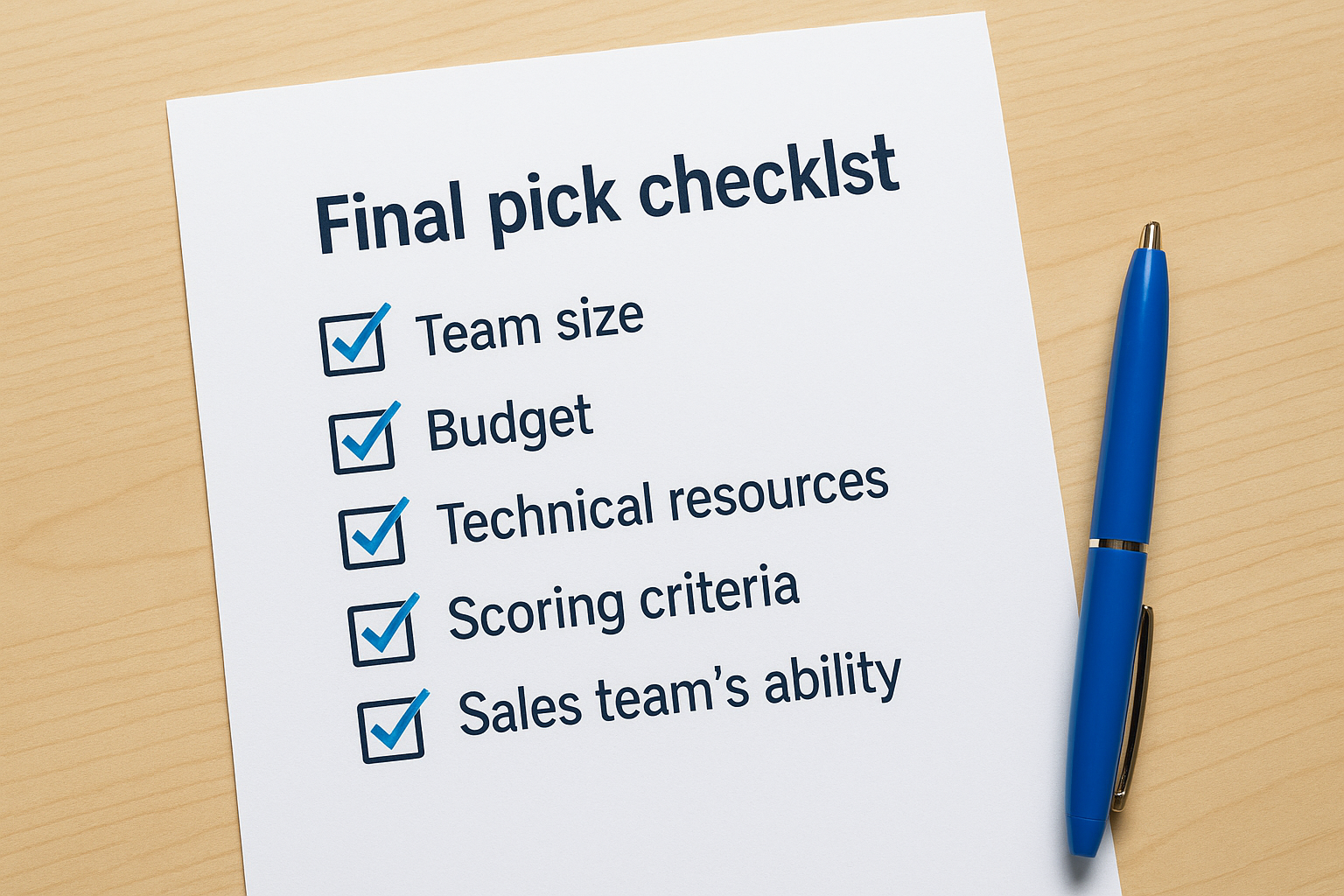
Consider implementation time, required training, and ongoing management when evaluating options. Some platforms demand constant tuning while others adapt automatically as your business evolves. Your sales team’s ability to act on scores matters more than the sophistication of the scoring engine itself. The best software becomes worthless if your team ignores the insights it provides.
If you want to skip the software learning curve entirely, Client Factory builds custom acquisition funnels with scoring already integrated into your client generation system. Their team handles implementation, optimization, and ongoing management so you focus on closing deals instead of configuring tools.