
Your marketing budget is stretched thin and your pipeline looks empty. You’re running ads that burn cash without producing qualified leads. Your sales team complains about the quality of prospects coming through. Meanwhile your competitors seem to fill their calendars with discovery calls while you wonder what they’re doing differently. This isn’t just frustrating—it’s costing you real revenue and growth opportunities.
This guide breaks down 15 lead generation strategies that actually work for B2B companies right now. You’ll discover proven tactics from demand generation partnerships to AI automation, each with clear implementation steps. Whether you run a service business or a law firm, these strategies will help you attract better leads, convert more prospects, and build a predictable client acquisition system that scales with your business.
1. Use Client Factory for demand generation
Partnering with a specialized demand generation agency gives you access to proven systems and expert execution without building an entire marketing team in-house. Client Factory focuses exclusively on client acquisition for service businesses and law firms, bringing over 30 years of combined experience in converting paid traffic into qualified leads and booked appointments.

What it is
Client Factory operates as your dedicated demand generation partner, handling everything from strategy development to campaign execution. The agency builds custom acquisition funnels tailored to your specific business, implements AI-powered tracking and optimization, and manages campaigns across Google Ads, YouTube, Facebook, and other high-intent channels. You get a complete system that identifies prospects, nurtures them through your funnel, and delivers qualified leads ready for your sales team.

Why it works in 2025
Businesses struggle with lead generation strategies because they lack the specialized knowledge required to navigate today’s complex advertising platforms. Algorithm changes happen constantly, buyer behavior shifts rapidly, and most companies can’t afford to hire full-time experts in every channel. Client Factory solves this by providing immediate access to tested frameworks, real-time optimization, and data-driven decision making that maximizes your return on ad spend while you focus on serving clients.
Working with specialists who live and breathe client acquisition daily beats trying to become an expert yourself while running your business.
How to implement it
Start by requesting a free funnel audit to identify gaps in your current client acquisition process. The audit reveals exactly where prospects drop off and what fixes will generate the biggest impact. After reviewing the findings, you can choose to implement recommendations yourself or partner with Client Factory to build and manage your complete demand generation system, from initial traffic acquisition through conversion optimization and lead qualification.
2. Build high converting lead magnets
A lead magnet trades valuable content for contact information from your target prospects. This exchange works because you offer something your audience genuinely needs right now, not generic content they can find anywhere. High-converting lead magnets solve a specific problem or answer an urgent question your ideal clients face before they’re ready to buy, making them essential elements in effective lead generation strategies.
What it is
Lead magnets are free resources you create to capture prospect information in exchange for immediate value. These include practical tools like calculators, templates, checklists, research reports, or video training that addresses a pressing challenge your target audience faces. The best lead magnets deliver quick wins and position your business as the expert who can solve bigger problems down the road.
Why it works in 2025
Prospects research solutions long before they contact vendors, and generic offers no longer capture attention in crowded markets. Specific lead magnets that solve real problems stand out because they demonstrate your expertise while building trust with potential buyers. Buyers expect personalized experiences, so a lead magnet that speaks directly to their situation converts better than broad content that tries to appeal to everyone.
Lead magnets that promise and deliver immediate value convert up to 10 times better than simple newsletter signups.
How to implement it
Identify the biggest obstacle your prospects face right before they need your service, then create a resource that helps them overcome it. Package your lead magnet professionally with a clear title that states the outcome they’ll achieve. Build a dedicated landing page with a simple form asking only for essential information, then promote this page through your paid ads, website, and social channels to attract qualified prospects.
3. Optimize your website for conversions
Your website serves as your digital storefront where prospects decide whether to trust you with their business. Most companies focus on driving traffic while ignoring the experience visitors have once they arrive. Conversion optimization transforms your site from a passive brochure into an active lead generation machine that guides prospects toward taking action, whether that’s booking a call, downloading a resource, or requesting a quote.
What it is
Website conversion optimization is the systematic process of improving elements on your site to increase the percentage of visitors who complete desired actions. This includes refining your headline copy, simplifying forms, adding trust signals like client testimonials and case studies, improving page load speeds, and creating clear calls-to-action that tell prospects exactly what to do next. Every element on your page either moves prospects toward conversion or creates friction that drives them away.
Why it works in 2025
Visitors make snap judgments about your credibility within seconds of landing on your site, and small improvements to key pages can dramatically increase your conversion rates without spending more on advertising. When you optimize your website properly, you extract more value from your existing traffic, which means better return on investment from all your lead generation strategies. Companies that prioritize conversion optimization typically see conversion rate improvements of 50% to 200%, turning the same traffic into significantly more qualified leads.
A 2% conversion rate doubling to 4% means you generate twice as many leads from the same advertising budget.
How to implement it
Begin by analyzing your current conversion data to identify which pages receive the most traffic but convert poorly. Test different headlines that speak directly to your prospect’s pain points, reduce form fields to capture only essential information, and add prominent trust indicators like client logos, testimonials, and case studies. Place clear calls-to-action above the fold on every key page, ensure your site loads quickly on mobile devices, and remove unnecessary navigation links from landing pages that could distract prospects from converting.
4. Use SEO to attract ready buyers
Search engine optimization positions your content where prospects actively search for solutions to their problems. When you rank for high-intent keywords, you intercept buyers at the exact moment they need your service, which makes SEO one of the most cost-effective lead generation strategies for building long-term pipeline growth without ongoing ad spend.
What it is
SEO involves optimizing your website and content to rank higher in search engine results for keywords your target clients use when researching solutions. This includes creating valuable content that answers specific questions, building authority through backlinks from reputable sites, improving your technical site structure, and targeting buyer-intent terms like “best [service] for [industry]” or “[problem] solution for [company type]” that indicate someone is ready to make a purchasing decision.
Why it works in 2025
Organic search delivers consistent traffic without the recurring costs of paid advertising, and prospects who find you through search already trust the content enough to click through from competitive results. Bottom-of-funnel keywords capture people actively comparing options or ready to hire, giving you warmer leads than cold outreach ever could. Once you achieve strong rankings, they tend to persist with minimal maintenance, compounding your results over time.
Companies that rank on page one for buyer-intent keywords generate 3-5 times more qualified leads than those buried on page two or three.
How to implement it
Research buyer-intent keywords your ideal clients use when they’re ready to purchase, focusing on terms with clear commercial intent rather than general information queries. Create comprehensive content that genuinely answers the search query better than competing pages, incorporating your target keywords naturally throughout. Build credible backlinks by creating data-driven resources others want to reference, ensure your site loads quickly on mobile devices, and update existing content regularly to maintain rankings as search algorithms and competitor strategies evolve.
5. Run targeted LinkedIn ad campaigns
LinkedIn advertising connects you directly with decision-makers and key influencers in your target industries, making it one of the most precise B2B lead generation strategies available today. Unlike consumer-focused platforms, LinkedIn’s professional user base and detailed targeting options let you reach specific job titles, company sizes, and industries with messages tailored to their exact business challenges.
What it is
LinkedIn ads are paid campaigns that appear in users’ feeds, messages, or sidebar while they browse the platform for professional content. You can choose from several ad formats including Sponsored Content that blends into the news feed, Message Ads that land directly in prospects’ inboxes, and Lead Gen Forms that pre-populate user information to reduce friction. The platform’s targeting capabilities let you narrow your audience by job function, seniority level, company revenue, industry, and even specific companies you want to reach.
Why it works in 2025
LinkedIn remains the primary platform where 61 million senior-level influencers and 40 million decision-makers spend their professional time, giving you direct access to people who control budgets and make purchasing decisions. The platform’s audience data comes from verified professional profiles rather than behavioral assumptions, which means your ads reach the actual job titles you need rather than rough approximations. Prospects on LinkedIn actively engage with business content and expect to discover solutions to their professional challenges, creating a receptive environment for your offers.
LinkedIn generates leads that convert at rates 2 to 5 times higher than other social platforms because you reach prospects in a professional mindset.
How to implement it
Start by defining your target audience using LinkedIn’s detailed filters to select specific job titles, company sizes, and industries that match your ideal client profile. Create compelling ad creative that speaks directly to the business problems your audience faces, using clear headlines and visual elements that stand out in crowded feeds. Set up Lead Gen Forms to capture prospect information without forcing them to leave LinkedIn, then connect these forms to your CRM to trigger immediate follow-up sequences that engage leads while your message stays fresh in their minds.
6. Launch profitable Google and YouTube ads
Google and YouTube advertising captures prospects at different stages of their buying journey, from initial research to ready-to-purchase moments. These platforms give you access to billions of daily searches and video views, letting you place your message exactly where your target audience looks for solutions. When you combine search intent targeting with video engagement, you create a powerful system that generates qualified leads while building brand recognition.

What it is
Google Ads targets prospects actively searching for specific solutions, displaying your offers when they type queries like “best [your service] for [industry]” or “[problem] solution.” YouTube ads reach viewers watching content related to your industry or target audience interests, using video formats that educate prospects about their problems and position your business as the answer. Both platforms use sophisticated targeting options including keywords, demographics, interests, and remarketing to connect you with qualified buyers.
Why it works in 2025
Search advertising intercepts prospects at the exact moment they need your service, delivering some of the highest conversion rates among all lead generation strategies. YouTube’s massive reach and video format let you explain complex services in ways that build trust faster than text alone, while its targeting capabilities ensure your message reaches decision-makers in your ideal client companies. The platforms’ machine learning algorithms optimize your campaigns automatically based on which audiences and placements drive actual conversions, not just clicks.
Businesses using both Google Search and YouTube ads together see 30% to 50% better lead quality than using either platform alone.
How to implement it
Create campaigns for high-intent keywords where prospects search for solutions you provide, writing ad copy that directly addresses the problem they want to solve. Develop short YouTube videos that identify a specific challenge your audience faces and preview how your service solves it, then target these ads to relevant channels and audiences. Set up conversion tracking to measure which keywords and videos generate actual leads rather than just traffic, then allocate more budget to your best-performing campaigns while pausing underperformers.
7. Design outbound email and calling campaigns
Outbound campaigns put your message directly in front of ideal prospects before they even know they need your service. While many lead generation strategies rely on inbound interest, strategic outbound efforts let you target specific companies and decision-makers who match your buyer profile. You control the timing, the message, and who receives it, creating predictable pipeline growth when you execute these campaigns with precision and personalization.
What it is
Outbound campaigns involve proactive outreach to prospects through cold email sequences and phone calls rather than waiting for them to find you. You build targeted lists of companies and contacts that match your ideal client profile, then craft personalized messages that address their specific challenges and explain how your service solves them. Modern outbound combines automation tools for email sequencing with human touchpoints through strategic calls, creating multi-channel campaigns that break through noise and generate responses.
Why it works in 2025
Outbound lets you reach high-value prospects who may never discover you through organic channels, giving you direct access to decision-makers at your target accounts. When you personalize your outreach based on company news, industry challenges, or role-specific pain points, you demonstrate relevance that cuts through generic sales pitches. Technology now enables sophisticated sequencing and tracking that scales personalized outreach while maintaining the human connection that converts cold contacts into qualified conversations.
Companies using targeted outbound campaigns generate 3 to 5 times more qualified meetings than relying solely on inbound tactics.
How to implement it
Build lists of target companies that match your ideal client profile using criteria like industry, company size, and growth indicators. Research each prospect to find relevant talking points such as recent funding, leadership changes, or expansion news that creates natural conversation starters. Craft email sequences that reference these specifics in the opening line, clearly state the problem you solve, and end with a simple ask for a short conversation. Follow up persistently but respectfully with calls on days three and seven, leaving voicemails that add value rather than just requesting callbacks.
8. Create authority building content marketing
Content marketing establishes your expertise by delivering valuable insights that prospects search for and share within their networks. When you consistently publish content that solves real problems, you attract qualified traffic, build trust, and position your business as the go-to authority in your space. This strategy works as a multiplier for other lead generation strategies because authoritative content fuels your SEO, provides material for social campaigns, and gives sales teams resources to share with prospects.
What it is
Authority-building content includes in-depth articles, research reports, case studies, and guides that demonstrate your deep understanding of your industry and the challenges your clients face. You create content that answers specific questions prospects ask during their buying journey, from early research through final decision-making. This differs from promotional material because it prioritizes education and insight over sales pitches, earning attention through genuine value rather than paid placement.
Why it works in 2025
Prospects conduct extensive research before contacting vendors, and the businesses that educate them during this process earn preferred status when buying decisions happen. Search engines prioritize comprehensive, expert content that demonstrates experience and knowledge, which means your authority pieces attract organic traffic for months or years after publication. Companies that publish consistent, high-quality content generate 67% more leads than those that neglect content marketing, proving that educational material converts browsers into buyers.
Prospects who engage with three or more pieces of your content before contact convert at rates 2 to 3 times higher than cold leads.
How to implement it
Identify the critical questions your ideal clients ask before hiring someone in your industry, then create comprehensive content that answers each question better than competing resources. Publish detailed case studies showing specific results you delivered for clients in target industries, including challenges faced, solutions implemented, and measurable outcomes achieved. Distribute your content through email newsletters, social media, and guest contributions on industry publications to expand your reach beyond your existing audience.
9. Host webinars and live demos that convert
Webinars and live demonstrations let you showcase your expertise and solution value while interacting directly with qualified prospects who raise their hands to attend. Unlike passive content that prospects consume alone, these interactive sessions create personal connections that accelerate trust-building and move attendees closer to purchasing decisions. This approach works exceptionally well for complex services where prospects need to see your process and ask questions before committing.
What it is
Webinars are scheduled online presentations where you educate prospects about solving specific problems they face, while live demos walk them through your actual service or platform in real time. You promote these sessions through email campaigns, paid ads, and social media to attract qualified registrants who provide contact information in exchange for attending. The interactive format lets you answer objections immediately, demonstrate expertise through live problem-solving, and identify hot prospects based on their questions and engagement level during the session.
Why it works in 2025
Prospects want to evaluate your capabilities before scheduling sales calls, and webinars provide this low-pressure environment where they can learn without commitment. Attendees self-select as qualified leads because they invest 30 to 60 minutes of their time to learn about solutions to problems they actively face. Recording sessions extends their value by creating evergreen content you repurpose across other lead generation strategies, while the live interaction builds relationships that convert significantly better than cold outreach.
Companies using webinars generate leads that convert at rates 20% to 40% higher than leads from other digital channels.
How to implement it
Choose topics that address urgent challenges your ideal clients face right before they need to hire your type of service. Promote your webinar two to three weeks in advance through paid ads targeting your buyer persona, email campaigns to your database, and social posts in relevant groups. Structure your presentation to deliver genuine insights in the first 40 minutes, then transition to showing how your service applies these concepts, ending with a clear call-to-action like booking a strategy call or starting a trial.
10. Implement account based marketing programs
Account based marketing flips traditional lead generation strategies on their head by targeting specific high-value accounts rather than casting wide nets for individual leads. Instead of attracting anyone who might buy, you identify your ideal client companies first, then create personalized campaigns designed specifically to engage decision-makers at those organizations. This laser-focused approach concentrates your resources on prospects with the highest potential revenue and best fit for your services.
What it is
ABM treats individual companies as markets of one, building customized campaigns for each target account based on their specific challenges, industry position, and organizational structure. You research each prospect company thoroughly, identify the key stakeholders involved in purchasing decisions, and create messaging that speaks directly to their unique situation. This includes personalized emails, custom landing pages, targeted ads that only your chosen accounts see, and coordinated outreach across multiple channels to surround your targets with relevant touchpoints.
Why it works in 2025
Traditional lead generation wastes budget reaching unqualified prospects who will never buy, while ABM focuses every dollar on pre-qualified accounts that match your ideal client profile. Marketing and sales teams align completely because everyone targets the same accounts, eliminating friction between departments. Companies using ABM report higher deal sizes and faster sales cycles because the personalization demonstrates your understanding of their business, making prospects more receptive to conversations.
Businesses implementing ABM programs see 208% increases in marketing revenue compared to traditional approaches.
How to implement it
Select 20 to 50 target accounts that represent your ideal clients based on company size, industry, growth indicators, and budget capacity. Map the buying committee at each account to identify all decision-makers and influencers involved in purchasing your type of service. Create personalized content addressing the specific challenges each account faces, then deploy coordinated campaigns using LinkedIn ads restricted to your target companies, custom email sequences referencing company-specific details, and direct outreach from your sales team mentioning the tailored resources you created for them.
11. Use retargeting to recapture warm traffic
Retargeting campaigns follow prospects who visited your site but left without converting, placing your strategic ads in front of them as they browse other websites and platforms. Most visitors need multiple touchpoints before they trust a business enough to provide contact information or request a call. Retargeting keeps your brand visible during their decision-making process, bringing warm prospects back to complete actions they abandoned during their first visit.
What it is
Retargeting uses tracking pixels on your website to identify visitors, then serves them targeted ads on platforms like Google Display Network, Facebook, LinkedIn, and YouTube after they leave. You create specific audience segments based on which pages prospects viewed, such as showing different ads to people who visited your pricing page versus those who only read a blog post. This precision lets you deliver relevant messages that address exactly where each prospect stopped in your funnel.
Why it works in 2025
Prospects typically visit five to seven websites before making a purchase decision, and retargeting ensures your business stays front-of-mind throughout their research process. Visitors who see retargeting ads convert at rates three to four times higher than cold traffic because they already demonstrated interest in your solution. The strategy maximizes return on your initial traffic investment by converting prospects who needed more time rather than losing them forever to competitors.
Retargeting recaptures 26% of visitors who would otherwise never return to complete their conversion action.
How to implement it
Install tracking pixels from your advertising platforms on key pages including your homepage, service pages, pricing page, and thank-you pages. Create audience segments that separate visitors by their behavior, such as those who spent significant time on your site versus quick bouncers. Design ad creative that specifically addresses common objections or questions prospects have at each stage, then set frequency caps to avoid overwhelming your audience with too many repeated impressions.
12. Deploy AI chatbots and automation
AI chatbots engage website visitors instantly while your team sleeps, answering questions and capturing lead information without requiring human intervention. These intelligent systems qualify prospects, book appointments, and route urgent inquiries to sales representatives in real time. Automation handles repetitive tasks like follow-up emails and data entry, freeing your team to focus on closing deals instead of chasing cold leads.
What it is
AI chatbots are software programs that simulate human conversation on your website, engaging visitors through text-based interactions that feel natural and helpful. Modern systems use machine learning to understand intent, answer common questions about your services, collect contact details, and schedule meetings directly into your calendar. Automation tools connect your chatbot data to your CRM, email platform, and other systems to trigger sequences that nurture prospects without manual work.
Why it works in 2025
Prospects expect immediate responses when they visit your website, and a chatbot provides instant engagement that captures attention before visitors leave for competitor sites. These systems operate 24/7, qualifying leads and booking appointments outside business hours when traditional sales teams are unavailable. Automation scales your lead generation strategies by handling hundreds of conversations simultaneously, ensuring no qualified prospect slips through the cracks due to slow response times.
Companies using AI chatbots capture 35% to 50% more leads than those relying solely on static contact forms.
How to implement it
Install a chatbot platform on your high-traffic pages like your homepage, service pages, and pricing page to engage visitors at key decision points. Program your bot to ask qualifying questions that identify prospect needs, budget, and timeline, then route hot leads directly to your sales team via Slack or CRM notifications. Set up automated email sequences triggered by chatbot interactions to nurture prospects who aren’t ready for immediate conversations, sending relevant content based on the specific questions they asked.
13. Identify anonymous website visitors
Website visitor identification software reveals which specific companies browse your site even when individual visitors don’t fill out forms or identify themselves. Most of your traffic leaves without converting, but these anonymous visitors still signal buying intent through the pages they view and time they spend researching your services. Capturing this hidden data transforms wasted traffic into actionable sales intelligence that feeds your pipeline with qualified prospects.

What it is
Visitor identification tools track the IP addresses of companies visiting your website and match them to business databases containing company information and employee contact details. You see which organizations viewed your pricing page, read specific case studies, or returned multiple times to research your solution. These platforms provide firmographic data like company size, industry, and revenue along with contacts for relevant decision-makers at each visiting company.
Why it works in 2025
Only 2% to 3% of website visitors typically convert into leads through traditional forms, which means you lose visibility into 98% of your traffic. Visitor identification recovers this lost opportunity by showing you which companies research your services, letting you proactively reach out before they contact competitors. This intelligence helps you prioritize outreach to companies demonstrating genuine interest, making your lead generation strategies more efficient by focusing on prospects already familiar with your brand.
Businesses using visitor identification contact prospects 3 to 5 days faster than competitors, winning deals before others even know opportunities exist.
How to implement it
Install visitor identification software that integrates with your existing CRM system to automatically log company visits and create new prospect records. Set up alerts for high-value targets viewing key pages like pricing or case studies so your sales team can reach out while your brand stays fresh in prospects’ minds. Combine this data with your other lead generation strategies by retargeting identified companies with personalized ads and adding them to targeted email sequences that reference the specific content they consumed on your site.
14. Start a referral and partner program
Referral and partner programs leverage existing relationships to generate qualified leads through trusted recommendations rather than cold outreach. Your satisfied clients and complementary service providers already know businesses that need your solutions, making them natural sources for warm introductions. These programs create systematic ways to tap into networks you can’t reach through traditional advertising or content marketing.
What it is
A referral program rewards your current clients for introducing new prospects to your business, typically offering incentives like discounts, cash payments, or service credits when referred leads convert. Partner programs establish formal relationships with businesses serving your target market but offering non-competing services, creating mutual referral arrangements where both companies benefit. You structure these programs with clear guidelines defining qualified referrals, tracking mechanisms to credit sources properly, and reward systems that motivate ongoing participation.
Why it works in 2025
Prospects trust recommendations from peers and service providers they already work with three times more than any marketing message you create. Referred leads convert at rates 30% to 50% higher than other sources because the introduction carries built-in credibility that shortcuts the trust-building process. Partner networks multiply your reach by placing your solution in front of qualified audiences through channels you don’t own or control, expanding your market presence without proportional increases in marketing spend.
Businesses with active referral programs generate leads at acquisition costs 50% to 70% lower than paid advertising channels.
How to implement it
Design a simple incentive structure that rewards referrers when introduced prospects become paying clients, making the benefit clear and valuable enough to motivate action. Identify complementary businesses serving your ideal clients, such as agencies offering adjacent services or software vendors targeting similar industries, then propose mutual referral agreements with defined terms. Provide referral partners with resources like one-pagers explaining your services, ideal client profiles to guide their recommendations, and a dedicated contact process that ensures referred prospects receive priority attention from your team.
15. Nurture and score leads intelligently
Lead nurturing moves prospects from initial interest to purchase readiness through strategic communication that provides value at each stage of their journey. Lead scoring assigns numerical values to prospect behaviors and characteristics, helping you identify which leads deserve immediate sales attention versus those needing more education. Together, these systems ensure your team focuses energy on the hottest opportunities while keeping cooler prospects engaged until they’re ready to buy.
What it is
Lead nurturing delivers automated email sequences triggered by specific actions prospects take, such as downloading a resource, viewing your pricing page, or abandoning a form. Each message provides relevant content that addresses questions prospects have at their current stage, gradually building trust and demonstrating your expertise. Lead scoring assigns points based on demographic fit like job title and company size, plus behavioral signals like email opens, page visits, and content downloads. Prospects reaching predetermined score thresholds trigger alerts for your sales team to initiate personal outreach.
Why it works in 2025
Most prospects need seven to thirteen touches before they convert, making systematic nurturing essential for maximizing the return on all your lead generation strategies. Scoring prevents your sales team from wasting time on unqualified leads while ensuring hot prospects receive immediate attention. Businesses using lead scoring see conversion rates increase by 30% to 50% because they contact prospects at exactly the right moment with relevant messages.
Companies implementing lead nurturing generate 50% more sales-ready leads at 33% lower cost than those without nurturing systems.
How to implement it
Map out your buyer’s journey from initial awareness through decision-making, identifying the questions prospects ask at each stage. Create email sequences that answer these questions systematically, spacing messages three to seven days apart to maintain engagement without overwhelming recipients. Assign point values to actions indicating purchase intent like pricing page visits or case study downloads, plus demographic factors matching your ideal client profile. Set score thresholds that automatically notify sales representatives when leads become hot, then track which scoring criteria predict actual conversions to refine your system over time.
Next steps
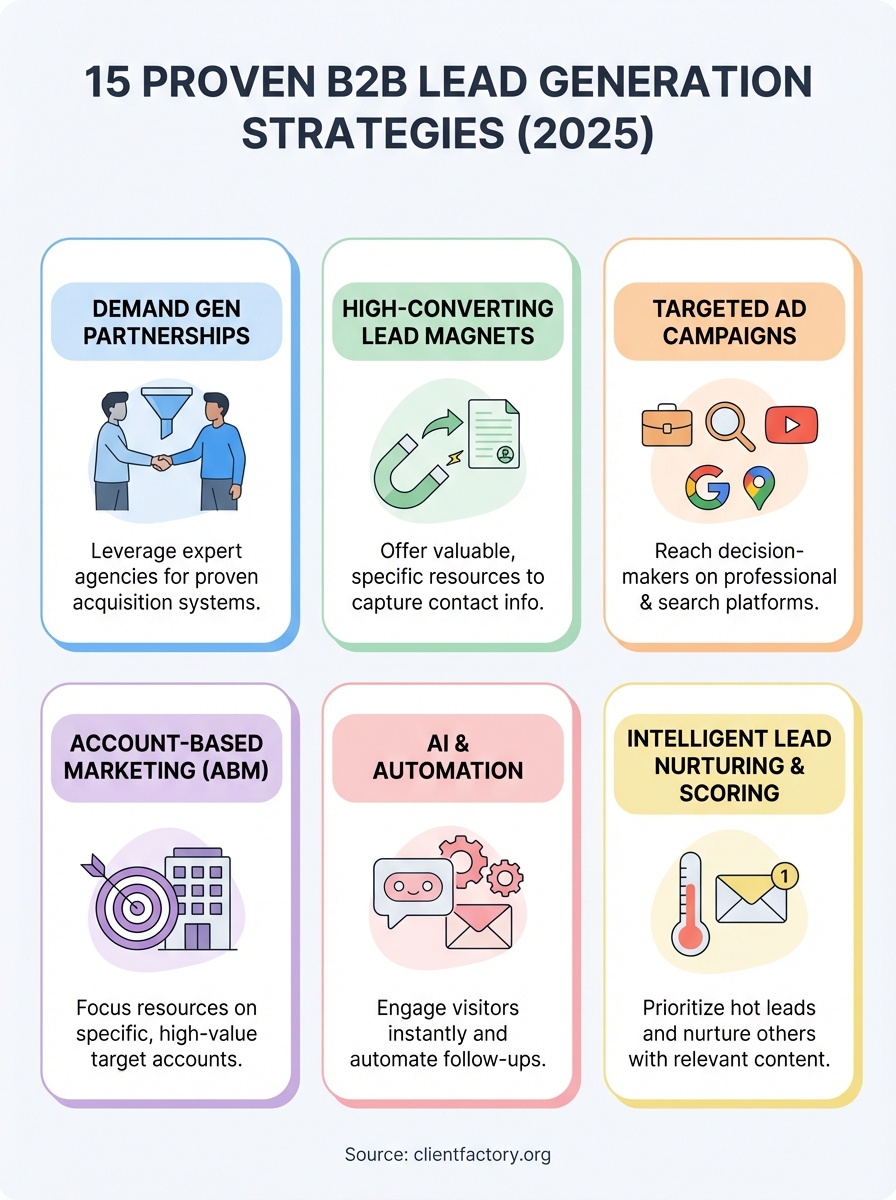
You now have 15 proven lead generation strategies you can implement immediately to fill your pipeline with qualified prospects. Start by choosing two or three tactics that best align with your current resources and business goals, then execute them consistently for 60 to 90 days before adding more. The businesses that succeed focus on mastering a few core strategies rather than attempting everything at once and diluting their efforts across too many different channels.
If you want expert help implementing these systems, Client Factory builds custom demand generation funnels that turn traffic into qualified leads and booked appointments. Request a free funnel audit to identify exactly where your current process loses prospects and discover which specific fixes will deliver the biggest impact on your lead quality and conversion rates.