

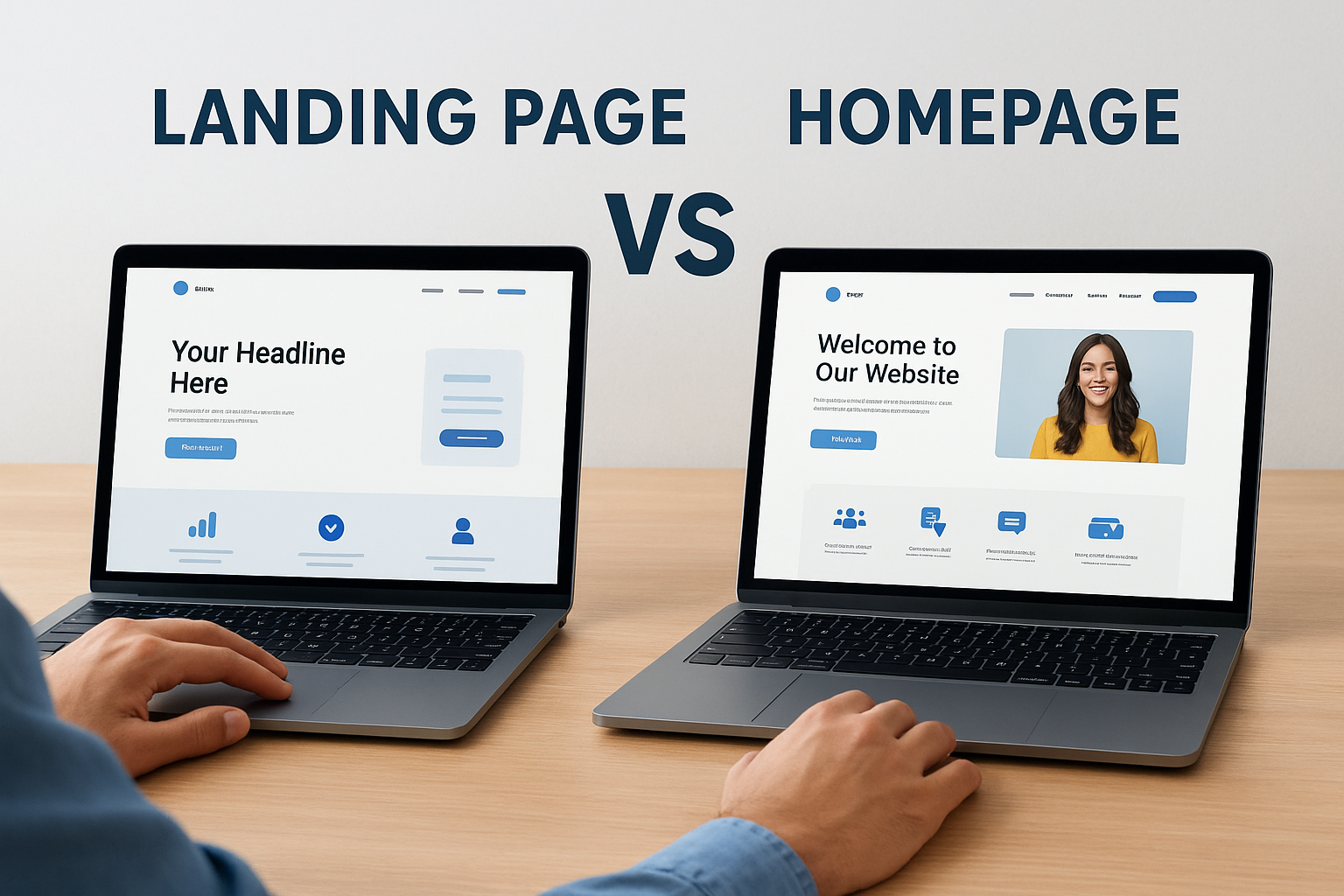
A landing page vs homepage debate comes down to focus. Your homepage welcomes visitors and gives them multiple paths to explore your business. A landing page drives one specific action with zero distractions. Most businesses confuse the two and send paid traffic to the wrong destination. That mistake costs money and kills conversions.
This article breaks down the core functional differences between landing pages and homepages so you know exactly when to use each. You’ll learn how to identify what makes each page type work, which situations call for a focused landing page versus a broader homepage, and the specific elements that make landing pages convert. We’ll also cover the strategic mistakes that tank campaign performance and how to integrate both page types into your marketing mix. By the end, you’ll have a clear framework for choosing the right page to match your business goals.
Why distinguishing between the two matters
You lose money every time you send paid traffic to your homepage instead of a dedicated landing page. The difference between these two page types directly impacts your cost per acquisition, conversion rates, and overall campaign profitability. Most businesses waste thousands of dollars monthly because they don’t understand this fundamental distinction. Your homepage serves one purpose, your landing page serves another, and mixing them up creates friction that drives prospects away.
Campaign costs multiply when you choose wrong
Directing Facebook or Google Ads traffic to your homepage burns your budget faster than almost any other mistake. Your homepage gives visitors multiple navigation options, external links, and competing calls to action that dilute your message. When someone clicks an ad promising a specific solution and lands on a page offering ten different paths, they get confused and leave. That click cost you money and delivered zero return.
Landing pages eliminate this waste by matching the ad message exactly and removing all distractions. You pay the same cost per click whether you send traffic to your homepage or a landing page. The difference shows up in your conversion rate, which can jump from 2% to 15% or higher with a properly designed landing page. That means you need fewer clicks to generate the same number of leads, cutting your acquisition cost by 80% or more in some cases.
A focused landing page removes decision paralysis and guides visitors toward one clear action.
Tracking and optimization become impossible with mixed pages
Your analytics data turns into noise when you treat your homepage like a landing page. You can’t accurately measure campaign performance because your homepage serves multiple traffic sources with different intents. Organic visitors researching your company mix with paid traffic expecting a specific offer. The resulting metrics tell you nothing useful about which campaigns work or how to improve them.
Landing pages give you clean attribution data for each campaign. You know exactly which ad, audience, and message combination drives results because each landing page connects to a specific source. This clarity lets you optimize with precision instead of guessing. You can test headlines, images, and offers without contaminating other traffic sources or confusing your baseline metrics.
Brand perception shifts based on page type
Visitors form immediate judgments about your business based on where they land. Sending someone who clicked an ad about a free consultation to your homepage signals that you don’t respect their time or understand their needs. They wanted the consultation form, not your company history and complete service menu. This mismatch makes you look disorganized or manipulative, which destroys trust before the relationship starts.
The landing page vs homepage choice also affects how professional you appear to sophisticated buyers. Marketing-savvy prospects expect to see dedicated landing pages for paid campaigns. Your homepage works perfectly for brand awareness and organic discovery, but using it for direct response campaigns marks you as inexperienced. That perception matters when you’re competing for high-value clients who evaluate vendors based on marketing sophistication.
How to tell a landing page from a homepage
You can spot the difference between these two page types in seconds by looking at three specific elements. The navigation structure, URL format, and content organization tell you exactly what you’re dealing with. Understanding these visual markers helps you audit your own pages and recognize what competitors do with their traffic. These distinctions aren’t subtle once you know what to look for.
Navigation tells the story
Your homepage displays a full navigation menu with links to every major section of your website. You’ll see menu items for Services, About, Contact, Blog, and other core pages that help visitors explore your business. This navigation bar typically appears at the top of the page and stays visible as users scroll. The goal is to guide discovery and help different visitor types find what they need.
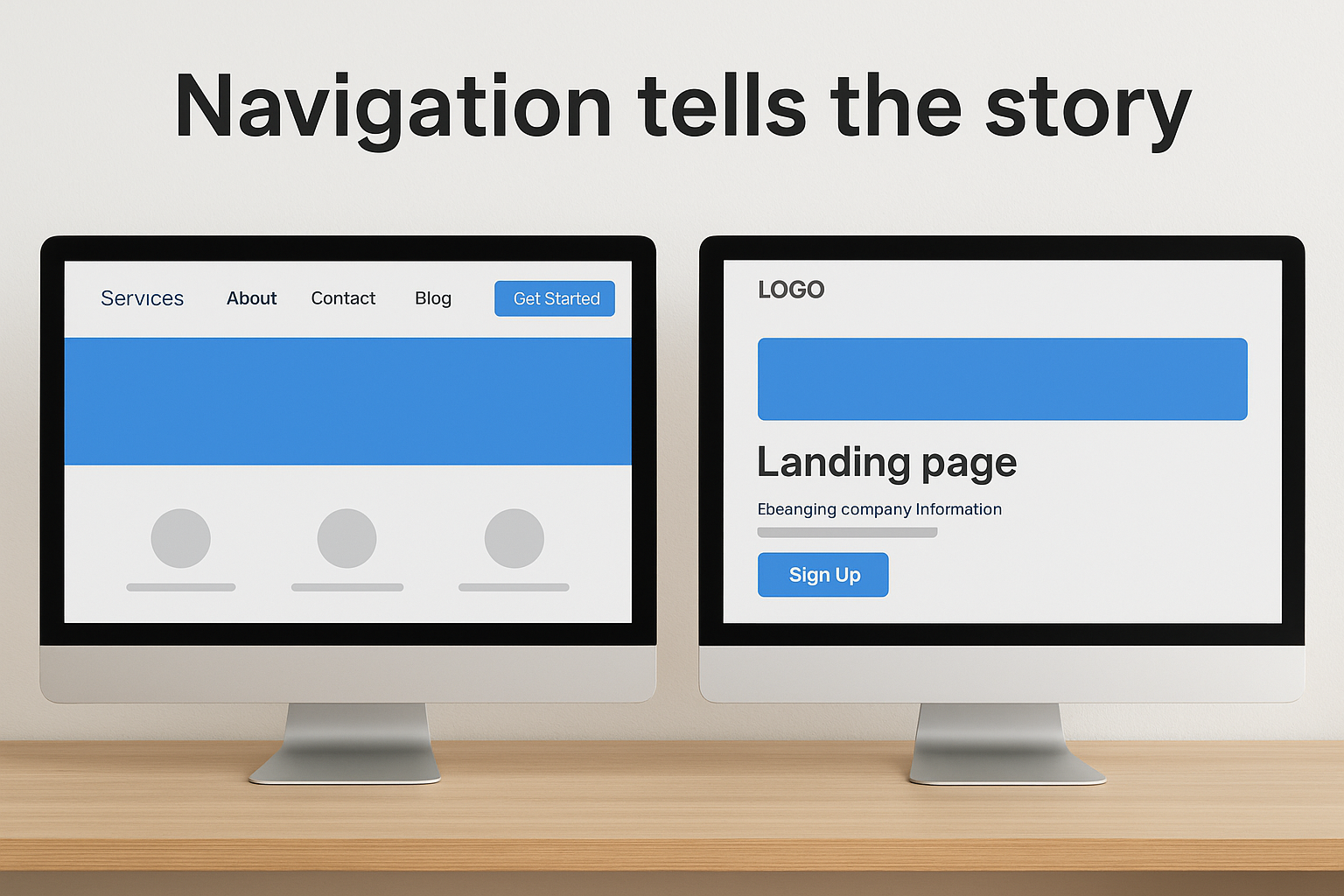
Landing pages strip away this navigation entirely or reduce it to a single logo link. You won’t find menu bars, footer links to other pages, or sidebar navigation that pulls attention away from the main offer. This intentional removal keeps visitors focused on one decision instead of browsing options. The landing page vs homepage navigation difference exists specifically to control visitor behavior and maximize conversions.
URL structure reveals the intent
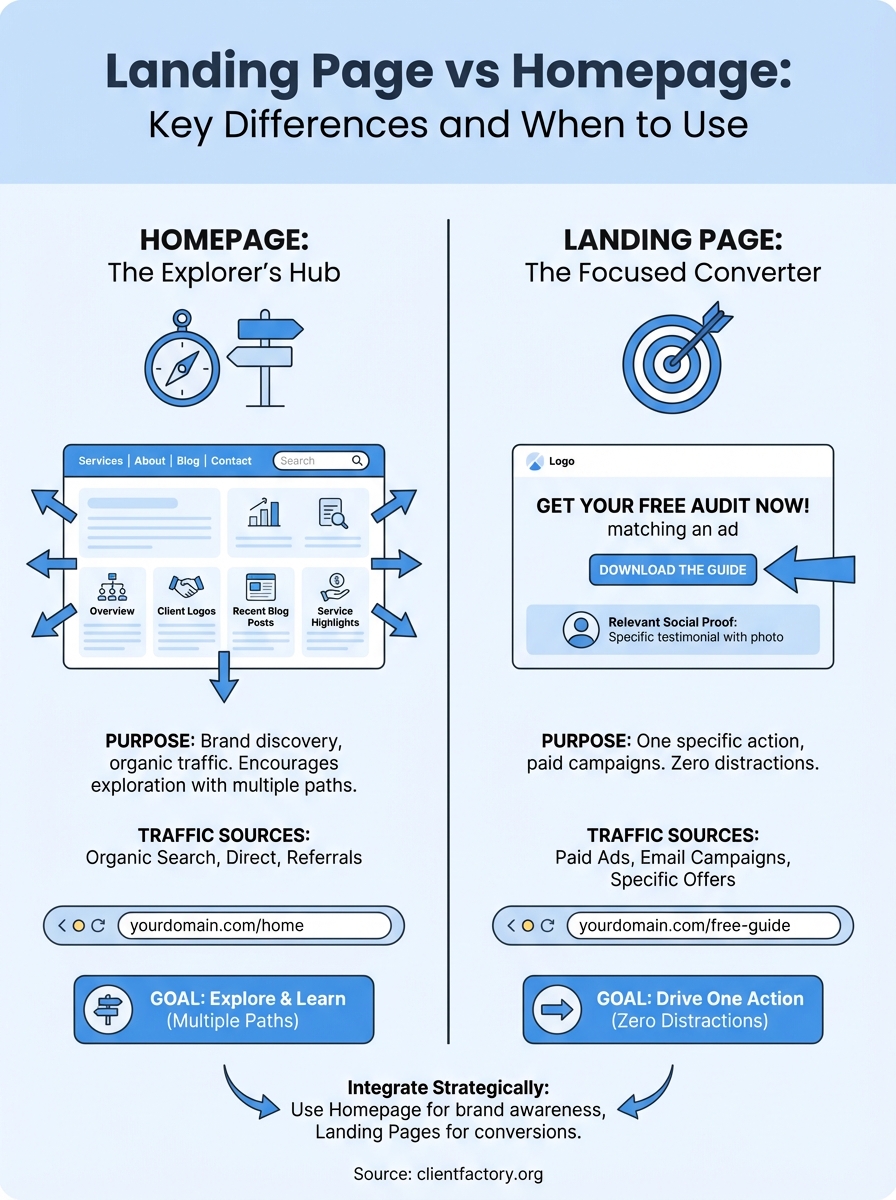
Homepage URLs sit at your root domain or include obvious indicators like “index” or “home.” You’ll see formats like “yourdomain.com” or “yourdomain.com/home” that signal this is the main entry point. These URLs rarely change and serve as the permanent address for your brand online.
Landing pages use campaign-specific URLs that often include the offer, product name, or traffic source. You’ll encounter formats like “yourdomain.com/free-consultation” or “yourdomain.com/webinar-registration” that immediately tell you what action to take. These URLs get created for specific campaigns and sometimes include tracking parameters that identify the ad source or audience segment.
A landing page URL describes the offer, while a homepage URL represents your brand.
Content focus shows the goal
Your homepage content addresses multiple audience segments with varied interests and awareness levels. You’ll find general company information, an overview of all services, client logos, testimonials, and links to recent blog posts. The layout organizes this information into sections that accommodate different visitor goals without forcing one path.
Landing page content hammers one message repeatedly through the headline, subheads, benefits, and call to action. Every element reinforces the specific offer advertised in your campaign. You won’t see company history, complete service listings, or distracting sidebars. The entire page exists to drive one conversion goal that matches the traffic source.
When to use a landing page versus a homepage
The landing page vs homepage decision comes down to traffic source and visitor intent. You need a landing page when you’re paying for clicks or targeting a specific audience with a defined offer. Your homepage works when visitors arrive through organic search, direct traffic, or general brand research. The page type you choose determines whether you guide prospects toward one action or let them explore multiple options.
Use landing pages for paid campaigns
Deploy a dedicated landing page every time you run ads on Facebook, Google, LinkedIn, or any platform where you pay per click. Paid traffic comes with specific expectations because your ad promised something concrete. Visitors who click your ad want the free guide, consultation, or discount you advertised. Sending them to your homepage breaks that promise and wastes your ad spend.
Landing pages also work for email campaigns promoting a single offer. When you send your list an email about a webinar registration or product launch, you need a page that continues the conversation from your message. Your homepage introduces too many competing options that pull attention away from the email’s core offer.
Your paid traffic deserves a page that matches the promise you made in your ad.
Use your homepage for organic discovery
Your homepage serves brand-building and general exploration better than any specialized page. People who type your company name into Google or hear about you from a referral need a starting point that explains who you are and what you offer. These visitors don’t have a specific intent yet, so a broad overview helps them self-navigate to relevant information.
Direct traffic from business cards, vehicle wraps, or word-of-mouth should also land on your homepage. These sources bring curious visitors who need context before they take action. Your homepage gives them the full picture while offering clear paths to dive deeper into specific services or solutions.
Match the page type to visitor awareness
Create landing pages when your audience already understands their problem and you’re offering a specific solution. These prospects don’t need education about why they have an issue. They need you to prove your solution works better than alternatives.
Use your homepage for visitors in the early research phase who might not even know they need your services yet. These people require more context, social proof, and multiple entry points to find what resonates with their situation. Your homepage accommodates this exploration without forcing a premature decision.
Key elements that make a landing page convert
Your landing page either converts or it doesn’t. The difference comes down to specific elements that work together to move visitors toward action. Missing even one of these components tanks your conversion rate and turns your traffic investment into waste. Understanding what separates high-converting landing pages from poor performers helps you build pages that generate results instead of excuses.
A headline that matches your ad
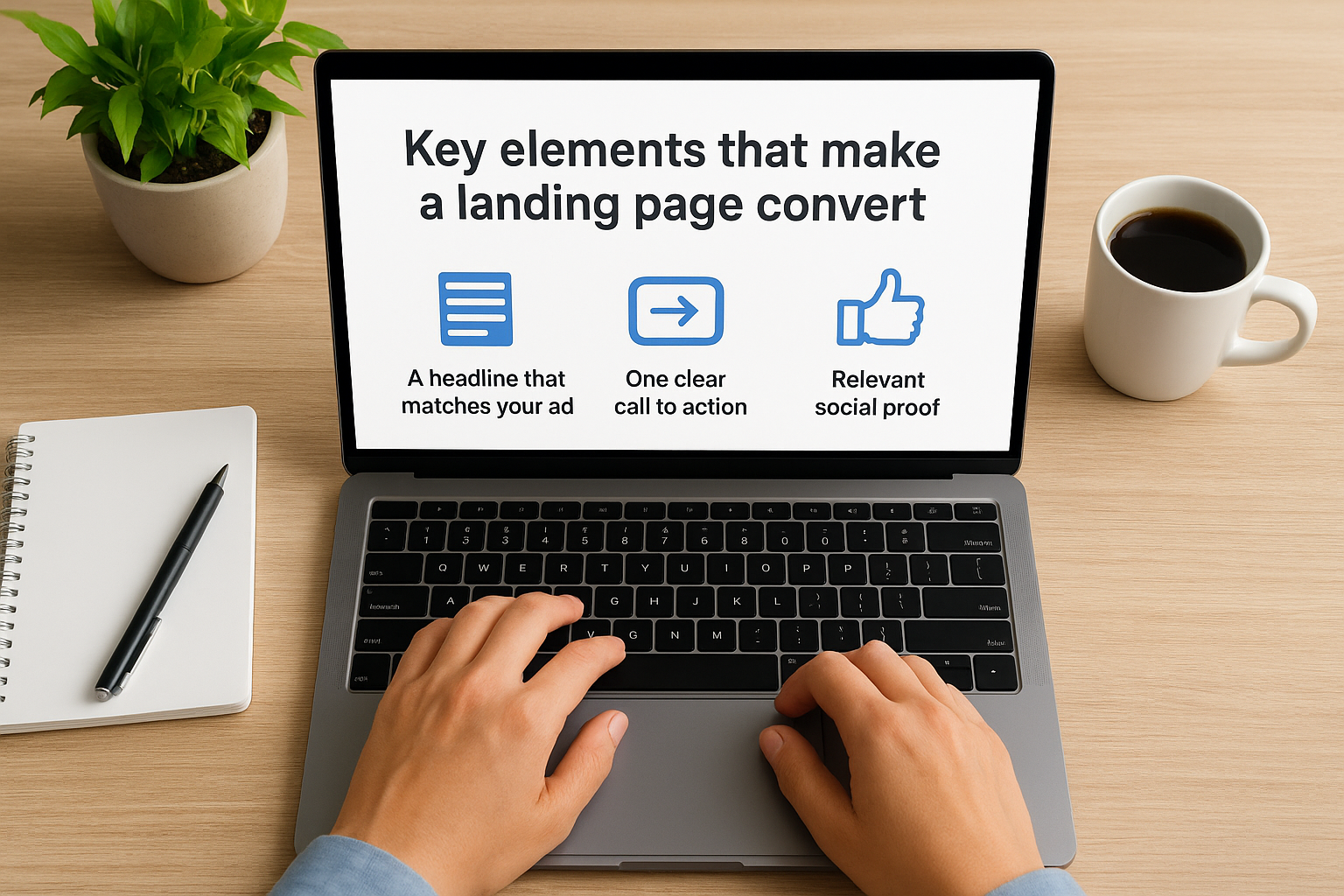
The first element visitors see determines whether they stay or bounce immediately. Your headline must echo the exact promise from your ad or email that brought people to the page. When someone clicks an ad about “Free Marketing Audit for Law Firms” and lands on a page with a generic headline like “Grow Your Practice,” they assume they’re in the wrong place.
Write headlines that include the specific offer and target audience from your traffic source. This continuation of the message reassures visitors they’ve found what they were looking for. The landing page vs homepage difference shows up clearly here because your homepage headline serves general brand messaging while your landing page headline drives toward one conversion goal.
One clear call to action
High-converting landing pages repeat the same call to action multiple times throughout the page. You tell visitors exactly what to do using action buttons that stand out visually and descriptively. Phrases like “Get Your Free Audit” or “Download the Guide” work better than vague commands like “Submit” or “Click Here.”
Remove every competing link or distraction that offers an alternative action. Your page should include only the primary conversion goal button and possibly a phone number for qualified prospects. Adding secondary navigation, social media links, or “learn more” options gives visitors an escape route that kills conversions.
A single focused call to action eliminates decision paralysis and drives more completions.
Relevant social proof
Prospects trust specific evidence over general claims. Include testimonials that mention measurable results, case studies with real numbers, and client logos that your target audience recognizes. Generic praise like “great service” converts poorly compared to detailed stories about problem, solution, and outcome.
Position social proof elements near your call to action where they reduce final objections. The most powerful testimonials address common concerns or objections specific to your offer. Video testimonials outperform text versions because they feel more authentic and harder to fake.
The specific role of a homepage for your business
Your homepage acts as the central hub for every visitor who wants to understand your business at a glance. This page introduces your brand, establishes credibility, and directs different audience types toward the information they need. Unlike the focused landing page vs homepage dynamic where landing pages drive one action, your homepage accommodates multiple visitor intents simultaneously without forcing immediate decisions.
Building trust through brand presentation
Your homepage establishes legitimacy in the first few seconds visitors spend on your site. Prospects judge your professionalism, credibility, and fit for their needs based on visual design, clear messaging, and social proof elements. You need your logo, value proposition, and proof of expertise displayed prominently to pass this initial trust test.
Include client logos, awards, or credentials that signal authority in your industry. Service businesses and law firms particularly benefit from showcasing recognizable brands they’ve served or professional certifications they’ve earned. These trust markers work differently than landing page social proof because they address general credibility rather than a specific offer outcome.
Your homepage serves as your digital storefront where first impressions determine whether prospects explore further.
Serving multiple audience segments
Different visitors arrive at your homepage with varied awareness levels and goals. Some prospects research your services for the first time, while existing clients look for contact information or support resources. Your homepage navigation and content sections must accommodate these diverse needs without overwhelming anyone.
Organize your homepage into clear sections that speak to primary audience segments. A law firm might include sections for practice areas, attorney profiles, case results, and client resources. This structure lets self-guided exploration happen naturally while providing obvious next steps for each visitor type.
Supporting organic search and direct traffic
Your homepage ranks for branded search terms and general industry keywords that bring curious visitors. People who search your company name or discover you through referrals need this foundational page to understand what you offer. The content breadth that hurts landing page conversions actually helps organic discovery by covering topics your target audience searches for.
Maintain updated, relevant content on your homepage to signal freshness to search engines and visitors. Adding recent client wins, new service offerings, or current company news shows active engagement with your market.
Common mistakes that kill campaign performance
Small errors compound quickly when you run paid campaigns. Most businesses sabotage their own conversion rates by making preventable mistakes that cost thousands in wasted ad spend. These errors stem from misunderstanding how visitors process information and make decisions online. Fixing these mistakes improves your cost per acquisition immediately without requiring additional traffic or budget.
Sending all traffic to one destination
You kill conversions when you route every campaign to the same page, whether that’s your homepage or a single generic landing page. Different offers attract different audience segments with unique objections and awareness levels. A prospect clicking an ad for a free consultation needs different messaging than someone downloading a pricing guide.

Create dedicated landing pages for each major campaign and offer instead of forcing all traffic through one funnel. The landing page vs homepage confusion extends to this mistake because businesses often think one landing page can replace proper campaign-specific pages. Match your page content to the specific ad promise and audience intent that generated the click.
Breaking message continuity from ad to page
Your ad copy and landing page headline must echo each other exactly. When visitors click an ad about reducing legal fees and land on a page about improving case outcomes, they bounce immediately. This disconnect signals you either baited them with false promises or don’t understand their needs.
Maintain identical language from your ad through your landing page headline and opening section. If your ad uses specific numbers, timeframes, or benefits, repeat those exact details on your landing page. Testing different headlines might improve results, but those variations must still align with the ad message that brought traffic to your page.
Visitors decide whether to stay or leave within three seconds of landing on your page based on message match.
Overwhelming prospects with unnecessary form fields
Long forms kill conversion rates by creating friction at the exact moment prospects decide to act. Asking for company size, budget range, and detailed project requirements before someone even talks to you raises barriers that filter out qualified leads. Every additional field reduces completion rates by creating more work and raising privacy concerns.
Request only the minimum information needed to continue the conversation. Name, email, and phone number suffice for most service business inquiries. You can qualify leads through follow-up conversations instead of forcing prospects to fill out interrogation forms that make them second-guess their decision to contact you.
How to integrate both into your marketing strategy
Your marketing strategy needs both page types working together instead of competing for attention. Most businesses treat the landing page vs homepage decision as an either-or choice when the real power comes from coordinating both pages strategically. Your homepage builds brand awareness and serves organic traffic while dedicated landing pages convert paid campaigns and specific offers. This division of labor maximizes the value from every traffic source without wasting budget or confusing visitors.
Map your traffic sources to page types
Start by auditing where your current traffic originates and what those visitors need when they arrive. Create a spreadsheet listing every traffic source including organic search, paid ads, email campaigns, social media, referrals, and direct visits. Assign each source to either your homepage or a dedicated landing page based on visitor intent and awareness level.
Paid advertising campaigns demand specific landing pages that match your ad messaging exactly. Organic search traffic for branded terms or general industry keywords works best with your homepage since these visitors need orientation and multiple exploration paths. Email subscribers clicking campaign-specific links convert better on landing pages while newsletter readers browsing your latest updates fit homepage traffic patterns.
Matching your page type to traffic source intent eliminates friction and improves conversion rates across every channel.
Create a clear funnel architecture
Design your funnel so landing pages feed qualified prospects back to your homepage for deeper exploration after conversion. Someone who downloads your free guide from a landing page receives a thank-you page with strategic links to relevant homepage sections. This approach captures the initial conversion while extending engagement for prospects who want more information before buying.
Build cross-linking between pages that supports natural progression through your marketing funnel. Your homepage can link to landing pages for visitors ready to take specific actions. Landing pages should avoid navigation distractions during the conversion process but can include post-conversion paths that guide new leads toward additional resources or next steps.
Test and optimize both page types continuously
Run separate optimization programs for your homepage and landing pages since they serve different goals and audiences. Your homepage testing focuses on improving brand perception, navigation clarity, and serving multiple audience segments effectively. Landing page tests target conversion rate improvements through headline variations, call-to-action placement, and form optimization.
Track performance metrics appropriate to each page type. Your homepage success shows through engagement metrics like time on site, pages per session, and traffic to key internal pages. Landing pages get measured by conversion rate, cost per acquisition, and qualified lead volume that directly impacts revenue.
Choosing the right page for your goals
Your success depends on matching page type to traffic source instead of guessing or defaulting to convenience. Use landing pages for every paid campaign, promotional email, or targeted offer where you need one specific action from a defined audience. Deploy your homepage for organic search traffic, brand awareness campaigns, and visitors who need to explore your full business before making decisions.
The landing page vs homepage choice isn’t complicated once you understand visitor intent. Prospects clicking your ads want the exact solution you promised, not a tour of your entire company. Stop sending paid traffic to your homepage and build dedicated landing pages that convert clicks into revenue. Your conversion rates will jump immediately when you eliminate the confusion and friction that mixed-purpose pages create.
Ready to optimize your client acquisition funnel with pages that actually convert? Client Factory builds data-driven campaigns that turn your traffic into qualified leads and paying clients. We create landing pages and strategies specifically designed for service businesses that need measurable results.