

Your email could contain the most valuable offer, the sharpest copy, or the perfect call to action, but none of it matters if nobody opens it. That’s why knowing how to write email subject lines is one of the most underrated skills in business communication and marketing. The subject line is your first (and sometimes only) shot at earning attention in a crowded inbox where every message competes for a click.
At Client Factory, we build client acquisition systems for service businesses and law firms, and email is a critical piece of that puzzle. We’ve seen firsthand how a single subject line tweak can double open rates overnight and turn a dead campaign into a lead machine. It’s not guesswork. It’s a skill backed by data, psychology, and a few proven principles anyone can learn.
This guide breaks down exactly what makes a subject line work, from structure and length to tone and personalization. You’ll get actionable tips you can apply immediately, plus real-world examples that show these principles in action. Whether you’re sending cold outreach, client follow-ups, or marketing campaigns, you’ll walk away with a clear framework for writing subject lines that actually get opened.
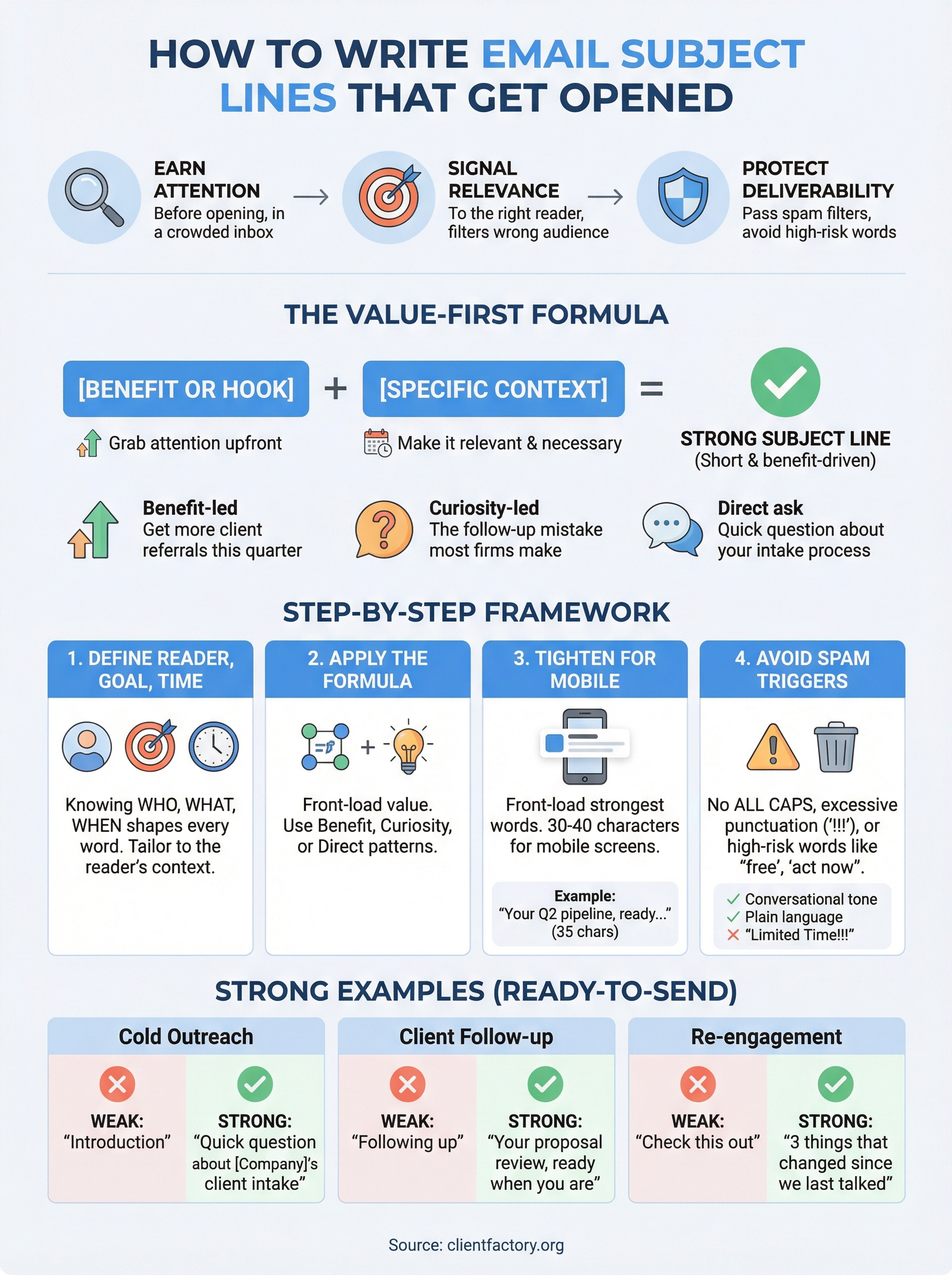
What a great subject line does
A subject line is not a label. It’s a decision trigger that sits at the top of your email and forces a split-second choice: open or ignore. Most readers make that call in two or three seconds, scanning a full inbox without stopping. Your subject line either earns the click or gets buried. There’s no middle ground.
It earns attention before the email is even opened
The inbox is a competitive space, and your subject line competes with every other sender fighting for the same limited attention. A great subject line creates a clear reason to open without overpromising or misleading. Think of it as a handshake: it sets the tone, builds initial trust, and makes the reader want to know what comes next.
The subject line is not part of your email content. It is the gate your content has to pass through first.
Strong subject lines tap into one of a few core motivations: curiosity, relevance, urgency, or self-interest. You don’t need all four at once. Picking one and executing it cleanly is almost always more effective than cramming multiple hooks into a single line.
It signals relevance to the right reader
When you understand how to write email subject lines well, you recognize that relevance is the engine behind every open. A subject line that feels personally aimed at the reader performs significantly better than a generic one. “Your contract renewal is coming up” consistently outperforms “Important update” because the first one answers the reader’s unspoken question: “Is this for me?”
Relevance also filters out the wrong audience, which is a feature, not a flaw. If your subject line is specific, only the people it’s actually for will open it. That improves your click-to-open rate, keeps your list healthy, and signals to email platforms that your messages belong in the inbox.
It protects your deliverability
Most people focus on the reader when crafting subject lines, but email platforms read them too. Gmail, Outlook, and other providers use subject line content as one of many signals to determine where your message lands. Certain words, patterns, and formatting choices trigger spam filters before your reader ever sees the email.
A strong subject line avoids high-risk words like “free,” “guaranteed,” or “act now” while still being compelling. It skips ALL CAPS and stacked exclamation points. It reads like something a real person wrote to another real person, which is exactly what email was designed to be. When your subject line passes both the human test and the platform filter, your deliverability improves, and more of your emails actually reach the people you’re trying to reach.
Step 1. Define the reader, goal, and timing
Before you write a single word, you need to answer three questions: who is reading this, what do you want them to do, and when will they see it? Skipping these questions is the most common mistake people make when learning how to write email subject lines. A subject line written without this context is a guess. One built from clear answers is a targeted message with a far better chance of getting opened.
Know who you’re writing to
Your reader’s identity shapes every word you choose. A cold prospect has no relationship with you, so your subject line needs to work harder to earn curiosity. An existing client already knows your name, so familiarity and specificity matter more than a hook. Write a short profile of your reader before you start: their role, their biggest current problem, and the language they actually use at work.
- Cold prospect: Lead with a relevant insight or a sharp question
- Warm lead: Reference context from your last interaction
- Existing client: Use their name, company, or a specific milestone
- Re-engagement: Acknowledge the gap and make returning feel easy
Match your goal to your subject line type
Every email has one goal, and your subject line should serve that goal directly. Trying to accomplish multiple things at once confuses the reader and dilutes your message. Define what you want the reader to do after opening, then reverse-engineer the subject line from that single action.
Your subject line should make opening feel like the obvious next step, not a gamble.
| Goal | Subject line angle |
|---|---|
| Book a call | Create urgency around a specific time window |
| Read content | Lead with a surprising fact or a useful promise |
| Accept an offer | Make the benefit personal and concrete |
| Re-engage a cold lead | Use curiosity or a low-pressure direct question |
Time your send
When your email arrives matters almost as much as what it says. An email landing at 2 a.m. competes with everything that piled up overnight. Tuesday through Thursday mornings, typically between 8 a.m. and 11 a.m. in your reader’s time zone, consistently produce stronger open rates for business emails. Test different send windows with your own list, track the results, and let your data guide you from there.
Step 2. Write with a simple value-first formula
Once you know your reader, goal, and timing, you need a reliable structure to build from. Most effective subject lines follow a value-first formula: state the benefit or hook upfront, then add enough context to make opening feel necessary. This approach works because it answers the reader’s core question (“Why should I open this?”) before their eyes even finish scanning the line. Give them a clear reason to click, and they will.
The value-first formula explained
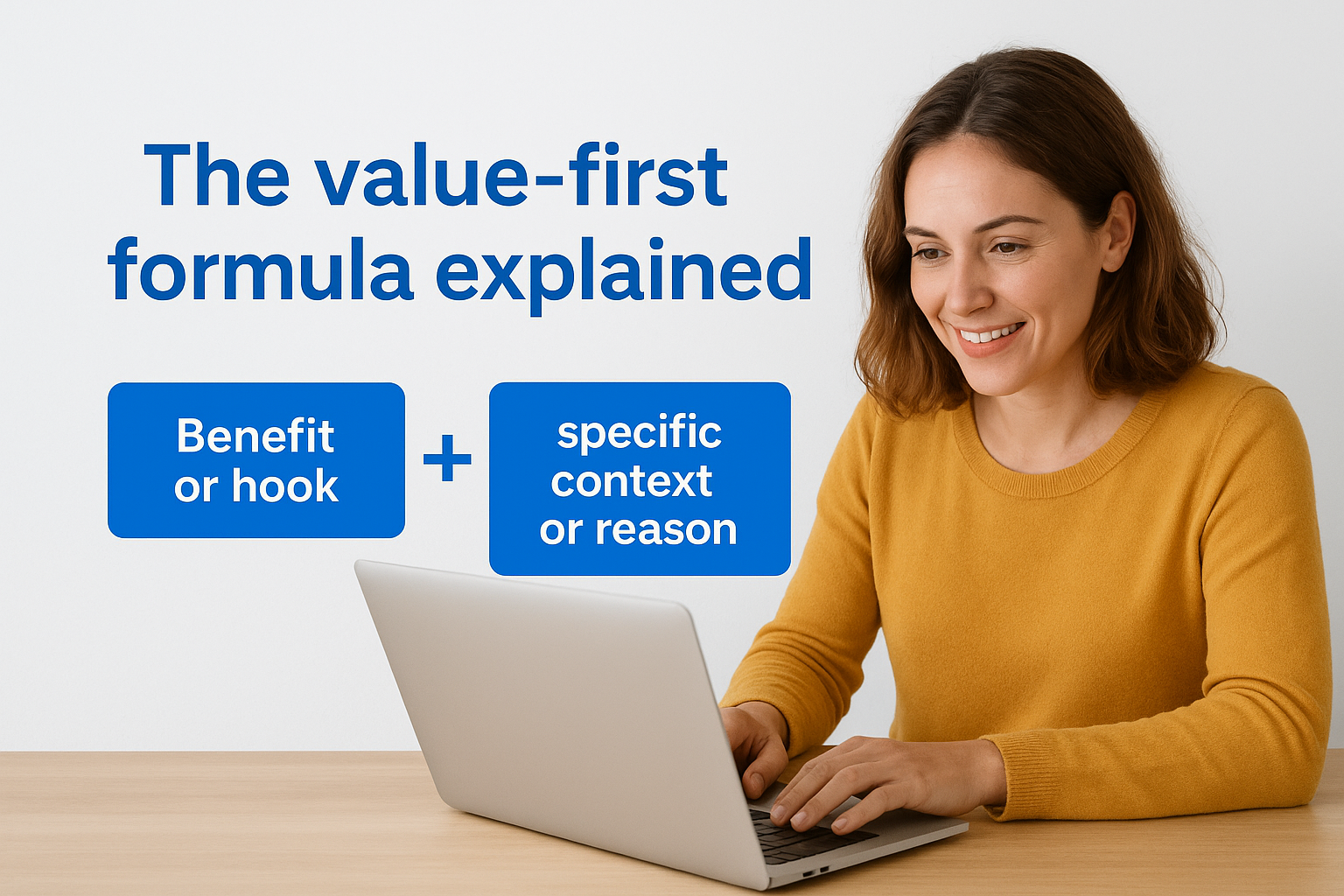
The formula is straightforward: [Benefit or hook] + [specific context or reason]. The first part grabs attention. The second part makes the email feel relevant and worth the click. You don’t need both elements in every subject line, but combining them consistently produces stronger results than using either element alone. Short, specific, and benefit-driven beats long, vague, and clever every time.
When you front-load the value, you give the reader a reason to act before they decide not to.
Here are three subject line patterns built on this formula that you can use directly:
- Benefit-led: “Get more client referrals this quarter” (clear payoff, no fluff)
- Curiosity-led: “The follow-up mistake most firms make” (creates a gap the reader wants to close)
- Direct ask: “Quick question about your intake process” (low pressure, high relevance)
Put the formula to work
Understanding how to write email subject lines with this formula is one thing; applying it to your actual emails is another. The table below shows how to adapt the value-first structure across three common email types you’re probably sending right now.
| Email type | Weak subject line | Value-first version |
|---|---|---|
| Cold outreach | “Introduction” | “How firms like yours cut no-show rates by 30%” |
| Client follow-up | “Following up” | “Your proposal review, ready when you are” |
| Campaign email | “Check this out” | “3 ways to fill your pipeline before Q3 ends” |
Each strong version leads with something the reader specifically cares about and gives a concrete reason to open. Notice that none of them rely on tricks, all caps, or vague teaser language. They simply tell the reader what’s in it for them, clearly and directly, which is all a great subject line needs to do.
Step 3. Tighten for mobile and avoid spam flags
You can write a subject line with a clear value hook and strong relevance, and still lose the open if it gets clipped by a small screen or caught by a spam filter. Mobile email clients typically display between 30 and 40 characters before cutting off, and most filters scan your subject line automatically before your reader ever sees it. Understanding how to write email subject lines that survive both of these gates is what separates a well-crafted message from one that never gets read.

Keep it short enough for mobile screens
More than 60 percent of emails are now opened on mobile devices, which means a long subject line almost always gets cut off mid-sentence. When the most important part of your message sits at the end of the line, mobile readers never see it. Front-load your strongest word or benefit so that even a truncated version still makes sense and earns the click.
A subject line that reads well at 35 characters is stronger than one that reads perfectly at 70.
Use the table below to match your subject line length to the device and context you’re writing for:
| Context | Recommended length | Example |
|---|---|---|
| Mobile-first list | 30-40 characters | “Your Q2 pipeline, ready to review” |
| Desktop business email | 40-60 characters | “3 intake fixes that reduce no-shows fast” |
| Cold outreach | Under 50 characters | “Quick question about your referral process” |
Cut words that trigger spam filters
Spam filters flag patterns, not just individual words, so you need to audit both the content and the formatting of your subject lines before you send. Avoid anything that looks like it was written to manufacture urgency or inflate a promise. The following choices reliably push emails toward the spam folder:
- Words like “free,” “guaranteed,” “winner,” or “risk-free”
- ALL CAPS in any part of the subject line
- Excessive punctuation such as “!!!” or “???”
- Dollar signs or numeric strings like “$$$” or “100% off”
- Phrases like “act now,” “limited time,” or “you’ve been selected”
Plain, conversational language consistently outperforms promotional-sounding copy on both the human and algorithmic level. Write your subject line the way you’d phrase a message to a colleague, and most spam flags will never become a problem.
Step 4. Use ready-to-send subject line examples
Knowing how to write email subject lines is most useful when you have real templates you can adapt and send immediately. The examples below are organized by use case so you can find what fits your situation, swap in your specific details, and hit send with confidence. Each one follows the value-first structure from Step 2 and stays within safe length limits for mobile screens.
Cold outreach and prospecting
Your goal with cold outreach is to earn a click from someone who has no relationship with you yet. Lead with relevance or a sharp question rather than a generic introduction. The subject line needs to make the reader feel the email was written specifically for them, not blasted to a list of thousands.
A cold subject line that feels personal gets opened. One that feels automated gets deleted.
- “Quick question about [Company Name]’s client intake”
- “How [Similar Firm] cut no-show rates by 25%”
- “One thing most [industry] firms miss in their pipeline”
- “[Mutual contact] suggested I reach out”
Follow-ups and warm leads
Warm leads already know who you are, so your subject line can skip the hook and move straight to specifics. Reference something concrete from your last conversation or name a clear next step. Familiarity paired with directness closes more conversations than clever wordplay at this stage.
- “Following up on your proposal, [First Name]”
- “Your intake review, ready when you are”
- “Still worth a 15-minute call this week?”
- “Next steps for [Project or Service Name]”
Re-engagement and campaign emails
Re-engagement subject lines need to acknowledge the gap without making the reader feel guilty for going quiet. Campaign emails should state the benefit upfront so the reader knows exactly what they’re getting before they commit to opening.
- “We haven’t spoken in a while, [First Name]”
- “3 things that changed since we last talked”
- “Your Q3 pipeline: what to fix now”
- “One question before the quarter ends”
- “The referral strategy most firms overlook”
Pick the template that fits your current email, customize the bracketed placeholders with real details, and test two versions against each other if your platform supports A/B testing. Small, consistent improvements to your subject lines compound into significantly better open rates across every campaign you send.
A simple checklist before you hit send
You now have everything you need to apply what you’ve learned about how to write email subject lines that actually get opened. Before every send, run through this quick checklist to catch the most common mistakes before they cost you an open.
- Reader and goal defined: You know exactly who this is for and what one action you want them to take
- Value-first structure: The benefit or hook appears at the front, not buried at the end
- Mobile length: Your subject line fits within 40-50 characters without losing meaning
- No spam triggers: No ALL CAPS, excessive punctuation, or high-risk promotional words
- Personalization added: A name, company, or specific detail makes it feel written for one person
Strong subject lines are a repeatable skill, and every email you send is a chance to sharpen it. If your broader client acquisition funnel needs the same level of attention, book a free conversion audit and we’ll show you exactly where to improve.