

Most businesses pour money into driving traffic, ads, SEO, social media, but completely overlook the one thing that actually determines revenue: how to improve website conversion rate. If your site gets 10,000 visitors a month and converts at 1%, you’re generating 100 leads. Bump that to 3%, and you’ve tripled your results without spending an extra dollar on traffic.
That gap between where you are and where you could be? That’s exactly what we obsess over at Client Factory. Our team has spent over 30 years building and optimizing conversion funnels for service businesses and law firms, turning underperforming websites into predictable client acquisition machines. We’ve seen what works, what doesn’t, and what looks clever but quietly kills your numbers.
This article breaks down 13 proven strategies you can implement right now to get more leads, calls, and sales from the traffic you already have. No theory-heavy fluff, just practical changes backed by data and real-world results. Whether you’re running paid campaigns or relying on organic search, every tactic here applies to your site and can start moving the needle fast.
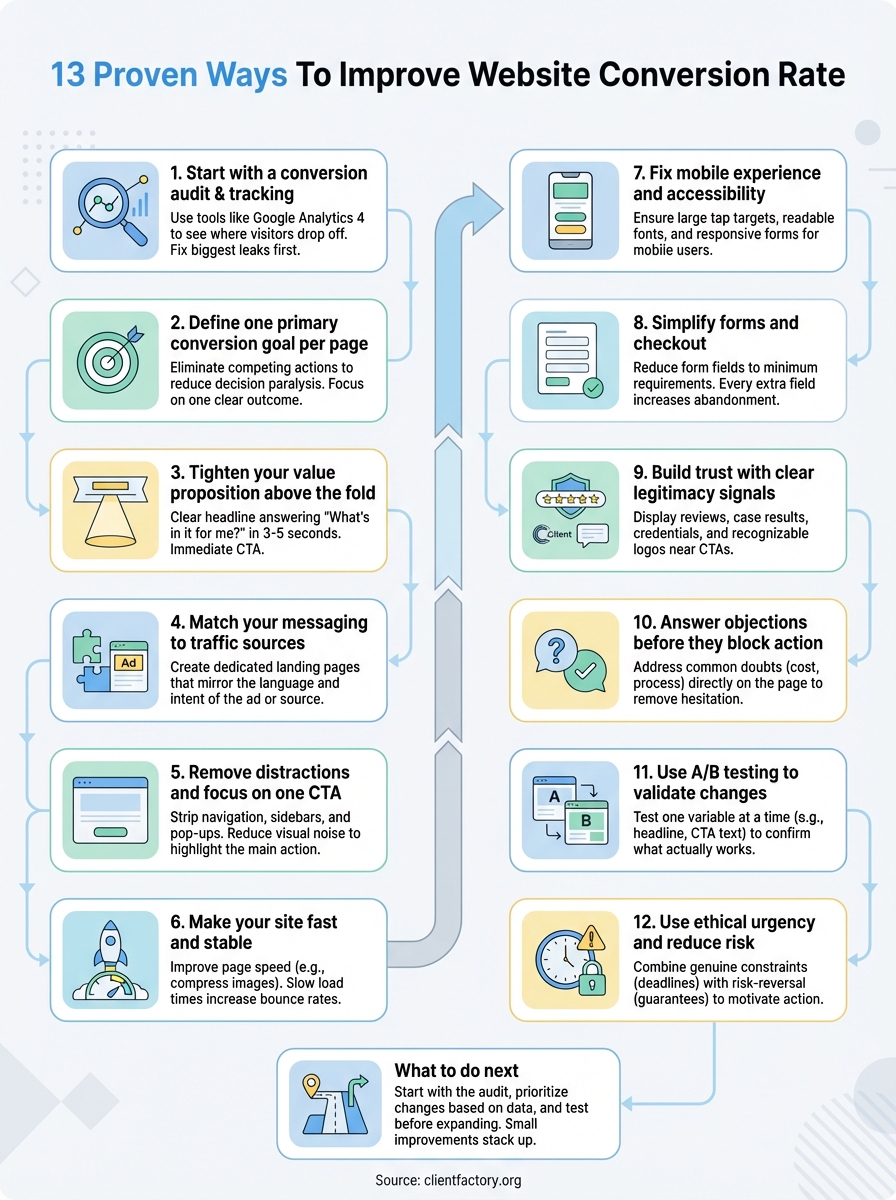
1. Start with a conversion audit and tracking
You can’t fix what you can’t see. Before you apply any tactics on how to improve website conversion rate, you need a clear picture of where visitors drop off, what they click, and which pages are silently killing your funnel. A conversion audit gives you that map, and without it, every change you make is a gamble.

Why this works
Most site owners guess at what’s broken. They swap headlines and redesign pages based on instinct, not data. Guessing wastes time and money, and it often makes things worse. A proper audit replaces opinion with evidence, showing you exactly where your funnel leaks and which fixes will produce the biggest return.
Fix the biggest leak first, and every visitor after that starts working harder for your bottom line.
How to implement it
Start by installing Google Analytics 4 and setting up conversion events for every action that matters: form submissions, phone calls, button clicks, and key page visits. Then layer in a session recording tool to watch real users navigate your site. Look for rage clicks, quick exits, and scroll depth to understand where people lose interest.
Run a heuristic review of each key page by asking whether the page makes the next step obvious. Check for broken links, slow load times, confusing navigation, and missing trust signals. Document every issue before you change anything, so you have a clear before-and-after record to work from.
Quick wins for service businesses and law firms
Service businesses and law firms share the same blind spots: contact forms nobody fills out and phone numbers buried in the footer. Pull your analytics and identify the pages that get the most traffic but produce zero conversions. Those are your first priority.
Your homepage, service pages, and any page tied to paid traffic deserve the closest attention. These areas typically account for the bulk of lost leads and deliver the fastest lift once you address the underlying problems.
Metrics to track
Focus on conversion rate by page, bounce rate, average session duration, and click-through rate on your primary CTA. These numbers tell you whether visitors are engaging or leaving, and they give you a reliable baseline to measure every change against going forward.
- Conversion rate by page: the percentage of visitors who complete your target action
- Bounce rate: the share of visitors who leave without interacting
- Average session duration: how long people actually spend on your site
- CTA click-through rate: whether your calls to action are prompting action
2. Define one primary conversion goal per page
Most pages try to do too many things at once: newsletter sign-up, contact form, social follow, free download, and product demo all competing for attention. Giving visitors too many choices leads to decision paralysis, and decision paralysis leads to them leaving without taking any action at all.
Why this works
Every extra option you add to a page reduces the chance your visitor takes the one action that matters to your business. This concept is backed by Hick’s Law: the more choices you present, the longer someone takes to decide. When you strip a page down to one clear goal, you remove friction and guide visitors toward a single, measurable outcome.
The page that tries to accomplish everything usually accomplishes nothing.
How to implement it
Start by assigning one conversion goal to every page on your site before you write a single word. Your homepage might exist to drive consultation requests. A service page might push visitors toward a phone call. Map each page to a single intended action, then audit your current content and remove or relocate anything that competes with that goal.
Quick wins for service businesses and law firms
If you want to know how to improve website conversion rate fast, this is one of the quickest fixes available. Law firms frequently clutter their pages with multiple practice area links and unrelated CTAs. Remove competing links from high-traffic service pages and replace them with one clear next step, whether that’s booking a call or submitting a case review.
Metrics to track
Track goal completion rate per page and compare pages that have a single CTA against pages with multiple options. You’ll typically see a direct lift in conversions once you eliminate competing actions and give visitors one clear path forward.
3. Tighten your value proposition above the fold
The first thing a visitor sees when they land on your page determines whether they stay or leave. Above the fold is the visible area before any scrolling, and if your value proposition is unclear within three to five seconds, most visitors will bounce without ever seeing the rest of your page.

Why this works
Your value proposition answers the question every visitor asks the moment they arrive: “What’s in it for me?” Weak or vague messaging forces people to work harder to understand what you offer, and most won’t bother. When your headline clearly states who you help, what problem you solve, and why you’re the right choice, visitors immediately self-qualify and move toward taking action.
The clearest message in the room wins, not the cleverest one.
How to implement it
Write a headline that names your ideal client and their desired outcome directly. Avoid generic phrases like “trusted experts” or “industry leaders.” Support your headline with a short subheadline that adds specificity, such as the timeframe, the mechanism, or the specific result you deliver. Then place your primary CTA button immediately below so the next step is obvious without scrolling.
Quick wins for service businesses and law firms
Law firms and service businesses often lead with their name and logo instead of a client-focused statement. Swap your current headline for one that speaks directly to your ideal client’s biggest pain point, and watch engagement improve. If you want to know how to improve website conversion rate fast, this single change can produce measurable results within days of going live.
Metrics to track
Watch scroll depth and bounce rate on your key landing pages. If visitors leave without scrolling, your above-the-fold message is not connecting. Track time on page as a secondary signal to confirm whether your value proposition pulls people in or pushes them away.
4. Match your messaging to traffic sources
A visitor arriving from a Google ad searching “emergency divorce lawyer” is in a completely different mindset than someone who clicked through from a blog post about estate planning. Sending both visitors to the same generic homepage is one of the most common conversion killers, and most businesses never catch it.
Why this works
When your landing page mirrors the language and intent of the source that sent the visitor, they feel an immediate sense of relevance. That continuity, called message match, reduces the cognitive gap between what someone expected and what they see. Stronger message match means lower bounce rates and higher conversion rates because visitors don’t have to re-orient themselves after clicking.
The page that matches the promise of the ad wins the conversion every time.
How to implement it
Create dedicated landing pages for each major traffic source and tailor the headline, subheadline, and CTA to reflect the specific intent behind that channel. A visitor from a paid search ad should land on a page that repeats the exact language from that ad. Organic traffic from a long-form article deserves a softer CTA that matches where that reader sits in the decision process.
Quick wins for service businesses and law firms
If you want to know how to improve website conversion rate without rebuilding your entire site, start with your paid traffic pages. Law firms running ads for specific practice areas should route each ad group to a practice-specific page, not the homepage. This single structural change typically produces a measurable lift in lead volume within the first billing cycle.
Metrics to track
Monitor landing page conversion rate by traffic source and compare performance across channels. A drop in conversion from paid traffic, but not organic, signals a message match problem worth fixing immediately.
5. Remove distractions and focus on one CTA
Navigation menus, sidebar links, pop-ups, and social share buttons all compete for your visitor’s attention. Every element that doesn’t support your primary goal is actively working against it, and too much visual competition pulls focus away from the single action you need visitors to take.
Why this works
Your visitor has a limited amount of attention to spend, and every competing element on the page burns through it. Reducing visual noise keeps that attention pointed directly at your CTA, and cleaner pages with fewer choices consistently produce higher conversion rates because visitors face less resistance on the path to action.
A distraction-free page makes the next step obvious, and obvious converts.
How to implement it
Audit each high-priority page and remove or hide any element that doesn’t directly support the primary CTA. Strip secondary navigation, unrelated service links, and social media icons from your landing pages. Use a single header CTA and a minimal footer. The goal is a straight line between arrival and conversion.
Quick wins for service businesses and law firms
If you want to know how to improve website conversion rate without rebuilding everything, removing competing links from your top service pages is one of the highest-leverage changes available. Law firms should cut practice area links from dedicated inquiry pages. Service businesses running paid ads should use standalone landing pages with no main navigation to keep visitors focused on one path forward.
Metrics to track
Watch CTA click-through rate and bounce rate before and after you strip distractions from your key pages. A climbing click-through rate confirms the changes are working. Secondary signals like time on page will also tell you whether cleaner pages hold attention better over time.
6. Make your site fast and stable
Page speed is not a technical detail you can defer to your developer indefinitely. Slow pages lose visitors before they ever see your offer, and a site that crashes under moderate traffic destroys trust at the worst possible moment.
Why this works
Every additional second your page takes to load reduces your conversion rate measurably. Google’s own research shows that as load time increases from one second to three seconds, the probability of a bounce increases by 32%. Speed is a conversion lever, not just a performance metric, and a stable, fast-loading site signals professionalism before a visitor reads a single word.
A page that loads in under two seconds gives your content a real chance to convert. A page that loads in five seconds rarely gets that far.
How to implement it
Run your key pages through Google PageSpeed Insights to get a prioritized list of fixes. Compress large images and eliminate render-blocking scripts to cut load time immediately. If your site runs on shared hosting with consistent traffic volume, moving to a dedicated or cloud-based server removes one of the most common causes of instability.
Quick wins for service businesses and law firms
If you want to know how to improve website conversion rate without redesigning anything, fixing page speed alone can produce a measurable lift fast. Law firm sites with oversized image files and outdated plugins typically see the quickest gains. Prioritize your five highest-traffic pages and address those before anything else.
Metrics to track
Monitor these numbers across your key conversion pages:
- Core Web Vitals scores: LCP, INP, and CLS from Google Search Console
- Time to first byte (TTFB): server responsiveness under real traffic
- Bounce rate shifts: a drop after speed fixes confirms the direct connection
7. Fix mobile experience and accessibility
More than half of your website traffic now arrives on a mobile device, and if your site isn’t built for that experience, you’re losing leads before visitors read a single word. A page that forces users to pinch, zoom, or hunt for a button sends an immediate signal of neglect, and most visitors leave without engaging further.
Why this works
Mobile visitors have far less patience for friction than desktop users. They abandon pages immediately when buttons are too small or text is too dense, and fixing your mobile layout removes a barrier that quietly blocks a significant share of conversions every single day. Addressing this is one of the most overlooked answers to how to improve website conversion rate.
If your site works beautifully on a laptop but frustrates users on a phone, you’re optimizing for the minority.
How to implement it
Open Google Search Console and review the Mobile Usability report for flagged issues across your key pages. Then manually test each page on a real device and address the following:
- Tap targets: buttons and links should be at least 48×48 pixels
- Font size: body text should read clearly without zooming
- Forms: inputs should expand naturally on smaller screens
- Contrast and alt text: meet basic accessibility standards throughout
Quick wins for service businesses and law firms
Law firms and service businesses often have desktop-first designs where CTAs shrink to near-invisible on mobile. Moving your primary CTA to a sticky bar at the bottom of the screen keeps it visible as visitors scroll and removes the need to hunt for the next step.
Metrics to track
Split your conversion rate by device type in Google Analytics 4 and compare mobile against desktop performance. A significant gap between the two points directly to a mobile experience problem that a targeted fix can close quickly.
8. Simplify forms and checkout
Forms are where many conversions die quietly. A visitor who reaches your contact form or checkout has already decided they’re interested, yet a long, complicated form can undo all the work your page did to get them there.

Why this works
Every field you add to a form is a small act of friction, and friction compounds fast. Research consistently shows that reducing form fields increases completion rates, sometimes dramatically. When you ask only for what you genuinely need at that stage, you signal respect for your visitor’s time and make the final step feel easy instead of invasive.
The form that asks for the least gets filled out the most.
How to implement it
Start by auditing every field on your current forms and cut any field you don’t act on within 24 hours of receiving it. For service inquiry forms, name, phone number, and a single open question are typically enough to start a conversation. If you run an e-commerce checkout, enable guest checkout and auto-fill address fields where possible to reduce the number of manual inputs required.
Quick wins for service businesses and law firms
If you want to know how to improve website conversion rate without a full redesign, shortening your intake form is one of the fastest wins available. Law firms routinely ask for details like case dates and prior counsel before a single consultation has taken place. Cut those fields from the initial form and move them to the intake call instead.
Metrics to track
- Form completion rate: the percentage of visitors who start and finish the form
- Field abandonment rate: which specific fields cause drop-off
- Cost per lead: whether simpler forms reduce your acquisition cost over time
9. Build trust with clear legitimacy signals
Visitors arrive at your site with skepticism baked in. Before they fill out a form or pick up the phone, they’re quietly asking whether you are who you say you are, and a site that fails to answer that question loses the lead before the CTA ever gets a chance to work.
Why this works
Trust is not a soft metric. When visitors see concrete proof that others have worked with you and gotten results, their hesitation drops fast. Review counts, case results, credentials, and recognizable logos all serve as social proof that shortens the decision timeline and moves visitors toward action faster than any headline alone.
The visitor who trusts you enough to act is worth far more than ten visitors who leave because they weren’t sure.
How to implement it
Place client testimonials, star ratings, and recognizable client logos on your highest-traffic pages, specifically above the fold and near your primary CTA. Add professional credentials and certifications where relevant. If you’ve been featured in publications or industry associations, display those badges prominently so visitors see them without needing to scroll.
Quick wins for service businesses and law firms
If you want to know how to improve website conversion rate without rebuilding your pages, adding three to five recent client reviews directly above your contact form is one of the simplest and most effective moves available. Law firms should display bar association credentials and verified review counts from Google on their intake pages to immediately reinforce credibility with prospects who are comparing multiple firms.
Metrics to track
Watch form completion rate and time on page on pages where you add trust signals. A rising completion rate after adding reviews confirms a direct impact on visitor confidence.
10. Answer objections before they block action
Every visitor who reaches your CTA carries a set of unspoken doubts. They wonder whether your service is worth the cost, whether the process is complicated, and whether you’ll actually deliver on your promises. Leaving those doubts unanswered forces visitors to talk themselves out of converting, and most of them will.
Why this works
When you surface and address common objections directly on the page, you remove the internal resistance that stops people from acting. Visitors who see their concerns acknowledged feel understood rather than sold to, and that shift makes the final step far less intimidating. This is one of the most underused answers to how to improve website conversion rate.
The objection you fail to address becomes the reason your visitor leaves.
How to implement it
Review your sales call notes or survey recent clients to identify the three to five objections that surface most often before someone hires you. Then address each one on your service or landing page, either in a short FAQ block or as inline copy near your CTA. Specific, honest answers outperform vague reassurances every time, so keep the language plain and direct rather than defensive.
Quick wins for service businesses and law firms
Law firms can tackle concerns around cost transparency and timeline expectations directly on their intake pages. Service businesses should address questions about contracts, pricing structure, and what happens if results fall short. Placing this content directly above your contact form puts it exactly where hesitation runs highest and the decision gets made.
Metrics to track
Watch form completion rate and scroll depth near your FAQ or objection-handling sections. A steady rise in completions after adding this content confirms that answering doubts directly removes a real barrier to conversion.
11. Use A/B testing to validate changes
Every change you make to your site is a hypothesis. A/B testing gives you a structured way to confirm whether that hypothesis improves performance or quietly makes things worse. Without testing, you’re making decisions based on opinion, and opinion rarely beats data when real conversion rates are on the line.
Why this works
Running a test pits your original page against a variation and measures which version drives more of the specific action you want. This process removes subjectivity from your decisions and builds a record of what actually resonates with your audience. Over time, a disciplined testing habit compounds into meaningful, permanent gains that no amount of guesswork can replicate.
The page you think is better is often not the one that converts better.
How to implement it
Pick one variable to test at a time, whether that’s a headline, CTA button text, or the placement of a trust signal. Split traffic evenly between your two versions and let the test run until you reach statistical significance at 95% confidence before declaring a winner and moving on.
Quick wins for service businesses and law firms
If you want to know how to improve website conversion rate without a large budget, start by testing your primary CTA button copy on your highest-traffic page. Law firms and service businesses often see fast lifts by testing specific, action-oriented language against generic alternatives like “Contact Us.”
Metrics to track
Track these numbers to confirm your tests are producing reliable, actionable results rather than misleading signals from small sample sizes:
- Conversion rate per variation: the primary indicator of which version wins
- Statistical confidence level: reach 95% before acting on any result
- Test duration: run for at least two full business cycles to normalize traffic patterns
12. Use ethical urgency and reduce risk
Visitors who feel no reason to act now rarely come back later. Urgency and risk reduction work together: one gives people a reason to decide today, and the other removes the fear that makes them stall. Knowing how to improve website conversion rate means understanding when and how to apply both tactics without undermining the trust you’ve built.
Why this works
When real scarcity or a genuine deadline exists, communicating it pushes visitors past the inertia that kills conversions. Pairing that pressure with a clear risk-removal signal answers the two questions every prospect carries: “Why act now?” and “What do I lose if this doesn’t work out?”
Urgency moves people toward a decision; risk reduction makes that decision feel safe enough to take.
How to implement it
Identify genuine constraints in your offer before writing any urgency copy. Limited availability, intake deadlines, or time-sensitive pricing all qualify. Combine these with a clear risk-reversal statement near your CTA so visitors see both the reason to act and the safety net at the same time.
Add urgency without breaking trust
Never fabricate scarcity. False countdown timers and manufactured availability limits destroy credibility the moment a visitor refreshes the page and notices nothing has changed. Use only urgency that reflects your actual capacity or a real deadline tied directly to your service.
Reduce perceived risk without discounting
A free consultation, a satisfaction guarantee, or a no-contract clause removes the financial hesitation that holds prospects back. You don’t need to cut your price to lower the perceived risk of working with you.
Metrics to track
- CTA click-through rate before and after adding urgency copy
- Form completion rate on pages where risk-reversal statements appear
What to do next
You now have a complete, prioritized framework for how to improve website conversion rate across every layer of your site. The 13 strategies in this article cover everything from foundational audit work to trust signals, mobile experience, and ethical urgency. None of them require a full redesign or a larger ad budget to produce real results.
Start with the audit. Identify your highest-traffic pages and measure what they currently convert at. Pick the two or three changes most likely to move that number based on what the data shows you, then test and confirm before expanding. Small, deliberate improvements stack up faster than sweeping overhauls.
If you want a second set of eyes on your funnel before you start making changes, our team at Client Factory has run hundreds of conversion audits for service businesses and law firms. Book a free funnel audit call and we’ll tell you exactly where your site is losing leads.