
You run a good business. Your service delivers real value. But if your pipeline stays empty, none of that matters. Most B2B companies burn through marketing budgets on tactics that generate noise instead of qualified leads. You get clicks that go nowhere. Forms filled by people who never convert. Trade show cards that sit in a drawer. Meanwhile, your competitors close deals with buyers you should have reached first.
This guide breaks down eight proven strategies that generate actual B2B leads in 2025. You will learn how to build AI powered funnels that qualify prospects automatically. How to run search campaigns that capture buyers at decision time. How to turn LinkedIn from a time sink into a lead machine. Each strategy includes real implementation steps and the exact metrics you need to track. No theory. No generic advice. Just the tactics that work right now for service businesses and B2B companies that need more qualified leads walking through their door.
1. Use Client Factory to build AI lead funnels
Client Factory specializes in AI-powered lead funnels that qualify prospects automatically before they reach your sales team. Traditional funnels leak leads at every stage. You capture a visitor’s email, but then what? Most businesses send generic follow-ups that get ignored. Client Factory builds conversion-optimized funnels that use artificial intelligence to segment leads by behavior, respond instantly to inquiries, and move qualified prospects toward booking calls without manual intervention. Your team only talks to people ready to buy.
What this looks like in B2B
A service business visitor lands on your website, downloads a resource, and triggers an automated qualification sequence. The AI chatbot asks targeted questions about budget, timeline, and decision-making authority. Based on responses, leads get scored and routed. High-intent prospects book directly into your calendar. Lower-intent leads enter a nurture sequence with case studies and proof points. You stop wasting time on tire kickers and start conversations with buyers who match your ideal client profile.
The best funnels qualify leads before your sales team ever picks up the phone.
Steps to put this into action
Schedule a conversion audit with Client Factory to identify where your current funnel loses leads. Map out your buyer journey from first click to closed deal. Build landing pages optimized for each traffic source with clear value propositions. Implement AI chat tools that capture lead information and qualify intent through conversational questions. Set up automated email sequences that deliver relevant content based on how leads interact. Connect your funnel to your CRM so every lead interaction gets tracked and scored.
KPIs to measure and optimize
Track your lead-to-qualified-lead conversion rate to see how many visitors turn into sales-ready prospects. Monitor cost per qualified lead across all traffic sources. Measure time from first touch to booked appointment. Watch your funnel drop-off rates at each stage to identify bottlenecks. Review lead quality scores and close rates to validate that your AI qualification actually works. Adjust your qualification questions and nurture sequences based on which leads convert into paying clients.
2. Run high intent search ad campaigns
Search ads on Google capture buyers at the exact moment they look for solutions. Unlike social media where you interrupt people, search campaigns respond to active demand. Someone types “enterprise software security audit” or “B2B marketing agency for SaaS” because they need help right now. Your ad appears. They click. You win the lead before your competitors even know that prospect exists. Search ads deliver the highest intent leads in digital marketing when you target the right keywords and build landing pages that match search intent.
What this looks like in B2B
Your service business bids on keywords that indicate buying intent rather than research intent. Instead of targeting “what is marketing automation,” you target “marketing automation implementation services.” You create separate campaigns for different buyer stages. Decision stage keywords get higher bids and send traffic to demo request pages. Research stage keywords get lower bids and route to educational content that captures emails. Your ads speak directly to pain points that prospects typed into the search bar.
Search ads work because you reach people who already decided they need what you sell.
Steps to put this into action
Build a keyword list focused on commercial intent terms that include “services,” “agency,” “consultant,” “solutions,” or your specific service category. Create tightly themed ad groups with three to five keywords each. Write ad copy that mirrors the exact language prospects use when they search. Design landing pages specific to each ad group that reinforce the message and make the next step obvious. Set up conversion tracking for every action that indicates lead quality. Start with modest budgets, test multiple ad variations, and scale what converts.
KPIs to measure and optimize
Monitor your cost per lead and compare it against your customer lifetime value to ensure profitability. Track conversion rates from click to lead for each keyword and ad group. Review your quality scores because higher scores lower your costs and improve ad placement. Measure lead-to-customer conversion rates to identify which keywords generate actual revenue. Watch impression share to understand if budget constraints limit your visibility. Adjust bids based on which search terms consistently deliver qualified leads that close into paying clients.
3. Turn LinkedIn into a lead engine
LinkedIn holds over 900 million professionals who make buying decisions for their companies. Most B2B marketers waste this opportunity by treating LinkedIn like a digital resume database. You need to approach the platform as a systematic lead generation system. Post content that solves specific problems your ideal clients face. Comment on posts from prospects in your target companies. Send connection requests with personalized messages that reference shared interests or mutual connections. Direct messages that lead with value instead of sales pitches start real conversations that turn into discovery calls.

What this looks like in B2B
Your service business publishes weekly thought leadership posts that address challenges your buyers actually care about. You engage with decision makers at target accounts by commenting thoughtfully on their content. When you send connection requests, you mention a specific post they shared or a mutual connection who suggested you connect. After connecting, you send a follow-up message that offers a free resource or insight rather than pitching your services immediately. You build relationships first and generate leads second.
LinkedIn works when you focus on helping before selling.
Steps to put this into action
Optimize your profile to clearly state what problems you solve and who you help. Identify 50 to 100 target accounts and follow key decision makers at each company. Create a content calendar with posts that demonstrate your expertise without selling. Spend 20 minutes daily engaging with content from prospects and industry leaders. Use LinkedIn Sales Navigator to filter prospects by job title, company size, and industry. Send five personalized connection requests each day. Follow up with new connections within 48 hours using messages that reference something specific about their business or role.
KPIs to measure and optimize
Track your connection acceptance rate to gauge whether your outreach resonates with prospects. Monitor engagement rates on your posts to identify which topics attract your ideal buyers. Measure the percentage of conversations that turn into discovery calls or demos. Count qualified leads generated through LinkedIn monthly. Review response rates to your initial messages and adjust your approach based on which messages get replies. Calculate cost per lead if you invest in Sales Navigator or LinkedIn ads and compare it against other channels that bring in qualified prospects.
4. Build a website that attracts ideal leads
Your website operates as your 24/7 sales representative that either converts visitors or sends them straight to competitors. Most B2B websites fail because they focus on looking professional instead of driving action. Clean design means nothing if prospects cannot figure out what you do, who you help, or how to take the next step. You need clear messaging that speaks to specific pain points, compelling calls to action on every page, and conversion paths optimized for different buyer stages. When someone lands on your site, they should understand your value proposition in five seconds and know exactly how to engage.
What this looks like in B2B
A high-converting B2B website presents your value proposition above the fold with concrete outcomes instead of vague promises. Your homepage explains who you serve and what results you deliver using language your prospects actually use. Each service page addresses specific challenges and includes client results that prove your claims. You place lead capture forms strategically throughout the site with clear value exchanges. Case studies showcase measurable outcomes. Your contact page offers multiple engagement options from scheduling calls to downloading resources.
Your website should answer the prospect’s question before they ask it.
Steps to put this into action
Audit your current site to identify where visitors drop off and which pages generate zero conversions. Rewrite your homepage headline to state the specific outcome you deliver for your target client. Create dedicated landing pages for each service offering with problem-focused copy. Add clear calls to action every 200 to 300 words that tell visitors exactly what to do next. Build forms that ask only for essential information to reduce friction. Include social proof like logos, testimonials, and case study results near conversion points. Test your site on mobile devices because over half of B2B research happens on phones.
KPIs to measure and optimize
Track your website conversion rate from visitor to lead across all traffic sources. Monitor bounce rates on key pages to identify content that fails to engage prospects. Measure time on page for your most important content to gauge whether visitors actually read it. Review form completion rates and test shorter versions if abandonment runs high. Watch which pages generate the most qualified leads and create more content around those topics. Use heatmaps to see where visitors click and scroll to understand how to generate leads more effectively through better page layouts and call-to-action placement.
5. Nurture leads with email and automation
Most leads never convert on the first interaction because buyers need multiple touchpoints before they trust you enough to take action. Email automation solves this problem by delivering the right message at the right time without requiring your team to manually follow up with every prospect. You set up behavior-triggered sequences that respond to how leads interact with your content. Someone downloads a case study gets different emails than someone who visits your pricing page three times. Automation keeps your business top of mind while you focus on closing deals with hot prospects.
What this looks like in B2B
Your marketing automation platform tracks every lead action and adjusts communication based on engagement signals. A prospect who opens three emails about a specific service gets invited to book a consultation. Someone who goes quiet for two weeks receives a re-engagement campaign with fresh content or a special offer. Leads who download multiple resources but never book a call get targeted with testimonials from clients in their industry. The system works continuously to move prospects from awareness to decision without human intervention until they signal buying intent.
Automation turns your email list into a revenue engine that works while you sleep.
Steps to put this into action
Segment your email list by industry, company size, and behavior to send relevant messages. Create welcome sequences that introduce new subscribers to your best content and case studies. Build nurture campaigns triggered by specific actions like downloading resources or visiting key pages. Write five to seven emails per sequence with clear calls to action that match the prospect’s stage. Use personalization tokens for names, companies, and industries. Set up lead scoring that increases when prospects engage and flags high-intent leads for sales outreach.
KPIs to measure and optimize
Monitor your email open rates to test subject lines that capture attention. Track click-through rates to identify which content resonates with prospects. Measure conversion rates from email to booked calls or demos. Review unsubscribe rates to ensure you provide value without overwhelming contacts. Watch lead scores to see which automation sequences generate the most sales-ready prospects. Calculate revenue generated per email sent to understand which campaigns drive actual business results and deserve more investment.
6. Host webinars and demos that convert
Webinars and live demonstrations cut through the noise by letting prospects experience your expertise before they commit. You build trust faster when people see your solution in action rather than reading about it. Most B2B buyers attend three to five webinars before making a purchase decision. Your webinar positions you as the authority while capturing contact information from attendees who already demonstrated interest. Demos take this further by showing exactly how your service solves the specific problem that brought prospects to you in the first place.
What this looks like in B2B
A software company hosts monthly webinars that address specific pain points like “reducing security vulnerabilities in legacy systems.” Registration requires business email, company name, and role. During the 45-minute session, you demonstrate your platform solving real problems with live examples. Attendees ask questions in chat. After the webinar, you send the recording with a personalized follow-up offering a private demo. High-engagement attendees who stayed for the full session and asked questions get flagged for immediate sales outreach.
Webinars work because prospects invest time learning from you before you ask for their business.
Steps to put this into action
Choose topics that directly address challenges your ideal clients face based on sales conversations. Create registration pages that clearly state what attendees will learn and accomplish. Promote webinars through email, LinkedIn, and search ads two weeks before the event. Prepare a structured presentation with concrete examples and actionable takeaways. Include live Q&A to address specific concerns. Follow up within 24 hours with the recording and a clear call to book a consultation or demo.
KPIs to measure and optimize
Track registration-to-attendance rates to improve your email reminders and timing. Monitor engagement metrics like average watch time and question volume to gauge content quality. Measure conversion rates from attendee to booked consultation. Review which topics generate the most qualified leads to guide future webinar planning. Calculate cost per lead including promotion expenses and compare against other channels that show you how to generate leads profitably.
7. Build referral and partner lead programs
Your existing clients already know businesses that need your services. Referral programs turn satisfied customers into active lead generators by creating systematic incentives for introductions. You stop relying entirely on cold outreach and paid advertising. Strategic partnerships multiply this effect by connecting you with companies that serve the same buyers without competing for the same business. A marketing agency partners with web developers. A law firm partners with accountants. Both sides refer clients who need complementary services, creating mutual lead flow that costs nothing except the effort to nurture the relationship.

What this looks like in B2B
You launch a referral program that rewards clients who introduce qualified leads with account credits, service upgrades, or cash bonuses. Your account managers ask for introductions during quarterly reviews when clients express satisfaction. For partnerships, you identify businesses whose clients need your services at predictable moments. A business insurance broker partners with commercial real estate agents because new tenants always need coverage. You formalize these relationships with co-marketing agreements that include joint webinars, shared content, and regular lead exchanges that benefit both companies.
Referrals convert three to five times higher than cold leads because trust transfers from the introducer.
Steps to put this into action
List your top 20 clients and identify which ones actively network in your target market. Create a simple referral program with clear rewards and an easy submission process. Reach out personally to explain the program and ask for one specific introduction. For partnerships, identify five companies that serve your ideal clients without competing. Propose a pilot partnership where you refer leads to each other for 90 days. Meet monthly to review lead quality and adjust your approach. Document your processes so your team knows how to generate leads consistently through these channels.
KPIs to measure and optimize
Track the number of referrals received monthly and which clients generate the most qualified introductions. Measure referral-to-customer conversion rates because these leads should close at higher rates than cold prospects. Monitor the lifetime value of referred customers since they typically stay longer. For partnerships, count leads exchanged in both directions and calculate close rates for partner-sourced leads. Review the cost per acquisition for referral programs including rewards paid out and compare against paid channels to validate ROI.
8. Retarget and optimize for more conversions
Most website visitors leave without converting, but retargeting campaigns bring them back when they show buying signals elsewhere online. You invest money driving traffic to your site. Only 2 to 3% convert on the first visit. The other 97% disappear unless you follow them with targeted ads that remind them why they came to you initially. Retargeting works because it reaches prospects who already know your business while they browse other sites, read industry news, or scroll social media. You stay visible during the consideration phase when buyers compare options and make final decisions.
What this looks like in B2B
Your service business places tracking pixels on key pages like case studies, pricing, and service descriptions. When prospects visit these pages, they enter retargeting audiences segmented by interest level. Someone who spent five minutes on your pricing page sees ads offering a free consultation. A visitor who read three case studies gets ads featuring client testimonials from their industry. You run these targeted ads across display networks, LinkedIn, and Facebook to reach decision makers wherever they spend time online.
Retargeting converts because you reach people who already expressed interest in what you sell.
Steps to put this into action
Install tracking pixels from Google Ads and LinkedIn on your website. Create audience segments based on specific page visits and time spent on site. Design ad variations that match each segment’s interest level and address common objections. Set frequency caps to avoid overwhelming prospects with too many impressions. Start with modest budgets and scale campaigns that deliver qualified leads. Test different messages, images, and calls to action to find what brings visitors back to complete conversions.
KPIs to measure and optimize
Monitor your click-through rates on retargeting ads to gauge message relevance. Track conversion rates from retargeted traffic compared to cold traffic. Measure cost per conversion for each audience segment to identify your most profitable retargeting strategies. Review frequency metrics to ensure you reach prospects enough times without causing ad fatigue. Calculate return on ad spend across all retargeting campaigns to validate that bringing visitors back costs less than acquiring new traffic through other methods that show you how to generate leads.
Bringing it all together
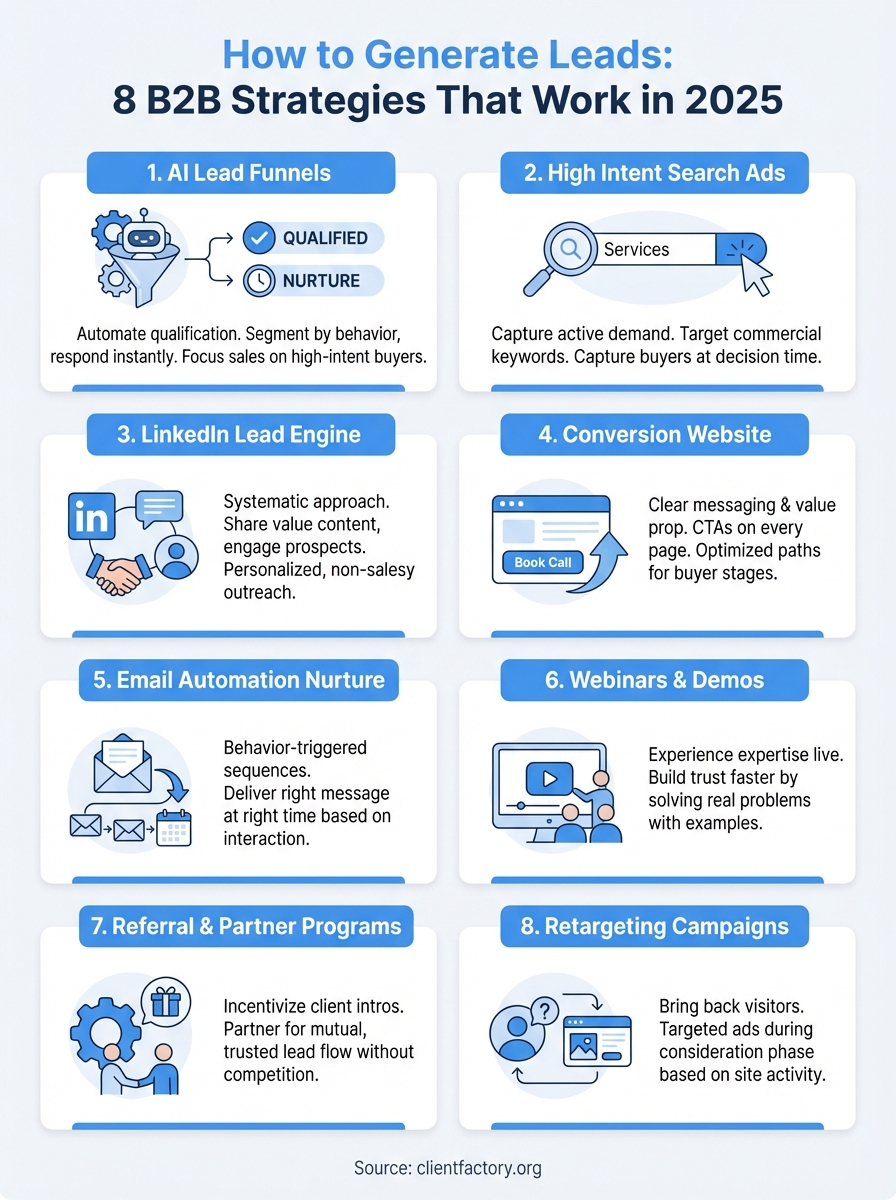
You now have eight proven strategies that show you how to generate leads consistently in 2025. These tactics work because they meet buyers where they already spend time and respond to real buying signals instead of interrupting random people with generic messages. AI-powered funnels qualify prospects automatically. Search campaigns capture high-intent buyers. LinkedIn builds relationships that convert. Your website becomes a lead machine. Email automation nurtures prospects without manual work. Webinars demonstrate your expertise. Referrals leverage existing trust. Retargeting brings visitors back when they show buying signals.
Most businesses try all these tactics at once and execute none of them well. Pick two or three strategies that match where your ideal clients spend time. Master those channels before adding more. Client Factory builds conversion-optimized systems that generate qualified leads while you focus on closing deals. Schedule your free funnel audit to identify exactly which strategies will deliver the highest ROI for your business.