
You want to grow your service business, but client acquisition feels like a constant uphill battle. Social media algorithms change overnight. Paid ads drain your budget faster than they bring in qualified leads. You’ve heard that email marketing delivers impressive returns, but figuring out how to do email marketing from scratch feels overwhelming when you’re already running a business.
Email marketing gives you direct access to people who’ve already shown interest in what you offer. No algorithm decides who sees your message. You own the list, control the timing, and build relationships that convert subscribers into paying clients. The average ROI sits at $36 for every dollar spent, making it one of the most cost-effective growth channels available.
This guide walks you through seven practical steps to launch and optimize your email strategy. You’ll learn how to choose the right platform, build a subscriber list that actually wants to hear from you, create automated sequences that nurture leads, and write emails that turn prospects into clients. By the end, you’ll have a clear roadmap to start generating consistent results through email.
Why email marketing drives growth for service firms
Service businesses face a unique challenge: your potential clients need to trust you before they buy. Unlike products, services require commitment, often involve significant investment, and depend on your expertise to deliver results. Email marketing creates the space for you to demonstrate your knowledge, answer objections, and build the confidence prospects need to hire you.
Direct communication builds trust with prospects
Email gives you unfiltered access to your audience. When someone subscribes to your list, they’re inviting you into their inbox, one of the most personal digital spaces they maintain. You bypass social media noise, ad blockers, and algorithm changes to deliver your message exactly when and how you choose. This direct line creates an environment where you can share case studies, explain your process, and address the specific concerns that keep potential clients from taking action.
Consistent communication through email positions you as the expert in your field. When prospects see your name appear regularly with valuable insights, you stay top-of-mind for the moment they’re ready to hire someone. Law firms use this approach to share legal updates that affect their target clients. Marketing agencies send strategy breakdowns that showcase their thinking. The pattern works across every service category because it demonstrates competence without asking for anything in return.
Building trust through email happens when you consistently deliver value before asking for the sale.
You control the channel and own the relationship
Social media platforms change their rules without warning. One algorithm update can tank your reach overnight. Paid advertising costs rise as more competitors enter your market. Email marketing gives you an asset you actually own: your subscriber list. Nobody can take it away, change how it works, or force you to pay more to reach the people who’ve already expressed interest in your services.
This ownership matters when you’re building a sustainable client acquisition system. You can export your list, move it to a different platform, or contact subscribers directly if needed. Service firms that rely solely on rented platforms like Facebook or LinkedIn put their entire pipeline at risk every time those companies adjust their terms or priorities.
Email converts better than other marketing channels
The numbers tell a clear story. Email marketing generates $36 for every dollar spent on average, outperforming social media and paid search for long-term ROI. Service businesses see even stronger results because email allows you to nurture relationships over weeks or months, the typical timeline for high-value service purchases.
Conversion rates for email campaigns average 1-3%, but service firms using segmentation and automation often see rates of 5% or higher on targeted sequences. Compare that to cold outreach or social media posts, which convert at a fraction of that rate. When you learn how to do email marketing effectively, you create a predictable system that turns subscribers into consultations and consultations into clients.
Nurturing sequences move leads through your sales cycle
Most prospects aren’t ready to hire you immediately. They need time to evaluate options, build internal buy-in, or wait for the right budget cycle. Automated email sequences keep you connected during this decision-making process without requiring constant manual follow-up from your team.
Service firms benefit from sequences that educate prospects about common problems, showcase different service packages, and answer frequently asked questions. A law firm might send a five-email sequence explaining the litigation process after someone downloads a legal guide. A consulting firm could automate case study delivery based on the prospect’s industry. These sequences work while you focus on serving current clients.
You reach decision-makers where they already spend time
Business decision-makers check email constantly. Research shows professionals spend an average of 4-6 hours per day in their inbox, making it the primary channel for business communication. Unlike social media, where people scroll for entertainment, email is where serious business conversations happen.
Executive-level prospects rarely engage with social posts, but they read emails that address their specific challenges. Service firms targeting B2B clients find email particularly effective because you can speak directly to pain points that matter in a professional context. Your message arrives in the same space where prospects handle contracts, communicate with vendors, and make purchasing decisions.
Step 1. Define goals and choose your platform
Before you send a single email, you need clear objectives and the right tools to execute your strategy. Too many service businesses jump straight into creating campaigns without defining what success looks like or choosing a platform that matches their workflow. This leads to scattered efforts, poor tracking, and wasted time on features you’ll never use. When you clarify your goals first, you can select a platform designed to help you achieve them.
Start by identifying what success looks like
Your email marketing goals should connect directly to revenue targets and client acquisition. Service firms typically focus on one of three primary objectives: generating qualified consultation requests, nurturing existing leads through the sales cycle, or maintaining relationships with past clients for referrals and repeat business. You can pursue multiple goals, but start with the one that addresses your biggest growth bottleneck right now.
Write down specific metrics that define success for each goal. If you want consultation requests, set a target like “10 qualified consultation bookings per month from email campaigns.” For lead nurturing, you might aim for “30% of email subscribers to schedule an initial call within 60 days.” Concrete numbers let you measure whether your email strategy actually works or needs adjustment.
Clear, measurable goals transform email marketing from busy work into a system that predictably generates clients.
Match platform features to your business needs
Email marketing platforms range from simple newsletter tools to complex automation systems with CRM integration. The right choice depends on your team’s technical skills, budget, and the complexity of your sales process. Service businesses with longer sales cycles need robust automation and segmentation capabilities. Firms with straightforward offerings can succeed with basic campaign tools that handle list management and template design.
Consider your current systems before committing to a platform. If you already use a CRM like Salesforce or HubSpot, choosing an email tool that integrates directly saves hours of manual data entry. Law firms often need platforms that support compliance requirements for client communications. Consulting firms benefit from platforms that track which content topics generate the most engagement from specific prospect segments.
Evaluate platforms using these criteria
Compare platforms based on factors that directly impact how to do email marketing effectively for your service business:
| Criteria | What to Look For | Why It Matters |
|---|---|---|
| Automation capabilities | Trigger-based sequences, conditional logic, behavioral targeting | Nurtures leads automatically while you focus on current clients |
| List segmentation | Tag management, custom fields, engagement scoring | Sends relevant messages to the right prospects |
| Deliverability rates | Sender reputation tools, authentication support | Ensures your emails reach inboxes instead of spam folders |
| Template builder | Drag-and-drop editor, mobile responsive designs | Creates professional emails without coding knowledge |
| Analytics depth | Open rates, click tracking, conversion attribution | Shows which campaigns generate actual clients |
| Support quality | Response time, available channels, knowledge base | Helps you solve problems quickly when issues arise |
Budget considerations matter, but don’t default to the cheapest option if it lacks features you’ll need within six months. Most platforms charge based on subscriber count, so start with a plan that fits your current list size but allows room to grow. You can always upgrade as your email marketing generates more leads and clients.
Step 2. Grow a high-quality subscriber list
Your email platform means nothing without subscribers who want to hear from you. Quality matters more than quantity when building your list. You need prospects who actually need your services, not random people who subscribed for a generic freebie and will never open another email. Service businesses succeed by attracting decision-makers with genuine interest in solving the problems you address.
Create lead magnets that attract your ideal clients
Lead magnets give prospects something valuable in exchange for their email address and permission to contact them. The best lead magnets for service firms address specific pain points your ideal clients face right now. Law firms might offer a legal checklist for business owners. Marketing agencies could provide an audit template that helps prospects identify gaps in their current strategy.

Your lead magnet should deliver immediate value while demonstrating your expertise. Avoid generic ebooks that anyone could write. Create resources that showcase your unique approach, methodology, or insider knowledge. A three-page implementation guide often works better than a 50-page report nobody will read.
Strong lead magnet formats for service businesses include:
- Checklists that walk prospects through a complex process step by step
- Templates they can customize for their specific situation
- Calculators that quantify potential savings or revenue opportunities
- Video training that demonstrates your process or answers common questions
- Case studies showing exact results you’ve delivered for similar clients
Place strategic opt-in forms on your website
You need multiple opportunities for visitors to join your list because different people engage with different pages. Place an opt-in form in your website header or navigation so it appears on every page. Add another form in your sidebar for blog readers. Create a dedicated landing page for each lead magnet you promote through ads or social media.
Exit-intent popups capture visitors right before they leave your site. These work particularly well for service businesses because prospects often visit multiple times before they’re ready to engage. The popup offers one more chance to stay connected with someone who’s clearly interested but not ready to book a consultation yet.
Strategic form placement turns passive website visitors into email subscribers you can nurture into clients.
Footer forms give you another conversion opportunity for people who scroll to the bottom of your pages. Keep the form simple with just email address and name fields. Every additional field you add drops your conversion rate by an average of 11%, so only ask for information you’ll actually use to segment or personalize your emails.
Use ethical list-building tactics that comply with regulations
Never buy email lists or add people without explicit permission. These practices violate regulations like CAN-SPAM and GDPR, damage your sender reputation, and fill your list with uninterested prospects who hurt your deliverability. Learning how to do email marketing correctly means building your list one opt-in subscriber at a time.
Double opt-in processes require subscribers to confirm their email address by clicking a link you send them. This extra step reduces fake signups and spam traps while proving that subscribers genuinely want to receive your emails. Most email platforms offer automated double opt-in sequences that handle this confirmation process without any manual work from your team.
Include clear unsubscribe links in every email you send and honor removal requests immediately. Make your privacy policy accessible and explain how you’ll use subscriber information. These requirements protect both you and your subscribers while building the trust that turns email contacts into paying clients.
Step 3. Segment your list for better engagement
Sending the same message to every subscriber wastes your most valuable asset: the attention of qualified prospects. Generic emails get ignored because they don’t speak to the specific challenges, interests, or buying stages of different people on your list. Segmentation divides your subscribers into targeted groups so you can send relevant messages that drive engagement and conversions. Service businesses that segment their lists see open rates increase by 14% and click rates jump by 100% compared to unsegmented campaigns.
Segment by service interest and buying stage
Your subscribers enter your list with different needs and levels of readiness. Some prospects want information about a specific service you offer, while others are just beginning to explore solutions. Creating segments based on the lead magnet they downloaded or the page they visited tells you exactly what problem they’re trying to solve right now.
Track which services interest each subscriber from the moment they join your list. If someone downloads your employment law guide, tag them with “employment-law-interest.” When a prospect requests your case study on digital advertising, add them to your “advertising-services” segment. These tags let you send targeted emails about relevant services instead of blasting your entire list with every offering.
Buying stage segments help you match message intensity to prospect readiness. Create categories like “awareness” for new subscribers, “consideration” for people who’ve engaged with multiple emails or visited your pricing page, and “decision” for prospects who’ve requested a consultation but haven’t booked. Each stage requires different content depth and call-to-action approaches.
Segmentation transforms generic email marketing into personalized conversations that move specific prospects toward hiring you.
Use behavior tracking to refine segments
Actions subscribers take after joining your list reveal what they care about most. Someone who clicks every link about your consulting methodology shows higher interest than someone who never opens your emails. Modern email platforms track opens, clicks, and website visits to automatically update segments based on engagement patterns.
Set up engagement scoring to identify your hottest leads. Assign points for opens (1 point), clicks (3 points), landing page visits (5 points), and consultation page views (10 points). Subscribers who cross a threshold like 20 points get moved into a “high-intent” segment that receives more direct sales messages and faster follow-up from your team.
Email interaction data shows you which topics resonate with each segment. If a subscriber consistently clicks links about SEO services but ignores your social media content, tag them accordingly. This behavioral segmentation lets you send more of what they want and less of what they ignore, keeping your sender reputation strong and your unsubscribe rates low.
Create segments based on business characteristics
Knowing your subscriber’s company size, industry, or role helps you tailor examples and case studies that match their situation. A solo consultant needs different advice than a 50-person agency. Healthcare businesses face unique compliance requirements that don’t apply to retail companies. When you understand how to do email marketing with this level of personalization, your messages feel like they were written specifically for each recipient.
Collect relevant business information through your signup forms or progressive profiling over time. Ask one additional question in follow-up emails after someone joins your list. Keep questions simple and directly related to how you’ll personalize their experience. Track responses in custom fields that feed your segmentation logic.
Common business characteristic segments include:
- Company size: Solo, small (2-20), medium (21-100), enterprise (100+)
- Industry vertical: Legal, healthcare, professional services, retail, manufacturing
- Job role: Owner, marketing manager, operations director, executive
- Geographic location: Local prospects vs. regional vs. national clients
- Technology stack: Current tools they use that integrate with your services
Step 4. Create automated nurturing sequences
Automated sequences do the heavy lifting of relationship building while you focus on delivering services to current clients. Instead of manually following up with every new subscriber, you create a series of pre-written emails that send automatically based on triggers and time delays. Service businesses using automated nurturing convert 50% more leads into consultations because prospects receive consistent, valuable communication during their decision-making process without any manual effort from your team.
Map out your nurturing journey
You need a clear plan before building any sequence. Start by identifying the starting point (what action triggers the sequence) and the desired outcome (consultation booked, service purchased, or specific action taken). Then map the steps that bridge these two points, considering what information prospects need at each stage to move closer to hiring you.
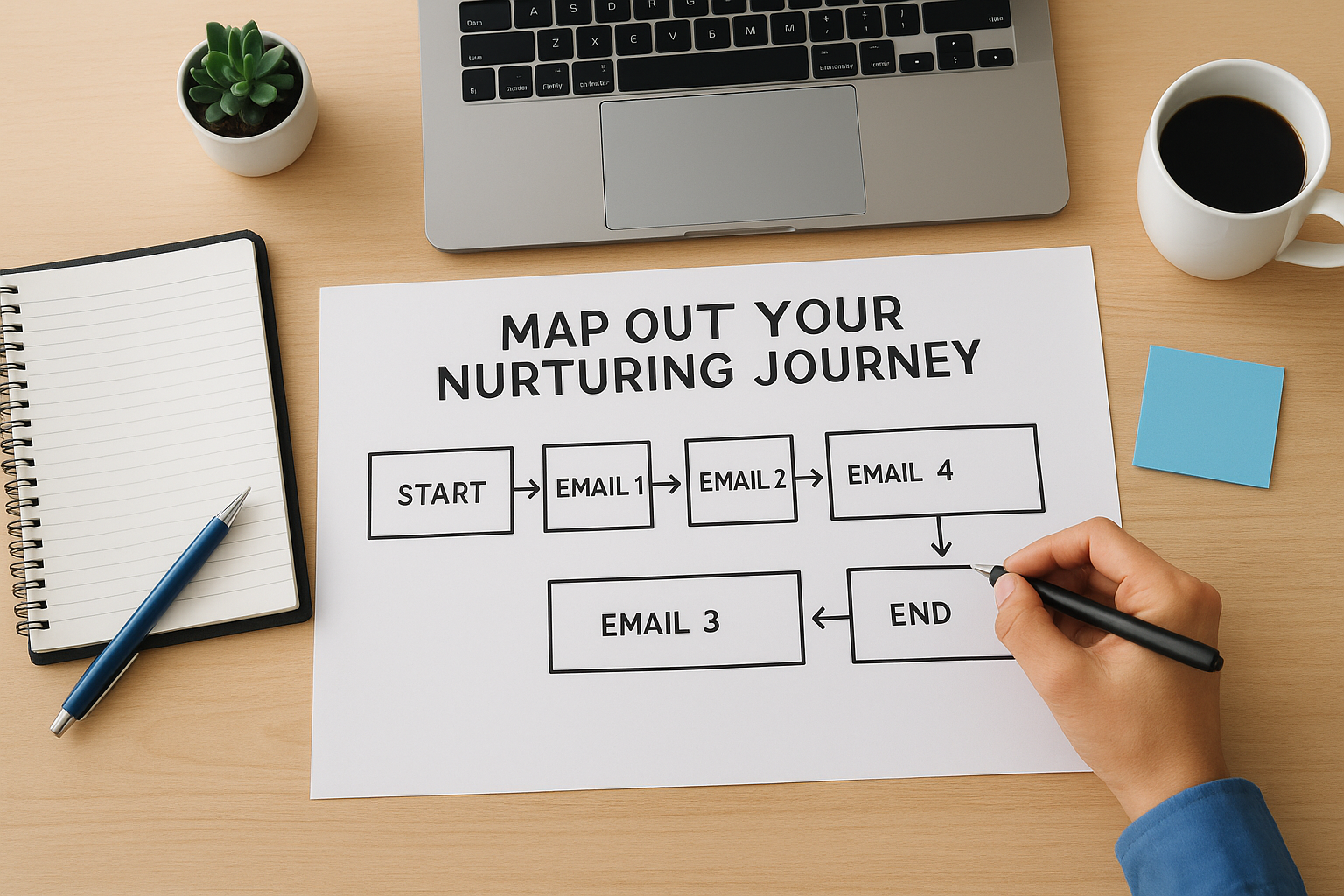
Create a simple outline that shows each email’s purpose and timing. A basic welcome sequence for service businesses might include five emails over two weeks that introduce your expertise, share a case study, explain your process, address common objections, and invite prospects to schedule a consultation. Write down what each email accomplishes before you draft the actual copy.
Effective nurturing sequences guide prospects through a logical progression that builds trust and demonstrates value at every step.
Use this template structure to plan your first automated sequence:
Email 1 (Day 0): Deliver lead magnet + set expectations
Email 2 (Day 2): Share relevant case study or success story
Email 3 (Day 5): Explain your unique methodology or approach
Email 4 (Day 8): Address top objection or concern
Email 5 (Day 12): Clear call-to-action for consultation
Set up trigger-based sequences
Triggers determine when sequences start for each subscriber. The most common trigger is a form submission, where someone downloads your lead magnet and immediately enters a pre-designed sequence. Advanced triggers based on subscriber behavior let you send targeted follow-ups when prospects click specific links or visit key pages on your website.
Configure your first sequence using your email platform’s automation builder. Most platforms use a visual workflow where you drag trigger boxes, delay timers, and email blocks into a logical flow. Set your trigger (form submission), add time delays between each email (typically 2-4 days for service businesses), and connect your pre-written email templates.
Behavioral triggers create powerful engagement opportunities by responding to prospect actions. When someone clicks your pricing page link but doesn’t book a consultation, trigger a sequence that answers common pricing questions and showcases payment flexibility. If a subscriber clicks multiple emails about a specific service, automatically add them to a segment that receives deeper content about that offering.
Time your emails for maximum engagement
Frequency matters as much as content when learning how to do email marketing through automation. Send emails too frequently and subscribers feel overwhelmed. Space them too far apart and prospects forget about you or lose interest. Service businesses with longer sales cycles should aim for one email every 2-4 days during active nurturing sequences, then shift to weekly or bi-weekly emails for ongoing relationship maintenance.
Test different sending times to find when your audience engages most. B2B service firms typically see higher open rates for emails sent Tuesday through Thursday between 10 AM and 2 PM in the recipient’s timezone. Your specific audience might behave differently, so track open rates by send time and adjust your automation timing accordingly.
Stop sequences when subscribers take your desired action like booking a consultation or making a purchase. Configure your platform to remove people from automated nurturing when they convert, preventing awkward situations where paying clients still receive emails asking them to schedule an initial call.
Step 5. Write copy that converts leads into clients
Email copy separates successful campaigns from ignored ones. You can have the perfect list and flawless automation, but poorly written emails won’t convert prospects into consultations or clients. Service businesses need copy that demonstrates expertise, addresses objections, and makes taking the next step feel like the obvious choice. When you master how to do email marketing through effective copywriting, each email moves subscribers closer to hiring you without feeling pushy or salesy.
Lead with value in your subject lines
Your subject line determines whether subscribers open your email at all. Service businesses get the best results with subject lines that promise specific value or create curiosity about a problem the reader faces. Avoid generic headlines like “Our Latest Newsletter” or “Check This Out” that give prospects no reason to click.
Test these proven formulas that work consistently for service firms:
Problem-focused: "Why [common problem] happens (and how to fix it)"
Case study angle: "How [company type] increased [result] by [percentage]"
Direct benefit: "[Specific outcome] in [timeframe] without [pain point]"
Question format: "Are you making this [common mistake]?"
Curiosity gap: "The [surprising factor] behind [desired outcome]"
Keep subject lines under 50 characters so mobile users see the complete message. Personalization tokens like the subscriber’s name or company increase open rates by 26%, but only use them if the data is accurate. A misspelled name damages trust faster than a generic subject line.
Structure emails around one clear action
Every email you send should have a single primary goal. If you want prospects to read a case study, don’t also ask them to follow your social media and check out three different blog posts. Multiple competing calls-to-action confuse readers and reduce conversion rates across all options.
Use this proven email structure for service business campaigns:
Opening: Address specific pain point or reference previous email
Body (2-3 paragraphs): Provide value, share insight, or tell story
Transition: Connect value delivered to natural next step
Call-to-action: One clear button or link with specific instruction
P.S.: Reinforce main benefit or add urgency element
Place your call-to-action after you’ve delivered value, not before. Prospects need to understand why they should take action before you ask them to do it. Link text should describe the outcome, not the action. “Get your consultation roadmap” converts better than “Click here” because it tells readers exactly what they’ll receive.
Clear, focused copy guides prospects toward one specific action instead of overwhelming them with options.
Write like you’re explaining to a colleague
Skip formal business jargon and write conversational copy that sounds like you’re talking to someone across the table. Service firms often make emails too stiff and corporate, creating distance instead of building relationships. Use contractions, ask questions, and write the way you actually speak during client calls.
Address objections directly in your email copy before prospects can raise them. If cost is a common concern, acknowledge it and explain your pricing philosophy. When prospects worry about time commitment, outline your streamlined process. This approach builds trust by showing you understand their hesitation and have thought through solutions.
Replace passive constructions with active, direct statements. Write “You’ll receive detailed recommendations” instead of “Detailed recommendations will be provided.” Active voice creates clarity and confidence, both essential when prospects are evaluating whether to hire you for important services.
Step 6. Design professional and readable emails
Email design directly affects whether prospects read your message and take action. A cluttered layout or tiny mobile text sends subscribers straight to the delete button, no matter how good your copy is. Professional service firms don’t need fancy graphics or complex designs. You need clean, readable emails that work perfectly on every device and make your key points impossible to miss. When you understand how to do email marketing with effective design principles, more subscribers engage with your content and move toward booking consultations.
Keep your layout clean and scannable
Most subscribers scan emails in under three seconds before deciding whether to read fully or delete. Your layout needs to communicate the main point immediately through clear headlines, short paragraphs, and strategic white space. Walls of text overwhelm busy prospects, while a scannable structure lets them quickly grasp your message and find the information most relevant to their needs.
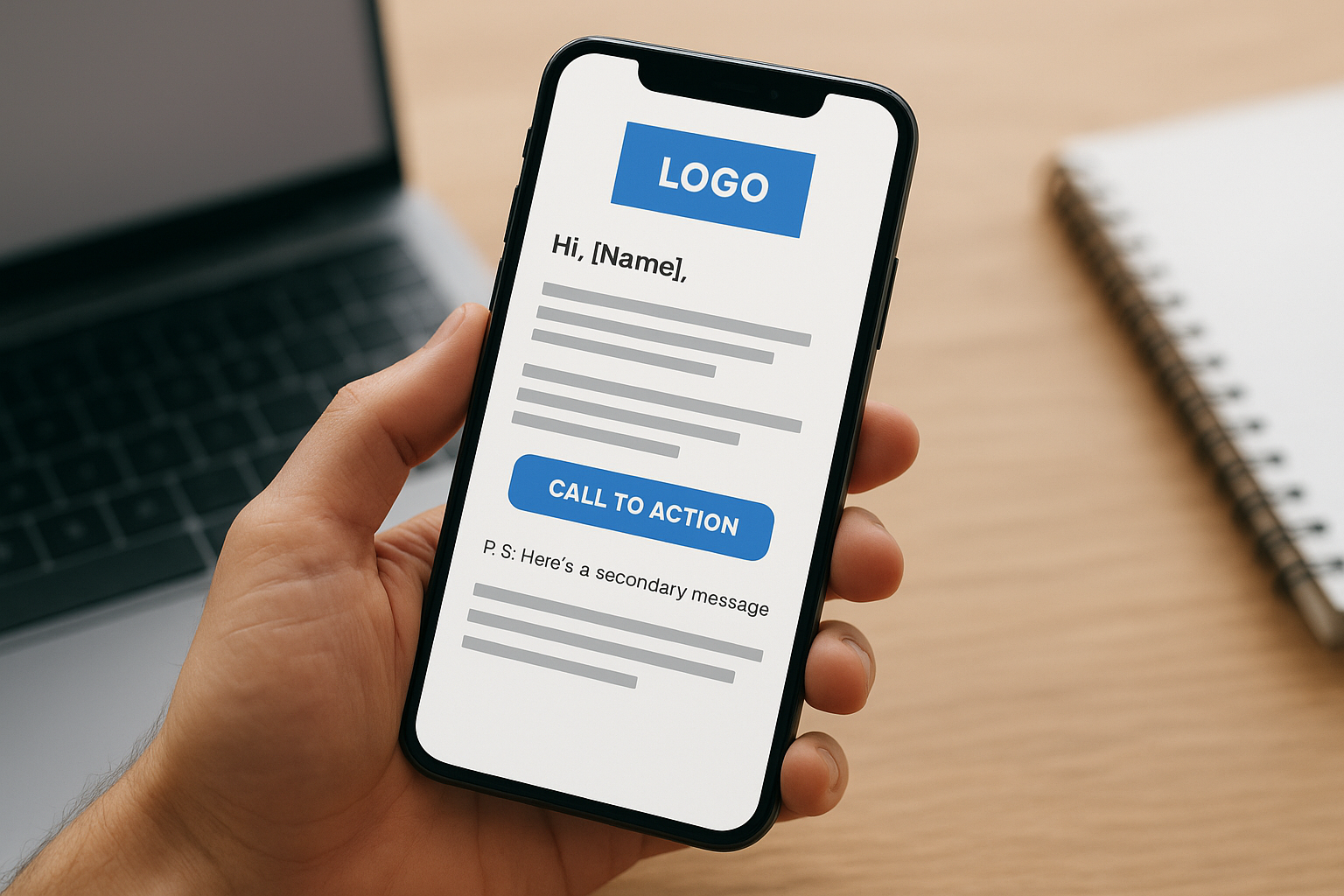
Limit each paragraph to 2-3 sentences and separate them with blank lines for visual breathing room. Use subheadings within your email body to break up different topics or sections. Bullet points work particularly well for listing benefits, features, or steps in a process because they create visual stops that guide the reader’s eye down the page.
Structure your emails using this proven template that keeps designs simple:
[Logo or header text]

[Personalized greeting]

[Brief opening paragraph - 2 sentences max]

[2-3 content paragraphs with line breaks between]

[Call-to-action button]

[Brief P.S. with secondary message]

[Footer with contact info and unsubscribe link]
Optimize for mobile devices first
Over 60% of emails get opened on mobile phones, making mobile optimization essential rather than optional. Text that looks perfect on desktop becomes unreadable on a small screen if you don’t design with mobile constraints in mind. Check every email you create on your phone before sending it to your list.
Use a single-column layout that adapts automatically to any screen width. Multi-column designs break on mobile devices, forcing readers to zoom and scroll horizontally. Keep your email width to 600 pixels or less so it displays properly on all devices without shrinking text to microscopic sizes.
Font size matters even more on mobile screens. Set your body text to at least 16 pixels and make headlines 22 pixels or larger. Smaller text forces readers to zoom in, creating friction that kills engagement. Your call-to-action buttons need minimum dimensions of 44 pixels height by 44 pixels width so thumbs can tap them easily without accidentally hitting nearby links.
Mobile-first email design ensures every subscriber can read and act on your message, regardless of which device they use.
Use visual hierarchy to guide attention
Visual hierarchy tells readers what matters most in your email through size, color, and positioning. Your most important elements should dominate the design, making it obvious where subscribers should focus their attention. Service businesses benefit from hierarchy that emphasizes the value proposition first, supporting details second, and call-to-action third.
Make your headline the largest text element, followed by subheadings and body copy in descending sizes. Place your call-to-action button in a contrasting color that stands out from your brand colors without clashing. Most email platforms let you choose button colors separate from your text, so pick something that draws the eye naturally.
Strategic use of bold text highlights key phrases within paragraphs without breaking the reading flow. Avoid underlining anything except actual links since underlines signal clickability. Keep your color palette simple with two or three colors maximum that align with your brand but don’t overwhelm the content.
Step 7. Test, measure, and refine your results
Your first email campaign won’t be perfect, and that’s expected. The service businesses that succeed with email marketing track specific metrics and use that data to make informed improvements over time. You need a systematic approach to testing different elements, measuring what works, and refining your strategy based on real performance data instead of guesses. When you understand how to do email marketing as an iterative process, each campaign performs better than the last.
Track the metrics that matter for service businesses
Focus on metrics that connect to revenue instead of vanity numbers that look impressive but don’t predict client acquisition. Open rates and click rates matter, but conversion rates and consultation bookings tell you whether your emails actually generate business. Service firms need to track the complete path from email send to paying client.
Set up conversion tracking in your email platform that monitors when subscribers take actions that indicate buying intent. Track consultation bookings, pricing page visits, contact form submissions, and calls to your business line. Connect these actions back to specific emails and segments so you know which messages drive the most qualified leads.
| Metric | What It Measures | Target Range for Service Firms |
|---|---|---|
| Open rate | Percentage who open your emails | 20-30% for engaged lists |
| Click-through rate | Percentage who click any link | 2-5% for targeted campaigns |
| Conversion rate | Percentage who complete desired action | 1-3% for consultation requests |
| Unsubscribe rate | Percentage who leave your list | Under 0.5% per campaign |
| Revenue per email | Total value generated divided by sends | Varies by service pricing |
Run A/B tests to improve performance
A/B testing shows you which email elements resonate with your specific audience instead of relying on general best practices that might not apply to your service business. Test one variable at a time so you know exactly what caused any performance difference. Your email platform can automatically split your list and send different versions to measure which performs better.
Start with subject line testing since that single element determines whether subscribers open your email at all. Send half your list a curiosity-based subject line and the other half a direct benefit statement. After 24 hours, check which version generated more opens and use that approach for future campaigns. Test different angles, personalization levels, and length to find what works for your audience.
Test these elements in order of impact:
1. Subject lines (different angles or benefits)
2. Call-to-action text and placement
3. Email length (shorter vs. detailed)
4. Content format (story vs. bullet points)
5. Send time and day of week
6. From name (personal vs. company)
Use data to optimize your campaigns
Your email analytics reveal patterns about subscriber behavior that should directly influence your strategy. If Wednesday morning emails consistently outperform Friday afternoon sends, adjust your automation timing. When case study emails generate twice the click rate of educational content, send more case studies to segments showing high buying intent.
Review your metrics weekly during the first three months as you establish your email strategy, then shift to monthly reviews once you’ve optimized the basics. Look for trends across multiple campaigns rather than making decisions based on single email performance. Service businesses with longer sales cycles need at least 30 days of data before drawing conclusions about what works.
Consistent testing and refinement transform basic email campaigns into a predictable system that generates qualified consultations and clients.
Segment your performance analysis by subscriber characteristics to uncover opportunities you might miss in aggregate data. One industry segment might engage heavily with technical content while another prefers high-level strategic insights. Use these patterns to create more targeted campaigns that speak directly to what each segment cares about most.
Start building your email strategy today
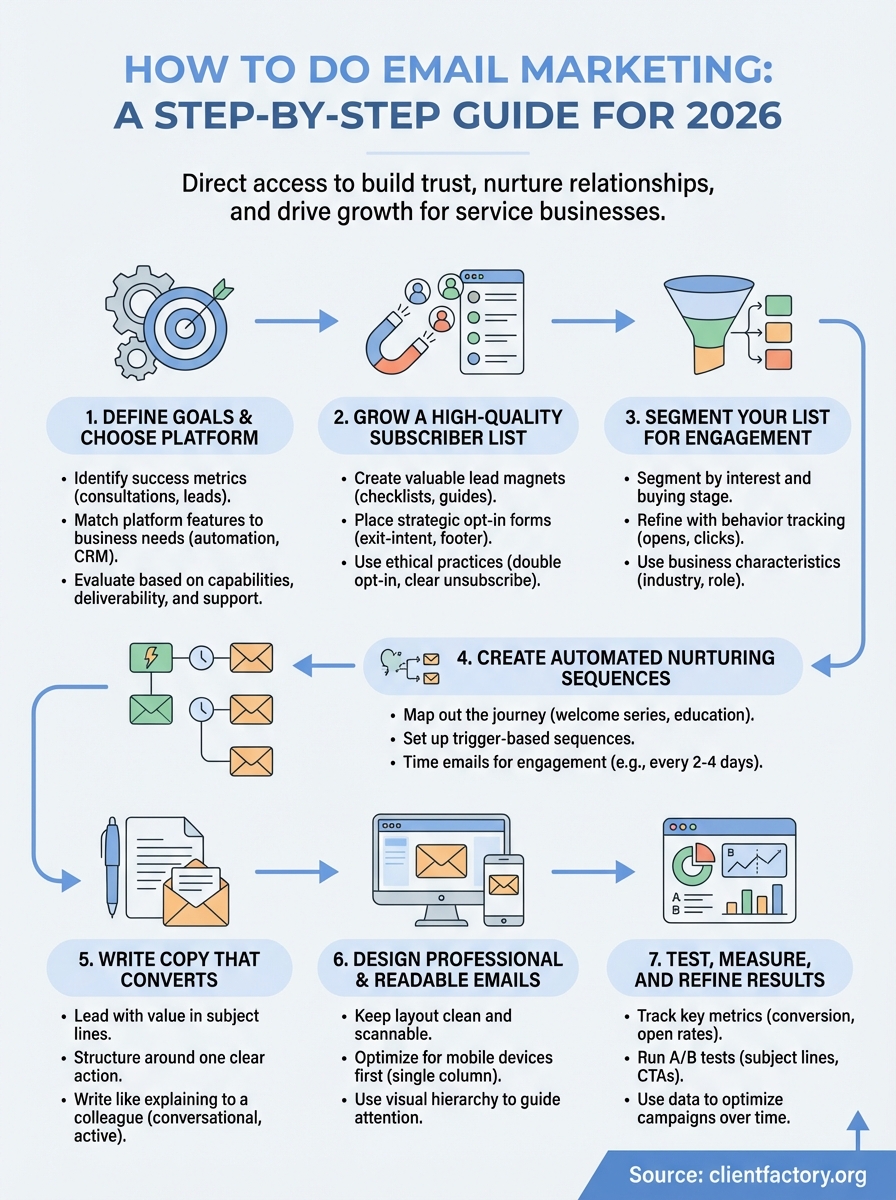
You now understand how to do email marketing from platform selection through optimization. The seven steps you’ve covered give you a complete roadmap to launch campaigns that generate consultations and clients for your service business. Most firms that implement these strategies see measurable results within 60-90 days of consistent execution.
Start with step one today. Define your goals, choose a platform, and create your first lead magnet this week. Don’t wait until everything feels perfect because you’ll learn more from actual campaigns than planning. Your email list grows only when you give prospects compelling reasons to subscribe and valuable content that keeps them engaged.
Client Factory helps service businesses build complete client acquisition systems that turn clicks into consultations and consultations into paying clients. Schedule a free strategy session to discover how we can accelerate your growth through email marketing and other proven channels.