

Google Ads management services are professional teams that handle your pay per click campaigns from start to finish. These agencies create your ads, target the right audience, monitor performance, and optimize campaigns to maximize your return. Instead of managing Google Ads yourself or learning the platform from scratch, you hire experts who do this full time. They know how to navigate bidding strategies, keyword research, ad copy testing, and conversion tracking. The right service turns your advertising budget into qualified leads and paying customers.
This article breaks down everything you need to know before hiring a management service. You’ll learn how pricing structures work, what to expect from different packages, and how to calculate your actual ROI. We’ll cover the key questions to ask potential agencies, red flags to watch for, and what separates good services from mediocre ones. By the end, you’ll know exactly how to evaluate options and choose a partner that fits your budget and business goals.
Why Google Ads management services matter
Your advertising budget disappears fast when you run Google Ads without expertise. Most business owners underestimate how much technical knowledge and daily attention successful campaigns require. You compete against companies with dedicated teams who optimize bids every few hours, test dozens of ad variations simultaneously, and adjust strategies based on real-time data. Professional management services bring that level of sophistication to your campaigns without requiring you to build an in-house team or spend months learning the platform yourself.
The complexity of modern PPC campaigns
Google Ads has evolved into a multifaceted platform with hundreds of settings that directly impact your results. You need to master keyword match types, quality scores, audience targeting, conversion tracking, bid strategies, ad extensions, and negative keyword lists. Each campaign type (Search, Display, Shopping, Video) operates with different rules and best practices. The platform updates constantly, adding new features and changing how existing ones work. Agencies stay current with these changes because it’s their full-time job. They know which automation features to enable, which bidding strategies work for different goals, and how to structure campaigns for maximum performance.
Managing Google Ads yourself means choosing between running your business and learning a complex advertising platform.
The cost of mistakes and missed opportunities
Poorly managed campaigns burn through your budget without generating returns. Common mistakes include targeting the wrong keywords, setting bids too high or too low, sending traffic to generic landing pages, and failing to track conversions properly. You might spend thousands before realizing your campaigns aren’t working. Professional google ads management services prevent these costly errors from the start. They also identify opportunities you’d miss, like high-performing search terms to expand on, audience segments that convert better, or times of day when your ads perform best. The difference between amateur and expert management often determines whether Google Ads becomes a profitable channel or a cash drain.
How to choose and use a management service
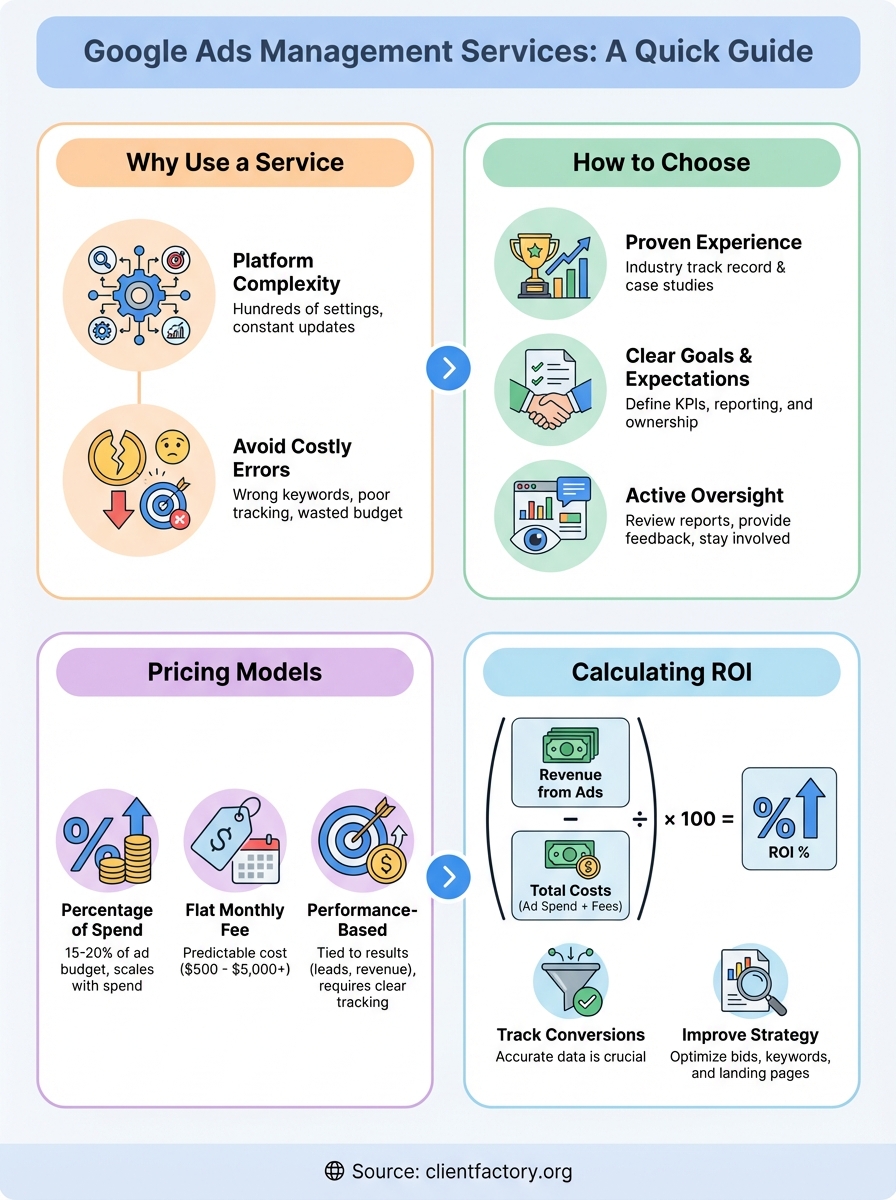
You need a systematic approach when evaluating google ads management services to ensure you partner with experts who understand your business goals. The right agency transforms your advertising spend into measurable growth, while the wrong one wastes your budget on generic strategies that don’t match your market. Start by defining what success looks like for your business: qualified leads, specific cost per acquisition targets, or revenue goals tied directly to your campaigns. This clarity helps you assess whether an agency’s approach aligns with what you actually need to grow.
Evaluate their track record and specialization
Look for agencies that have proven results in your industry or with similar business models. A service that excels at e-commerce campaigns might struggle with service-based local businesses. Ask for case studies, client testimonials, and specific metrics from past campaigns. You want concrete numbers like conversion rate improvements, cost per lead reductions, or ROI increases. Agencies that specialize in certain verticals understand the unique challenges, competition levels, and customer behavior patterns in those markets. They know which keywords convert, what ad copy resonates, and how to structure campaigns for your specific audience.

Set clear expectations from the start
Establish reporting frequency, communication channels, and performance benchmarks before signing any contract. You should receive regular updates that go beyond vanity metrics like impressions or clicks. Demand reports that show leads generated, conversion rates, cost per acquisition, and return on ad spend. Clarify who owns the campaigns, ad accounts, and data. Some agencies lock you into proprietary systems, making it difficult to switch providers later. The best partnerships include transparent access to your Google Ads account and clear ownership of all campaign assets.
The agencies that succeed long-term treat your business goals as their own, not just another account to manage.
Monitor performance and stay involved
Your role doesn’t end after hiring a management service. Review monthly reports, ask questions about strategy changes, and provide feedback on lead quality. Share information about seasonal trends, product launches, or competitive changes that might affect your campaigns. Agencies perform better when they understand your business deeply. Schedule quarterly strategy calls to discuss what’s working and what needs adjustment. This ongoing collaboration ensures your campaigns evolve with your business rather than running on autopilot with outdated targeting or messaging.
Understanding pricing and packages
Google ads management services typically charge using one of three pricing models, and each structure affects your total investment differently. Most agencies charge between 15-20% of your monthly ad spend, a flat monthly fee ranging from $500 to $5,000+, or a performance-based arrangement tied to results. Your choice depends on your budget size, campaign complexity, and whether you prefer predictable costs or results-focused payments. Smaller businesses with limited budgets often start with flat-fee packages, while companies spending $10,000+ monthly on ads typically work better with percentage-based pricing.

Percentage of ad spend models
Agencies using this structure charge a percentage of your total advertising budget, usually between 15-20% but sometimes as low as 10% for larger accounts. If you spend $5,000 monthly on ads and the agency charges 15%, you pay $750 for management plus your $5,000 ad spend, totaling $5,750. This model scales with your investment, which means you pay more as your campaigns grow. The advantage is that agencies have direct incentive to increase your ad spend, though reputable services only do this when data supports scaling. Watch for agencies pushing budget increases without clear performance justification.
Flat monthly fee structures
Flat fees provide predictable costs regardless of your ad spend fluctuations. Agencies charge anywhere from $500 for basic packages to $5,000+ for comprehensive management with strategic consulting. Entry-level packages typically include campaign setup, monthly optimization, and basic reporting. Mid-tier plans add conversion tracking, A/B testing, and landing page recommendations. Premium packages include dedicated account managers, weekly strategy calls, and advanced features like audience segmentation and remarketing campaigns. This pricing works well when you have a consistent budget and want to avoid percentage-based fees that increase as you scale.
Flat fees protect you from paying more during months when you test higher budgets or seasonal campaigns.
Performance-based and hybrid models
Some agencies tie their compensation directly to conversion targets or revenue generated from campaigns. They might charge a base fee plus bonuses for hitting specific cost-per-lead goals or maintaining target ROI thresholds. Hybrid models combine a smaller flat fee with performance incentives, aligning agency success with your actual business results. These arrangements sound attractive but require crystal-clear definitions of what counts as a conversion and how attribution works. You need written agreements specifying exactly which actions trigger payments and how disputes get resolved. Performance-based pricing only works when both parties have complete transparency into tracking data and conversion reporting.
Package tiers usually differ by service depth rather than just campaign size. Basic packages handle setup and monthly adjustments. Mid-tier services include strategic planning, competitor analysis, and quarterly reviews. Premium packages add creative development, landing page testing, and integration with your CRM or sales systems. Ask specifically what each tier includes, what counts as extra work, and whether they charge separately for major campaign restructures or platform migrations.
Calculating and improving your Google Ads ROI
You need to track return on investment accurately before you can improve it. Most business owners calculate ROI incorrectly by only looking at immediate ad costs versus revenue from first purchases, ignoring lifetime customer value and attribution complexities. True ROI calculation requires tracking every dollar spent on management fees and ad spend against the total revenue those campaigns generate over time. Google ads management services should provide detailed reporting that connects your advertising investment to actual business growth, not just surface-level metrics like clicks or impressions.
The basic ROI calculation
Calculate your return by dividing revenue generated from ads by total costs (ad spend plus management fees), then multiplying by 100. If you spend $3,000 on ads and $500 on management while generating $10,000 in revenue, your calculation looks like this: ($10,000 / $3,500) x 100 = 286% ROI. This means you earn $2.86 for every dollar spent. However, this simple formula only works when you track conversions properly and know exactly which sales came from your campaigns. Many businesses fail at this step because they don’t set up conversion tracking correctly or they can’t connect online leads to offline sales.

Tracking conversions accurately
Your ROI calculations mean nothing without reliable conversion data feeding into them. Set up conversion tracking in Google Ads for every valuable action: form submissions, phone calls, purchases, appointment bookings, or quote requests. Connect your CRM system to see which leads actually became customers and how much revenue they generated. Track assisted conversions too, since customers often click multiple ads before converting. Attribution windows matter because someone might click your ad today but purchase next week. Professional management services handle this technical setup and ensure your tracking captures the complete customer journey from first click to final sale.
Without accurate conversion tracking, you’re flying blind and making decisions based on incomplete data.
Strategies to improve ROI
Reduce wasted spend by adding negative keywords that prevent your ads from showing on irrelevant searches. Review search term reports weekly to identify queries that generate clicks but never convert. Focus your budget on high-performing campaigns and pause or restructure underperformers. Test different ad variations to improve click-through rates and conversion rates simultaneously. Adjust bids based on device performance, location data, and time of day patterns. Improve your landing page experience to match ad messaging and reduce friction in the conversion process. Even small improvements in conversion rate dramatically impact ROI when you maintain the same ad spend. Better targeting combined with compelling offers turns marginal campaigns into profitable ones.
Quality management services continuously optimize these variables rather than setting campaigns once and forgetting them. They identify opportunities to scale winning campaigns while cutting losses quickly. The best agencies show you exactly which changes improved your ROI and why those adjustments worked.
Key questions to ask before you hire
Asking the right questions during initial consultations separates quality google ads management services from agencies that overpromise and underdeliver. You need direct answers about their experience, processes, and how they measure success before committing to any contract. The agencies worth hiring answer these questions confidently with specific examples and transparent explanations of their approach. Vague responses or pushback on basic questions signals potential problems down the road.
Questions about experience and results
Start by asking what industries they specialize in and whether they’ve managed campaigns for businesses similar to yours. Request case studies with actual numbers showing cost per lead, conversion rates, and ROI improvements. Find out how they handled campaigns that underperformed initially and what specific changes they made to turn those around. Ask about their Google Ads certifications and how many accounts their team currently manages. You want proof they have the expertise and capacity to give your campaigns proper attention rather than spreading resources too thin across hundreds of clients.
Questions about process and communication
Clarify exactly what their setup process includes and how long it takes to launch your first campaigns. Ask how often they optimize campaigns, who you’ll communicate with directly, and what their typical response time is for questions or concerns. Find out what reporting format they use and whether you’ll have direct access to your Google Ads account at all times. Request examples of their monthly reports to see if they focus on meaningful metrics or surface-level vanity numbers. Understanding their workflow prevents misaligned expectations about involvement and oversight.
The best agencies welcome tough questions because they know transparency builds trust.
Questions about contracts and ownership
Review contract terms carefully, especially regarding minimum commitments and cancellation policies. Ask who owns the ad account, campaign data, and any creative assets they develop. Clarify whether you can export all historical data if you decide to switch providers. Find out if they charge setup fees, what counts as additional work outside your package, and how billing changes if you increase or decrease your ad budget. Understanding these details protects you from unexpected costs or complicated exit processes.
Next steps
You’ve learned how google ads management services work, what different pricing models mean for your budget, and which questions separate quality agencies from ones that waste your money. The information in this article gives you everything needed to evaluate potential partners and make an informed decision about who manages your campaigns.
Start by defining your specific goals and budget constraints before reaching out to agencies. Review your current campaign performance if you’re already running ads, or identify your target cost per lead if you’re starting fresh. Request proposals from at least three services that specialize in your industry. Compare their approaches, reporting systems, and contract terms using the questions outlined above.
Ready to work with a team that treats your advertising budget like their own? Client Factory combines data-driven strategies with transparent reporting to turn your Google Ads investment into qualified leads and paying customers. Our team focuses exclusively on client acquisition for service businesses, delivering measurable results without the complexity or hidden fees that plague most agencies.