
You spend money on ads. Some people click. A few convert. Most disappear. This happens because your marketing only targets people ready to buy right now. You ignore everyone else. That means you miss out on the 96% of visitors who need more time before they commit. Your customer acquisition costs stay high. Your conversion rates stay low.
A full funnel marketing strategy fixes this. It guides potential clients from their first interaction with your brand all the way through to becoming customers. You reach people when they first discover their problem. You educate them as they research solutions. You convince them when they compare options. Every stage connects to the next. Your marketing spend works harder. Your conversions increase.
This guide walks you through building a full funnel strategy that actually converts. You’ll learn how to map your client journey, set the right metrics for each stage, create campaigns that move people through your funnel, and optimize everything for better results. No theory. Just practical steps you can implement today.
What a full funnel strategy really means
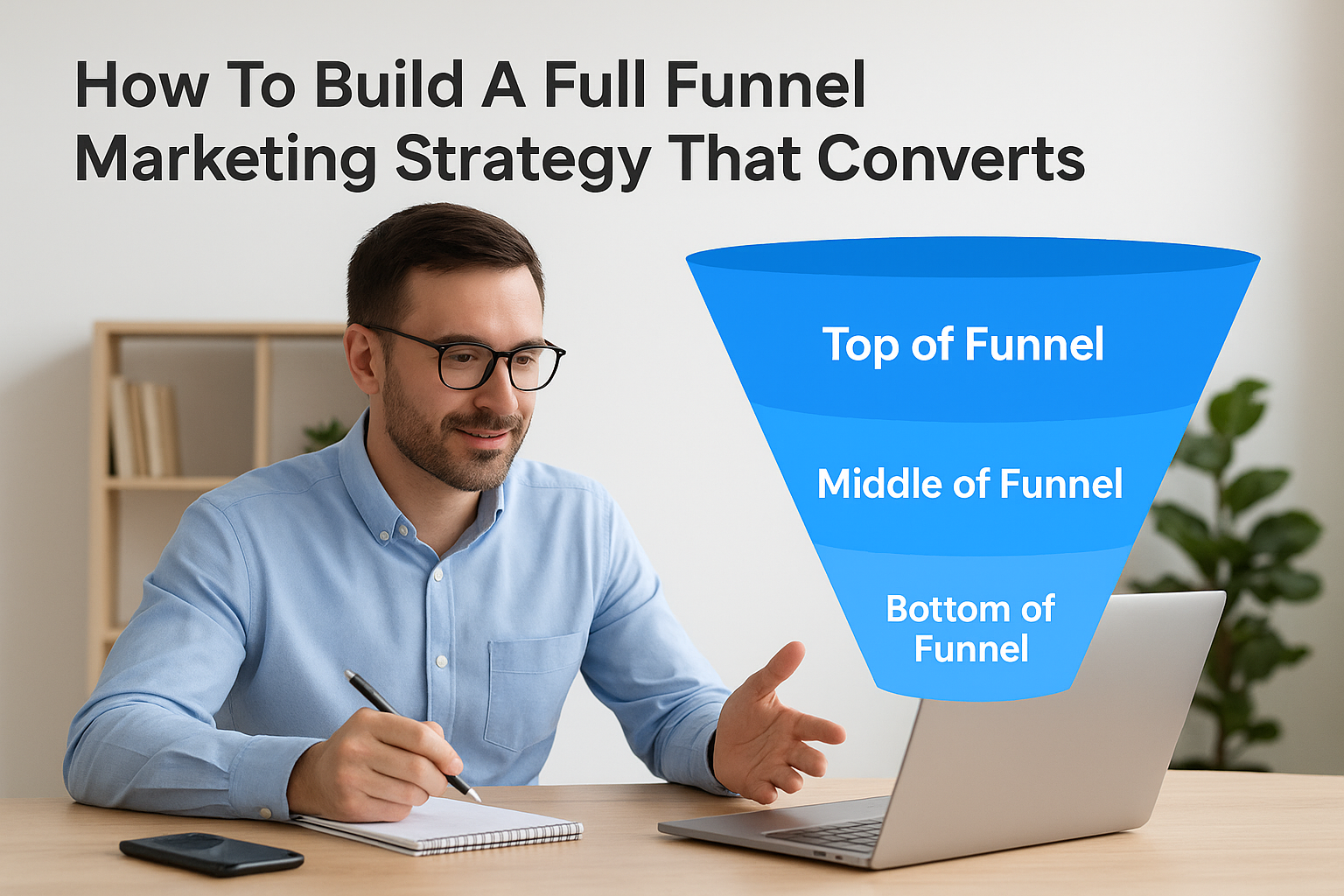
A full funnel marketing strategy addresses every stage of your client’s decision-making process, not just the final purchase moment. You build brand awareness at the top, nurture interest in the middle, and drive conversions at the bottom. Each stage connects to and strengthens the others. Your campaigns work together as one system instead of competing for budget and attention.
The three funnel stages you need to master
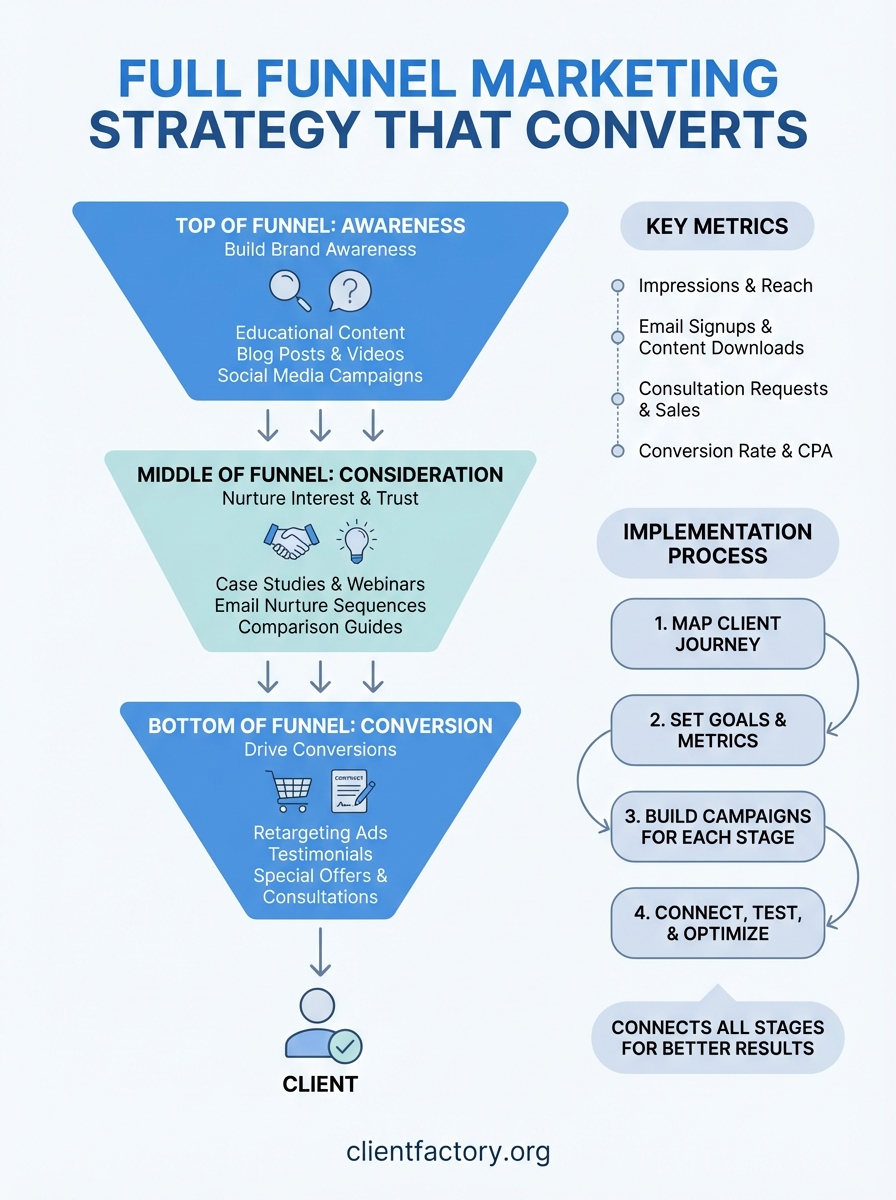
Top of funnel (awareness) attracts people who just discovered they have a problem. You cast a wide net here. Your content educates without selling. Examples include blog posts, videos, and social media campaigns that answer common questions in your industry.
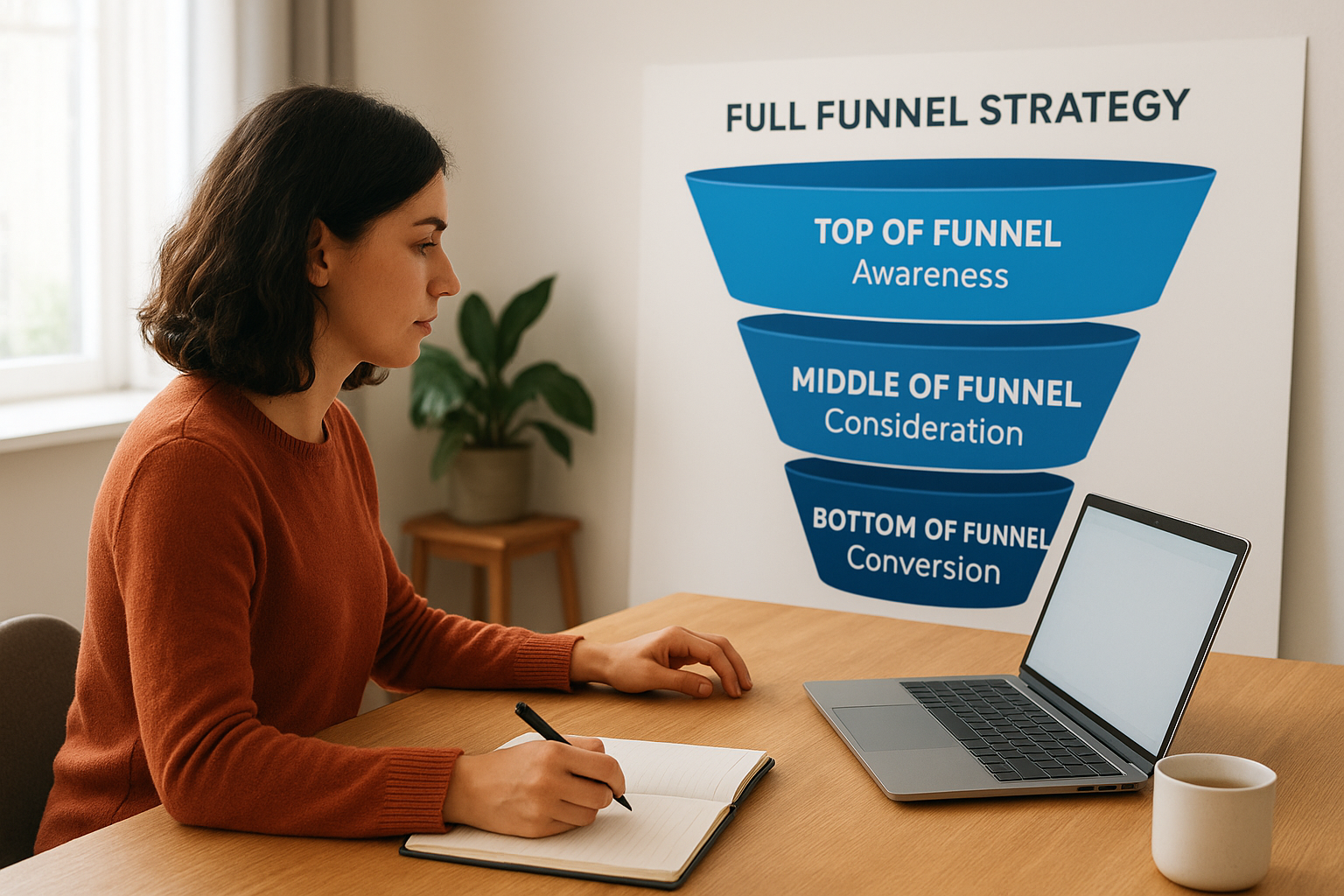
Middle of funnel (consideration) nurtures people who know their problem and research solutions. You build trust and demonstrate expertise. Your tactics include case studies, webinars, email sequences, and comparison guides that position your service as the right choice.
Bottom of funnel (conversion) targets people ready to make a decision. You remove friction and prove value. Your campaigns use retargeting, testimonials, free consultations, and special offers that make saying yes easy.
Most businesses waste money by focusing only on bottom-funnel tactics while ignoring the 96% of potential clients who need more time and information before they convert.
The power of a full funnel marketing strategy comes from how these stages reinforce each other. Your awareness campaigns feed qualified prospects into consideration. Your consideration content warms leads for conversion campaigns. You spend less per client because each stage makes the next one more effective.
Step 1. Map your client journey and funnel
You can’t build an effective full funnel marketing strategy without knowing how your clients actually make decisions. Start by identifying the specific steps someone takes from first hearing about you to becoming a paying client. Document every touchpoint, question, and objection that appears along the way. This map becomes your blueprint for all future campaigns.
Identify your client’s decision points
Write down the major milestones your potential clients pass through before they hire you. A law firm client might go from “I have a legal problem” to “I need a specific type of lawyer” to “Which lawyer should I choose?” to “I’m ready to schedule a consultation.” Your business will have different milestones, but the pattern stays similar.
Talk to recent clients and ask them what they were thinking at each stage. What information did they search for? What questions did they have? What nearly stopped them from moving forward? Their answers reveal the real journey, not the one you assume exists.
Document touchpoints at each stage
List every place a potential client might interact with your brand during their journey. Use this template to organize your findings:

Awareness stage touchpoints:
- Google searches for problem-related keywords
- Social media posts from industry peers
- YouTube videos explaining the issue
- Blog articles ranking for informational queries
Consideration stage touchpoints:
- Your website service pages
- Case studies and client success stories
- Email nurture sequences
- Comparison content and buying guides
Conversion stage touchpoints:
- Contact forms and booking pages
- Sales calls or consultations
- Pricing pages and proposal documents
- Retargeting ads with specific offers
Mapping your client journey reveals gaps where potential clients drop off because you’re not providing the right information at the right time.
Review this map monthly. Your client journey evolves as your market changes, competitors enter, and buyer behavior shifts. Update your touchpoint list whenever you add new marketing channels or notice patterns in how clients discover and choose you.
Step 2. Set goals and metrics for each stage
Your full funnel marketing strategy needs clear success metrics for every stage, or you won’t know what’s working. Generic vanity metrics like total traffic or impressions waste your time. You need specific numbers that show whether people move from one stage to the next. These metrics tell you where to invest more budget and where to fix problems.
Choose the right metrics for each funnel stage
Track different measurements at each level because the goals change as prospects move through your funnel. Use this framework to select metrics that actually matter:

| Funnel Stage | Primary Metrics | What They Tell You |
|---|---|---|
| Awareness | Impressions, reach, new visitors | How many people discover you |
| Consideration | Email signups, content downloads, time on site | Who shows genuine interest |
| Conversion | Consultation requests, sales, revenue | Who becomes a paying client |
Awareness metrics show if your message reaches the right audience. You want high impression numbers but also need to track cost per impression to ensure efficiency. Consideration metrics reveal if your content builds trust and keeps prospects engaged. Look at email open rates, video completion rates, and repeat website visits. Conversion metrics prove your funnel actually generates revenue. Track cost per acquisition, conversion rate, and average client value.
Measuring stage-to-stage progression rates reveals exactly where your funnel leaks potential clients, so you know which campaigns need immediate attention.
Set specific numerical targets for each metric based on your current performance and business goals. If your awareness campaigns currently reach 10,000 people per month at $2 per impression, aim for 15,000 at $1.75 next quarter. Make your goals ambitious but achievable based on your budget and historical data.
Step 3. Build campaigns for every funnel stage
You need specific campaigns designed for each part of your full funnel marketing strategy, not generic ads that try to do everything. Each stage requires different messaging, creative formats, and calls to action that match where prospects are in their decision process. Build campaigns that move people smoothly from awareness to consideration to conversion by giving them exactly what they need at each stage.

Top of funnel campaigns that build awareness
Create educational content campaigns that solve problems without pushing sales. Your goal is to get noticed by people who just discovered they have a problem your service solves. Use these campaign types:
Content distribution campaigns promote blog posts, videos, or guides on platforms where your target clients spend time. A law firm might run Facebook ads promoting an article titled “5 Common Mistakes That Weaken Your Legal Case” instead of “Hire Our Law Firm Today.”
Search engine optimization campaigns target informational keywords people search when researching their problem. Create content that answers questions like “how to,” “what is,” and “why does” related to your industry. Optimize these pages for visibility, not immediate conversion.
Middle of funnel campaigns that nurture leads
Build trust and expertise through campaigns that demonstrate why you’re the right choice. Your prospects now know their problem and compare potential solutions. Deploy these tactics:
Email nurture sequences send valuable content to people who downloaded a guide or subscribed to your list. Send one email every three days for three weeks. Share case studies, client results, and in-depth explanations of your process. Each email includes one soft call to action like “schedule a consultation” or “read this case study.”
Retargeting campaigns show ads to people who visited your website but didn’t convert. Create ad variations that address common objections or highlight your unique advantages. Use testimonial quotes, success statistics, and comparison content.
Building separate campaigns for each funnel stage lets you allocate budget based on which stage needs more prospects, instead of treating all traffic the same way.
Bottom of funnel campaigns that drive conversions
Launch conversion-focused campaigns that remove friction and make choosing you easy. Your prospects are ready to decide and need the final push. Use these approaches:
Offer-based campaigns provide limited-time incentives like free consultations, discounted assessments, or fast-track scheduling. Target people who visited your pricing page or watched a service explanation video.
Direct response campaigns use specific calls to action like “Book your free strategy session” or “Get your case evaluation in 24 hours.” Make the next step clear, simple, and low-risk for prospects ready to commit.
Step 4. Connect, test, and optimize your funnel
Your full funnel marketing strategy only works when you connect all stages together and continuously improve performance. Most businesses build campaigns for each stage but fail to track how prospects move between them. You need tracking systems that show the complete journey from first click to final conversion. Set up tools that reveal which awareness campaigns feed your best leads, which consideration content converts highest, and where prospects drop off before converting.
Track data across all funnel stages
Install tracking pixels and tags on every page, form, and campaign asset to capture the full client journey. You need visibility into how someone who clicked your awareness ad three weeks ago became a client today. Use UTM parameters in all your campaign URLs to identify which specific campaigns drive results at each stage.
Create a tracking spreadsheet that connects metrics across stages:
| Campaign Type | Stage | Prospects In | Moved to Next Stage | Conversion Rate | Cost Per Advancement |
|---|---|---|---|---|---|
| Blog SEO | Awareness | 5,000 | 250 | 5% | $2.40 |
| Email Nurture | Consideration | 250 | 45 | 18% | $8.50 |
| Consultation Offer | Conversion | 45 | 12 | 27% | $125 |
This reveals your actual funnel flow and shows exactly where prospects get stuck or exit your system completely.
Run systematic tests on each stage
Test one variable at a time within each funnel stage to identify what improves performance. Your awareness campaigns might need different headlines, images, or targeting parameters. Your consideration content might convert better with video instead of text, or shorter emails instead of longer ones. Test these systematically instead of guessing what works.
Start with high-impact tests at the stage with your worst conversion rate. If only 3% of awareness prospects move to consideration, fix that before optimizing your bottom funnel. Run each test for at least two weeks or until you reach 100 conversions, whichever comes first.
Testing and optimization transform an average full funnel marketing strategy into a high-performing client acquisition system that gets better every month.
Adjust your budget allocation based on what you learn. Move money from underperforming awareness campaigns into consideration tactics that convert awareness prospects at higher rates. Your funnel becomes more efficient when you feed the stages that perform best.
Wrap up and next steps
Your full funnel marketing strategy transforms how you acquire clients by addressing every stage of their decision journey. You stop wasting budget on bottom-funnel tactics that only reach the 4% ready to buy today. Instead, you build awareness campaigns that attract prospects early, consideration content that nurtures them, and conversion campaigns that close deals. Each stage feeds the next, creating a system that gets more efficient over time.
Start implementing today by mapping your current client journey and identifying which funnel stage needs the most attention. Build one campaign for that stage, track the results, and expand from there. Your funnel won’t be perfect immediately, but systematic testing and optimization will compound your results month after month.
Need help building a full funnel marketing strategy that actually converts? Client Factory specializes in creating data-driven client acquisition systems that turn clicks into clients for service businesses and law firms.