


Figuring out email marketing services pricing feels like solving a puzzle with missing pieces. Some agencies quote $3,000 per month while freelancers offer similar work for $500. Software platforms range from free to enterprise-level investments. Without clear benchmarks, you’re essentially guessing whether you’re getting a fair deal or overpaying for basic services.
The confusion makes sense. Email marketing pricing depends on list size, send frequency, automation complexity, and the level of strategy involved. An agency handling your entire funnel commands different rates than a freelancer setting up a few campaigns. And the gap between DIY software costs and fully managed services can be staggering.
At Client Factory, we help service businesses and law firms build client acquisition systems that actually convert, and email marketing often plays a critical role in those funnels. We’ve seen firsthand how the right email strategy (at the right price point) can transform lead nurturing results. This guide breaks down what agencies, freelancers, and software tools actually cost, so you can make an informed decision that fits your budget and business goals.
Why email marketing services pricing varies
Email marketing services pricing swings wildly because providers bill for fundamentally different deliverables. You might pay an agency $5,000 per month for full-funnel strategy, copywriting, design, automation setup, and ongoing optimization. Or you could hire a freelancer for $800 to write and schedule a month of newsletters. Both call themselves email marketing services, but the scope, expertise, and time investment look nothing alike.
The biggest cost driver is how many subscribers you’re emailing and how often you’re hitting send. A 5,000-person list costs less to manage than a 150,000-person list because the software fees scale up, and larger audiences demand more segmentation, testing, and quality control. Service providers also factor in whether you need weekly emails, daily sequences, or complex automation triggered by user behavior. Each layer adds hours to setup and management.
Pricing varies because you’re not just paying for emails, you’re paying for the strategy, technical skill, and time that turn sends into conversions.
Your list size directly affects costs
Most software platforms price by subscriber count or send volume, and service providers pass those costs to you. If you’re managing 10,000 subscribers, your software alone might run $150 to $500 per month depending on features. Agencies and freelancers then layer their service fees on top. They know larger lists require more segmentation work, A/B testing, and deliverability monitoring to maintain performance, so they adjust rates accordingly.
Small businesses with under 2,500 subscribers often get flat-rate pricing because the effort stays relatively consistent. Once you cross into five or six figures of contacts, providers switch to custom quotes because the workload multiplies. List hygiene becomes critical. Compliance checks take longer. Reporting gets more detailed. Every percentage point of improvement means real revenue, so the stakes (and the fees) climb.
Campaign complexity determines service hours
Sending a monthly newsletter to your entire list takes two to four hours of work for writing, design, testing, and deployment. Building a seven-email onboarding sequence with conditional logic, dynamic content blocks, and CRM integration can take 15 to 30 hours upfront, then ongoing maintenance. Agencies charge more for complex campaigns because they require advanced technical skills and strategic thinking, not just execution.
You also pay extra when campaigns tie into other systems. If your emails need to sync with your CRM, trigger based on website behavior, or pull personalized data from multiple sources, that integration work adds hours. Freelancers often quote separately for automation setup versus ongoing campaign management. Agencies typically bundle those services but charge higher retainers to cover the infrastructure work.
Industry experience commands premium rates
Specialists who understand your specific industry charge more because they deliver faster results with less trial and error. A freelancer experienced in legal marketing knows which subject lines work for law firms, what compliance issues to avoid, and how to structure consultation request sequences. That expertise saves you months of testing and avoids costly mistakes.
Generalists cost less because they’re still learning your market’s nuances. You’ll pay $50 to $75 per hour for someone who writes emails for any business type. Vertical specialists command $100 to $200 per hour because they bring proven templates, audience insights, and conversion benchmarks specific to your field. Agencies with deep industry experience charge premium retainers but often deliver ROI faster because their strategies skip the experimentation phase and go straight to what works.
Pricing models and typical cost ranges
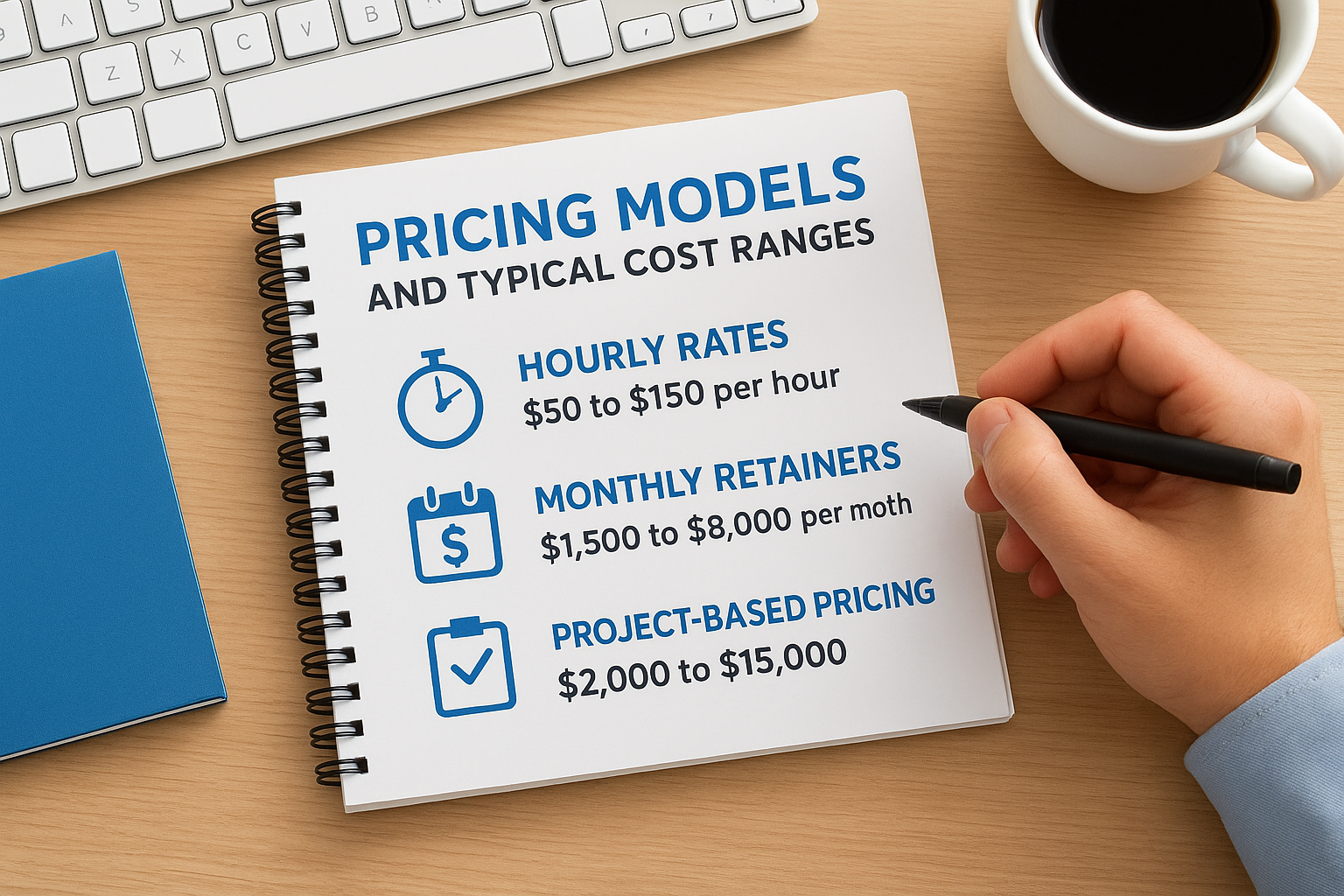
Service providers structure email marketing services pricing around three core models: hourly rates, monthly retainers, and project-based fees. Each model fits different business needs and budget constraints. Hourly billing works when you need sporadic help with specific campaigns. Monthly retainers make sense for ongoing management and strategy. Project fees cover one-time initiatives like automation setup or funnel builds. Understanding these models helps you compare quotes accurately and choose the pricing structure that matches your actual needs, not just what sounds cheapest upfront.
Hourly rates for freelance email marketers
Freelancers typically charge $50 to $150 per hour depending on their experience and specialization. Entry-level email marketers handling basic campaign execution sit at the lower end. Specialists with proven track records in list segmentation, automation, and conversion optimization command higher rates because they deliver faster results with fewer revisions.
You’ll burn through hours quickly if you’re not careful about scope. Writing a single email might take two hours. Designing a template adds another three. Testing and deployment add one more. A seemingly simple weekly newsletter can consume 8 to 12 hours per month when you factor in strategy calls, revisions, and performance reporting. Hourly pricing gives you flexibility but requires tight project management to avoid budget creep.
Hourly rates look affordable until you calculate how many hours your email program actually needs each month.
Monthly retainers for managed services
Agencies and experienced freelancers offer retainers ranging from $1,500 to $8,000 per month for full-service email management. The fee covers strategy, copywriting, design, deployment, and monthly reporting. Lower retainers ($1,500 to $3,000) typically include four to eight campaigns per month with limited automation work. Mid-tier packages ($3,000 to $5,000) add advanced segmentation, A/B testing, and basic automation sequences. Premium retainers ($5,000+) deliver comprehensive funnel management with complex automation, personalization, and deep analytics integration.
Retainers create predictable costs and ensure consistent attention to your email program. You’re not negotiating every task or tracking hours. The provider commits to delivering results within the agreed scope, and you get priority support and strategic guidance as part of the package.
Project-based pricing for campaign setup
One-time projects like building an email sequence, migrating platforms, or setting up automation workflows cost $2,000 to $15,000 depending on complexity. A simple five-email welcome series might run $2,000 to $4,000. A comprehensive abandoned cart sequence with dynamic product recommendations and CRM integration can hit $8,000 to $15,000. These fees cover strategy, copywriting, design, technical setup, and testing, but not ongoing management or optimization.
Project pricing works well when you need infrastructure built once, then plan to manage campaigns internally. You pay more upfront but avoid recurring monthly fees if you have the internal capacity to execute campaigns after the initial setup.
Agency pricing and what you get for the fee
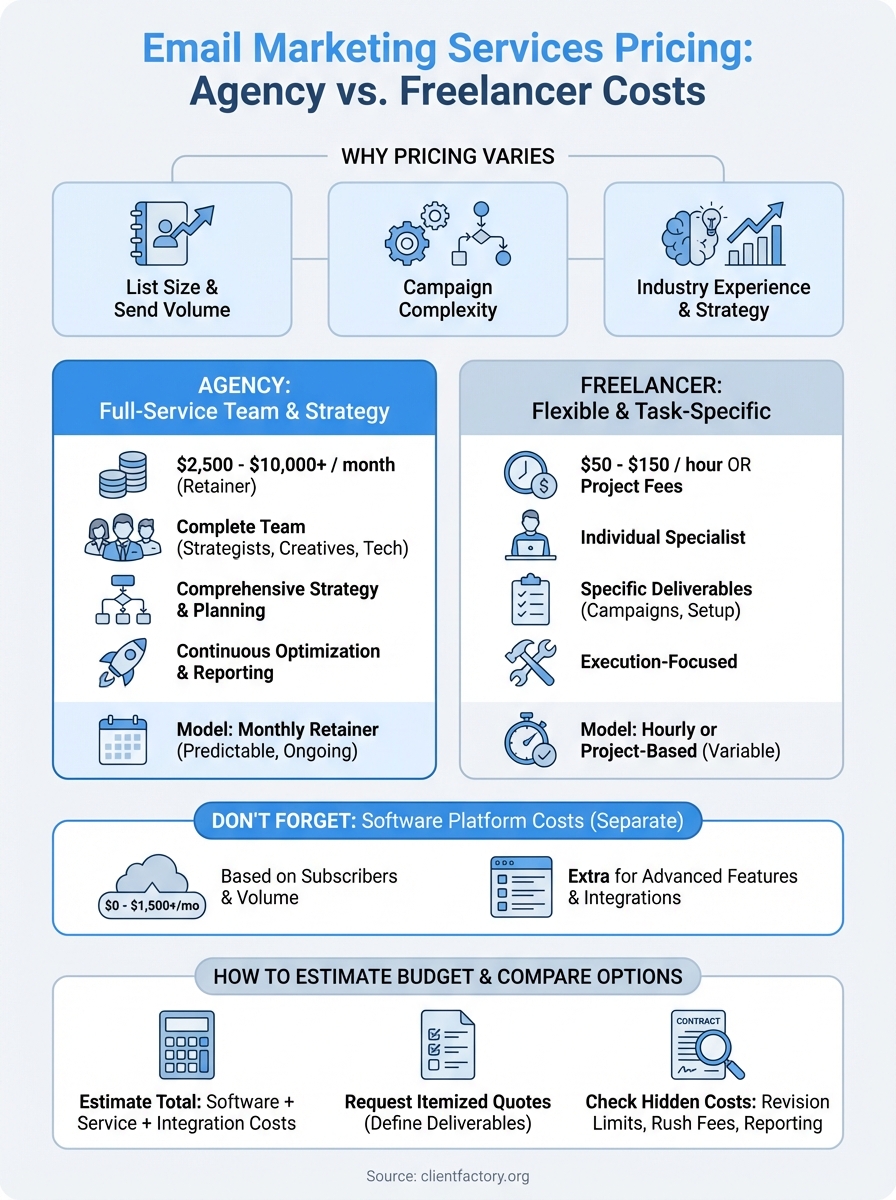
Agencies charge $2,500 to $10,000+ per month for comprehensive email marketing management, and those fees buy you a complete team rather than a single person. You’re paying for strategists, copywriters, designers, and developers working in coordination. The higher price point reflects dedicated resources, established processes, and accountability structures that freelancers can’t match. Agencies also carry overhead like software licenses, project management tools, and quality assurance systems that protect your investment.

Strategy development and campaign planning
Your agency retainer includes monthly strategic planning sessions where you review performance data, adjust targeting, and plan upcoming campaigns. The strategy team analyzes your funnel metrics, identifies drop-off points, and develops email sequences to address those gaps. You get quarterly roadmaps outlining campaign themes, automation enhancements, and testing priorities that align with your business goals.
Most agencies assign a dedicated account manager who serves as your primary contact and coordinates all email marketing activities. This person translates your business objectives into executable campaigns and ensures every send supports your revenue targets and customer retention goals. Strategic planning typically consumes 5 to 10 hours per month of senior-level expertise that would cost $150 to $250 per hour if billed separately.
Full-service creative and technical execution
Agencies handle everything from subject line writing to template coding and deployment scheduling. Your monthly fee covers all copywriting for promotional emails, nurture sequences, and newsletters. The creative team designs email templates that match your brand guidelines and test properly across dozens of email clients. Technical specialists build automation workflows, integrate with your CRM, and troubleshoot deliverability issues when they arise.
Full-service agencies remove the burden of managing multiple vendors because copywriters, designers, and developers work under one roof.
Performance tracking and continuous optimization
You receive detailed monthly reports showing open rates, click rates, conversion metrics, and revenue attribution from email campaigns. Agencies don’t just report numbers; they provide analysis and recommendations for improvement. The team runs ongoing A/B tests on subject lines, send times, and content formats to incrementally improve performance. They monitor deliverability metrics, manage list hygiene, and ensure compliance with regulations like CAN-SPAM.
Most agencies guarantee a dedicated account review each month where they walk you through results, answer questions, and adjust strategy based on what the data reveals. This continuous optimization cycle separates email marketing services pricing at the agency level from one-off freelance work because you’re investing in sustained improvement rather than task completion.
Freelancer pricing and how to scope the work
Freelancers offer more flexible pricing than agencies because you’re paying for specific deliverables rather than comprehensive team resources. Most email marketing freelancers charge $50 to $150 per hour or quote flat fees for defined projects like campaign creation or sequence setup. The key to controlling costs is defining exactly what you need before you start, because scope creep turns a $1,200 project into a $3,000 surprise when you keep adding “just one more thing.”
Typical freelancer rate structures
You’ll encounter three pricing approaches when hiring freelancers. Hourly rates work best for ongoing campaign management or consulting where the workload varies month to month. Project-based pricing ($500 to $5,000) covers specific deliverables like building a welcome sequence or designing five promotional emails. Monthly retainers ($1,000 to $4,000) secure dedicated hours each month for consistent campaign execution and performance monitoring. Each structure has merit depending on whether you need occasional help, one-time setup work, or regular campaign management.
Entry-level freelancers charge $50 to $75 per hour and handle basic tasks like writing emails from your outlines or loading content into templates. Mid-level specialists ($75 to $125 per hour) bring strategic thinking and can develop entire campaigns with minimal direction. Expert freelancers ($125 to $200+ per hour) deliver advanced automation, segmentation strategies, and conversion optimization that directly impact revenue.
Defining deliverables to control costs
Your scope document should specify exactly what the freelancer delivers. For campaign work, list how many emails, whether design is included, how many revision rounds, and who handles deployment. For automation projects, define which sequences you’re building, what triggers activate them, and how they integrate with your existing systems. Vague scopes lead to billing disputes and disappointing results.
Clear deliverables protect both you and the freelancer by establishing mutual expectations before any work begins.
Include timeline expectations and approval processes in your scope. You might need drafts delivered five business days before send dates to allow time for review. Specify whether the freelancer manages the deployment schedule or simply prepares campaigns for your team to launch. These details prevent confusion and keep email marketing services pricing aligned with actual work completed.
Managing the freelancer relationship
Start with a small test project before committing to a long-term arrangement. A single campaign or simple automation sequence lets you evaluate quality, communication style, and reliability without major financial risk. Pay attention to how the freelancer asks clarifying questions, meets deadlines, and incorporates your feedback.
Request weekly status updates for ongoing work so you catch problems early. Review performance metrics together monthly to ensure campaigns deliver expected results. Most successful freelancer relationships involve clear communication, defined boundaries, and regular check-ins that keep projects on track and within budget.
Software and tools that change your total cost
Your email marketing software subscription forms the foundation of your total costs, and platform fees can range from $0 for basic plans to $1,500+ per month for enterprise solutions. The software you choose determines what features you access, how many contacts you can manage, and whether you need additional tools to fill functionality gaps. Understanding these cost layers helps you accurately forecast email marketing services pricing when you factor in both software and service fees.
Platform fees based on list size
Most email marketing platforms charge based on subscriber count or send volume, with pricing tiers that jump as your list grows. You might pay $15 per month for 1,000 subscribers, $75 for 10,000 subscribers, and $350 for 50,000 subscribers on the same platform. These increases happen because platforms calculate costs around server capacity, deliverability infrastructure, and support resources required for larger accounts.
Free plans exist but they severely limit functionality. You typically get basic email sends without automation, limited templates, and branding on every email that damages your professional appearance. Small businesses operating under 2,500 subscribers often start with free tiers but upgrade within months because the restrictions block growth. Mid-tier plans ($50 to $200 monthly) unlock automation, segmentation, and A/B testing that directly improve conversion rates.
Platform fees represent your baseline cost, but the features you need often push you into higher pricing tiers faster than subscriber growth alone.
Features that increase monthly costs
Advanced capabilities like marketing automation, landing page builders, and CRM functionality add $50 to $500 per month on top of base platform fees. Automation features let you build triggered sequences that run without manual intervention, but platforms charge extra because these workflows require more server processing and sophisticated tracking systems. Multivariate testing, advanced segmentation, and predictive analytics live in premium tiers where monthly fees start around $300.
You also pay more for features like custom domains, dedicated IP addresses, and priority support that improve deliverability and performance. A dedicated IP costs $20 to $100 monthly but gives you complete control over sender reputation. Priority support packages ($100 to $500 monthly) guarantee faster response times when technical issues threaten campaign deadlines.
Integration and technical overhead
Connecting your email platform to your CRM, e-commerce system, or analytics tools sometimes requires middleware software that adds $50 to $300 monthly to your technology stack. Native integrations work smoothly but limit you to specific platform combinations. Third-party integration tools expand your options but introduce another subscription fee and potential failure points that need monitoring.
Custom development for unique integration needs costs $2,000 to $10,000 upfront, then ongoing maintenance fees. These investments make sense when you need sophisticated data flows between systems that standard integrations cannot handle, but they significantly increase your total email marketing technology budget.
How to estimate your monthly email marketing budget
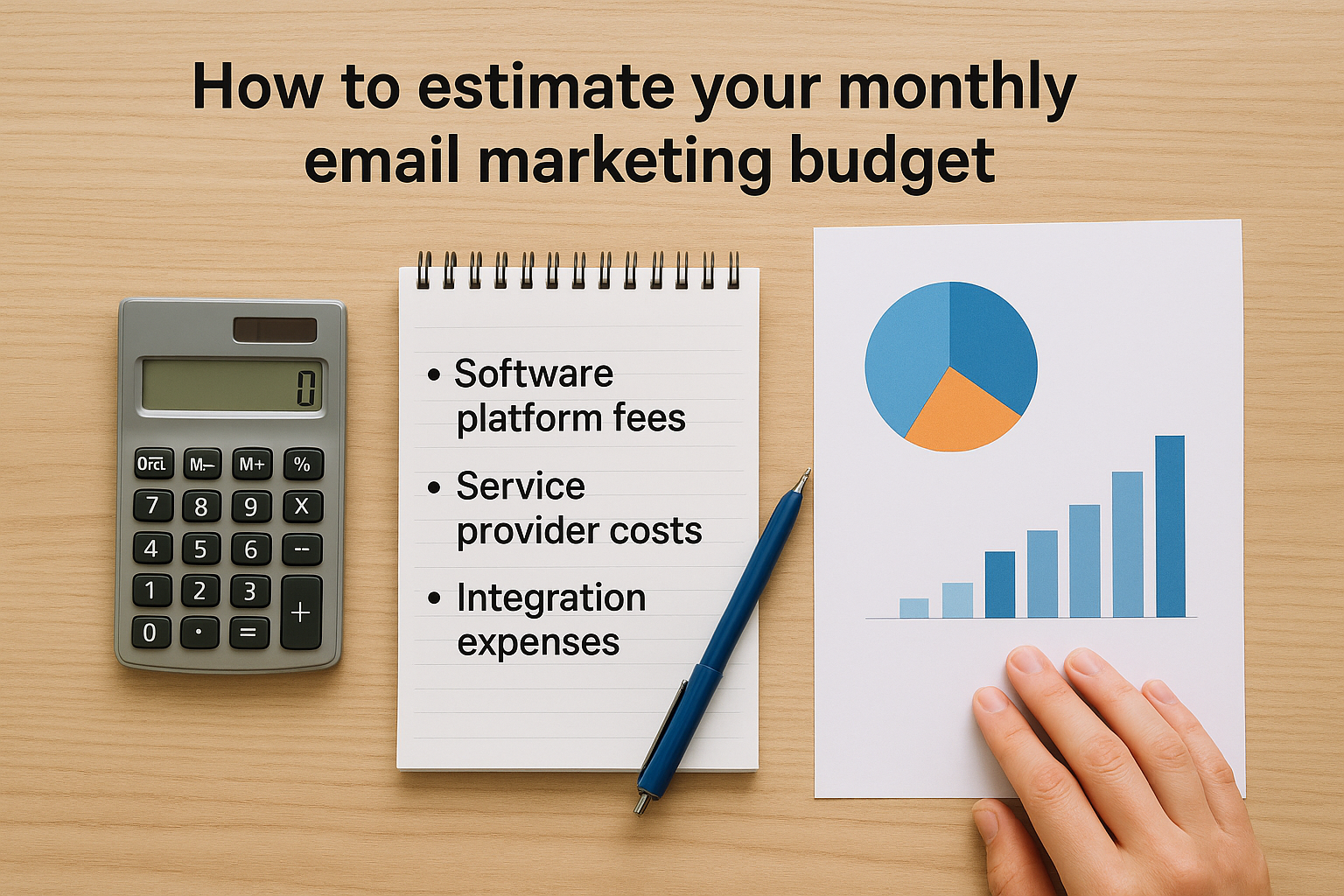
Building an accurate budget starts with calculating three core components: software platform fees, service provider costs, and integration expenses. You need to estimate each category separately, then add them together for your total monthly investment. Most businesses underestimate their true costs because they focus only on the obvious service fees and forget about software subscriptions, third-party tools, and technical maintenance that accumulate over time.
Start with your subscriber count and growth rate
Your current list size determines baseline software costs, but you should budget based on where your list will be in six months, not where it sits today. If you have 8,000 subscribers now and expect 20% growth, you’ll cross into the 10,000-subscriber pricing tier within months. Platform fees jump at these thresholds, so forecast growth to avoid budget surprises when your monthly bill suddenly increases by $50 to $100.
Calculate your growth rate by reviewing the past three to six months of subscriber additions. Factor in seasonal variations if your business experiences predictable spikes. Building your budget around projected list size protects you from scrambling for additional funds when your subscriber count pushes you into the next pricing tier.
Calculate service hours based on campaign frequency
Estimate how many emails you plan to send monthly, then multiply by the hours required per campaign. A simple promotional email takes two to four hours including strategy, writing, design, and deployment. Weekly sends consume 8 to 16 hours monthly. Add automation work separately because building sequences requires front-loaded investment of 10 to 30 hours depending on complexity.
Multiply your estimated hours by the hourly rate your provider charges, or compare that calculation against monthly retainer quotes. This exercise reveals whether email marketing services pricing from agencies makes financial sense compared to piecing together freelance help.
Budget for at least 20% more hours than you initially estimate because revisions, testing, and performance analysis always take longer than planned.
Factor in software and integration costs
Your email platform subscription forms the base cost, typically $50 to $350 monthly depending on features and list size. Add integration middleware if you need it ($50 to $200 monthly). Budget for premium features like dedicated IP addresses ($30 to $100) or advanced automation capabilities that live in higher-priced platform tiers. Sum these technology costs with your service provider fees to calculate your true monthly investment in email marketing.
How to compare options and avoid hidden costs
Comparing email marketing services pricing across multiple providers requires standardized quotes that break down exactly what you’re paying for. Request detailed proposals that separate strategy fees, creative work, technical setup, and ongoing management costs. Without itemized breakdowns, you can’t tell whether a $3,500 monthly retainer includes automation development or if that’s a $2,000 extra charge. Standardized quotes let you compare apples to apapples instead of guessing what each provider actually delivers for their fee.
Request itemized quotes with all deliverables listed
Your quote should specify how many emails per month, whether design and copywriting are included, who handles deployment, and what reporting you receive. Vague proposals that promise “full-service email marketing” leave room for disputes about what’s actually covered when you need extra campaigns or automation tweaks. Ask providers to list deliverables by quantity: “4 promotional emails monthly,” “1 automation sequence setup per quarter,” and “monthly performance reporting with recommendations.”
Itemized quotes reveal hidden costs before you commit. Some providers charge separately for list segmentation, A/B testing setup, or template design updates that you assumed were included in base pricing. Others bill revision rounds beyond the first draft at hourly rates. Getting these details upfront protects your budget from unexpected charges that accumulate over time.
Ask about revision limits and rush fees
Most service agreements include one to two revision rounds per campaign before additional changes trigger hourly billing. You need to know these limits because three rounds of feedback on every email can add $200 to $400 monthly to your costs. Providers also charge rush fees of 25% to 50% extra when you request faster turnarounds than the standard timeline. Understanding these charges helps you plan campaigns with realistic lead times that avoid premium pricing.
Revision limits and rush fees represent the most common hidden costs that inflate your email marketing budget beyond the base quote.
Clarify reporting and performance tracking inclusions
Basic reporting typically covers open rates, click rates, and unsubscribe metrics at no extra cost. Advanced analytics like revenue attribution, customer lifetime value tracking, and predictive modeling often cost $300 to $1,000 monthly extra because they require sophisticated integration with your sales systems. Ask specifically what metrics your provider tracks and whether custom dashboards or deeper analysis trigger additional fees. This clarity prevents surprise charges when you request the performance insights you need to evaluate ROI properly.
Next steps
You now understand how email marketing services pricing breaks down across agencies, freelancers, and software platforms. Armed with this knowledge, you can request accurate quotes, identify hidden costs before they surface on your invoices, and build a realistic monthly budget that aligns with your business goals and subscriber growth projections.
Start by documenting your current list size, planned campaign frequency, and specific automation needs before reaching out to providers. Use these details to request itemized quotes from at least three providers in each category you’re considering. Compare not just the bottom-line price but the specific deliverables, revision policies, and reporting included at each price point. This structured comparison reveals which option delivers the best value for your specific situation rather than just the lowest monthly fee.
If you’re looking for proven client acquisition systems that convert, Client Factory combines email marketing with broader funnel strategy to maximize your ROI. We help service businesses and law firms build data-driven email campaigns that nurture leads and drive revenue without the guesswork or budget surprises.