
You spend thousands on ads and content, but leads vanish before they become customers. Your sales team complains about lead quality while your marketing team defends their numbers. The pipeline stays thin no matter how much traffic you drive. This disconnect costs you revenue every single month.
A structured demand generation strategy fixes this problem. It aligns your marketing and sales teams around one goal: filling your pipeline with qualified buyers who are ready to have real conversations. When you build this foundation correctly, you create a predictable system that turns strangers into prospects and prospects into closed deals.
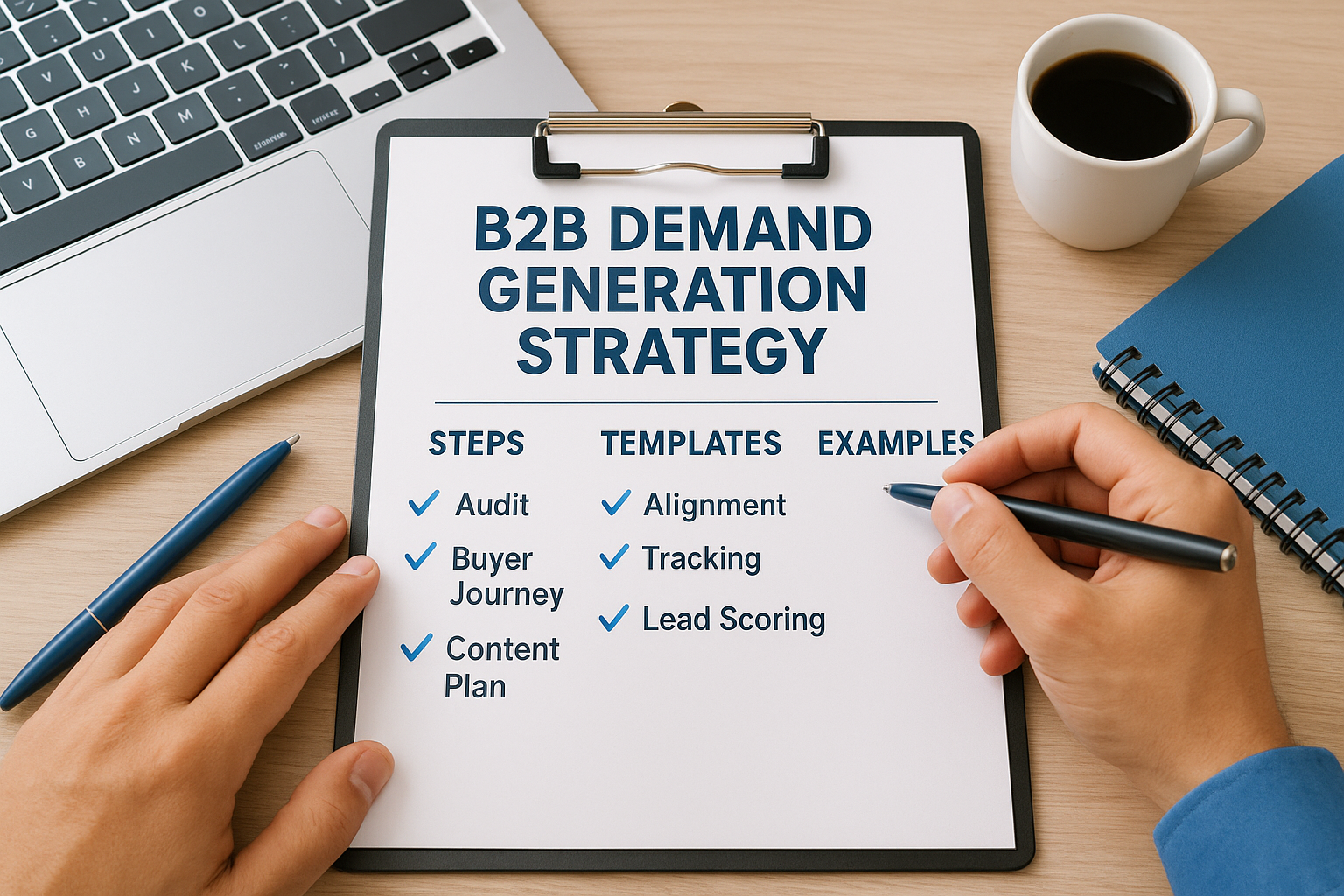
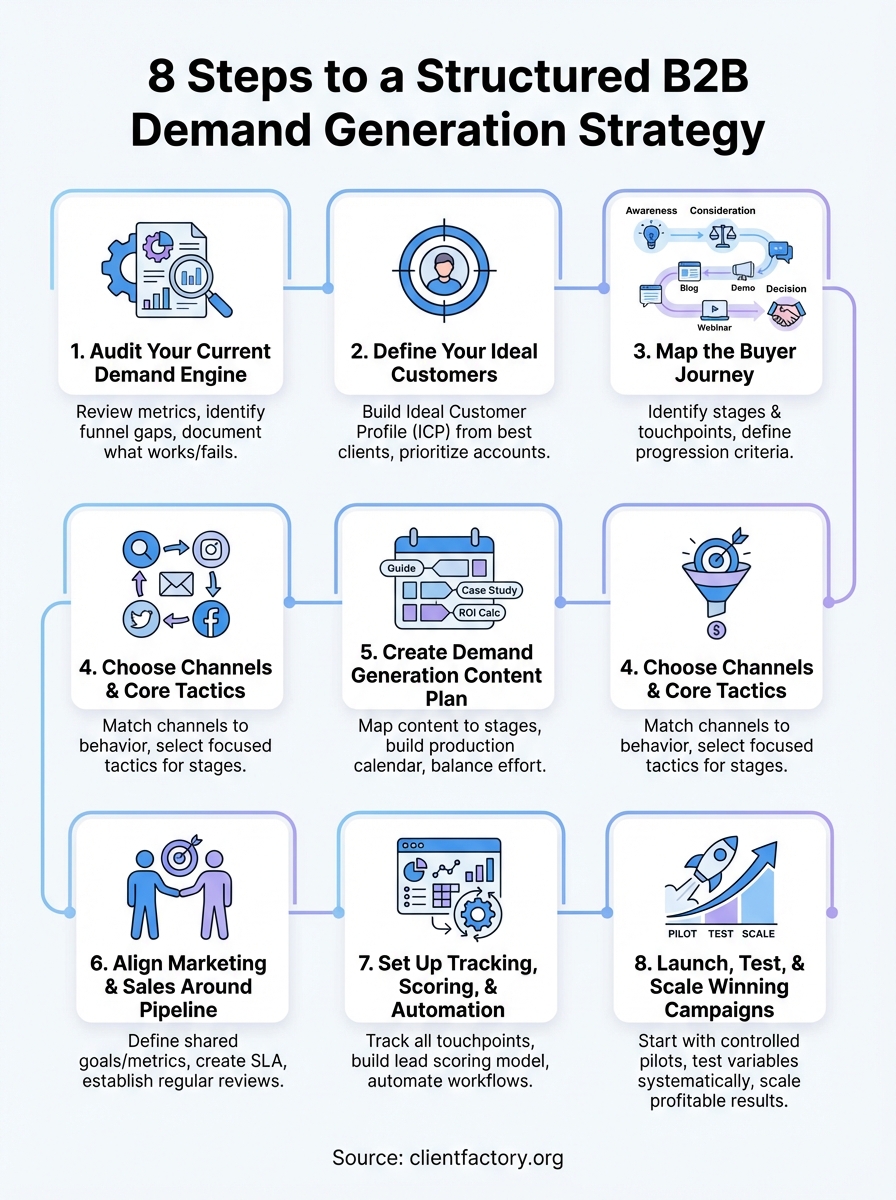
This guide walks you through eight specific steps to build or fix your B2B demand generation strategy. You will learn how to audit what you have now, define your best customers, map their buying process, choose the right channels, create content that converts, align your teams, set up tracking systems, and scale what works. We included templates and real examples you can model. By the end, you will have a clear roadmap to generate consistent, high quality leads for your business.
Understand an effective demand generation strategy
An effective demand generation strategy creates sustained awareness and genuine interest in your products or services before prospects ever talk to sales. You focus on educating your target market about problems they face and positioning your company as the authority that solves those problems. This approach builds trust over time instead of pushing for immediate conversions that rarely stick.
What separates demand gen from lead gen
Demand generation differs from lead generation in timing and scope. Lead generation captures contact information from people already interested in your solution, while demand generation creates that interest from scratch. You invest in content, campaigns, and experiences that reach cold audiences and warm them up through multiple touchpoints. Lead gen sits inside your broader demand generation strategy as one specific conversion point, not the entire system.
The three core phases
Your demand generation strategy operates across three distinct phases that prospects move through at different speeds. Each phase requires different content, messaging, and conversion goals based on where buyers are in their journey.

The phases break down this way:
-
Awareness: You reach new audiences through content marketing, social media, paid ads, and SEO. Your goal is to get your company name in front of people who match your ideal customer profile, even if they do not know they have a problem yet.
-
Consideration: You nurture engaged prospects with deeper content like webinars, case studies, and comparison guides. Prospects in this phase actively research solutions and evaluate different vendors. You position your approach as superior without hard selling.
-
Decision: You provide sales enablement assets, product demos, ROI calculators, and pricing information that help prospects choose your solution. Marketing qualified leads become sales qualified leads, and your sales team takes over the conversation.
A complete demand generation strategy connects all three phases with consistent messaging and clear handoffs between marketing and sales.
Your strategy should define specific tactics for each phase, conversion metrics that show progression, and content assets that move prospects forward. When you map everything out before launching campaigns, you avoid the common mistake of generating awareness without a plan to convert that attention into pipeline.
Step 1. Audit your current demand engine
You cannot build an effective demand generation strategy without understanding what you already have in place. Start by examining every marketing channel, campaign, and content asset you currently run. This audit reveals which efforts drive actual pipeline and which ones waste your budget. Most businesses discover they spread resources too thin across tactics that never converted a single qualified lead.
Review your current metrics and channels
Pull data from the last six months of your marketing activities across all channels. Look at your website traffic sources, paid ad performance, email open rates, social media engagement, and content downloads. Track how many leads each channel generated and how many of those leads became sales opportunities. You need hard numbers, not assumptions about what works.
Create a simple spreadsheet that lists each channel in one column, total leads generated in another, and leads that became opportunities in a third column. Add a fourth column for your cost per lead and a fifth for cost per opportunity. This breakdown shows you exactly where your money goes and what return you get.
Identify gaps in your funnel
Map your current buyer journey from first touch to closed deal. Look for stages where prospects drop off in large numbers. You might discover that plenty of people download your lead magnet but nobody attends your webinars. Or perhaps you generate demo requests but your sales team cannot close them.
Common gaps include no middle-of-funnel content, poor lead nurturing sequences, misaligned messaging between marketing and sales, and no clear path from awareness to decision. When you spot these breaks in your funnel, you know exactly where to focus your new demand generation strategy.
Document what’s working and what’s not
Create a working inventory of your findings using this template structure:
| Category | What Works | What Fails | Action Needed |
|---|---|---|---|
| Traffic Sources | Organic search drives 40% of leads | Paid social generates clicks but no conversions | Stop paid social, invest more in SEO |
| Content | Case studies convert at 12% | Blog posts get traffic but no engagement | Create more case studies, update blog strategy |
| Nurture sequences convert 8% | Cold outreach gets 1% reply rate | Scale nurture, kill cold outreach | |
| Sales Handoff | Demo requests close at 35% | Contact form leads close at 5% | Qualify better before sending to sales |
This audit gives you the baseline you need to measure improvement and prevents you from repeating past mistakes when you rebuild your strategy.
Your audit should take two to three days of focused work. Rush through it and you will miss critical insights that could save you thousands of dollars in wasted ad spend later.
Step 2. Define your ideal customers and accounts
You cannot generate demand effectively if you target everyone who might possibly buy from you. Your demand generation strategy needs a specific audience defined by characteristics that predict success. Companies that close fastest, stay longest, and spend most share common traits you can identify and replicate. When you focus your resources on prospects who match this profile, your conversion rates climb while your acquisition costs drop.
Build your ideal customer profile
Start with your best existing customers and reverse engineer what makes them successful. Pull data on your top 20% of customers by revenue, lifetime value, or contract size. Look for patterns in their company size, industry, technology stack, growth stage, and organizational structure. These patterns become your ideal customer profile criteria.
Document your findings in this format:
| Criteria | Must Have | Nice to Have |
|---|---|---|
| Company Size | 50-500 employees | 200-500 employees |
| Revenue | $10M-$100M annual | $25M+ annual |
| Industry | SaaS, Professional Services | Technology, Consulting |
| Tech Stack | Salesforce CRM | Marketing automation platform |
| Pain Points | Struggling with lead quality | Manual sales processes |
| Budget Authority | VP or C-level buyer | Dedicated budget for solutions |
Your ideal customer profile should include firmographic data (company facts), technographic data (tools they use), and behavioral indicators (actions that signal buying intent). The more specific you get, the easier it becomes to find similar prospects.
Prioritize your target accounts
Translate your ideal customer profile into a ranked list of companies you want to pursue. Use tools like LinkedIn Sales Navigator or your CRM to build a list of accounts that match your criteria. Assign each account a priority score based on fit and opportunity size.
Create three tiers: Tier 1 accounts match all your must-have criteria and represent significant revenue potential. Tier 2 accounts match most criteria but might be smaller or in adjacent industries. Tier 3 accounts show some fit but require more qualification before heavy investment.
When you define clear account tiers, your marketing and sales teams stop wasting time on prospects who will never close and focus energy on accounts that actually convert.
This targeting framework guides every decision in your demand generation strategy from content creation to channel selection to budget allocation. Without it, you scatter your efforts and wonder why nothing works.
Step 3. Map the buyer journey and key touchpoints
Your demand generation strategy needs a clear map of how prospects move from unaware strangers to qualified opportunities. Most businesses assume they understand this journey, but their actual buyer behavior reveals different patterns. You need to document the specific stages your ideal customers pass through and identify every touchpoint where your marketing influences their progress. This map becomes your blueprint for content creation, campaign sequencing, and sales handoff decisions.
Identify the stages your buyers actually move through
Talk to your sales team and review closed deals from the last quarter. Ask them to walk through how customers discovered your company, what content they consumed, what questions they asked, and how long the process took. You will likely find that your theoretical funnel does not match reality.
Most B2B buyers move through these actual stages: problem recognition, solution education, vendor research, internal alignment, and final evaluation. Your buyers might add or skip stages based on purchase complexity and organizational dynamics. Document the stages specific to your business, not generic funnel templates.
Document touchpoints at each stage
List every interaction point where prospects encounter your brand during their journey. These touchpoints include your website, content assets, ads, emails, sales conversations, demos, and third-party review sites. Match each touchpoint to the stage where it typically occurs.

Use this template to map your touchpoints:
| Stage | Primary Touchpoints | Content Needed | Goal |
|---|---|---|---|
| Problem Recognition | Blog posts, social media, search ads | Educational content about pain points | Build awareness |
| Solution Education | Webinars, guides, case studies | How solutions work, approaches to consider | Establish authority |
| Vendor Research | Product pages, demos, comparison content | Features, benefits, differentiators | Generate interest |
| Internal Alignment | ROI calculators, presentation decks | Business case materials | Support champion |
| Final Evaluation | Pricing, contracts, reference calls | Sales enablement assets | Close deal |
Define progression criteria
Establish clear indicators that show when a prospect moves from one stage to the next. Someone who downloads an awareness-stage guide has not yet reached the consideration stage. They need to take multiple actions that demonstrate growing interest and research behavior.
Your progression criteria determine when marketing passes leads to sales and prevent premature handoffs that damage conversion rates.
Track engagement signals like repeated website visits, content downloads across multiple topics, demo requests, and direct questions about implementation. These behaviors tell you when prospects have sufficient intent to warrant sales outreach.
Step 4. Choose your channels and core tactics
Your demand generation strategy fails when you spread budget across every possible marketing channel instead of focusing where your buyers actually spend time. You need to select three to five channels that match your ideal customer behavior and allocate resources to tactics that move prospects through each stage of their journey. This focused approach delivers better results than running scattered campaigns across ten different platforms with insufficient budget to succeed anywhere.
Match channels to your buyer behavior
Start by reviewing where your best customers found you before they became opportunities. Check your CRM attribution data to see which channels drove your highest value deals. Look at your buyer journey map from Step 3 and identify where prospects spend time during each stage of their research process.
B2B buyers research solutions differently based on their role and industry. Technical buyers start with search engines and online communities. Executive buyers respond better to LinkedIn content and industry events. If your ideal customers hang out in Slack communities or attend specific trade shows, those channels matter more than generic social media presence.
Create a simple channel priority list based on this analysis:
| Channel Type | Specific Channels | Best For Stage | Priority Level |
|---|---|---|---|
| Organic Search | Google, industry sites | Problem recognition | High |
| Paid Search | Google Ads | Solution education | High |
| Social Media | Vendor research | Medium | |
| Content Syndication | Industry publications | Problem recognition | Medium |
| Email Marketing | Nurture sequences | All stages | High |
| Events | Webinars, conferences | Solution education | Low |
Select tactics based on resources and goals
Match specific tactics to each priority channel based on your team capacity and budget constraints. Running five mediocre tactics across different channels produces worse results than executing two tactics exceptionally well. Choose tactics you can sustain consistently for at least six months before expecting meaningful results.
For organic search, your core tactics might include publishing weekly blog posts, optimizing product pages, and building backlinks through guest contributions. For LinkedIn, you might focus on executive thought leadership posts and targeted sponsored content campaigns. Your email tactics could include automated nurture sequences, monthly newsletters, and account-based outreach to Tier 1 prospects.
When you align your channel selection with actual buyer behavior and match tactics to your execution capacity, you build a sustainable demand generation engine that compounds results over time.
Document your chosen tactics with specific frequency commitments and success metrics. A tactic like “do content marketing” stays vague and fails. A tactic like “publish two case studies monthly and promote through email and LinkedIn” creates accountability and measurable outcomes that improve your demand generation strategy.
Step 5. Create your demand generation content plan
Your demand generation strategy lives or dies on the quality and consistency of content you publish across each stage of the buyer journey. You need a structured plan that specifies what content to create, when to publish it, and how each asset moves prospects closer to becoming qualified opportunities. Most companies create random content based on gut feelings or whatever topic seems interesting that week. This scattered approach wastes your team’s time and produces assets that never convert.
Map content types to buyer stages
Match specific content formats to the stage-appropriate needs you identified in your buyer journey map. Early stage prospects need educational content that addresses their problems without pushing your solution. Middle stage buyers want detailed comparisons and proof that your approach works. Late stage evaluators require business case materials that help them justify the purchase internally.

Use this framework to align your content production:
| Buyer Stage | Content Types | Format Examples | Purpose |
|---|---|---|---|
| Problem Recognition | Educational, awareness | Blog posts, social content, industry reports | Drive traffic, build authority |
| Solution Education | Explanatory, how-to | Guides, webinars, templates, videos | Generate leads, nurture interest |
| Vendor Research | Proof, differentiation | Case studies, comparison guides, demos | Convert to opportunities |
| Internal Alignment | Business justification | ROI calculators, presentation decks, implementation plans | Support buying committee |
| Final Evaluation | Sales enablement | Pricing sheets, contracts, reference calls | Close deals |
Build your production calendar
Create a quarterly content calendar that specifies what you will produce each week and where you will distribute it. Your calendar should balance content across different stages instead of clustering everything in awareness or conversion stages. Plan for one to two major assets per month like webinars or comprehensive guides, plus weekly smaller pieces like blog posts or social content.
Structure your calendar with these columns: publish date, content title, format, target stage, primary channel, secondary distribution, owner, and status. This level of detail prevents content from sitting in draft mode forever and ensures your entire team understands their responsibilities.
Balance effort with expected impact
Prioritize content that serves multiple purposes across different channels and stages. A single case study can become a blog post, email nurture content, sales leave-behind, and social proof on your website. Video content converts into blog transcripts, social clips, and email newsletter features. This repurposing approach multiplies your content investment without requiring proportional increases in production time.
When you plan content strategically instead of reactively, you build a library of assets that compounds in value and continuously feeds your demand generation engine.
Start with your highest priority tier one accounts and create content that speaks directly to their specific pain points and industry context. Generic content might generate some traffic but targeted content converts prospects into pipeline. Your plan should specify how you will customize messaging for different segments without creating entirely new assets from scratch each time.
Step 6. Align marketing and sales around pipeline
Your demand generation strategy breaks down when marketing and sales operate as separate teams with conflicting priorities. Marketing celebrates lead volume while sales complains about quality. Sales hoards contacts instead of sharing feedback about what converts. This disconnect wastes budget on the wrong prospects and creates friction that kills deals before they close. You need formal alignment around shared pipeline goals and regular communication rhythms that keep both teams focused on revenue instead of vanity metrics.
Define shared pipeline goals and metrics
Establish common definitions for every stage of your pipeline that both teams understand and accept. Marketing qualified leads become sales accepted leads based on specific criteria, not arbitrary judgment calls. Sales qualified leads meet concrete requirements that predict close probability. When you document these definitions in writing and get sign-off from both departments, you eliminate the blame game that destroys collaboration.
Set shared targets that force cooperation instead of competition. Your goals should specify how many marketing qualified leads convert to opportunities, how many opportunities close, and what the average deal size looks like. Both teams own these conversion rates together, which means marketing cannot declare victory after generating leads that never convert and sales cannot ignore follow-up on qualified prospects.
| Metric | Marketing Responsibility | Sales Responsibility | Shared Target |
|---|---|---|---|
| MQLs Generated | 200 per month | Respond within 24 hours | 150 become SQLs |
| SQLs Created | Provide context and research | Follow up within 48 hours | 50 become opportunities |
| Opportunities | Support with content | Run discovery and demo | 15 close as customers |
| Average Deal Size | Target accounts $50K+ | Upsell during negotiation | $60K average |
Create a service level agreement
Build a formal SLA that specifies exactly what marketing delivers to sales and what sales commits to doing with those leads. Your agreement should cover lead response times, follow-up requirements, feedback loops, and disqualification criteria. When sales ignores qualified leads for a week, they lose the right to complain about lead quality.
Document your SLA using this template structure:
Marketing commits to:
- Deliver 200 MQLs monthly that meet agreed-upon criteria
- Provide lead context including content consumed and engagement history
- Continue nurturing leads that sales marks as “not ready”
- Report on campaign performance and lead quality metrics weekly
Sales commits to:
- Contact all MQLs within 24 hours of assignment
- Log all interactions and outcomes in CRM within same day
- Provide feedback on lead quality and conversion barriers
- Return unqualified leads to marketing with specific reasons
When both teams operate under a clear SLA, finger-pointing stops and problem-solving starts because everyone knows their responsibilities and can see who drops the ball.
Establish regular pipeline review meetings
Schedule weekly pipeline reviews where marketing and sales examine leads moving through each stage together. These meetings focus on identifying bottlenecks, sharing prospect feedback, and adjusting targeting or messaging based on what actually converts. You review which campaigns generated the best opportunities, which content assets helped close deals, and where prospects consistently stall out.
Your weekly agenda should cover current pipeline health, conversion rates by source, deal stage movement, and upcoming campaign plans that sales needs to prepare for. Keep meetings under 30 minutes and focus on action items instead of status updates that could happen in Slack.
Step 7. Set up tracking, scoring, and automation
Your demand generation strategy produces measurable results only when you track every prospect interaction, score their readiness to buy, and automate repetitive tasks that waste your team’s time. Without proper tracking, you cannot identify which campaigns drive revenue or where prospects drop off in your funnel. Manual lead qualification and follow-up create inconsistent experiences and let hot prospects go cold while your team chases dead ends. You need systems that capture data automatically, flag high-intent prospects, and trigger the right actions at the right time.
Track every touchpoint from first click to closed deal
Set up tracking parameters that follow prospects through their entire journey across all channels and touchpoints. You need to know which blog post they read first, what emails they opened, which pages they visited repeatedly, and what content they downloaded before requesting a demo. This visibility shows you the complete story of how prospects move through your funnel instead of isolated snapshots.
Implement these tracking mechanisms in your marketing stack:
| Tracking Element | Purpose | Implementation |
|---|---|---|
| UTM parameters | Attribute traffic sources | Add to all external links and paid campaigns |
| Form field tracking | Capture lead source and campaign | Include hidden fields in all forms |
| Website behavior | Monitor page visits and time spent | Install analytics and heat mapping tools |
| Email engagement | Track opens, clicks, and replies | Use your email platform’s tracking features |
| CRM activity logs | Record all sales interactions | Train sales team to log every call and email |
Build your lead scoring model
Create a points-based system that assigns numeric values to specific prospect behaviors and characteristics. Someone who downloads a bottom-of-funnel case study scores higher than someone who reads a blog post. A prospect from your Tier 1 account list scores higher than someone from an unknown company. When scores reach your threshold, prospects move from marketing to sales automatically.

Start with this basic scoring framework and adjust based on what predicts actual conversions in your business:
Demographic scoring (who they are):
- Title match: +20 points
- Company size match: +15 points
- Industry match: +10 points
- Location match: +5 points
Behavioral scoring (what they do):
- Demo request: +50 points
- Pricing page visit: +30 points
- Case study download: +25 points
- Webinar attendance: +20 points
- Blog post read: +5 points
Your scoring model transforms gut feelings about lead quality into objective criteria that both marketing and sales trust and respect.
Automate repetitive tasks that slow pipeline velocity
Build automated workflows that eliminate manual busy work and ensure consistent follow-up across every prospect. When someone downloads your guide, they should receive a welcome email immediately, get added to a nurture sequence, and trigger a notification to sales if they match your ideal customer profile. These automations run 24/7 without human intervention.
Priority automations to implement first include lead assignment rules that route prospects to the right sales rep based on territory or account ownership, email nurture sequences that deliver stage-appropriate content over time, and follow-up reminders that notify sales when high-scoring prospects take important actions.
Step 8. Launch, test, and scale winning campaigns
Your demand generation strategy exists on paper until you put it into action with real campaigns that reach actual prospects. You start small with controlled tests that validate your assumptions about messaging, channels, and targeting before committing your full budget. This disciplined approach prevents expensive failures and identifies winning combinations of tactics that you can scale confidently. Most companies launch everything at once, spend their entire budget in weeks, and learn nothing useful from the chaos.
Start with controlled pilot campaigns
Begin with one campaign per channel from your priority list in Step 4. If LinkedIn and organic search topped your channel selection, launch a single sponsored content campaign on LinkedIn and publish a series of optimized blog posts targeting your core keywords. Run these pilots for 30 to 45 days with a limited budget that lets you gather meaningful data without betting everything on untested approaches.
Set clear success metrics before launch. Your LinkedIn campaign might target 500 clicks, 50 content downloads, and 10 qualified conversations. Your SEO content might aim for 20 target keywords ranking on page one, 2,000 monthly visits, and 40 email subscribers. These specific targets tell you whether pilots succeed or fail instead of leaving interpretation to gut feelings.
Test variables systematically
Change one element at a time across your test campaigns so you know exactly what drives different results. You might test three different headlines for the same LinkedIn ad, or try two different lead magnets on similar blog posts. When you change multiple variables simultaneously, you cannot identify which change improved performance and which hurt it.
Track your tests using this framework:
| Variable | Version A | Version B | Winner | Improvement |
|---|---|---|---|---|
| Ad headline | “Stop losing leads” | “Generate 3x more pipeline” | Version B | +45% CTR |
| Landing page CTA | “Download guide” | “Get the template” | Version A | +22% conversion |
| Email subject | Question format | Benefit statement | Version B | +18% open rate |
| Webinar day | Tuesday 2pm | Thursday 11am | Version A | +35% attendance |
When you document every test result, you build institutional knowledge that improves every future campaign instead of repeating the same mistakes.
Scale what proves profitable
Double down on winning combinations that deliver qualified opportunities at acceptable costs. If your LinkedIn case study ads generated sales qualified leads at $200 each while your generic awareness ads cost $800 per SQL, you shift budget toward case studies and pause the awareness campaign. This ruthless focus on results over creativity drives consistent pipeline growth.
Increase budgets gradually on proven winners. Boost spending by 25 to 50 percent monthly while monitoring whether performance holds steady. Campaigns often maintain efficiency at 2x to 3x their pilot budgets but degrade quickly beyond that threshold as you exhaust your best audience segments and targeting options.
Templates and examples to model
You need working templates that translate strategy into execution instead of starting from scratch every time you launch a campaign. These frameworks give you proven structures you can customize for your specific business while avoiding common mistakes that waste budget and time. Each template below comes from actual demand generation programs that produced measurable pipeline results for B2B companies.
Campaign planning template
Use this framework to plan every demand generation campaign before you spend a dollar on execution. Your template should force you to answer the critical questions that determine success or failure before launch rather than discovering problems after you burn through your budget.
Campaign Planning Template:
Campaign Name: [Descriptive title]
Target Audience: [Specific ICP segment]
Campaign Goal: [Pipeline generated, MQLs created, opportunities opened]
Duration: [Start date - End date]
Budget: [Total allocation]

Messaging:
- Primary pain point addressed: [Specific problem]
- Key benefit statement: [Clear value proposition]
- Call to action: [Exact next step]

Channels & Tactics:
- Primary channel: [Main distribution method]
- Supporting channels: [2-3 amplification channels]
- Content assets needed: [List each piece]

Success Metrics:
- Impressions target: [Number]
- Engagement target: [Clicks, views, etc.]
- Conversion target: [Leads or opportunities]
- Cost per SQL: [Maximum acceptable]

Dependencies:
- Content creation deadline: [Date]
- Sales team briefing: [Date]
- Technical setup completion: [Date]
Lead scoring matrix example
Build your scoring model using this matrix that balances demographic fit with behavioral engagement. You assign points based on how well prospects match your ideal customer profile and how actively they research solutions like yours. This example comes from a SaaS company selling to mid-market businesses.
| Criteria Type | Attribute | Points | Rationale |
|---|---|---|---|
| Demographic | VP or C-level title | +25 | Decision maker access |
| Demographic | 100-500 employees | +20 | Sweet spot company size |
| Demographic | Target industry | +15 | Product-market fit |
| Behavioral | Pricing page visit | +30 | High purchase intent |
| Behavioral | Case study download | +25 | Solution research stage |
| Behavioral | Webinar attendance | +20 | Active engagement |
| Behavioral | Email click | +10 | General interest |
| Behavioral | Blog read | +5 | Early awareness |
MQL threshold: 50 points | SQL threshold: 80 points
Email nurture sequence template
Deploy this five-email sequence to move cold leads toward sales readiness over 14 days. Each message builds on the previous one while respecting that prospects need time to evaluate solutions at their own pace.
Email 1 (Day 0): Welcome and deliver promised asset
Email 2 (Day 2): Share related educational content addressing same pain point
Email 3 (Day 5): Provide case study showing how similar company solved problem
Email 4 (Day 9): Offer comparison guide or deeper product information
Email 5 (Day 14): Include direct call to action for demo or consultation
These templates eliminate guesswork and establish consistent processes across your demand generation strategy that your entire team can execute reliably.
Your implementation speed matters more than perfect customization. Start with these baseline templates and refine them based on actual performance data from your first campaigns rather than theorizing about what might work better.
Next steps and wrap up
You now have a complete roadmap to build or fix your demand generation strategy from audit through scaling. Your next action is to choose one single step from this guide and complete it this week. Most businesses fail because they try to implement everything simultaneously instead of building their system methodically over 60 to 90 days.
Start with Step 1 if you need clarity on what works now. Jump to Step 2 if you already know your numbers but target the wrong accounts. Begin at Step 5 if your targeting and channels are solid but your content calendar stays empty. Pick your weakest link and fix it before moving forward.
The companies that win at demand generation execute consistently rather than perfectly. They test small, learn fast, and scale what converts. Your pipeline growth depends on disciplined implementation of these eight steps, not discovering some secret tactic your competitors missed.
Ready to accelerate your results? Partner with a team that builds high-performance demand generation systems that fill your pipeline with qualified buyers.