
You’re ready to invest in conversion rate optimization services pricing research because you already know that getting more from your existing traffic beats paying for more clicks. Smart move. But the moment you start requesting quotes, you’ll notice something frustrating: prices are all over the map. One agency quotes $1,000 a month, another wants $25,000, and neither makes it easy to understand what you’re actually getting.
That gap exists for real reasons, scope, expertise, tools, and testing volume all affect cost. The problem is that most businesses don’t know what’s reasonable, so they either overpay for basic work or underspend and get nothing measurable in return. At Client Factory, we build conversion-focused funnels and run data-driven campaigns for service businesses and law firms, so we see firsthand how the right CRO investment compounds returns across every marketing dollar you spend. We also see what happens when businesses skip it entirely: ad budgets that bleed out through broken landing pages and leaky funnels.
This guide breaks down what CRO services actually cost in 2026, from hourly consulting rates to full-service retainers and performance-based models. You’ll get clear pricing benchmarks, understand what drives costs up or down, and learn how to evaluate whether a quote is fair for your situation. By the end, you’ll have enough context to set a realistic budget and hire with confidence.
What CRO services pricing includes in 2026
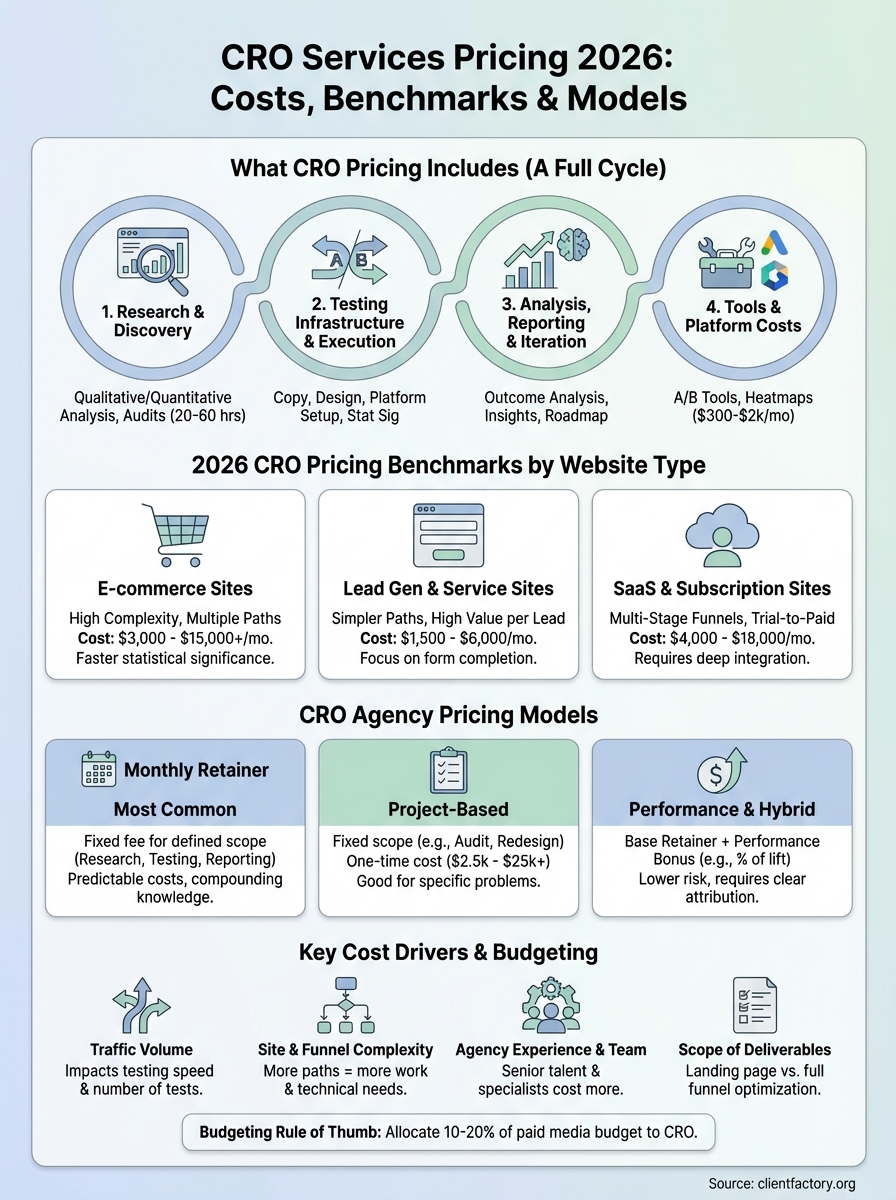
Most businesses research conversion rate optimization services pricing expecting a simple menu of options. What they find instead is a wide range of services bundled differently by every agency. Before you can evaluate any quote, you need to understand what work actually goes into CRO. The price isn’t just for someone to run an A/B test. It covers a full cycle of research, hypothesis development, testing infrastructure, data analysis, and iteration. Skipping any part of that cycle produces results that are either unmeasurable or impossible to repeat.
Research and discovery
Every credible CRO engagement starts with a deep research phase. This is where the agency figures out why your visitors aren’t converting. That work includes qualitative analysis such as heatmaps, session recordings, and user surveys, along with quantitative analysis of your analytics data to find drop-off points in your funnel. Some agencies also conduct customer interviews or review your existing sales data to understand what objections are killing conversions before the visitor even reaches your form or checkout page.
This phase takes real time. For a moderately complex website, a thorough audit can take anywhere from 20 to 60 hours depending on how much traffic data is available and how many conversion paths exist. Agencies that skip this step and jump straight to design changes are guessing. You’re paying for that guesswork either way, but you won’t see the same ROI.
Testing infrastructure and execution
Once the research phase identifies where the leaks are, the agency builds and runs tests. This includes writing copy variations, designing alternative layouts, setting up split tests in a testing platform, and making sure the test reaches statistical significance before declaring a winner. Running tests correctly requires both technical setup and enough traffic to generate reliable data.
Most legitimate tests need at least 1,000 conversions per variation to produce statistically valid results, which means low-traffic sites can’t run the same volume of tests as high-traffic ones.
The cost here reflects how many tests run per month and how technically complex each test is. Simple headline swaps are quick to build. Full-page redesign tests with multiple elements and dynamic content take significantly longer. Agencies with experienced UX designers, copywriters, and developers on staff charge more for this work, but they also produce higher-quality tests.
Analysis, reporting, and iteration
Running a test is only useful if someone interprets the results correctly. This part of the service includes statistical analysis of test outcomes, building documentation of what worked and why, and using those insights to inform the next round of tests. The best CRO programs build a knowledge library over time so each test builds on the last.
Reporting deliverables vary widely between agencies. Some send a one-page summary with a win/loss label. Others provide a full breakdown of user behavior patterns, revenue impact estimates, and a prioritized roadmap for the next quarter. The agencies that deliver substantive reporting tend to charge more, but they also give you something you can actually use to make broader business decisions.
Tools and platform costs
Many agencies include the cost of CRO tools in their retainer. These tools include A/B testing platforms, heatmap software, session recording tools, and sometimes customer survey platforms. Others pass these costs through to you directly. Tools for a mid-size CRO program can run anywhere from $300 to $2,000 per month depending on traffic volume and the number of tools required. When you’re comparing agency quotes, ask whether tool costs are included or billed separately, because that difference alone can shift your total spend by several thousand dollars annually.
2026 CRO pricing benchmarks by website type
Not every website needs the same level of CRO investment, and agencies price their services accordingly. Website type determines complexity, which in turn drives the number of conversion paths, the volume of tests needed, and how long it takes to reach statistical significance. Understanding where your site falls helps you evaluate whether a quote is reasonable before you sign anything.
E-commerce sites
E-commerce sites typically carry the highest CRO costs because they have multiple conversion paths: product pages, category pages, cart pages, and checkout flows. Each one requires separate testing, and small gains on a high-volume store translate directly to measurable revenue. Expect to pay $3,000 to $15,000 per month for a full-service CRO retainer on a mid-size e-commerce site. High-volume retailers with complex product catalogs and personalization requirements can push past $20,000 per month.
The upside is that e-commerce sites generate enough conversion data to reach statistical significance faster, which means more tests per quarter and faster returns on your CRO investment.
Lead generation and service business sites
Service businesses and law firms typically have simpler conversion paths, usually one or two goal actions like a form submission, a phone call, or a booked appointment. That simplicity keeps costs lower, but it also means each conversion carries higher individual value, so even small improvements in form completion rates have a significant revenue impact. Conversion rate optimization services pricing for lead generation sites typically falls between $1,500 and $6,000 per month for a managed retainer. The lower end covers basic testing and analytics setup; the upper end includes ongoing testing cycles, landing page redesigns, and detailed reporting.
SaaS and subscription sites
SaaS sites introduce unique complexity because the conversion funnel often spans multiple sessions, free trial activations, onboarding flows, and upgrade prompts. Each stage of the funnel requires its own testing program, and optimizing for trial-to-paid conversion involves both product and marketing decisions. Monthly retainers for SaaS CRO work typically range from $4,000 to $18,000, depending on how many funnel stages the engagement covers and whether the agency is also supporting in-app onboarding improvements. Agencies with dedicated SaaS experience charge a premium for this work because the testing environment requires deeper technical integration than a standard landing page test.
CRO agency pricing models and how they work
When you start evaluating conversion rate optimization services pricing, you’ll notice agencies structure their fees in fundamentally different ways. The model an agency uses affects how you pay, what you get, and how much risk each side carries. Understanding each model helps you match your budget structure and business goals to the right engagement type before you sign a contract.

Monthly retainer model
The monthly retainer is the most common pricing structure for ongoing CRO work. You pay a fixed fee each month in exchange for a defined scope of services, typically covering research, testing cycles, analysis, and reporting. Retainers give you predictable costs and allow the agency to build a compounding knowledge base about your specific audience over time.
The longer a retainer runs, the more valuable the accumulated test data becomes, because each experiment informs the next hypothesis and shortens the path to meaningful lifts.
Retainers work best when you have consistent traffic volume and want continuous testing rather than a one-time audit. The tradeoff is that you’re paying whether the month produces a winning test or not, so vetting the agency’s process before committing matters.
Project-based pricing
Project-based engagements cover a fixed scope of work for a set price. Common examples include a full CRO audit, a landing page redesign backed by user research, or a single testing sprint. Costs for project work typically range from $2,500 for a basic audit to $25,000 or more for a comprehensive funnel overhaul with multiple deliverables.
This model suits businesses that need a specific problem solved rather than an ongoing testing program. The limitation is that CRO generates the strongest returns through iteration, so a single project often identifies opportunities without giving the agency time to fully exploit them.
Performance-based and hybrid models
Some agencies tie part of their fee to measurable outcomes such as a percentage of revenue lift or a cost-per-conversion improvement target. Pure performance deals are rare because proving attribution cleanly is difficult, but hybrid models that combine a lower base retainer with a performance bonus are more common in 2026.
Hybrid arrangements reduce your upfront risk, but they require clear baseline metrics, agreed attribution methodology, and a tracking setup both sides trust. Before entering a performance-based deal, confirm exactly how the agency defines a conversion win and how they calculate their bonus.
The factors that change CRO cost the most
When you request quotes for conversion rate optimization services pricing, the range you see isn’t random. Specific variables push costs up or down more than anything else, and understanding them helps you predict where your budget will land before you talk to a single agency. The four factors below account for the majority of price differences across comparable CRO engagements.
Traffic volume
Traffic volume directly controls how fast tests can reach statistical significance, which determines how many tests you can run per month. A site with 50,000 monthly visitors needs weeks to validate a single test, while a site with 500,000 visitors can run multiple concurrent tests and generate conclusions in days. Low-traffic sites require longer engagements to produce the same number of validated insights, which means the agency spends more time per result and prices accordingly.
If your site generates fewer than 10,000 monthly sessions, expect agencies to recommend a longer minimum contract term because the testing cycle is slower and results take more time to accumulate.
Site and funnel complexity
The number of distinct conversion paths on your site has a direct impact on how much work CRO requires. A law firm with one contact form has a simpler testing environment than a SaaS product with a free trial flow, an onboarding sequence, and multiple upgrade prompts. More paths mean more hypotheses to test, more pages to instrument, and more reporting to deliver. Technical complexity matters too: custom-built platforms and legacy CMS setups often require additional developer hours to implement test variations cleanly, and those hours show up in your quote.
Agency experience and team composition
Agencies with senior strategists, dedicated UX designers, and in-house developers charge more than generalist shops or solo consultants, and the price difference usually reflects genuine skill gaps. A well-structured test built by an experienced team produces cleaner data and higher-quality insights than a basic A/B split thrown together in an afternoon. When you evaluate quotes, ask specifically who will be running your account and what their individual backgrounds are. Junior teams priced attractively can cost you more in wasted months than a higher-priced senior team would have.
Scope of deliverables
Your final cost also depends on what you actually ask for. An engagement limited to landing page testing costs less than one that covers full-funnel optimization, including ad-to-page messaging alignment, post-conversion email sequences, and quarterly strategy reviews. Defining your scope clearly before requesting quotes prevents you from comparing a comprehensive retainer against a stripped-down package and drawing the wrong conclusions about which agency offers better value.
Common CRO service packages and deliverables
When you research conversion rate optimization services pricing, you’ll quickly notice that agencies package their work differently, which makes apples-to-apples comparisons difficult. Knowing what typically falls inside each tier helps you spot what’s missing from a quote and push back when a package doesn’t match your actual needs.
Entry-level and audit-only packages
Entry-level packages focus on identifying conversion problems rather than solving them. You typically receive a full audit of your analytics data, heatmaps, and session recordings, along with a prioritized list of opportunities. These packages rarely include live testing; they hand you a roadmap and leave execution to your internal team or a future engagement.
Audit-only packages are a reasonable starting point if you have in-house developers who can implement changes, but they don’t deliver the iterative testing that produces compounding results over time.
Deliverables at this tier usually include an analytics review, a recorded walkthrough of findings, and a written recommendations document. Pricing for standalone audits typically runs between $2,500 and $7,500 depending on site complexity and the depth of the analysis.
Mid-tier managed testing packages
Mid-tier packages add active testing cycles on top of the research work. You get hypothesis development, test build-out, execution, and a post-test analysis report each month. Most agencies at this level run two to four tests per month depending on your traffic volume and the complexity of each variation.
These packages suit businesses that want measurable outcomes without committing to a full-service engagement. Typical deliverables include monthly test reports, a running test log, and a priority backlog for upcoming experiments. You can usually expect a monthly call with your account lead to review results and set direction for the next cycle.
Full-service retainer packages
Full-service retainers cover the entire optimization program from strategy through execution and reporting. In addition to ongoing testing, these packages typically include landing page redesigns, ad-to-page message alignment reviews, conversion copywriting, and quarterly strategy sessions.
Deliverables at this tier go beyond test reports and into business-level impact analysis, including revenue lift estimates, cost-per-acquisition tracking, and a documented knowledge base of every insight your program has generated. Some agencies also include UX design, developer resources, and tool licensing inside the retainer fee, which simplifies your vendor management and keeps your total spend predictable. Full-service packages represent the highest monthly cost but also deliver the most complete program, which means fewer gaps for your team to fill internally.
Agency vs in-house vs freelancer for CRO work
When you’re evaluating conversion rate optimization services pricing, the vendor type matters as much as the scope of work. Agencies, in-house hires, and freelancers each carry different cost structures, skill sets, and levels of risk, and picking the wrong model for your stage of growth can set your program back by months.
Hiring a CRO agency
Agencies give you an assembled team of specialists covering strategy, UX, copywriting, and development under one retainer. You pay a premium for that breadth, but you avoid the months it takes to recruit, onboard, and coordinate individual contributors. Agencies also bring documented testing processes and historical benchmark data from working across multiple clients, which accelerates hypothesis development on your account.
Agencies work best when you need a complete program running quickly and don’t have internal resources to manage testing infrastructure yourself.
The main downside is cost. Even a mid-tier agency retainer runs higher than a single freelancer contract, and you’re sharing your account team’s attention with other clients. If your program requires deeply specialized knowledge of your product or audience, an agency without prior experience in your industry may spend the first few months getting up to speed at your expense.
Building an in-house CRO team
An in-house hire makes sense when CRO is a core, ongoing function in your business and you have enough traffic and testing volume to keep a specialist fully occupied. A dedicated CRO manager costs between $75,000 and $130,000 annually in salary alone, and that figure doesn’t include tool costs, developer support, or the ramp-up period before they produce their first validated test.
Building in-house also means you own the institutional knowledge your program generates. Every insight stays inside your organization rather than living in an agency’s internal documentation. For larger businesses with complex funnels and high traffic, the long-term cost per result can favor in-house over agency once the team is fully productive.
Working with a freelancer
Freelancers sit in the middle of the cost range and work best for targeted, time-limited projects such as a single audit, a landing page overhaul, or a short testing sprint. You can expect to pay $75 to $200 per hour depending on experience, or a fixed project fee for defined deliverables. The risk is that most freelancers specialize in one or two areas, so a strong analyst may lack design skills or development capacity, and you’ll need to coordinate those gaps yourself.
How to budget for CRO and estimate ROI
Figuring out how much to spend on conversion rate optimization services pricing starts with understanding what a single conversion is worth to your business. Without that number, you’re guessing at both your budget and whether any results your agency reports actually matter. Before you talk to a single agency, do the math on your own funnel first.
Start with your baseline conversion metrics
Your current conversion rate is the foundation for every ROI calculation. Pull the last 90 days of data from your analytics platform and identify your primary conversion goal, whether that’s a form submission, a booked call, or a completed purchase. Calculate how many sessions it took to generate each conversion. That number is your baseline, and it’s the starting point every credible CRO provider will use to frame expectations.
Once you have your baseline, you can model what a 1 to 2 percentage point improvement means in real volume. If your site converts 2% of 5,000 monthly visitors, you’re generating 100 leads. A lift to 3% produces 150 leads from the same traffic, with no additional ad spend required.
That incremental volume gain is how CRO pays for itself, and it compounds every month the program runs.
Calculate your revenue per conversion
Your average revenue per conversion is the multiplier that turns percentage improvements into dollar figures. Take your average client value or order value and multiply it by the number of additional conversions your improved rate would produce. If each new client generates $3,000 in revenue and you add 50 new leads per month with a 30% close rate, that’s $45,000 in additional monthly revenue from a conversion rate improvement you achieved without increasing your ad budget.
Run this calculation before you finalize any CRO budget. Agencies use similar models to justify their fees, and having your own numbers lets you evaluate their projections critically rather than accepting them at face value.
Set a realistic CRO budget range
A reasonable starting point is to allocate 10 to 20 percent of your paid media budget toward CRO. If you’re spending $10,000 a month on Google or Facebook ads, a $1,000 to $2,000 monthly CRO investment is defensible because even a modest lift in conversion rate reduces your effective cost per acquisition across your entire ad spend. Adjust this range based on your traffic volume and funnel complexity: higher-traffic sites with multiple conversion paths justify spending toward the upper end of that range because testing cycles move faster and produce results sooner.
A simple way to choose your CRO plan
Choosing the right level of conversion rate optimization services pricing comes down to two numbers: your current monthly traffic volume and your revenue per conversion. If your site generates fewer than 20,000 sessions per month, start with a mid-tier managed testing package rather than a full-service retainer. You won’t have enough data velocity to justify the higher spend, and a focused engagement will produce better results per dollar at that stage.
Once you have baseline conversion data and a clear revenue model, matching your budget to the right scope becomes straightforward. Higher traffic, more complex funnels, and larger revenue per conversion all justify moving up the investment curve. If you’re unsure where your funnel is losing the most ground, the fastest way to find out is to get a professional review of your setup. Book a free conversion audit and we’ll show you exactly where to start.