
Your website gets traffic. Your ads run. People click. But the numbers that matter most keep disappointing you. You’re spending money to attract visitors who browse for a few seconds and vanish without booking a call or requesting a consult. Every lost conversion represents a client who went somewhere else or gave up entirely. The gap between clicks and actual clients costs you real revenue every single day. You know your services deliver results, but your website isn’t proving that fast enough to turn browsers into buyers.
You don’t need another theory or vague best practice list. You need proven conversion optimization tactics you can test and implement right away. This guide walks you through 10 actionable best practices that turn more of your existing traffic into qualified leads and signed clients. Each practice includes specific steps you can take this week, from tightening your value proposition to optimizing forms and building a testing habit that compounds results over time. By the end, you’ll have a clear roadmap for improving conversions at every stage of your client acquisition funnel.
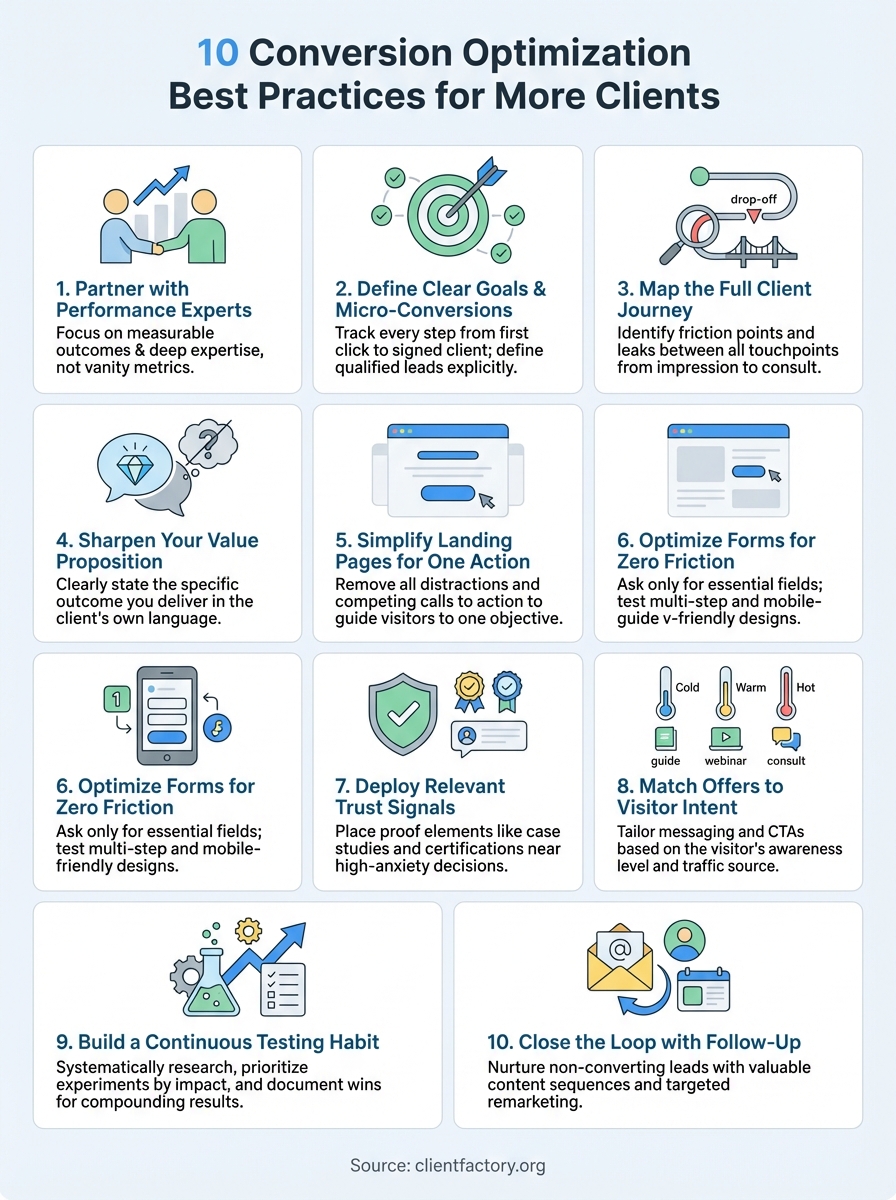
1. Work with a performance first conversion partner
Most conversion optimization best practices remain theoretical until someone with deep client acquisition experience puts them into action for your specific business. You can read guides and watch videos, but implementing tests, interpreting data, and building funnels that consistently convert requires specialized expertise most firms don’t have in-house. The right partner brings years of trial and error across dozens of industries, so you skip the expensive mistakes and move straight to tactics proven to work for businesses like yours.
Why a strategic partner multiplies your results
A performance-first agency focuses on measurable outcomes rather than vanity metrics or busy work. They track qualified leads, consultation bookings, and signed clients instead of impressions or clicks. This approach keeps every optimization effort tied to revenue impact, which means you invest in changes that actually grow your firm. When your partner stakes their reputation on results, you get strategies built for conversion, not just traffic.

How Client Factory approaches client acquisition
Client Factory uses AI-powered analytics and data-driven testing to identify exactly where your funnel leaks prospects. The team builds tailored client acquisition systems for service businesses and law firms, focusing on qualified lead generation and optimized conversion paths. You get U.S.-based strategists with over 30 years of combined experience who treat your growth as their primary goal.
What to prepare before engaging an agency
Gather your current conversion data and lead quality information before your first conversation. Document what you’ve already tried, what worked, and what failed. Clarify your budget, timeline, and definition of a qualified client so your partner can design realistic strategies from day one.
2. Get clear on your primary conversions and micro goals
You can’t optimize what you haven’t defined. Most firms track website visits and contact form submissions, but those metrics tell you nothing about conversion quality or funnel performance. You need specific definitions for both your primary conversion goal (a signed client) and every micro conversion that leads someone closer to hiring you. Clear goals let you identify which pages, campaigns, and messages actually move prospects forward versus those that just generate activity without results.
Define what a qualified lead means for your firm
A qualified lead isn’t just anyone who fills out a form. You need explicit criteria that separate serious prospects from tire kickers, competitors, and people who can’t afford your services. Write down the characteristics that define your ideal client: industry, company size, budget range, decision authority, and timeline. Use these filters to score every lead so your team focuses energy on high probability conversions instead of chasing dead ends.
Map micro conversions along the path to a client
Trace every step between first website visit and signed agreement. Your prospects might click an ad, read a blog post, download a guide, watch a video, submit a form, book a call, attend a consultation, and receive a proposal before they convert. Each action represents a micro conversion worth tracking and optimizing. Identify which steps have the highest drop-off rates so you know where to apply conversion optimization best practices first.
The firms that convert best measure progress at every stage, not just at the finish line.
Set up tracking and analytics for each key action
Install event tracking for every micro conversion you identified. Use Google Analytics or your CRM to capture form submissions, video plays, downloads, button clicks, and page scrolls. Tag your paid traffic sources so you know which campaigns deliver qualified consultations versus cheap clicks that waste your budget.
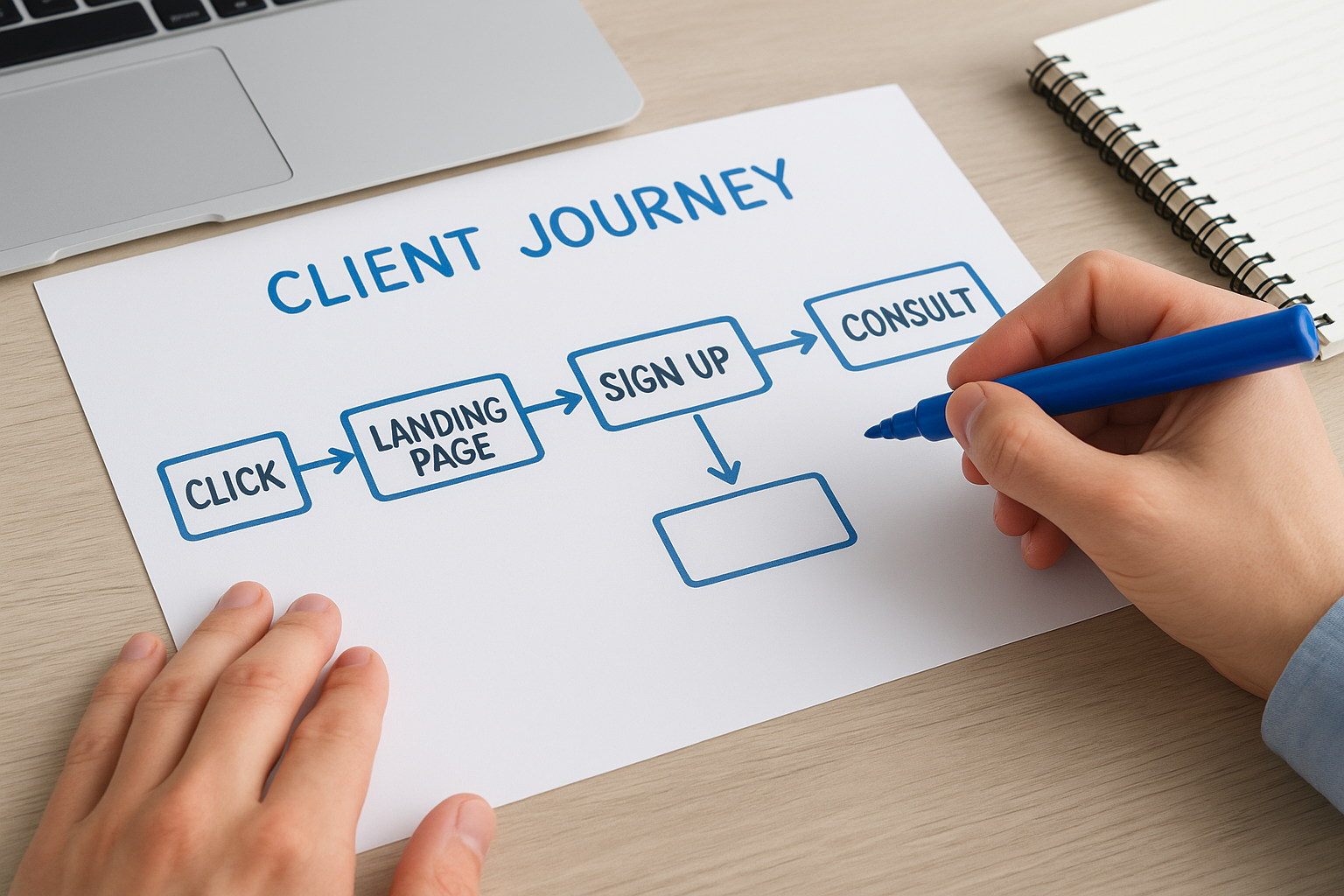
3. Map your client journey from click to signed client
Your prospects follow a specific path from their first click to the moment they sign your agreement. Most firms operate blind to this journey, which means they miss obvious opportunities to remove friction points and guide more people to conversion. When you document every stage of your client acquisition process, you gain a clear view of where prospects drop off and which touchpoints need immediate optimization. This visibility transforms conversion optimization best practices from generic advice into targeted improvements that fix your actual bottlenecks.
Capture every step from first impression to consult
Start by recording the complete sequence of interactions your typical client experiences. They might see a Google ad, land on a service page, read testimonials, check your about page, download a resource, receive three email follow-ups, and finally book a consultation. Document every channel, page, email, and touchpoint in chronological order. Assign conversion percentages to each transition so you know exactly how many people move from one stage to the next.
Spot friction points and leaks in your funnel
Review your documented journey and identify stages with the highest drop-off rates. A 60% exit rate after your pricing page signals a problem worth investigating immediately. Look for patterns: do mobile users abandon faster, do certain traffic sources perform worse, or does one specific form field kill conversions? The data reveals where your biggest opportunities live, which tells you where to apply your optimization efforts first.
The biggest conversion gains come from fixing your worst leaks, not polishing your best pages.
Align pages and messages to each journey stage
Match your content and calls to action to where prospects sit in their decision process. Early-stage visitors need educational content and low-commitment offers like guides or webinars. Late-stage prospects want case studies, guarantees, and direct booking options. Review each page in your journey and ask whether the message and offer fit the prospect’s mindset at that exact moment.
4. Tighten your value proposition and core message
Generic promises kill conversions faster than any technical issue on your site. When visitors land on your page and read vague statements like “we provide excellent service” or “trusted partner for your success,” they bounce because you haven’t given them a compelling reason to stay. Your value proposition must communicate exactly who you serve and what specific outcome they get when they work with you. This clarity separates firms that convert from those that get ignored, especially when prospects compare multiple options in seconds.
Clarify who you help and what outcome you deliver
Strip away every word that doesn’t directly address your ideal client’s situation and the transformation you deliver. Instead of “we help businesses grow,” write “we help mid-sized law firms book 15+ qualified consultations monthly without wasting budget on unqualified clicks.” The specificity signals expertise and helps the right prospects self-identify immediately. Review your homepage, landing pages, and ad copy to eliminate ambiguous language that tries to appeal to everyone but convinces no one.
Use client language pulled from real conversations
Your prospects don’t describe their problems using industry jargon or corporate buzzwords. They use plain language pulled from real frustrations they express during sales calls and consultations. Listen to recorded calls, read intake forms, and review email exchanges to capture the exact phrases clients use when explaining what prompted them to search for help. When your copy mirrors their internal dialogue word for word, they feel understood instantly.
The best value propositions sound like your prospects wrote them, not your marketing team.
Test headlines and offers against different segments
Different visitor segments respond to different messages based on their awareness level and specific pain points. Run split tests comparing outcome-focused headlines against process-focused ones, or test problem-aware messaging against solution-aware positioning. Track which variations drive more consultation bookings from your highest-value segments, then apply those winning messages across your conversion optimization best practices implementation.
5. Simplify your landing pages around one action
Landing pages built with multiple goals confuse visitors and destroy conversion rates. When you present three different calls to action, five navigation links, and four sidebar offers, your prospects freeze instead of taking the one action you actually want them to complete. Every additional element competes for attention and gives visitors another reason to click away without converting. The most effective landing pages eliminate every distraction and guide visitors toward a single clear objective, whether that’s booking a consultation, downloading a resource, or requesting a proposal.
Remove distractions and competing calls to action
Strip your landing page down to only elements that support your primary conversion goal. Remove top navigation menus, footer links to other services, social media icons, and sidebar widgets that pull attention away from your main call to action. Keep your logo clickable to your homepage for branding purposes, but eliminate every other exit route. When your conversion optimization best practices include ruthless simplification, your visitors focus their decision energy on the one choice that matters.

Structure pages for clarity, scannability, and flow
Organize your content using clear visual hierarchy that guides eyes down the page toward conversion. Use descriptive subheadings every 150-200 words so scanners grasp your key points instantly. Break long paragraphs into shorter blocks, add bullet points for feature lists, and include white space that prevents overwhelm. Your prospects should understand your offer and feel compelled to act within 30 seconds of landing on your page.
Pages designed for scanners convert better than walls of text, even when the content is identical.
Optimize above the fold content for first impressions
Your headline, supporting subheadline, and primary call to action button must all appear above the fold on desktop and mobile devices. Visitors decide whether to stay or bounce within 3-5 seconds, so your most persuasive elements need immediate visibility without any scrolling required. Test different headline formulas, hero images, and button placements to maximize conversions from visitors who never scroll past your opening screen.
6. Optimize forms and booking for zero friction
Forms represent your biggest conversion bottleneck. Every additional field you ask prospects to complete increases the cognitive load and abandonment risk by 5-10%. When visitors reach your contact form or booking page, they’ve already decided you might solve their problem. Your form either confirms that decision by making conversion easy, or it creates doubt by demanding too much information too soon. The conversion optimization best practices that matter most happen at this critical moment when prospects transform into qualified leads.
Ask only for fields you truly need
Remove every form field that doesn’t serve an immediate business purpose. You don’t need job titles, company names, or street addresses to book a consultation call. Stick to name, email, phone number, and one qualifying question about their specific need. Review your CRM data to identify which fields your sales team actually uses during initial outreach. Delete the rest. Each removed field increases your completion rate by an average of 10-15%.
Experiment with multi step and conversational forms
Break long forms into 2-3 sequential steps that reveal one question at a time. This approach reduces visual overwhelm and creates psychological momentum as prospects complete each micro-step. Test conversational formats that ask questions in natural language with button selections instead of open text fields. Multi-step forms typically convert 20-30% better than single-page versions for complex service businesses.
Forms that feel like conversations convert better than forms that feel like interrogations.
Prioritize mobile speed and ease of use
Over 60% of your form traffic comes from mobile devices, yet most forms frustrate thumb-based navigation. Use large touch-friendly buttons, enable autofill functionality, and trigger appropriate mobile keyboards for each field type. Test your booking process on actual phones to identify tiny tap targets and input fields that require zooming.
7. Use trust signals to reduce risk and objections
Prospects hesitate to convert because they don’t know whether they can trust you with their business and their sensitive information. Every unfamiliar website triggers skepticism, especially for service businesses and law firms where clients share confidential details and make significant financial commitments. Trust signals act as conversion accelerators by reducing perceived risk at the exact moment prospects consider taking action. When you strategically position the right proof elements, you remove the objections that prevent qualified visitors from becoming clients.
Choose proof elements that matter to your buyers
Not all trust signals carry equal weight with your specific audience. Law firm clients respond strongly to bar associations, case results, and peer review ratings like Martindale-Hubbell or Super Lawyers. Service businesses benefit from industry certifications, client logos from recognizable brands, and detailed case studies with measurable outcomes. Skip generic trust badges that mean nothing to your prospects and focus on credentials your target clients actually verify before hiring someone. Review which trust elements your competitors display, then identify gaps where you can demonstrate superior credibility.
The trust signals that convert best prove you’ve already solved problems identical to your prospect’s situation.
Place trust signals near high friction decisions
Position your strongest proof elements adjacent to conversion points where prospects experience the most doubt. Add client testimonials directly above your contact form, display security badges next to payment fields, and showcase relevant certifications on your booking page. These conversion optimization best practices work because they address objections at the precise moment prospects need reassurance to move forward.
Make compliance and privacy easy to understand
Explain your data handling practices and privacy commitments in plain language that takes 10 seconds to read. Link to your full privacy policy but summarize the key protections directly on your forms and booking pages. When prospects understand how you safeguard their information, they feel safer sharing details required to qualify them properly.
8. Match offers and calls to action to intent
Visitors at different stages of awareness require completely different conversion approaches. Someone who just discovered they have a problem needs educational content and low-commitment offers like guides or webinars. A prospect actively comparing your firm against two competitors wants case studies, pricing transparency, and direct booking options. When you present the wrong call to action to the wrong audience, you either ask for too much too soon or waste hot prospects with weak offers. Smart conversion optimization best practices adapt your messaging and offers to match exactly where each visitor sits in their decision journey.
Tailor offers to cold, warm, and hot traffic
Cold traffic from awareness-stage campaigns converts best when you offer free resources that solve immediate problems without requiring commitment. These prospects need proof you understand their situation before they’ll consider hiring you. Warm traffic from retargeting campaigns or email clicks responds to webinars, calculators, and assessments that demonstrate your specific approach. Hot traffic searching for solution-specific terms or visiting your pricing page wants consultation bookings and proposal requests. Segment your traffic sources and serve offers that match each temperature level.
Adjust calls to action by channel and campaign
Your primary call to action should change based on where traffic originates. Paid search visitors responding to problem-focused ads need “Schedule Your Free Consultation” buttons prominently displayed. Social media audiences from educational content campaigns convert better with “Download the Complete Guide” offers. Email subscribers who’ve engaged with multiple messages deserve direct calendar links that skip unnecessary qualification steps.
Calls to action that match traffic intent convert 2-3x better than generic “Contact Us” buttons.
Personalize experiences with simple rules and AI
Use basic conditional logic to show different offers based on visitor behavior, traffic source, or previous interactions. Display “Welcome Back” messages with fast-track booking options for return visitors. Implement AI-powered recommendations that suggest relevant case studies or resources based on which pages prospects viewed during their session.
9. Build a continuous testing and experimentation habit
Random changes and gut feelings waste your conversion optimization budget. You need a systematic approach that turns testing into a repeatable process rather than occasional experiments you run when inspiration strikes. The firms that consistently improve conversion rates treat testing as a permanent discipline, not a project with a start and end date. When you build this habit into your weekly operations, you compound small wins into significant revenue increases over months and years.
Start with research before you design tests
Successful tests begin with qualitative research that identifies real problems worth solving. Review session recordings to watch where visitors hesitate or abandon your funnel. Read chat transcripts and sales call notes to capture the specific objections prospects voice before they decide against hiring you. Run quick surveys asking non-converters what stopped them from booking a consultation. This research reveals which conversion optimization best practices will actually move your numbers instead of wasting time on changes that address imaginary problems.
Prioritize experiments by impact and effort
Not every test deserves equal attention. Score each potential experiment using a simple impact versus effort matrix that helps you focus on high-value changes you can implement quickly. Tests affecting high-traffic pages with poor conversion rates deserve priority over optimizing pages few people visit. Headline changes and form simplification deliver faster results than complete page redesigns.
Tests that take two hours to build and affect 1,000 weekly visitors beat month-long projects targeting 50 visitors.
Read test results the right way and document wins
Stop tests only after reaching statistical significance at your predetermined confidence level, typically 95% for major conversion actions. Track secondary metrics beyond your primary goal to catch unintended consequences like increased form submissions but decreased consultation show rates. Document every test outcome in a shared repository with screenshots, results, and insights that inform future experiments.
10. Close the loop with follow up and remarketing
Most conversion optimization best practices focus on first-time visitors, but your biggest revenue opportunity lives in the qualified prospects who engaged with your content but didn’t convert immediately. These leads already demonstrated interest, which means they’re significantly more likely to hire you than cold traffic. When you implement strategic follow-up sequences and remarketing campaigns, you capture conversions that would otherwise disappear forever. Your systematic approach to staying connected transforms one-time browsers into clients who convert weeks or months after their initial visit.
Nurture leads who are not ready to hire yet
Build automated email sequences that deliver valuable content over 30-90 days without aggressive sales pitches. Send case studies, industry insights, and practical guides that reinforce your expertise while keeping your firm top of mind. Segment your sequences based on which pages prospects visited or which resources they downloaded so your messages address their specific interests. Track email engagement to identify when lukewarm leads heat up and deserve direct outreach from your team.
Prospects who receive educational follow-up convert at 3-5x higher rates than those who only see your site once.
Align sales follow up scripts with your messaging
Your sales team’s phone scripts and email templates must mirror the language, promises, and positioning prospects saw in your marketing. When your follow-up messages contradict the tone or offers from your landing pages, you create confusion that kills trust. Review actual conversations to ensure your team emphasizes the same outcomes and addresses the same objections your conversion-focused content covered.
Use remarketing ads to stay visible and trusted
Launch remarketing campaigns targeting visitors who reached high-intent pages like pricing, services, or your booking form without converting. Show ads featuring client testimonials, case results, and specific outcomes relevant to the pages they viewed. Adjust your remarketing message frequency to stay visible without annoying prospects who need time to make hiring decisions.
Final thoughts
These conversion optimization best practices work only when you implement them consistently and measure results at every stage. Reading guides doesn’t improve your conversion rates. Taking action does. Start with the tactics that address your biggest funnel leaks, then build a testing habit that compounds improvements over time. Your prospects need clear messages, frictionless experiences, and compelling reasons to choose your firm over competitors who ignore these fundamentals.
Most firms struggle because they lack the specialized expertise required to execute these strategies effectively. You can spend months learning through expensive trial and error, or you can partner with a team that’s already mastered client acquisition for businesses like yours. Client Factory builds AI-powered conversion systems that turn your traffic into qualified consultations and signed clients. Book a free funnel audit today to discover exactly where your conversion opportunities hide.