

Most visitors leave your website without converting. That’s not a failure, it’s an opportunity. Retargeting lets you bring those visitors back when they’re ready to act, and choosing the best retargeting platforms can mean the difference between wasted ad spend and a predictable client acquisition system.
At Client Factory, we’ve managed paid advertising campaigns across dozens of platforms for service businesses and law firms. We’ve seen firsthand which retargeting tools deliver real ROI and which ones drain budgets with little to show for it. The right platform depends on your audience, your channels, and how sophisticated your funnel needs to be to convert clicks into clients.
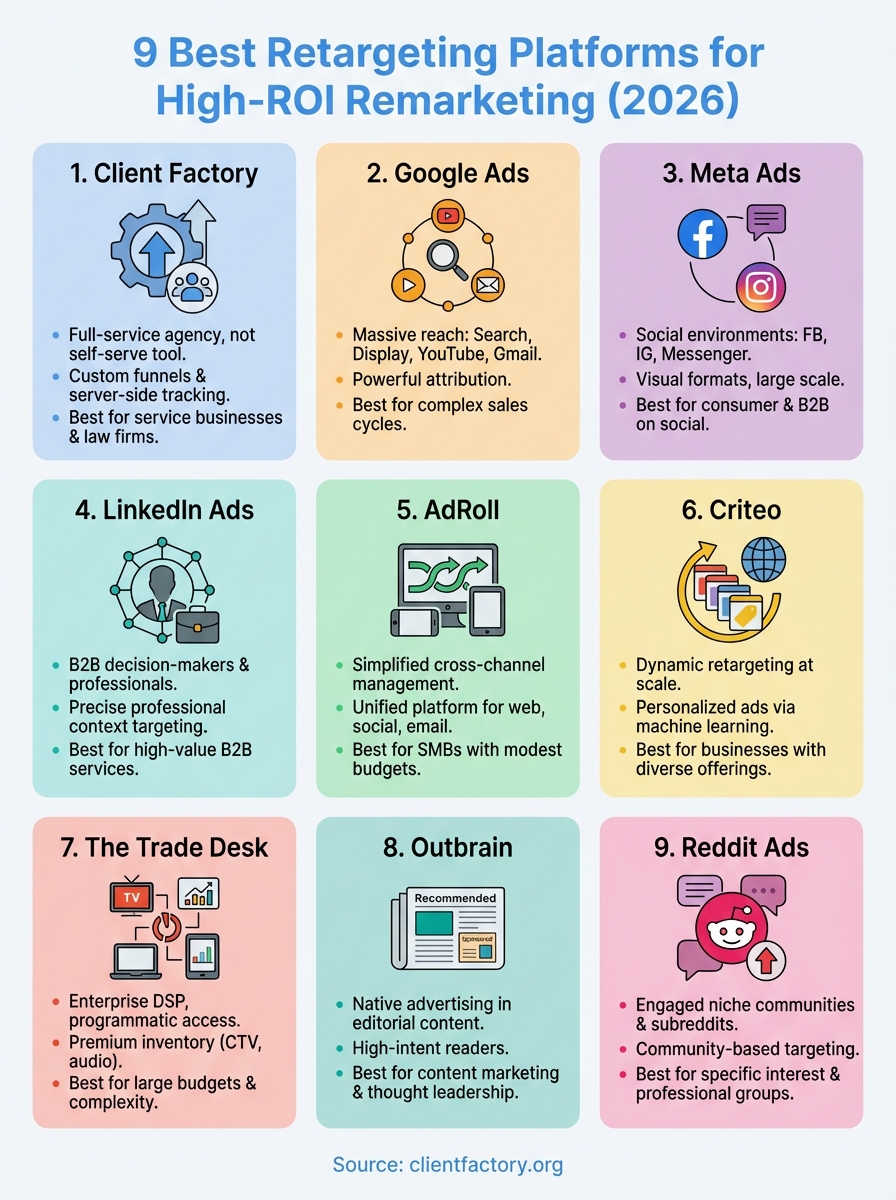
This guide breaks down nine retargeting platforms worth your attention in 2026. We’ll cover features, pricing, strengths, and limitations so you can make an informed decision without sifting through vendor marketing fluff. Whether you’re running Google Ads, Facebook campaigns, or multi-channel strategies, you’ll find options here that fit your goals and budget.
1. Client Factory
Client Factory stands out among the best retargeting platforms because it’s built specifically for service businesses and law firms that need more than just ad placements. Instead of handing you software and leaving you to figure it out, you get a full-service team that designs, manages, and optimizes your retargeting campaigns across every channel that matters.
What it is and where it runs retargeting
Client Factory operates as a digital marketing agency with a focus on client acquisition funnels powered by retargeting. Your campaigns run across Google Ads, Facebook, Instagram, YouTube, and display networks, with the agency managing platform selection based on where your audience actually converts. This isn’t a self-serve tool; it’s a done-for-you service that includes strategy, creative, and ongoing optimization tailored to your business goals.
Retargeting options and funnel strategy
You get customized retargeting funnels designed around your specific audience segments, not generic templates. The agency builds multi-touch sequences that move prospects from awareness to conversion using different ad formats and messaging at each stage. This includes dynamic remarketing for service pages, video retargeting on YouTube, and sequential messaging across platforms to reinforce your value proposition without overwhelming your audience.

“The right retargeting funnel doesn’t chase every visitor; it nurtures the ones most likely to convert based on their behavior and intent.”
Tracking, measurement, and attribution approach
Client Factory implements server-side tracking and conversion APIs to capture data that browser-based pixels miss, especially important as third-party cookies phase out. You get access to dashboards that track leads, appointments, and closed clients back to specific campaigns and audience segments. Attribution modeling helps you understand which touchpoints drive conversions, not just which ads get the last click.
Pricing and what affects total cost
Pricing follows a retainer model that includes strategy, management, creative development, and reporting. Your total cost depends on ad spend, funnel complexity, and the number of platforms you need to reach your audience. Most service businesses should expect a monthly investment starting around $3,000 to $5,000 for management, plus your actual ad budget.
Pros, limits, and best-fit businesses
The biggest advantage is having experienced strategists manage your campaigns instead of learning platforms yourself. You also get AI-powered optimization and data-driven creative testing without hiring an in-house team. Limitations include higher upfront costs compared to self-serve tools and less direct control over daily campaign adjustments. This platform works best for service businesses and law firms generating high lifetime customer value where professional management pays for itself through better conversion rates.
2. Google Ads
Google Ads remains one of the best retargeting platforms because of its reach across search, display, YouTube, and Gmail. You’re not limited to chasing visitors across random websites; you can intercept them when they’re actively searching for solutions or consuming content related to your service.
What it is and where it runs retargeting
Google Ads puts your retargeting campaigns in front of visitors across the Google Display Network (over 2 million websites), YouTube, Google Search, Shopping, and Gmail. You can show display banners, video ads, responsive search ads, and dynamic product ads depending on where your audience spends time. The platform leverages Google’s vast user data and browsing behavior signals to place your ads where they’re most likely to convert.
Retargeting options and audience building
You build audiences based on website visitors, YouTube engagement, customer lists, and app activity. Google lets you create custom segments based on specific pages visited, time on site, or actions taken before leaving. You can layer demographics, interests, and in-market signals to refine who sees your ads. Dynamic remarketing automatically shows personalized ads featuring the exact services or pages visitors viewed on your site.
Tracking, measurement, and attribution setup
Conversion tracking requires installing the Google tag on your website and defining conversion actions like form submissions, calls, or purchases. Attribution reports show which touchpoints contributed to conversions across the entire customer journey, not just the last click. Enhanced conversions and offline conversion imports help you connect ad interactions to real business outcomes like signed contracts or booked appointments.
“Google’s attribution models reveal which retargeting touchpoints actually move prospects closer to conversion, not just which ads they clicked last.”
Pricing model and budget realities
Google Ads uses auction-based pricing with CPC (cost per click) or CPM (cost per thousand impressions) depending on your campaign type. Retargeting typically costs $0.50 to $2.00 per click on the Display Network and more on Search. You set daily budgets and bid caps, but competitive industries push costs higher. Plan to spend at least $1,000 to $2,000 monthly to gather enough data for optimization.
Pros, limits, and best-fit businesses
The platform’s strength lies in its massive reach and sophisticated targeting options combined with powerful attribution and measurement tools. Limitations include a steep learning curve for beginners and rising costs in competitive markets. Google Ads works best for businesses with complex sales cycles that need multiple touchpoints across search and display to close deals.
3. Meta Ads
Meta Ads delivers retargeting across Facebook, Instagram, Messenger, and the Meta Audience Network, making it one of the best retargeting platforms for reaching audiences in social environments where they’re already engaged. You’re not interrupting search intent; you’re appearing in feeds where people scroll, watch, and interact with content naturally.
What it is and where it runs retargeting
Meta’s platform places your retargeting ads across Facebook news feeds, Instagram stories, Reels, Messenger conversations, and thousands of third-party apps connected to the Audience Network. You can deploy image ads, video ads, carousel formats, and collection ads depending on your creative strategy. The platform uses behavioral data from billions of users to optimize delivery and timing.
Retargeting options and audience building
You create Custom Audiences based on website visitors, engagement with your content, customer lists, or app activity. Lookalike Audiences let you expand reach to users who share characteristics with your best converters. Meta’s pixel tracks visitor behavior to build segments based on pages viewed, time spent, and actions taken before leaving your site.
Tracking, measurement, and attribution setup
The Meta Pixel or Conversions API tracks user actions and feeds data back into the platform for optimization. Conversion tracking requires defining events like leads, purchases, or form completions on your website. Attribution windows show which ad interactions drove results, though iOS privacy changes have limited tracking accuracy.
“Meta’s pixel combined with Conversions API captures more conversion data than pixel-only tracking, especially after iOS privacy updates.”
Pricing model and budget realities
Meta uses auction-based pricing with costs per click, impression, or action depending on your objective. Retargeting typically costs $0.50 to $3.00 per click based on industry competitiveness. You control daily or lifetime budgets, but expect to invest $1,500 to $3,000 monthly for meaningful audience reach and testing.
Pros, limits, and best-fit businesses
Strengths include massive audience scale, visual ad formats, and detailed demographic targeting. Limitations center on tracking restrictions from iOS updates and declining organic reach forcing higher ad spend. This platform works best for businesses targeting consumer audiences or B2B decision-makers who use social platforms during their research process.
4. LinkedIn Ads
LinkedIn Ads ranks among the best retargeting platforms for B2B service businesses because it reaches decision-makers and professionals in the context where they’re researching vendors, consuming industry content, and building business relationships. You’re not competing with personal photos and viral videos; you’re showing up where professionals go to solve business problems.
What it is and where it runs retargeting
LinkedIn places your retargeting ads across news feeds, LinkedIn Messaging, and the LinkedIn Audience Network, which extends to premium business sites beyond the platform itself. You can deploy single image ads, video ads, carousel formats, conversation ads, and dynamic ads tailored to professional audiences. The platform uses job titles, company data, and professional interests to optimize delivery.
Retargeting options and audience building
You build retargeting audiences using website visitors tracked through the Insight Tag, video viewers, lead form opens, or contact lists uploaded directly. Matched Audiences let you layer job function, seniority, company size, and industry to refine who sees your ads. Account-based targeting enables you to retarget specific companies or decision-makers at organizations that visited your site.
Tracking, measurement, and attribution setup
The LinkedIn Insight Tag tracks conversions on your website and feeds data back for campaign optimization. You define conversion events like form submissions, downloads, or consultation requests and measure performance through LinkedIn’s Campaign Manager. Conversion tracking connects ad interactions to qualified leads entering your sales pipeline.
“LinkedIn’s professional targeting combined with website retargeting lets you chase the exact decision-makers who already showed interest in your services.”
Pricing model and budget realities
LinkedIn uses auction-based pricing with costs typically ranging from $5 to $15 per click, making it the most expensive platform on this list. You can bid on CPM, CPC, or cost per send for message ads. Expect to budget $3,000 to $5,000 monthly minimum to generate enough volume for meaningful results.
Pros, limits, and best-fit businesses
Strengths include unmatched B2B targeting precision and access to high-value decision-makers in professional contexts. Limitations center on high costs per click and smaller audience scale compared to Google or Meta. This platform works best for B2B service businesses and law firms selling to other businesses where client lifetime value justifies premium acquisition costs.
5. AdRoll
AdRoll positions itself among the best retargeting platforms for small to mid-sized businesses that need cross-channel campaigns without the complexity of enterprise-level tools. The platform combines display advertising, social retargeting, and email marketing into a single interface, letting you manage campaigns across multiple networks without juggling separate accounts.
What it is and where it runs retargeting
AdRoll delivers your retargeting ads across Google Display Network, Facebook, Instagram, TikTok, and native ad exchanges through a unified platform. You manage everything from one dashboard instead of logging into multiple ad accounts. The platform connects to over 500 ad exchanges and publisher networks, giving you broad reach without negotiating individual placements.
Retargeting options and audience building
You create audiences based on website behavior, email engagement, and cross-device activity tracked through AdRoll’s pixel. Segmentation options include pages visited, products viewed, cart abandonment, and visit frequency. Dynamic retargeting automatically generates ads featuring specific services or pages visitors viewed on your site, personalizing the experience without manual creative work.
Tracking, measurement, and attribution setup
The AdRoll pixel tracks conversions and feeds data into cross-device attribution reports that show how desktop and mobile interactions contribute to conversions. You define conversion events like form submissions or phone calls and monitor performance through unified dashboards. Attribution modeling reveals which channels and touchpoints drive results across your retargeting mix.
“AdRoll’s cross-device tracking connects visitor behavior across smartphones, tablets, and desktops to show the complete path to conversion.”
Pricing model and budget realities
AdRoll charges a monthly platform fee starting around $30 to $100 plus your ad spend. You set budgets and bids across networks, with typical costs ranging $1 to $4 per click depending on competition. Minimum ad spend requirements start at $1,000 monthly to access most features.
Pros, limits, and best-fit businesses
Strengths include simplified cross-channel management and built-in dynamic creative that reduces production time. Limitations involve less granular control than native platforms and sometimes higher costs due to platform fees. This works best for businesses running modest budgets across multiple channels who prefer unified reporting over managing separate accounts.
6. Criteo
Criteo specializes in dynamic retargeting at scale, making it one of the best retargeting platforms for businesses with diverse service offerings or product catalogs that need personalized ad experiences. The platform uses machine learning to predict which services or content each visitor is most likely to convert on, then automatically generates ads tailored to those predictions across thousands of publisher sites.
What it is and where it runs retargeting
Criteo operates as a standalone retargeting platform with access to over 20,000 publisher websites and apps globally. Your ads appear across premium content sites, news platforms, and mobile apps through Criteo’s direct relationships with publishers. The platform focuses on display advertising with dynamic creative rather than social or search placements.
Retargeting options and dynamic personalization
The platform builds audiences based on website behavior, browsing patterns, and engagement signals captured through its tracking tag. Dynamic personalization automatically generates ad variations showing specific services, pages, or content each visitor viewed on your site. Machine learning algorithms optimize which creative elements and messaging perform best for different audience segments.
“Criteo’s dynamic engine tests hundreds of creative combinations per visitor to show the exact offer most likely to drive conversion.”
Tracking, measurement, and attribution setup
You install Criteo’s JavaScript tag on your website to track visitor behavior and conversion events. The platform measures view-through conversions, click-through conversions, and incremental lift compared to non-retargeted audiences. Reporting dashboards connect ad spend to conversions and revenue attribution.
Pricing model and budget realities
Criteo uses cost-per-click or cost-per-acquisition bidding depending on your campaign goals. Typical costs range $1 to $5 per click based on industry and competition. Minimum monthly spend requirements usually start around $2,000 to $3,000 to access the full platform.
Pros, limits, and best-fit businesses
Strengths include powerful dynamic personalization and extensive publisher reach without managing multiple ad networks. Limitations involve less control over specific placements and reliance on Criteo’s algorithm for optimization. This platform works best for businesses with multiple service lines or offerings where personalized messaging significantly impacts conversion rates.
7. The Trade Desk
The Trade Desk operates as an enterprise-grade demand-side platform (DSP) that gives you access to programmatic advertising inventory across the open internet. Unlike the previous platforms on this list of best retargeting platforms, you’re buying ad placements through real-time bidding across thousands of websites, apps, streaming services, and connected TV platforms rather than running campaigns through a single network’s interface.
What it is and where it runs retargeting
The platform connects you to premium inventory across display, video, audio, native, and connected TV through partnerships with major ad exchanges and supply-side platforms. Your retargeting campaigns appear on news sites, content platforms, streaming services like Hulu and Roku, and mobile apps based on where your audience consumes media. You’re not limited to Google’s or Meta’s networks; you access inventory they don’t control.
Retargeting options across programmatic inventory
You build audiences using first-party website data, CRM lists, and behavioral signals collected through The Trade Desk’s pixel. Retargeting options include site visitors, video viewers, and cross-device matching that follows users across smartphones, tablets, desktops, and smart TVs. The platform layers third-party data segments for additional refinement based on demographics, interests, and purchase intent.

Tracking, measurement, and attribution setup
The Trade Desk uses its Unified ID 2.0 tracking solution to measure conversions across devices and browsers without relying on third-party cookies. You define conversion events and track performance through custom dashboards that show cost per acquisition, return on ad spend, and attribution across touchpoints. Cross-device reporting connects impressions on one device to conversions on another.
“The Trade Desk’s programmatic access lets you retarget visitors across premium inventory that major platforms can’t reach through their own networks.”
Pricing model and budget realities
Pricing follows a percentage-of-spend model where you pay The Trade Desk a platform fee (typically 15-20%) on top of your media costs. Media costs vary based on inventory quality and competition, with typical CPMs ranging $2 to $10. You need substantial budgets to justify the complexity; expect $10,000 monthly minimum spend to make this worthwhile.
Pros, limits, and best-fit businesses
Strengths include access to premium inventory beyond walled gardens and sophisticated cross-device tracking. Limitations involve steep learning curves, high minimum budgets, and often requiring agency partners to manage effectively. This platform works best for larger service businesses and established law firms with marketing budgets exceeding $100,000 annually who need enterprise-level programmatic capabilities.
8. Outbrain
Outbrain operates as a native advertising platform that places your retargeting ads within editorial content recommendations on major news sites, magazines, and publisher platforms. Instead of banner ads that scream “advertisement,” your retargeting appears as recommended content alongside articles readers are already consuming, making it one of the best retargeting platforms for businesses that rely on content marketing and thought leadership to build trust before conversion.
What it is and where it runs retargeting
The platform delivers ads across premium publisher sites like CNN, The Guardian, MSN, and thousands of content-focused websites where readers engage with articles and editorial content. Your retargeting campaigns appear in content recommendation widgets labeled as sponsored content at the bottom of articles or embedded within editorial feeds. Outbrain connects you to high-intent readers who are actively consuming information related to your industry.
Retargeting options with native and content-led ads
You build audiences based on website visitors, content engagement, and behavioral signals tracked through Outbrain’s pixel. Retargeting options include visitors to specific service pages, blog readers, and video viewers who didn’t convert on their first visit. Your ads appear as native content recommendations that match the editorial style of each publisher, increasing click-through rates compared to traditional display formats.
Tracking, measurement, and attribution setup
Outbrain’s conversion tracking pixel measures actions like form submissions, downloads, and consultation requests after users click your retargeting ads. You define conversion events and monitor performance through dashboards that show cost per conversion and engagement metrics specific to content-style advertising. Attribution reports connect content interactions to downstream conversions.
“Outbrain’s native format blends retargeting into editorial content streams where readers are most engaged and least resistant to advertising.”
Pricing model and budget realities
The platform uses cost-per-click bidding with typical costs ranging $0.30 to $1.50 per click depending on publisher quality and competition. You set daily budgets and maximum bids, with minimum monthly spend usually starting around $1,000 to $2,000 for meaningful reach.
Pros, limits, and best-fit businesses
Strengths include premium publisher placements and native ad formats that drive higher engagement than banner ads. Limitations involve less precise targeting than social platforms and reliance on content-style creative. This platform works best for service businesses and law firms using educational content and thought leadership to build credibility before asking for conversions.
9. Reddit Ads
Reddit Ads reaches highly engaged community members who participate in niche discussions related to your services, making it one of the best retargeting platforms for businesses targeting audiences based on specific interests or professional communities. You’re not interrupting passive scrolling; you’re appearing in front of users who actively seek out and contribute to conversations about topics relevant to what you offer.
What it is and where it runs retargeting
The platform places your retargeting ads across Reddit feeds, comment threads, and subreddit pages where users engage with community content. Your ads appear as promoted posts that blend into organic content or as display units in sidebars and feeds. Reddit’s unique structure lets you retarget visitors while they participate in communities directly related to your industry or service category.
Retargeting options and community-based targeting
You build audiences using website visitors tracked through Reddit’s pixel and layer them with subreddit interests, community participation, and behavioral signals. Retargeting options include visitors to specific landing pages combined with users active in relevant subreddits, creating hyper-focused audience segments that traditional platforms can’t match.
Tracking, measurement, and attribution setup
The Reddit Pixel tracks conversions like form submissions or consultation requests on your site. You define conversion events and monitor performance through Reddit’s dashboard, measuring cost per conversion and engagement metrics specific to community-based advertising.
“Reddit’s community-based retargeting combines website behavior with active participation in niche discussions for precise audience targeting.”
Pricing model and budget realities
Reddit uses auction-based CPC or CPM bidding with typical costs ranging $0.50 to $3.00 per click depending on subreddit competitiveness. Minimum daily budgets start at $5, making it accessible for smaller tests before scaling.
Pros, limits, and best-fit businesses
Strengths include community-based targeting and authentic engagement from users who participate rather than passively scroll. Limitations involve smaller overall reach than major platforms and audiences that resist obvious advertising. This works best for businesses targeting specific professional communities or interest groups where Reddit discussions directly relate to your services.
Next steps
You’ve now seen nine of the best retargeting platforms available in 2026, each with distinct strengths depending on your audience, budget, and conversion goals. The right choice depends on where your prospects spend time and how sophisticated your funnel needs to be to turn visitors into clients.
Most businesses waste money chasing every visitor instead of building strategic retargeting sequences that nurture qualified prospects through multiple touchpoints. If you’re running retargeting campaigns that aren’t delivering ROI, the problem usually isn’t the platform, it’s the funnel strategy and targeting behind it.
Your next step isn’t picking a platform and hoping for results. Start by auditing your current conversion path to identify where visitors drop off and which audience segments show genuine purchase intent. Then match those insights to platforms that reach those specific segments most effectively.
Client Factory specializes in building data-driven retargeting funnels for service businesses and law firms that convert clicks into clients. Schedule a conversion audit to identify what’s broken in your current approach and get a roadmap to fix it.