


Your team spends hours each week on repetitive marketing tasks. Manually sending follow-up emails. Scoring leads one by one. Tracking campaign performance across multiple platforms. Meanwhile, qualified prospects slip through the cracks because you can’t respond fast enough. Marketing automation tools promise to solve these problems, but choosing the right one feels overwhelming when you’re staring at dozens of options with overlapping features and wildly different price tags.
This guide cuts through the noise. We’ve evaluated 13 marketing automation platforms based on their core capabilities, integration options, pricing structures, and real-world performance. You’ll find detailed breakdowns of each tool, including who they work best for and where they fall short. Whether you run a service business, law firm, or ecommerce store, you’ll discover which platforms align with your specific needs and budget. By the end, you’ll know exactly which tool deserves your investment.
1. Client Factory
Client Factory brings AI-powered client acquisition systems to service businesses and law firms. The platform combines data-driven automation with hands-on strategy, focusing specifically on converting paid traffic into qualified clients. You get tailored funnels built around your specific practice area or service offering, backed by over 30 years of combined marketing expertise. Unlike generic automation platforms, Client Factory designs each automation workflow to match your client acquisition process, from initial ad click through intake and consultation booking.
Core automation capabilities
The platform automates your entire client acquisition funnel. You can set up automated lead capture sequences that trigger when prospects engage with your ads on Facebook, YouTube, or Google. The system scores leads based on qualification criteria specific to your business, then routes high-value prospects through personalized nurture sequences. Conversion tracking connects directly to your ad accounts, letting you see which campaigns drive actual clients, not just clicks.
Ideal use cases and business size
Client Factory works best for service businesses and law firms generating between $500K and $5M annually. You’ll see the strongest results if you’re already running paid advertising but struggling with conversion rates or lead quality. The platform fits businesses ready to invest in sophisticated acquisition systems but lacking the in-house expertise to build them from scratch.
Integrations and ecosystem
The platform integrates with major advertising platforms including Google Ads, Facebook Ads, and YouTube. You also get connections to popular CRM systems and lead management tools used by service businesses. The AI assistant Susan provides immediate support for prospects visiting your site, capturing contact information before they leave.
Pricing overview
Client Factory operates on a custom pricing model based on your specific needs and business size. You’ll need to schedule a consultation to receive a detailed quote. The investment typically includes strategy development, funnel implementation, and ongoing optimization support.
Strengths and limitations
Performance-focused approach delivers measurable ROI tracking from ad spend to client acquisition. The U.S.-based team provides direct access to experienced strategists. However, the platform requires a meaningful marketing budget to justify the investment, making it less suitable for startups or businesses testing paid acquisition for the first time.
Client Factory stands out among the best marketing automation tools for businesses that need complete client acquisition systems, not just email sequences.
2. HubSpot Marketing Hub
HubSpot Marketing Hub delivers enterprise-grade automation wrapped in an interface that actually makes sense. The platform combines email marketing, social media management, landing pages, and CRM functionality into a single unified system. You get visual workflow builders, advanced segmentation, and detailed analytics without needing technical expertise. The tool scales from small businesses to large enterprises, offering free starter tools and premium features that grow with your needs.
Core automation capabilities
The platform lets you build complex automation workflows using a drag-and-drop visual editor. You can trigger sequences based on website behavior, email engagement, form submissions, or CRM data changes. Lead scoring adjusts automatically as prospects interact with your content, and the system routes qualified leads to sales teams at precisely the right moment. The workflows support branching logic, delays, and A/B testing across every touchpoint.
Ideal use cases and business size
HubSpot works for businesses of all sizes but shines brightest for growing companies with $1M to $50M in revenue. You’ll benefit most if you need a complete marketing stack rather than point solutions. The platform fits teams that value integrated reporting across marketing, sales, and service activities. Companies committed to inbound marketing strategies see the strongest returns.
Integrations and ecosystem
The system connects with over 1,000 third-party applications through native integrations and an open API. You get direct connections to major advertising platforms, webinar tools, social media networks, and business software. The App Marketplace provides pre-built integrations that install in minutes, eliminating custom development work.
Pricing overview
Free tools cover basic CRM and limited marketing features. Paid plans start at $890 monthly for Professional tier with full automation capabilities. Enterprise pricing begins at $3,600 monthly. All plans bill based on the number of marketing contacts in your database.
Strengths and limitations
Comprehensive feature set eliminates the need for multiple tools, and the integrated CRM provides complete customer visibility. However, the steep price jump from free to paid tiers creates sticker shock, and advanced features require Professional or Enterprise subscriptions.
HubSpot ranks among the best marketing automation tools for businesses prioritizing an all-in-one approach over specialized point solutions.
3. ActiveCampaign
ActiveCampaign combines email marketing, CRM, and sales automation into a platform that prioritizes customer experience over feature bloat. The system offers machine learning capabilities that predict customer behavior and optimize send times automatically. You get sophisticated automation builders with conditional logic, split testing, and goal tracking built into every workflow. The platform stands out for its balance between power and usability, making advanced automation accessible to teams without dedicated technical resources.

Core automation capabilities
The platform provides visual automation maps that let you design complex customer journeys across email, SMS, and site messaging. You can trigger workflows based on behavioral data, including page visits, purchase history, and engagement patterns. The system includes predictive sending that uses AI to determine optimal contact times for each subscriber. Attribution reporting connects automation sequences directly to revenue, showing which workflows drive actual sales.
Ideal use cases and business size
ActiveCampaign fits small to mid-sized businesses with sophisticated marketing needs but limited budgets. You’ll see the strongest results if you’re managing complex customer journeys that span multiple touchpoints. The platform works particularly well for B2B companies and ecommerce businesses that need both marketing automation and sales pipeline management.
Integrations and ecosystem
The system connects with over 870 applications through native integrations and Zapier. You get direct connections to major ecommerce platforms, payment processors, and webinar tools. Custom objects let you sync unique data structures from external systems directly into your automation workflows.
Pricing overview
Plans start at $15 monthly for the Starter tier with basic automation. Professional plans begin at $49 monthly and include predictive sending and split automation. Enterprise pricing requires custom quotes.
Strengths and limitations
Powerful automation at accessible price points makes this platform competitive for growing businesses. The machine learning features deliver real performance improvements. However, the interface can feel cluttered when managing dozens of automations, and advanced reporting requires higher-tier plans.
ActiveCampaign earns its spot among the best marketing automation tools by delivering enterprise features at small business prices.
4. Salesforce Account Engagement
Salesforce Account Engagement (formerly Pardot) powers B2B marketing automation for enterprise sales teams that need sophisticated lead management. The platform integrates directly into the Salesforce ecosystem, creating seamless handoffs between marketing and sales activities. You get advanced lead scoring models, multi-touch attribution reporting, and account-based marketing tools designed specifically for complex B2B sales cycles. The system excels at aligning marketing efforts with sales pipeline goals, making it the preferred choice for organizations already invested in Salesforce CRM.
Core automation capabilities
The platform delivers enterprise-grade automation workflows that support complex buyer journeys across multiple decision-makers. You can build dynamic lists that automatically segment prospects based on firmographic data, engagement history, and buying signals. Lead nurturing programs adjust content delivery based on prospect behavior and lifecycle stage. The system includes engagement scoring that combines explicit data (forms, downloads) with implicit signals (page views, email opens) to identify sales-ready opportunities.
Ideal use cases and business size
Salesforce Account Engagement serves mid-market to enterprise B2B companies with annual revenues exceeding $10M. You’ll benefit most if your sales cycle involves multiple stakeholders and requires detailed tracking of account-level engagement. The platform fits organizations with dedicated marketing operations teams capable of managing sophisticated automation logic and reporting structures.
Integrations and ecosystem
The system offers native Salesforce integration that syncs data in real-time between marketing automation and CRM. You get access to the Salesforce AppExchange with thousands of pre-built connectors for webinar platforms, event management tools, and business intelligence systems.
Pricing overview
Pricing starts at approximately $1,250 monthly for the Growth edition with core automation features. Advanced editions with AI capabilities and premium support begin around $4,000 monthly.
Strengths and limitations
Deep Salesforce integration creates unified visibility across marketing and sales. However, the high entry price and complex implementation process make this platform unsuitable for small businesses or teams new to marketing automation.
Salesforce Account Engagement ranks among the best marketing automation tools for enterprises requiring sophisticated B2B lead management and Salesforce alignment.
5. Zoho Marketing Automation
Zoho Marketing Automation brings multichannel marketing capabilities to businesses already using the Zoho ecosystem. The platform integrates seamlessly with Zoho CRM, Zoho Analytics, and other Zoho applications, creating a unified workspace for marketing teams. You get email campaigns, webinar management, social media scheduling, and lead scoring tools that share data across your entire business stack. The system focuses on providing comprehensive automation features at competitive price points, making it attractive for cost-conscious organizations that want to consolidate their tools.
Core automation capabilities
The platform offers journey builder workflows that automate lead nurturing across email, SMS, web push notifications, and social media. You can segment audiences dynamically based on engagement behavior, demographic data, and lifecycle stage. Lead scoring automatically adjusts as prospects interact with your content, and the system assigns qualified leads to sales reps based on predefined rules. RCS messaging support adds rich media capabilities to your mobile campaigns.
Ideal use cases and business size
Zoho Marketing Automation fits small to mid-sized businesses seeking an affordable alternative to premium platforms. You’ll benefit most if you already use Zoho CRM or other Zoho products, as the native integrations eliminate data silos. The platform works well for businesses with straightforward automation needs that don’t require the advanced features found in enterprise tools.
Integrations and ecosystem
The system connects natively with all Zoho business applications, including CRM, Analytics, SalesIQ, and Desk. You also get integrations with third-party tools through Zapier and native connectors for platforms like Shopify, WordPress, and Facebook Lead Ads.
Pricing overview
Plans start at $24 monthly per user for basic automation. The Standard plan at $39 per user monthly adds advanced segmentation and A/B testing. Professional tier begins at $59 per user monthly.
Strengths and limitations
Competitive pricing and Zoho ecosystem integration create value for existing Zoho customers. However, the platform lacks some advanced features found in dedicated marketing automation tools, and the interface feels less polished than competitors.
Zoho Marketing Automation deserves consideration among the best marketing automation tools for businesses prioritizing cost efficiency and Zoho ecosystem compatibility.
6. Zapier
Zapier connects your marketing tools together without requiring code or technical expertise. The platform acts as a workflow automation hub that moves data between applications automatically, letting you build sophisticated automation sequences across your entire marketing stack. You create “Zaps” that trigger actions in one app based on events in another, eliminating manual data entry and repetitive tasks. Unlike standalone marketing automation platforms, Zapier focuses exclusively on connecting your existing tools rather than replacing them.

Core automation capabilities
The platform offers multi-step workflows that chain together unlimited apps and actions. You can set up triggers that watch for new leads in your CRM, then automatically add them to email lists, create tasks in project management tools, and send notifications to your team. Conditional logic paths let workflows branch based on specific criteria, routing high-value prospects through different sequences than standard leads. The built-in formatter tool manipulates data between apps, converting formats and extracting specific information.
Ideal use cases and business size
Zapier works for businesses of all sizes that use multiple marketing tools and want to eliminate data silos. You’ll benefit most if your team wastes hours on repetitive data transfer between applications. The platform fits organizations with established tool stacks that need better integration rather than complete platform replacement.
Integrations and ecosystem
The system connects over 7,000 applications through pre-built integrations, covering virtually every popular business tool. You get instant access to CRMs, email platforms, advertising networks, and analytics tools without custom development work.
Pricing overview
Free plans include 100 tasks monthly with single-step Zaps. Paid plans start at $19.99 monthly for 750 tasks. Team plans begin at $103.50 monthly with shared workspaces.
Strengths and limitations
Massive integration library solves connectivity challenges across disparate tools. However, costs escalate quickly as your automation volume grows, and complex workflows become difficult to troubleshoot.
Zapier earns recognition among the best marketing automation tools for teams needing to connect existing applications rather than adopt new platforms.
7. Gumloop
Gumloop delivers AI-powered workflow automation without requiring coding skills. The platform connects your existing tools with large language models like ChatGPT, Claude, and Gemini, creating intelligent automation sequences that adapt to your specific needs. You build workflows using a visual drag-and-drop interface that combines data collection, AI processing, and action execution into unified systems. The platform focuses on making advanced AI capabilities accessible to marketing teams that lack technical resources, offering pre-built templates for common use cases like lead enrichment, content creation, and data analysis.
Core automation capabilities
The platform lets you create multi-step AI workflows that scrape websites, enrich contact data, generate personalized content, and route leads based on AI-powered analysis. You can connect any LLM to your workflows without managing API keys yourself, and the system includes built-in web scraping tools that extract data from any online source. Conditional logic and branching paths let your automations make decisions based on AI analysis of incoming data.
Ideal use cases and business size
Gumloop fits growing businesses that need custom automation solutions but can’t afford dedicated development teams. You’ll benefit most if you’re building unique workflows that require AI processing of unstructured data. The platform works well for teams creating content at scale or enriching lead databases with information gathered from multiple sources.
Integrations and ecosystem
The system connects with over 8,000 applications through native integrations and APIs. You get direct access to popular LLM providers, webhooks for custom connections, and Zapier compatibility for additional tool support.
Pricing overview
Free plans include 2,000 credits monthly with unlimited workflows. Solo plans start at $37 monthly for 10,000 credits. Team plans begin at $244 monthly with multi-user support.
Strengths and limitations
Generous free tier lets you test sophisticated AI workflows without financial commitment. However, the learning curve steepens for complex automations, and you may encounter occasional bugs given the platform’s newer status.
Gumloop stands out among the best marketing automation tools for teams needing custom AI-powered workflows without coding expertise.
8. Customer.io
Customer.io specializes in behavioral email automation for product-driven companies. The platform monitors user actions within your application and triggers personalized messages based on specific behaviors, creating responsive communication that adapts to how people actually use your product. You connect your product data directly to the system, letting you send onboarding sequences, feature announcements, and retention campaigns triggered by real usage patterns rather than arbitrary time delays. This approach transforms generic email marketing into contextual communication that responds to individual user journeys.
Core automation capabilities
The platform provides event-based workflow builders that trigger messages when users perform specific actions in your application. You can create sequences that activate when someone signs up, completes key features, or goes inactive for defined periods. Segmentation tools let you group users based on behavioral data, product usage patterns, and custom attributes you define. The visual campaign designer shows the entire customer journey, making complex automation logic easier to understand and modify.
Ideal use cases and business size
Customer.io fits SaaS companies and digital product businesses that need to communicate based on in-app behavior. You’ll benefit most if you’re managing onboarding flows, feature adoption campaigns, or retention efforts that require precise timing. The platform works well for companies generating $500K to $10M annually with established product analytics infrastructure.
Integrations and ecosystem
The system connects with product analytics platforms, data warehouses, and customer data platforms through native integrations and webhooks. You get direct connections to Segment, Amplitude, and major development frameworks that track user events.
Pricing overview
Plans start at $100 monthly for 5,000 profiles. Professional tier begins around $1,000 monthly with annual billing. Enterprise pricing requires custom quotes based on contact volume.
Strengths and limitations
Product-focused automation delivers relevant messages at precisely the right moments in the user journey. However, costs increase rapidly as your user base grows, and setup requires technical implementation to track events properly.
Customer.io ranks among the best marketing automation tools for product teams that need behavior-triggered communication tied to actual usage data.
9. Klaviyo
Klaviyo powers email and SMS automation specifically designed for ecommerce businesses that need revenue-focused marketing. The platform connects directly to your store’s transaction data, creating customer segments based on actual purchase behavior rather than simple demographic information. You get pre-built automation flows for abandoned carts, post-purchase follow-ups, and win-back campaigns that understand the unique dynamics of online retail. The system tracks revenue attribution down to individual emails, showing precisely which automated sequences drive sales and which need optimization.

Core automation capabilities
The platform delivers behavioral automation workflows triggered by shopping actions like browsing specific products, adding items to carts, or completing purchases. You can build dynamic segments that update automatically as customers move through different purchase stages, lifetime value tiers, or engagement levels. Predictive analytics identify customers likely to make their next purchase, helping you time promotional campaigns perfectly.
Ideal use cases and business size
Klaviyo fits ecommerce brands ranging from startups to enterprises, particularly those generating over $500K annually in online sales. You’ll benefit most if your business relies heavily on email marketing for customer retention and repeat purchases. The platform works exceptionally well for Shopify stores and direct-to-consumer brands building subscription models.
Integrations and ecosystem
The system connects natively with over 300 ecommerce platforms including Shopify, WooCommerce, Magento, and BigCommerce. You get direct integrations with review platforms, loyalty programs, and advertising networks that share customer data bidirectionally.
Pricing overview
Free plans cover up to 250 contacts with 500 monthly email sends. Paid plans start at $20 monthly for 500 contacts. Pricing scales based on contact count, reaching several hundred dollars monthly as your list grows.
Strengths and limitations
Deep ecommerce integration provides revenue tracking that generic email platforms cannot match. However, costs escalate significantly with list growth, and the platform offers limited value for non-ecommerce businesses.
Klaviyo ranks among the best marketing automation tools for ecommerce brands prioritizing revenue-driven email and SMS campaigns over general marketing automation.
10. Omnisend
Omnisend focuses on omnichannel marketing automation specifically for ecommerce businesses that need coordinated campaigns across email, SMS, and push notifications. The platform provides pre-built automation workflows tailored to online retail scenarios like abandoned cart recovery, welcome series, and order confirmation sequences. You get a visual workflow builder that lets you combine multiple channels into single customer journeys, ensuring consistent messaging whether prospects engage through email or text. The system stands out for offering substantial functionality at accessible price points, making sophisticated ecommerce automation available to stores of all sizes.
Core automation capabilities
The platform delivers pre-configured automation templates designed specifically for ecommerce lifecycles, including abandoned cart sequences, browse abandonment flows, and post-purchase nurture campaigns. You can build multi-channel workflows that shift between email, SMS, and web push notifications based on customer engagement patterns. The visual automation editor shows the complete customer journey across channels, making it simple to coordinate messaging timing and content.
Ideal use cases and business size
Omnisend fits ecommerce stores generating between $100K and $10M annually that need multi-channel marketing automation. You’ll benefit most if you sell physical products through Shopify or similar platforms and want to combine email with SMS marketing. The platform works well for growing online retailers ready to move beyond basic email campaigns.
Integrations and ecosystem
The system connects with over 160 ecommerce platforms including Shopify, WooCommerce, BigCommerce, and Magento. You get native integrations with review platforms, loyalty programs, and customer service tools commonly used by online stores.
Pricing overview
Free plans support up to 250 contacts with basic automation features. Standard plans start at $16 monthly and scale based on contact count and message volume.
Strengths and limitations
Generous free tier lets small stores test omnichannel automation without upfront investment. However, the platform offers limited value outside ecommerce contexts and lacks advanced features found in enterprise tools.
Omnisend ranks among the best marketing automation tools for ecommerce businesses needing affordable multi-channel automation without complex setup requirements.
11. Mailchimp
Mailchimp started as an email marketing platform and evolved into an automation tool that serves small businesses transitioning from manual campaigns to automated workflows. The platform combines email campaign management, basic CRM functionality, and landing page creation into an interface designed for users without technical expertise. You get straightforward automation builders, pre-designed templates, and reporting dashboards that track email performance across your contact database. The system prioritizes simplicity over advanced features, making it accessible for teams new to marketing automation while offering upgrade paths as your needs grow.
Core automation capabilities
The platform provides customer journey builders that automate email sequences based on signup behavior, purchase activity, and engagement patterns. You can create welcome series, abandoned cart reminders, and re-engagement campaigns using visual workflow editors with drag-and-drop functionality. The automation supports basic conditional logic and time delays, though it lacks the sophisticated branching available in specialized platforms.
Ideal use cases and business size
Mailchimp fits small businesses and solopreneurs generating under $1M annually who need straightforward email automation without overwhelming complexity. You’ll benefit most if you’re moving from completely manual email marketing to your first automated campaigns. The platform works well for service providers and small retailers focused primarily on email communication.
Integrations and ecosystem
The system connects with over 300 applications including ecommerce platforms, accounting software, and social media tools. You get native integrations with major website builders and payment processors that sync customer data automatically.
Pricing overview
Free plans cover up to 500 contacts with basic features. Essentials plans start at $13 monthly and scale based on contact count. Standard plans begin at $20 monthly with automation features.
Strengths and limitations
User-friendly interface makes automation accessible to marketing beginners, and the free tier provides genuine value for testing. However, limited advanced features restrict growth potential, and costs increase substantially as contact lists expand beyond 10,000 subscribers.
Mailchimp deserves consideration among the best marketing automation tools for small businesses prioritizing simplicity and email-first marketing over complex multi-channel automation.
12. Clay
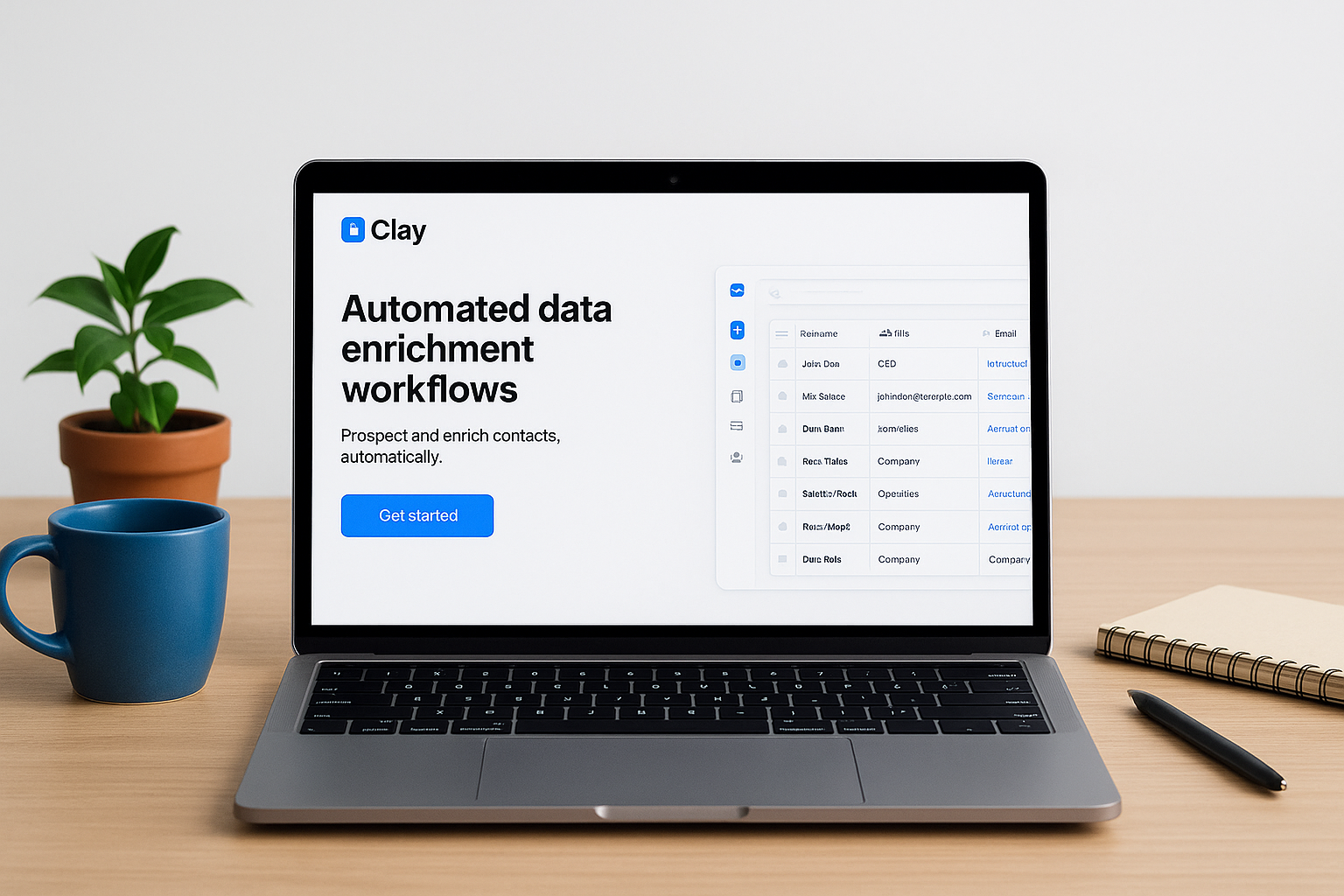
Clay transforms prospecting and lead enrichment into automated workflows for go-to-market teams. The platform combines over 75 data providers into a single interface, letting you gather contact information, company details, and intent signals without switching between multiple tools. You build enrichment workflows using a spreadsheet-like interface that feels familiar but adds powerful automation capabilities. The system uses AI to research prospects at scale, finding relevant information about decision-makers and their organizations that would take hours to collect manually.
Core automation capabilities
The platform delivers automated data enrichment workflows that pull information from dozens of sources simultaneously and compile it into unified contact records. You can create sequences that find email addresses, verify contact accuracy, research company details, and generate personalized outreach messages using AI analysis of prospect data. The system supports conditional logic that tries multiple data providers in sequence until it finds accurate information.
Ideal use cases and business size
Clay fits B2B companies and agencies running outbound prospecting campaigns that require detailed contact research. You’ll benefit most if you’re building account-based marketing lists or sales sequences that demand accurate, comprehensive prospect data. The platform works well for businesses generating $1M to $10M annually with dedicated growth teams.
Integrations and ecosystem
The system connects with 75+ data providers including Clearbit, ZoomInfo, Apollo, and LinkedIn. You get integrations with CRM platforms, email tools, and outreach systems that receive enriched contact data automatically.
Pricing overview
Free plans include 100 credits monthly with limited features. Starter plans begin at $149 monthly for 2,000 credits. Explorer and Pro tiers scale to $349 and $800 monthly respectively.
Strengths and limitations
Comprehensive data coverage eliminates the need for multiple enrichment subscriptions, and AI research capabilities find insights competitors miss. However, the steep learning curve requires dedicated training time, and credit-based pricing adds complexity to budget planning.
Clay ranks among the best marketing automation tools for growth teams prioritizing data quality and prospecting automation over general marketing workflows.
13. Ortto
Ortto combines marketing automation with advanced analytics to give growth teams complete visibility into customer behavior and campaign performance. The platform tracks user activities across your entire marketing funnel, from initial website visit through conversion and retention, then visualizes that data in customizable dashboards. You get journey builder tools for email and SMS automation paired with detailed reporting that shows exactly which touchpoints drive revenue. The system includes AI-powered features for segmentation, lead enrichment, and predictive analytics, making it particularly valuable for data-driven teams that base strategy decisions on concrete performance metrics.
Core automation capabilities
The platform provides journey automation workflows that orchestrate email and SMS campaigns based on user behavior and lifecycle stage. You can track over 60 preset activities like email opens, widget interactions, and trial completions, plus create custom activities specific to your business model. The system includes lead capture widgets that you can embed across your website to automate list building. AI tools help you segment audiences, evaluate customer quality, and enrich contact records with behavioral data automatically.
Ideal use cases and business size
Ortto fits mid-sized B2B and SaaS companies generating between $2M and $20M annually that prioritize data analysis alongside automation execution. You’ll benefit most if your team makes frequent optimization decisions based on performance data rather than intuition. The platform works well for growth teams that need both automation tools and the analytics to measure their effectiveness.
Integrations and ecosystem
The system connects with common CRM platforms, payment processors, and business tools through native integrations and webhooks. You get compatibility with data warehouses and analytics platforms that feed additional behavioral information into your automation workflows.
Pricing overview
Plans start at $199 monthly for the Professional tier with full automation and analytics features. Custom Enterprise pricing accommodates larger organizations with advanced requirements.
Strengths and limitations
Comprehensive analytics capabilities provide deeper insights than most automation platforms offer, and the visual reporting makes data accessible to non-technical team members. However, the higher starting price exceeds budgets for smaller businesses, and the analytics focus may provide more features than teams prioritizing simple automation need.
Ortto ranks among the best marketing automation tools for growth teams that need detailed performance analytics integrated directly with their automation workflows.
Putting it all together
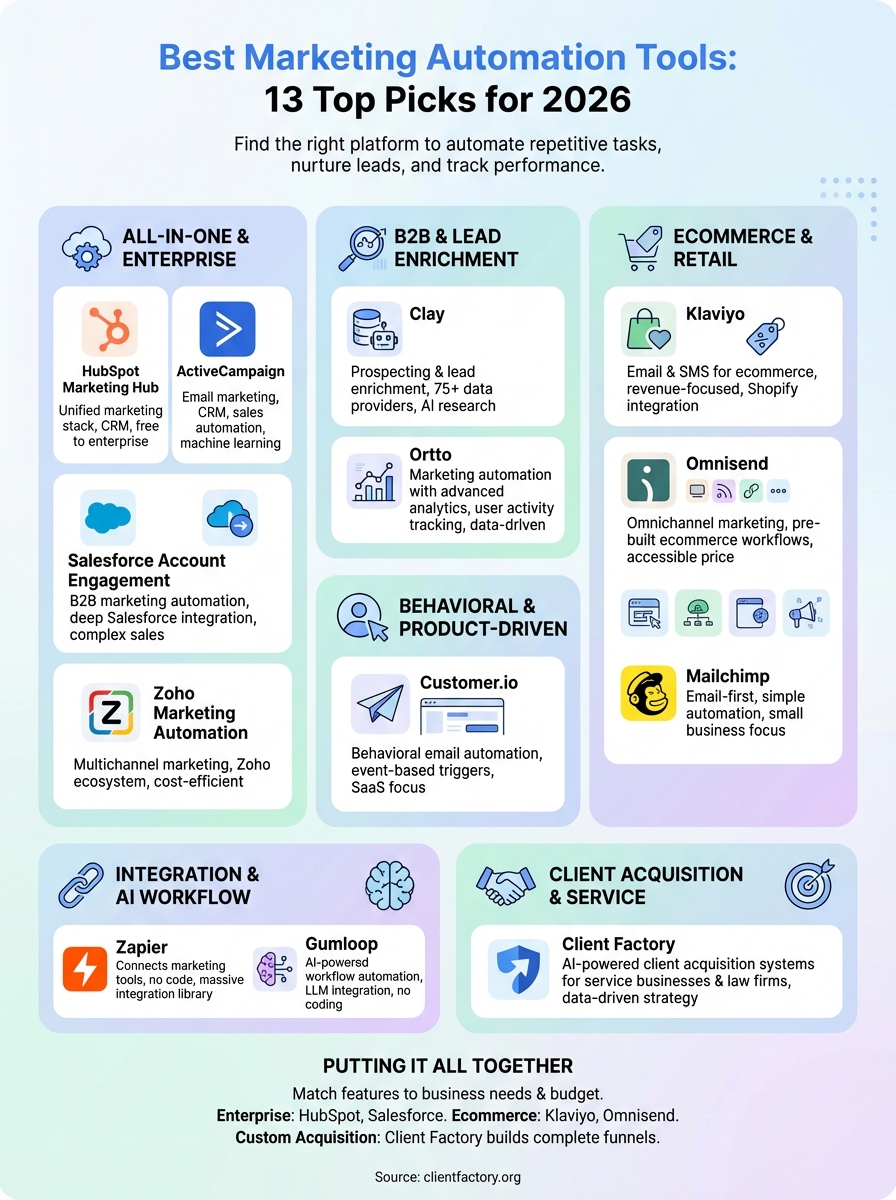
The best marketing automation tools transform how you acquire and nurture clients, but choosing the right platform requires matching features to your specific business needs. HubSpot and Salesforce deliver comprehensive enterprise solutions, while Klaviyo and Omnisend specialize in ecommerce automation. Tools like Zapier and Gumloop connect your existing stack, and Customer.io excels at product-driven engagement.
Your decision should balance automation capabilities against budget constraints and technical resources. Start by identifying your primary use case, whether that’s email nurturing, lead enrichment, or multi-channel campaigns. Then evaluate platforms that specialize in that area.
If you need complete client acquisition systems rather than standalone automation tools, Client Factory builds custom funnels that convert paid traffic into qualified clients for service businesses and law firms.