

Finding qualified leads shouldn’t feel like searching for a needle in a haystack. Yet for many service businesses and law firms, that’s exactly what client acquisition looks like without the right systems in place. The best lead generation tools can transform this frustrating process into a predictable pipeline, one that consistently delivers prospects ready to become paying clients.
At Client Factory, we’ve tested dozens of platforms across hundreds of campaigns for our clients. Some tools promise the world and deliver a sandbox. Others quietly become the backbone of million-dollar acquisition funnels. The difference often comes down to how well a tool fits your specific business model, budget, and technical comfort level.
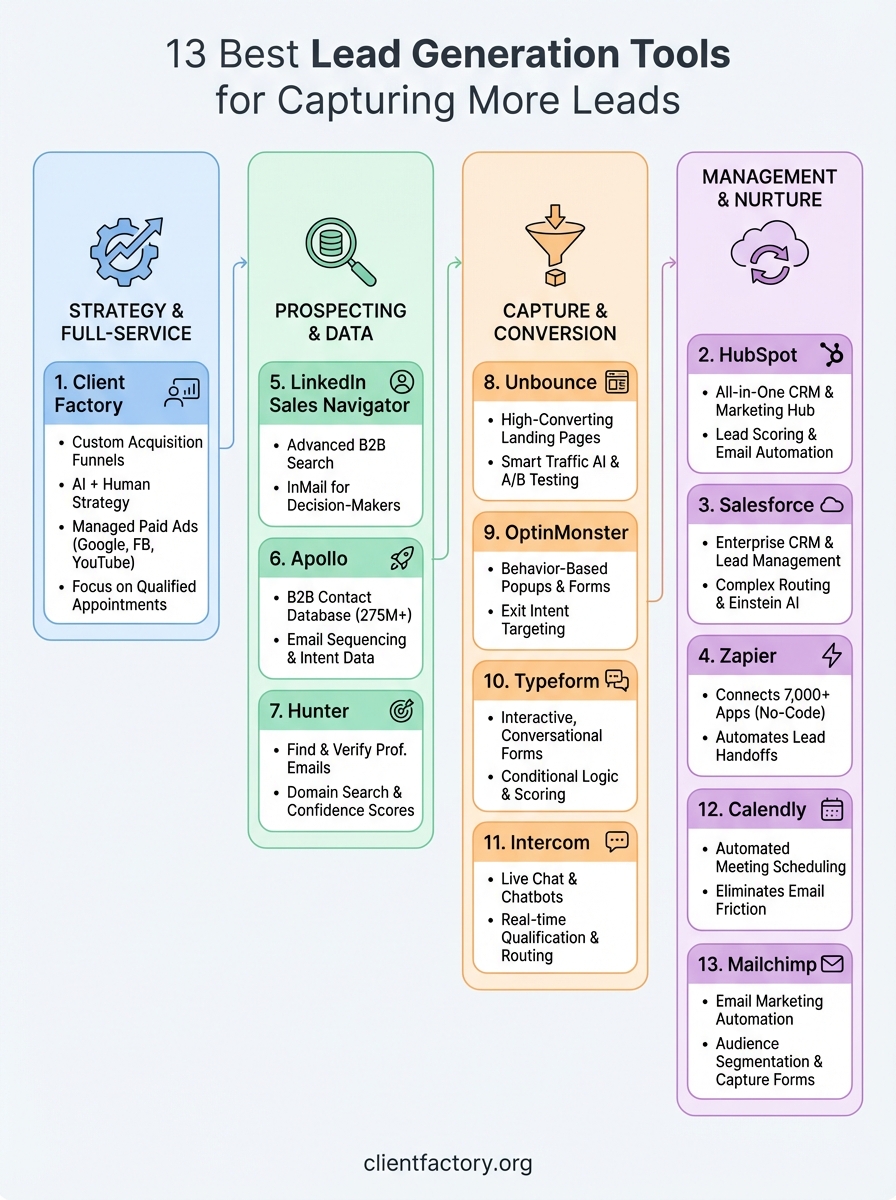
This guide breaks down 13 lead generation tools that actually move the needle. We’ve organized them by function, from B2B prospecting platforms to landing page builders to social media capture tools, so you can quickly find what fits your current gaps. Each recommendation includes honest assessments of pricing, learning curves, and ideal use cases. Whether you’re building your first lead gen system or looking to upgrade an existing stack, you’ll walk away knowing exactly which tools deserve your attention and your budget.
1. Client Factory
Client Factory operates differently from traditional lead generation software. Instead of buying a monthly subscription to a platform, you partner with a full-service agency that builds and manages your entire client acquisition system from the ground up. We combine AI-powered automation with human strategy to deliver qualified leads directly into your pipeline, handling everything from funnel design to paid advertising execution.
What it does for lead generation
Client Factory creates custom acquisition funnels tailored to your specific service or legal practice. The team analyzes your ideal client profile, then builds campaigns across Google Ads, Facebook, and YouTube that drive targeted traffic to conversion-optimized landing pages. You don’t manage the tools yourself. The agency handles data analysis, A/B testing, and ongoing optimization while you focus on closing the leads that arrive.
The system includes conversion audits that identify where prospects drop off in your current process. These audits reveal specific friction points that kill conversions, whether that’s confusing messaging, slow load times, or poorly timed calls to action. After identifying gaps, Client Factory rebuilds your funnel architecture and implements tracking that shows exactly which marketing dollars generate revenue.
When you work with Client Factory, you get a U.S.-based team with over 30 years of combined experience in service business client acquisition, not just a dashboard to figure out yourself.
Best for
Service businesses and law firms that want predictable lead flow without building an in-house marketing department see the best results. You fit this profile if you’re already closing clients consistently but need more qualified appointments on your calendar. This approach works especially well when you have a proven offer and decent close rates but struggle with the technical complexity of modern paid advertising platforms and funnel optimization.
Businesses spending at least $3,000 monthly on advertising or willing to invest that amount typically reach profitability fastest. Smaller budgets can work, but you need enough volume to test and optimize campaigns effectively.
Pricing and what you need to run it
Client Factory operates on a performance-first model with pricing customized to your business goals and advertising budget. You’ll need a discovery call to get specific numbers, but expect to invest in both the agency management fee and your actual advertising spend across platforms. The service includes strategy development, creative production, campaign management, and conversion rate optimization.
Your main requirement is availability for onboarding calls to define your ideal client profile and decision-making authority to approve creative direction. Client Factory handles the technical setup, platform access, and ongoing management. You receive regular performance reports showing cost per lead, conversion rates, and ROI metrics.
2. HubSpot
HubSpot combines CRM functionality with marketing automation to create a unified system for attracting and managing leads. The platform started as a marketing tool but evolved into a comprehensive lead generation hub where you can build landing pages, automate email sequences, track website visitors, and score prospects based on their behavior. Many businesses choose HubSpot because it eliminates the need to connect separate tools for contact management, email marketing, and sales pipeline tracking.
What it does for lead generation
HubSpot captures leads through customizable forms embedded on your website, pop-ups triggered by visitor behavior, and standalone landing pages you create in their drag-and-drop builder. Every interaction gets logged in the CRM automatically, so you see which blog posts a prospect read, which emails they opened, and how many times they visited your pricing page before requesting a demo.
The lead scoring system assigns points based on actions you define as valuable. You might give 10 points for downloading a guide, 20 points for visiting your services page three times, and 50 points for requesting a consultation. When a contact hits your threshold score, HubSpot notifies your sales team or triggers an automated email sequence.
HubSpot’s free CRM tier makes it one of the best lead generation tools for businesses testing automation before committing to paid plans.
Best for
Small to mid-sized companies that want all-in-one simplicity benefit most from HubSpot. You’ll appreciate the unified dashboard if you’re tired of logging into five different platforms to understand your lead pipeline. Marketing teams that create significant content like blog posts, guides, and webinars find value in the built-in analytics that connect content performance directly to revenue.
Pricing and key limits to know
HubSpot offers a free tier with basic CRM and limited marketing tools, sufficient for capturing and organizing up to 1 million contacts. The Marketing Hub Starter plan begins at $20 monthly but jumps to $890 monthly for Professional features like A/B testing and marketing automation workflows. Free users can’t remove HubSpot branding from forms and landing pages. Contact limits apply across all tiers, with additional charges for databases exceeding your plan’s threshold.
3. Salesforce
Salesforce dominates the enterprise CRM market with a platform that scales from small businesses to Fortune 500 companies. While known primarily as a customer relationship management system, Salesforce includes powerful lead generation and nurturing capabilities through its Sales Cloud and Marketing Cloud products. The platform gives you advanced tools for capturing, scoring, and routing leads based on sophisticated criteria you define.
What it does for lead generation
Salesforce captures leads through web-to-lead forms you embed on any page, automatically creating records in your database when prospects submit information. The Lead Management system then scores these contacts using criteria you configure, assigns them to the right sales representatives based on territory rules, and triggers automated follow-up sequences. You track every interaction from first touch to closed deal in a single timeline.
The Einstein AI features analyze historical data to predict which leads will most likely convert, helping your team prioritize outreach efforts. Campaign management tools let you track ROI across multiple channels, connecting marketing spend directly to pipeline value. Integration with third-party tools expands functionality without switching platforms.
Salesforce processes over 100 billion transactions daily across its customer base, making it one of the most battle-tested systems for managing high lead volumes.
Best for
Large sales teams needing complex lead routing and detailed pipeline visibility get the most value from Salesforce. You’ll appreciate the customization depth if your business has unique workflows or requires specific compliance tracking. Organizations with multiple product lines, territories, or sales processes benefit from the advanced segmentation capabilities.
Pricing and key limits to know
Salesforce Essentials starts at $25 per user monthly with basic lead management for up to 10 users. Professional edition costs $80 per user monthly and removes the team size restriction. Storage limits apply across all tiers, with 10 GB included in lower plans and additional storage costing extra. The platform requires significant configuration time to match your processes, often necessitating administrator training or consultant support.
4. Zapier
Zapier connects different apps in your lead generation stack without requiring coding knowledge. The platform acts as a bridge between tools that don’t communicate natively, automatically moving data when specific triggers occur. You create workflows called Zaps that capture leads from one source and instantly send them to your CRM, email marketing platform, or sales notification system. This automation eliminates manual data entry and reduces the lag time between lead capture and first contact.

What it does for lead generation
Zapier automates the lead handoff process between your marketing and sales tools. When someone fills out a form on your website, Zapier can create a CRM contact, add them to an email sequence, notify your sales team in Slack, and schedule a follow-up task simultaneously. You connect over 7,000 supported apps through a visual interface where you select triggers and actions without writing code.
The multi-step Zap functionality lets you build conditional logic into your workflows. You might route high-value leads to your senior sales representative while sending lower-scoring prospects to a nurture sequence. Filter steps ensure only qualified contacts trigger expensive actions like SMS notifications or premium enrichment services.
Zapier processes over 6 billion automated tasks monthly across its user base, making it one of the most reliable options for connecting your best lead generation tools into a unified system.
Best for
Marketing teams managing multiple disconnected platforms gain the most efficiency from Zapier. You’ll benefit if you’re using a form builder that doesn’t integrate directly with your CRM or need to sync leads across platforms that compete rather than cooperate. Small to mid-sized businesses that lack dedicated developers appreciate the no-code approach to building sophisticated automation.
Pricing and key limits to know
Zapier’s free tier includes 100 tasks monthly across five single-step Zaps, sufficient for testing workflows but limiting for active lead generation. Starter plans begin at $29.99 monthly for 750 tasks. Tasks count each time a Zap runs, so a workflow with five actions consumes five tasks per lead. Premium app access requires Professional plans starting at $73.50 monthly. Multi-step Zaps and custom logic need paid tiers, restricting free users to basic one-action automations.
5. LinkedIn Sales Navigator
LinkedIn Sales Navigator transforms the world’s largest professional network into a targeted prospecting machine. The platform gives you advanced search filters and direct messaging capabilities that go far beyond the free LinkedIn experience. You access detailed company and contact information, track prospect activity, and receive alerts when leads change jobs or share content, creating natural conversation starters for outreach campaigns.
What it does for lead generation
Sales Navigator provides Boolean search capabilities that filter LinkedIn’s 900+ million members by job title, company size, industry, geography, and dozens of other criteria. You save these searches and receive daily notifications when new prospects match your parameters. The platform highlights warm introduction paths through your existing network and shows which contacts have engaged with your company’s content.
Lead recommendations surface prospects similar to accounts you’ve already saved, expanding your pipeline with qualified contacts you might have missed. InMail credits let you message prospects directly without connection requests, bypassing the limitations of standard LinkedIn accounts. Integration with major CRMs automatically syncs contact data and activity, eliminating manual updates.
Best for
Sales teams targeting B2B decision-makers in specific roles or industries extract maximum value from Sales Navigator. You’ll benefit if your ideal clients are active on LinkedIn and you have the bandwidth to conduct personalized outreach. Companies selling high-ticket services or enterprise solutions see strong ROI when they combine the platform with consistent prospecting habits.
Pricing and key limits to know
Sales Navigator Core starts at $99.99 monthly per user with 50 InMail credits and basic search filters. Advanced plans cost $149.99 monthly with expanded credits and TeamLink features showing connection paths across your organization. Annual commitments reduce monthly costs but lock you into 12-month contracts. InMail credits expire monthly and don’t roll over, pushing users toward consistent prospecting activity.
Sales Navigator users who send 10+ personalized messages weekly typically see 3x higher response rates than those relying solely on connection requests, making it one of the best lead generation tools for relationship-based selling.
6. Apollo
Apollo combines a B2B contact database with sales engagement tools in a single platform designed for outbound prospecting. The system gives you access to over 275 million contacts and 73 million companies with verified email addresses and phone numbers. You search for prospects using detailed filters, then launch email sequences directly from the platform while tracking opens, clicks, and responses in real time. This integration eliminates the need to export lists to separate outreach tools.
What it does for lead generation
Apollo’s search engine lets you filter prospects by job title, company revenue, technology stack, funding stage, and dozens of other criteria. You build targeted lists of decision-makers who match your ideal customer profile, then verify their contact information before reaching out. The platform includes email sequencing that automatically sends follow-up messages based on prospect behavior, pausing when someone replies to prevent awkward automation fails.
The Chrome extension reveals contact details while you browse LinkedIn profiles or company websites, letting you add prospects to sequences without switching tabs. Intent data shows which companies are actively researching solutions like yours, helping you prioritize accounts more likely to convert. Integration with your CRM keeps contact records synchronized automatically.
Apollo users report average email open rates of 34% and reply rates of 8%, making it one of the best lead generation tools for volume-based prospecting campaigns.
Best for
Sales teams running high-volume outbound campaigns to B2B prospects get the most value from Apollo. You’ll benefit if you need to quickly build lists of specific decision-makers and have processes for following up consistently. Companies with dedicated sales development representatives who focus exclusively on prospecting see strong ROI.
Pricing and key limits to know
Apollo’s free plan includes unlimited email credits but restricts you to 10 mobile phone credits monthly and 60 export credits annually. Basic plans start at $49 monthly per user with increased mobile credits and sequence capabilities. Professional tiers cost $79 monthly with advanced filters and intent data access. Email verification accuracy varies by contact age, with recently updated records performing better than stale database entries.
7. Hunter
Hunter specializes in finding and verifying professional email addresses for any company or individual you want to reach. The platform searches publicly available sources to discover email patterns used by organizations, then constructs verified contact information for specific employees. You enter a domain name and receive a list of associated email addresses along with confidence scores indicating verification accuracy. This focused approach makes Hunter one of the best lead generation tools for teams that need contact data without paying for massive B2B databases.
What it does for lead generation
Hunter’s Domain Search reveals all public email addresses associated with a company website, showing you the email format pattern the organization uses. You then use the Email Finder to construct addresses for specific employees who aren’t in the initial results. The platform verifies each address through multiple validation checks, reducing bounce rates before you launch outreach campaigns.
The Chrome extension surfaces contact information while you browse company websites or LinkedIn profiles, letting you build prospect lists without switching platforms. Bulk tasks let you verify entire spreadsheets of email addresses at once, cleaning your existing database. API access connects Hunter to your CRM or sales automation tools for seamless workflows.
Best for
Sales teams conducting targeted outreach to specific companies benefit most from Hunter. You’ll find value if you know which organizations you want to contact but lack verified email addresses for decision-makers. Small teams that can’t justify expensive database subscriptions appreciate the pay-as-you-go model.
Pricing and key limits to know
Hunter’s free plan includes 25 searches and 50 verifications monthly, suitable for light prospecting. Starter plans cost $49 monthly for 500 searches and 1,000 verifications. Growth plans reach $149 monthly with 10,000 searches. Verification accuracy depends on email age and public data availability, with recently used addresses performing best.
Hunter maintains a 95%+ accuracy rate on verified email addresses, significantly reducing bounce rates compared to unverified database providers.
8. Unbounce
Unbounce specializes in building high-converting landing pages without requiring developer resources. The platform gives you a drag-and-drop editor designed specifically for capturing leads through focused, single-purpose pages that eliminate distractions. You create dedicated destinations for each campaign where prospects land after clicking your ads or email links, then test different versions to improve conversion rates continuously. This focused approach makes Unbounce one of the best lead generation tools for businesses running paid traffic campaigns.

What it does for lead generation
Unbounce converts ad clicks into qualified leads through customizable landing pages that load quickly and work seamlessly across devices. You build pages using templates proven to convert or start from scratch with complete design control. The Smart Traffic feature uses AI to automatically send each visitor to the page variant most likely to convert them based on their characteristics, eliminating guesswork from A/B testing.
Popups and sticky bars capture visitors who might otherwise leave without taking action. You trigger these overlays based on exit intent, scroll depth, or time on page, creating multiple conversion opportunities. Form fields connect directly to your CRM or email platform through native integrations.
Best for
Marketing teams running paid advertising campaigns on Google, Facebook, or other platforms benefit most from Unbounce. You’ll see strong ROI if you’re spending significant budget on traffic and need to maximize conversion rates. Agencies managing multiple client campaigns appreciate the client sub-account structure.
Unbounce users report an average conversion rate of 8.6% across landing pages, significantly higher than typical website conversion rates of 2-3%.
Pricing and key limits to know
Unbounce starts at $99 monthly for 500 conversions and one domain. Premium plans cost $249 monthly with unlimited domains and A/B testing. Conversion limits count each form submission, so high-traffic campaigns require higher tiers. Page load speed depends on image optimization and custom code additions.
9. OptinMonster
OptinMonster focuses on converting website visitors into leads through strategically timed popups, floating bars, and inline forms that appear based on user behavior. The platform gives you advanced targeting options that display different offers to visitors depending on where they came from, which pages they view, and how they interact with your site. You create campaigns that feel personalized rather than intrusive, capturing emails and contact information at the exact moment prospects show buying intent.
What it does for lead generation
OptinMonster captures leads using behavior-based triggers that respond to exit intent, scroll depth, time on page, and inactivity. You build campaigns that show different messages to first-time visitors versus returning prospects, increasing relevance and conversion rates. The Yes/No form approach reduces friction by asking visitors a qualifying question before presenting your opt-in form, filtering out casual browsers.
A/B testing runs automatically across campaign elements, showing you which headlines, images, and calls to action convert best. Integration with major email platforms and CRMs ensures captured leads flow directly into your nurture sequences without manual exports.
OptinMonster users report average conversion rate increases of 785% after implementing targeted campaigns, making it one of the best lead generation tools for squeezing more value from existing traffic.
Best for
Websites with steady traffic volume that struggle with high bounce rates benefit most from OptinMonster. You’ll see results if you already attract qualified visitors but need better capture mechanisms before they leave.
Pricing and key limits to know
OptinMonster starts at $9 monthly for basic features on one site. Growth plans cost $19 monthly with advanced targeting and A/B testing. Conversion limits don’t apply, but campaign creation limits restrict lower tiers to fewer active campaigns simultaneously.
10. Typeform
Typeform transforms standard web forms into interactive conversations that feel more like chat experiences than traditional data collection. The platform presents one question at a time with smooth transitions and engaging visuals, dramatically reducing form abandonment compared to lengthy single-page layouts. You build conditional logic that adapts questions based on previous answers, creating personalized experiences that capture qualified leads while gathering the specific information your sales team needs to close deals.
What it does for lead generation
Typeform captures leads through conversational interfaces that ask questions sequentially rather than displaying overwhelming forms all at once. You embed these forms on landing pages, share them via direct links, or integrate them into email campaigns. The conditional logic feature shows different follow-up questions based on how prospects answer, letting you qualify leads during the capture process rather than after.
Calculation features score responses in real time, routing high-value prospects to priority follow-up while sending lower-scoring leads to nurture sequences. Hidden fields pass campaign data like traffic source or ad group into your CRM automatically, connecting each lead to the marketing channel that generated them. Integration with tools like HubSpot, Salesforce, and Zapier ensures captured information flows directly into your existing systems.
Best for
Businesses collecting detailed qualification information before sales conversations benefit most from Typeform. You’ll see strong results if your sales process requires understanding prospect needs, budget, or timeline before scheduling calls. Companies in consulting, coaching, or complex B2B services appreciate the ability to pre-qualify leads through engaging question flows.
Pricing and key limits to know
Typeform’s free plan allows 10 responses monthly across unlimited forms, suitable for testing but limiting for active campaigns. Basic plans start at $25 monthly for 100 responses. Professional tiers cost $50 monthly with logic jumps and calculation features. Response limits count each form submission, requiring plan upgrades as volume increases.
Typeform users report completion rates averaging 40-60%, significantly higher than traditional forms that typically see 20-30% completion, making it one of the best lead generation tools for businesses that need detailed prospect information.
11. Intercom
Intercom combines live chat, chatbots, and targeted messaging into a unified platform designed to capture and qualify leads directly on your website. The system engages visitors with automated conversations that feel personal, asking qualifying questions and routing prospects to your sales team when they show buying intent. You deploy customizable chat widgets that appear based on visitor behavior, page location, and user attributes, creating timely touchpoints that convert browsers into conversations.
What it does for lead generation
Intercom captures leads through conversational interfaces that engage website visitors proactively based on triggers you define. You build custom bot flows that ask qualification questions, schedule meetings, and collect contact information without requiring human intervention. The platform segments visitors by behavior, showing different messages to first-time browsers versus returning prospects who viewed your pricing page three times.
Live chat transitions smoothly between bot and human agents when prospects need detailed answers. Targeted messages appear as banners, pop-ups, or in-app notifications based on specific actions, like viewing high-intent pages or spending time on feature comparisons. Integration with your CRM ensures every conversation syncs automatically.
Best for
Businesses with moderate to high website traffic that want to engage prospects in real time benefit most from Intercom. You’ll see results if your sales team has capacity to respond quickly to qualified conversations.
Companies using Intercom’s automated qualification bots report 40% faster response times to high-intent leads compared to traditional contact forms, making it one of the best lead generation tools for immediate engagement.
Pricing and key limits to know
Intercom starts at $74 monthly for basic chat features with 2 team seats. Advanced plans cost $395 monthly with automation and multiple inbox routing. Seat limits require additional payments as your team grows, and conversation volume affects overall costs.
12. Calendly
Calendly removes the back-and-forth email friction that kills momentum between initial interest and actual sales conversations. The platform automates meeting scheduling by letting prospects book time directly on your calendar based on your real availability. You share customized booking links through email signatures, landing pages, or chat widgets, and qualified leads select times that work for both parties instantly. This immediate scheduling capability shortens your sales cycle by eliminating the delays that occur when prospects lose interest during coordination attempts.

What it does for lead generation
Calendly captures lead information through customizable booking forms that collect contact details and qualification questions before confirming appointments. You embed these scheduling links on high-intent pages like pricing or demo request forms, converting interest into confirmed meetings without manual coordination. The platform syncs with your calendar in real time, preventing double bookings while respecting your buffer times and meeting preferences.
Routing rules distribute incoming meeting requests across your sales team automatically based on round-robin assignment, territory matching, or lead scoring criteria. Automated reminders reduce no-shows through email and SMS notifications sent before scheduled calls. Integration with video conferencing platforms generates meeting links automatically.
Businesses using Calendly report 30-50% faster conversion from initial contact to first meeting compared to manual scheduling methods, making it one of the best lead generation tools for accelerating sales cycles.
Best for
Sales teams managing high volumes of consultation requests benefit most from Calendly. You’ll see immediate time savings if your team currently wastes hours coordinating meeting times through email chains. Service businesses offering free consultations appreciate the automated qualification through pre-meeting questions.
Pricing and key limits to know
Calendly’s free plan supports one calendar connection and unlimited meetings with basic scheduling features. Essentials plans start at $10 monthly per user with multiple calendar connections and customization options. Professional tiers cost $15 monthly with team routing and integrations. Meeting type limits restrict free users to one active booking page configuration.
13. Mailchimp
Mailchimp evolved from a simple email marketing platform into a comprehensive marketing automation system that captures and nurtures leads across multiple channels. The platform combines email campaign creation with landing page builders, signup forms, and audience segmentation tools that work together to grow your contact database. You access analytics showing which campaigns generate the most engaged leads, then use that data to refine your capture strategies and improve conversion rates over time.
What it does for lead generation
Mailchimp captures leads through customizable signup forms you embed on your website, pop-ups triggered by visitor behavior, and standalone landing pages created in their visual builder. The platform segments new contacts automatically based on signup source, interests indicated during registration, and engagement with your initial welcome emails. You create automated workflows that deliver targeted content sequences to different audience segments, warming leads progressively until they’re ready for sales conversations.
The audience tagging system tracks prospect interactions with your emails and website, scoring engagement levels automatically. Integration with e-commerce platforms and CRMs ensures captured leads sync with your existing systems. Built-in A/B testing optimizes form designs and email content to maximize conversion rates.
Mailchimp processes over 500 million emails daily across its user base, making it one of the best lead generation tools for businesses building permission-based marketing databases.
Best for
Small businesses and content creators needing affordable email capture combined with basic automation see the strongest results from Mailchimp. You’ll benefit if you’re building an audience from scratch and need simple tools that don’t require technical expertise.
Pricing and key limits to know
Mailchimp’s free plan supports 500 contacts and 1,000 monthly email sends with basic signup forms. Essentials plans start at $13 monthly for 500 contacts with A/B testing and landing pages. Contact limits increase costs significantly as your database grows, with pricing jumping to hundreds monthly for larger audiences.
Next steps
You now have a detailed breakdown of the best lead generation tools across different functions, from B2B prospecting to landing page optimization to email capture. The right combination depends on your current gaps, not which tools sound most impressive. Start by identifying where prospects drop off in your existing process, then choose tools that specifically address those friction points rather than building a bloated tech stack that creates more confusion than conversions.
Most businesses see the fastest results when they pair tools with expert implementation and ongoing optimization. Software alone won’t fix unclear messaging, weak offers, or poorly targeted campaigns. These foundational issues kill conversion rates regardless of which platforms you deploy. If you’re spending money on traffic but struggling to convert clicks into qualified appointments, book a free conversion audit with Client Factory. We’ll identify the specific bottlenecks costing you clients and show you exactly how to fix them.