

You’re driving traffic to your site. Ads are running, SEO is working, people are clicking, but sales aren’t keeping up. That gap between clicks and customers is exactly where conversion rate optimization (CRO) lives. And closing it starts with choosing from the best conversion rate optimization tools available right now.
The problem? There are dozens of CRO tools out there, each promising to be the one that fixes everything. Some focus on A/B testing, others on heatmaps or user behavior analytics, and a few try to do it all. Picking the wrong tool wastes budget and, worse, wastes time you could’ve spent actually improving your funnel.
At Client Factory, we build and optimize client acquisition funnels for service businesses and law firms every day. CRO tools are core to how we turn clicks into clients for our partners. We’ve tested plenty of them, and have strong opinions about what actually moves the needle. Below, we break down 14 CRO tools worth your attention, what each does best, and how to match the right one to your needs.
1. Client Factory
Client Factory is a U.S.-based digital marketing agency that specializes in building and optimizing client acquisition funnels for service businesses and law firms. While most of the best conversion rate optimization tools on this list are software platforms you manage yourself, Client Factory operates differently. It sits at the strategic layer of your CRO stack, combining paid media, SEO, analytics, and funnel design into a single managed service.
What it is and where it fits in a CRO stack
Most CRO tools give you data. Client Factory gives you a team that acts on that data. It fits above the individual tool layer, orchestrating platforms like Google Analytics 4, heatmaps, and A/B testing software to run a coherent optimization program. You get one accountable team managing the full picture rather than disconnected tools running in parallel with no clear owner.
What problems it solves fastest
The fastest wins come in two areas: leaky funnels and underperforming paid traffic. If you’re spending money on ads and watching potential clients bounce from your landing page or intake form, Client Factory diagnoses exactly where you’re losing them and fixes it. They also address low-quality lead flow, where traffic volume looks fine but the leads converting aren’t worth closing.
If your traffic is healthy but your pipeline isn’t, a funnel audit will almost always surface something worth fixing right away.
Best for service businesses and law firms
Client Factory is built specifically for professional service businesses and law firms that rely on generating qualified consultations or intake calls. Generic marketing agencies treat every vertical the same. Client Factory’s approach is calibrated for high-trust, high-ticket service relationships where a phone call or form submission starts the client relationship.
What the process looks like from audit to launch
The engagement starts with a free funnel audit that identifies specific gaps in your current client acquisition flow. From there, the team builds a tailored acquisition funnel, sets up tracking, launches campaigns, and iterates based on real conversion data. The audit-to-launch timeline is structured to surface early wins quickly rather than keeping you waiting months for movement.

Pricing model and what affects cost
Client Factory uses a custom pricing model based on your business goals, traffic volume, and scope of services. Factors that affect cost include whether you need paid media management, SEO, or both, and how competitive your local market is. You get a performance-first engagement, meaning the investment scales with what’s actually required to move your numbers.
2. Google Analytics 4
Google Analytics 4 (GA4) is Google’s current web and app analytics platform, and it’s the data foundation that most conversion optimization programs are built on. If you’re comparing the best conversion rate optimization tools, GA4 is less a “tool” and more a core infrastructure requirement.
What it is and where it fits in a CRO stack
GA4 sits at the measurement layer of your CRO stack. It tells you where traffic comes from, how users move through your site, and where they stop converting. Every other tool you layer on top, whether A/B testing software or heatmaps, relies on GA4 to provide baseline conversion context.
What to track for lead gen and sales funnels
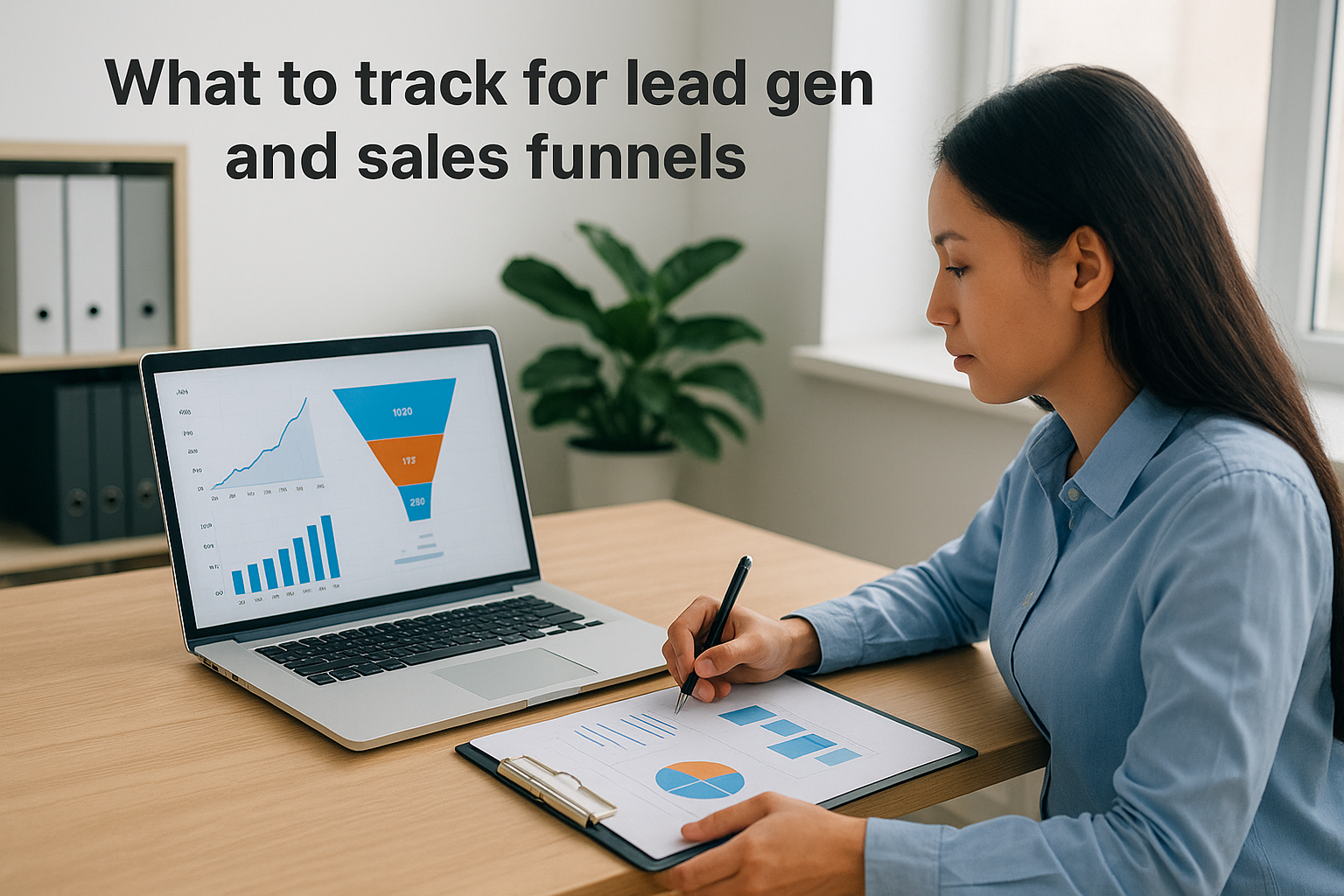
For service businesses, the most important events to track are form submissions, phone call clicks, and intake page visits. GA4’s funnel exploration report lets you map each step a visitor takes before converting, so you can pinpoint exactly where drop-offs happen and prioritize which fixes will have the most impact.
If you’re not tracking micro-conversions like scroll depth and CTA clicks, you’re missing half the story GA4 can tell you.
Best for service businesses and law firms
GA4 is the right choice for any service business running a lead generation funnel. Its audience segmentation and traffic source reporting help you understand which channels bring in leads that actually convert to clients, not just clicks.
Setup basics, events, and attribution notes
You’ll need to configure custom events manually for most conversion actions beyond basic pageviews. Attribution defaults to data-driven, which works well for multi-touch campaigns but requires at least 30 days of data before it becomes reliable.
Pricing
GA4 is free for most businesses. The paid tier, Google Analytics 360, starts at approximately $50,000 per year and is designed for enterprise-level data needs.
3. Google Tag Manager
Google Tag Manager (GTM) is a free tag management system from Google that lets you deploy and update tracking codes on your website without touching the underlying code. It sits between your site and every analytics or advertising platform you connect to it.
What it is and where it fits in a CRO stack
GTM sits at the data collection layer of your CRO stack. It acts as the container that fires the tracking scripts your other tools depend on, including GA4 event tags, ad conversion pixels, and heatmap snippets. Without it, every tracking update requires a developer and a deployment cycle.
What it helps you track without engineering bottlenecks
GTM gives your marketing team direct control over form submissions, button clicks, scroll depth, and video interactions without waiting on developers. You configure triggers and tags inside the GTM interface, test them in preview mode, and publish instantly.
The ability to move fast on tracking changes is often what separates teams that improve their funnel quickly from teams that stall waiting on technical resources.
Best for service businesses and law firms
If you’re running paid ads or working with any of the best conversion rate optimization tools in this list, GTM makes your data collection more reliable and faster to update. Service businesses benefit specifically because intake form tracking and call tracking tags can be adjusted without delays.
Governance, QA, and privacy considerations
GTM workspaces and user permission levels let you control who can publish tags, which reduces the risk of broken tracking or unauthorized scripts. Always test tags in preview mode before publishing, and audit your container regularly for outdated or duplicate tags that can slow page load times.
Pricing
GTM is completely free for standard use. There is no paid tier for the web container version.
4. Hotjar
Hotjar is a behavior analytics platform that combines heatmaps, session recordings, and user feedback tools in a single interface. It fills the gap between raw traffic numbers and actual user behavior, showing you what visitors do on your pages rather than just where they come from.
What it is and where it fits in a CRO stack
Hotjar sits at the qualitative data layer of your CRO stack, directly below your quantitative analytics setup. While GA4 tells you that users are dropping off a specific page, Hotjar shows you exactly what they were doing before they left. That combination of tools is what most of the best conversion rate optimization tools workflows are built around.
What it reveals that analytics misses
Hotjar surfaces friction points that numbers alone never expose, like users rage-clicking on non-clickable elements, ignoring your primary CTA, or abandoning a form mid-way through a specific field. Session recordings let you watch real user journeys, which is often faster than running a full A/B test to confirm a hypothesis.
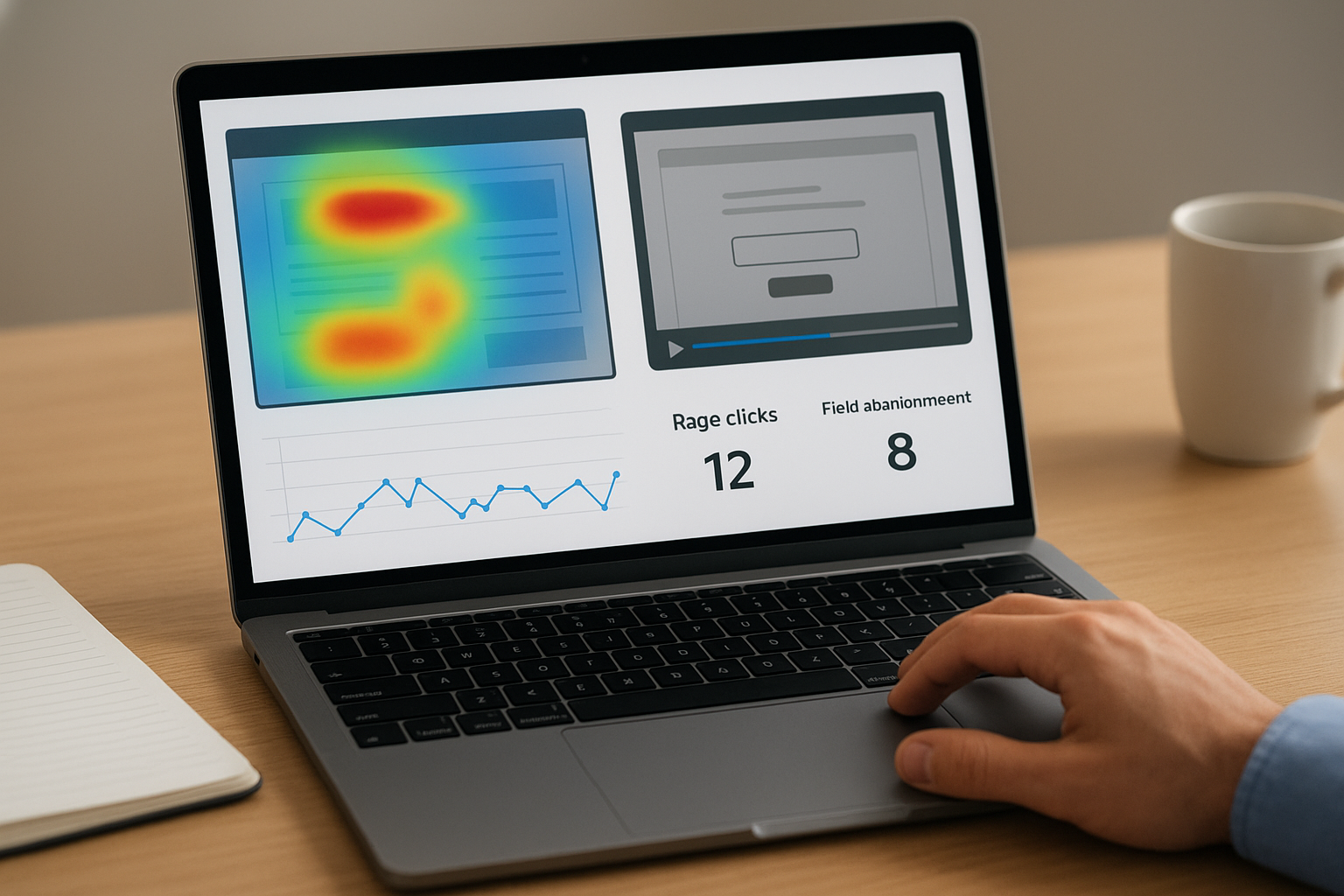
Watching five session recordings on your intake page will often tell you more about why people aren’t converting than a month of reviewing bounce rate data.
Best for service businesses and law firms
Service businesses benefit because consultation request forms and contact pages are high-value conversion points where small friction issues cost real revenue. Hotjar helps you identify exactly where those forms are losing people.
Privacy, sampling, and data retention notes
Hotjar masks sensitive fields by default, but you should audit your recording settings before launch. Free plans limit data retention to 365 days, and session recording samples are capped based on your plan tier.
Pricing
Hotjar offers a free Basic plan with limited session recordings. Paid plans start at $32 per month, scaling with session volume and feature access.
5. Microsoft Clarity
Microsoft Clarity is a free behavior analytics tool from Microsoft that delivers heatmaps, session recordings, and engagement metrics without any usage caps or cost. It launched in 2020 and has grown into a legitimate alternative to paid behavior tools for teams watching their budget.
What it is and where it fits in a CRO stack
Clarity fits at the qualitative data layer, the same position Hotjar occupies. You use it to watch how visitors interact with your pages, where they click, how far they scroll, and where they drop off. For teams building out the best conversion rate optimization tools stack on a tight budget, Clarity fills this layer for free.
When to use it instead of paid behavior tools
Choose Clarity when you need unlimited session recordings without paying per session. Paid tools like Hotjar cap recordings based on your plan tier, which limits how much you can analyze during high-traffic periods. Clarity removes that ceiling entirely.
If you’re launching a new landing page and want to record every visitor session during the first week, Clarity lets you do that without upgrading a plan.
Best for service businesses and law firms
Service businesses with high-value intake forms benefit from watching exactly how potential clients interact with those pages. Clarity’s dead-click and rage-click reports are particularly useful for identifying form fields or navigation elements that create friction before a consultation request.
Setup, performance, and privacy notes
Setup requires one script tag added to your site, or you can deploy it through Google Tag Manager. Clarity automatically masks text input fields to protect user data, and Microsoft states the tool has minimal impact on page load performance.
Pricing
Microsoft Clarity is completely free with no paid tiers, session limits, or feature paywalls.
6. Mixpanel
Mixpanel is a product analytics platform built around tracking user actions over time rather than just sessions. It creates a user-level event history that lets you follow exactly how people move through your conversion flow across multiple visits.
What it is and where it fits in a CRO stack
Mixpanel sits at the behavioral analytics layer of your CRO stack, positioned between your traffic data and your testing tools. While GA4 gives you aggregate session-level data, Mixpanel gives you user-level event streams that let you trace individual paths through your funnel over days or weeks, not just single sessions.
How it helps you find drop-offs and retention issues
Mixpanel’s funnel reports show you exactly which step in your conversion flow loses the most users, and its retention reports tell you whether converted users return. That combination helps you prioritize fixes based on actual revenue impact rather than assumption.
If your funnel has five steps and 60% of users exit at step three, Mixpanel surfaces that pattern in minutes rather than requiring custom queries.
Best for service businesses and law firms
Service businesses with multi-touch intake processes benefit most from Mixpanel, where a potential client might visit several pages across multiple sessions before submitting a form. Tracking those extended paths is one of the strongest use cases among the best conversion rate optimization tools available.
Tracking plan and identity stitching basics
Before firing events, you need a defined tracking plan that maps each user action to a named event. Mixpanel also requires identity stitching, which links anonymous visitors to identified users after form submission, to keep funnel data accurate and avoid inflated drop-off numbers.
Pricing
Mixpanel offers a free plan covering up to 20 million monthly events. Paid plans start at $28 per month, scaling with event volume and team size.
7. Heap
Heap is a product analytics platform that automatically captures every user interaction on your site the moment you install it. Instead of pre-defining events, Heap records clicks, form submissions, and page views by default, building a retroactive data set you can query at any time.
What it is and where it fits in a CRO stack
Heap sits at the behavioral analytics layer, similar to Mixpanel but with one major distinction: you don’t need a tracking plan before collecting data. Among the best conversion rate optimization tools in this category, Heap alone lets you define events after the fact and apply them to data already captured.
Autocapture pros and what still needs planning
Autocapture means you never lose data from an event you forgot to tag. That advantage is real during fast launches or site redesigns. You still need to name and categorize captured events into a clean taxonomy, or your workspace fills with unlabeled interactions that make analysis harder than it should be.
Autocapture removes the “we forgot to track that” problem, but it doesn’t replace the discipline of maintaining organized event naming.
Best for service businesses and law firms
Service businesses gain direct access to retroactive intake form data they can analyze without re-tagging. If a conversion drop surfaces weeks after launch, your historical event data is already waiting to show you exactly where it happened.
Data quality, governance, and privacy notes
Heap’s autocapture approach can pull in sensitive field inputs unintentionally. Before going live, configure your suppression rules for any fields handling personal data and restrict raw event access to only the team members who need it.
Pricing
Heap offers a free plan for small teams with limited data history. Paid plans are custom-quoted based on session volume, so contact Heap directly for pricing specific to your site traffic.
8. Optimizely
Optimizely is an enterprise-grade experimentation platform that lets teams run A/B tests, multivariate tests, and feature experiments across web, mobile, and server-side environments. It sits at the top tier of the best conversion rate optimization tools for testing, built for organizations with dedicated CRO programs and the technical resources to support them.
What it is and where it fits in a CRO stack
Optimizely fits at the testing and experimentation layer of your CRO stack. After your analytics tools surface drop-off points and your behavior tools confirm user friction, Optimizely is where you run controlled experiments to validate that a proposed change actually improves conversion before you roll it out permanently.
Testing capabilities and common limitations
The platform supports A/B, multivariate, and multi-page testing along with server-side experiments for more complex product changes. The core limitation is scale: running statistically valid tests requires sufficient traffic volume, and most small or mid-size service businesses cannot generate enough sessions per variant to reach significance within a reasonable timeframe.
If your site receives fewer than 10,000 monthly visitors, most A/B tests will take weeks or months to reach a reliable result.
Best for service businesses and law firms
This tool fits best when you have high-traffic paid campaigns feeding a landing page and need to test different offer structures, form layouts, or CTAs at volume. Smaller practices are better served by a tool with lower traffic requirements.
Implementation approach and technical requirements
Deploying Optimizely requires JavaScript snippet installation and coordination with your development team for server-side tests. You also need to configure QA environments before pushing experiments to production to avoid broken experiences for real visitors.
Pricing
The platform uses custom enterprise pricing with no public rates listed. Contact their sales team directly for a quote based on your traffic volume and feature requirements.
9. VWO
VWO (Visual Website Optimizer) is a full-stack conversion optimization platform that combines A/B testing, multivariate testing, heatmaps, session recordings, and funnel analysis under one roof. Unlike tools that only handle one part of the CRO process, VWO positions itself as a complete experimentation suite for teams who want to consolidate their testing and behavior analytics into a single platform.
What it is and where it fits in a CRO stack
VWO fits at the testing and experimentation layer, but it also covers parts of the qualitative layer that dedicated tools like Hotjar occupy. Among the best conversion rate optimization tools available today, VWO is one of the few options that lets you identify a friction point, form a hypothesis, run a test, and review heatmap data without switching platforms.
What you can test and measure in one platform
VWO supports A/B, split URL, and multivariate tests alongside on-page surveys, funnel reports, and session replay. You can track form completions, clicks, and custom goals within the same dashboard where your experiments live, which cuts down the time spent correlating data across separate tools.
Consolidating your testing and behavior data in one platform removes the blind spots that come from piecing together results across multiple tools.
Best for service businesses and law firms
Service businesses benefit from VWO’s visual editor, which lets non-technical team members build test variations on landing pages and intake forms without writing code.
Setup notes, targeting, and QA workflow
VWO deploys via a single JavaScript snippet added to your site or through Google Tag Manager. Use VWO’s built-in QA mode to preview test variations before activating them, and configure audience targeting rules to segment tests by traffic source or device type.
Pricing
VWO offers a free plan for low-traffic sites. Paid plans start at $199 per month, with pricing scaling based on monthly tracked users and feature access.
10. AB Tasty
AB Tasty is an experimentation and personalization platform that combines A/B testing, multivariate testing, and dynamic content personalization in a single interface. It targets mid-market and enterprise teams that want to test page variations and serve tailored experiences to different audience segments at the same time.
What it is and where it fits in a CRO stack
AB Tasty fits at the testing and personalization layer of your CRO stack, one step above your analytics and behavior tools. Where most platforms focus on testing alone, AB Tasty lets you run experiments and apply audience-specific content changes simultaneously, which reduces the number of separate tools you need to manage.
Experimentation and personalization strengths
AB Tasty’s visual editor makes it straightforward to build test variations without writing code, and its audience targeting engine lets you segment by traffic source, device, location, and behavioral data. The platform also includes feature flag functionality, which lets marketing and product teams toggle changes on and off without a full deployment cycle.
If you’re testing different CTAs for paid traffic versus organic visitors simultaneously, AB Tasty handles both within a single experiment setup.
Best for service businesses and law firms
Among the best conversion rate optimization tools in this tier, AB Tasty works well for service businesses running targeted landing pages tied to specific campaigns or distinct practice areas that need differentiated messaging.
Privacy, consent, and performance considerations
AB Tasty supports GDPR and CCPA compliance frameworks, and you can configure it to activate experiments only after a visitor provides consent. The platform loads asynchronously to limit page speed impact, but you should audit load times after implementation to confirm performance.
Pricing
AB Tasty uses custom pricing based on your traffic volume and feature requirements. Contact their sales team directly for a quote.
11. Unbounce
Unbounce is a dedicated landing page platform that lets you build, publish, and test pages without touching your development team. It focuses on post-click conversion, meaning it takes over exactly where your ads leave off and works to turn that click into a contact or consultation request.
What it is and where it fits in a CRO stack
Unbounce fits at the conversion layer of your CRO stack, positioned between your paid traffic sources and your CRM or intake system. Among the best conversion rate optimization tools for paid campaigns, it is one of the few platforms designed specifically to maximize what happens after the click, not before.
Landing page optimization features that impact conversion
The platform includes a drag-and-drop builder, native A/B testing, and Smart Traffic, which uses machine learning to route visitors to whichever variant is most likely to convert based on their attributes. You can test headlines, CTAs, form length, and page structure without writing a single line of code.

Smart Traffic begins routing visitors automatically once a page collects enough data, which shortens the path to meaningful results compared to standard A/B testing setups.
Best for service businesses and law firms
Service businesses running Google or Meta ad campaigns benefit directly from Unbounce because each campaign can point to a dedicated page built around a specific offer or practice area rather than sending traffic to a generic homepage that dilutes your message.
Integrations, routing, and tracking notes
Unbounce connects with CRMs, email platforms, and Google Analytics through native integrations and Zapier. You can pass UTM parameters through to your CRM to attribute which campaigns are generating qualified leads.
Pricing
Unbounce plans start at $99 per month, with higher tiers unlocking additional visitors, custom domains, and expanded AI features.
12. Instapage
Instapage is a landing page platform built around advertising conversion, offering page building, A/B testing, and team collaboration tools designed to reduce cost per acquisition from paid campaigns. It competes in the same space as Unbounce but positions itself more firmly toward ad-focused teams managing multiple campaigns and client accounts.
What it is and where it fits in a CRO stack
Instapage fits at the conversion layer, sitting between your paid traffic sources and your intake or CRM system. Among the best conversion rate optimization tools in the landing page category, it adds a collaboration layer that most competitors skip, making it useful for teams that need to review and approve pages before publishing.
When it makes sense over other landing page builders
Instapage makes the most sense when you’re running multiple simultaneous ad campaigns that each need dedicated, message-matched landing pages. If your team also includes designers or outside reviewers who need to comment directly on page mockups before launch, Instapage’s built-in feedback tools reduce revision cycles significantly.
The closer your landing page message matches your ad copy, the higher your conversion rate will be.
Best for service businesses and law firms
Service businesses running practice area-specific ad campaigns benefit from Instapage’s ability to build and maintain separate pages for each service without slowing down on approvals or collaboration.
Collaboration, approvals, and analytics notes
Instapage includes real-time visual collaboration that lets stakeholders leave comments directly on page elements. Analytics tie into your ad platforms and track conversion events at the page level without requiring a separate analytics setup.
Pricing
Instapage plans start at $99 per month, with higher tiers unlocking additional pages, team seats, and advanced personalization features.
13. Honorable mentions: Typeform and OptinMonster
Two tools didn’t make the main list but still show up consistently in effective CRO stacks. Typeform and OptinMonster each solve a specific conversion problem that the broader platforms above don’t prioritize.
Typeform
Typeform is a form and survey builder that replaces traditional multi-field forms with a one-question-at-a-time format. That format reduces friction significantly, and service businesses that switch intake forms to Typeform often see immediate improvements in form completion rates without changing a single thing about their offer or page copy.
OptinMonster
OptinMonster is a lead capture and on-site retargeting tool that lets you display targeted popups, slide-ins, and sticky bars based on visitor behavior. Its exit-intent technology detects when a visitor is about to leave and triggers a last-chance offer or lead magnet. For service businesses, that means capturing contact information from visitors who would otherwise disappear without converting.
If your site generates consistent traffic but captures very few leads from that volume, OptinMonster addresses that gap directly without requiring a full funnel rebuild.
When to add these to your stack
Add Typeform when your current intake form has a low completion rate and session recordings show users abandoning mid-form. Add OptinMonster when your analytics show strong traffic but weak lead capture numbers across key service pages.
Pricing
Typeform’s free plan covers basic forms with limited responses. Paid plans start at $25 per month. OptinMonster starts at $9 per month on annual billing, with higher tiers unlocking exit-intent and advanced targeting rules.
Next steps
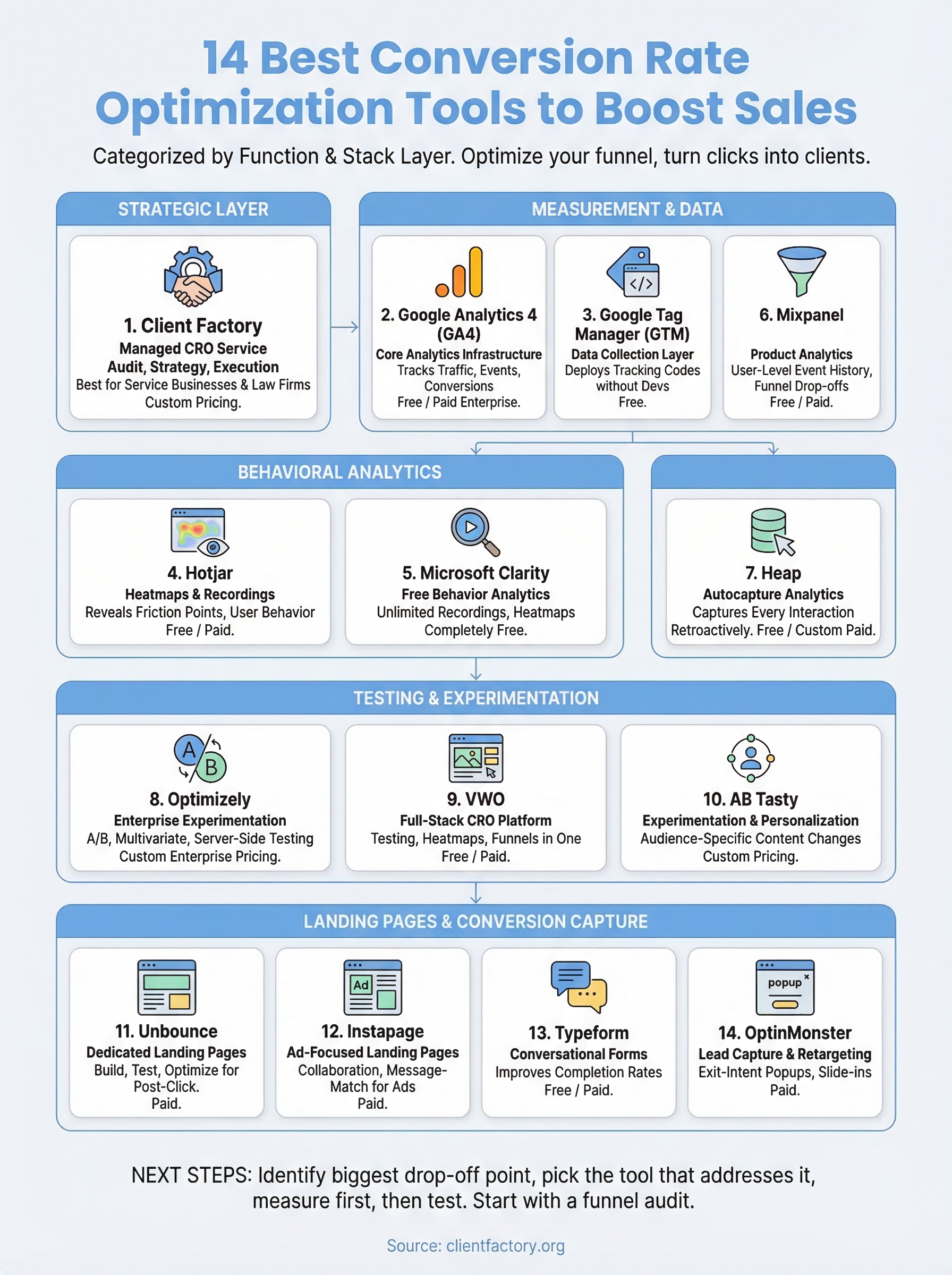
The best conversion rate optimization tools don’t fix a broken funnel on their own. They surface the data, and someone has to act on it. Start by identifying your single biggest drop-off point, whether that’s a landing page with high bounce rates, an intake form with poor completion numbers, or paid traffic that never reaches your core offer. Pick the tool that addresses that specific gap first rather than building a full stack before you’ve confirmed the problem.
Once you’ve closed the most obvious leak, layer in additional tools as your needs grow. Measurement always comes before testing, and testing always comes before personalization. If you’d rather skip the trial-and-error phase and work with a team that already knows which tools drive results for service businesses, book a free funnel audit and get a clear picture of exactly where your funnel is losing clients right now.