
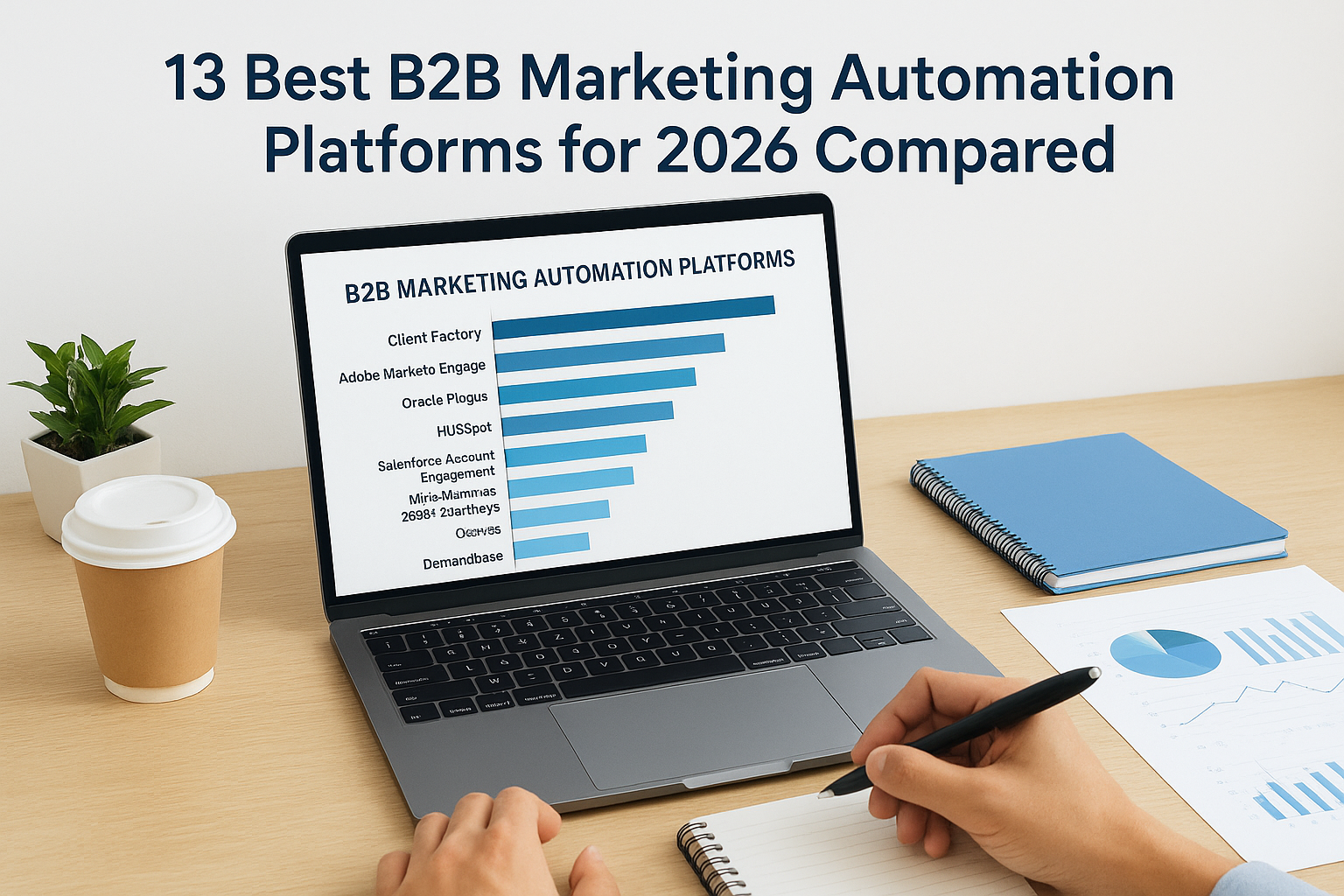
Choosing the right B2B marketing automation platforms can mean the difference between a pipeline that runs itself and one that constantly needs manual intervention. With dozens of options competing for your budget, each claiming to be the “complete solution”, evaluating features, pricing, and actual ROI becomes a real challenge.
That’s why we’ve done the heavy lifting. At Client Factory, we’ve spent years building data-driven client acquisition systems for service businesses and law firms, and marketing automation sits at the core of what makes those systems work. We know which platforms actually deliver and which ones just look good in demos.
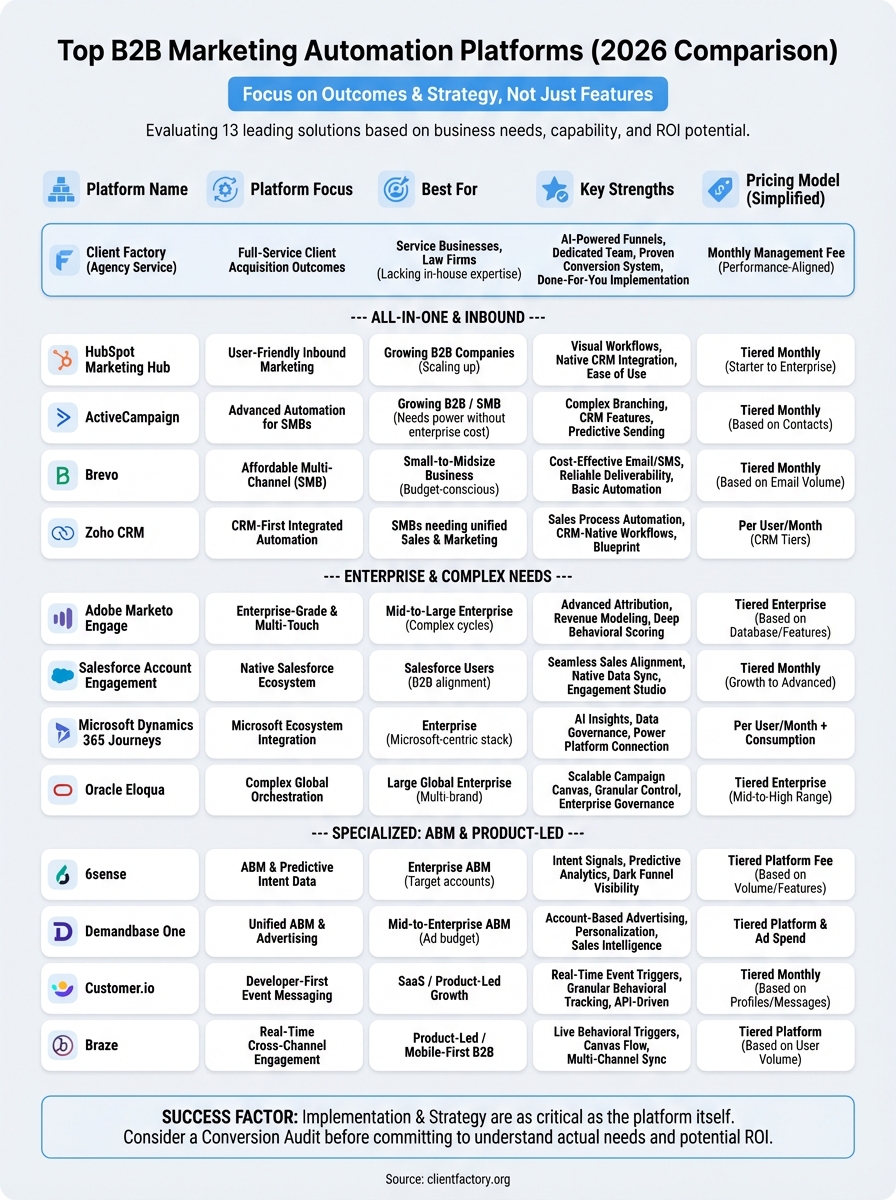
This guide breaks down 13 top platforms available in 2026. You’ll find honest comparisons of features, pricing tiers, and where each solution ranks, including insights from Gartner’s Magic Quadrant, so you can make a purchasing decision that fits your actual business needs.
1. Client Factory
Client Factory positions itself differently from traditional B2B marketing automation platforms by focusing specifically on client acquisition outcomes rather than just software features. Instead of handing you a platform to figure out yourself, you get a complete service that combines proprietary technology with hands-on implementation from a U.S.-based team with over 30 years of experience in digital marketing.
What it is
Client Factory operates as a full-service client acquisition agency that builds and manages custom marketing automation funnels for service businesses and law firms. The platform integrates AI-powered lead qualification, multi-channel campaign management, and conversion optimization into a single system that connects your paid advertising directly to booked appointments. You don’t just license software; you partner with a team that designs, deploys, and continuously optimizes your entire client acquisition system.
Best for
This solution works best for service businesses and law firms that need predictable client acquisition but lack the in-house expertise to build and manage complex automation systems themselves. You’ll see the most value if you’re currently struggling with low conversion rates from your marketing spend, inconsistent lead quality, or a disconnect between your advertising and actual client bookings. Legal practices dealing with competitive markets and service businesses scaling beyond referral-only growth fit this model particularly well.
How it works
Your engagement starts with a free conversion audit where the Client Factory team analyzes your current funnel to identify bottlenecks and missed opportunities. From there, they build a customized acquisition system that typically includes paid advertising management across Facebook, YouTube, and Google Ads, automated lead nurturing sequences, AI-powered qualification through their conversational agent Susan, and direct integration with your existing CRM or intake systems. The team handles campaign deployment, A/B testing, and ongoing optimization while providing transparent reporting on cost per qualified lead and client acquisition costs.
“Client Factory combines over 30 years of experience with a performance-first mindset to ensure optimized marketing funnels and a high ROI.”
What you get
Beyond the standard automation features found in most platforms, you receive dedicated account management, custom funnel design tailored to your specific service offerings, real-time performance dashboards tracking leads through to closed clients, and monthly strategy sessions with your account team. The inclusion of Susan, their AI assistant, provides immediate engagement with website visitors and qualification before human follow-up, which significantly improves response times and conversion rates.
Setup and implementation timeline
Implementation typically takes 4 to 6 weeks from contract signing to your first active campaigns. This timeline includes discovery and strategy development (week 1), funnel design and copywriting (weeks 2-3), technical setup and integration (week 4), testing and refinement (week 5), and full launch with monitoring (week 6). Unlike self-service platforms where you might spend months trying to configure everything correctly, Client Factory’s team handles the entire technical lift while keeping you informed at each milestone.
Pricing approach
Client Factory structures pricing based on monthly management fees rather than simple software licensing, reflecting the full-service nature of the offering. Pricing depends on your advertising budget, campaign complexity, and the number of lead sources being managed. Most service businesses and law firms invest between $3,000 and $10,000 monthly, which includes both the technology platform and the hands-on management that ensures it actually produces results. The pricing model aligns their success with yours since their reputation depends on delivering measurable ROI.
2. HubSpot Marketing Hub
HubSpot Marketing Hub stands as one of the most widely adopted B2B marketing automation platforms due to its user-friendly interface and unified approach to inbound marketing. The platform combines email automation, lead nurturing, landing pages, and analytics into a single system that integrates seamlessly with HubSpot’s CRM, making it accessible for teams without deep technical resources.
What it is
HubSpot Marketing Hub operates as a comprehensive marketing platform that handles everything from content creation to lead lifecycle management. You get drag-and-drop email builders, workflow automation, social media scheduling, and SEO recommendations all within one dashboard that your entire marketing team can access without extensive training.
Best for
This platform works best for growing B2B companies that need an all-in-one solution and value ease of use over advanced customization. You’ll find it particularly effective if you’re scaling from basic email marketing to sophisticated automation and want your sales and marketing teams working from the same data source.
Standout automation features
HubSpot offers visual workflow builders that let you create complex nurture sequences based on website behavior, email engagement, and CRM properties. The platform excels at list segmentation, automated lead scoring, and personalized email content that adjusts based on contact attributes. You can also automate internal notifications to your sales team when leads hit specific engagement thresholds.
CRM and data model fit
Since HubSpot CRM comes free and integrates natively with Marketing Hub, you maintain complete visibility across the entire customer journey. Contact records automatically update as leads engage with your marketing, and you can build custom properties to track any data point relevant to your business model.
“HubSpot’s unified data model means your marketing automation and CRM stay perfectly synchronized without manual intervention.”
Integrations and ecosystem
HubSpot connects with over 1,400 apps through its marketplace, including Salesforce, Slack, and most major business tools. The platform also offers a robust API for custom integrations when standard connectors don’t meet your needs.
Pricing notes
Marketing Hub starts at $800 monthly for the Professional tier (paid annually), which includes most automation features. Enterprise pricing begins at $3,600 monthly and adds advanced reporting, predictive lead scoring, and custom event triggers.
3. Adobe Marketo Engage
Adobe Marketo Engage ranks as one of the most sophisticated B2B marketing automation platforms available, particularly for enterprises running complex multi-touch attribution models and account-based strategies. The platform delivers advanced lead management, revenue cycle modeling, and predictive analytics that help larger marketing teams orchestrate campaigns across multiple channels while maintaining granular control over every touchpoint.
What it is
Marketo Engage functions as an enterprise-grade automation platform that connects your marketing activities directly to revenue outcomes. You get comprehensive tools for email marketing, lead nurturing, account-based marketing, and multi-channel campaign orchestration, all backed by Adobe’s broader Experience Cloud ecosystem that extends capabilities into content management and analytics.
Best for
This solution works best for mid-market to enterprise B2B companies with complex sales cycles and multiple stakeholders involved in purchasing decisions. You’ll see maximum value if you need sophisticated lead scoring models, detailed attribution reporting, and the ability to coordinate marketing efforts across numerous products or business units.
Standout automation features
Marketo excels at behavioral tracking and trigger-based workflows that respond to hundreds of possible engagement signals. The platform lets you build complex nurture streams with dynamic content that adjusts based on firmographic data, engagement history, and predicted conversion likelihood.
Data, scoring, and attribution strengths
The platform’s lead scoring engine processes both explicit data (company size, role, industry) and implicit behaviors (content downloads, webinar attendance, email engagement) to rank prospects accurately. Revenue cycle modeling gives you visibility into how leads progress through each stage and where bottlenecks occur in your funnel.

“Marketo’s attribution capabilities track the full customer journey across every touchpoint, helping you understand which campaigns actually drive pipeline.”
Integrations and ecosystem
Marketo connects natively with major CRMs including Salesforce and Microsoft Dynamics, and integrates with Adobe’s Experience Cloud for unified customer data. The platform also supports hundreds of third-party integrations through LaunchPoint, Adobe’s partner ecosystem.
Pricing notes
Marketo pricing starts around $1,200 monthly for basic functionality but typically runs $3,000 to $5,000 monthly for mid-market implementations. Enterprise contracts with advanced features often exceed $10,000 monthly, and pricing scales based on database size and feature requirements.
4. Salesforce Account Engagement
Salesforce Account Engagement (formerly Pardot) operates as the native marketing automation platform built directly into the Salesforce ecosystem. This platform gives you seamless connection between your marketing activities and your sales pipeline without the data sync issues that plague third-party integrations, making it a natural choice for companies already invested in Salesforce CRM.
What it is
Account Engagement delivers email marketing, lead nurturing, and scoring capabilities that live entirely within your Salesforce instance. You get access to engagement studios for building automated campaigns, dynamic content personalization, and landing page builders that capture leads directly into your existing CRM records.
Best for
This platform works best for B2B companies already using Salesforce Sales Cloud who need marketing automation that mirrors their sales processes. You’ll find maximum value if your sales team relies heavily on Salesforce reporting and you want marketing metrics to appear in the same dashboards they already use daily.
Standout automation features
The platform’s Engagement Studio lets you build multi-step nurture programs with branching logic based on prospect actions. You can automate lead assignment, create drip campaigns triggered by CRM field changes, and set up behavioral scoring that adjusts based on both marketing engagement and sales activity.
Salesforce-native advantages
Because Account Engagement runs natively on Salesforce, you maintain bi-directional data flow without middleware or integration platforms. Campaign members, lead scores, and engagement history sync instantly, and your sales team sees marketing touchpoints directly in their contact records.
“Native Salesforce integration means your marketing and sales data stays perfectly aligned without the complexity of third-party connectors.”
Integrations and ecosystem
While built for Salesforce, Account Engagement connects with webinar platforms, social media tools, and analytics systems through Salesforce’s AppExchange marketplace. The platform also supports API access for custom integrations when standard connectors don’t meet your requirements.
Pricing notes
Account Engagement pricing starts at $1,250 monthly for the Growth edition (paid annually), which includes basic automation features. Advanced editions run $2,500 to $15,000 monthly depending on database size and feature requirements.
5. Microsoft Dynamics 365 Journeys
Microsoft Dynamics 365 Journeys delivers enterprise-grade marketing automation that integrates deeply with the broader Microsoft ecosystem. This platform connects your marketing operations directly to Power Platform, Azure, and Microsoft 365, giving you access to advanced AI capabilities, robust data governance, and unified customer data that flows seamlessly between marketing, sales, and service teams.
What it is
Dynamics 365 Journeys operates as a comprehensive customer journey orchestration platform built natively within the Microsoft Dynamics 365 environment. You get tools for email marketing, event management, lead scoring, and multi-channel campaign automation that work directly with your existing Dynamics CRM data without requiring separate integrations or data synchronization.
Best for
This solution works best for enterprise B2B organizations already invested in the Microsoft technology stack who need advanced compliance capabilities and sophisticated data governance. You’ll find maximum value if your company operates in regulated industries requiring strict data controls or if you’re coordinating marketing efforts across multiple business units with complex organizational structures.
Standout automation features
The platform leverages AI-powered insights to optimize send times, predict customer actions, and recommend next-best actions for each contact. You can build sophisticated journey orchestrations that respond to customer behaviors across email, web, events, and custom channels while maintaining full control over timing and decision points.
“Dynamics 365 Journeys integrates Microsoft’s AI capabilities to deliver predictive lead scoring and intelligent campaign optimization out of the box.”
Data and governance strengths
Microsoft provides enterprise-level compliance features including GDPR tools, consent management, and data residency controls. The platform’s Common Data Model ensures consistent data structure across all Dynamics applications, making it easier to maintain accurate customer records.
Integrations and ecosystem
Dynamics 365 Journeys connects natively with Microsoft Teams, Outlook, and Power BI for seamless collaboration and reporting. The platform also integrates with LinkedIn for account-based marketing and supports custom connectors through Power Automate.
Pricing notes
Pricing starts at approximately $1,500 monthly for the base package, with enterprise implementations typically running $3,000 to $8,000 monthly depending on contact volume and feature requirements.
6. Oracle Eloqua
Oracle Eloqua stands as one of the most powerful B2B marketing automation platforms designed specifically for complex enterprise organizations managing sophisticated campaign structures across global markets. The platform delivers advanced segmentation capabilities, detailed campaign orchestration, and extensive customization options that support multi-brand, multi-region marketing operations at scale.
What it is
Eloqua operates as an enterprise-focused marketing automation solution built to handle intricate campaign workflows and massive contact databases. You get comprehensive tools for email marketing, lead management, campaign orchestration, and revenue attribution that support the complex requirements of large marketing teams coordinating across multiple products and geographies.
Best for
This platform works best for large enterprise B2B companies with multiple business units, complex approval processes, and global marketing operations. You’ll find maximum value if your organization needs granular permission controls, multi-language campaign support, and the ability to manage hundreds of simultaneous campaigns.
Standout automation features
Eloqua excels at campaign canvas orchestration where you build sophisticated multi-step campaigns with advanced branching logic and wait periods. The platform’s segmentation engine processes complex criteria combining firmographic data, behavioral signals, and custom business rules to target precisely the right audiences.
Enterprise orchestration strengths
The platform handles large-scale operations efficiently, supporting millions of contacts and thousands of campaigns without performance degradation. You gain detailed control over campaign execution timing, approval workflows, and compliance requirements that enterprise teams need.
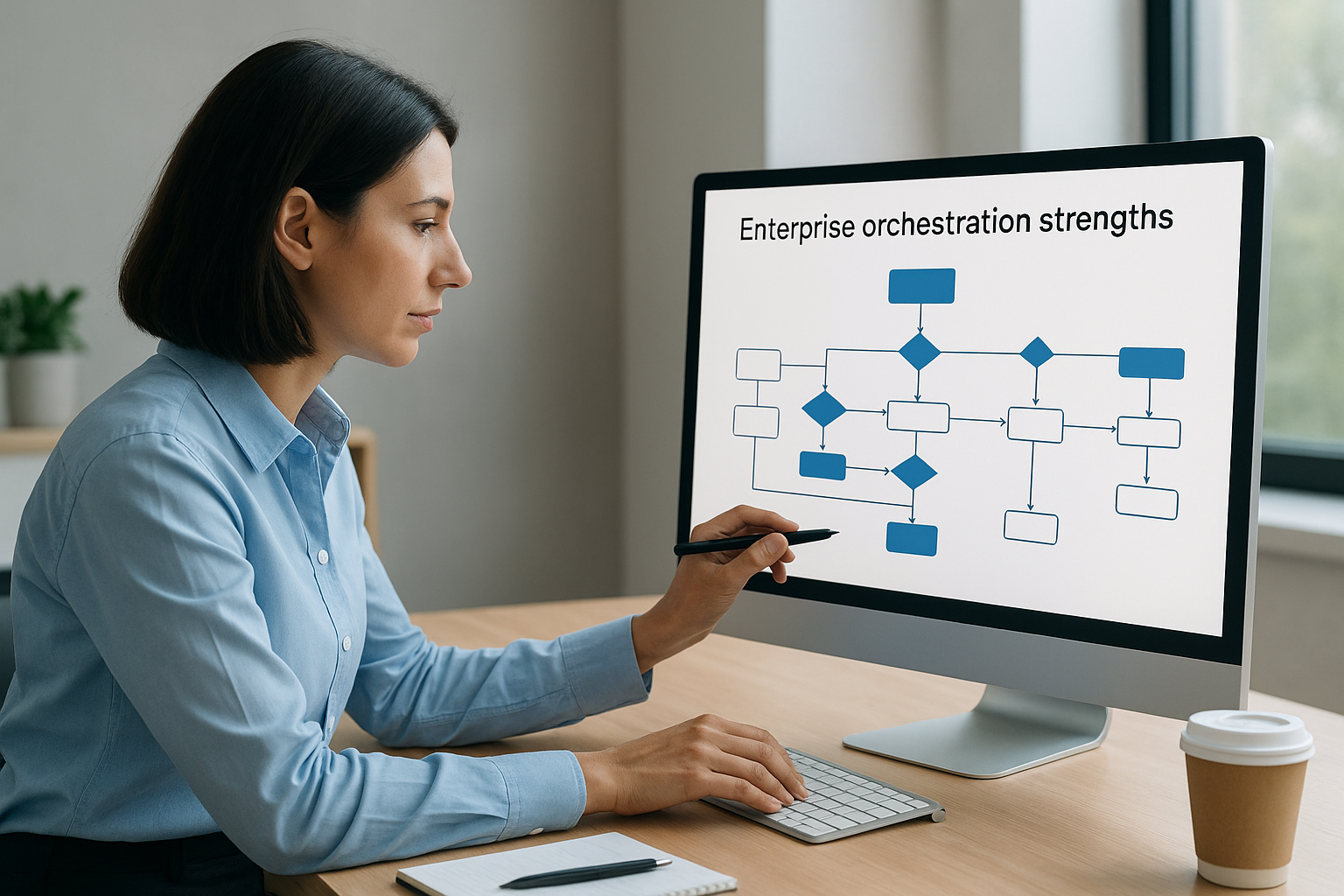
“Eloqua’s campaign canvas lets you orchestrate complex multi-touch campaigns that respond to hundreds of variables while maintaining enterprise-grade governance controls.”
Integrations and ecosystem
Eloqua integrates natively with Oracle CX Cloud and connects to major CRMs including Salesforce and Microsoft Dynamics. The platform supports extensive customization through APIs and webhooks for specialized business requirements.
Pricing notes
Eloqua pricing typically starts around $2,000 monthly for basic editions but enterprise implementations commonly run $4,000 to $12,000 monthly depending on contact volume and feature requirements.
7. 6sense
6sense distinguishes itself among B2B marketing automation platforms by focusing specifically on account-based marketing powered by predictive analytics and buyer intent data. The platform identifies which accounts actively research solutions in your category, even when those prospects haven’t directly engaged with your website or content yet, giving you the ability to prioritize outreach to accounts showing genuine purchase intent.
What it is
6sense operates as an AI-powered revenue platform that combines intent data, predictive analytics, and account-based orchestration into a unified system. You get visibility into anonymous buying behavior across the web, enabling you to identify target accounts based on their research patterns rather than waiting for them to fill out forms on your site.
Best for
This platform works best for enterprise B2B companies with defined target account lists and complex sales cycles involving multiple decision makers. You’ll find maximum value if your deals require six months or longer to close and you need to coordinate marketing and sales efforts across entire buying committees rather than individual contacts.
Standout ABM and intent features
6sense captures third-party intent signals from across the web to show you which accounts research topics related to your solutions. The platform’s AI engine scores accounts based on buying stage and predicted likelihood to purchase, letting you focus resources on opportunities with the highest conversion potential.
“6sense’s predictive analytics help you identify in-market accounts before your competitors reach them, giving you first-mover advantage in competitive deals.”
How it supports marketing to sales handoff
The platform provides account-level insights that sales teams can act on immediately, including detailed views of research topics, engagement patterns, and predicted buying stage. You can trigger automated alerts to sales reps when target accounts reach specific intent thresholds or engagement milestones.
Integrations and ecosystem
6sense integrates with Salesforce, Microsoft Dynamics, and major marketing automation platforms to enrich your existing data with intent signals and predictive scores. The platform also connects with advertising networks for orchestrating targeted campaigns.
Pricing notes
6sense pricing typically starts around $3,500 monthly but varies significantly based on account volume and feature requirements. Enterprise implementations commonly run $5,000 to $15,000 monthly depending on data sources and integration complexity.
8. Demandbase One
Demandbase One positions itself among B2B marketing automation platforms as an account-based marketing platform that unifies advertising, website personalization, and sales intelligence into a single system. The platform focuses on orchestrating coordinated experiences across paid media, owned channels, and sales touchpoints based on account-level insights and buying signals.
What it is
Demandbase One operates as an ABM platform that combines advertising technology, intent data, and engagement orchestration capabilities. You get tools for account identification, targeted display and social advertising, website personalization, and sales enablement that work together to deliver consistent experiences across every touchpoint where your target accounts interact with your brand.
Best for
This platform works best for mid-market to enterprise B2B companies running account-based strategies with significant advertising budgets. You’ll find maximum value if you need to coordinate marketing messages across paid channels and your website while providing your sales team with real-time account intelligence.
Standout ABM and advertising features
Demandbase excels at account-based advertising that targets specific companies across display networks, social platforms, and video channels. The platform’s website personalization engine adjusts content, calls-to-action, and messaging based on which account visits your site, creating tailored experiences without requiring manual segmentation.
“Demandbase One connects your advertising spend directly to account engagement metrics, helping you measure which campaigns influence pipeline at the account level.”
Measurement and account journey tracking
The platform provides account-level analytics that track engagement across all channels, showing you how target accounts progress through awareness, consideration, and decision stages. You can measure advertising impressions, website visits, content downloads, and sales interactions in a unified timeline.

Integrations and ecosystem
Demandbase integrates with Salesforce, Microsoft Dynamics, and major marketing automation platforms to sync account data and engagement signals. The platform also connects with advertising networks including LinkedIn, Google Ads, and programmatic exchanges.
Pricing notes
Demandbase pricing typically starts around $3,000 monthly but varies based on advertising spend and feature requirements. Enterprise implementations commonly run $5,000 to $12,000 monthly depending on account volume and integration complexity.
9. ActiveCampaign
ActiveCampaign bridges the gap between simple email marketing tools and complex enterprise platforms, offering sophisticated automation capabilities at a price point accessible to small and mid-sized B2B companies. The platform combines email marketing, CRM functionality, and behavioral tracking into a unified system that lets you build advanced nurture sequences without requiring a dedicated marketing operations team.
What it is
ActiveCampaign operates as a customer experience automation platform that handles email marketing, sales automation, and basic CRM functions. You get visual workflow builders, predictive sending, and machine learning recommendations that help you optimize campaigns based on historical engagement patterns.
Best for
This platform works best for growing B2B companies that need powerful automation features but lack enterprise budgets or technical resources. You’ll find maximum value if you’re scaling from basic email campaigns to sophisticated lifecycle marketing and want a platform you can implement without extensive consulting help.
Standout automation features
ActiveCampaign offers conditional branching and goal-based automation that adjusts nurture paths based on contact behavior. The platform’s predictive sending uses machine learning to determine optimal email delivery times for each contact, and you can trigger automations based on website visits, CRM field changes, and custom event tracking.
“ActiveCampaign’s automation builder lets you create complex workflows with the same level of control found in enterprise platforms at a fraction of the cost.”
Lead scoring and segmentation fit
The platform provides customizable lead scoring that combines demographic data with engagement behaviors to prioritize your hottest prospects. You can build dynamic segments that update automatically as contacts meet specific criteria.
Integrations and ecosystem
ActiveCampaign connects with over 850 third-party applications including Salesforce, WordPress, Shopify, and major webinar platforms through native integrations and Zapier.
Pricing notes
Pricing starts at $29 monthly for basic email marketing but scales to $149 monthly for the Professional tier with full automation features (based on 1,000 contacts).
10. Customer.io
Customer.io stands out among B2B marketing automation platforms by taking a developer-first approach to behavioral messaging and event-driven automation. The platform focuses on tracking granular user actions within your product or website and triggering highly personalized messages based on those specific behaviors, making it particularly effective for SaaS companies and product-led businesses.
What it is
Customer.io operates as an event-based messaging platform that connects directly to your product or application through APIs and SDKs. You get tools for sending targeted emails, in-app messages, push notifications, and SMS based on how users interact with your product, rather than relying solely on traditional form fills or email opens.
Best for
This platform works best for B2B SaaS companies and product-led businesses that need to automate onboarding, drive feature adoption, and reduce churn through behavioral triggers. You’ll find maximum value if your product generates frequent user events and you want to respond to those actions with timely, relevant messages.
Standout automation features
The platform excels at triggered campaigns based on product usage patterns, letting you send messages when users complete specific actions, reach certain milestones, or stop engaging with key features. You can build complex workflows that combine behavioral data with demographic attributes to create highly targeted automation sequences.
“Customer.io’s event-based approach lets you automate messages based on actual product usage rather than just marketing engagement.”
Data and event tracking fit
Customer.io captures unlimited custom events from your application, giving you complete flexibility in how you track and respond to user behaviors. The platform processes events in real-time and lets you segment users based on any combination of attributes and actions.
Integrations and ecosystem
Customer.io connects with Segment, Zapier, and major data warehouses for unified customer data. The platform also integrates with tools like Slack and webhooks for custom workflows.
Pricing notes
Pricing starts at $100 monthly for basic email functionality but scales to $1,000 monthly or more for advanced features based on contact volume and message sends.
11. Braze
Braze operates differently from traditional B2B marketing automation platforms by focusing on real-time, cross-channel customer engagement that responds to user behaviors as they happen. The platform excels at coordinating messages across email, mobile push, in-app notifications, SMS, and web channels based on sophisticated lifecycle triggers, making it particularly effective for B2B companies with product-led growth models or digital platforms.
What it is
Braze functions as a customer engagement platform built for real-time behavioral messaging across multiple channels. You get tools for orchestrating complex lifecycle campaigns that trigger based on user actions, custom events, and predictive analytics that anticipate what customers need next.
Best for
This platform works best for B2B SaaS companies and digital-first businesses that need to coordinate messaging across multiple touchpoints including web, mobile, and email. You’ll find maximum value if your customers interact with your product frequently and you want to drive adoption, retention, and expansion through behavioral triggers.
Standout lifecycle features
Braze delivers Canvas Flow, a visual journey builder that lets you create sophisticated lifecycle campaigns responding to hundreds of potential triggers. The platform processes events in real-time and supports A/B testing at every decision point to optimize conversion paths continuously.
“Braze’s real-time processing lets you respond to customer behaviors within seconds rather than waiting for batch processing cycles.”
Cross-channel orchestration fit
The platform coordinates message delivery across email, push notifications, in-app messages, and SMS while maintaining consistent frequency caps and message priority rules across all channels.
Integrations and ecosystem
Braze connects with Segment, mParticle, and major data warehouses for unified customer data. The platform also integrates with analytics tools and supports custom webhooks.
Pricing notes
Braze pricing typically starts around $2,000 monthly but varies significantly based on monthly active users and channels utilized.
12. Brevo
Brevo (formerly Sendinblue) positions itself among B2B marketing automation platforms as an accessible all-in-one solution that combines email marketing, SMS campaigns, and basic CRM functionality at price points significantly lower than most competitors. The platform delivers reliable automation capabilities without the complexity or steep learning curve that comes with enterprise tools, making it particularly attractive for small to mid-sized businesses looking to scale their marketing operations.
What it is
Brevo operates as a multi-channel marketing platform that handles email automation, transactional messaging, SMS campaigns, and chat functionality within a single interface. You get visual workflow builders, contact segmentation, and landing page creation tools that work together to support end-to-end campaign management.
Best for
This platform works best for small to mid-sized B2B companies with limited budgets who need reliable email and SMS automation without paying enterprise prices. You’ll find maximum value if you’re prioritizing deliverability and multi-channel messaging over advanced features like predictive analytics or sophisticated attribution modeling.
Standout automation features
Brevo provides workflow automation that triggers based on contact behavior, time delays, and custom attributes. The platform supports A/B testing, dynamic content personalization, and basic lead scoring to help you prioritize your most engaged prospects.
“Brevo’s pricing structure based on email volume rather than contact count makes it cost-effective for businesses with large databases but moderate sending needs.”
Email and SMS deliverability considerations
The platform maintains dedicated IP addresses for higher-tier plans and provides detailed deliverability reporting to help you monitor sender reputation and inbox placement rates.
Integrations and ecosystem
Brevo connects with WordPress, Shopify, and major CRM platforms through native integrations and supports API access for custom workflows.
Pricing notes
Pricing starts free for basic email marketing and scales to $65 monthly for automation features (based on 20,000 emails monthly).
13. Zoho CRM
Zoho CRM differs from most B2B marketing automation platforms by starting with a comprehensive CRM foundation and adding marketing automation as an integrated layer rather than bolting on basic CRM features to a marketing tool. The platform delivers workflow automation, email marketing, and lead management capabilities that work natively with your sales pipeline data, making it particularly effective for companies that want their marketing and sales teams working from a single unified system.
What it is
Zoho CRM operates as a complete customer relationship management platform with built-in marketing automation features including email campaigns, workflow rules, and lead scoring. You get tools for managing contacts, deals, and activities alongside automation capabilities that trigger based on CRM events and field changes.
Best for
This platform works best for small to mid-sized B2B companies that need both CRM and marketing automation in a single affordable package. You’ll find maximum value if you want to avoid managing separate systems and prefer marketing automation that responds directly to sales pipeline changes.
Standout automation features
Zoho provides blueprint automation that guides prospects through predefined stages with automated tasks, email sequences, and field updates. The platform supports time-based workflows, lead assignment rules, and custom functions that execute when specific criteria are met.
“Zoho’s CRM-native automation ensures your marketing workflows trigger directly from sales activities without requiring third-party integrations.”
CRM-first workflow fit
The platform excels at sales process automation where marketing sequences adjust based on deal stages, contact ownership changes, and pipeline velocity. You can automate follow-up sequences when deals stall or trigger re-engagement campaigns when opportunities close.
Integrations and ecosystem
Zoho connects with Google Workspace, Microsoft 365, and hundreds of business applications through native connectors. The platform also integrates with other Zoho products including Analytics, Projects, and Desk.
Pricing notes
Pricing starts at $14 per user monthly for basic CRM and scales to $52 per user monthly for the Enterprise tier with full automation features.
Next steps
Choosing from the 13 B2B marketing automation platforms we’ve covered requires honest assessment of your actual needs, budget, and internal capabilities. Most companies struggle not because they picked the wrong platform, but because they underestimated the implementation effort required to make any system deliver results. The software itself represents only half the equation; successful automation depends on strategy, quality content, and continuous optimization that turns features into actual client acquisition outcomes.
If you’re weighing whether to build your automation in-house or partner with a team that handles the entire technical lift, consider starting with a conversion audit of your current funnel. At Client Factory, we analyze where your existing client acquisition process loses prospects and identify specific improvements that drive measurable ROI. Schedule your free conversion audit to see exactly what’s holding back your marketing performance and how a properly implemented automation system can fix it.