
Most B2B companies waste thousands on lead generation that never converts. They chase every shiny tactic, spread budgets thin across channels, and wonder why their pipeline stays dry. The problem isn’t a lack of effort, it’s a lack of focus on b2b lead generation tactics that actually move the needle toward revenue, not just clicks.
At Client Factory, we’ve spent over 30 years helping service businesses and law firms turn marketing spend into qualified opportunities. We’ve seen what works, what falls flat, and what separates companies with predictable pipeline growth from those stuck in feast-or-famine cycles. The tactics that win aren’t always the flashiest, they’re the ones built on data, targeting precision, and relentless optimization.
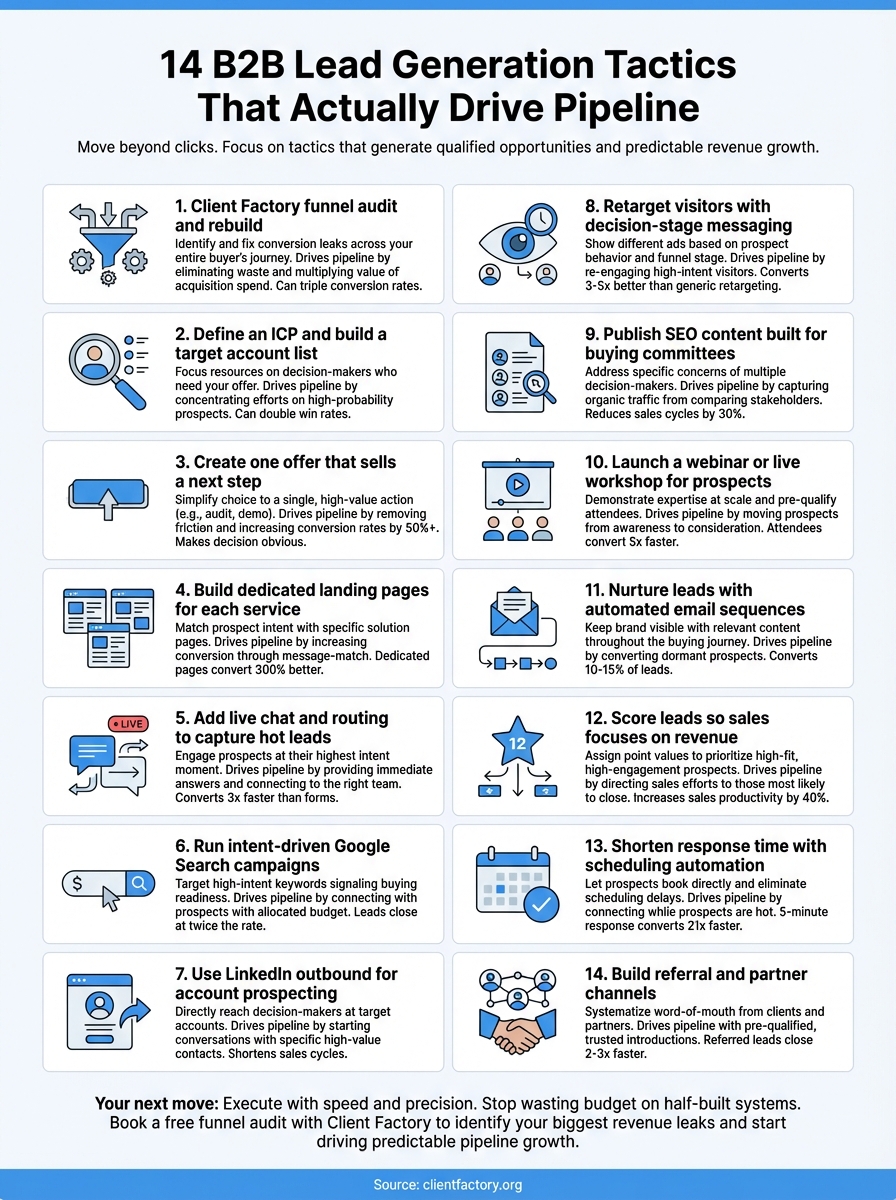
This guide breaks down 14 proven tactics that drive real results. Whether you’re looking to squeeze more conversions from your current funnel or build a client acquisition system from scratch, you’ll find actionable strategies you can put to work this quarter, no fluff, no theory, just what’s actually generating pipeline right now.
1. Client Factory funnel audit and rebuild
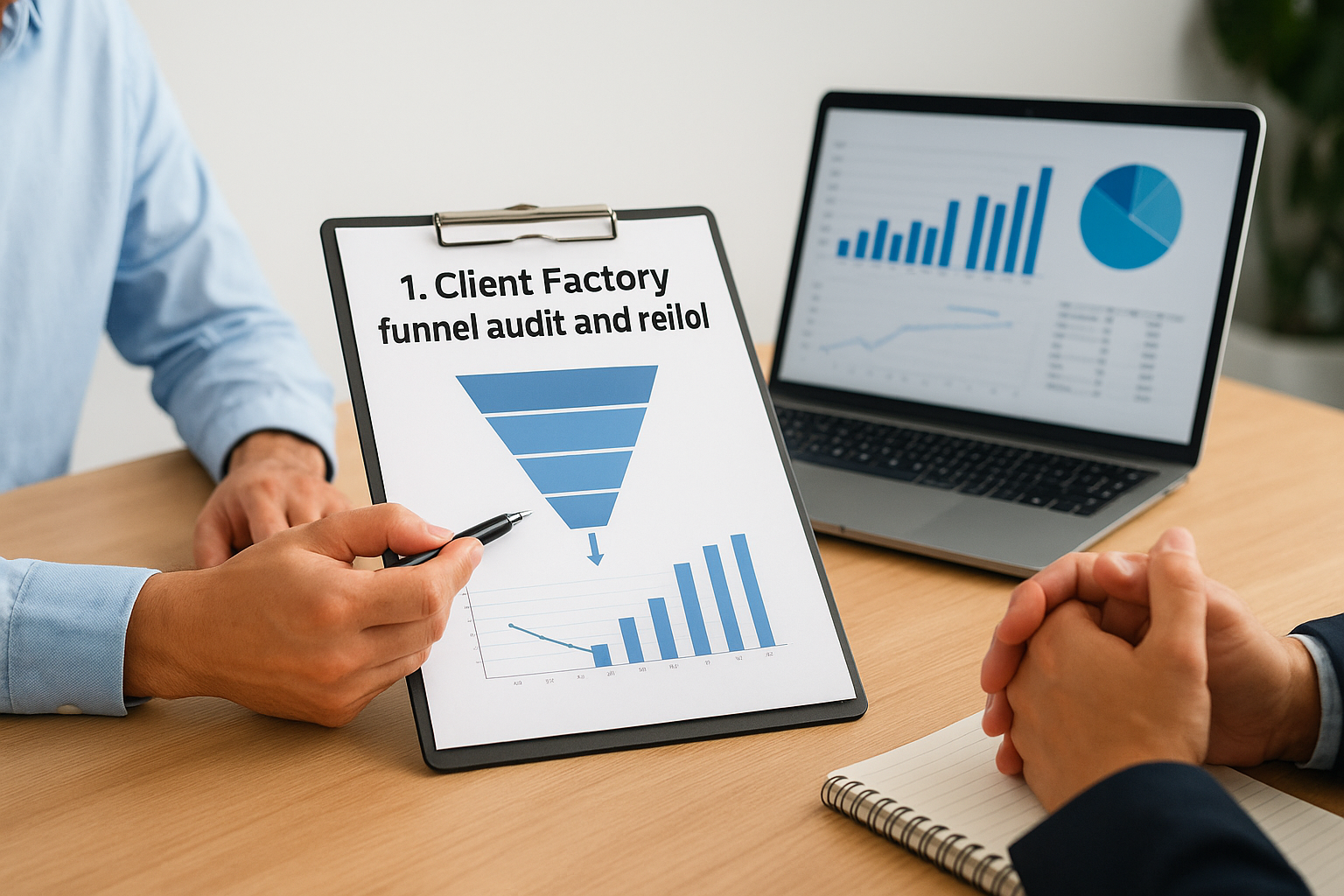
Your funnel might be bleeding revenue without you even knowing it. Most B2B companies launch marketing campaigns and build landing pages without auditing the entire conversion path, which means you’re spending money to send traffic into a broken system. Client Factory’s funnel audit and rebuild service identifies every leak in your acquisition process and fixes it with data-backed changes that increase conversions at every stage.
What this tactic is
A funnel audit examines every step of your buyer’s journey, from the first click to closed deal. You get a full breakdown of where prospects drop off, which messaging fails to convert, and what friction points kill momentum. Client Factory’s team analyzes your traffic sources, landing page performance, form submissions, call booking rates, and sales follow-up processes. Then they rebuild your funnel with optimized messaging, streamlined conversion paths, and proper tracking to capture every opportunity you’re currently losing.
How it drives pipeline
This tactic drives pipeline by eliminating waste and multiplying the value of every dollar you spend on acquisition. When you fix a funnel that converts at 2% and push it to 5%, you triple your lead volume without spending another cent on ads. You also shorten sales cycles because prospects who move through a well-designed funnel arrive more educated and ready to buy. Client Factory’s rebuilds focus on high-intent actions like call bookings and demo requests, not just form fills, which means your sales team gets qualified opportunities that actually close.
A properly audited and rebuilt funnel can triple conversion rates without increasing ad spend.
How to implement it fast
Start by requesting a free funnel audit from Client Factory. Their team will map your current conversion path and identify the biggest revenue leaks in your system. You’ll receive a detailed report showing exactly where you’re losing prospects and what changes will have the highest impact. Client Factory then handles the rebuild, from rewriting landing page copy to setting up conversion tracking and automations. Most audits and rebuilds take between two to four weeks, depending on complexity, and you start seeing improved conversion rates within the first month.
Metrics to track
Track your conversion rate at each funnel stage: ad click to landing page visit, visit to form submission, submission to call booked, and call booked to closed deal. Monitor your cost per qualified lead to see how the rebuild impacts your acquisition efficiency. Watch your sales cycle length because better-qualified prospects close faster. Finally, measure your return on ad spend before and after the rebuild to quantify the revenue impact of a properly optimized funnel.
2. Define an ICP and build a target account list
Spraying your message to everyone means connecting with no one. Most B2B companies waste budget targeting audiences that will never buy because they skip the foundational work of defining an Ideal Customer Profile and building a focused target account list. When you know exactly who you’re selling to, every dollar you spend on acquisition works harder because you’re reaching decision-makers who actually need what you offer.
What this tactic is
An Ideal Customer Profile defines the exact type of company that gets the most value from your service and has the budget to pay for it. You build this profile using firmographic data like industry, company size, revenue range, and growth stage. Then you create a target account list of specific businesses that match your ICP criteria. This list becomes the foundation for all your outbound prospecting, paid advertising targeting, and content distribution efforts.
How it drives pipeline
This tactic drives pipeline by concentrating your resources on prospects with the highest probability of conversion. You stop wasting ad spend on companies that can’t afford you or don’t have the problem you solve. Your sales team closes deals faster because they’re talking to qualified prospects instead of chasing dead ends. Marketing and sales alignment improves because everyone works from the same list of priority accounts, which shortens sales cycles and increases win rates.
A focused target account list can double conversion rates by eliminating prospects who were never going to buy.
How to implement it fast
Start by analyzing your best customers from the last 12 months. Identify common characteristics like industry, company size, technology stack, and growth indicators. Document these patterns into a written ICP that your entire team can reference. Build your initial target account list using LinkedIn Sales Navigator or similar tools to find 100 to 500 companies that match your profile. Prioritize accounts based on fit score and buying signals.
Metrics to track
Track your account coverage rate, which measures what percentage of your target list you’ve actually engaged. Monitor your win rate by account tier to confirm your ICP assumptions are correct. Measure average deal size from target accounts versus non-target accounts to quantify the revenue impact. Watch your sales cycle length for target accounts because proper ICP definition should reduce time to close.
3. Create one offer that sells a next step
Most B2B companies confuse prospects by offering too many options on a single page. You present case studies, whitepapers, consultations, and demos all at once, which paralyzes decision-making and kills conversions. The most effective b2b lead generation tactics simplify choice by presenting one clear offer that moves prospects to the next stage of your sales process, nothing more.
What this tactic is
A single-focus offer eliminates every distraction and drives visitors toward one specific action. Instead of giving prospects five ways to engage, you build your landing page, ad creative, and follow-up sequence around one next step that qualifies and advances the relationship. This might be booking a strategy call, requesting a custom audit, or scheduling a product demo. Your entire page exists to sell this single action, not to educate about every service you offer.
How it drives pipeline
This tactic drives pipeline by removing conversion friction and increasing your landing page conversion rate by 50% or more. Prospects stop overthinking their options because you’ve made the decision obvious. Your sales team gets more qualified conversations because everyone who converts took the same intentional step. Marketing attribution becomes clearer since you can directly tie campaign performance to a single conversion goal.
A focused offer can increase landing page conversions by 50% compared to pages with multiple calls to action.
How to implement it fast
Identify the highest-value action a prospect can take before they’re ready to buy. Build a dedicated landing page that sells only this action. Remove navigation menus, footer links, and secondary CTAs. Write your headline, benefits, and call-to-action around this single conversion goal. Test different offer formats like audits, workshops, or assessments to find what resonates with your ideal customer profile.
Metrics to track
Track your landing page conversion rate as your primary success metric. Monitor your cost per conversion to measure acquisition efficiency. Measure your show rate for booked calls to ensure the offer attracts serious prospects. Watch your conversion-to-opportunity rate because the right offer should pre-qualify leads before they reach sales.
4. Build dedicated landing pages for each service
Generic landing pages kill conversions because they force prospects to figure out which service solves their problem. You lose qualified leads when visitors can’t immediately see how your specific solution addresses their exact pain point. Dedicated landing pages for each service you offer eliminate confusion and match prospect intent to the right conversion path, which dramatically increases the percentage of visitors who become leads.
What this tactic is
A dedicated service landing page focuses on one specific solution you provide and speaks directly to prospects researching that exact offering. Instead of a homepage that lists everything you do, you build separate pages for each service like “PPC Management for Law Firms” or “SEO for SaaS Companies.” Each page includes targeted messaging, case studies relevant to that service, benefits specific to that solution, and a conversion form designed to capture prospects ready to buy that particular offering.
How it drives pipeline
This tactic drives pipeline by increasing your conversion rate through message-match and reducing bounce rates from paid traffic. When someone clicks an ad for “demand generation services” and lands on a page specifically about demand generation, they’re more likely to convert than if they land on a generic homepage. Your sales team receives pre-qualified leads who already understand what they’re buying, which shortens discovery calls and accelerates deal velocity.
Dedicated service pages can increase conversion rates by 300% compared to generic homepage traffic.
How to implement it fast
List every distinct service you offer and build one landing page per service. Write headlines that mirror the search terms prospects use when looking for that solution. Include three to five benefits, one to two case studies, and a single conversion form. Remove navigation links to keep visitors focused on conversion.
Metrics to track
Monitor your conversion rate for each service page to identify which offerings resonate strongest. Track bounce rate to measure message-match quality. Measure cost per lead by service to optimize your budget allocation across different offerings.
5. Add live chat and routing to capture hot leads
Most B2B websites miss their hottest prospects because no one responds when buyers are ready to talk. You lose qualified opportunities when visitors spend five minutes reading your service pages, then leave because they can’t get immediate answers to their questions. Live chat with intelligent routing captures prospects at their highest intent moment and connects them to the right person before they bounce to a competitor.
What this tactic is
Live chat places a conversation widget on your highest-traffic pages that lets visitors ask questions and book calls without filling out forms. Smart routing sends different types of inquiries to the appropriate team member based on the page they’re viewing, their company size, or the question they ask. You can route pricing questions to sales, technical questions to product specialists, and general inquiries to your support team. The system works 24/7 through chatbots that answer common questions and capture contact information when your team is offline.
How it drives pipeline
This tactic drives pipeline by catching prospects at their decision-making moment instead of making them wait hours or days for a response. You increase conversion rates because live chat removes the friction of form fills and email back-and-forth. Your sales team connects with higher-intent leads who have already consumed your content and are ready for a conversation. Response speed directly impacts close rates, prospects who get immediate answers convert at three times the rate of those who wait.
Prospects who engage with live chat convert at three times the rate of form submissions.
How to implement it fast
Choose a chat platform that integrates with your CRM and supports routing rules. Install the widget on your service pages, pricing page, and case study pages first. Set up routing rules that direct conversations based on page URL or visitor behavior. Create a library of saved responses for common questions your team answers repeatedly. Train your sales team to respond within 60 seconds during business hours.
Metrics to track
Track your chat engagement rate to measure what percentage of visitors start a conversation. Monitor your response time because speed directly impacts conversion quality. Measure your chat-to-opportunity conversion rate to quantify pipeline impact. Watch your conversation-to-meeting-booked rate since the goal is qualified sales conversations, not just chats.
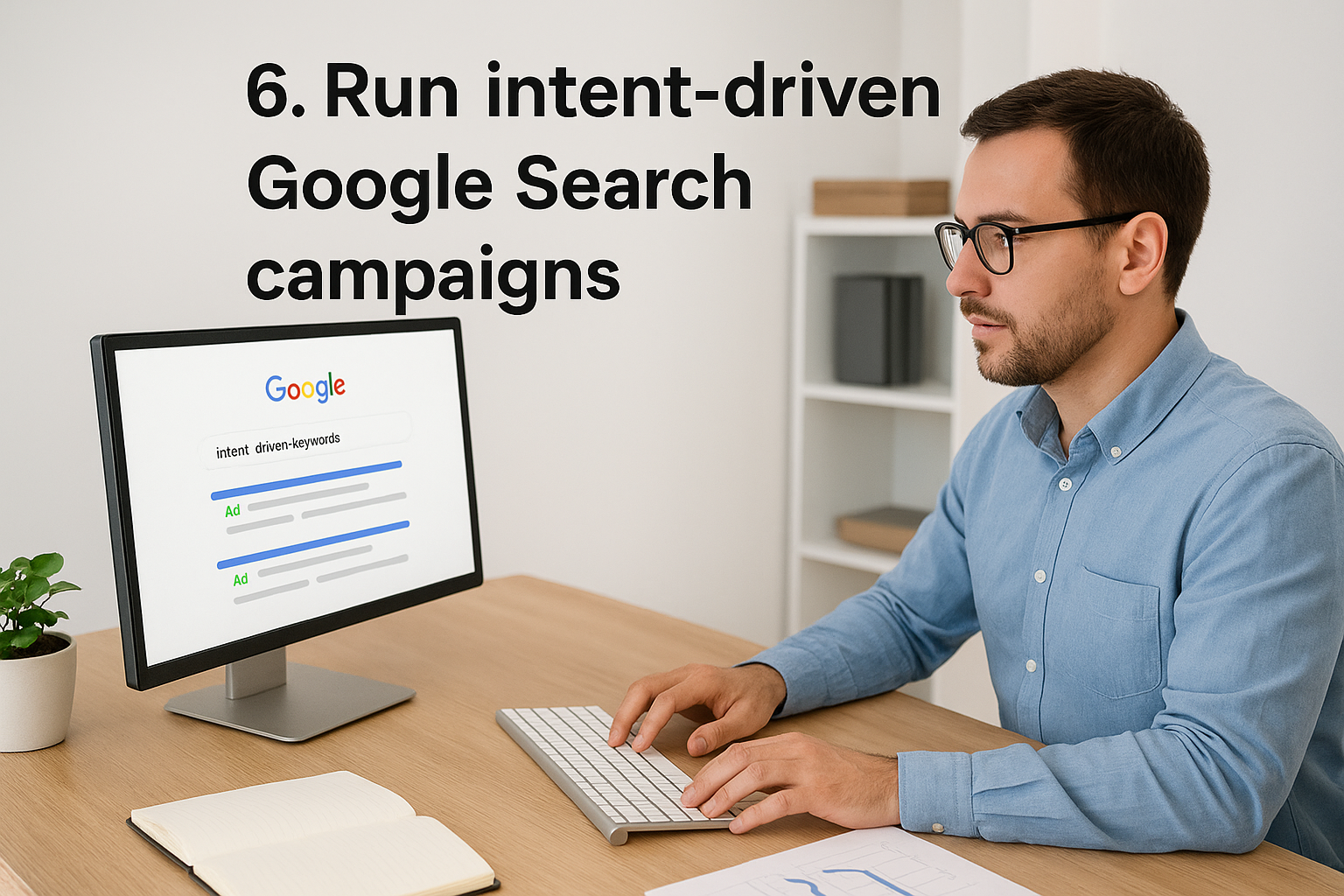
6. Run intent-driven Google Search campaigns
Most B2B companies waste their Google Ads budget on broad keywords that attract researchers instead of buyers. You pay for clicks from prospects who are months away from making a decision, which inflates your cost per lead and clogs your pipeline with unqualified contacts. Intent-driven Google Search campaigns target prospects who are actively searching for solutions they’re ready to buy, which means you capture demand instead of creating it.
What this tactic is
Intent-driven search campaigns focus your budget on high-intent keywords that signal buying readiness rather than educational research. You bid on phrases like “hire [service] agency” or “[solution] for [industry]” instead of broad terms like “what is [topic].” Your ad copy speaks directly to decision-makers searching for vendors, and your landing pages match the specific solution they’re researching. You also layer audience targeting to prioritize companies that match your ICP and exclude accounts that don’t fit.
How it drives pipeline
This tactic drives pipeline by connecting you with prospects who have budget allocated and timelines established. You reduce your sales cycle because these buyers have already completed their research phase and are comparing vendors. Your conversion rates increase because ad message, search intent, and landing page content all align perfectly. Intent-driven campaigns deliver qualified opportunities that close at twice the rate of awareness-stage traffic.
Intent-driven search campaigns deliver leads that convert at twice the rate of broad awareness-stage keywords.
How to implement it fast
Build separate campaigns for each service you offer using bottom-funnel keywords. Start with 10 to 20 high-intent keywords per service. Write ad copy that addresses the specific problem prospects are trying to solve. Send traffic to dedicated service landing pages that match search intent exactly.
Metrics to track
Monitor your conversion rate by keyword to identify which search terms drive the most qualified leads. Track cost per qualified lead instead of just cost per click. Measure your lead-to-opportunity conversion rate to confirm you’re attracting buyers, not researchers.
7. Use LinkedIn outbound for account prospecting
LinkedIn outbound prospecting puts your message directly in front of decision-makers at your target accounts instead of waiting for them to find you. Most b2b lead generation tactics rely on inbound discovery, which means you’re competing for attention against every other company in your space. LinkedIn prospecting flips this dynamic by letting you start conversations with specific people at specific companies when they’re most likely to be evaluating solutions like yours.
What this tactic is
LinkedIn outbound prospecting means sending personalized connection requests and direct messages to decision-makers at companies on your target account list. You identify the right people using filters like job title, company size, and industry, then reach out with messages that reference their specific challenges or recent company activity. This approach works best when combined with a clear ICP because you’re not messaging everyone, you’re targeting the exact people who have the authority and budget to buy what you sell.
How it drives pipeline
This tactic drives pipeline by creating sales conversations with accounts that might never discover you organically. You control who you talk to and when you reach out, which means you can prioritize high-value accounts and strike while they’re in active buying cycles. Your response rates increase when you personalize outreach based on company news, job changes, or funding announcements. LinkedIn prospecting also shortens sales cycles because you’re talking directly to buyers instead of nurturing them through months of content.
LinkedIn outbound can generate qualified conversations with decision-makers who would take months to reach you through inbound channels.
How to implement it fast
Build a list of target accounts from your ICP and identify two to three decision-makers at each company using LinkedIn Sales Navigator. Write a connection request template that mentions a specific pain point your service solves. Send 20 to 30 connection requests per day to stay within LinkedIn’s limits. Follow up with accepted connections using a short message that offers value, like a relevant case study or industry insight, before pitching your service.
Metrics to track
Track your connection acceptance rate to measure how well your requests resonate with your target audience. Monitor your reply rate to gauge message effectiveness. Measure your conversation-to-meeting-booked rate because pipeline impact comes from qualified calls, not just LinkedIn chats. Watch your meeting-to-opportunity conversion rate to confirm you’re reaching the right decision-makers who can actually buy.
8. Retarget visitors with decision-stage messaging
Most retargeting campaigns waste budget showing generic brand ads to people who already visited your site once and left. You lose pipeline opportunities when you treat all visitors the same instead of adjusting your message based on behavior. Retargeting with decision-stage messaging shows different ads to prospects based on which pages they viewed and how far they traveled through your conversion funnel, which turns cold traffic into qualified opportunities.
What this tactic is
Decision-stage retargeting segments your website visitors based on the specific pages they viewed and delivers ads that match their buying stage. Someone who only visited your homepage sees educational content about your approach. A prospect who viewed your pricing page but didn’t convert sees case studies and testimonials. Visitors who started a form but abandoned it get reminded to complete their request with a limited-time consultation offer. You create separate audience segments for each funnel stage and craft messaging that addresses the exact questions or objections preventing conversion.
How it drives pipeline
This tactic drives pipeline by re-engaging high-intent prospects who showed buying signals but didn’t convert on their first visit. You increase your conversion rate by three to five times compared to generic retargeting because your message acknowledges where prospects are in their decision process. Sales cycles shorten when you address specific objections through targeted ads instead of waiting for prospects to return organically.
Decision-stage retargeting converts at three to five times the rate of generic brand awareness retargeting.
How to implement it fast
Create audience segments in your ad platform based on page visits: homepage only, service pages, pricing page, and form abandonment. Build three ad variations per segment that address different stages of the buying journey. Set frequency caps at two to three impressions per week to avoid ad fatigue. Start with a 30-day retargeting window and adjust based on your typical sales cycle length.
Metrics to track
Monitor your conversion rate by audience segment to identify which retargeting messages drive the most pipeline. Track your cost per conversion for retargeting versus cold traffic to measure efficiency gains. Measure your return visit rate to understand how many prospects come back after seeing your ads.
9. Publish SEO content built for buying committees
Most B2B content targets individual readers instead of the multiple stakeholders who actually make buying decisions. You waste your SEO investment when you write for one person because enterprise purchases involve three to seven decision-makers who all need different information. Content built for buying committees addresses the specific concerns of each stakeholder, from technical evaluators to financial approvers, which multiplies your organic search value and accelerates deal velocity.
What this tactic is
SEO content for buying committees creates articles, guides, and comparison pages that answer questions from every role involved in purchasing your solution. You publish content that addresses the CFO’s ROI concerns, the technical lead’s implementation questions, and the end user’s workflow impact. Each piece targets bottom-funnel keywords that decision-makers search when they’re actively evaluating vendors. You structure your content to surface in search results for comparison queries, specific use cases, and implementation considerations that multiple stakeholders research during their buying process.
How it drives pipeline
This tactic drives pipeline by capturing organic search traffic from prospects who are comparing solutions and building their business case. You shorten sales cycles because buyers arrive educated about your approach and pre-sold on your value proposition. Your close rates increase when content addresses stakeholder objections before they reach your sales team. Committee-focused content also improves your search visibility for high-intent commercial keywords that competitors overlook because they’re only writing for one buyer persona.
Committee-focused SEO content can reduce sales cycles by 30% by pre-educating all stakeholders before they engage with sales.
How to implement it fast
Map the buying committee roles at your target accounts and list the top three questions each role asks during evaluation. Create one content piece per role that answers those questions with data, case studies, and implementation details. Target keywords like “[solution] for [role]” or “how to evaluate [category].” Publish these pages under your main domain and interlink them to improve SEO authority.
Metrics to track
Track your organic traffic to committee-focused pages to measure search visibility. Monitor your keyword rankings for commercial intent terms that buying committees search. Measure your content-to-opportunity conversion rate to confirm these pages attract qualified buyers.
10. Launch a webinar or live workshop for prospects
Webinars and live workshops position you as the expert before prospects ever book a sales call. Most b2b lead generation tactics focus on capturing contact information without building trust first, which means your sales team spends half their time convincing skeptical leads you know what you’re doing. Educational sessions let you demonstrate expertise at scale, pre-qualify attendees based on engagement, and create natural transition points to sales conversations with prospects who already believe in your approach.
What this tactic is
A prospect-focused webinar delivers valuable training or insights on a specific challenge your ideal customers face, then positions your service as the natural solution. You pick one pain point your ICP struggles with, build a 30 to 45 minute presentation that teaches them how to solve it, and include real examples from your client work. Live workshops work the same way but add interactive elements like Q&A sessions, worksheets, or group exercises that increase engagement and qualification signals.
How it drives pipeline
This tactic drives pipeline by moving prospects from awareness to consideration in a single session instead of over weeks of email nurturing. You shorten sales cycles because attendees who stay for the full session arrive at discovery calls already educated about your methodology and convinced you can help. Your close rates increase when you convert webinar attendees because they’ve self-selected as qualified prospects who invested time learning your approach.
Webinar attendees who engage for the full session convert at five times the rate of cold leads.
How to implement it fast
Choose one high-value problem your best clients hired you to solve. Build a presentation that teaches prospects how to diagnose and address this problem using your framework. Promote the webinar through email, LinkedIn, and retargeting ads to your target account list. Host it live using basic webinar software and record it for follow-up nurturing.
Metrics to track
Track your registration-to-attendance rate to measure topic relevance and promotion effectiveness. Monitor average watch time to identify which content keeps prospects engaged. Measure your attendee-to-opportunity conversion rate because pipeline impact matters more than registration volume.
11. Nurture leads with automated email sequences
Most leads die in your CRM because you expect prospects to remember you after a single website visit or downloaded asset. You lose qualified opportunities when you fail to stay top-of-mind during the weeks or months prospects spend researching solutions. Automated email sequences keep your brand visible throughout the buying journey, educate leads on your value proposition, and create natural re-engagement points that move cold contacts back into active pipeline.
What this tactic is
Automated email nurture sequences send a series of timed messages to leads based on their behavior and position in your funnel. You build separate sequences for different entry points like webinar attendees, ebook downloaders, or trial signups. Each sequence delivers relevant content that addresses common questions, shares case studies, and demonstrates your expertise without requiring manual sends from your team. Most effective sequences run between five to eight emails spaced three to seven days apart.
How it drives pipeline
This tactic drives pipeline by converting prospects who weren’t ready to buy during their first interaction with your brand. You increase your lead-to-opportunity rate by staying visible during the consideration phase when competitors might disappear. Automated sequences also free your sales team to focus on hot prospects while marketing handles early-stage education. Properly designed nurture campaigns can convert 10 to 15 percent of dormant leads into sales conversations.
Well-designed nurture sequences convert 10 to 15 percent of dormant leads into qualified sales conversations.
How to implement it fast
Map your lead sources and create one email sequence per source. Write five emails that move from education to consideration to decision-stage content. Set up triggers in your email platform to automatically enroll new leads based on their form submission or page visit. Include clear calls-to-action in emails three and five that direct prospects to book a call.
Metrics to track
Monitor your email open rates to gauge subject line effectiveness and audience engagement. Track your click-through rate to measure content relevance. Measure your sequence-to-opportunity conversion rate to quantify pipeline impact and identify which nurture paths drive the most revenue.
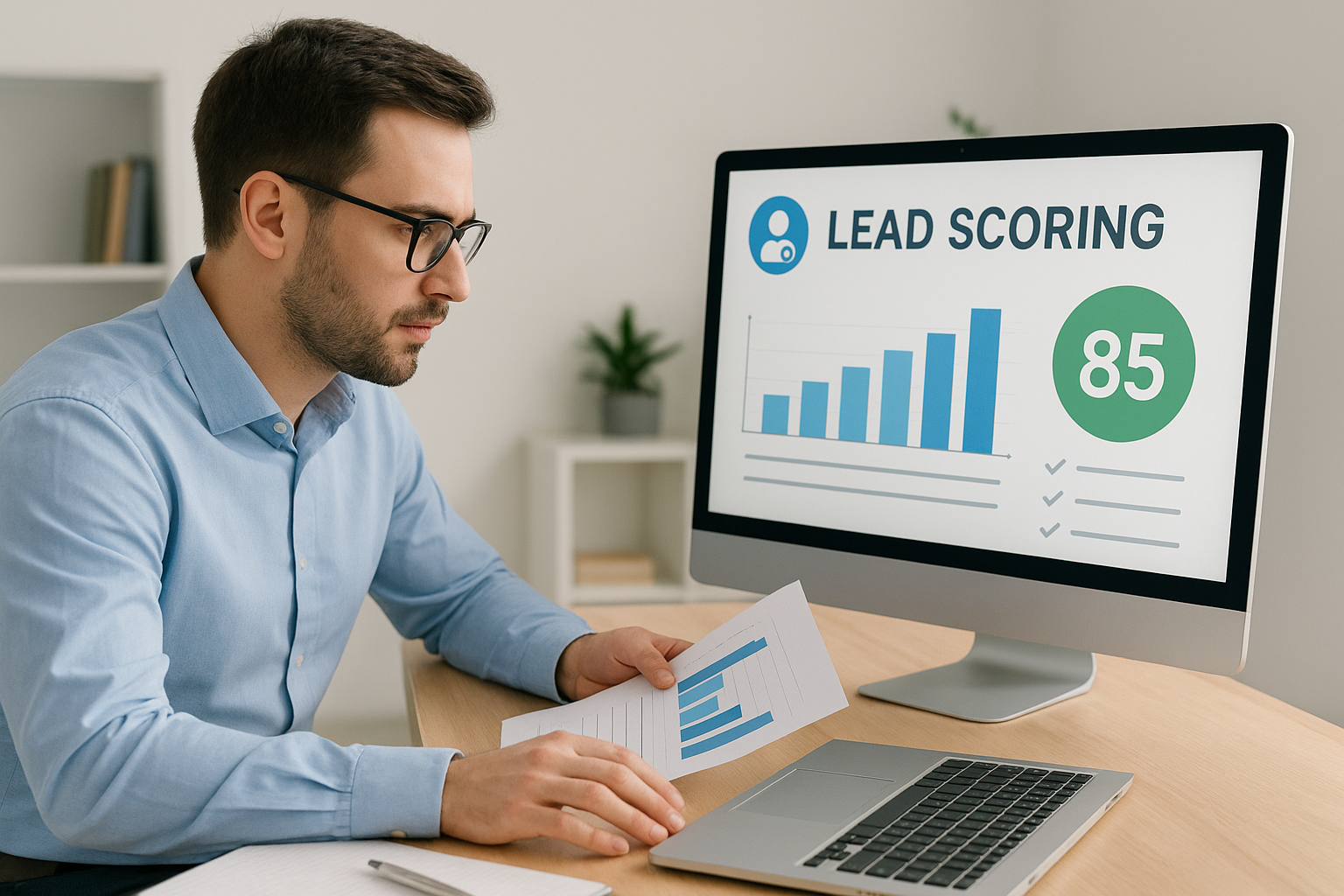
12. Score leads so sales focuses on revenue
Your sales team wastes hours chasing prospects who will never buy while qualified opportunities sit ignored in your CRM. Most b2b lead generation tactics treat all leads equally, which means your closers spend as much time on tire-kickers as they do on decision-makers with budget. Lead scoring assigns numerical values to prospects based on their fit and behavior, then routes high-scoring leads to sales immediately while keeping low-quality contacts in automated nurture until they’re actually ready to buy.
What this tactic is
Lead scoring assigns point values to demographic data and behavioral signals that indicate buying readiness. You award points when prospects match your ICP criteria like company size, industry, or job title. You also track engagement behaviors like pricing page visits, case study downloads, or email clicks. When a lead’s combined score crosses your threshold, typically 75 to 100 points, your system automatically alerts sales or books a call.
How it drives pipeline
This tactic drives pipeline by directing your sales resources toward prospects most likely to close instead of spreading effort across unqualified contacts. Your close rates increase because scored leads have already demonstrated both fit and interest before they reach your team. Sales cycles shorten when reps focus on hot prospects instead of nurturing cold leads who need months of education.
Lead scoring can increase sales productivity by 40% by eliminating time spent on unqualified prospects.
How to implement it fast
Define your scoring criteria by analyzing which attributes your best customers shared before they bought. Assign points for firmographic fit and behavioral engagement in your marketing automation platform. Set your qualification threshold and create automatic workflows that notify sales when leads cross it.
Metrics to track
Monitor your scored-lead-to-opportunity conversion rate to validate your scoring model. Track sales acceptance rate to measure whether sales agrees with your qualification criteria. Measure average deal size by score range to confirm high-scoring leads generate more revenue.
13. Shorten response time with scheduling automation
Speed kills deals when prospects wait days for your sales team to find mutual availability for a call. You lose qualified opportunities to faster competitors when your manual back-and-forth scheduling process adds friction between lead capture and actual conversation. Scheduling automation eliminates the email ping-pong by letting prospects book directly into your team’s calendar the moment they convert, which cuts your response time from hours or days down to seconds.
What this tactic is
Scheduling automation embeds calendar booking links directly in your confirmation emails, chatbot responses, and landing page thank-you messages. Prospects see available time slots pulled from your team’s real calendar and book meetings instantly without waiting for a sales rep to respond. The system automatically sends confirmation emails, reminder sequences, and updates both the prospect’s and your team’s calendars. You can route different types of leads to specific team members based on geography, deal size, or service interest.
How it drives pipeline
This tactic drives pipeline by connecting with prospects while they’re still hot and engaged instead of letting them cool off during scheduling delays. Your show rate increases because prospects who book their own meetings feel more committed to attending. Sales cycles compress when you eliminate the three to five day lag most companies experience between form submission and first conversation. Response speed directly correlates with conversion rates, leads contacted within five minutes convert at 21 times the rate of those reached after 30 minutes.
Leads contacted within five minutes convert at 21 times the rate of those reached after 30 minutes.
How to implement it fast
Add booking links from tools like Google Calendar or Microsoft Outlook to your form confirmation pages and automated email replies. Set availability windows that match your team’s actual selling hours. Create routing rules that assign leads to the right rep based on territory or specialization. Enable automatic reminder emails 24 hours and one hour before scheduled calls.
Metrics to track
Track your time-to-first-meeting metric to measure how quickly prospects move from conversion to conversation. Monitor your meeting show rate because automation should improve attendance compared to manual scheduling. Measure your meeting-to-opportunity conversion rate to confirm faster response times deliver better-qualified conversations.
14. Build referral and partner channels
Your best leads come from people who already trust you, but most B2B companies treat referrals as happy accidents instead of systematic revenue channels. You leave money on the table when you rely solely on paid acquisition and content marketing while ignoring the qualified introductions your satisfied clients and industry partners can deliver. Building formal referral and partner channels turns word-of-mouth recommendations into a predictable pipeline source that delivers higher close rates at zero acquisition cost.
What this tactic is
Referral and partner channels create structured programs that incentivize others to send qualified prospects your way. Referral programs reward existing clients for introducing you to companies that match your ICP. Partner channels establish relationships with complementary service providers who serve the same audience but don’t compete with your offerings. You formalize these relationships with clear referral processes, commission structures, and mutual value propositions that make sending business your direction easy and worthwhile for your partners.
How it drives pipeline
This tactic drives pipeline by delivering pre-qualified prospects who arrive with built-in trust from their referral source. Your close rates double or triple because referred leads skip the skepticism phase that slows down cold outreach. Sales cycles compress when prospects come through trusted introductions instead of discovering you through generic search results. Partner channels also expand your market reach by connecting you with audiences you couldn’t afford to target through paid advertising alone.
Referred leads close at two to three times the rate of cold prospects and typically generate 30% higher lifetime value.
How to implement it fast
Document a simple referral process that takes partners less than five minutes to complete. Create an incentive structure that rewards successful introductions with cash bonuses, service credits, or revenue sharing. Identify five to ten potential partners who serve your ICP without competing directly. Reach out with a specific proposal that explains what types of referrals you’re seeking and what you’ll provide in return.
Metrics to track
Monitor your referral volume by source to identify which partners deliver the most qualified introductions. Track your referral-to-opportunity conversion rate to measure lead quality from different channels. Measure your partner activation rate to understand what percentage of your network actively sends referrals.
Your next move
You now have 14 proven b2b lead generation tactics that companies use to fill their pipelines with qualified opportunities. The difference between reading this list and actually growing your business comes down to execution speed and systematic implementation. Most companies pick one or two tactics and spend months trying to implement them without expert guidance, which means they waste budget on half-built systems that never deliver results.
Client Factory eliminates that risk by auditing your entire funnel, identifying your biggest revenue leaks, and rebuilding your conversion path in weeks instead of months. Our team has spent over 30 years helping service businesses and law firms turn marketing spend into closed deals. We know which tactics will work for your specific situation because we’ve tested them across hundreds of clients in competitive markets.
Book your free funnel audit and get a detailed breakdown of where you’re losing revenue right now and what fixes will drive the biggest pipeline impact.