

Most B2B companies have the same problem: they’re spending money on marketing but not seeing it translate into actual sales conversations. Campaigns run, content gets published, ads get clicks, and yet the pipeline stays thin. The issue usually isn’t effort. It’s that the b2b demand generation tactics being used are either outdated, disconnected from the buyer’s journey, or simply not designed to create real purchase intent.
Pipeline doesn’t come from awareness alone. It comes from a deliberate system that moves the right buyers from “never heard of you” to “let’s talk”, and does it consistently. That’s the kind of system we build every day at Client Factory, where our entire focus is turning clicks into clients through data-driven funnels, paid media, and SEO strategies built for measurable business outcomes.
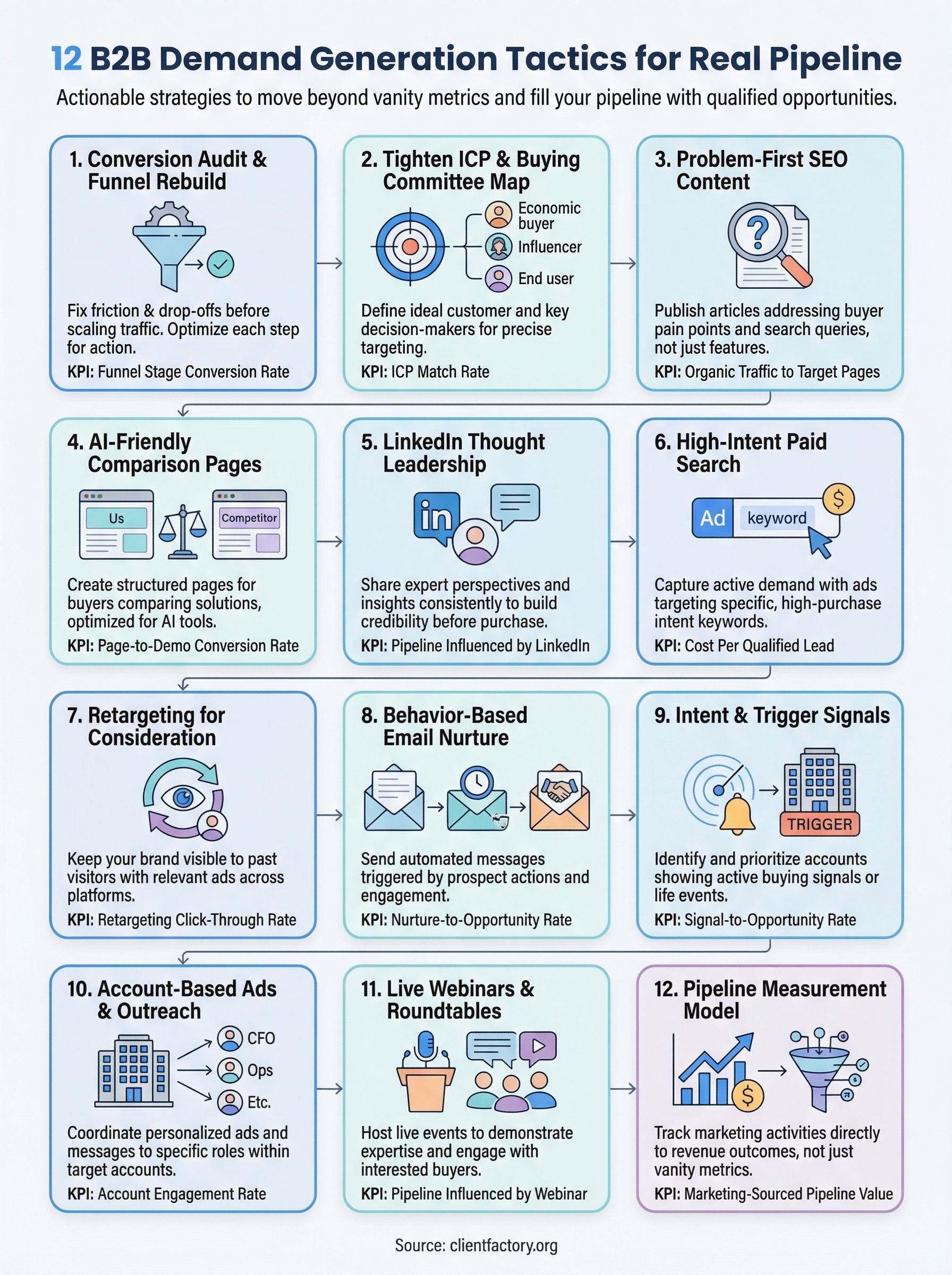
This article breaks down 12 specific tactics that generate demand and fill your pipeline with qualified opportunities, not vanity metrics. Whether you run a service business, a law firm, or any B2B operation looking to scale, you’ll walk away with actionable strategies you can implement now and a clear picture of how each tactic fits into a larger acquisition engine. Let’s get into it.
1. Run a conversion audit and funnel rebuild
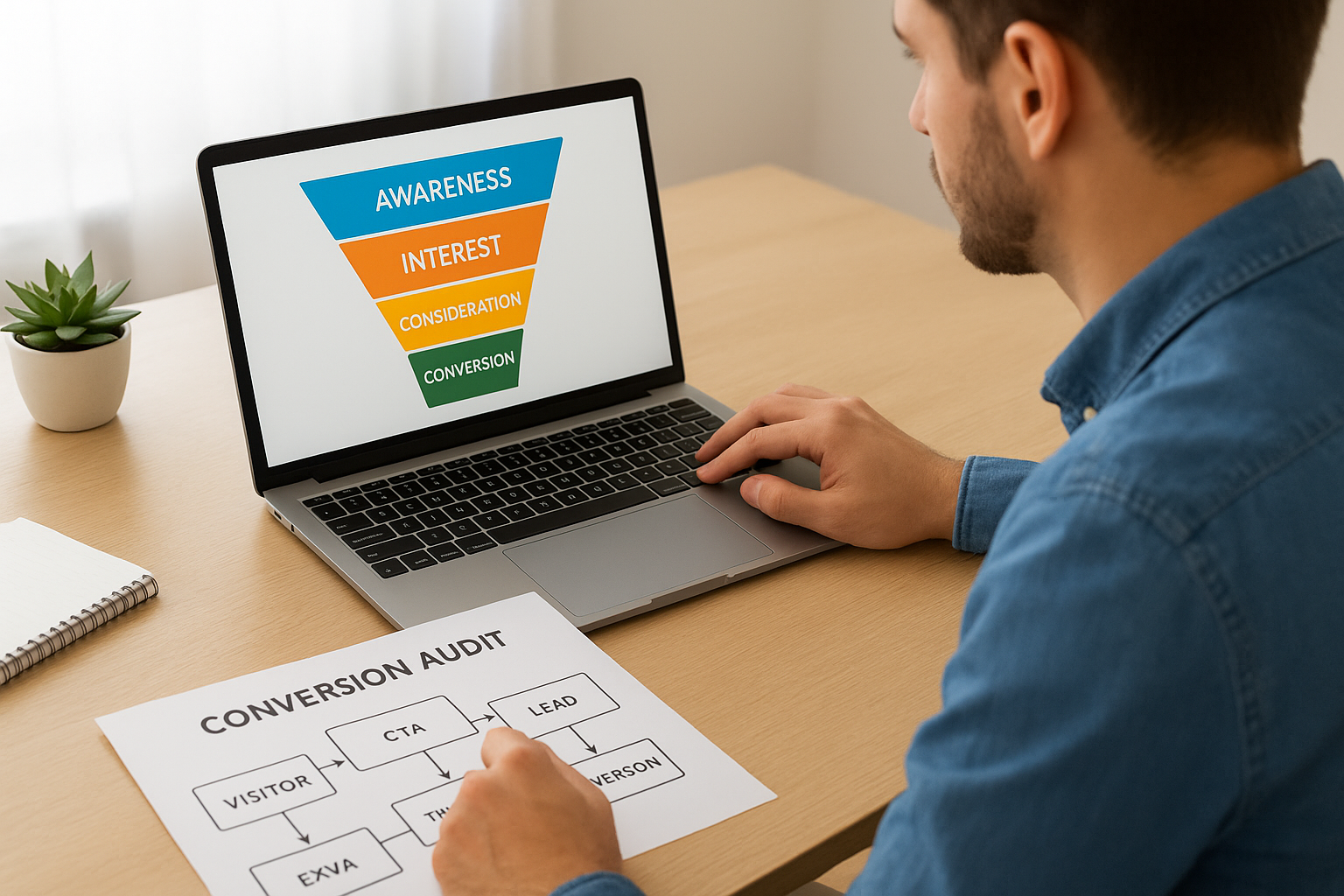
Before you add more traffic to your funnel, you need to understand where buyers are dropping off and why they’re not converting. Most B2B companies skip this step and pour budget into demand generation tactics that send people into a broken system. A conversion audit and funnel rebuild fixes the foundation so every downstream tactic you run actually produces pipeline instead of just activity.
What it is
A conversion audit is a structured review of every touchpoint in your marketing and sales funnel, from the first ad or search result a prospect sees to the moment they book a call or submit a form. You’re looking for friction points, messaging gaps, and structural failures that bleed qualified leads before they ever reach your sales team.
A funnel rebuild takes the findings from that audit and reconstructs the flow with clear stages, aligned messaging, and conversion-optimized assets at each step. You’re not just patching what’s broken. You’re building a deliberate path from awareness to action that matches how your buyers actually make decisions.
Most B2B funnels don’t fail because of bad traffic. They fail because the path from awareness to action is unclear, inconsistent, or broken in ways the team never stopped to diagnose.
How to run it
Start by mapping every step a buyer takes from first contact to closed deal, then pull performance data at each stage. Look at landing page conversion rates, form completion rates, email click rates, ad click-through rates, and call booking rates. Identify where the biggest drop-offs occur. Google Analytics 4 gives you behavioral data to see exactly where users leave and what they do before they go.
Once you’ve pinpointed the breaks, prioritize fixes by impact. Rebuild landing pages converting under 2%, rewrite vague CTAs, restructure lead nurture sequences that go quiet after the first email, and align your ad creative with the page content it sends people to. Test one change at a time so you know what’s actually moving the numbers.
Where it fits in the funnel
The conversion audit touches every stage simultaneously, which is what makes it the highest-leverage starting point in any demand generation program. Fixing top-of-funnel landing rates, mid-funnel nurture drop-off, and bottom-of-funnel conversion to booked meetings all happen in one concentrated effort. Without this work done first, every other tactic on this list will underperform relative to the budget you put behind it.
KPIs to track
After a funnel rebuild, watch these specific metrics to confirm your changes are working:
- Funnel stage conversion rates: The percentage of prospects who move from one stage to the next
- Cost per qualified lead: What you pay to bring in a lead who actually fits your buyer profile
- Lead-to-opportunity rate: How many leads turn into real sales conversations
- Time to first conversion: How long it takes a new visitor to take a meaningful action
- Form completion rate: The percentage of visitors who start and finish your lead capture forms
2. Tighten your ICP and buying committee map
Running any b2b demand generation tactic against a vague audience profile wastes budget fast. Before you scale campaigns, you need precise clarity on who you’re targeting and who else sits inside that purchasing decision alongside them.
What it is
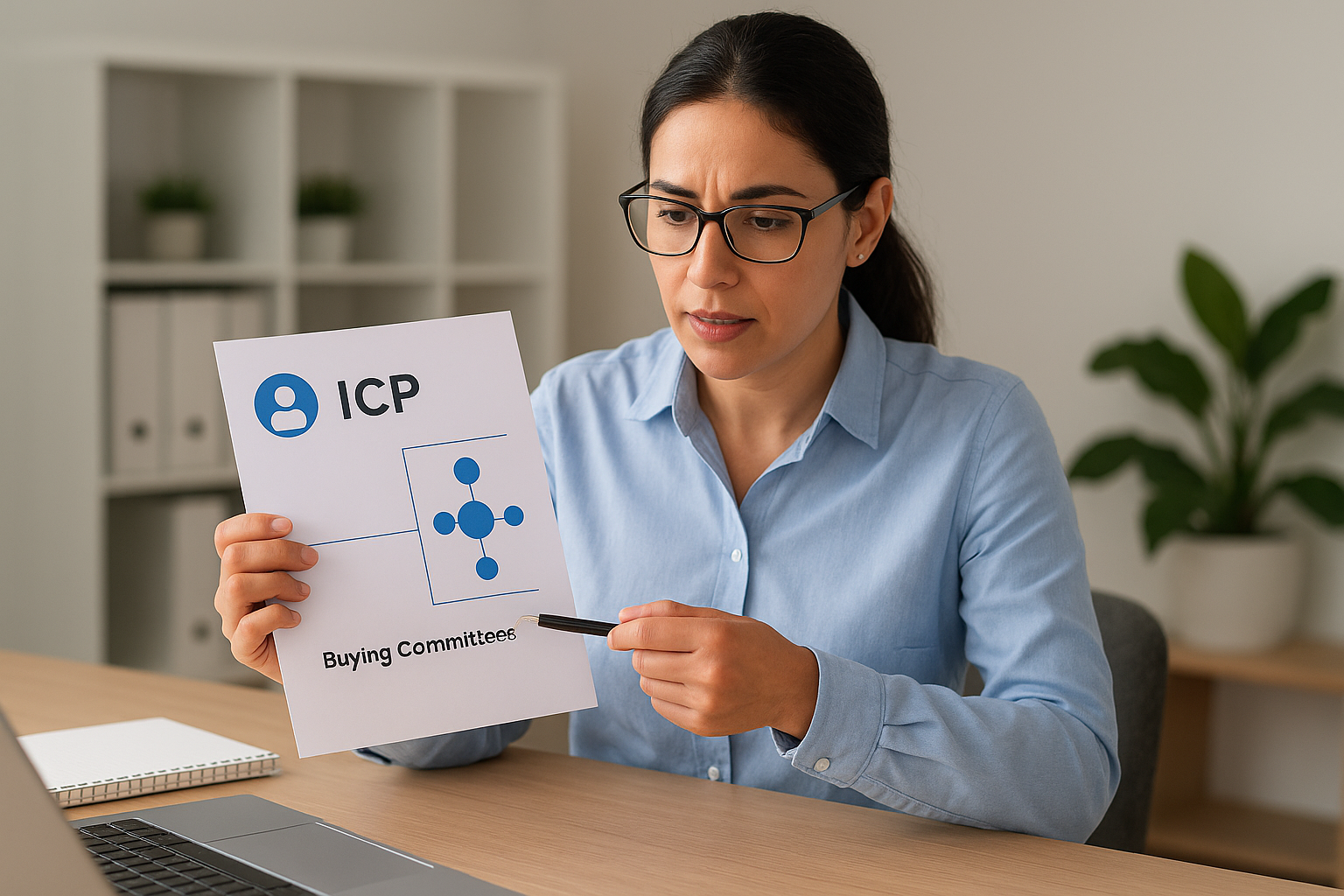
Your Ideal Customer Profile (ICP) is a detailed description of the company type most likely to buy and stay. A buying committee map goes one level deeper by identifying every person involved in the purchase decision at that company, from the economic buyer who signs the contract to the end users who influence the shortlist. Together, they give your marketing and sales teams a shared target to aim at instead of a broad market category that produces inconsistent results.
How to run it
Start with your best existing customers and look for patterns. Pull data on company size, industry, tech stack, annual revenue, and sales cycle length. Interview five to ten of your best clients and ask what made them choose you and who else was in the room when the decision got made. Document the titles, priorities, and objections of each role in the buying committee. Build a one-page reference document your whole team uses for targeting decisions going forward.
When your ICP is sharp, every ad, every email, and every piece of content suddenly has a specific person to speak to instead of a vague market segment.
Where it fits in the funnel
A tight ICP and buying committee map directly improve every stage of your funnel. At the top, it narrows your paid and organic targeting so you attract higher-quality traffic. In the middle, it shapes your nurture messaging to address the specific concerns of each stakeholder role. At the bottom, it helps your sales team handle objections from every corner of the committee before they become deal blockers.
KPIs to track
Watch these numbers after refining your ICP and committee map:
- ICP match rate: The percentage of inbound leads that actually fit your target profile
- Opportunity-to-close rate: How often qualified deals actually convert
- Average deal size: Whether sharper targeting produces higher-value contracts
- Sales cycle length: Whether clearer targeting shortens time to close
3. Publish problem-first SEO content that ranks
Most B2B buyers start their research on Google before they ever contact a vendor. If your content doesn’t appear when they search for the problems your product solves, you’re invisible during the most critical part of their decision process. Problem-first SEO content puts you in front of buyers at the exact moment they’re actively looking for a way out of a painful situation.
What it is
Problem-first SEO content means writing articles, guides, and landing pages built around the specific questions and pain points your buyers search for, not around your product features. Instead of publishing “Our platform features” pages, you publish content like “Why your sales pipeline dries up in Q3.” The content educates first and introduces your solution second, which builds trust before the sales conversation even starts.
How to run it
Start with keyword research focused on problem-based search terms your ICP actually uses, like queries beginning with “how to,” “why does,” or “what causes.” Map each piece to a specific buyer problem at a specific awareness stage. Write thoroughly enough to answer the question completely, and include a clear next step at the end of each article that moves the reader toward your offer.
The goal isn’t traffic for its own sake. It’s traffic from buyers who already have the problem you solve and are actively searching for a way out.
Where it fits in the funnel
Buyers in the awareness and consideration phases are actively researching options and building a shortlist, which is exactly where this content meets them. As part of your broader b2b demand generation tactics, it feeds organic leads into your nurture system as a top-of-funnel and mid-funnel asset without requiring ongoing ad spend to sustain the flow.
KPIs to track
Track these specific numbers to measure whether your SEO content is actually contributing to pipeline:
- Organic traffic to target pages: Monthly visitors arriving from non-paid search
- Keyword ranking positions: Where your content appears for target queries
- Content-attributed leads: Leads that first touched your site through organic content
- Time on page: Whether readers are engaging with what you publish
4. Create AI-friendly comparison and alternatives pages
B2B buyers now use AI tools like ChatGPT and Google’s AI Overviews to shortlist vendors before they visit a single website. If your site doesn’t have structured comparison and alternatives content, you’re missing the moment buyers are actively narrowing their choices. These pages capture high-intent traffic that converts at a significantly higher rate than general awareness content.
What it is
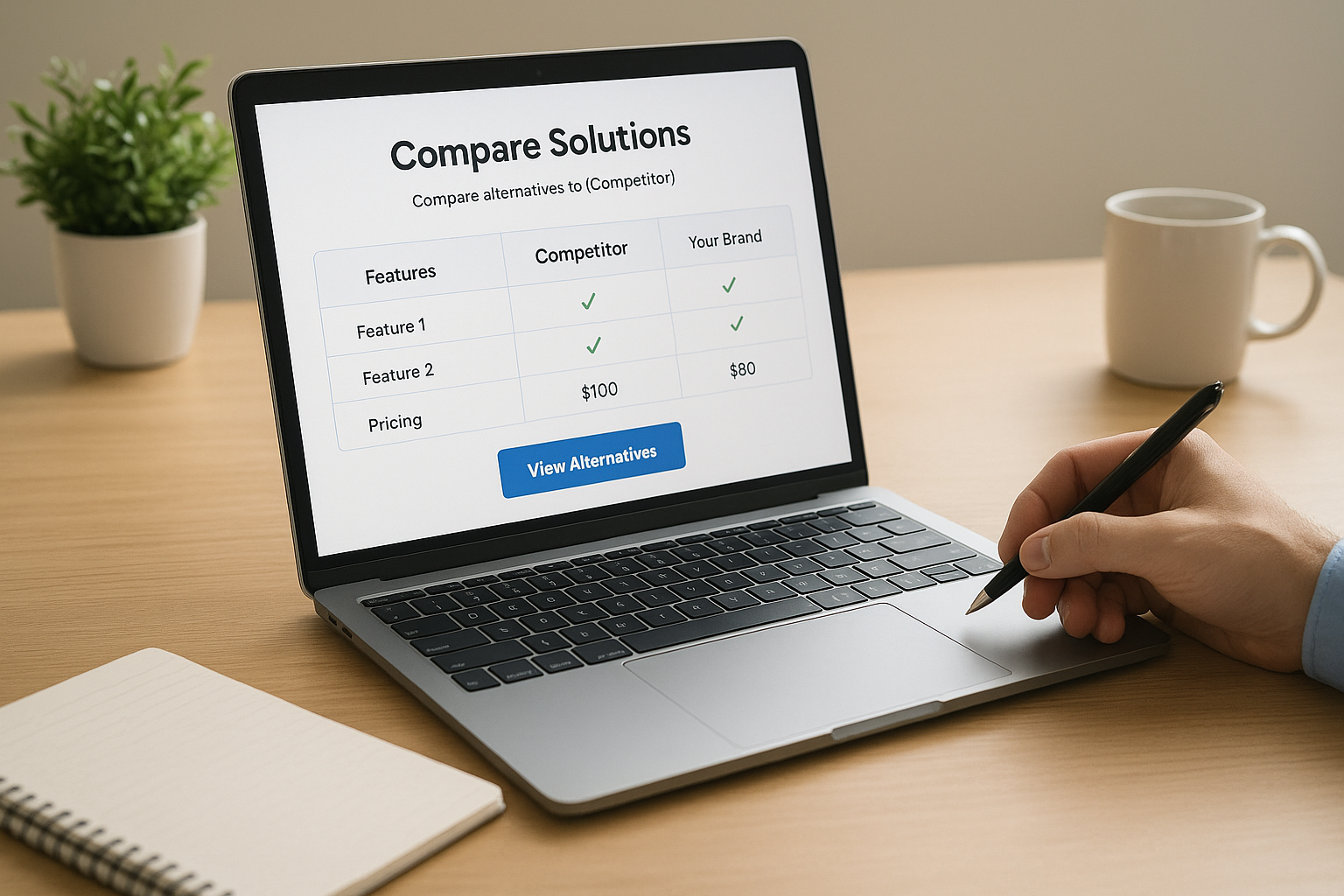
Comparison and alternatives pages are dedicated landing pages that directly address searches like “[Competitor] alternatives” or “[Competitor] vs [Your Brand].” They present an honest, structured breakdown of how your solution stacks up against others in the market. AI systems pull from well-organized, factual content to answer user queries, so building these pages correctly puts you inside the answer rather than outside the conversation.
How to run it
Research the exact queries your buyers use when comparing options in your category, then build one page per major competitor or comparison scenario. Structure each page with clear headings, a comparison table that lists features, pricing, and ideal use cases, and a section that speaks directly to the specific buyer role making the decision. Write honestly: acknowledge where competitors are strong, then clearly explain where your solution wins. AI systems reward balanced, factual content, and so do buyers.
If you only appear when someone searches your brand name directly, you’re invisible to buyers who don’t know you exist yet but are already evaluating your competitors.
Where it fits in the funnel
These pages live at the bottom of the funnel, where buyers are comparison-shopping and nearly ready to commit. As part of your broader b2b demand generation tactics, they intercept high-intent searchers who have already decided to buy something and are just deciding who from.
KPIs to track
Monitor these numbers to gauge how well your comparison pages drive real pipeline:
- Page-to-demo conversion rate: The percentage of visitors who book a call directly from a comparison page
- Organic ranking position: Where each page appears for its target comparison query
- Assisted conversions: How often these pages appear in a buyer’s path before they close
5. Use LinkedIn thought leadership for constant reach
LinkedIn is the one platform where B2B buyers actively engage with industry content during their workday. When your team publishes consistently, you stay visible to decision-makers who aren’t searching for a solution yet but will be soon. Most b2b demand generation tactics focus on capturing buyers who are already in-market, but LinkedIn thought leadership builds the relationship before the need ever surfaces.
What it is
Thought leadership on LinkedIn means publishing original posts, analysis, and perspective from real people inside your company, not from brand accounts. When your founders, sales leaders, or subject matter experts share genuine takes on industry problems, they build the kind of credibility that makes your company the obvious first call when a prospect finally needs what you offer.
Buyers shortlist vendors they’ve seen consistently, not vendors they only discover when they’re ready to buy.
How to run it
Start by identifying two or three people inside your company who have both expertise and enough visibility to matter to your target audience. Build a simple content calendar where each person posts three to four times per week. Focus content on specific problems your ICP faces, case-driven observations, and contrarian takes on common industry assumptions.
Avoid corporate announcements and feature launches, which get ignored. Engage genuinely in the comments on your posts and on posts from target accounts to extend your reach without paid distribution. Consistency over a 90-day window is what separates accounts that build pipeline influence from accounts that get forgotten.
Where it fits in the funnel
LinkedIn thought leadership works primarily at the top of the funnel, building awareness and trust with buyers who aren’t actively shopping yet. Over time, it also supports mid-funnel re-engagement as prospects who follow your team’s content move closer to an active buying cycle already feeling familiar with your point of view.
KPIs to track
Track these numbers to confirm that your LinkedIn content is building real pipeline influence over time:
- Follower growth rate among ICP profiles: Month-over-month increase from the companies you actually target
- Post impressions from target accounts: Reach inside the specific companies you want to sell to
- Inbound connection requests from buyers: Prospects who seek out your team after seeing content
- Pipeline influenced by LinkedIn: Opportunities where a prospect engaged with your content before converting
6. Run paid search for high-intent demand capture
When a buyer types a specific query into Google, they’re signaling exactly what they need and when they need it. Paid search captures that intent at the precise moment it exists, which makes it one of the most efficient b2b demand generation tactics for pulling buyers who are already in an active evaluation cycle into your pipeline.
What it is
Paid search means running Google Ads campaigns targeted to keywords that signal a buyer is actively looking for a solution in your category. Unlike brand awareness channels, paid search doesn’t build demand from scratch. It captures demand that already exists by putting your offer in front of people who are searching for exactly what you provide.
Unlike organic content, paid search produces results immediately, which makes it especially valuable when you need to fill pipeline gaps quickly while longer-term demand generation channels like SEO and LinkedIn build momentum.
How to run it
Start with a tight keyword list focused on high-intent terms: queries like “best [service] for [industry],” “[category] pricing,” and “[solution type] for [specific problem].” Match your ad copy directly to the search query so the message feels immediately relevant. Send traffic to dedicated landing pages built for conversion, not to your homepage. Use negative keyword lists aggressively to block irrelevant traffic before it burns your budget.
Sending paid search traffic to a generic homepage is like answering a specific question with a brochure. The buyer bounces, and you pay for it.
Where it fits in the funnel
Paid search operates at the bottom of the funnel, where buyers are actively comparing options and ready to take action. It works best when your landing pages are already optimized, so the qualified traffic you pay for actually converts once it arrives on your site.
KPIs to track
Watch these specific numbers to confirm your campaigns are contributing real pipeline value:
- Cost per lead: What you pay for each qualified inquiry
- Click-through rate: Whether your ad copy connects with the search query
- Landing page conversion rate: The percentage of paid visitors who take the target action
- Cost per booked meeting: The true cost of turning a click into a sales conversation
7. Add retargeting to stay in the consideration set
Most B2B buyers don’t convert on their first visit. They visit multiple sites, evaluate several vendors, and deliberate for weeks before making contact. Retargeting keeps your brand visible throughout that extended evaluation window so that when a buyer is finally ready to act, your solution is still top of mind instead of a vague memory from three weeks ago.
What it is
Retargeting means serving targeted ads to people who already visited your website or engaged with your content but didn’t take a conversion action. Instead of letting those visitors disappear into a competitor’s funnel, retargeting follows them across platforms like Google Display, LinkedIn, and Meta with ads tailored to what they already showed interest in. As b2b demand generation tactics go, it’s one of the most cost-efficient because you’re spending budget on an audience that already knows who you are.
How to run it
Install tracking pixels from Google and LinkedIn across your key pages before anything else. Segment your audiences by the specific pages each visitor viewed, since a pricing page visitor and a blog reader carry very different intent levels. Serve different ads to each group. Pricing page visitors get case studies and ROI proof. Blog readers get educational content with a soft CTA. Set frequency caps so your ads stay visible without becoming intrusive.
The buyers who visited your pricing page and left are not gone. They are still evaluating, and retargeting is how you stay in the room while they do it.
Where it fits in the funnel
Retargeting works across mid-funnel and bottom-of-funnel stages, re-engaging buyers who already know your brand but haven’t committed yet. It extends the impact of every other tactic you run by ensuring that traffic you already paid to acquire doesn’t simply vanish after a single visit.
KPIs to track
Monitor these numbers to confirm your retargeting campaigns are earning their budget:
- Retargeting click-through rate: Whether your ads pull past visitors back
- View-through conversions: Leads who converted after seeing but not clicking your ads
- Cost per retargeting conversion: What you pay to bring a previous visitor back to act
- Return visitor conversion rate: The percentage of retargeted visitors who complete a goal on their next visit
8. Build an email nurture system tied to behavior
Generic email sequences burn your list. Buyers receive dozens of automated messages every week, and they ignore anything that doesn’t feel directly relevant to what they were just doing. An email nurture system tied to actual prospect behavior sends the right message at the right moment, which is what separates email that builds pipeline from email that builds unsubscribe rates.
What it is
A behavior-based email nurture system triggers specific messages based on actions a prospect takes, not just the date they entered your list. When someone downloads a pricing guide, they get an email about ROI. When someone visits your case studies page three times in a week, they get a direct outreach from your sales team. The messages respond to intent signals your prospects are already showing, which makes every send feel timely rather than random.
How to run it
Start by mapping your key behavioral triggers to the content that matches each one. A prospect who opens every email but never clicks needs a different message than one who clicked through to your demo page and stopped. Use your CRM and marketing automation platform to build segmented sequences for each behavior pattern. Keep individual emails short, focused on one problem and one next step, and test subject lines against each other consistently so your open rates improve over time.
Most B2B email programs fail not because of bad writing but because they send the same message to everyone regardless of what those people actually did.
Where it fits in the funnel
Behavior-based nurture operates across mid-funnel and bottom-of-funnel stages, moving prospects who showed initial interest through the evaluation process toward a booked conversation. As one of the most scalable b2b demand generation tactics, it works in the background continuously, warming buyers who aren’t ready yet while flagging those who are.
KPIs to track
Watch these numbers to confirm your nurture system is moving buyers forward:
- Email open rate by segment: Whether behavior-triggered messages outperform broadcast sends
- Click-to-conversion rate: How often email clicks result in a meaningful next action
- Nurture-to-opportunity rate: How many nurtured leads eventually become active pipeline
- Time from lead to booked meeting: Whether nurture shortens your sales cycle
9. Use intent and trigger signals to pick accounts
Most B2B outreach fails because it targets accounts based on who fits your ICP on paper, not on which accounts are actually showing active buying behavior right now. Intent and trigger signals let you focus your sales and marketing resources on the specific accounts most likely to convert in a near-term window, which dramatically improves the efficiency of your entire program.
What it is
Intent signals are behavioral indicators that a company is actively researching your category, such as when employees at a target account start consuming content about the problem you solve across the web. Trigger signals are event-based indicators like a leadership change, a funding announcement, or a new hire in a relevant role that signals a buying window is opening. Together, they help you stop guessing and start prioritizing.
How to run it
Pull intent data from sources that track what topics specific companies are researching across the web. Set up Google Alerts and LinkedIn Sales Navigator filters to catch trigger events like funding rounds, executive hires, and job postings that signal active buying activity. Build a simple scoring model that ranks accounts by the number and recency of signals they generate, then hand the highest-scoring accounts to your sales team for immediate outreach rather than letting them sit in a general queue.
Chasing accounts with no active signals means selling to people who aren’t ready. Signals tell you who raised their hand before they called you.
Where it fits in the funnel
This tactic operates at the top and middle of the funnel, narrowing your prospecting pool down to accounts with genuine, near-term intent. As part of your broader b2b demand generation tactics, it ensures your paid, outbound, and content efforts concentrate on the accounts most likely to actually enter your pipeline instead of spreading resources across a cold market.
KPIs to track
Monitor these specific numbers to confirm your signal-based targeting is producing real results:
- Signal-to-opportunity rate: How often a flagged account becomes an active deal
- Outreach response rate from intent accounts: Whether signal-based targeting improves replies
- Pipeline value from intent-sourced accounts: Total deal value tied to signal-triggered outreach
- Time to first meeting: Whether intent accounts book faster than cold outreach targets
10. Launch account-based ads and outreach by role
When you know exactly which accounts are ready to buy, broad-market advertising wastes budget. Account-based advertising and outreach lets you concentrate your spend on a defined list of target companies and speak directly to each role inside the buying committee, which produces higher engagement rates and shorter sales cycles than generic demand campaigns ever will.

What it is
Account-based advertising means running highly targeted ads that serve only to employees at specific companies you’ve already identified as high-fit targets. Role-based outreach pairs those ads with personalized messages and emails that speak to the specific concerns of each stakeholder, from the CFO evaluating cost to the operations lead worrying about implementation. The combination creates a coordinated surround effect that makes your solution hard to ignore.
How to run it
Build your target account list using your ICP criteria and the intent signals you identified in the previous step. Upload that list to LinkedIn Campaign Manager to serve ads directly at employees of those companies, filtered by job title and seniority level. Run separate creative for each major role in the buying committee, since the CFO needs different proof points than the end user. Pair those ads with sequenced outreach from your sales team that references the same themes, so every touchpoint reinforces the same core message.
When your ads and outreach deliver the same message, buyers feel recognized rather than marketed to, and that shift in perception is what opens real conversations.
Where it fits in the funnel
This tactic works at the mid-funnel and bottom-of-funnel stages, pushing high-fit accounts from passive awareness into active consideration. As one of the most targeted b2b demand generation tactics in your program, it produces the best results when intent signals confirm an account is already in a buying window rather than months away from one.
KPIs to track
Monitor these numbers to confirm your account-based program is generating real pipeline value:
- Account engagement rate: The percentage of target accounts that interact with your ads or outreach
- Meeting booked rate from target list: How often outreach converts to a scheduled call
- Pipeline influenced by ABM: Deal value tied to accounts inside your coordinated program
- Cost per target account meeting: What you spend to get one high-fit buyer on a call
11. Host live webinars and roundtables for authority
Webinars and roundtables give your team a live stage to demonstrate expertise in front of buyers who already care about the problem you solve. Unlike static content, a live session creates a real-time conversation that builds trust faster than any blog post or ad can.
What it is
A webinar is a scheduled live presentation where your team teaches a specific concept, shares data, or walks through a case study in front of a registered audience. A roundtable brings in multiple voices, often including clients or industry peers, to discuss a shared challenge from different angles. Both formats position your company as a source of credible, practical knowledge rather than just another vendor pushing a product.
How to run it
Pick a single, specific problem your ICP is struggling with and build each session around that topic. Promote the event on LinkedIn and through your email list three to four weeks in advance, and require registration so every attendee becomes a trackable lead. Record every session and repurpose it into short clips, follow-up emails, and summary posts to extend reach beyond the live audience.
The registration list from a single webinar is a ready-made segment of buyers who already care about the exact problem your solution addresses.
Where it fits in the funnel
Webinars and roundtables serve mid-funnel buyers who are actively evaluating options and need more than a landing page to build confidence in your team. As part of your broader b2b demand generation tactics, they bridge the gap between early awareness content and a direct sales conversation by giving prospects a low-risk way to experience your expertise before committing to a formal meeting.
KPIs to track
Track these metrics to confirm your webinar and roundtable program is generating real pipeline contributions:
- Registration-to-attendance rate: The percentage of registrants who show up live
- Post-event conversion rate: How many attendees take a next step within two weeks
- Pipeline influenced by webinar: Deal value tied to prospects who attended at least one session
12. Build a measurement model that proves pipeline impact
Most marketing teams track activity metrics like impressions, clicks, and email opens, and then struggle to explain to leadership why those numbers don’t connect to revenue. A proper measurement model solves that problem by creating a direct line from every tactic you run to the pipeline it produces, so you can defend your budget and cut what isn’t working before it bleeds resources for another quarter.
What it is
A measurement model is a structured framework that tracks which marketing activities drive which pipeline outcomes across your entire funnel. It connects your b2b demand generation tactics to actual business results, such as qualified opportunities created, deals influenced, and revenue closed, rather than stopping at surface-level engagement data. Without this framework, your team makes budget decisions based on guesswork instead of evidence.
How to run it
Start by defining the specific pipeline stages your business uses, from marketing-qualified lead to closed deal, and assign a metric to each transition. Build attribution into your CRM from day one so every lead carries a source tag through the entire journey. Use a multi-touch attribution model rather than last-touch only, since most B2B deals involve five or more touchpoints before a buyer commits.
If you can’t trace a closed deal back to the first tactic that started the conversation, you can’t know which channels deserve more investment.
Review your attribution data monthly, not quarterly, so you catch underperforming channels before they drain your budget across an entire planning cycle.
Where it fits in the funnel
A measurement model sits behind every stage of your funnel simultaneously, making it the connective tissue that ties all other tactics together. It turns your marketing program from a set of independent experiments into a single, accountable system.
KPIs to track
Focus on these numbers to prove real pipeline impact:
- Marketing-sourced pipeline value: Total deal value tied to marketing-initiated touches
- Cost per pipeline dollar: What you spend to generate each dollar of pipeline
- Attribution accuracy rate: The percentage of closed deals with a complete source record
- Channel-to-revenue contribution: Which specific tactics generate the most closed revenue
Your next move
You now have 12 b2b demand generation tactics that build real pipeline, not just activity reports. The tactics work individually, but they compound when you run them as a connected system where each layer feeds the next. Fix your funnel first, then layer in traffic, then nurture the leads your traffic produces, and then measure everything so you know exactly where to put your next dollar.
The biggest mistake B2B teams make at this point is trying to launch everything at once. Pick three tactics that address your most urgent pipeline gap, run them with discipline for 90 days, and measure the results before expanding. That approach builds momentum instead of spreading your team thin across a dozen half-executed initiatives.
If you want a faster start, we can review your current funnel and identify the exact breaks costing you pipeline right now. Book a free conversion audit and we will show you precisely where to focus first.