

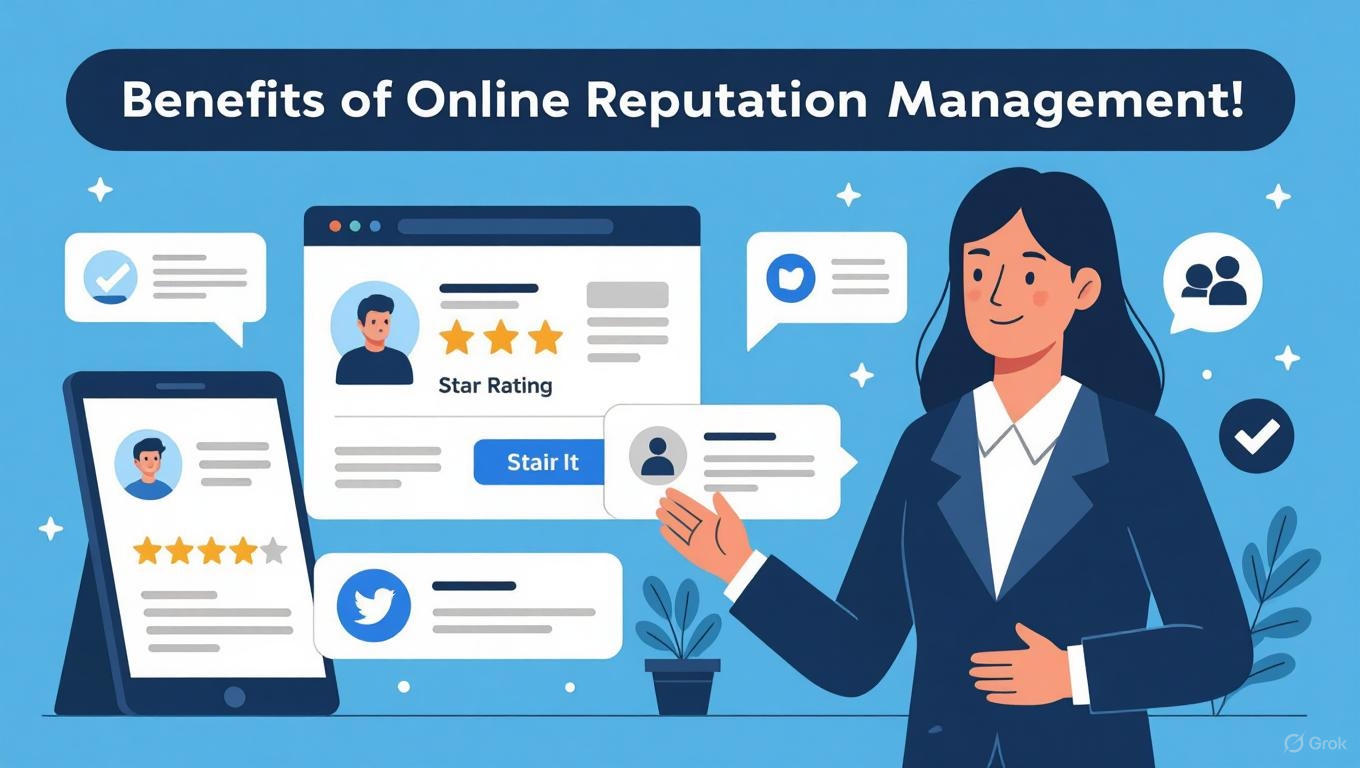
Online reputation management (ORM) lets a company shape how it shows up on search engines, review sites, and social channels—amplifying praise, calming complaints, and guiding the story customers see first. That control pays off: stronger trust signals lift click-through rates, higher star ratings nudge buyers over the line, and quick responses to criticism stop revenue-crushing snowballs before they roll.
Put simply, ORM is the systemized practice of monitoring, analyzing, and influencing every mention of your brand online—a must in a review-driven marketplace where a single comment can rank beside your homepage. The sections that follow walk through fifteen concrete benefits, starting with bedrock credibility and climbing to market-expansion strategy, so you can see exactly how a disciplined reputation program compounds value each quarter. Along the way you’ll get actionable pointers—tools, response templates, and key metrics—to turn theory into revenue. Whether you run a local practice or a multi-state operation, these insights will help you own page one and win the click.
1. Builds Rock-Solid Brand Credibility and Trust
Trust isn’t a fuzzy feel-good metric; it’s the lead domino that topples every other conversion metric in your funnel. When visitors see consistent five-star stories and respectful brand replies, they subconsciously decide you’re worth their time—and their credit card.
Why credibility is the currency of modern commerce
Industry research shows that 93 % of shoppers read reviews before buying, and most won’t touch a business with an average below four stars. Those tiny yellow icons act as instant social proof, shortcutting the evaluation phase the same way a personal recommendation would. Because search engines surface ratings in rich snippets, your reputation often becomes the first brand experience, shaping click-through rates long before prospects visit your site.
Practical steps to earn and display trust signals
Start by hard-coding credibility into daily ops: request a review in every post-purchase email, add QR codes at checkout, and thank customers publicly when they oblige. Next, curate what you collect—feature the best quotes on your homepage hero, embed Google Review widgets on service pages, and sprinkle star snippets into structured data (AggregateRating schema). Finally, answer the tough comments within 24 hours. A calm, solution-oriented reply demonstrates transparency and flips potential detractors into spectators who applaud your honesty.
2. Boosts Sales and Revenue Conversion Rates
A glowing reputation doesn’t just make people feel good about your brand—it moves hard numbers. When visitors see four-plus stars and real-world praise at the decision point, hesitation drops, baskets grow, and your cost per acquisition shrinks. In many cases, optimizing reputation delivers faster sales lifts than tweaking ad copy or bidding higher on keywords.
The direct link between reputation scores and purchase decisions
Multiple marketplace studies show that climbing from 3 ⭐ to 4 ⭐ can boost revenue by up to 9 % on high-traffic platforms. Higher ratings reduce perceived risk, so shoppers add items to cart sooner and complete checkout more often. Positive sentiment also slashes cart abandonment; prospects who trust a brand are less likely to bail when shipping fees or upsells appear. In subscription or service models, the effect compounds—strong first-impression credibility shortens sales cycles and lifts lifetime value as happy clients renew.
Conversion-focused reputation tactics
- Embed live review widgets near “Add to Cart” and contact forms; social proof beside a CTA routinely lifts click-through by 4–6 %.
- Run A/B tests that insert your average star rating or review count into headlines (“Trusted by 1,347 owners—4.8⭐ average”).
- Use
AggregateRatingschema so search snippets display stars, pre-qualifying traffic before the click. - Retarget abandoners with ads that feature testimonial quotes; the fresh credibility nudge often closes the sale.
Treat these plays like any CRO experiment—measure, iterate, and watch revenue graphs tick northward.
3. Enhances Search Engine Visibility and Overall SEO Performance
Search engines reward brands that users already trust. High star ratings and steady review velocity signal relevance and reliability, two qualities Google loves to showcase at the top of organic results and inside the lucrative local pack. In practice, good sentiment translates into richer snippets, higher click-through rates, and an easier climb for the pages sitting just below page-one perfection. Treat ORM as an SEO force-multiplier and every content dollar you spend will stretch further.
How Google factors sentiment and reviews into rankings
Google’s quality raters handbook leans heavily on E-E-A-T—Experience, Expertise, Authoritativeness, Trustworthiness. Public reviews feed all four signals:
- Experience: first-hand stories validate that real customers used the product.
- Expertise & Authoritativeness: detailed praise positions your team as pros in the field.
- Trustworthiness: volume and consistency of positive feedback reduce perceived risk.
For local searches, review count and average rating sit alongside distance and relevance in the ranking algorithm. A steady stream of recent five-star reviews can push you above competitors even if their site authority is similar.
Reputation-SEO synergy techniques
- Add
ReviewandFAQschema to product and service pages so stars, counts, and Q&As surface directly in SERPs. - Keep NAP (Name, Address, Phone) citations identical across directories for maximum local trust.
- Seek brand mentions on high-authority sites—industry blogs, chambers of commerce, university partners—to amplify both backlink equity and credibility.
- Monitor keyword-rich review phrases; mine them for on-page copy updates that mirror the language prospects use when searching.
4. Creates a Sustainable Competitive Advantage
Of all the benefits of online reputation management, the most defensible is the durable edge it gives you against rivals. When product features copy quickly and ads shout the same promises, a five-star reputation becomes the moat competitors can’t breach. Continuous monitoring and swift responses turn customer sentiment into a compounding asset that separates leaders from the pack—and keeps margins healthier as discount wars rage.
Standing out in saturated markets
Shoppers comparison-shop in tabs, scanning stars before price. When your listing shows 4.7 from 2,000 reviews beside a rival at 3.9, the decision is over before value props load. Positive sentiment compresses evaluation, letting you command premium pricing and higher click-through rates without outbidding rivals.
Strategies to widen the gap with competitors
Track rival feedback with Google Alerts or paid dashboards, then convert those gaps into differentiated talking points:
- If competitors get dinged for slow support, showcase your 24/7 live chat on product pages.
- Surface five-star pull quotes in Google Ads; headlines with star emojis often lift CTR 10 %.
- Publish side-by-side comparison content backed by real review data—customers see proof, not hype.
5. Improves Customer Engagement and Lifetime Loyalty
A polished reputation doesn’t stop at the first sale—it sparks an ongoing conversation that keeps customers circling back. When people see their feedback acknowledged publicly, they feel heard, valued, and far more likely to recommend you. Those micro-interactions accumulate into a relationship moat rivals struggle to cross, driving higher repeat-purchase rates and increasing customer lifetime value (CLV).
Engagement loops driven by positive sentiment
Every five-star review you reply to becomes content that algorithms surface and prospects read. A simple “Thanks for the shout-out, we loved working with you!” can trigger follow-up questions, user-generated photos, and shares to personal feeds. That extra organic reach feeds the next wave of reviews, creating a flywheel effect:
- Great experience →
- Positive review →
- Brand response →
- Public dialogue →
- New referrals discovering your high rating.
Loyalty-building playbook
- Gamify review requests: offer loyalty points or exclusive perks for verified feedback.
- Segment advocates who leave standout comments and invite them to private beta groups or VIP webinars.
- Showcase customer stories on Instagram Reels, tagging contributors to amplify reach.
- Automate milestone check-ins (30-, 90-day emails) that ask how things are going and link directly to review platforms.
- Close the loop visibly: post “You said, we did” updates highlighting fixes born from customer suggestions—proof you listen and act.
Treat engagement like a two-way street and you’ll grow a community that defends your brand and buys for years.
6. Attracts Top Talent and Quality Partnerships
An overlooked but lucrative benefit of online reputation management is its pull on people who can grow your business from the inside out—future employees, vendors, and strategic allies. Before they email a résumé or draft a partnership agreement, these stakeholders scour Google, LinkedIn, Glassdoor, and news stories for red flags. A consistent stream of positive buzz shortens hiring cycles, lowers cost-per-hire, and positions your firm as the safe bet when high-caliber professionals have options.
Why employees vet companies like customers do
Job seekers read company reviews the same way shoppers read product ratings. A poor culture score on Glassdoor or scathing tweet can spike recruitment costs and force expensive sign-on bonuses. Conversely, brands with four-plus-star employer ratings enjoy larger applicant pools, quicker acceptance rates, and higher retention—saving both payroll dollars and institutional knowledge.
Employer-brand reputation management
- Encourage team members to post honest testimonials after milestones or promotions.
- Spotlight behind-the-scenes culture moments—volunteer days, hackathons, customer wins—on social channels.
- Fold CSR initiatives into your storytelling; partners and prospects love aligning with mission-driven brands.
- Audit third-party career sites quarterly, replying to negative comments with the same transparency you apply to customer reviews.
- Sync HR and marketing calendars so product launches, media mentions, and hiring pushes reinforce one another.
7. Mitigates PR Crises and Reduces Legal & Financial Risk
Even the most beloved brand sits one tweet away from a headline-making disaster. Proactive online reputation management is a form of insurance—detecting sparks before they ignite, containing misinformation quickly, and logging a paper trail that can help satisfy regulators and attorneys if things escalate.
The real cost of unmanaged negativity
A single viral complaint can empty shopping carts, sink ad performance, and shave millions off market value overnight. Negative narratives also attract class-action law firms and watchdog agencies that mine social chatter for patterns of negligence. Beyond direct revenue loss, brands often face higher insurance premiums, steeper borrowing costs, and talent drain when unresolved backlash dominates search results.
Crisis-proofing framework
- Set up real-time social listening alerts for brand keywords, executive names, and emerging industry issues.
- Maintain pre-approved response templates that cover apologies, restitution offers, and clarification statements—speed matters.
- Establish an internal escalation ladder: frontline support → PR lead → legal counsel → designated spokesperson.
- Archive all interactions in a centralized dashboard; documented goodwill can soften penalties if litigation arises.
- Conduct quarterly “fire drills” to test message consistency across email, social, and press channels.
Treating crisis readiness as a standing ORM workflow keeps small flare-ups from turning into balance-sheet bonfires.
8. Provides Actionable Customer Insights and Innovation Ideas
A star rating is more than a vanity metric; it’s a free, always-on focus group. By systemically harvesting the language customers use in reviews and social mentions, you uncover pain points, wish-list features, and service gaps that never surface in formal surveys. Few benefits of online reputation management deliver ROI this quickly.
Mining reviews for product and service feedback
Pipe every new review into a sentiment dashboard and tag comments by theme—price, UX, support, shipping. Patterns jump out fast: repeated “setup took hours” flags onboarding friction, while praise like “love the dark-mode option” validates previous roadmap bets. Quantifying these mentions with simple counts or a positive / total formula shows which fixes will move satisfaction scores—and revenue—the most.
Closing the feedback loop
Insights only matter when acted on. Build a workflow: collect ➜ prioritize ➜ implement ➜ announce. Publish release notes that credit reviewers (“You asked for faster checkouts—done!”), then request an updated review. Customers feel heard, ratings climb, and your innovation cycle stays permanently customer-powered.
9. Increases Online Review Volume and Star Ratings
More reviews mean more proof. When prospects see a long trail of fresh, glowing feedback, they assume the experience they’ll get tomorrow is as good as the one others got yesterday. That perception lifts click-through rate, shortens decision time, and fuels the compounding benefits of online reputation management across every channel.
Volume, velocity, and variety explained
- Volume: The total number of reviews; it signals popularity and statistical reliability.
- Velocity: How frequently new reviews appear; steady inflow tells algorithms—and humans—that you’re still delivering.
- Variety: Distribution across platforms (Google, Yelp, Facebook) and media types (text, photo, video); wider coverage reaches more buyer personas and search intents.
Ethical review generation tactics
- Trigger an automated email or SMS request within 24 hours of purchase while the excitement is fresh.
- Drop a QR code on receipts, packaging, or lobby signage so in-store customers can review in two taps.
- Rotate between platforms to balance footprints—Monday pushes Google, Wednesday highlights Facebook.
- Thank every reviewer publicly and privately; appreciation primes them to update scores after future visits.
- Build a mini-loyalty perk (exclusive guide, discount) for verified reviewers—valuable yet compliant with platform policies.
10. Strengthens Social Media Presence and Share of Voice
Every like, retweet, or TikTok stitch is a public vote on your brand. When you actively manage reputation, those votes skew positive, boosting algorithmic reach and ensuring your message drowns out the chatter from competitors—without blowing up the ad budget.
Reputation signals spill into social discovery
Algorithms on X, Instagram, and Facebook prioritize content that sparks engagement and feels trustworthy. High review scores, rapid complaint resolution, and glowing customer stories send exactly those signals, so your posts surface more often in Explore tabs and hashtag feeds. The effect compounds: positive sentiment → higher reach → more user-generated content → yet more sentiment. Among the underrated benefits of online reputation management is this virtuous cycle that turns organic social into a reliable acquisition channel.
Social listening and response best practices
- Monitor brand keywords in real time; aim for sub-60-minute reply times on priority platforms.
- Follow a tone guide—empathetic for complaints, playful for praise—to keep voice consistent.
- Tag satisfied customers in follow-up posts, giving them the spotlight and you the extra impressions.
11. Improves Local Search Visibility and Physical Foot-Traffic
The battle for neighborhood customers plays out long before they reach your door—it’s decided on the Google Map three inches above the fold. Effective online reputation management pushes your listing into that coveted three-pack, where searchers tap “Directions” without ever clicking your website. High star averages and fresh reviews also power “near me” voice searches and zero-click results, converting digital trust into real-world visits.
Importance of local pack and map ratings
Google’s local algorithm weighs proximity, relevance, and prominence, and reviews influence two of the three. Listings with 4.5-plus stars and steady review velocity earn more taps, calls, and “Navigate” clicks than lower-rated competitors. BrightLocal reports that 56 % of consumers visit a business within 24 hours of finding it in map results—proof that a polished reputation literally moves people.
Local reputation tactics
- Fully optimize your Google Business Profile: precise NAP, categories, service areas, and up-to-date photos.
- Encourage reviewers to mention key services (“roof repair,” “estate planning”) to boost relevance.
- Drop geotagged QR codes on receipts or table tents to collect photo reviews in two taps.
- Partner with neighborhood micro-influencers for quick, geo-tagged video testimonials.
12. Elevates Investor Confidence and Overall Business Valuation
Whether you’re courting a bank loan, lining up Series A capital, or fielding buy-out offers, your online reputation is the investor’s first proxy for operational health and future cash flow. Clean sentiment data shortens negotiation cycles and can nudge EBITDA multiples upward.
How reputation data appears in due diligence
Analysts scrape Google, Yelp, Reddit threads, and industry forums, feeding the text into sentiment models that flag red-alert themes—product safety, billing disputes, executive conduct. They cross-reference Glassdoor scores, complaint ratios, and review velocity to calculate risk premiums that directly influence term sheets.
Steps to present a strong digital narrative to investors
Package the story the way analysts already think:
- Aggregate three-year review trendlines and Net Promoter Score in one chart.
- Highlight ratio of resolved-to-unresolved complaints and average response time.
- Include curated press hits and case studies that showcase market adoption and brand goodwill.
13. Lowers Marketing and Customer Acquisition Costs Over Time
Paid ads can fill your funnel today, but they’re expensive fuel. One of the underrated benefits of online reputation management is that a steady stream of unsolicited praise keeps brand discovery and referrals humming without the same media spend. Each five-star review is a micro-ad you didn’t pay for.
ORM as a compounding asset
Trust assets behave like interest: the more you have, the faster they grow. High ratings lift organic click-through rates, improve Quality Scores in PPC platforms, and boost social reach—all of which drop your effective cost per lead. Over months, the delta between what you could have spent on traffic and what you actually spend widens into real savings.
Budget reallocation ideas
- Redirect reduced ad spend into retention programs (loyalty perks, community events).
- Fund product R&D informed by review insights to keep the flywheel spinning.
- Invest in evergreen content that spotlights customer success stories.
- Build referral incentives—happy clients become unpaid brand ambassadors.
14. Gives You Greater Control Over Your Brand Narrative
Stories about your company are already circulating—on blogs, Reddit threads, even in AI-generated summaries. Effective online reputation management keeps you in the director’s chair, ensuring the first version people see mirrors your values and value proposition instead of a skewed hot take.
Own the Story Before Others Tell It
Proactive ORM means publishing expert content, customer wins, and culture highlights before a crisis or rumor defines you. Reactive ORM—responding after a narrative gains steam—can still salvage trust, but it’s costlier and rarely restores the same authority. Controlling the timeline lets you frame issues, provide context, and demonstrate accountability on your terms.
Tools and Processes for Narrative Control
- Build a rolling 90-day content calendar that ties product news, thought leadership, and social proof into one coherent storyline.
- Deploy Google Alerts and social listening dashboards to spot untracked mentions within minutes.
- Dominate branded SERPs with owned assets—knowledge panels, FAQs, press releases, and schema-enhanced pages—so authoritative content pushes fringe commentary lower on page one.
- Review and update messaging quarterly to keep every channel—ads, email signatures, investor decks—singing the same tune.
15. Accelerates Expansion Into New Markets and Product Lines
When your brand already carries thousands of glowing reviews, entering a fresh geography—or unveiling a spin-off service—feels less like a gamble and more like copy-paste. The stored social proof lowers skepticism among first-time buyers, slashes the ad impressions required to gain traction, and reassures distributors or channel partners that you’re a safe bet. In short, a healthy online reputation becomes the fast-pass lane for growth initiatives that might otherwise stall in the “who are these guys?” phase.
Reputation as a Passport to New Audiences
Surveys show unfamiliar shoppers lean 2-to-1 on public ratings over brand messaging when no prior relationship exists. High star averages and detailed testimonials act as proxy experience, signaling that promises made in Market A will hold true in Market B. The same halo helps upsell adjacent product lines—customers who trust your core offer are 80 % more likely to try the next SKU.
Launch Checklist for New Territories
- Localize review requests—prompt ratings on region-specific platforms (e.g., Trustpilot UK, MouthShut India).
- Secure culturally relevant trust badges or certifications before paid campaigns begin.
- Pre-seed FAQs and knowledge-base content reflecting local regulations and slang.
- Recruit micro-influencers to post first-look reviews within 48 hours of launch for algorithmic momentum.
- Monitor sentiment hourly for the first week; rapid replies cement early goodwill.
Final Thoughts That Stick
Stacked together, the 15 benefits of online reputation management form a growth engine: trust breeds clicks, clicks become customers, and satisfied customers reinforce the brand narrative that fuels tomorrow’s expansion. By treating reviews, social chatter, and search results as assets—not afterthoughts—you insulate revenue from crises, trim acquisition costs, and earn the goodwill that attracts investors, partners, and top-tier talent.
Ready to turn all that upside into actual pipeline? Schedule a free funnel and conversion audit with the Client Factory team today and see how a reputation-first strategy can unlock compounding ROI for your firm. Book your audit and start owning every digital first impression.