

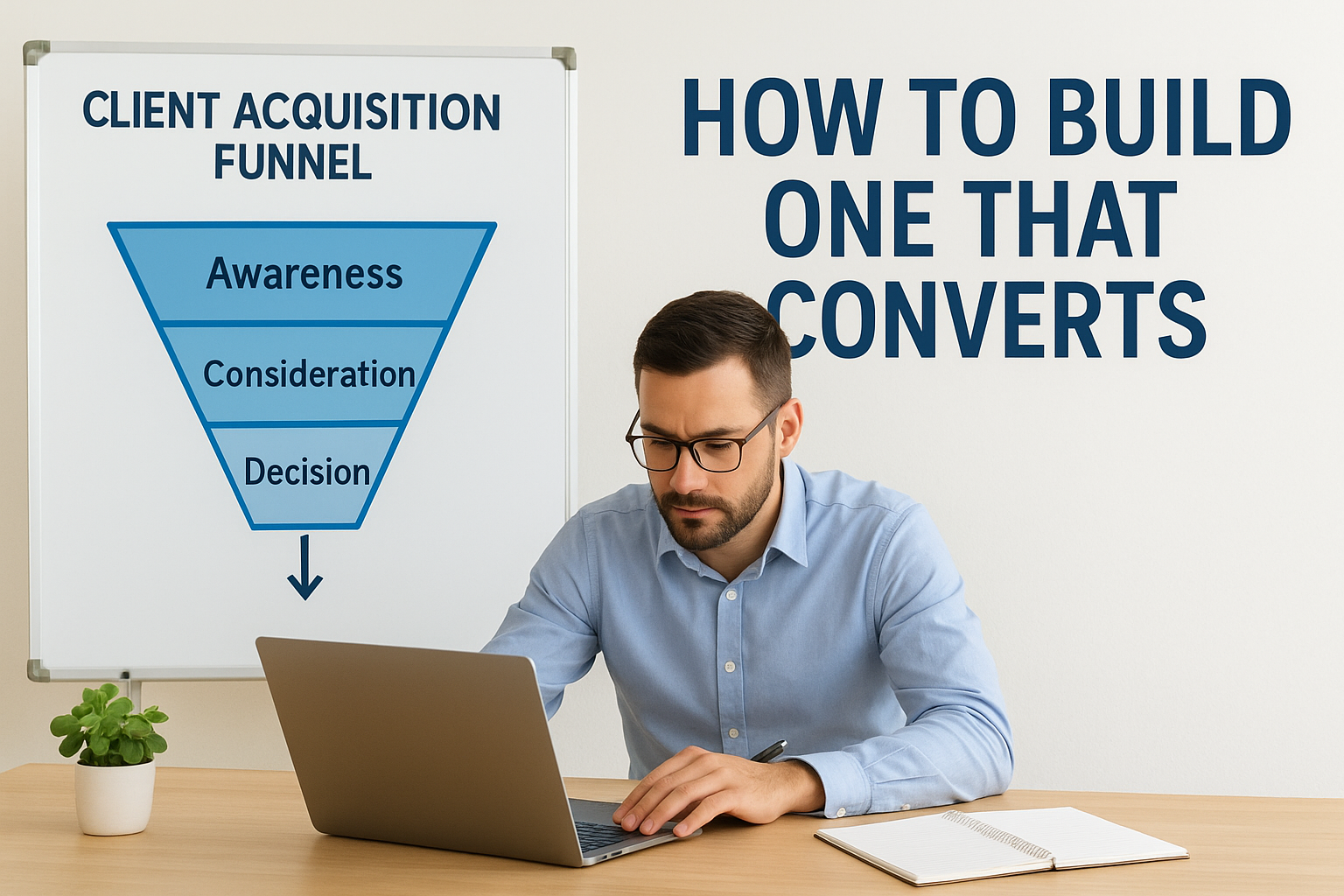
Most businesses don’t have a lead problem. They have a client acquisition funnel problem. Traffic shows up, clicks happen, forms get filled out, but somewhere between that first interaction and the signed contract, prospects quietly disappear. Sound familiar?
The issue usually isn’t your offer or your ad spend. It’s the system (or lack of one) that’s supposed to guide a stranger from "just browsing" to "ready to buy." Without a structured funnel built around how people actually make decisions, you’re leaving revenue on the table, and handing warm leads to competitors who have their process dialed in. That’s the gap we help service businesses and law firms close every day at Client Factory.
This guide breaks down exactly how to build a client acquisition funnel that converts, stage by stage, with actionable strategies you can implement whether you’re starting from scratch or fixing what’s broken. You’ll learn what belongs at each level of the funnel, where most businesses lose prospects, and how to optimize for real results instead of vanity metrics. Let’s get into it.
What a client acquisition funnel is and why it matters
A client acquisition funnel is a structured system that moves a potential client from first awareness of your business to becoming a paying customer. Think of it as a series of deliberate steps, each designed to do one thing: bring the right people closer to a decision while filtering out those who aren’t a fit. It’s not a landing page. It’s not a single ad. It’s the entire sequence that takes someone from stranger to signed client.
The core stages of a funnel
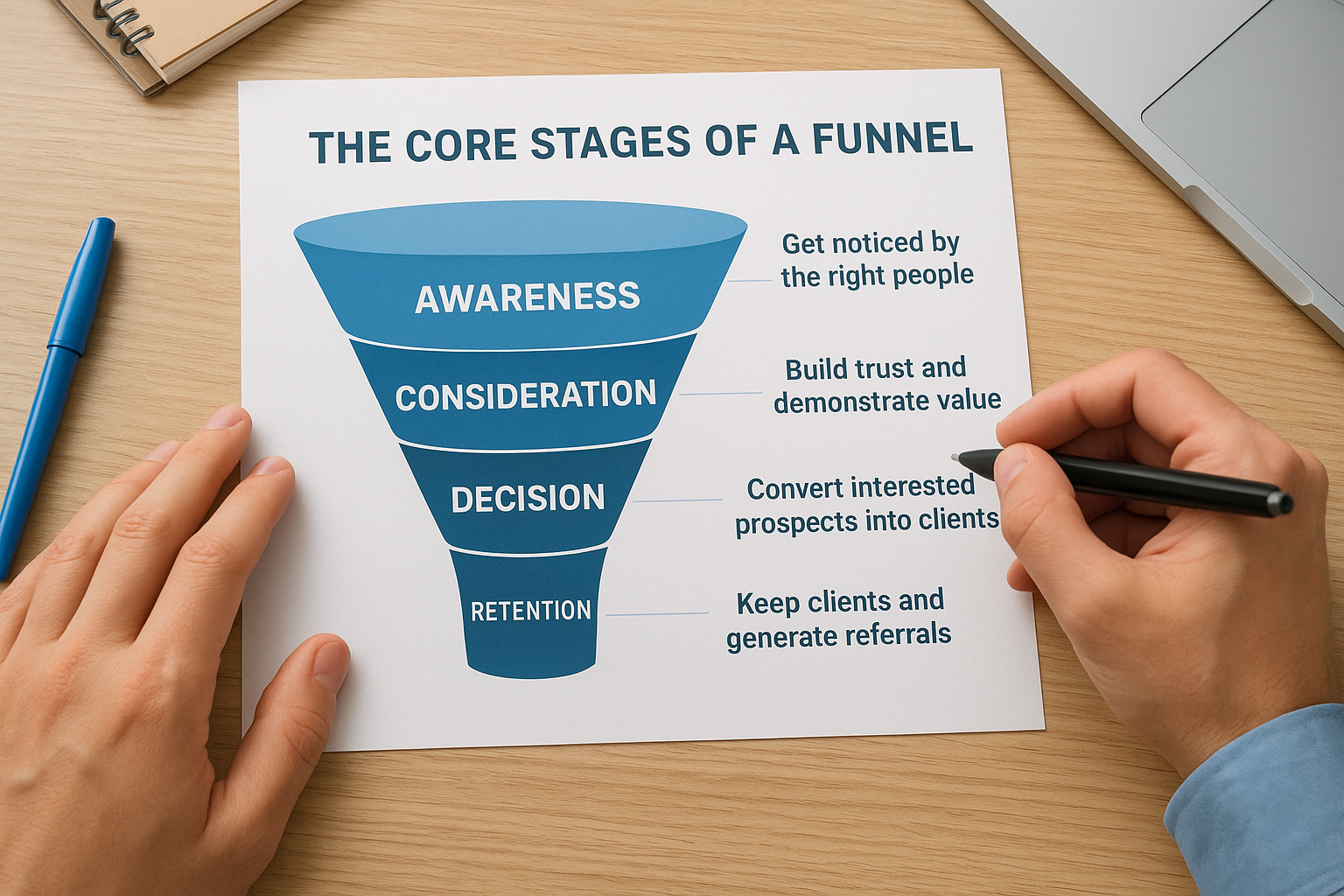
Every client acquisition funnel, regardless of industry, operates through the same fundamental levels. The names vary depending on who you ask, but the logic stays consistent.
| Stage | Goal | Example Tactics |
|---|---|---|
| Awareness (Top) | Get noticed by the right people | SEO, paid ads, social content |
| Consideration (Middle) | Build trust and demonstrate value | Case studies, email sequences, retargeting |
| Decision (Bottom) | Convert interested prospects into clients | Consultations, proposals, follow-up calls |
| Retention (Post-funnel) | Keep clients and generate referrals | Onboarding, check-ins, referral programs |
Understanding which stage a prospect is at determines what message to send and what specific action to ask them to take. Pushing a bottom-of-funnel offer at someone who just discovered your business for the first time will kill the conversion before it starts.
The funnel isn’t about being clever with your marketing. It’s about showing the right message to the right person at the right moment.
Why the funnel matters more than individual tactics
Most service businesses focus on individual tactics: run an ad, post on social media, send an email blast. These things can generate activity, but activity alone isn’t revenue. Without a connected funnel, each tactic operates in isolation, and you have no way to see where prospects are dropping off or why conversions stall.
Building a proper funnel gives you visibility and control over the entire process. You can see exactly how many people enter at the top, how many move to the middle, and how many convert at the bottom. When something breaks, you know where to look. When something works, you know what to scale. That’s the difference between guessing and running a real, repeatable client acquisition system.
Why service businesses and law firms need this most
If you run a service business or a law firm, the sale rarely happens in a single click. Your clients are making a high-stakes decision, often spending thousands of dollars, and they need time, information, and trust before they commit. That buying process happens whether or not you have a funnel in place. Without a funnel, you have no control over that process. With one, you guide every step of it.
Your prospects also deal with longer consideration windows and more complex objections than someone buying a product online. A lead might visit your site three times, read two articles, watch a testimonial video, and then call you two weeks later. Your funnel needs to account for that entire journey and stay in front of them at each touchpoint, or a competitor with a better system will fill that gap before you get the chance to close.
Step 1. Define your ideal client and your core offer
Before you build a single page or write a single ad, you need to know who you’re trying to reach and what you’re offering them. Skipping this step is the single biggest reason client acquisition funnels fail before they even launch. Without clarity on these two things, every decision downstream becomes a guess.
Build your ideal client profile
Your ideal client profile isn’t a vague demographic sketch. It’s a detailed picture of the specific person most likely to need your service, afford your fees, and become a long-term client. To build one, answer these questions directly:
- Who they are: Industry, role, business size, or personal situation
- What problem they have: The specific pain point your service solves
- What they’ve tried before: Solutions that didn’t work and why
- What a win looks like: The outcome they’re actually buying, not just the service
- Where they look for answers: Channels where they research and compare options
For example, a law firm targeting small business owners in contract disputes would profile a client very differently than one serving individuals in personal injury cases. Each audience requires a different message, different channels, and a different funnel structure. Get this wrong and you’ll attract the wrong traffic no matter how well the rest of your funnel is built.
Your funnel can only be as strong as your understanding of the person it’s built for.
Nail down your core offer
Your core offer is the specific result you deliver and how you deliver it, not a general service description. "We handle your marketing" is not an offer. "We build and manage paid ad campaigns that generate qualified leads for service businesses within 90 days" is an offer. That level of specificity makes it easier for the right prospects to self-select into your funnel and for the wrong ones to opt out early, which saves everyone time.
When shaping your offer, tie it directly to the outcome your ideal client actually wants. Avoid feature-heavy descriptions and focus instead on the transformation or result the client walks away with. A strong, specific offer also makes every piece of content, every ad, and every follow-up email in your client acquisition funnel significantly easier to write because you always know exactly who you’re talking to and what they need to hear.
Step 2. Map funnel stages, touchpoints, and handoffs
Once you know who you’re targeting and what you’re offering, you need to lay out the full path a prospect travels from first contact to signed client. Most businesses skip this step and end up with gaps in their client acquisition funnel where prospects fall through with no follow-up and no recovery. Mapping your stages and touchpoints before you build anything forces you to identify those gaps upfront instead of discovering them after you’ve already lost the lead.
Identify every touchpoint in the journey
A touchpoint is any moment a prospect interacts with your business, whether that’s clicking an ad, reading a blog post, watching a testimonial video, or speaking with someone on your team. Every touchpoint is an opportunity to move them forward, and a missed touchpoint is an open door for a competitor to step in. Your job here is to list every single interaction in the order a prospect typically encounters them.
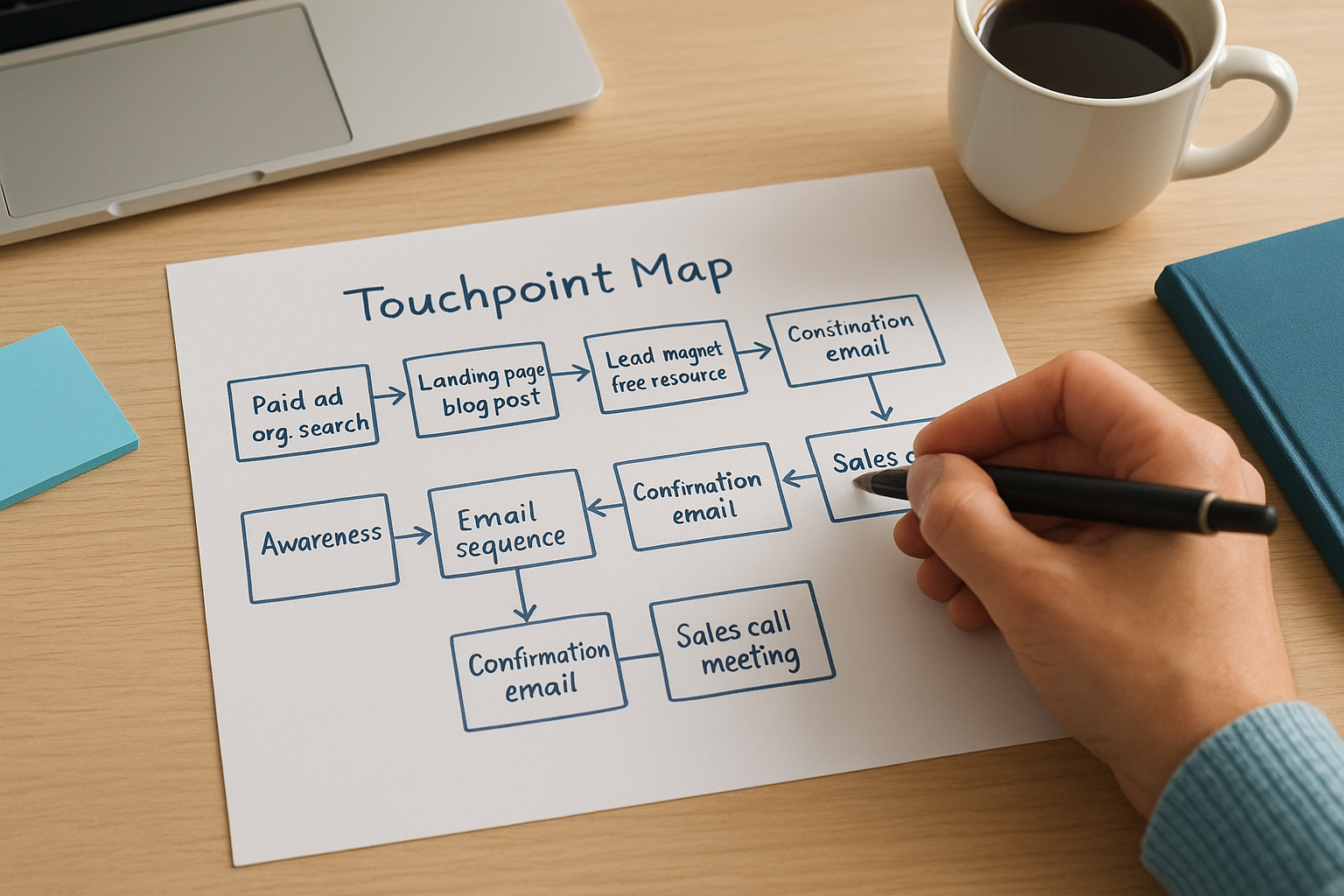
Here’s a practical touchpoint map for a service business:
| Stage | Touchpoint | Purpose |
|---|---|---|
| Awareness | Paid ad or organic search result | Get the first click |
| Awareness | Landing page or blog post | Deliver relevant value |
| Consideration | Lead magnet or free resource | Capture contact information |
| Consideration | Email sequence (3 to 5 emails) | Build trust, address objections |
| Consideration | Retargeting ad | Re-engage non-converters |
| Decision | Consultation booking page | Remove friction from scheduling |
| Decision | Confirmation email and reminder | Reduce no-shows |
| Decision | Sales call or meeting | Close the engagement |
Walk through this map as if you were the prospect. Each step should feel like a natural next move, not an abrupt jump, and every touchpoint should have a single, clear action you want the prospect to take.
Define your handoff points
Handoffs are the moments where responsibility for the prospect shifts, from marketing to sales, from automated follow-up to a live conversation, or from a free resource to a paid engagement. Unclear handoffs are where deals die. If your marketing generates a lead and no one follows up within 24 hours, you’ve already lost momentum on that opportunity.
A lead that waits more than a day for a response is a lead your competitor is talking to right now.
For each handoff in your funnel, document who owns the next step, what triggers the handoff, and what the response timeline is. A shared document or a simple CRM field works fine. The format matters far less than the clarity.
Step 3. Build pages, follow-up, and tracking
With your funnel mapped, the next step is to build the actual infrastructure that moves prospects through it. This means creating pages that convert, follow-up sequences that stay in front of leads, and tracking systems that tell you what’s working. Most businesses build these pieces in isolation and then wonder why their client acquisition funnel underperforms. Build them as a connected system from the start.
Build landing pages that do one job
Every page in your funnel should have one goal and one call to action. If your landing page is asking visitors to book a call, subscribe to a list, and follow you on social media at the same time, you’re splitting attention and killing conversions. Strip each page down to a single focus.
Use this structure for a high-converting service landing page:
| Section | What to Include |
|---|---|
| Headline | Specific outcome the prospect gets |
| Subheadline | Who it’s for and the timeframe |
| Problem statement | The pain they’re currently experiencing |
| Solution overview | How your service solves it |
| Social proof | Client results, testimonials, or case counts |
| Call to action | One clear next step (book, apply, download) |
A landing page that tries to do everything ends up doing nothing.
Set up your follow-up sequence
Most prospects won’t convert on the first visit. A structured follow-up sequence keeps you in front of them until they’re ready to move. Build a minimum 5-email sequence triggered the moment someone opts in or requests more information.
Here’s a practical template for the sequence:
- Email 1 (Day 0): Deliver what you promised (resource, confirmation, next step)
- Email 2 (Day 2): Share a relevant client result or case study
- Email 3 (Day 4): Address the most common objection your prospects have
- Email 4 (Day 7): Reinforce your core offer with a specific outcome
- Email 5 (Day 10): Direct ask with a clear call to action and deadline
Track the numbers that matter
Without tracking, you’re managing your funnel blind. Set up conversion tracking on every key action: form submissions, call bookings, and page visits at each stage. Google Analytics 4 paired with your ad platform’s conversion tracking gives you end-to-end visibility across the entire journey. Focus on three core metrics: cost per lead, lead-to-consultation rate, and consultation-to-client rate. Those three numbers will tell you exactly where your funnel needs attention.
Step 4. Improve conversions and scale what works
Running a client acquisition funnel isn’t a one-time build. Once it’s live, your job shifts to identifying weak points and systematically improving them. Most businesses either ignore their funnel data entirely or make sweeping changes all at once, and then have no idea what actually moved the needle. The smarter approach is incremental, data-driven testing that gives you clear answers about what to fix and what to keep.
Test one variable at a time
Every test you run should isolate a single element so you know exactly what caused the change in results. If you rewrite your headline and redesign your page layout at the same time, you can’t tell which change drove the improvement. Pick one element, test it against the original, and let the data decide before you move on. Common high-impact elements to test include your headline, your call-to-action button text, your offer framing, and the length of your lead form.
A single headline change can double your conversion rate. You’ll never know unless you test it deliberately.
Find where prospects drop off
Your funnel data will show you exactly where people exit before converting. Pull your conversion rates at each stage and look for the biggest gap. If 40% of visitors reach your consultation booking page but only 8% complete the booking, that page is your priority, not your ad creative. Focus your optimization effort on the stage with the largest percentage drop-off first because fixing it produces the highest return on your time.
Use this quick audit checklist to spot friction at any stage:
- Does the page load in under 3 seconds?
- Is there a single, visible call to action above the fold?
- Does the copy speak directly to the prospect’s problem?
- Are you asking for the minimum amount of information required?
- Is there social proof on the page (testimonials, results, or case counts)?
Scale what’s already working
Once you find a winning version of a page, ad, or email, resist the urge to keep tinkering with it. Instead, increase your budget or distribution on the element that’s converting and replicate its structure across other parts of your funnel. If a specific ad angle drives cheap, qualified leads, test that same angle on a different channel. If one email in your sequence gets high reply rates, model your other emails after it. Scaling a proven system is always faster than building a new one from scratch.
Next Steps
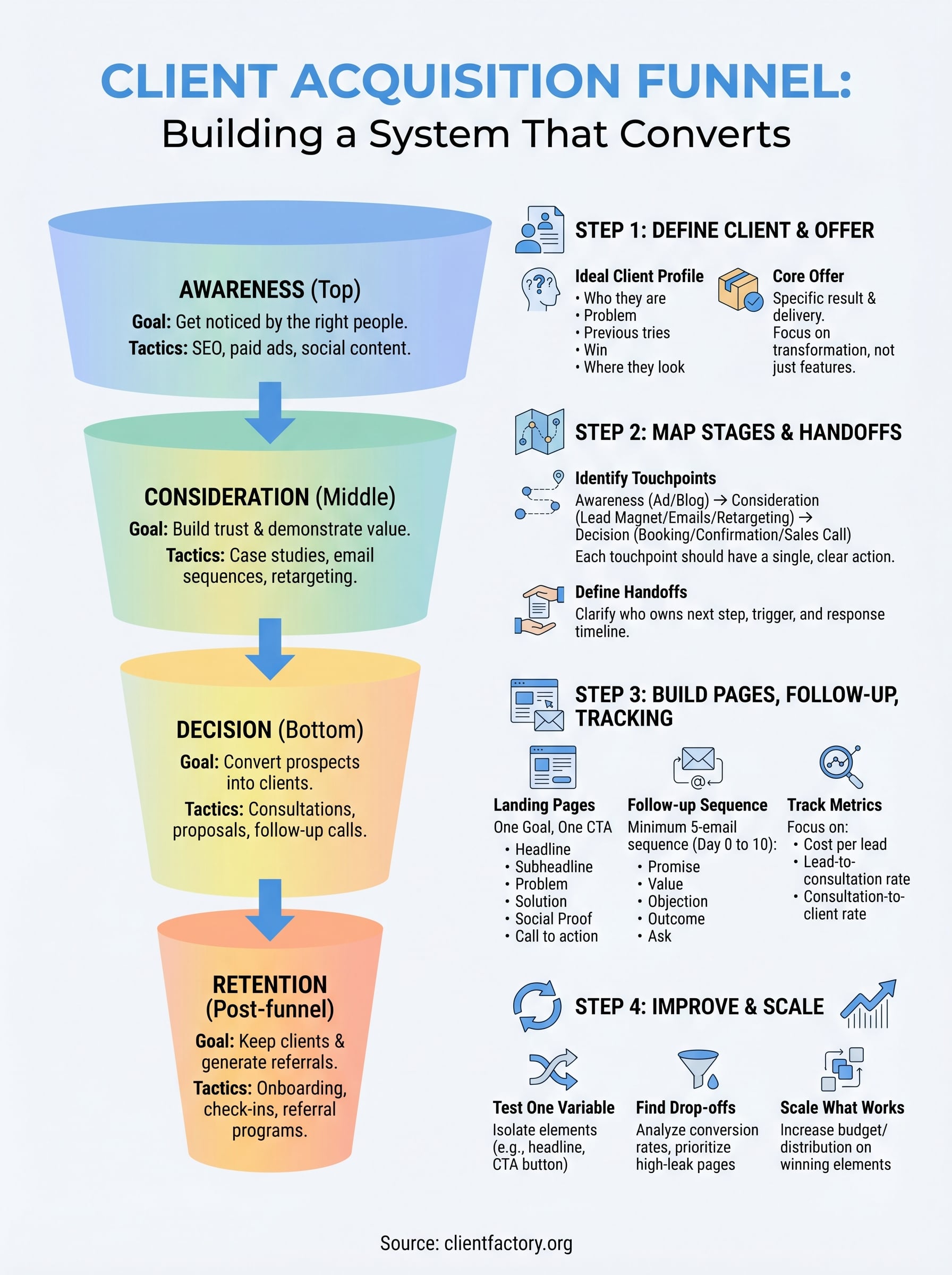
You now have everything you need to build a client acquisition funnel that moves prospects toward a decision. Start with your ideal client profile, map every touchpoint, build your pages and follow-up sequence, and let the data tell you where to improve. Each step builds on the one before it, so resist the urge to skip ahead or build everything at once.
The biggest mistake at this point is waiting until conditions feel perfect. Your funnel improves through real data, not through more planning. Launch a minimum viable version, measure what matters, and optimize from there. Small, deliberate improvements compound quickly when you stay consistent.
If you want expert eyes on your current setup before you invest more time or budget, book a free funnel audit with the Client Factory team. We’ll show you exactly where your funnel is leaking and what to fix first.