
Most businesses lose potential clients not because their offer is weak, but because their funnel has gaps. Understanding lead generation funnel stages gives you a clear framework for how strangers become prospects, and how prospects become paying clients. Without that framework, you’re essentially guessing, running ads, publishing content, and hoping something sticks. That’s expensive and unsustainable.
Each stage of the funnel serves a specific purpose: attract attention, build trust, and drive a decision. When even one stage underperforms, the whole system breaks down. Conversions drop. Cost per lead climbs. And growth stalls out right when you need it most. The good news? Once you understand how these stages work together, fixing the leaks becomes straightforward.
At Client Factory, we build and optimize client acquisition funnels for service businesses and law firms every day. This article breaks down each funnel stage with clear definitions, real examples, and actionable tips you can apply immediately. Whether you’re building your first funnel or trying to figure out why your current one isn’t converting, you’ll walk away with a practical understanding of how to move leads from first click to signed client.
What lead generation funnel stages are
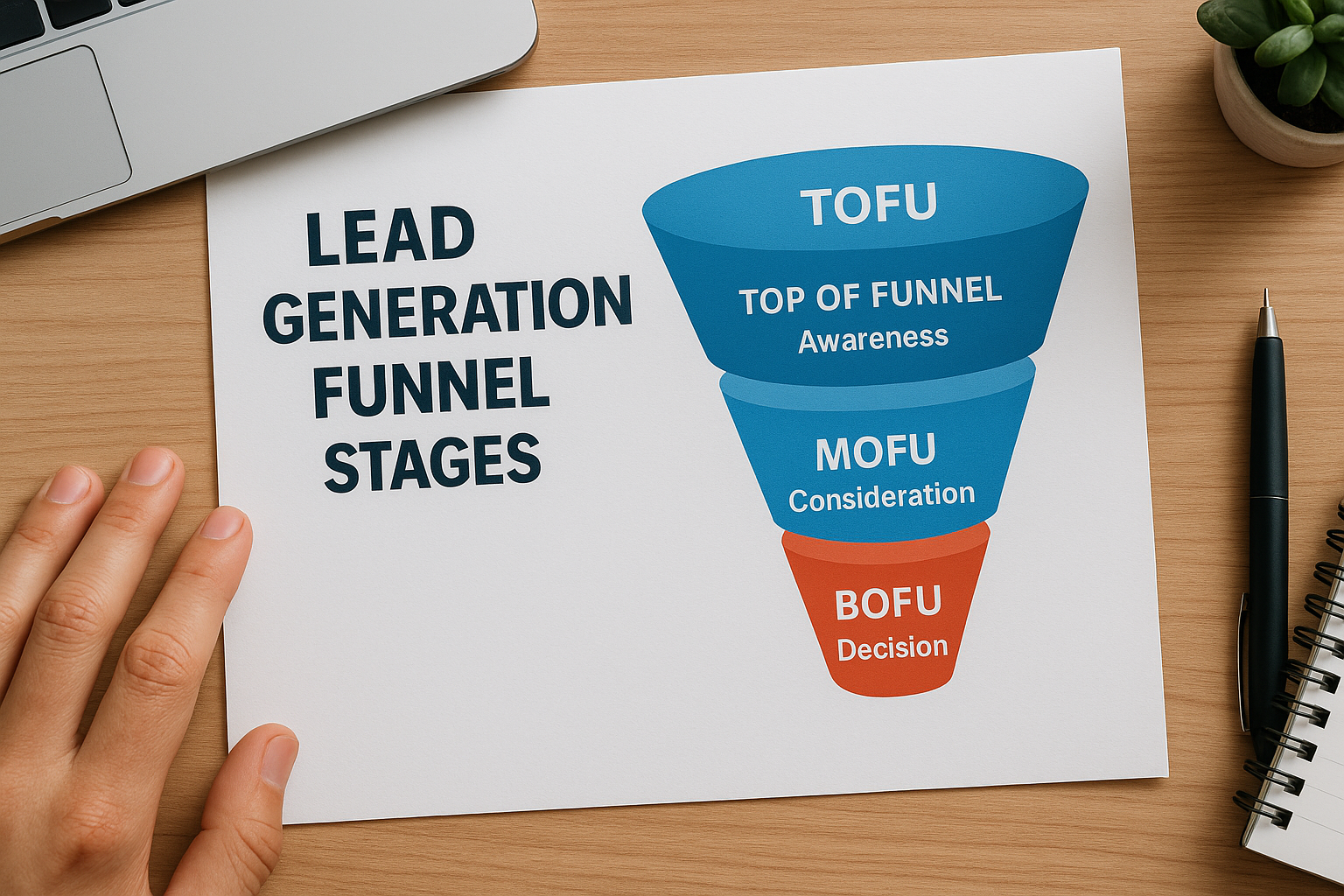
A lead generation funnel is a structured model that maps the journey a person takes from first hearing about your business to becoming a paying client. The term "funnel" is intentional: at the top, you have a large pool of people who might be interested in what you offer. As they move through each stage, that pool narrows. People who are not a fit drop out, and those who are a strong match continue forward. Lead generation funnel stages give you a way to visualize, measure, and improve that process at every point along the way, rather than treating your marketing as one undifferentiated effort.
The funnel as a visual model
Think of the funnel in three broad layers: top, middle, and bottom. The top of the funnel (TOFU) is where you attract attention from a wide audience. The middle of the funnel (MOFU) is where you build trust and nurture interest. The bottom of the funnel (BOFU) is where you close the deal. Each layer has a specific job, and what works at the top will rarely work at the bottom. A social media post might pull someone into your world, but it will not be what convinces them to sign a contract or hand over their credit card.
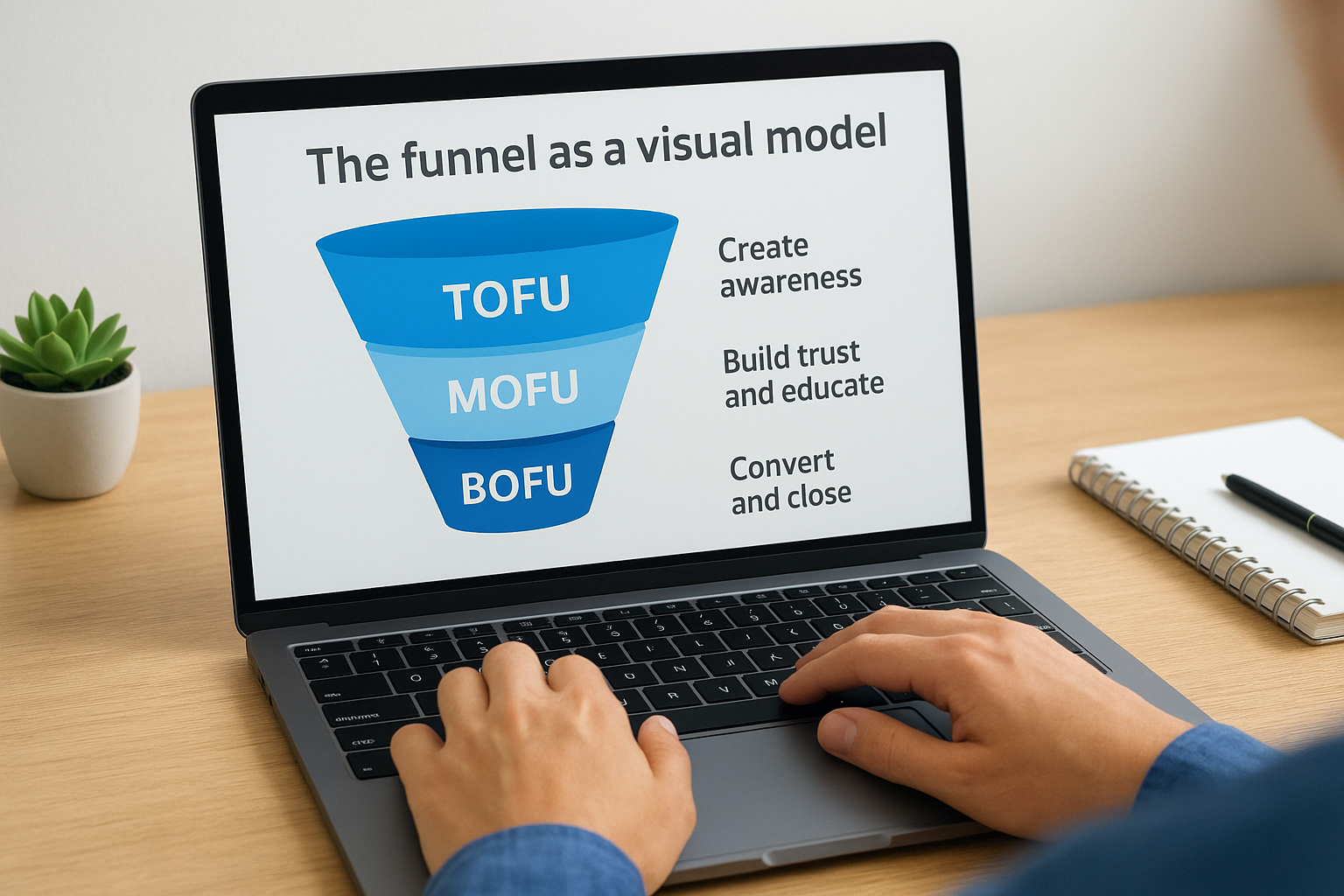
Every stage of your funnel requires a different message, medium, and call to action, and mixing them up is one of the most common reasons funnels fail to convert.
Here is how the three layers map to what your leads are actually thinking:
| Funnel Layer | Lead Mindset | Your Job |
|---|---|---|
| Top (TOFU) | "I have a problem" | Create awareness |
| Middle (MOFU) | "Who can help me?" | Build trust and educate |
| Bottom (BOFU) | "Should I choose you?" | Convert and close |
How stages differ from tactics
Stages and tactics are not the same thing, and confusing the two leads directly to wasted budget. A stage describes where your lead is in their decision-making process. A tactic, such as running a Google Ad or sending an email sequence, is a tool you use to move them from one stage to the next. Your funnel stages stay constant, but the tactics you deploy within each stage can and should shift based on what your data tells you.
Recognizing this distinction also helps you diagnose problems faster. If your ads generate clicks but your leads never convert, the issue is likely in your middle or bottom funnel, not the awareness stage. Knowing exactly where leads drop off tells you where to focus your time and budget instead of making changes at random and hoping the numbers improve.
Why funnel stages matter for lead quality and ROI
Understanding lead generation funnel stages does more than give you a map of your marketing process. It gives you a measurement framework that tells you exactly where you’re winning and where you’re losing budget. Without defined stages, every dollar you spend goes into a process with no clear feedback loop. With stages clearly defined, you can track conversion rates at each step and make targeted improvements rather than overhauling everything at once.
Lead quality starts with stage alignment
Most businesses struggling with low-quality leads are not running bad ads or targeting the wrong keywords. The real issue is a mismatch between their message and the stage their audience is actually in. When you push bottom-funnel offers at top-funnel audiences, people disengage because they are simply not ready to buy.
Aligning your message to the right stage keeps your pipeline full of leads who are genuinely interested and ready to move forward, not just people who clicked out of curiosity.
Fixing stage alignment does not require a bigger budget. It requires you to audit what you are saying at each stage and match it to where your audience is in their decision-making process. That shift alone can significantly improve both the volume and quality of leads entering your funnel.
How stages connect directly to ROI
Every stage you optimize reduces your cost per acquisition. If your awareness content pulls in 1,000 visitors but only 10 convert to leads, fixing that gap improves every downstream metric. Better top-of-funnel targeting feeds better middle-funnel conversations, and stronger middle-funnel nurturing produces higher close rates at the bottom.
The compounding effect is real: a 10% improvement at each of three stages can double your overall conversion rate without adding a single dollar to your ad spend. That is why understanding and acting on your funnel stages is not optional if ROI matters to your business.
The core funnel stages and what happens in each
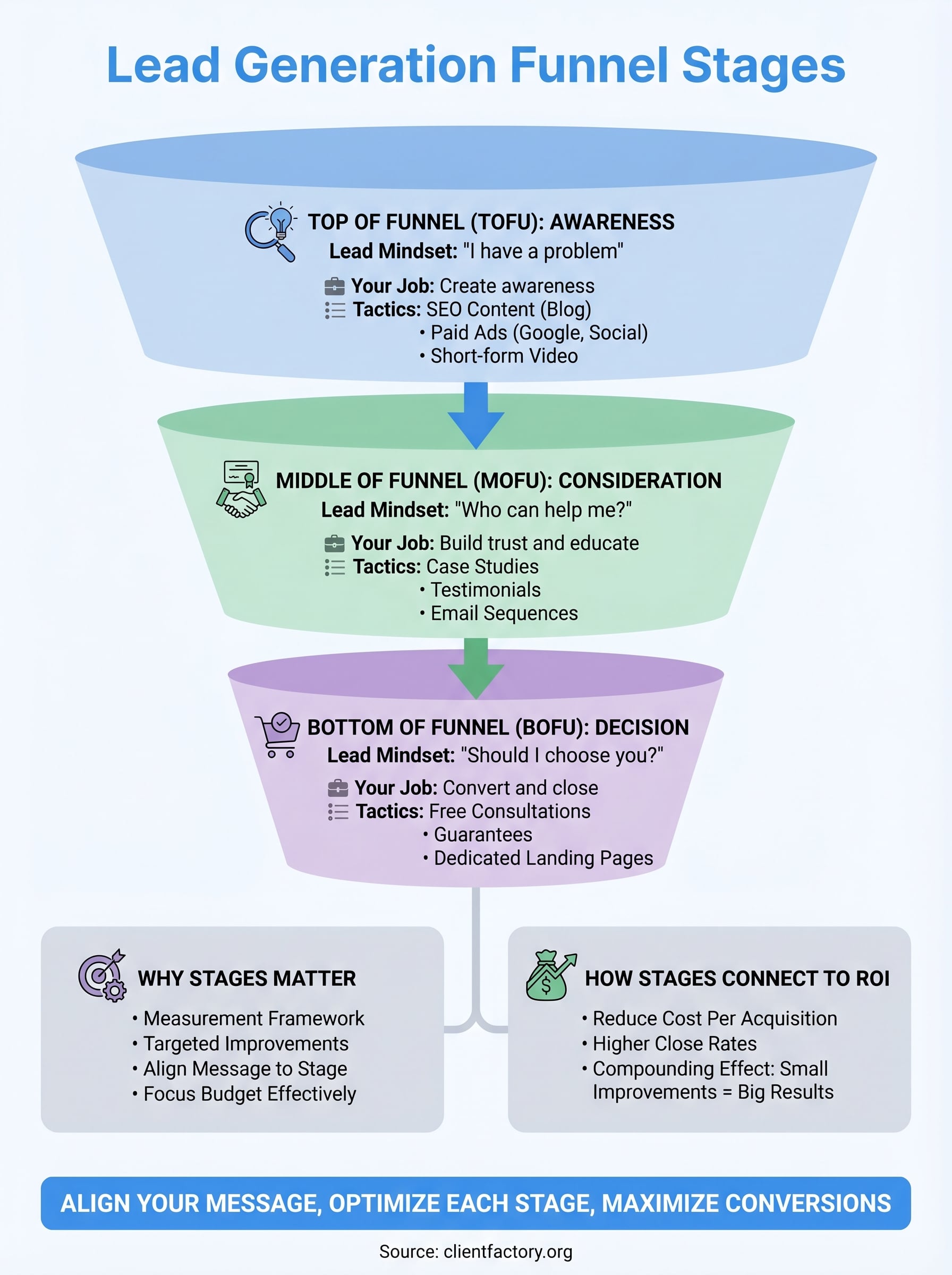
Each of the lead generation funnel stages has a specific role, and skipping any one of them creates gaps that cost you clients. The three core stages are awareness, consideration, and decision. Each requires a different message and a different type of offer to move leads forward effectively.
Matching the right content to the right stage is what separates a funnel that converts from one that leaks budget at every step.
Top of funnel: Awareness
At the awareness stage, your lead doesn’t know you yet. They recognize a problem but haven’t started comparing solutions. Your job is to get in front of the right audience with content that speaks directly to that pain point. Common awareness tactics include:
- Blog posts and SEO content targeting problem-aware searches
- Paid ads on Google or social platforms
- Short-form video that explains the problem you solve
Middle of funnel: Consideration
Once a lead knows you exist, they start evaluating their options. Trust becomes the deciding factor at this stage. Your job is to give them concrete evidence that you can solve their problem better than anyone else. Effective consideration-stage content includes:
- Case studies showing real client results
- Testimonials from businesses in similar situations
- Email sequences that consistently reinforce your expertise
Bottom of funnel: Decision
At the decision stage, your lead is ready to act. They need a clear, low-friction path to take the next step. Your offer, your call to action, and your intake process all determine whether you close or lose the deal. Strong decision-stage tools include:
- Free consultations or audits that reduce the barrier to entry
- Guarantees that lower perceived risk
- Dedicated landing pages built specifically to convert
Examples of how leads move through the funnel
Seeing the lead generation funnel stages in action makes the model concrete. Two real-world scenarios below show how leads move from first contact to signed client and where each stage does its specific job instead of just existing on a slide deck.
A law firm attracting new clients
A personal injury law firm runs Google Ads targeting people who searched "car accident lawyer near me." That ad sends the lead to a landing page with one clear call to action: request a free case review. The lead submits the form and enters a nurture email sequence that shares past case results and direct client testimonials.

By the time the consultation call happens, the lead already trusts the firm. The attorney closes far more often on the first call because every stage built credibility before the phone rang. Nothing about that outcome is accidental.
The firm is not closing leads through charm alone. It closes them because each stage did its job before the conversation even started.
A home services company filling its calendar
A roofing company targets homeowners in storm-affected zip codes using Facebook ads that show before-and-after job photos. Homeowners who click land on a page offering a free roof inspection. Those who book get a follow-up text sequence that reinforces the company’s certifications and local reviews.
When the inspector arrives, the homeowner has already seen the social proof and is ready to say yes. Conversion rates on those inspections run significantly higher than any cold outreach the company tried before implementing the funnel.
Both examples share the same pattern: top-of-funnel content pulls in the right audience, middle-funnel nurturing builds trust before the sales conversation, and bottom-funnel offers remove the friction that stops people from acting. That sequence is what fills your pipeline instead of quietly burning your budget.
How to build and optimize each stage
Building strong lead generation funnel stages starts with auditing what you already have before adding anything new. Most businesses have pieces in place at each stage, but those pieces are disconnected, meaning leads enter at the top and fall out before they ever reach a conversion point. Your goal is to close those gaps with intentional content, clear calls to action, and consistent follow-up at every level.
A funnel you’ve never audited is almost always leaking budget at more than one stage, and fixing those leaks costs far less than increasing ad spend.
Build your top-of-funnel with intent-driven content
Your awareness stage lives or dies on targeting precision. You need to reach people who are actively experiencing the problem you solve, not just anyone who fits a broad demographic profile. Use keyword research and audience data to identify the specific searches and behaviors that signal real intent, then build your ads and content around those signals directly.
- Focus ad copy on specific pain points, not your company name
- Use landing pages that match the exact promise in your ad
- Measure click-to-lead conversion rates weekly, not monthly
Strengthen your middle funnel with trust signals
Once leads enter your pipeline, your job is to eliminate doubt before the sales conversation happens. Send a follow-up email sequence that shares case studies, client results, and credentials relevant to your specific audience. The goal is not to overwhelm them but to answer the objections they already have before they voice them on the call.
Close more at the bottom with friction-free offers
Your bottom-funnel offer needs to make saying yes easier than saying no. Replace vague contact forms with a specific next step, such as a free audit, a consultation, or a short discovery call. Reduce the number of form fields, write confirmation pages that reinforce the decision, and follow up within minutes, not hours.
Next steps
You now have a complete picture of how lead generation funnel stages work, what each stage demands from your marketing, and where most businesses lose leads they should be closing. The framework is straightforward: attract the right audience at the top, build trust in the middle, and remove friction at the bottom. Every gap you close in that sequence lowers your cost per client and raises your conversion rate without requiring a bigger budget.
Knowing the stages is the first step. Putting that knowledge into action is where the results actually show up. If you are unsure which stage of your funnel is leaking the most leads, the fastest way to find out is to have someone review it with fresh eyes. Book a free conversion audit and get a clear breakdown of exactly what to fix and where to start: schedule your funnel audit today.