

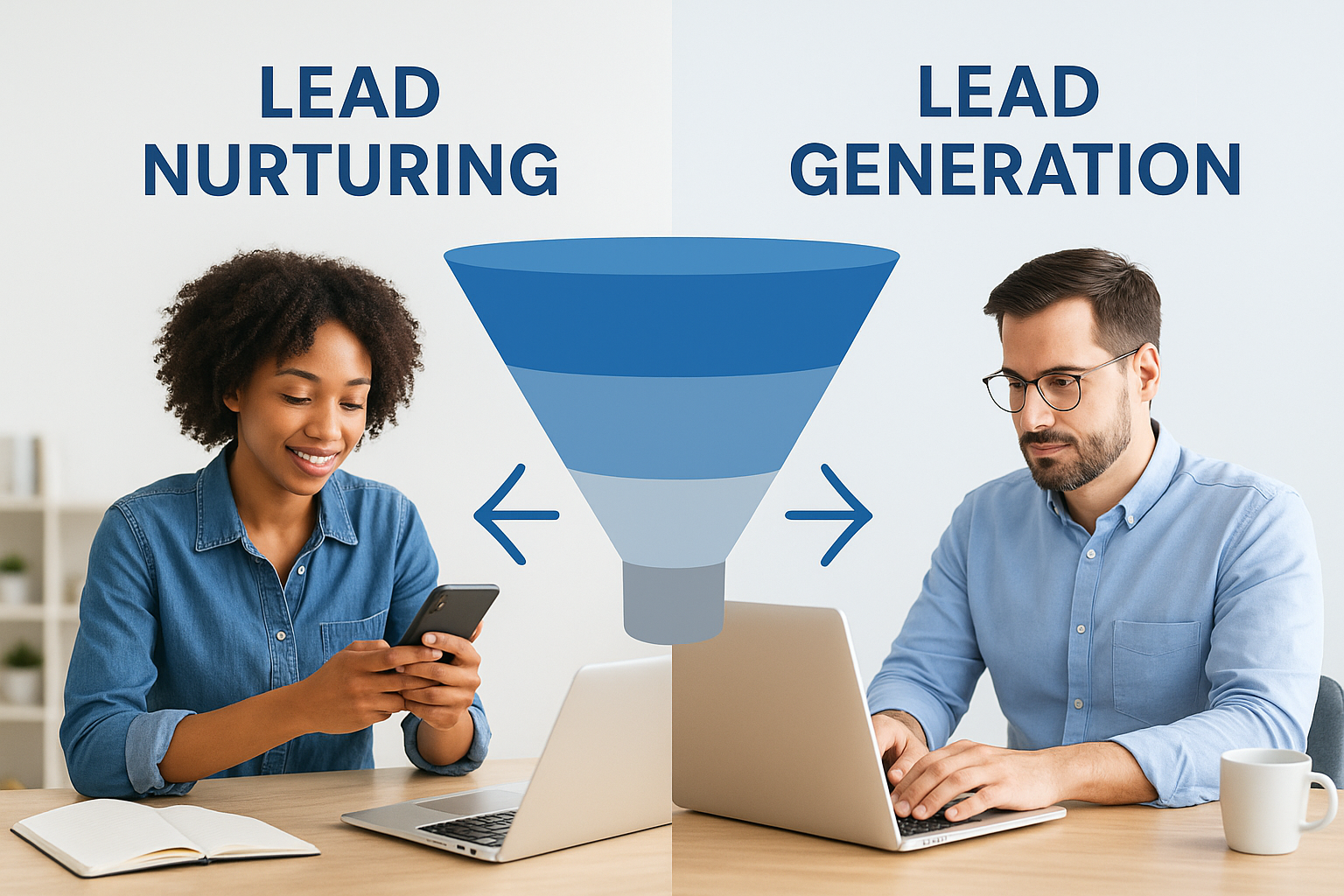
Most businesses treat lead nurturing vs lead generation as interchangeable terms, and that confusion costs them real money. They pour budget into attracting new prospects but have no system for turning those prospects into paying clients. Or they build elaborate email sequences for leads that were never qualified in the first place. Either way, the funnel leaks.
Here’s the truth: lead generation and lead nurturing are two distinct stages of client acquisition, and each one requires a different strategy, different tools, and different metrics. When you understand where one ends and the other begins, you stop wasting effort on tactics that don’t match your actual problem. You also stop blaming "bad leads" when the real issue is what happens after the click.
At Client Factory, we build complete acquisition funnels for service businesses and law firms, which means we see both sides of this equation every day. We know exactly where most funnels break down, and it’s almost always at the handoff between generation and nurturing. This article breaks down the key differences between these two processes, explains how they fit together inside a healthy funnel, and gives you a practical framework for diagnosing which one needs your attention right now.
What lead generation is in the sales funnel
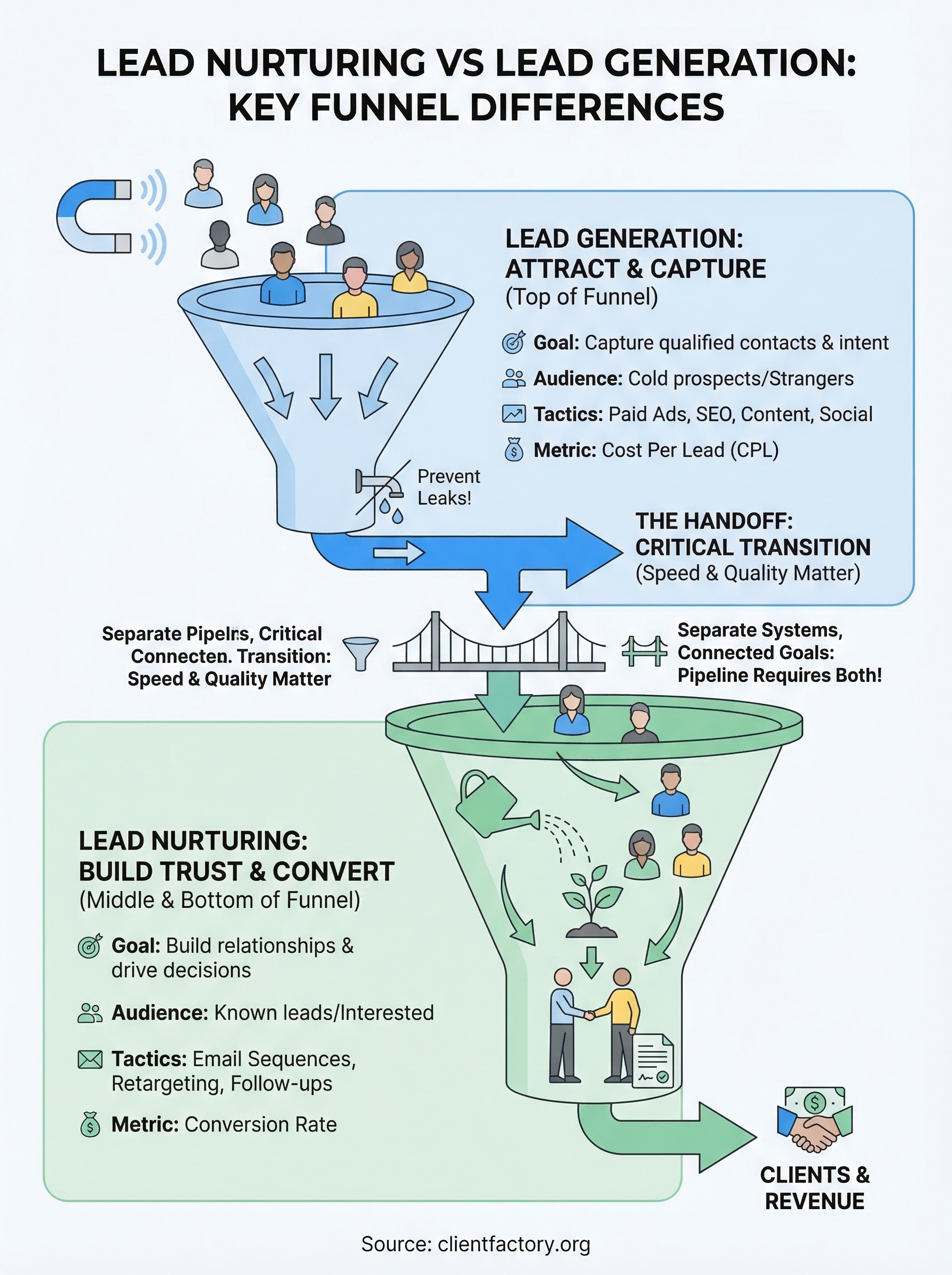
Lead generation is the process of identifying and attracting people who have some level of interest in what you offer, and getting them to raise their hand. In funnel terms, it lives at the top of the funnel and feeds everything below it. Without lead generation, your sales pipeline runs dry. Nothing downstream works if no one is entering the funnel in the first place.
The job of lead generation is not to close deals. Its job is to produce a steady, predictable flow of potential buyers who match your target profile and have shown enough interest to share their contact information or engage with your brand in a meaningful way. That’s the handoff point. Once someone crosses that threshold, you have a lead.
The goal of lead generation
Every lead generation effort shares one core objective: bring qualified strangers into your world. The word "qualified" matters here. Generating a massive list of random contacts is not success. It’s noise that clogs your funnel and wastes your team’s time on conversations that were never going to convert.
Effective lead generation isn’t about volume. It’s about getting the right people through the door so your nurturing process has something real to work with.
Qualifying starts at the generation stage itself. When you target the right audience with the right message on the right channel, you pre-filter who enters the funnel. This is why audience targeting inside platforms like Google Ads is so important: your campaign settings determine lead quality before a single person clicks.
What lead generation looks like in practice
For service businesses and law firms, lead generation typically involves paid advertising, organic search (SEO), referral programs, and social media content. Each of these channels serves the same function: place your offer in front of people who match your ideal client profile and give them a clear reason to act.
A prospect sees your Google ad, clicks it, lands on a targeted landing page, and fills out a contact form. That’s a lead. Or they find your blog post while searching for answers to a legal question and download a checklist in exchange for their email address. That’s also a lead. The channel changes, but the core mechanism stays the same: capture intent, capture contact.
Common lead generation tactics for service businesses include:
- Paid search campaigns targeting high-intent keywords
- Local SEO optimized for geographic service areas
- Content marketing designed to rank and convert
- Social media advertising on platforms like Facebook or YouTube
- Referral programs that turn current clients into a source of new prospects
How to measure lead generation performance
Lead generation has a specific set of metrics that tell you whether the top of your funnel is working. Keeping these separate from your nurturing metrics is critical when you’re diagnosing performance issues, because conflating the two stages makes it nearly impossible to identify where your funnel is actually breaking down.
The numbers you track at this stage include cost per lead (CPL), total lead volume, lead source breakdown, and lead quality rate (how many generated leads are actually worth pursuing). If your CPL is climbing or your lead volume is inconsistent, the problem lives here, at the generation stage, not inside the nurturing sequence that follows it. Fix the right problem, and you fix the right part of the funnel.
What lead nurturing is in the sales funnel
Lead nurturing is the process of building a relationship with prospects after they enter your funnel, guiding them toward a buying decision over time. It lives in the middle and bottom of the funnel, where the job shifts from attracting attention to earning trust. Your prospect already knows you exist. Your task now is to give them enough value, credibility, and confidence to take the next step with you.
The goal of lead nurturing
Where lead generation is about volume and reach, nurturing is about depth and timing. Most prospects who enter your funnel are not ready to buy immediately. High-consideration purchases, especially in legal and professional services, require multiple touchpoints before a prospect commits. Nurturing keeps you present and credible throughout that decision process so you’re the first call they make when they’re finally ready.
The biggest mistake service businesses make is treating nurturing as a follow-up task rather than a strategic system built to move people toward a decision.
What lead nurturing looks like in practice
For service businesses and law firms, lead nurturing typically happens through email sequences, retargeting ads, personalized follow-up calls, and content that addresses specific objections or questions your prospects have at that stage. These are not random touchpoints. Each one serves a defined purpose inside the sequence: build familiarity, establish authority, remove friction, or prompt action.
A typical nurturing sequence for a law firm might look like this:
- Day 1: Automated email confirming the inquiry and setting clear expectations
- Days 2-3: Educational content explaining the legal process the prospect is concerned about
- Day 5: A client success story or case result that builds credibility
- Day 7: A direct prompt to book a consultation
This kind of structured sequence moves a cold prospect through the decision process in a predictable, repeatable way. When you understand the real difference in lead nurturing vs lead generation, you stop expecting your generation campaigns to do the nurturing work. These are separate systems with separate jobs, and both need to be built intentionally if you want a funnel that closes consistently.
Lead nurturing vs lead generation: the key differences
The clearest way to separate these two processes is by where they operate in the funnel and what they’re trying to accomplish. Lead generation works at the top, pulling people in. Lead nurturing works in the middle and bottom, pushing people forward. Treating them as the same thing is like expecting your advertising budget to also close your deals. Each stage has a distinct job, and when you mix them up, neither one gets done well.

They target different stages of the buyer journey
Lead generation targets strangers and cold audiences who haven’t interacted with your business yet. Your goal at this stage is visibility and capture: get the right person to see your offer and take a first action. Lead nurturing targets people already in your funnel who’ve shown interest but haven’t committed. The audience mindset is completely different, which means the tactics need to be completely different too.
| Factor | Lead Generation | Lead Nurturing |
|---|---|---|
| Funnel position | Top | Middle and bottom |
| Audience | Cold prospects | Known leads |
| Primary goal | Capture contact and intent | Build trust and drive decisions |
| Primary channels | Paid ads, SEO, social | Email, retargeting, follow-up calls |
| Key metric | Cost per lead | Lead-to-client conversion rate |
They require different budgets and timelines
Running lead generation campaigns typically requires upfront spend on paid media or content to drive visibility and traffic. Results can come quickly with paid channels, but you pay for every click whether or not the lead converts. Nurturing, by contrast, is often lower-cost but more time-intensive because it relies on sequences, content, and follow-up built over days or weeks.
When you understand lead nurturing vs lead generation as separate investments with separate timelines, you stop making the mistake of cutting nurturing budgets just because lead volume looks strong.
Your nurturing system also tends to compound over time in ways that generation does not. A well-built email sequence continues to convert leads that entered your funnel weeks ago. A paid ad campaign delivers results only while it’s actively running. Both investments matter, but they operate on different return timelines and need to be evaluated on those terms individually.
How the two work together to create pipeline
Lead generation and lead nurturing don’t compete with each other. They connect in sequence, and that connection is exactly where your pipeline gets built. Think of lead generation as the engine that fills the top of your funnel, and nurturing as the system that moves prospects through it. Without both working together, you either have a full funnel that doesn’t close or a great nurturing sequence with no one entering it. Most service businesses have one or the other, rarely both, and that gap is what keeps their pipeline unpredictable.
The handoff point is where most funnels fail
The transition from lead generation to nurturing is the most fragile point in any acquisition funnel. A prospect fills out a form or clicks an ad, and then nothing happens fast enough. They go cold. The speed and quality of your initial follow-up determines whether the momentum from your generation effort carries forward or evaporates. When you understand lead nurturing vs lead generation as connected stages rather than separate campaigns, you stop treating the handoff as an afterthought and start building a deliberate bridge between the two.

The best-performing funnels treat the moment a lead enters as the trigger point for a pre-built nurturing system, not a manual task to complete whenever someone gets around to it.
For service businesses, that bridge typically looks like an automated response within minutes of the lead action, followed by a structured sequence that carries the prospect from initial interest to consultation-ready. This kind of connected system is what turns a paid ad into a signed client rather than just a name in a spreadsheet.
How they build pipeline together over time
When both systems run in parallel, your pipeline becomes self-reinforcing. Lead generation keeps filling the top with fresh prospects. Nurturing keeps working on everyone already inside, including people who entered weeks or months ago. The result is a funnel where closed clients come from multiple entry points and time frames, not just your most recent campaign.
Consistent pipeline requires both components to perform. If your generation slows down, nurturing has fewer prospects to work with. If your nurturing breaks down, your generation spend produces leads that never convert. The two processes are separate in function but entirely dependent on each other for real results.
How to set up lead gen and nurturing for services
For service businesses and law firms, the practical question isn’t just understanding lead nurturing vs lead generation in theory. It’s knowing how to build both in a way that works together without creating unnecessary complexity. The good news is that both systems follow a repeatable structure you can set up once and then optimize over time as you gather data.
Build your lead generation foundation first
Your lead generation setup starts with identifying your highest-value client profile and working backward from there. Who are you targeting, what problem do they have, and where are they already looking for solutions? Once you have clear answers, you can build your campaign structure around those specifics rather than guessing your way toward results.
The clearest signal that your lead generation is working is consistent, qualified contact from people who match your target profile, not just raw volume.
For most service businesses, the core setup includes a paid search campaign targeting high-intent keywords, a landing page built specifically for that campaign (not your homepage), and a form that captures name, contact info, and one qualifying question. Keep the entry point simple. The goal is to confirm interest and capture contact, not close the deal on the landing page.
- Define your target client profile with specific criteria
- Build a dedicated landing page with a single clear call-to-action
- Set up conversion tracking so you know which campaigns produce real leads
- Test two or three ad variations before scaling your spend
Build your nurturing sequence second
Once your generation is live and producing contacts, build the nurturing sequence that activates the moment a lead enters your funnel. For service businesses, a five-to-seven step email sequence covers the core journey from initial inquiry to consultation-ready. Each email should serve a specific function in the decision process: confirm trust, address a common objection, demonstrate results, or prompt a booking.
Your nurturing setup also needs a retargeting campaign running alongside your email sequence to stay visible with leads who opened but didn’t respond. Many prospects need repeated exposure before they act, and retargeting handles that without requiring manual follow-up on every contact. Combine both channels, and your nurturing system covers the full middle of the funnel without depending on a single tactic to carry the whole load.
Bring it all together
Lead nurturing vs lead generation are not competing priorities. They are two connected stages that each carry a specific job inside your funnel, and the businesses that treat them as a single blurry process are the ones watching their pipeline stall despite consistent ad spend. When you build both systems with clear roles and a deliberate handoff between them, you stop losing leads in the gap between attraction and conversion.
Your generation system fills the top of the funnel with qualified prospects who match your target profile. Your nurturing system takes those prospects and builds enough trust and momentum to carry them to a decision. Neither one works without the other. Once you have both running, your pipeline becomes consistent and repeatable rather than dependent on timing and luck.
If you want help building a funnel that connects both sides, book a free conversion audit and we’ll show you exactly where yours is leaking.