
Most business owners hit the same wall: you need more clients, but building a full in-house marketing team costs a fortune and takes months to ramp up. That’s where outsourced demand generation comes in, handing the strategy, execution, and optimization of your pipeline growth to a specialized partner. It’s not about giving up control. It’s about getting results faster without burning through your budget on trial and error.
But outsourcing isn’t always the right move, and doing it at the wrong time or with the wrong partner can set you back. The decision depends on your current revenue, your internal capacity, and how quickly you need to fill your pipeline. At Client Factory, we’ve spent over 30 years helping service businesses and law firms build client acquisition systems that actually convert, so we’ve seen firsthand when outsourcing works, when it doesn’t, and what separates a good engagement from a wasted one.
This article breaks down the real benefits, realistic costs, and timing signals that tell you whether outsourced demand generation is the right strategic move for your business right now, or whether you should wait.
Why outsourced demand generation matters
The core problem most service businesses face isn’t a lack of ambition. It’s a resource gap between where you are now and what serious demand generation actually requires. Running effective campaigns across paid search, organic content, and email takes a team with distinct skill sets, and most growing businesses don’t have all of those skills under one roof. Outsourced demand generation exists to close that gap without forcing you to hire, train, and manage a full internal marketing department before you’re ready to justify the payroll.
The businesses that grow fastest aren’t always the ones with the biggest internal teams. They’re the ones that plug into the right expertise at the right moment.
The true cost of an empty pipeline
When your pipeline runs dry, every part of your business feels it. Sales teams lose momentum, leadership shifts attention to short-term fixes, and revenue becomes unpredictable month over month. The longer your pipeline stays thin, the harder it becomes to recover, because demand generation compounds over time. Campaigns build audience data, messaging sharpens with each test cycle, and retargeting pools grow deeper. If you pause or delay, you lose that compounding effect and have to start over.
Building momentum from scratch takes significant time. Most businesses that try to ramp up demand generation in-house underestimate how long it takes to see results. Paid ad campaigns need weeks of performance data before meaningful optimization kicks in, and content-driven demand takes months to build enough authority to move the needle. A specialized partner brings proven frameworks and platform experience that compress that ramp-up period considerably, so you’re not paying for a learning curve.
Why in-house teams struggle to keep pace
In-house marketing hires are expensive and highly specialized. A single demand generation manager can cost between $90,000 and $130,000 per year in salary alone, before you factor in benefits, tools, and ad spend budgets. One person rarely covers the full scope effectively: you typically need separate expertise for paid media, content strategy, and analytics. That’s a team, not a single hire, and it adds up fast.
Small and mid-sized service businesses often can’t justify that payroll until they already have a strong revenue base. The problem is that demand generation is what builds that revenue base in the first place. Outsourcing breaks that deadlock directly. You get a team with full capability and no fixed overhead, and you can scale the engagement up or down based on what your pipeline actually needs at any given point in your growth cycle.
What outsourced demand generation includes
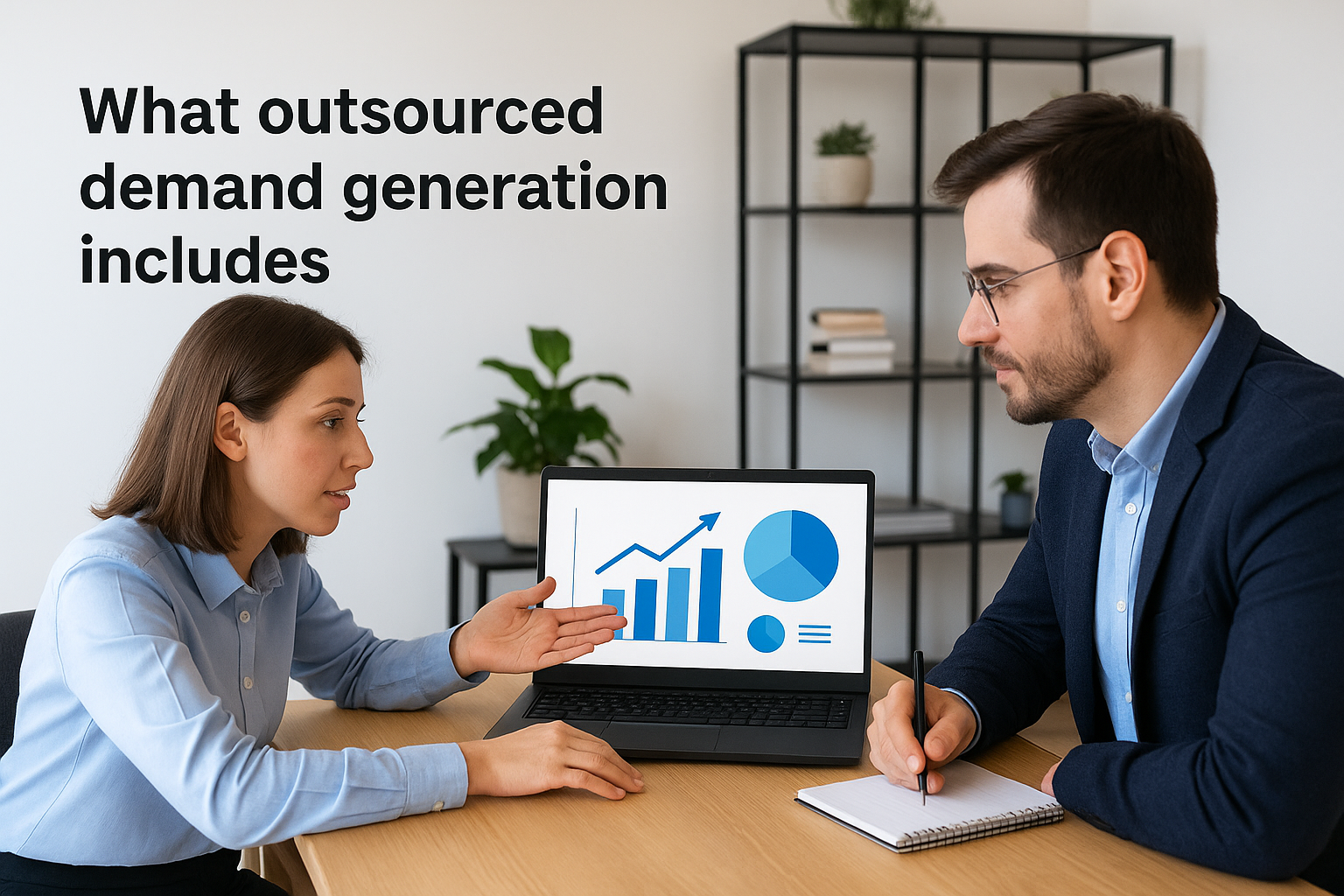
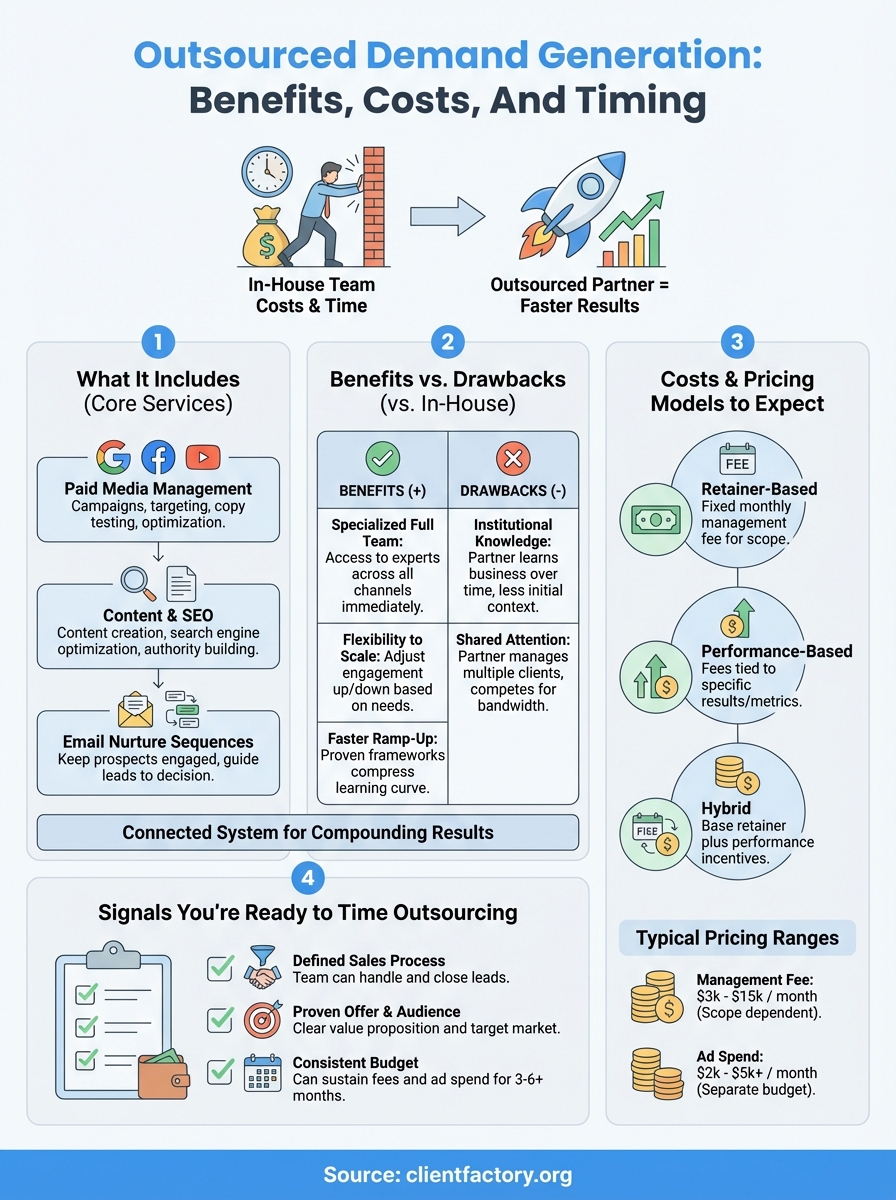
When you bring in an external partner, you’re not outsourcing a single tactic. Outsourced demand generation covers a connected set of services that work together to build your pipeline consistently. The exact scope varies by provider, but most engagements bundle strategy, execution, and measurement into one arrangement so you aren’t managing five separate vendors to get a single outcome.
Core services your partner handles
Paid media management is typically the engine of any engagement. Your partner builds, launches, and optimizes campaigns across platforms like Google Ads, Facebook, and YouTube, covering everything from audience targeting and ad copy testing to bid strategy and landing page alignment. Beyond paid, your partner handles content creation and search engine optimization, developing material that positions your business as the credible answer to problems your ideal clients are already searching for online.
Email nurture sequences are another standard component. These sequences keep your business in front of prospects between their first touchpoint and their final decision, so leads don’t go cold while they’re still weighing their options. Each piece of the service stack is designed to feed the next one, which is what makes the system work.
Demand generation produces compounding results when paid, organic, and nurture channels operate as one connected system rather than separate tactics running independently.
Reporting and pipeline accountability
Clear, consistent performance reporting is what separates a real demand generation partner from a vendor that just spends your ad budget. Your partner should tie campaign activity directly to pipeline metrics, including cost per lead, lead quality scores, and cost per acquisition, so you understand exactly where your investment is producing results and where adjustments need to happen. Regular strategy reviews allow your partner to refine targeting, messaging, and channel allocation based on actual data, not assumptions, keeping the program moving in the right direction month over month.
Benefits and drawbacks versus in-house
Choosing between outsourced demand generation and building in-house comes down to speed, cost, and control. Neither option is universally better, but understanding where each model wins helps you make a decision that fits your actual situation rather than a generic recommendation.
Benefits of outsourcing
The biggest advantage is immediate access to a full team with specialized skills across paid media, content, and analytics without the time and expense of recruiting. You skip the onboarding period entirely and plug into frameworks that have already been tested across multiple campaigns and industries. Your risk is lower because you’re not betting a salary on a single hire who may or may not deliver.
When speed matters, outsourcing compresses the time between deciding to invest in demand generation and seeing qualified leads enter your pipeline.
Your flexibility to scale the engagement up or down based on pipeline needs is another real advantage. If you enter a slow season or need to redirect budget, you can adjust your scope without laying anyone off or breaking an employment contract.
Drawbacks to keep in mind
The primary tradeoff is institutional knowledge. An external partner learns your business over time, but they will never have the same depth of context that a dedicated in-house hire develops after years working inside your organization. Early in the engagement, expect a ramp-up period where your partner is still building that understanding.
You also share your partner’s attention with their other clients, which means your account competes for bandwidth during high-demand periods. A well-structured agency mitigates this with clear account management protocols, but it’s a real dynamic you should ask about directly before signing any agreement.
Costs and pricing models to expect
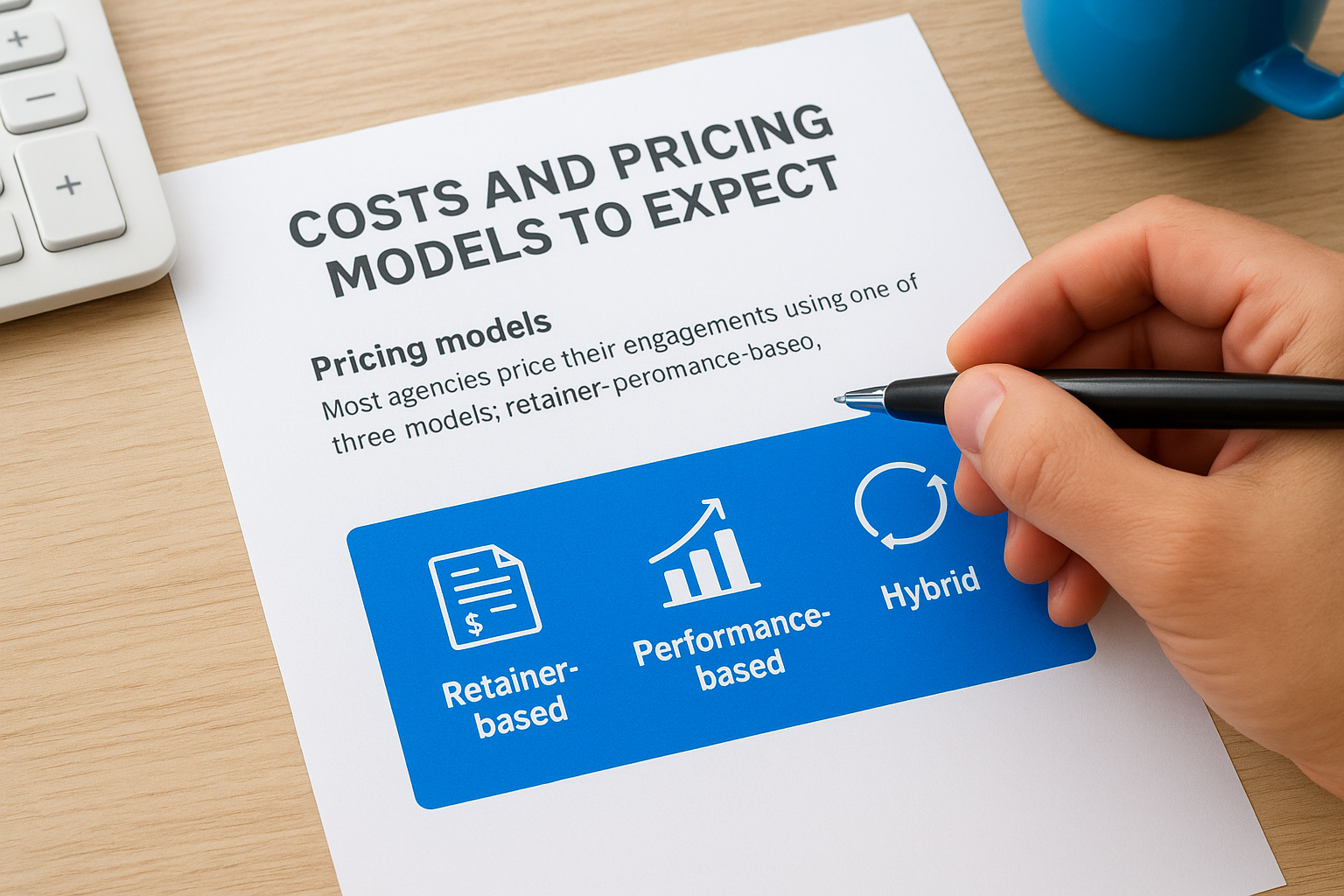
Understanding what outsourced demand generation actually costs helps you budget realistically and avoid sticker shock during vendor conversations. Most agencies price their engagements using one of three models: retainer-based, performance-based, or a hybrid of both, and each has a different risk profile depending on how confident your partner is in their ability to deliver.
Typical pricing ranges
Most full-service engagements run between $3,000 and $15,000 per month for the management fee alone, separate from your ad spend budget. Smaller agencies or specialists focused on a single channel tend to sit at the lower end, while full-stack partners managing paid media, content, and email nurture sit at the higher end. Ad spend is always a separate line item and typically runs at a minimum of $2,000 to $5,000 per month for campaigns to generate meaningful data.
The monthly management fee buys you strategy and execution. Your ad spend budget is what actually puts your offer in front of the right audience.
What drives your total investment
Scope is the primary cost driver. Paying for a partner to run a single Google Ads campaign costs far less than engaging one to manage paid search, paid social, content creation, and a full email nurture sequence simultaneously. The more channels your program covers, the more your investment climbs, but the compounding effect of a connected multi-channel system also tends to produce better cost-per-lead results over time.
Your industry and target audience also affect pricing. Competitive markets like legal services require larger ad budgets to buy meaningful visibility, which pushes total program costs higher. Before committing to any engagement, ask your partner for a clear breakdown of what the management fee covers, what it excludes, and how they handle budget increases so there are no surprises once the program launches.
How to time outsourcing and choose a partner
Timing your move into outsourced demand generation poorly can waste budget and create frustration on both sides of the engagement. The right moment to outsource is when you have a clear offer that converts and enough budget to fund both management fees and ad spend consistently for at least three to six months. If you’re still figuring out your core offer or can’t commit to a sustained investment, you’ll burn through budget before the program has enough data to optimize against.
Signals that you’re ready
You’re ready to outsource when your sales process is defined and your team can actually handle the leads an external partner generates. Outsourcing demand generation before your sales capacity is in place creates a different problem: leads enter the pipeline with no one to close them, and your cost per acquisition climbs unnecessarily. A clear target audience, a working offer, and a sales process are the three prerequisites that make an external engagement productive rather than premature.
The fastest way to waste money on outsourced demand generation is to launch before your sales team is ready to work the leads coming in.
How to evaluate potential partners
Start by asking for case studies from businesses in your industry or a comparable service category. Generic case studies with vague metrics are a warning sign. A credible partner shows you specific results tied to specific strategies, including what channels they used, what the cost per lead looked like, and how long it took to reach those numbers. Ask how they structure reporting and how often you’ll review performance together, since accountability is what keeps a program on track over time. Finally, check whether they assign a dedicated account manager or rotate contacts, because consistent communication directly affects how quickly your program improves.
Wrapping it up
Outsourced demand generation works when your offer is solid, your sales process is ready, and you have the budget to sustain a program long enough to generate real data. The businesses that get the most out of external partnerships are the ones that treat the engagement as a growth investment rather than a quick fix for a slow month. Timing, scope clarity, and choosing a partner with proven results in your category all determine whether the engagement pays off.
Your next step doesn’t have to be a major commitment. A focused audit of your current funnel shows you exactly where you’re losing leads and what a demand generation program would need to fix first. If you want a clear picture of what’s working and what isn’t before spending another dollar on marketing, book a free conversion audit and get specific answers built around your business.