

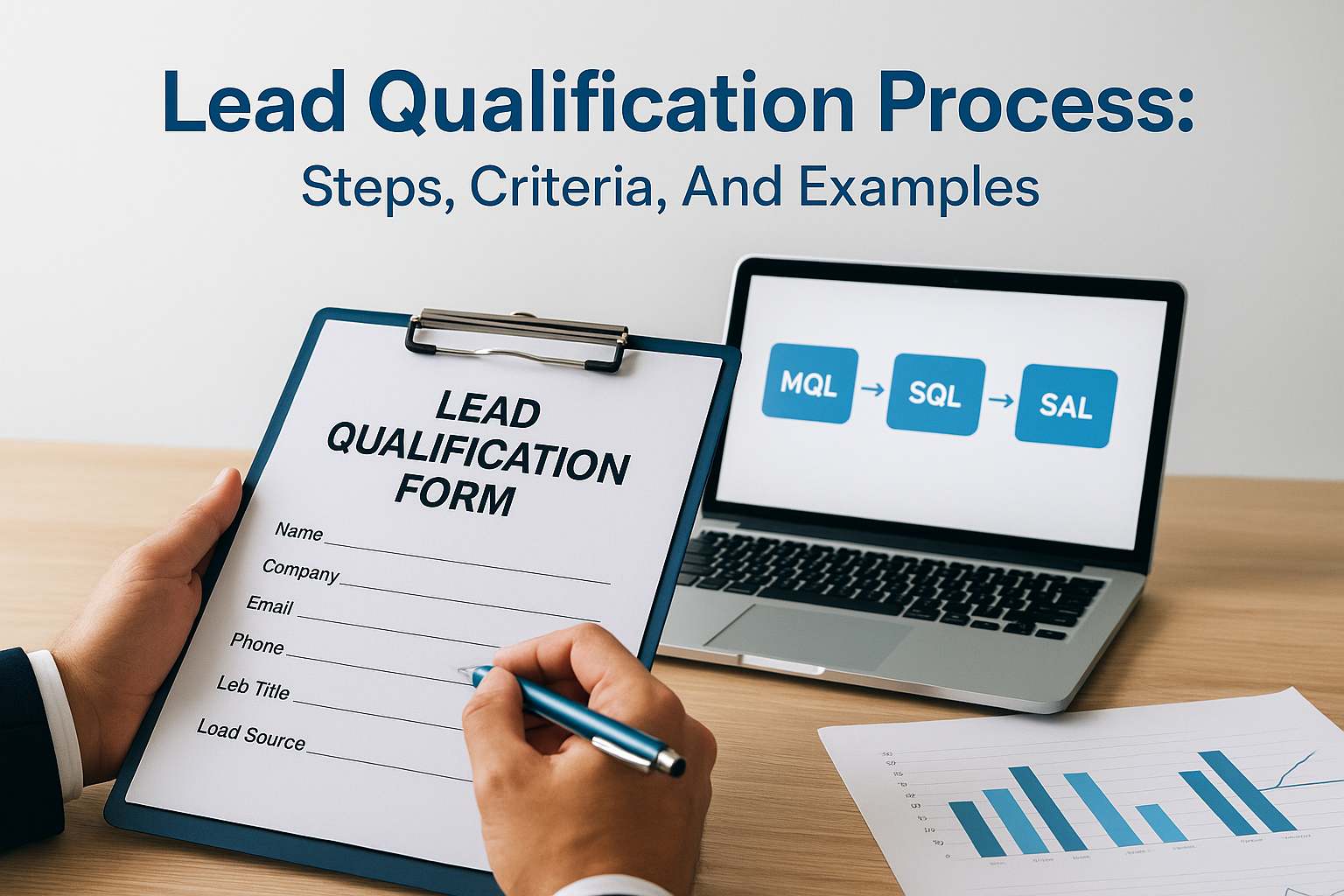
Not every lead deserves your time. That’s not cynicism, it’s math. If your sales team treats every inquiry the same, they’ll burn hours chasing people who were never going to buy. A structured lead qualification process fixes that by giving you a repeatable way to separate serious prospects from tire-kickers before you invest real resources. For service businesses and law firms especially, where every consultation costs time and expertise, this distinction can make or break your revenue targets.
At Client Factory, we build client acquisition funnels that generate qualified leads, not just traffic. But even the best funnel in the world won’t help if you can’t tell a hot lead from a dead end once they raise their hand. That’s where qualification comes in. It’s the bridge between marketing that attracts attention and sales conversations that actually close.
This guide breaks down what lead qualification really means, why it matters at each stage of your sales cycle, and how to build a process that works. You’ll get actionable frameworks, specific criteria to score against, and real examples you can adapt to your own business. Whether you’re qualifying leads manually or looking to systematize your approach, this article gives you the structure to prioritize the prospects most likely to become paying clients.
Why lead qualification matters for revenue
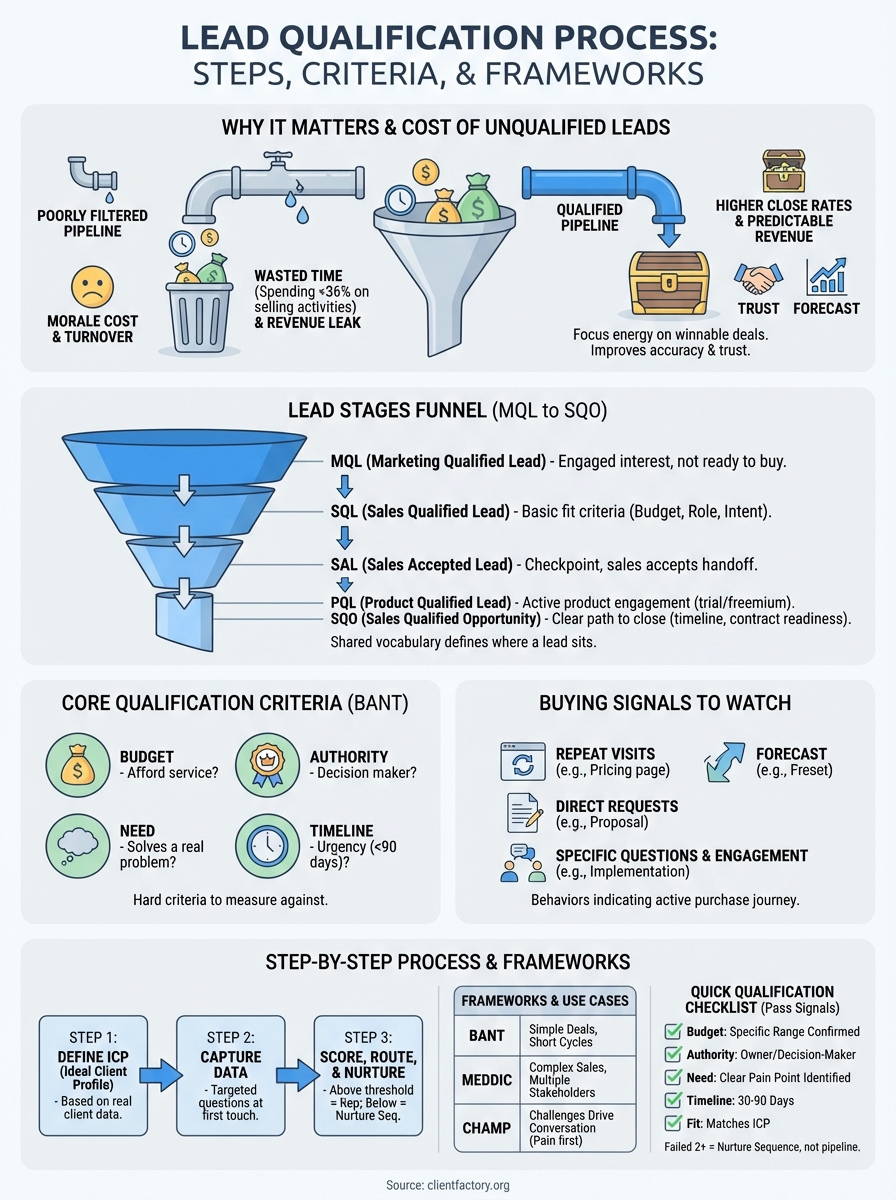
When sales teams skip qualification, they treat every lead as equal, and that’s where revenue starts leaking. A poorly filtered pipeline forces reps to spend their most valuable resource, time, on people who lack the budget, authority, or urgency to buy. For service businesses and law firms especially, where every discovery call or consultation carries a real opportunity cost, this mistake accumulates fast. Building a solid lead qualification process means your team focuses energy only where it has a realistic chance of closing.
Research from HubSpot consistently shows that sales reps spend less than 36% of their time on actual selling activities. A rigorous qualification standard protects that time by eliminating prospects who were never a real opportunity.
The cost of chasing unqualified leads
Unqualified leads don’t just waste time, they distort your entire pipeline. When your CRM fills up with contacts that will never convert, your sales forecasts become unreliable and your team loses confidence in the numbers. This creates a cycle where leadership pushes for more volume, reps work harder without results, and the root problem (bad qualification) never gets addressed.
There’s also a morale cost that most businesses overlook. Sales teams that consistently pitch unqualified prospects experience higher burnout and turnover rates. When reps invest real effort with nothing to show for it, motivation deteriorates. Tightening your qualification criteria often delivers faster improvements to team performance than any training program or incentive structure.
How qualification improves close rates
A stricter qualification standard doesn’t shrink your pipeline in a bad way. It shrinks it in the right way by removing contacts that were inflating your numbers without contributing to actual revenue. When you filter out weak leads early, your close rate rises because the deals remaining in the pipeline are genuinely winnable.
For law firms and service businesses that depend on referrals and reputation, close rate also functions as a trust signal. Clients who convert on a strong fit are more likely to refer others. Clients who were pushed through a weak qualification step and were never a real match often become dissatisfied buyers, or they leave a negative review. Qualifying well protects your brand just as much as your bottom line.
Qualification as a revenue prediction tool
One of the most underrated benefits of a consistent qualification process is what it does to your revenue forecasting accuracy. When every lead in your pipeline has been measured against the same criteria, your data becomes meaningful. You can calculate average deal values, time-to-close, and conversion rates with confidence because you’re comparing equivalent opportunities.
This gives leadership the ability to make smarter hiring, budgeting, and growth decisions. Instead of guessing how many leads you need to hit next quarter’s target, you work backward from qualified pipeline data. That shift from gut-feel to data-driven planning is one of the clearest signs that a sales operation has matured, and it starts with knowing exactly what a qualified lead looks like before one enters the pipeline.
Lead stages: MQL, SQL, SAL, PQL, and SQO
Understanding where a lead sits in your funnel is the foundation of any effective lead qualification process. Not all leads carry the same weight, and treating them as if they do is exactly how deals fall through the cracks. The five core lead stages give your marketing and sales teams a shared vocabulary so everyone agrees on what a lead actually is before resources get committed.

MQL and SQL: where marketing hands off to sales
A Marketing Qualified Lead (MQL) is a contact who has engaged with your content or campaigns at a level that signals genuine interest. They might have downloaded a guide, attended a webinar, or clicked through a targeted ad more than once. MQLs are not ready to buy yet, but they’ve raised their hand enough to warrant closer attention from your sales team.
The gap between MQL and SQL is where most pipeline problems start. Define the handoff criteria explicitly, and you eliminate the blame cycle between marketing and sales.
A Sales Qualified Lead (SQL) is an MQL that your sales team has reviewed and accepted as worth pursuing. To reach SQL status, the contact needs to meet basic fit criteria: typically budget, role, and expressed intent. At this stage, a rep should be willing to invest time in an outreach sequence or a discovery call.
SAL, PQL, and SQO: beyond the basics
A Sales Accepted Lead (SAL) sits between MQL and SQL and acts as a formal checkpoint. Marketing passes a lead, and sales accepts or rejects it based on a defined set of criteria. This stage forces accountability on both teams and keeps your pipeline from filling with leads that marketing called qualified but sales quietly ignored.
A Product Qualified Lead (PQL) applies when you offer a free trial or freemium tier. This contact has already used your product and demonstrated active engagement, making them significantly more likely to convert than someone who only read a blog post. Finally, a Sales Qualified Opportunity (SQO) represents a lead that has moved past initial qualification into an active deal with a clear path to close. At this stage, you’re evaluating timeline, decision-makers, and contract readiness, not basic fit.
Lead qualification criteria and buying signals
Every lead qualification process needs a consistent set of criteria to measure leads against. Without defined standards, your team makes judgment calls based on gut feeling, and those calls vary from rep to rep. Clear criteria give your entire sales operation a shared benchmark so qualification decisions stay consistent regardless of who reviews the lead.
Hard criteria: budget, authority, need, and timeline
The most reliable qualification criteria fall into four categories that you’ve probably seen packaged as the BANT framework. Budget tells you whether the prospect can realistically afford your service. Authority confirms that the person you’re speaking with can actually approve the purchase or has direct influence over whoever can. Without both, even a genuinely interested contact can stall indefinitely in your pipeline.
Need establishes whether your offer actually solves a problem the prospect is already aware of. Timeline adds urgency: a prospect who needs a solution in the next 30 days is a fundamentally different opportunity than one who is "exploring options for next year." Your team should gather all four data points before committing to a full discovery call.
If a lead can’t answer questions about budget and authority within the first two touchpoints, treat that as a signal to deprioritize until more information surfaces.
Buying signals to watch
Buying signals are behaviors that indicate a prospect is actively moving toward a purchase decision, not just browsing. High-value signals include repeat visits to your pricing page, direct requests for a proposal, specific questions about implementation, and references to a competitor they’re trying to replace. Each of these tells you the prospect is past the awareness stage and already thinking about next steps.
Passive signals carry less weight but still matter. A contact who opens every email, watches your video content past the halfway point, or responds quickly to follow-up messages is showing consistent engagement worth tracking. Log these behaviors in your CRM so your team spots momentum before it fades. Prioritizing leads based on a combination of hard criteria and behavioral signals gives you a qualification picture that’s far more accurate than criteria alone.
How to run a lead qualification process step by step
Running a consistent lead qualification process requires more than a checklist. You need a sequence that captures the right information at the right moment, routes leads to the correct team, and gives every rep a clear picture of where each prospect stands before they invest time in a call or proposal. The steps below build on each other, so skipping one typically creates a gap that shows up later as a stalled deal or a wasted discovery call.
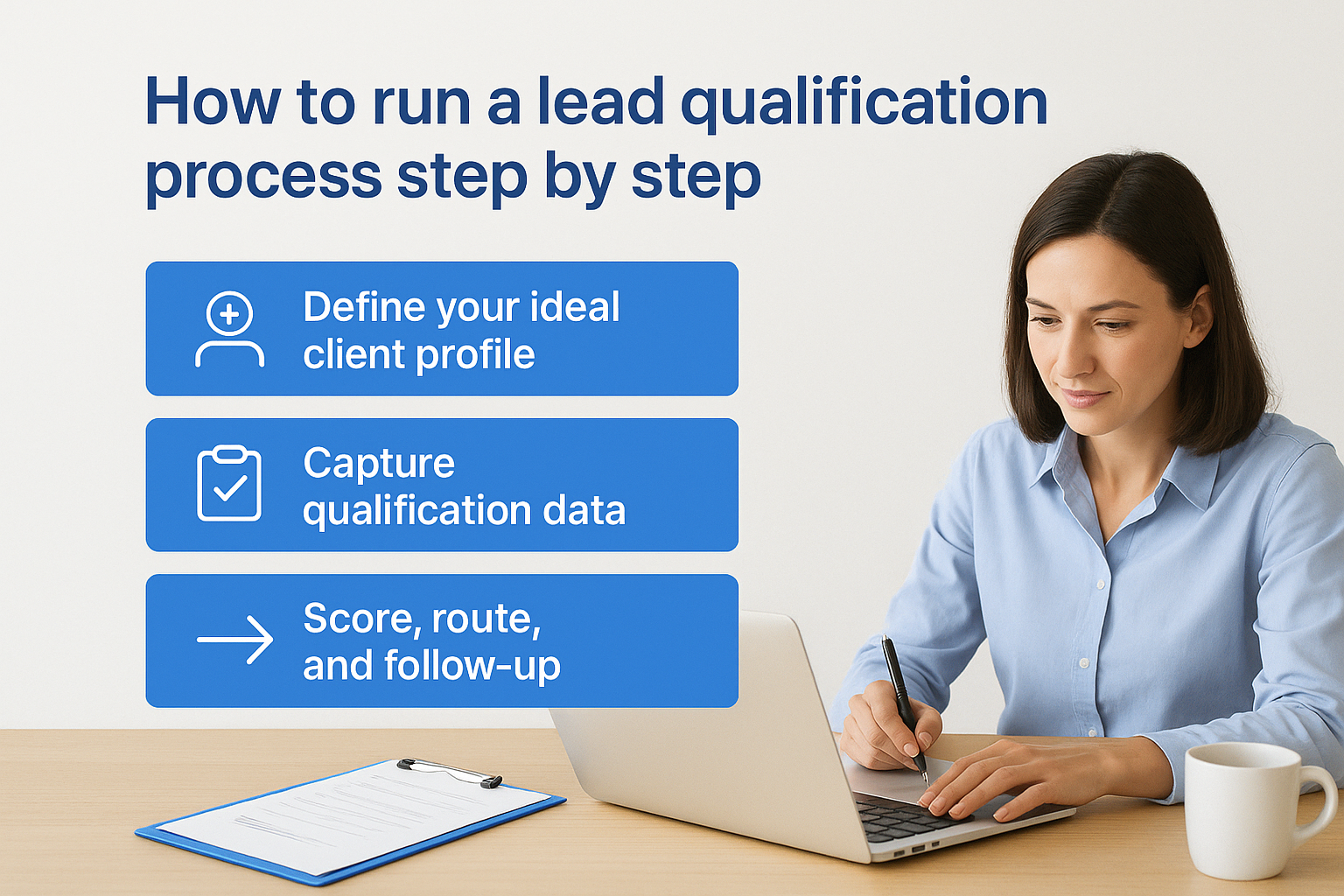
Step 1: Define your ideal client profile before leads enter your funnel
Your ideal client profile (ICP) is the baseline everything else measures against. List the specific characteristics that describe your best current clients: industry, company size, role of the decision-maker, common problems, and the budget range where your service makes financial sense for both parties. Without this definition, your team has no objective standard to compare incoming leads to, and qualification becomes a matter of personal preference rather than repeatable criteria.
Build your ICP from real client data, not assumptions. Pull your top ten clients by revenue and identify what they have in common before you write a single qualification question.
Step 2: Capture qualification data at the first touchpoint
Your intake form, chatbot, or initial outreach sequence needs to ask targeted questions that surface the information your team needs to make a quick qualification call. At minimum, collect the prospect’s role, their primary problem, their timeline, and whether they have a budget already allocated. Keep the form short enough that prospects actually complete it, but specific enough that vague or mismatched answers stand out immediately without a rep having to read between the lines.
Step 3: Score, route, and set a follow-up standard
Once a lead submits information, assign a lead score based on how closely their answers match your ICP. Leads that score above your threshold move directly to a rep for follow-up within a defined window, ideally within one business day of submission. Leads that fall below the threshold enter a nurture sequence instead of a live sales queue. This routing step keeps your sales team focused on real opportunities while keeping lower-priority contacts engaged until their situation changes.
Lead qualification frameworks and when to use them
Choosing the right framework depends on your sales cycle, deal size, and how much information you can realistically gather early in the conversation. No single framework fits every business, and forcing one that doesn’t match your context will produce false positives or push reps to skip steps. The frameworks below cover the most widely used approaches in the lead qualification process, each with a distinct use case.
BANT: simple deals and short sales cycles
BANT (Budget, Authority, Need, Timeline) is the most widely adopted framework because it covers the four factors that predict whether a deal can realistically close. It works best for straightforward service engagements where the buying decision involves one or two people and doesn’t require extensive internal approval. If a prospect confirms all four elements within the first two touchpoints, your rep has enough to move forward with confidence.
The main limitation of BANT is that it assumes budget is already allocated, which isn’t always true for small businesses or growing law firms making a first-time investment in professional services. When budget is undefined but pain is clear, a different framework often gets better results.
BANT works well as a starting point, but it tends to underperform in complex sales where multiple stakeholders share the buying decision.
MEDDIC: complex sales with multiple decision-makers
MEDDIC (Metrics, Economic Buyer, Decision Criteria, Decision Process, Identify Pain, Champion) was built for deals where the buying process involves layers of approval and competing priorities. It adds depth by asking reps to identify a champion inside the prospect’s organization who will advocate for your solution internally. Law firms and larger service businesses benefit from MEDDIC because contracts above a certain value rarely get approved by a single contact, and understanding the internal decision process prevents late-stage surprises.
CHAMP: when challenges drive the conversation
CHAMP (Challenges, Authority, Money, Prioritization) reorders the traditional BANT sequence to lead with the prospect’s core business challenge rather than budget. This approach works well when your typical buyer hasn’t allocated a specific budget yet but is actively aware of a problem that costs them money. Starting with challenges builds trust faster and surfaces the urgency your team needs to assess fit before the conversation reaches pricing.
Examples and a simple qualification checklist
Seeing a lead qualification process applied to real scenarios makes the criteria and frameworks easier to put into practice. The two examples below show how qualification plays out for a law firm and a service business, followed by a checklist you can adapt for your own team.
A law firm qualifying a new inquiry
A personal injury law firm receives a contact form submission. The prospect describes a recent car accident, mentions they are looking for representation "as soon as possible," and lists their location within the firm’s practice area. Your intake coordinator runs through the core qualification criteria: the prospect has clear need, an urgent timeline, and geographic fit. The coordinator then confirms that the statute of limitations gives the case a viable window and that the prospect is the actual injured party, establishing decision-making authority. That contact moves directly to a consultation slot. A submission that describes an accident from four years ago with no documented injuries routes to a polite decline, saving the attorney’s time entirely.
The fastest way to improve consultation quality at a law firm is to add two or three targeted intake questions that surface deal-breakers before a rep ever picks up the phone.
A service business qualifying an inbound lead
A digital marketing agency receives a demo request. The prospect runs a regional HVAC company, has a monthly ad budget already allocated, and wants to launch a campaign within 60 days. Your rep checks authority: the person who submitted the form is the owner, not an employee gathering information. Every BANT element checks out, so the rep books a discovery call within 24 hours. By contrast, a request from an individual freelancer with no stated budget and a vague "someday" timeline enters a nurture sequence instead of a live sales queue.
Quick qualification checklist
Use this checklist to evaluate any inbound lead before committing to a discovery call or proposal.
| Criteria | Question to ask | Pass signal |
|---|---|---|
| Budget | Does the prospect have funds allocated? | Specific range confirmed |
| Authority | Can this person approve the purchase? | Owner or direct decision-maker |
| Need | Does your service solve their stated problem? | Clear pain point identified |
| Timeline | When do they need a solution? | 30 to 90 days |
| Fit | Do they match your ideal client profile? | Industry and size align |
Any lead that fails two or more criteria belongs in a nurture sequence, not your active pipeline.
Put your process to work
A strong lead qualification process doesn’t require a massive overhaul of how you operate. Start with your ideal client profile, add targeted intake questions to your first touchpoint, and pick one framework that matches your typical deal complexity. Apply it consistently across every inbound lead for 30 days and track what changes in your close rate and pipeline accuracy. Most businesses see measurable improvement within the first month simply by adding structure to decisions they were already making informally.
Your next step is to stress-test what you currently have. Audit your existing funnel to find where unqualified leads are entering your pipeline and at what stage they stall. If you want a faster path to clarity, our team reviews your funnel and identifies exactly where your client acquisition is leaking. Book a free conversion audit and get a clear picture of what to fix first.