
Your ads might be driving traffic, but if visitors bounce without converting, you’re burning money. The difference between a page that collects leads and one that collects dust often comes down to design and strategy, which is exactly why many businesses turn to a landing page design agency for help. These specialized firms focus on one thing: building pages that convert clicks into customers.
But not all agencies deliver the same results. Some prioritize aesthetics over performance. Others lack the conversion rate optimization expertise that actually moves the needle. Choosing the wrong partner can cost you months of wasted budget and missed opportunities. Choosing the right one can transform your entire client acquisition process and generate consistent, qualified leads month after month.
At Client Factory, we’ve spent over 30 years helping service businesses and law firms turn their marketing funnels into reliable client-generating machines. That experience has shown us exactly what separates effective landing page agencies from the rest. In this guide, you’ll learn what a landing page design agency actually does, when it makes sense to hire one, and how to evaluate your options so you can make a decision that drives real results for your business.
What a landing page design agency does
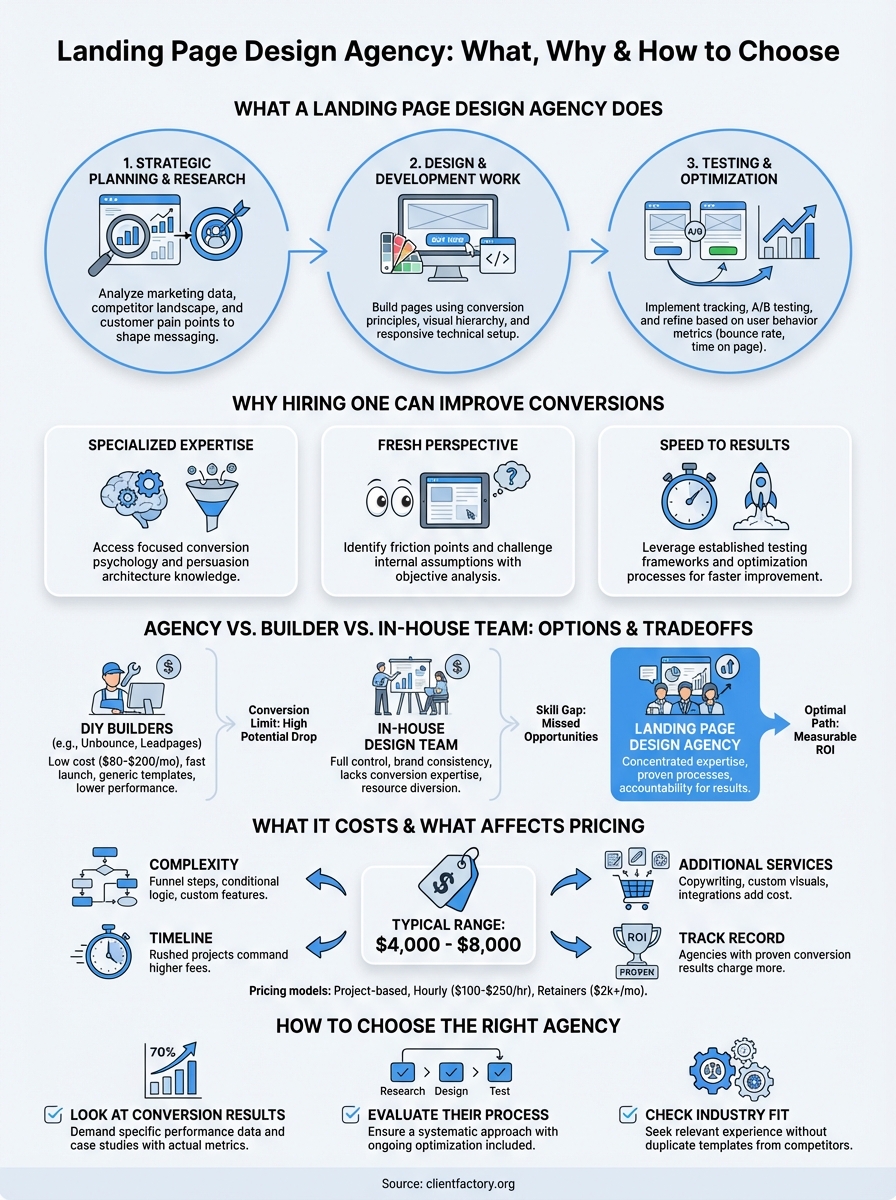
A landing page design agency handles much more than just making a page look good. These specialized firms combine strategic thinking, conversion psychology, and technical expertise to build pages that drive specific actions from your visitors. They start by understanding your business goals, analyze your target audience, and then craft pages designed to move people through your funnel. Instead of generic websites, they create focused, single-purpose pages built around one clear conversion goal.
Strategic planning and research
Before any design work begins, the agency digs into your business to understand what makes your audience tick. They analyze your current marketing data, review your competitor landscape, and identify the specific pain points your offer solves. This research phase shapes everything that follows, from the messaging hierarchy to the visual elements that appear on your page.
Your agency partner will typically conduct customer interviews or review existing feedback to understand the language your prospects use when describing their problems. They examine your sales process to identify objections that need addressing and benefits that deserve emphasis. This groundwork ensures the landing page speaks directly to your ideal client’s needs rather than relying on generic marketing speak.
The best agencies don’t start with templates. They start with your business data and customer insights.
Design and development work
Once strategy is locked in, the agency builds the actual page using proven conversion principles and design best practices. They create visual hierarchies that guide your visitor’s eye toward key information and calls to action. Every element gets positioned intentionally, from headlines and benefit statements to trust signals like testimonials and certifications.
The design process typically includes creating multiple layout variations and content frameworks that align with your brand while prioritizing clarity and action. Your agency handles both the frontend design you see and the backend technical setup that makes everything function properly. They ensure your page loads quickly, displays correctly on mobile devices, and integrates seamlessly with your existing marketing tools and CRM systems.
Testing and optimization
A professional agency doesn’t consider the job done when your page goes live. They implement tracking systems to monitor how visitors interact with your page and identify friction points that prevent conversions. Using A/B testing methodologies, they systematically test different elements like headlines, button colors, form lengths, and offer positioning to find what actually moves the needle for your specific audience.
Your agency analyzes the data from these tests to make informed decisions about what changes to implement next. They look at metrics beyond just conversion rates, examining bounce rates, time on page, and scroll depth to understand the full picture of user behavior. This ongoing optimization cycle means your landing page continuously improves over time rather than remaining static.
Some agencies include this optimization work as part of their initial engagement, while others offer it as a separate retainer service. The approach varies, but the principle remains the same: effective landing page design is an iterative process built on real performance data. By continuously refining based on how actual visitors behave, agencies help you squeeze more conversions from the same amount of traffic you’re already paying to generate.
Why hiring one can improve conversions
Your internal team might be talented, but converting cold traffic into paying clients requires a specific skill set that most businesses don’t have sitting around. A landing page design agency brings focused expertise that directly impacts your bottom line. They’ve tested thousands of variations, analyzed countless data points, and know exactly which elements drive action versus which ones just look nice. This concentrated experience means they can spot conversion killers you’d never notice and implement fixes that produce measurable results faster than trial and error ever could.
Specialized expertise you can’t replicate in-house
Agencies work on landing pages all day, every day. They’ve seen what works across dozens of industries and hundreds of campaigns, giving them pattern recognition your team simply can’t match. When they analyze your page, they’re drawing from a database of real-world performance data rather than theoretical best practices or personal preferences.
This expertise extends beyond design into conversion psychology and persuasion architecture. Professional agencies understand how prospects make buying decisions, what objections typically arise at each stage, and how to structure content that addresses concerns before they become deal-breakers. They know when to use video versus static images, how to position social proof for maximum impact, and which form fields actually increase completion rates versus killing them.
Fresh perspective on your funnel
You’re too close to your business to see it clearly. Your agency partner brings objective eyes that spot problems you’ve become blind to through familiarity. They question assumptions about what your audience needs to hear and challenge internal sacred cows that might be tanking your conversion rates.
External specialists identify friction points your team has normalized simply because they’ve lived with them too long.
Agencies also bring accountability that internal projects often lack. When you’ve paid for results, someone’s measuring whether you’re getting them. This focus keeps optimization efforts on track instead of getting deprioritized when other fires need fighting.
Speed to results
Building an effective landing page in-house means your team learns on your dime. They’ll make rookie mistakes, test variations that experienced professionals already know don’t work, and spend weeks figuring out technical issues agencies solve in hours. The time cost alone usually exceeds what you’d pay a specialist.
Professional agencies also have established testing frameworks and optimization processes that compress months of learning into weeks. They implement tracking correctly from day one, know which metrics actually matter, and can interpret data to make smart decisions quickly. This velocity means you start seeing conversion improvements while competitors are still debugging their homegrown solutions.
Agency vs builder vs in-house team
You have three main options when creating landing pages: DIY page builders, in-house design teams, or hiring a landing page design agency. Each approach comes with distinct tradeoffs in cost, speed, quality, and results. Understanding these differences helps you choose the path that aligns with your budget, timeline, and conversion goals rather than defaulting to whatever seems easiest in the moment.

DIY landing page builders
Page builders like Unbounce, Leadpages, and Instapage offer templates you can customize without coding knowledge. You pay a monthly subscription fee (typically $80 to $200) and handle the design work yourself. This option costs the least upfront and lets you launch quickly if you already know what converts.
The limitation shows up in conversion performance. Templates get used by thousands of businesses, so yours looks generic. You’re also guessing at what works rather than applying proven conversion principles. Most business owners lack the expertise to write compelling copy, structure information hierarchy effectively, or set up proper tracking. The result is often pages that look acceptable but underperform professionally designed alternatives by 30% or more.
Building with an in-house team
Internal teams give you complete control and avoid external agency fees. Your designer and developer already understand your brand, and you can iterate whenever you want without negotiating contracts or waiting on external schedules.
However, building effective landing pages requires specialized skills your team may not possess. Your web designer focuses on brand consistency and aesthetics, not conversion rate optimization. Your developer handles functionality, not persuasion psychology. Unless you employ dedicated conversion specialists, your pages will likely miss critical elements that professional agencies include by default. You also face opportunity costs as your team spends time on landing pages instead of their core responsibilities.
Generalists can build functional pages, but specialists build pages that convert traffic into revenue.
When a professional agency makes sense
Agencies deliver the fastest path to high-performing pages when you need measurable results quickly. You get concentrated expertise without hiring full-time specialists, proven processes instead of trial-and-error learning, and accountability tied to actual conversion metrics.
This option works best when you’re spending significant money on paid traffic (where small conversion improvements generate substantial returns), launching new offers that need optimization from day one, or scaling established campaigns where performance directly impacts growth. Agencies cost more upfront than page builders but typically pay for themselves through higher conversion rates within the first few months of operation.
What it costs and what affects pricing
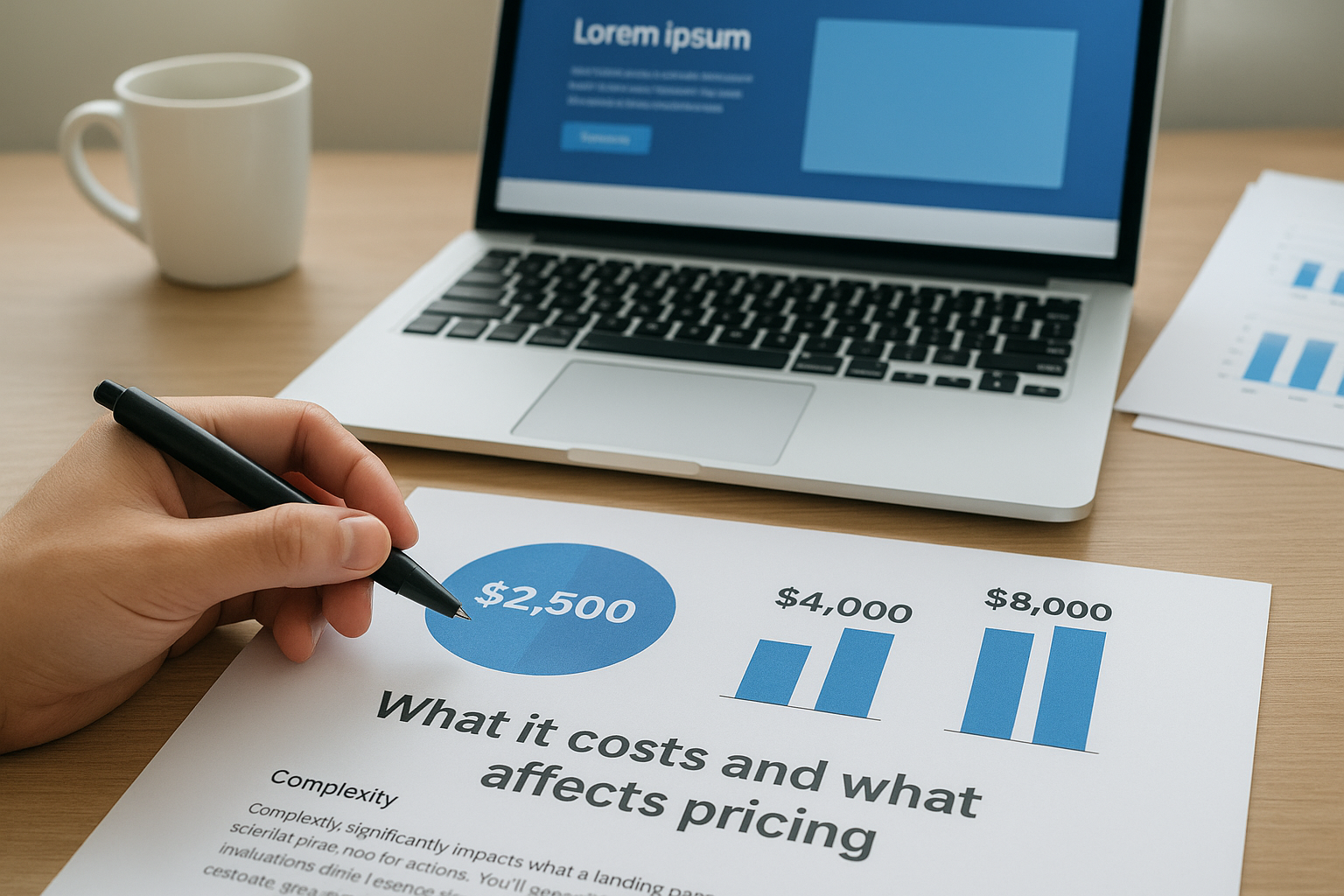
Expect to pay anywhere from $2,500 to $15,000 for a professionally designed landing page, with most agencies charging between $4,000 and $8,000 for standard projects. This wide range reflects significant differences in what you’re actually getting. A basic page with limited strategy might cost less, while a comprehensive engagement that includes conversion research, copywriting, design, development, and initial optimization work pushes toward the higher end. Understanding what drives these price variations helps you evaluate whether you’re getting real value or just paying for overhead.
Typical pricing models
Most agencies use one of three approaches when billing for landing page work. Project-based pricing means you pay a flat fee for a defined scope that typically includes strategy, design, development, and launch support. This model works well when you need a single page and want predictable costs upfront.
Hourly rates range from $100 to $250 per hour depending on the agency’s expertise and location. You’ll see this model when scope isn’t clearly defined or when you’re buying optimization services after initial launch. Retainer arrangements bundle ongoing testing and optimization work into monthly fees that usually start around $2,000 and scale based on how actively the agency manages your pages.
The pricing model matters less than what you’re getting for your money and whether the agency ties compensation to actual performance metrics.
Factors that drive costs higher
Complexity significantly impacts what a landing page design agency charges. A simple lead capture page costs far less than a multi-step funnel with conditional logic, dynamic content personalization, and sophisticated integrations. Custom design work tailored specifically to your brand costs more than template-based approaches that require minimal customization.
Your timeline also affects pricing. Agencies charge premiums for rushed projects that require reallocating resources from other clients. Similarly, pages targeting highly competitive industries often need more strategic depth and testing to break through the noise, which increases the investment required.
Additional services beyond basic design and development add to your total cost. Professional copywriting typically adds $1,000 to $3,000 depending on page length and research required. Custom illustrations or professional photography cost extra. Integration with complex marketing automation systems or CRMs requires additional development work. Some agencies bundle these services into their base pricing while others itemize them separately, so compare quotes carefully to understand what’s actually included versus what carries additional fees.
Track record matters too. Agencies with proven conversion results and case studies demonstrating measurable ROI command higher fees than newer firms still building their portfolios. You’re paying for certainty that your investment will generate returns rather than gambling on unproven capabilities.
How to choose the right agency
Selecting the right landing page design agency separates businesses that scale their client acquisition from those that waste money on pretty pages that don’t convert. You need to look beyond portfolios filled with attractive designs and focus on agencies that demonstrate measurable impact on conversion rates. The wrong choice costs you months of missed opportunities and budget burned on underperforming campaigns, while the right partner transforms your marketing funnel into a reliable revenue generator.
Look at conversion results, not design awards
Ask every agency you consider for specific performance data from previous clients. You want to see case studies that include actual conversion rate improvements, not vague claims about increased engagement or brand awareness. Agencies that deliver results happily share numbers showing how they took a client’s landing page from 2% to 5% conversion or generated 300% more qualified leads from the same traffic volume.
Request references from clients in situations similar to yours. A service business needs different proof points than an e-commerce brand. Talk to these references directly and ask how the agency handled obstacles, whether they hit deadlines, and if the pages actually generated the promised ROI. Agencies reluctant to connect you with satisfied clients often lack the track record they claim.
The best agencies back up their claims with hard data and client references who verify the results.
Evaluate their process and methodology
Strong agencies follow systematic approaches to landing page development rather than winging it based on intuition. During sales conversations, they should explain their research process, how they identify conversion barriers, and their testing methodology. You want partners who ask probing questions about your business, audience, and goals rather than jumping straight to design discussions.
Pay attention to whether they discuss ongoing optimization as part of their standard engagement. Agencies focused purely on launching pages and moving on rarely deliver lasting value. Your ideal partner treats launch as the beginning of the optimization process, not the end, and explains how they’ll use data to improve performance over time.
Check industry fit and relevant experience
Agencies with experience in your specific industry understand the unique challenges and objections your prospects face. They know the compliance requirements for law firms, the trust factors that matter in professional services, and the sales cycles that shape how you need to structure information. This domain knowledge accelerates results because they’re not learning on your dime.
However, avoid agencies that work exclusively with your direct competitors. You want relevant experience without risking that your landing page looks identical to three other firms in your market because the agency recycled the same template and messaging framework. Balance industry knowledge with the ability to bring fresh perspectives that differentiate your offer.
Key takeaways
Choosing the right landing page design agency makes the difference between wasted ad spend and a marketing funnel that reliably converts traffic into clients. The best agencies bring specialized expertise in conversion optimization, fresh perspective on your business, and proven processes that deliver results faster than internal teams or DIY builders. You’ll pay between $4,000 and $8,000 for most professional engagements, but higher conversion rates typically generate returns within months.
Focus your evaluation on measurable results rather than attractive portfolios. Ask for specific conversion data, talk to client references, and verify the agency follows systematic optimization processes instead of relying on guesswork. Industry experience matters, but domain knowledge should complement fresh thinking rather than recycling tired templates your competitors already use.
If you’re ready to transform your landing pages from expense drains into client-generating assets, schedule a free conversion audit with Client Factory. We’ll identify exactly what’s holding your funnel back and show you how to fix it.