
Most B2B companies pour money into demand generation without a clear strategy, and wonder why their pipeline stays dry. The truth is, demand generation best practices have evolved significantly, and what worked three years ago often falls flat now. Getting this right means the difference between predictable revenue growth and wasted marketing budgets.
At Client Factory, we’ve spent over 30 years helping service businesses and law firms build client acquisition systems that actually convert. We’ve seen firsthand how proper demand generation separates thriving businesses from those stuck chasing leads that never close. The pattern is consistent: companies that follow proven frameworks outperform those relying on guesswork or outdated tactics by a wide margin.
This guide breaks down nine actionable best practices that drive real B2B ROI. You’ll learn how to align your sales and marketing teams, create content that moves prospects through your funnel, and measure what actually matters. Whether you’re building a demand generation program from scratch or optimizing an existing one, these strategies will give you a clear path forward.
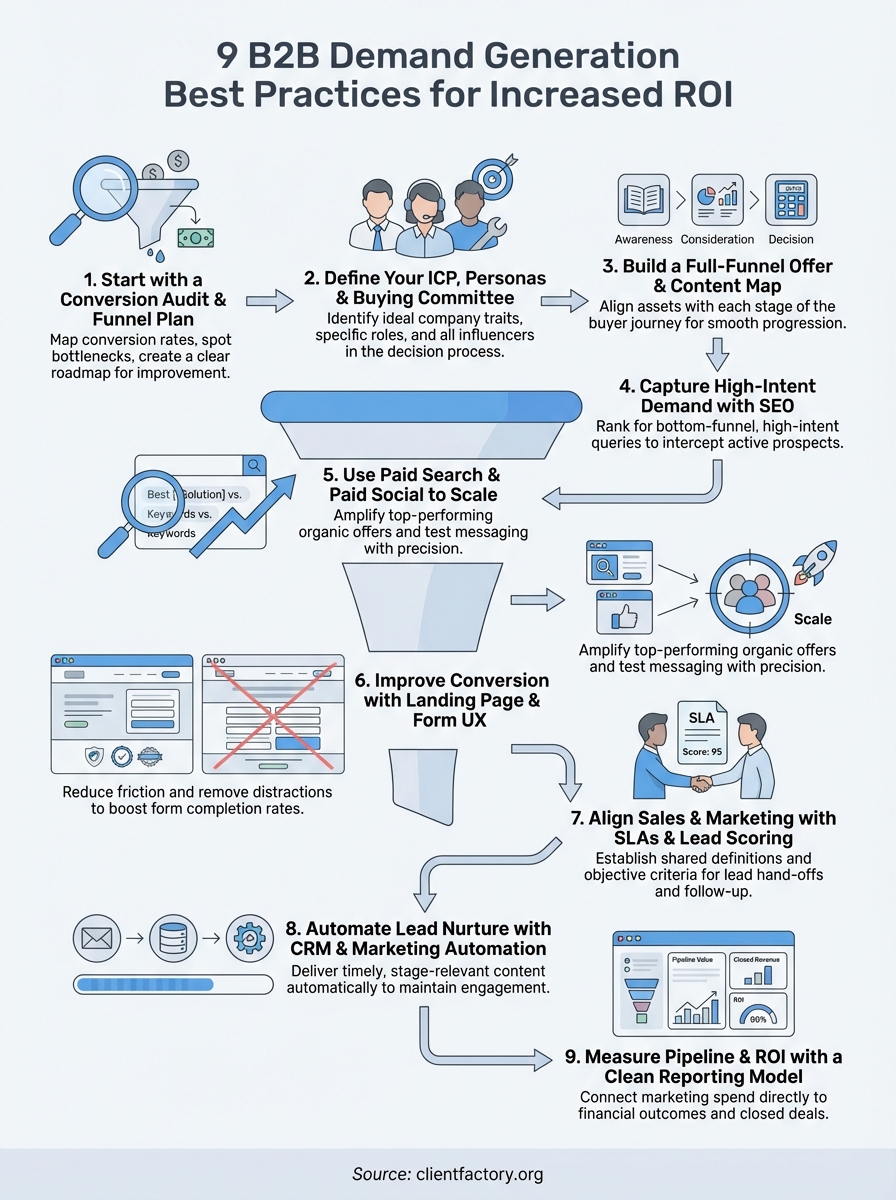
1. Start with a conversion audit and funnel plan
A conversion audit reveals exactly where your demand generation program bleeds revenue. You can’t fix what you don’t measure, and most B2B companies skip this foundational step entirely. This creates a blind spot where marketing dollars disappear without explanation, while sales teams complain about lead quality. Before you invest another dollar in demand generation, you need to understand which parts of your funnel actually convert and which ones need immediate attention.
What it is and why it works
A conversion audit maps every touchpoint in your buyer’s journey and calculates conversion rates at each stage. You examine how prospects move from awareness to consideration to decision, identifying where they drop off and why. This audit includes analyzing your website analytics, CRM data, lead forms, and sales pipeline velocity to spot bottlenecks. The reason this works is simple: you gain clarity on your highest-leverage opportunities instead of guessing where to allocate resources.
The funnel plan that follows your audit creates a roadmap for systematic improvement across every stage of the buyer journey.
How to implement it
Start by pulling data from your analytics platform and CRM for the past 90 days. Calculate conversion rates between each funnel stage: visitor to lead, lead to marketing qualified lead, MQL to sales qualified lead, and SQL to customer. Document the average time spent in each stage and identify where prospects stall or exit completely. Next, analyze your top-performing content and campaigns to understand what moves prospects forward. Build your funnel plan by setting specific targets for each conversion point and mapping out the content, offers, and nurture sequences needed to hit those targets.
Common pitfalls and fixes
Many teams conduct surface-level audits that miss critical conversion blockers. They look at top-line metrics but ignore micro-conversions like email clicks or content downloads that signal buying intent. Another mistake is auditing without involving sales, which creates a disconnect between marketing activities and actual revenue. Fix this by including sales team feedback on lead quality and creating shared definitions for each funnel stage. Also, avoid the trap of auditing once and forgetting it. Your conversion patterns shift as markets change and competitors adjust their strategies.
How to measure success
Track your funnel conversion rates monthly and compare them to your baseline audit. Monitor the overall pipeline velocity to see if prospects move through stages faster after implementing your plan. Measure the percentage improvement in your most critical bottleneck stage within 60 days of making changes. Calculate your cost per SQL and customer acquisition cost to ensure your optimizations actually improve ROI, not just activity metrics.
2. Define your ICP, personas, and buying committee
Your demand generation program fails when you target everyone and appeal to no one. Defining your ideal customer profile (ICP), buyer personas, and buying committee structure creates the foundation for every campaign, message, and offer you create. This precision eliminates wasted spend on prospects who will never buy and allows you to craft content that resonates with the specific pain points and priorities of decision-makers who actually sign contracts.
What it is and why it works
An ICP describes the company characteristics that make someone your best customer: industry, company size, revenue, tech stack, and growth stage. Personas add the human layer by defining the individual roles, responsibilities, goals, and challenges of people within those companies. The buying committee maps out every stakeholder involved in purchase decisions, from economic buyers to technical evaluators to end users. This framework works because B2B purchases involve multiple decision-makers, and your messaging must address each one’s unique concerns.
Understanding who influences, recommends, and approves purchases lets you create content that moves deals forward instead of stalling in committee.
How to implement it
Interview your best current customers to identify common attributes across company profile and individual roles. Analyze closed-won deals in your CRM to spot patterns in company size, industry, and buying cycle length. Document the titles and departments that participated in each purchase decision. Build 3-5 detailed personas that represent your core buyer types, including their goals, challenges, objections, and preferred information sources. Map the typical buying committee structure for your solutions, noting who has budget authority, technical veto power, and end-user influence.
Common pitfalls and fixes
Most companies create generic personas based on assumptions rather than actual customer research. They describe job titles without capturing real motivations or decision criteria. Another mistake is ignoring the buying committee dynamics, which causes you to focus all content on one persona while neglecting other critical influencers. Fix this by conducting quarterly customer interviews and updating your ICPs based on win/loss analysis. Ensure your content library addresses every committee member’s specific concerns.
How to measure success
Track the percentage of your pipeline that matches your ICP characteristics monthly. Measure engagement rates by persona across your content to validate your understanding of each role. Calculate the win rate for ICP-fit opportunities versus non-fit opportunities to prove targeting precision improves close rates.
3. Build a full-funnel offer and content map
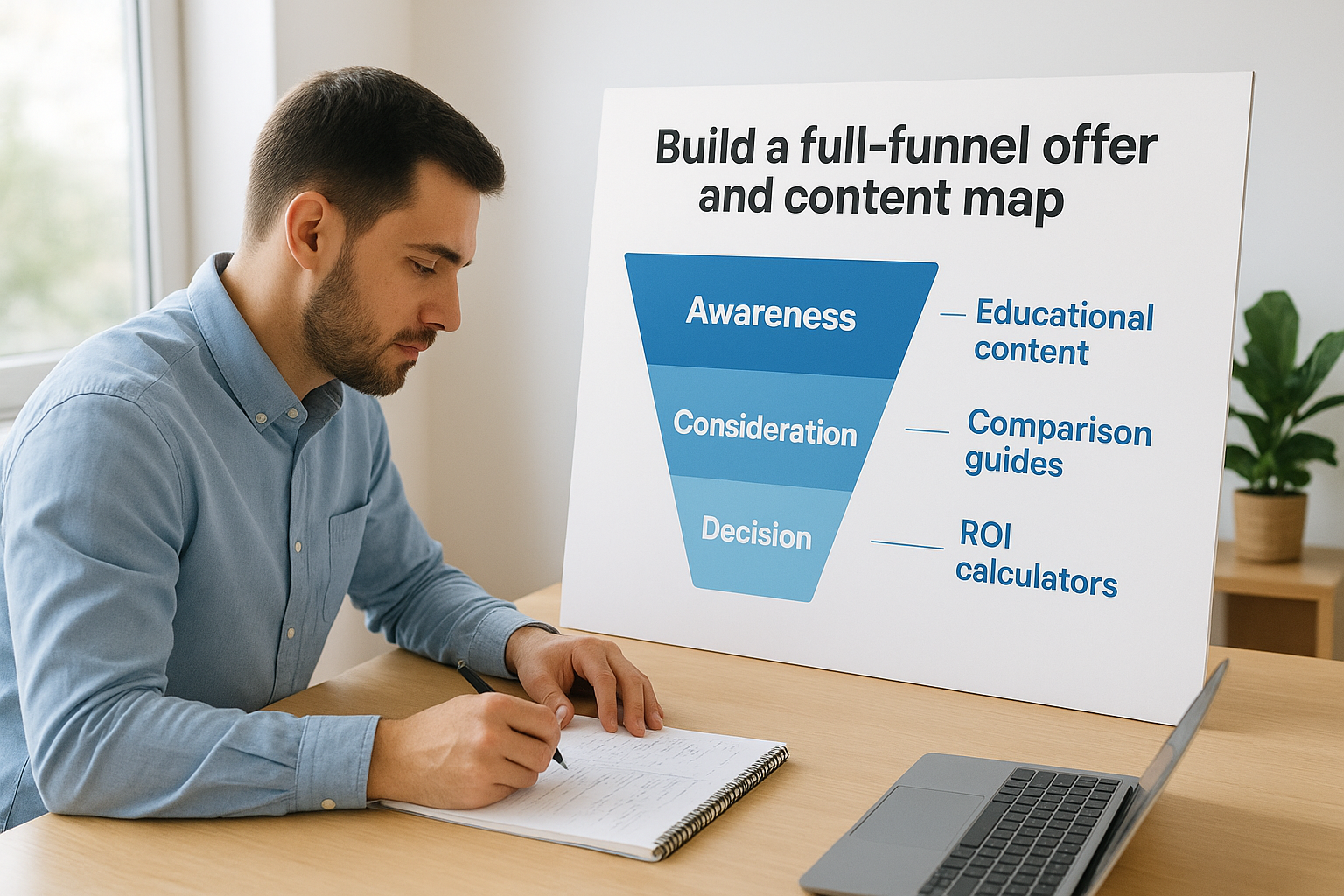
Your content needs to match where prospects are in their buying journey, not where you want them to be. A full-funnel content map aligns specific offers and assets with each stage of awareness, from problem recognition through purchase decision. This approach prevents the common mistake of pushing sales-ready content to cold prospects or educational material to people ready to buy. When you map content to funnel stages correctly, you guide prospects through their decision process naturally instead of forcing premature conversions.
What it is and why it works
A content map connects awareness, consideration, and decision-stage content to the problems your prospects face at each point in their journey. You create specific offers that match their information needs: educational content for early-stage research, comparison guides for active evaluation, and ROI calculators or demos for final decisions. This systematic approach works because it respects the natural buying process instead of interrupting it with mismatched calls to action.
Matching your content to buyer readiness eliminates friction and accelerates pipeline velocity across every stage.
How to implement it
Map your existing content to funnel stages and identify gaps where prospects have no relevant resources. Create a matrix that lists each buyer persona, their stage-specific questions, and the content formats that answer those questions. Build new assets to fill critical gaps, prioritizing the stages with the lowest conversion rates from your audit. Ensure each piece of content has a clear next step that moves prospects to the subsequent stage.
Common pitfalls and fixes
Most teams create bottom-funnel content exclusively because it feels closest to revenue. They ignore early-stage education, which means prospects never enter your funnel in the first place. Another mistake is building content without considering buying committee needs, so you address the end user but neglect the economic buyer. Fix this by creating content for every stage and every committee member role.
How to measure success
Track content consumption patterns by funnel stage to confirm prospects engage with stage-appropriate assets. Measure the percentage of leads that progress through multiple content stages before converting. Monitor your stage velocity to see if your content map reduces time spent in each funnel phase.
4. Capture high-intent demand with SEO
Search engine optimization captures prospects who are actively researching solutions right now. Unlike paid channels that stop delivering the moment you pause spending, SEO builds compounding value that generates qualified leads month after month. Your prospects search for specific problems, solutions, and vendor comparisons before they ever fill out a form. When you rank for these high-intent queries, you intercept demand at the exact moment it matters most.
What it is and why it works
SEO-driven demand generation targets the specific keywords and topics your ideal customers search when they’re ready to evaluate solutions. You create content that ranks for bottom-funnel queries like "best [solution] for [specific use case]" and comparison searches that signal active buying intent. This approach works because it captures existing demand rather than trying to create it, and prospects who find you through search already have context about their problem.
When you rank for buyer-intent keywords, you eliminate cold outreach and intercept prospects who are already seeking what you offer.
How to implement it
Research the keywords your target personas use when evaluating solutions in your category. Focus on terms with clear commercial intent rather than informational queries. Build content that directly addresses these searches with detailed answers, comparisons, and specific use cases. Optimize your technical SEO foundation so search engines can crawl and index your content efficiently. Create topic clusters that demonstrate depth of expertise across your solution categories.
Common pitfalls and fixes
Most companies target high-volume vanity keywords instead of specific buyer-intent terms that convert. They create thin content that ranks poorly instead of comprehensive resources that earn top positions. Fix this by prioritizing keywords that include buying signals like "best," "vs," "pricing," or specific solution categories. Another mistake is neglecting technical SEO basics like page speed and mobile optimization, which prevent even great content from ranking.
How to measure success
Track your rankings for target keywords monthly and monitor organic traffic growth to key landing pages. Measure the conversion rate of organic visitors compared to other channels. Calculate the percentage of pipeline sourced from organic search and the customer acquisition cost for SEO-generated leads versus paid channels.
5. Use paid search and paid social to scale
Paid channels give you immediate visibility with your target accounts while your organic efforts build momentum. When you combine paid search and paid social advertising, you control exactly who sees your offers and when they see them. This precision targeting eliminates wasted impressions on unqualified audiences and lets you test messaging and offers at scale before committing to larger content investments. Smart demand generation best practices leverage paid channels to amplify what already works organically.
What it is and why it works
Paid search captures prospects actively searching for solutions like yours through Google Ads and Microsoft Ads. Paid social reaches decision-makers based on job titles, company size, and interests through LinkedIn, Facebook, and other platforms. You control your budget, targeting parameters, and ad creative to drive traffic to specific offers. This approach works because you bypass the time required for organic visibility and put your most compelling offers directly in front of qualified prospects.
Paid channels let you scale what converts instead of waiting months for organic traction to build.
How to implement it
Start with search campaigns targeting high-intent keywords identified in your SEO research. Build tightly themed ad groups that match search intent with specific landing pages. Launch LinkedIn campaigns targeting your ICP characteristics and buyer personas with content mapped to their funnel stage. Set daily budgets that allow sufficient data collection without overspending. Test multiple ad variations and landing page combinations to identify your highest-converting combinations before scaling spend.
Common pitfalls and fixes
Most teams spread budgets too thin across multiple platforms and audiences, which prevents gathering statistically significant data. They also send paid traffic to generic pages instead of conversion-optimized landing pages built for specific campaigns. Fix this by focusing on one or two channels initially and creating dedicated landing pages for each campaign. Another mistake is neglecting negative keywords in search campaigns, which drains budgets on irrelevant clicks.
How to measure success
Track your cost per lead and cost per SQL by channel and campaign to identify your most efficient sources. Measure click-through rates and conversion rates to optimize underperforming ads. Calculate your return on ad spend by comparing paid acquisition costs to customer lifetime value for paid-sourced deals.
6. Improve conversion with landing page and form UX
Your landing pages either convert visitors into leads or send them back to search results. The difference between a 5% conversion rate and a 20% conversion rate isn’t luck, it’s intentional design that removes friction and builds trust. Poor landing page experience wastes every dollar you spend driving traffic, while optimized pages multiply the value of your demand generation best practices across every channel. Small changes to form fields, page layout, and copy often double conversion rates without touching your traffic sources.
What it is and why it works
Landing page and form optimization focuses on reducing cognitive load and eliminating obstacles between click and conversion. You remove distractions, clarify your value proposition, and ask for only the information you need at this stage. This approach works because visitors make split-second decisions about whether to trust you with their contact details, and every unnecessary form field or confusing element increases abandonment.
Simplifying your conversion path respects your prospect’s time and dramatically increases the percentage who complete your forms.
How to implement it
Remove navigation menus and footer links from landing pages so visitors focus on one clear action. Write headlines that match the promise of your ad or search result exactly. Reduce form fields to the absolute minimum for your sales team to qualify and follow up. Add trust signals like customer logos, security badges, or specific results near your form. Test your pages on mobile devices to ensure forms work smoothly on smaller screens.
Common pitfalls and fixes
Most companies ask for too much information upfront, which kills conversion before the relationship starts. They also create generic landing pages that serve multiple campaigns instead of building campaign-specific pages with matched messaging. Fix this by progressive profiling through your nurture sequences rather than demanding complete information immediately.
How to measure success
Track your conversion rate by landing page and identify which pages perform above or below your baseline. Measure form abandonment rate to see where prospects start filling fields but don’t complete submission. Calculate the cost per conversion for each landing page to determine which designs deliver the best ROI.
7. Align sales and marketing with SLAs and lead scoring
Sales and marketing alignment breaks down when both teams operate with different definitions of a qualified lead. This misalignment causes marketing to celebrate lead volume while sales complains about quality, creating friction that kills pipeline velocity. When you establish service level agreements (SLAs) and implement lead scoring, you create shared accountability and ensure every lead receives appropriate follow-up based on actual buying signals.

What it is and why it works
SLAs define the specific commitments each team makes to the other: marketing agrees to deliver a certain quantity and quality of leads, while sales commits to contacting and working those leads within defined timeframes. Lead scoring assigns numerical values to prospect behaviors and attributes, creating an objective system that prioritizes which leads deserve immediate attention. This framework works because it eliminates subjective disagreements about lead quality and creates measurable expectations for both teams.
Shared definitions and mutual accountability transform sales and marketing from competing departments into a unified revenue engine.
How to implement it
Define what constitutes a marketing qualified lead (MQL) and sales qualified lead (SQL) through joint meetings between both teams. Create a scoring model that assigns points for demographic fit, engagement behaviors, and buying signals like pricing page visits or demo requests. Document response time commitments from sales and lead quality commitments from marketing in a written SLA. Review the agreement quarterly and adjust scoring thresholds based on actual conversion data from your CRM.
Common pitfalls and fixes
Most teams create SLAs that favor one department over the other, which breeds resentment instead of collaboration. They also build overly complex scoring models that no one understands or trusts. Fix this by involving both teams equally in defining criteria and keeping your initial scoring model simple with 5-10 key attributes.
How to measure success
Track the percentage of MQLs that convert to SQLs and compare it to your baseline before implementing scoring. Measure sales follow-up speed on scored leads versus unscored leads. Calculate the win rate by lead score tier to validate your scoring model actually predicts close probability.
8. Automate lead nurture with CRM and marketing automation
Manual follow-up doesn’t scale when you generate hundreds of leads monthly. Marketing automation turns your CRM into a nurture engine that delivers the right message at the right time based on actual prospect behavior. This eliminates the gap between lead capture and sales contact, ensuring every prospect receives consistent communication that builds trust and maintains momentum. Without automation, high-potential leads slip through cracks while your team wastes time on manual tasks that software handles better.
What it is and why it works
Marketing automation creates triggered email sequences that respond to specific prospect actions like content downloads, page visits, or email engagement. Your CRM tracks these behaviors and sends relevant follow-up content automatically based on lead score, funnel stage, and persona type. This approach works because it maintains consistent contact without requiring manual intervention, and it personalizes communication at scale by responding to demonstrated interests rather than generic timelines.
Automated nurture sequences keep prospects engaged between awareness and purchase decision without burning out your team on repetitive tasks.
How to implement it
Connect your marketing automation platform to your CRM and website tracking to capture behavioral data. Build email sequences for each funnel stage that deliver stage-appropriate content over 4-6 weeks. Set triggers based on specific actions like form submissions, email opens, or pricing page visits. Create branching logic that adjusts messaging based on engagement levels and content preferences. Test your sequences with internal leads before launching to ensure proper timing and relevant content delivery.
Common pitfalls and fixes
Most companies build generic nurture tracks that ignore persona differences and buying committee roles. They also overwhelm prospects with daily emails instead of respecting natural buying cycles. Fix this by creating persona-specific sequences that acknowledge different decision criteria and timeframes. Another mistake is neglecting to monitor nurture performance, which means ineffective sequences run indefinitely without optimization.
How to measure success
Track your email open rates and click-through rates by sequence to identify underperforming content. Measure the percentage of nurtured leads that convert to SQLs compared to non-nurtured leads. Calculate the time reduction from MQL to SQL for prospects who complete your automated sequences versus those who receive only manual follow-up.
9. Measure pipeline and ROI with a clean reporting model
Your demand generation investment means nothing if you can’t prove which activities drive revenue. Most companies track vanity metrics like impressions and clicks while ignoring the financial outcomes that actually matter to leadership. A clean reporting model connects your marketing spend directly to pipeline value and closed revenue, giving you the data needed to double down on what works and cut what doesn’t. Without this clarity, you’re flying blind while competitors optimize their way to market dominance.
What it is and why it works
A clean reporting model tracks every lead from first touch through closed deal, attributing revenue to specific channels, campaigns, and content assets. You establish consistent definitions for pipeline stages and ensure your CRM captures accurate source data for every opportunity. This framework works because it eliminates guesswork about which demand generation best practices actually generate positive ROI and which ones drain resources without return.
Accurate attribution transforms your demand generation program from a cost center into a predictable revenue driver with measurable returns.
How to implement it
Build a reporting dashboard that shows pipeline created and revenue closed by source, campaign, and time period. Implement multi-touch attribution that credits all touchpoints in the buyer journey rather than only first or last touch. Ensure your sales team updates opportunity stages consistently in your CRM so your data reflects reality. Schedule weekly pipeline reviews that examine conversion rates and velocity between stages.
Common pitfalls and fixes
Most teams rely on single-touch attribution models that oversimplify complex B2B buying journeys. They also fail to clean duplicate records and incorrect source data, which corrupts their entire analysis. Fix this by conducting monthly data hygiene audits and training your team on proper CRM usage.
How to measure success
Calculate your marketing-sourced pipeline percentage and compare it quarterly to validate growth trends. Track your customer acquisition cost by channel and monitor how it changes as you optimize. Measure the revenue ROI for each major campaign to identify your most profitable demand generation investments.
Next steps
These nine demand generation best practices give you a complete framework for building predictable B2B revenue. You now understand how to audit your funnel, target the right accounts, create stage-appropriate content, and measure what drives results. The difference between knowing these strategies and implementing them successfully comes down to execution discipline and technical expertise.
Most companies struggle to implement these practices simultaneously because they lack the specialized resources or experience to execute at a high level. Your team focuses on running the business while demand generation requires constant optimization and testing. This gap between strategy and results costs you qualified pipeline every quarter.
Client Factory specializes in implementing these exact frameworks for service businesses and law firms. We’ve spent three decades perfecting client acquisition systems that convert, and we start every engagement with a comprehensive conversion audit. Schedule your free funnel audit to identify your biggest revenue leaks and get a custom roadmap for optimizing your demand generation program.