

Facebook ads management services connect you with specialized agencies or professionals who handle your paid advertising on Meta platforms. These experts take over everything from creating ad campaigns and targeting the right audience to optimizing performance and tracking results. Instead of struggling with ad settings, budget allocation, and performance metrics yourself, you get a dedicated team that lives and breathes Meta advertising daily. They bring expertise in audience targeting, creative testing, conversion optimization, and campaign scaling that most business owners simply don’t have time to develop.
This guide breaks down what you need to know before hiring an agency. You’ll discover how professional management differs from DIY approaches, what services you should expect, and how pricing structures work across different providers. We’ll show you the metrics that matter most for measuring success, help you evaluate potential agencies, and explain how the right partner can transform your advertising ROI. By the end, you’ll know exactly what to look for and how to avoid costly mistakes when choosing a Facebook ads management partner.
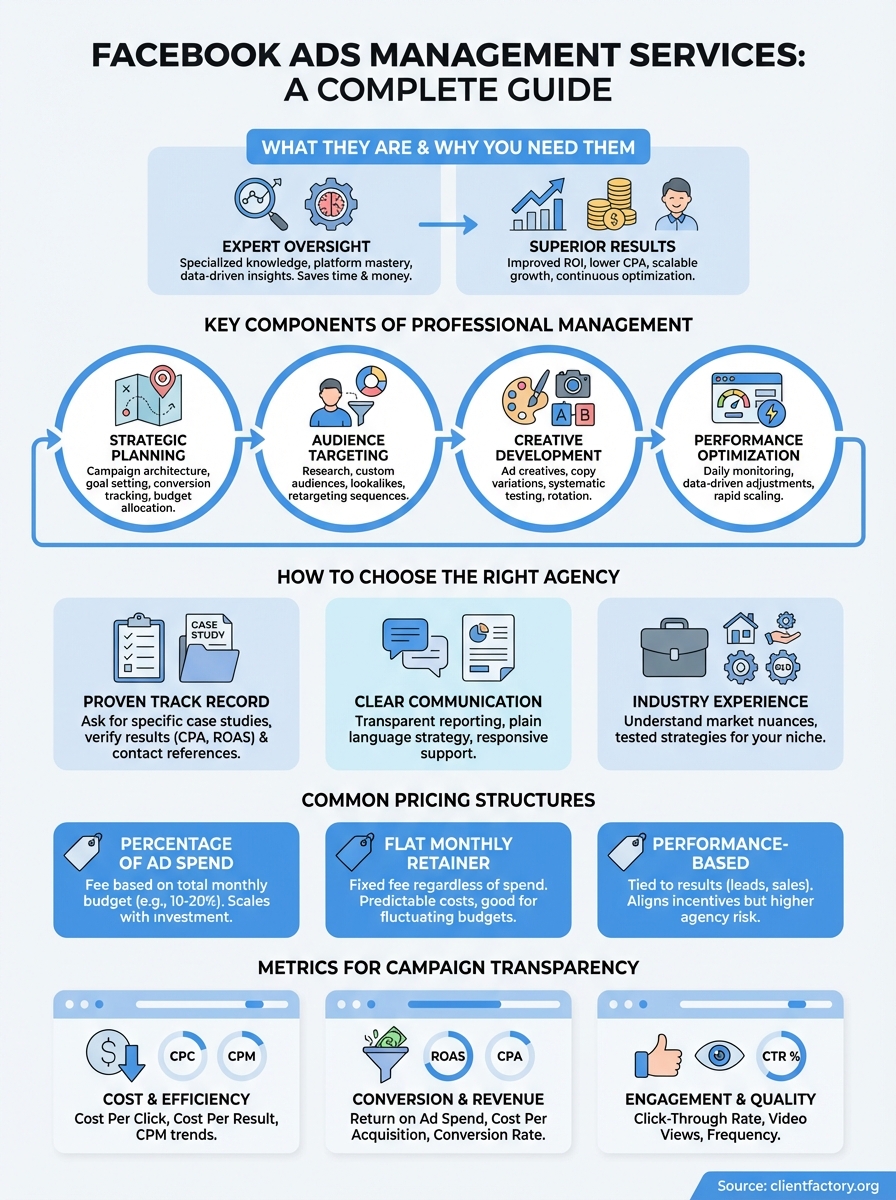
Why expert oversight drives superior marketing results
Running profitable Facebook campaigns requires more than just clicking the "Boost Post" button. Experienced professionals bring specialized knowledge of Meta’s advertising platform that most business owners take years to develop on their own. They understand how the auction system works, which bidding strategies maximize efficiency, and how to structure campaigns for optimal performance. When you hire facebook ads management services, you gain immediate access to expertise that would otherwise cost you thousands in wasted ad spend and months of trial and error.

Platform mastery saves money from day one
Professionals know Meta’s interface inside and out, including features that casual users never discover. They leverage advanced targeting options like lookalike audiences, custom conversion events, and sequential retargeting that dramatically improve campaign efficiency. Your manager also stays current with platform updates and policy changes that can make or break campaign performance. While you focus on running your business, they’re testing new features, adapting to algorithm shifts, and implementing best practices that keep your ads competitive.
The difference between amateur and expert management often shows up in cost per acquisition, where professionals routinely achieve 40-60% better results through proper audience layering and bid optimization.
Data analysis turns insights into revenue
Expert managers don’t just look at surface metrics like reach and impressions. They dig into conversion data, identify which audience segments produce the highest-value customers, and reallocate budget accordingly. Your agency analyzes customer journey patterns, tracking how prospects interact with your ads before converting. This depth of analysis reveals opportunities that basic reporting completely misses. Professionals spot trends early, kill underperforming ad sets quickly, and scale winners aggressively based on statistical significance rather than guesswork.
Creative testing accelerates performance growth
Professional teams systematically test ad creative variations to discover what resonates with your target market. They rotate headlines, images, video hooks, and calls-to-action while maintaining proper statistical controls. Your campaigns evolve continuously as managers identify winning combinations and apply those insights across all ad sets. This structured approach to creative testing produces compounding improvements that DIY advertisers rarely achieve. Each winning variation gets documented, refined, and scaled while losers get eliminated before they drain your budget.
Strategic campaign architecture maximizes efficiency
Experts structure your account strategically rather than dumping everything into one campaign. They separate cold traffic from warm audiences, create distinct funnels for different customer segments, and build retargeting sequences that nurture prospects over time. Your manager also implements proper conversion tracking across all customer touchpoints, ensuring every dollar spent gets attributed correctly. This architectural foundation allows for precise optimization that dramatically improves return on ad spend compared to flat, single-campaign approaches that most beginners use.
How to choose the right agency for your business
Selecting the right facebook ads management services provider determines whether you’ll see exponential growth or waste thousands on mediocre results. Your decision should rest on concrete evidence of past performance, not flashy sales pitches or cheap pricing. You need an agency that understands your market, communicates transparently, and has a proven system for delivering measurable results. The wrong choice costs you far more than just monthly fees because you’ll lose valuable time and market opportunities while poor campaigns drain your budget.
Review their proven track record
Start by demanding case studies from businesses similar to yours, not generic examples from completely different industries. Your potential agency should show specific metrics like cost per lead, conversion rates, and return on ad spend across campaigns they’ve managed. Ask for references you can contact directly to verify results and learn about their working relationship. Watch out for agencies that only showcase vanity metrics like reach and impressions without connecting them to actual business outcomes.
Agencies confident in their abilities willingly share detailed performance data and connect you with satisfied clients who can verify their results.
Evaluate communication and reporting practices
Your agency should explain their strategy in plain language without hiding behind technical jargon. During initial conversations, notice whether they ask detailed questions about your business goals, customer base, and profit margins. Quality agencies send regular performance reports with clear explanations of what’s working, what needs improvement, and how they plan to optimize moving forward. Test their responsiveness by asking specific questions about campaign management. If they take days to respond during the sales process, expect worse communication after you sign.
Assess industry-specific experience
Agencies familiar with your industry understand your customer journey and know which messaging resonates with your target market. They’ve already tested creatives, offers, and targeting strategies that work for businesses like yours. Industry experience accelerates results because your manager doesn’t need months learning your market from scratch. Ask potential agencies how many clients they currently serve in your sector and what unique challenges they’ve solved. Their answers reveal whether they bring specialized knowledge or just apply generic templates across all clients.
Key components of professional ad management
Professional facebook ads management services include several essential elements that work together to produce results. Quality agencies deliver far more than just launching campaigns and hoping for the best. They implement systematic processes for strategy development, creative production, audience targeting, performance optimization, and transparent reporting. Each component builds on the others to create a comprehensive approach that consistently outperforms scattered, reactive campaign management. Understanding these core elements helps you evaluate whether an agency delivers complete service or cuts corners that hurt your results.
Strategic campaign architecture and planning
Your agency should start by developing a comprehensive advertising strategy tailored to your business goals, customer lifecycle, and competitive landscape. This includes mapping out your customer journey, identifying key conversion points, and structuring campaigns that guide prospects from awareness to purchase. Professionals segment your audiences strategically, creating separate campaigns for cold traffic, warm prospects, and existing customers rather than lumping everyone together. They also establish clear conversion goals, budget allocation frameworks, and scaling plans before launching any ads.
Audience research and precise targeting
Effective management requires continuous audience research and refinement to reach the people most likely to buy from you. Your team analyzes your existing customer data, builds detailed buyer personas, and creates custom audiences based on website behavior, email lists, and purchase history. They test new audience segments systematically, expanding reach while maintaining efficiency through lookalike modeling and interest-based targeting. This ongoing research uncovers profitable audience pockets your competitors overlook.
Professional managers combine first-party data with Meta’s targeting options to reach high-intent prospects at the exact moment they’re ready to take action.
Creative development and systematic testing
Your agency produces ad creatives specifically designed for Meta’s platform, including images, videos, copy variations, and compelling offers that stop the scroll. Professional teams continuously test different creative angles, messaging approaches, and visual styles to identify what resonates with your target audience. They rotate fresh creatives regularly to combat ad fatigue and maintain strong engagement rates across all campaigns.
Performance monitoring and rapid optimization
Quality agencies monitor campaign performance daily, making data-driven adjustments to improve efficiency and scale winning elements. Your manager tracks metrics across all funnel stages, identifies bottlenecks quickly, and reallocates budget toward top performers. They respond immediately to performance shifts, testing new variables and implementing fixes before problems drain significant budget.
Common pricing structures and fee models
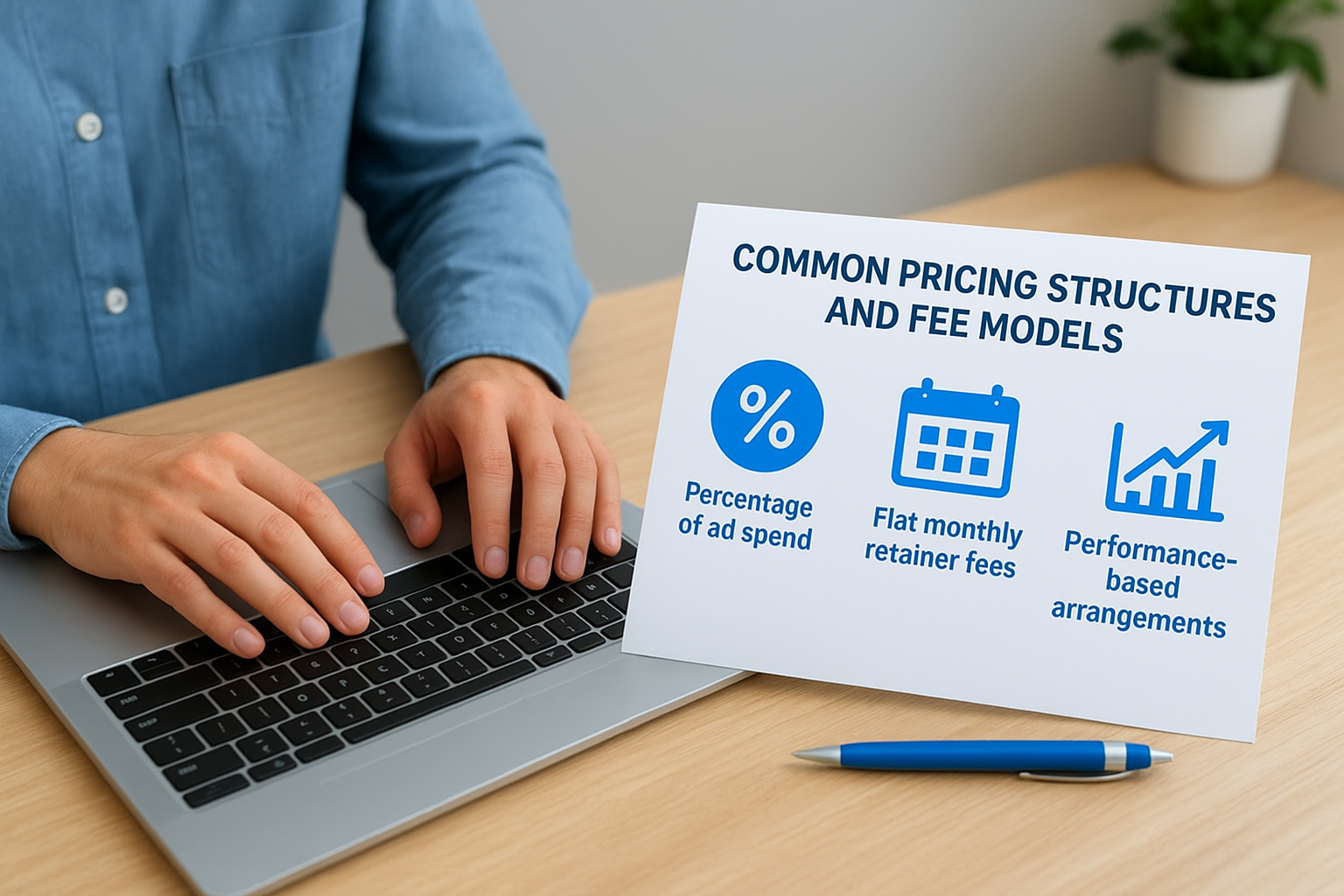
Understanding how agencies charge for facebook ads management services helps you budget accurately and avoid surprises. Pricing models vary significantly between agencies, and the structure you choose directly impacts your overall marketing costs and how incentives align with results. Most agencies use one of three primary fee structures, each with distinct advantages and drawbacks. Your choice should match your business size, monthly ad budget, and risk tolerance. Agencies typically adjust their pricing based on campaign complexity, industry competitiveness, and the level of service you require.
Percentage of ad spend model
This popular structure charges you a percentage of your total monthly ad budget, typically ranging from 10% to 20% depending on spend levels. If you invest $10,000 monthly in ads and your agency charges 15%, you pay $1,500 in management fees. This model scales proportionally with your investment, making it straightforward to calculate costs as you increase budget. Agencies favor this structure because their revenue grows as your campaigns expand, creating natural alignment as they help you scale profitably.
Flat monthly retainer fees
Retainer arrangements charge a fixed monthly fee regardless of ad spend, usually ranging from $1,000 to $5,000 for small businesses and climbing higher for complex accounts. Your agency provides agreed-upon services for this flat rate, which creates predictable costs you can budget around. This structure works best when your ad spend fluctuates or when you’re testing new markets with varying monthly investments. Agencies offering retainers typically outline specific deliverables like the number of ad sets, creative variations, and optimization hours included each month.
Flat retainers benefit businesses with smaller ad budgets because percentage-based fees on low spend often don’t cover the actual work required to manage campaigns effectively.
Performance-based arrangements
Some agencies offer pricing tied directly to results, charging based on leads generated, sales closed, or specific conversion targets you define. These arrangements usually include a smaller base fee plus bonuses when campaigns hit performance benchmarks. Performance pricing aligns agency incentives with your goals but requires robust tracking systems and clear attribution models. This structure carries higher risk for agencies, so they typically reserve it for businesses with proven offers, established conversion funnels, and realistic expectations about market conditions.
Metrics to track for campaign transparency
Quality facebook ads management services provide detailed reporting on metrics that directly impact your bottom line. You need clear visibility into campaign performance to verify your investment produces real results and to hold your agency accountable. Professional managers track dozens of data points, but certain metrics matter most for understanding whether your campaigns drive profitable growth. Agencies should present these numbers in straightforward reports that show trends over time, explain significant changes, and outline optimization actions taken. Understanding which metrics reveal true campaign health helps you spot problems early and ensure your agency focuses on outcomes that matter rather than vanity numbers.
Cost and efficiency indicators
Your primary cost metrics include cost per click (CPC), cost per thousand impressions (CPM), and cost per result based on your campaign objectives. These numbers reveal how efficiently your ads compete in Meta’s auction and whether your targeting reaches audiences at sustainable prices. Watch for upward trends in these costs that signal audience fatigue, increased competition, or declining ad relevance. Your agency should explain what drives cost changes and how they plan to improve efficiency through creative refreshes, audience expansion, or bid strategy adjustments.
Conversion and revenue tracking
Return on ad spend (ROAS) and cost per acquisition (CPA) directly measure campaign profitability by showing how much revenue you generate per dollar spent and what you pay to acquire each customer. Your manager tracks these metrics at multiple levels including campaign, ad set, and individual ad performance. Conversion rate percentages reveal how effectively your landing pages and offers turn clicks into customers, highlighting where funnel improvements deliver the biggest impact.
Profitable campaigns require tracking beyond the click to see which audiences and creatives produce customers who actually complete purchases rather than just filling your pipeline with unqualified leads.
Engagement and quality signals
Click-through rate (CTR), engagement rate, and video view percentages indicate whether your creative resonates with target audiences before they even reach your website. High engagement signals strong audience targeting and compelling messaging, while low rates suggest creative fatigue or poor audience fit. Your agency monitors frequency metrics to catch when people see your ads too often, causing performance drops and wasted spend on burned-out audiences.
Scaling your business with confidence
Professional facebook ads management services transform your advertising from a frustrating expense into a reliable growth engine. You gain immediate access to expertise that would take years to develop independently, while your agency handles the daily optimization, testing, and strategy adjustments that drive results. Your campaigns run more efficiently, your customer acquisition costs drop, and you free up valuable time to focus on serving clients and growing your business instead of wrestling with Meta’s platform.
Choosing the right partner requires looking beyond price to evaluate their track record, communication standards, and strategic approach. Demand transparency through detailed reporting that shows real business outcomes, not just surface metrics. The right agency becomes an extension of your team, invested in your growth and aligned with your goals.
Ready to accelerate your client acquisition? Client Factory specializes in converting clicks into paying clients through data-driven Facebook advertising strategies. Our performance-first approach delivers measurable results for service businesses ready to scale.