

Landing page optimization services help you turn more visitors into customers by testing and improving your landing pages. These providers analyze your pages, run experiments, fix conversion blockers, and guide you through systematic improvements. You pay them to do the research, design changes, run tests, and implement winning variations so you don’t waste time or money guessing what works. The right optimization partner can double or triple your conversion rates within months.
This guide walks you through choosing a provider that fits your business. You’ll learn what these services actually include, how to evaluate different agencies and tools, when to hire outside help, and which questions separate great providers from mediocre ones. We’ll also cover pricing models, key metrics to track, common hiring mistakes, and how Client Factory handles optimization projects. By the end, you’ll know exactly what to look for and how to avoid expensive missteps when selecting your optimization partner.
Why landing page optimization services matter
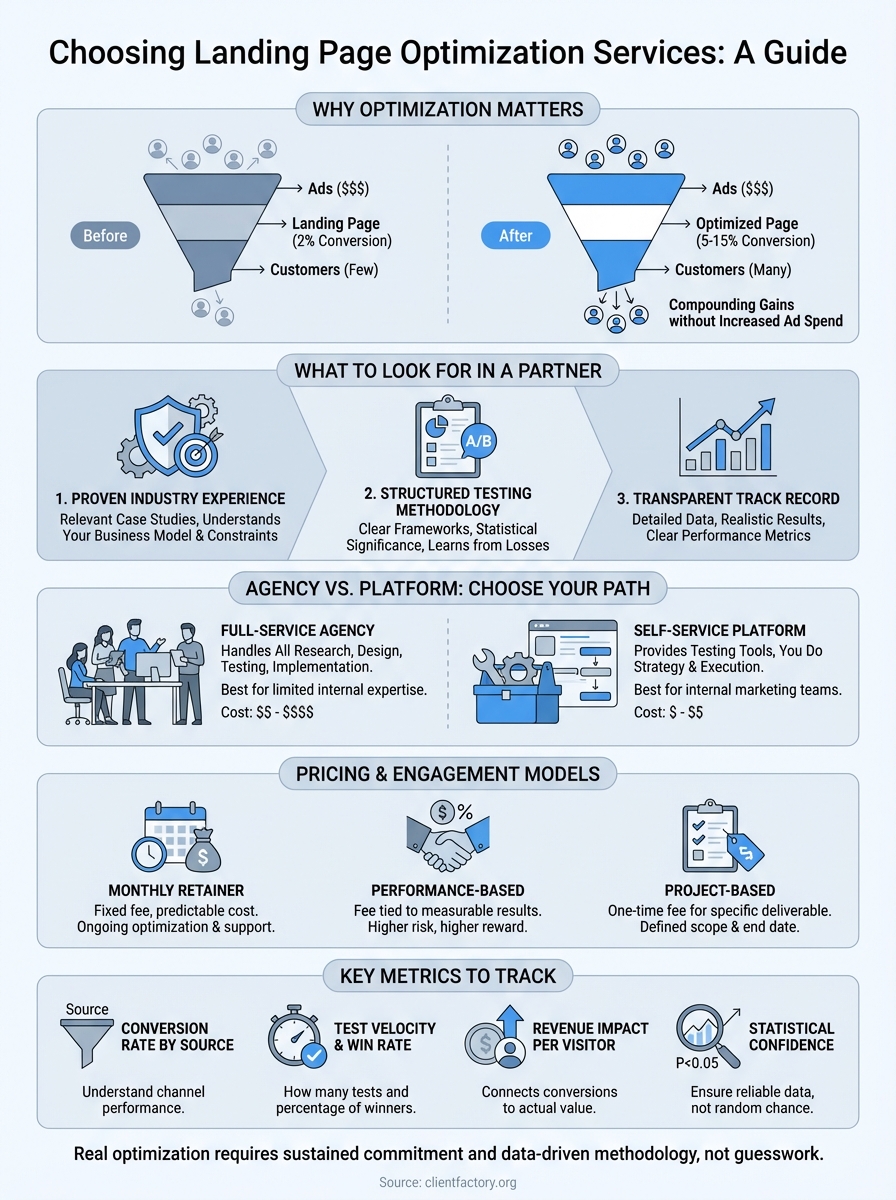
Your landing pages determine whether visitors become customers or bounce to competitors. Most businesses waste thousands on ads that drive traffic to pages that convert at 1-2%, when tested and optimized pages regularly hit 5-15% conversion rates. That difference transforms your entire business. If you’re spending $10,000 monthly on ads and converting at 2%, you get 200 conversions. Optimize to 6% and you triple that to 600 conversions without spending another dollar on traffic. The math is simple but most companies never see these gains because they never systematically test and improve their pages.
The real cost of poor landing pages
You pay for every click whether it converts or not. Unoptimized pages bleed money daily because small friction points accumulate into massive losses over months. A confusing headline costs you 30% of visitors in seconds. Form fields that ask too much cut conversions by half. Slow load times kill 40% of potential customers before they see your offer. These problems compound, and you can’t spot them by staring at your page. You need data, testing, and expertise to identify exactly what’s breaking and fix it systematically.
Professional optimization providers see patterns across hundreds of tests that you’ll never spot on your own.
Landing page optimization services bring specialized knowledge and testing infrastructure you don’t have in-house. They know which elements typically drive the biggest gains, how to prioritize tests, and how to interpret results correctly. Building this capability yourself takes years and costs more than hiring experts who already know what works.
What optimized pages deliver
Better conversions multiply the value of everything else you do. Your email campaigns perform better, your ads become more profitable, and your sales team closes more deals because qualified leads arrive ready to buy. Optimization doesn’t just improve one metric. It creates a compounding effect across your entire acquisition funnel. Companies that commit to continuous testing see 20-50% year-over-year improvements in conversion rates, which translates directly to revenue growth without proportional increases in marketing spend.
How to choose a landing page optimization partner
The right optimization partner understands your business model, has proven testing methodologies, and delivers measurable results within your budget. You need someone who can explain their process clearly, shows you real data from past projects, and commits to specific improvement targets. Start by identifying providers who specialize in your industry or business model because what works for e-commerce rarely works for B2B services or lead generation. Generic optimization advice wastes your time and money. You want partners who have optimized pages for businesses like yours and can show you the specific tests that drove results.
Look for proven experience in your industry
Industry-specific expertise matters more than general conversion knowledge because different audiences respond to different triggers. A provider who has optimized landing page optimization services for law firms knows that trust signals and credentials drive conversions, while e-commerce optimizers focus on product imagery and urgency. Ask potential partners to show you three to five relevant case studies from companies in your space. Look for specifics about what they tested, how long tests ran, and what improvements they achieved. Vague claims about "increased conversions" mean nothing without context.

Check whether they understand your customer acquisition model and typical decision-making process. If you sell high-ticket services with long sales cycles, you need different optimization strategies than someone selling $50 impulse purchases. The right provider asks detailed questions about your offer, target audience, competitive landscape, and current performance before proposing solutions.
Evaluate their testing methodology
Strong optimization partners follow structured testing processes instead of making random changes based on opinions. They should explain how they prioritize which elements to test first, how they determine sample sizes, and how long they run tests before declaring winners. Watch out for providers who promise quick wins without discussing statistical significance or proper test duration. You want methodical experimenters who collect data, form hypotheses, run controlled tests, and analyze results objectively.
Real optimization takes patience and discipline, not guesswork and gut feelings.
Ask how they handle tests that fail or produce inconclusive results. Good providers learn from losses and use that data to inform the next round of testing. They should have clear frameworks for test design, traffic allocation, and result interpretation. If they can’t walk you through their methodology step by step, they’re probably winging it.
Check their track record and case results
Request detailed performance data from past optimization projects, not just testimonials or percentages without context. You want to see actual numbers like starting conversion rate, ending conversion rate, test duration, traffic volume, and statistical confidence levels. Many providers inflate results by cherry-picking their best tests or measuring the wrong metrics. Demand full transparency about how they measure success and what percentage of their tests typically produce positive results.
Look for providers who have worked with businesses at your scale and budget level. An agency that optimizes pages for Fortune 500 companies may not fit your $5,000 monthly budget or understand the constraints of smaller teams. Similarly, a freelancer who typically works with startups may lack the infrastructure to handle enterprise-level testing requirements. Match the provider’s experience level to your specific situation and resources.
What landing page optimization services include
Professional landing page optimization services include research, testing, design, implementation, and ongoing analysis of your conversion funnel. You get a team that identifies problems, proposes solutions, runs experiments, and implements winning changes across your pages. Most providers bundle several core services together because optimization requires multiple skill sets working in coordination. Understanding what you’re actually paying for helps you evaluate proposals and hold your provider accountable for deliverables.
Conversion research and analysis
Your optimization partner starts by analyzing current performance data and identifying conversion barriers. They examine analytics to understand how visitors move through your page, where they drop off, and which elements get the most attention. This research phase includes reviewing heatmaps, session recordings, form analytics, and traffic sources to build a complete picture of user behavior. Providers also analyze your competitors’ landing pages, review industry benchmarks, and identify quick wins based on proven patterns.
Strong teams conduct qualitative research alongside quantitative data analysis. They may run user surveys, conduct customer interviews, or analyze support tickets to understand why people hesitate or abandon your pages. This research informs hypothesis development and test prioritization so you focus on changes that actually matter to your audience.
A/B testing and experimentation
Testing forms the core of what landing page optimization services deliver. Your provider designs experiments that compare different versions of page elements against each other to measure which performs better. They test headlines, copy, images, forms, call-to-action buttons, layouts, and value propositions systematically. Each test runs until it reaches statistical significance with enough traffic to declare a reliable winner.

Real optimization happens through disciplined testing, not opinions about what looks better.
Good providers manage the entire testing lifecycle from hypothesis formation through implementation. They calculate required sample sizes, set up proper traffic splits, monitor tests daily, and analyze results objectively. You receive detailed reports explaining what they tested, why they tested it, what happened, and what changes they recommend based on the data.
Design and copywriting improvements
Most optimization services include design and copy work to create test variations and implement winning changes. Your provider designs new page layouts, writes alternative headlines and body copy, creates different form structures, and develops new visual elements. They understand conversion-focused design principles like visual hierarchy, directional cues, contrast, and white space usage. This isn’t about making pages prettier. It’s about designing elements that guide visitors toward conversion.
Copywriters on optimization teams write specifically for persuasion and clarity. They craft headlines that communicate value immediately, body copy that addresses objections, and calls-to-action that remove friction. Every word serves a purpose in moving visitors closer to the desired action.
Technical implementation and tracking
Your optimization team handles technical setup and tracking so tests run correctly and you capture accurate data. They implement testing platforms, set up conversion tracking, configure analytics events, and ensure page speed remains fast. Technical work includes adding tracking pixels, setting up goal funnels, implementing tag management systems, and troubleshooting tracking issues. Providers also handle quality assurance testing across different browsers and devices to catch bugs before they affect real visitors.
Implementation includes deploying winning variations permanently after tests conclude. Your team updates page code, adjusts content management systems, and documents changes for future reference. They maintain detailed records of what was tested, what won, and what impact each change delivered so you understand exactly what drives your conversion improvements.
Agencies versus tools for optimization
You face two main paths when investing in landing page optimization services: hiring a full-service agency or using self-service optimization platforms. Agencies bring experienced teams who handle research, testing, design, and implementation for you. Platforms give you software to run your own tests but leave the strategy and execution to your internal team. Your choice depends on budget, internal expertise, and how much control you want over the optimization process. Neither option is universally better because they solve different problems for different businesses.
Full-service agencies handle everything
Agencies provide complete optimization teams including strategists, analysts, designers, copywriters, and developers who work on your landing pages. You pay for their expertise and labor, which means higher monthly costs but less work for your team. They manage the entire process from research through implementation, deliver regular reports, and take responsibility for results. This path works best when you lack internal optimization expertise or don’t have time to manage testing programs yourself.
Agencies deliver faster results because they’ve already solved similar problems for other clients.
Expect to invest between $3,000 and $15,000 monthly for agency services depending on page complexity and testing volume. You get proven methodologies and experienced professionals but sacrifice some control over daily decisions and test prioritization.
Self-service platforms give you control
Optimization platforms like Google Optimize provide testing infrastructure without the human expertise agencies offer. You get software to create variations, split traffic, and measure results, but your team does all the strategic work. These tools cost $0 to $500 monthly, making them attractive for budget-conscious businesses with internal marketing talent. You maintain complete control over what gets tested and when changes go live.
Platforms demand more from your team because someone needs to design tests, create variations, analyze results, and implement winners. This approach works when you have skilled marketers who understand conversion principles and can dedicate 10-20 hours weekly to optimization projects. You save money but progress more slowly than with agencies.
When to hire an optimization provider
You should hire landing page optimization services when conversion improvements would deliver more value than the cost of expert help. Most businesses wait too long and waste months trying to optimize pages without proper methodology or tools. The right time to bring in professionals is when you have consistent traffic hitting pages that underperform, when testing expertise doesn’t exist on your team, or when your ad spend makes even small conversion gains financially significant. You don’t need millions in revenue to justify optimization help. You just need enough traffic volume and customer value to make testing feasible and profitable.
Your conversion rates have plateaued
Hire an optimization provider when your pages convert at flat or declining rates despite traffic growth. You’ve made obvious fixes like improving load speed and clarifying your headline, but conversions stay stuck between 1-3%. This plateau signals you need systematic testing to identify hidden friction points that only data and experimentation reveal. Professional optimizers break through plateaus by testing elements you wouldn’t think to change and running experiments your team lacks time or knowledge to execute properly.
When obvious fixes stop working, you need structured testing to find what actually moves the needle.
You lack testing expertise internally
Bring in experts when your team doesn’t understand statistical significance, test design, or result interpretation. Running tests incorrectly produces misleading data that costs you money when you implement losing variations. Optimization requires specific skills in hypothesis formation, sample size calculation, and multivariate analysis that most marketing teams don’t possess. Providers deliver faster results and fewer mistakes than teams learning through trial and error on live traffic.
Ad spend justifies optimization investment
Consider hiring when monthly ad spend exceeds $5,000 because small conversion improvements multiply the value of every dollar you spend on traffic. If you spend $10,000 monthly and convert at 2%, increasing to 4% doubles your results without additional ad costs. The optimization service pays for itself when conversion gains exceed the monthly fee.
Key questions to ask potential providers
Asking the right questions during your evaluation process separates providers who deliver results from those who waste your budget. You need specific answers about their methodology, experience, team structure, and how they handle failures. Most agencies sound impressive in sales calls but reveal their true capabilities when you push for details. Strong landing page optimization services providers answer these questions confidently with concrete examples and data. Weak ones dodge specifics or give vague responses about "best practices" and "proven strategies." Use these questions to identify partners who actually know what they’re doing.
What results have you achieved for similar businesses
Ask potential providers to show you three detailed case studies from businesses in your industry or with similar business models. You want specifics including starting conversion rate, ending conversion rate, number of tests run, test duration, and traffic volumes involved. Generic claims like "we increased conversions by 200%" mean nothing without context. Push for documentation that shows exactly what they tested, why they tested it, and what data drove their decisions. Strong providers walk you through specific experiments that produced results and explain the strategic thinking behind each test.
Request references from clients who match your business size and budget level. A provider who optimizes pages for enterprise companies may not understand constraints faced by businesses spending $5,000 monthly. You need someone experienced with your specific challenges and resource limitations.
How do you prioritize and structure tests
Understanding their testing methodology reveals whether they follow disciplined processes or make random changes hoping something works. Ask them to explain how they decide which elements to test first, how they calculate required sample sizes, and how long they run experiments before declaring winners. You want providers who can articulate clear frameworks for hypothesis development, test design, and statistical analysis. They should explain concepts like confidence intervals and significance thresholds in plain language you understand.
Providers who can’t explain their testing process in simple terms don’t actually have one.
Question how they handle multivariate testing versus A/B tests and when they use each approach. Strong teams know that testing too many variables simultaneously requires massive traffic volumes most businesses don’t have. They start with focused A/B tests on high-impact elements before moving to more complex experiments.
What happens if tests fail
Ask directly about their failure rate and what they do when tests produce no improvement or hurt conversions. Every optimization team runs tests that fail because that’s how experimentation works. Providers who claim every test wins are lying or cherry-picking data. You want partners who treat failures as learning opportunities and use that data to inform better hypotheses for the next round of testing. They should explain how they analyze losing variations to understand why they underperformed.
Find out whether they share data from unsuccessful tests or only report winners. Transparent providers give you complete visibility into every experiment including the ones that didn’t work. This honesty builds trust and helps you understand the true nature of optimization work.
Who will work on my account
Clarify exactly which team members handle your optimization projects and what qualifications they bring. Many agencies sell you on senior strategists who never touch your account while junior staff do the actual work. You deserve to know whether experienced professionals or entry-level employees run your tests. Ask for names, backgrounds, and specific roles of everyone who will contribute to your landing pages. Strong providers introduce you to your actual working team before you sign contracts.
How pricing and engagement models work
Landing page optimization services typically charge through monthly retainers, performance-based agreements, or project fees depending on scope and commitment level. Understanding how each model works helps you budget correctly and choose arrangements that align with your business goals. Most providers offer multiple pricing options so you can select the structure that fits your cash flow, risk tolerance, and testing timeline. Pricing varies widely based on page complexity, traffic volume, number of tests, and provider expertise level. You might pay $2,000 monthly for basic testing services or $20,000 for comprehensive optimization programs with dedicated teams.
Monthly retainer agreements
Retainer models charge you a fixed monthly fee for ongoing optimization work regardless of how many tests run or what results you achieve. You pay the same amount whether tests win big or produce no improvement because you’re buying the provider’s time and expertise rather than guaranteed outcomes. Retainers typically range from $3,000 to $15,000 monthly depending on service level and provider experience. This structure works best when you commit to continuous testing over six to twelve months because optimization delivers compounding results over time.
Providers usually tier retainer packages by testing volume and team access. Basic packages might include two to three tests monthly with email support, while premium tiers offer weekly tests, dedicated strategists, and priority implementation. You get predictable costs that make budgeting easier, plus the provider invests in learning your business deeply because they know you’ll stick around. The downside is paying during slow months when traffic drops or tests take longer to reach significance.
Performance-based pricing
Performance agreements tie some or all of your costs to measurable conversion improvements the provider delivers. You might pay a base fee plus bonuses when conversion rates hit specific targets, or pay nothing upfront and share a percentage of revenue increases. This model appeals to businesses that want providers with skin in the game and want to minimize risk if optimization doesn’t work. Expect providers to charge higher rates under performance terms because they assume more risk and only profit when you succeed.
Performance pricing aligns incentives but requires clear definitions of what counts as success and how you’ll measure it.
Negotiate exactly how you’ll track results, what attribution window applies, and whether the provider gets credit for organic improvements that would have happened anyway. Strong contracts define baseline metrics, measurement methods, and payment thresholds before work begins. Watch for providers who focus purely on conversion rate increases without considering lead quality or customer lifetime value.
Project-based engagements
Project fees charge a one-time price for specific deliverables like auditing your current pages, designing new variations, or running a defined test series. You might pay $5,000 to $25,000 depending on project scope and complexity. This structure makes sense when you need targeted help rather than ongoing optimization services or want to test a provider before committing to longer terms. Projects have clear start and end dates with defined deliverables you can evaluate.
Fixed-price projects work well for businesses that already understand optimization but need extra resources for specific initiatives. You get cost certainty and can evaluate results before deciding whether to continue the relationship. The limitation is that real optimization requires sustained effort over months, and one-off projects rarely produce the compounding gains that continuous testing delivers.
Metrics to track with your optimization team
Tracking the right metrics separates successful optimization programs from wasted effort because you need objective data to evaluate whether your landing page optimization services deliver real value. Your provider should report on specific performance indicators that tie directly to business outcomes, not vanity metrics that look impressive but don’t affect revenue. Establish clear measurement frameworks before testing begins so everyone agrees on what success looks like and how you’ll calculate it. Most providers track dozens of metrics, but only five to seven actually matter for understanding whether your pages improve and your investment pays off.
Conversion rate by traffic source
Monitor conversion rate separately for each traffic source because visitors from Google Ads behave differently than those from organic search or social media. Your optimization team should show you which sources improved most from testing and which still underperform. This granular tracking reveals whether changes benefit all visitors equally or only specific segments. You might discover that variations optimized for paid traffic actually hurt organic conversions, which changes how you implement winning tests.
Demand monthly reports that break down performance by device type, geographic location, and referral source. Your provider should explain why certain segments respond better to specific variations and recommend targeted optimizations for underperforming traffic sources. This level of detail helps you allocate ad budget more effectively because you know which channels deliver the highest-converting visitors.
Test velocity and win rate
Track how many tests your provider runs monthly and what percentage produce statistically significant improvements. Test velocity measures whether your team moves fast enough to compound gains over time. You want providers completing at least two to four meaningful experiments monthly depending on your traffic volume. Win rate reveals testing quality because teams that win 60-70% of tests understand your audience well, while teams winning less than 30% waste resources on poorly designed experiments.

Strong optimization teams run frequent tests and win more often than they lose because experience teaches them what actually works.
Ask your provider to report their cumulative impact from all tests combined, not just individual winners. Small gains compound into major improvements when you run dozens of tests annually. A provider who delivers 5-10% lifts per winning test and runs 30 tests yearly can triple your conversion rate even if only half the tests succeed.
Revenue impact per visitor
Measure revenue generated per visitor rather than just conversion rate because higher conversions mean nothing if average order value drops or lead quality declines. Your optimization team should track total revenue divided by total visitors to show whether changes improve actual business outcomes. This metric accounts for both conversion rate and transaction value, giving you a complete picture of optimization ROI.
Calculate the incremental revenue your provider generates compared to baseline performance before testing began. Multiply the revenue lift per visitor by your monthly traffic volume to understand the dollar value optimization delivers. If your provider increases revenue per visitor from $2 to $3 and you get 10,000 monthly visitors, they generate an extra $10,000 monthly that directly justifies their fee.
Statistical confidence levels
Require your provider to report confidence intervals and p-values for every test result, not just percentage improvements. Statistical confidence tells you whether observed changes resulted from real performance differences or random chance. Professional landing page optimization services never declare winners without reaching at least 95% confidence that results weren’t coincidental. Tests that end prematurely or with insufficient traffic produce unreliable data that hurts conversions when you implement false winners.
Common mistakes when choosing a provider
Most businesses sabotage their optimization results before testing even begins by making avoidable selection mistakes that cost them months and thousands of dollars. You pick providers based on price alone, accept promises without proof, or skip reference checks that would reveal red flags. These errors compound because bad optimization partners don’t just fail to improve your pages. They actively harm conversions by implementing changes that drive visitors away. Understanding the most frequent hiring mistakes helps you avoid wasting budget on landing page optimization services that deliver nothing but excuses and disappointing reports.
Choosing based on price alone
You hurt your business when you select the cheapest provider without evaluating expertise or methodology. Low-cost optimization teams often lack the skills to run valid tests or interpret results correctly. They implement changes based on opinions rather than data, producing random results that teach you nothing about your audience. The $2,000 monthly savings from hiring budget providers costs you tens of thousands in lost conversions when their amateur testing decreases performance. Investment in proven experts returns far more than the money you save with inexperienced teams.
Providers who drastically undercut market rates either rush through work to serve more clients or staff projects with junior employees learning at your expense. You get generic recommendations copied from blog posts instead of customized strategies built from analyzing your specific data and audience behavior.
Accepting vague success metrics
Failing to define clear performance metrics before testing begins lets providers claim success regardless of actual business impact. You need specific agreements about what counts as improvement and how you’ll measure it. Providers who promise to "increase conversions" without specifying whether they mean form submissions, purchases, or button clicks leave themselves room to manipulate reporting. Demand precise definitions of every metric they’ll track and how those numbers tie to revenue growth.
Providers who resist defining success metrics upfront plan to spin mediocre results as wins later.
Watch for teams that focus on vanity metrics like time on page or bounce rate without connecting those numbers to actual conversions or revenue. These measurements might correlate with business outcomes, but optimizing for them directly doesn’t guarantee you make more money or acquire better customers.
Skipping reference conversations
You risk hiring incompetent providers when you don’t speak directly with their past clients about real experiences. References reveal whether agencies deliver on promises or overpromise and underdeliver. Current clients tell you how responsive the team is, whether they hit deadlines, and if their reported results matched what actually happened. Ask references specific questions about testing volume, communication quality, and whether they would hire the provider again.
Providers who refuse to connect you with references or only offer scripted testimonials likely hide poor performance or difficult working relationships. Strong optimization teams happily introduce you to satisfied clients who will vouch for their work.
Not verifying technical capabilities
Many businesses assume optimization providers handle technical implementation competently without checking their actual capabilities. You discover too late that your team can’t properly configure testing tools, breaks your site during deployments, or lacks developers to implement winning variations quickly. Ask providers to explain their technical infrastructure and deployment process in detail before signing contracts. Request examples of past technical challenges they solved and how they ensure changes don’t introduce bugs or slow down pages.
How Client Factory approaches landing page optimization
Client Factory treats landing page optimization services as part of your complete acquisition system rather than isolated page improvements. We start every engagement by mapping your entire conversion funnel from first click through customer onboarding to identify exactly where prospects drop off and why. This holistic approach reveals opportunities other providers miss because they focus narrowly on individual landing pages without considering how changes affect downstream metrics like lead quality and customer lifetime value. You get strategies that improve conversions while maintaining or increasing the value of customers you acquire.
Data-driven testing methodology
We build optimization programs around rigorous testing frameworks that prioritize experiments based on potential revenue impact rather than gut feelings about what looks better. Your dedicated strategist analyzes current performance data, identifies the biggest conversion barriers, and develops hypotheses grounded in behavioral psychology and proven conversion principles. Each test runs until it reaches statistical significance with proper traffic allocation and control groups. You receive detailed reports explaining what we tested, why we tested it, what the data showed, and what changes we recommend based on results.
Real conversion improvements come from systematic testing and learning, not random changes based on design preferences.
Industry-specific optimization strategies
Our team specializes in service businesses and law firms where trust signals and credibility indicators drive conversions differently than in e-commerce or SaaS. We know that potential clients researching legal services need different reassurances than someone buying products online. You benefit from our 30-plus years of experience optimizing acquisition funnels specifically for service providers who sell complex, high-value offerings with longer decision cycles. This specialization means we test elements proven to matter in your industry instead of wasting time on generic best practices that don’t fit your business model.
Integrated AI-powered optimization
Client Factory combines human expertise with AI-powered analysis to identify patterns and opportunities faster than traditional manual testing. Our systems analyze visitor behavior across hundreds of data points to surface insights your team would never spot manually. You get the strategic thinking of experienced optimizers backed by machine learning capabilities that continuously refine our understanding of what drives conversions for your specific audience. This integration accelerates your testing velocity while maintaining the rigorous methodology that produces reliable, repeatable results.
Final thoughts
Choosing the right landing page optimization services transforms how your business converts traffic into customers. You’ve learned what separates strong providers from weak ones, which questions expose real expertise, and how different pricing models affect your results. The best optimization partners bring proven methodologies, industry-specific experience, and transparent reporting that shows exactly what they test and what improvements they deliver. You avoid expensive mistakes by demanding case studies, checking references, and verifying technical capabilities before signing contracts.
Start your search by evaluating whether you need full-service agencies or self-service platforms based on your internal expertise and budget. Remember that optimization requires sustained commitment because small improvements compound into major gains over months of continuous testing. Your provider should increase both conversion rates and customer quality while helping you understand which traffic sources deliver the most value.
Contact Client Factory to discuss how our data-driven optimization approach can double or triple your landing page conversions. We specialize in service businesses and law firms, combining 30-plus years of experience with AI-powered testing to deliver measurable results within your budget.