
You spent time and money building a landing page that should convert. But when you check Google, it’s nowhere to be found. Your competitor’s pages rank higher, pull more traffic, and likely convert more leads. Meanwhile, your page sits invisible, wasting its potential.
SEO for landing pages fixes this. When you optimize correctly, your page climbs search results and attracts people already looking for what you offer. Better rankings mean more qualified traffic. More qualified traffic means more conversions. The math is simple.
This guide walks you through five practical steps to optimize your landing pages for search engines without sacrificing conversion rates. You’ll learn how to pick keywords that drive revenue, structure pages that satisfy both Google and visitors, optimize technical elements that boost rankings, and build authority that lasts. By the end, you’ll have a clear roadmap to transform your landing pages from invisible to indispensable.
What SEO for landing pages really means
SEO for landing pages means optimizing your conversion-focused pages to rank in search engines while maintaining their ability to turn visitors into leads or customers. Traditional SEO focuses on getting traffic. Traditional landing page design focuses on converting that traffic. When you combine both approaches correctly, you create pages that attract qualified visitors from Google and guide them toward taking action.
The difference between SEO pages and conversion pages
Most marketers treat SEO content and landing pages as separate entities. Your blog posts target informational keywords and build authority. Your landing pages capture leads from paid ads. This separation creates a missed opportunity because landing pages can serve both purposes when you optimize them correctly.
A conversion-only landing page prioritizes a single call to action above everything else. It strips away navigation, limits text, and removes distractions. An SEO-only page prioritizes content depth and keyword coverage. It includes extensive information but often lacks the focused design that drives conversions. The sweet spot combines strategic keyword targeting with conversion-optimized design.
When you optimize landing pages for search, you create a sustainable traffic source that doesn’t disappear when your ad budget runs out.
What makes a landing page SEO-friendly
An SEO-friendly landing page satisfies search intent while guiding visitors toward conversion. You need enough quality content to rank without overwhelming visitors. You need clear technical optimization without sacrificing design. You need internal links that build authority without creating distractions. Each element serves both search engines and human visitors. Your page must load quickly on mobile devices, include relevant keywords in strategic locations, and provide genuine value beyond what competitors offer. The goal remains conversion, but you optimize every element to also signal relevance and authority to search engines.
Step 1. Clarify intent and choose keywords to convert
You cannot optimize a landing page for search until you know what people actually type into Google when they’re ready to buy. Most businesses waste time targeting keywords that bring traffic but never convert. They rank for informational queries like "what is email marketing" when they should target transactional queries like "email marketing software for small business." The first keyword attracts researchers. The second attracts buyers.
Understand the four types of search intent
Search intent determines what someone expects to find when they search. Google analyzes billions of searches to understand these patterns, and your landing page must match the intent behind your target keyword. Four types of intent exist, and only one reliably converts on landing pages.

Informational intent means someone wants to learn something. They search "how does SEO work" or "landing page best practices." These searchers need blog posts and guides, not sales pages. Navigational intent means someone wants to reach a specific website. They type "Gmail login" or "Facebook homepage." Your landing page won’t rank for these unless you’re the brand they’re seeking.
Commercial intent indicates someone researching options before buying. They search "best CRM software" or "Mailchimp vs Constant Contact." These keywords work for comparison pages and reviews, but your conversion rate stays lower because these visitors still compare options. Transactional intent signals someone ready to take action now. They search "buy project management software" or "hire personal injury lawyer Boston." These keywords convert because the searcher already decided to act.
Target transactional keywords on your landing pages because these searches come from people who already moved past the research phase and want solutions now.
Target bottom-of-funnel keywords
Bottom-of-funnel keywords indicate high purchase intent and strong conversion potential. When you optimize your landing page for these terms, you attract visitors who need what you offer right now. Location-based service keywords work particularly well. "Divorce attorney in Chicago" beats "divorce laws Illinois" every time for a law firm’s landing page.
Action-oriented keywords signal readiness to engage. Someone searching "schedule roof inspection Denver" wants to book an appointment, not read about roof maintenance. Someone typing "get free marketing audit" wants your lead magnet, not general marketing advice. Pricing and comparison keywords also indicate late-stage research. "Email marketing software pricing" or "HubSpot alternatives for agencies" attract people close to deciding.
Find keywords your competitors miss
You need a systematic approach to uncover conversion-focused keywords that lack strong competition. Start by listing every service you offer and every problem you solve. A personal injury law firm might list "car accident claims," "slip and fall cases," "workplace injuries," and "wrongful death lawsuits." Add location modifiers to each term if you serve specific areas.
Next, add qualifiers that indicate intent to these base terms:
- "hire [service] in [location]"
- "best [service] for [specific need]"
- "[service] near me"
- "[service] consultation"
- "affordable [service]"
Search Google for each potential keyword and examine the results carefully. If you see mostly paid ads and weak organic results, you found an opportunity. If established competitors dominate with comprehensive pages, choose a more specific variation. Tools help, but manual research reveals the keywords that actually convert because you see exactly what Google shows to potential clients.
Step 2. Design your page for intent and conversion
Your landing page design determines whether visitors take action or leave within seconds. When you optimize seo for landing pages, you need a design that satisfies both Google’s ranking factors and human psychology. Search engines want comprehensive, valuable content. Visitors want clarity and speed. You achieve both by structuring your page to deliver exactly what your keyword promises while removing friction from the conversion path.
Match your design to search intent
You must analyze the actual search results for your target keyword before designing your page. Open Google in an incognito window and type your keyword. Look at the top five organic results. What format do they use? Do they show product pages, comparison charts, or step-by-step guides? Google ranks these pages because they match what most searchers want to see.
Someone searching "hire tax attorney Phoenix" expects to see attorney profiles, credentials, and contact forms. They do not expect blog posts about tax law. Someone searching "best email marketing software for coaches" expects feature comparisons and pricing tables. Your design must mirror these expectations or visitors bounce immediately, which sends negative signals to search engines about your page’s relevance.
When your page design mismatches search intent, you lose both rankings and conversions because visitors leave before engaging with your content.
Structure your page for scanning and action
Visitors scan pages in an F-pattern, reading headlines and the first few words of paragraphs. You need a clear visual hierarchy that guides eyes down the page toward your conversion goal. Place your primary call to action above the fold where visitors see it immediately. Use a contrasting color that stands out from surrounding elements. Make the button text specific and action-oriented: "Get Your Free Audit" beats "Submit" every time.

Break your content into digestible sections with descriptive H2 and H3 headings that incorporate secondary keywords. Someone should understand your entire offer by reading only your headlines. Add white space between sections to prevent overwhelming visitors. Include relevant images or screenshots that support your points, not generic stock photos that add no value.
Your page should follow this proven structure:
- Hero section: Headline, subheadline, and primary CTA
- Value proposition: 3-5 key benefits in clear language
- Social proof: Testimonials, case studies, or logos
- Features or process: How your solution works
- Objection handling: FAQ or comparison to alternatives
- Final CTA: Repeat your call to action with urgency
Balance content depth with conversion focus
Search engines favor pages with comprehensive coverage of the target topic, but walls of text destroy conversion rates. You solve this conflict by placing conversion elements prominently while keeping supporting content accessible. Your above-the-fold section focuses entirely on conversion: headline, benefits, and call to action. Below the fold, you add the content depth Google rewards.
Write paragraphs that stay under four sentences. Use bullet points to present multiple ideas quickly. Bold important phrases that answer common questions or address specific objections. Include internal links to related resources, but only after your primary call to action so you don’t redirect visitors before they convert. This structure gives search engines the content signals they need while keeping your conversion path clear and direct.
Step 3. Optimize on page elements for search
You must optimize specific HTML elements that search engines read to understand and rank your page. These on-page elements tell Google what your page covers and why it deserves to rank. When you implement seo for landing pages correctly, each element reinforces your target keyword while making your page attractive to potential visitors. Skip this step and your page stays buried in search results, regardless of content quality.
Craft title tags that drive clicks
Your title tag appears as the blue clickable link in search results and determines whether someone clicks through to your page. Google displays roughly 60 characters, so you need to communicate value quickly. Place your target keyword near the beginning, followed by a benefit or unique angle. "Hire Personal Injury Lawyer Phoenix | Free Consultation" performs better than "Personal Injury Attorney Services in the Greater Phoenix Metropolitan Area."

Test different formulas until you find what drives clicks:
[Keyword] | [Benefit] | [Brand]
Example: Email Marketing Software | 2x Your Opens | MailVision

[Action Word] + [Keyword] + [Location/Qualifier]
Example: Get Professional Tax Help in Boston

[Keyword] + [Number/Stat] + [Outcome]
Example: SEO Audit | Fix 47+ Issues | Rank Higher
Every title tag you write should trigger curiosity or promise a specific result that matches what your target keyword implies. Someone searching for a solution wants proof you deliver it.
Your title tag competes against nine other results on the page, so it must immediately communicate why your page deserves the click over alternatives.
Write meta descriptions that persuade
Meta descriptions appear below your title in search results and provide 155 characters to convince searchers to visit your page. Google does not use meta descriptions as a ranking factor, but click-through rate influences rankings indirectly. Write descriptions that explain exactly what visitors get when they click while incorporating your primary keyword.
Structure your meta description as a mini sales pitch. Start with the problem or desire, mention your solution, and end with a specific benefit. "Struggling with client acquisition? Our proven funnel system generates 30+ qualified leads monthly for service businesses. Book your free strategy call today." This format acknowledges the searcher’s need, presents your solution, and prompts action.
Include these elements in every meta description:
- Target keyword in the first 100 characters
- Specific benefit or outcome
- Call to action that matches your page
- Differentiator from competitors
Structure URLs for clarity and keywords
Your URL structure tells both search engines and visitors what they will find on your page. Keep URLs short, descriptive, and keyword-rich. Use hyphens to separate words and lowercase letters only. "clientfactory.org/client-acquisition-services" beats "clientfactory.org/page?id=2847" every time for clarity and SEO value.
Remove unnecessary words like "and," "the," or "of" from your URLs. Focus on the core keywords that describe your page content. A law firm targeting "divorce attorney Chicago" should use "/divorce-attorney-chicago" rather than "/legal-services/family-law/divorce-representation-in-chicago-illinois."
Optimize headers and images strategically
Headers organize your content into scannable sections that both humans and search engines understand. Use one H1 tag that matches or closely mirrors your title tag. Break supporting content into H2 sections with descriptive labels that include secondary keywords. "How Our Client Acquisition Process Works" outperforms "Our Process" because it provides context and includes relevant keywords.
Images need descriptive file names and alt text before you upload them. Name your file "email-marketing-dashboard-screenshot.jpg" instead of "IMG_8472.jpg." Write alt text that describes the image content and context: "Email marketing dashboard showing open rates and click metrics." This approach helps search engines index your images while improving accessibility for visitors using screen readers.
Step 4. Improve speed and mobile experience
You lose rankings and conversions when your landing page loads slowly or displays poorly on mobile devices. Google uses page speed and mobile usability as direct ranking factors, and visitors abandon pages that take longer than three seconds to load. When you optimize seo for landing pages, speed and mobile experience become as important as keyword optimization. Slow pages cost you both search visibility and revenue.
Test and optimize page speed
Your page speed determines whether visitors stay or leave within seconds of clicking your result. Use Google’s PageSpeed Insights to analyze your landing page performance on both desktop and mobile devices. This free tool shows exactly where your page slows down and provides specific recommendations to fix problems.
Implement these speed improvements immediately:
- Compress images to under 200KB without losing quality using tools like TinyPNG or built-in compression
- Enable browser caching so repeat visitors load your page faster
- Minimize CSS and JavaScript files by removing unused code and combining files
- Use a content delivery network (CDN) to serve files from servers closer to your visitors
- Remove unnecessary plugins or scripts that add weight without adding value
Each second you shave off load time increases conversion rates by an average of 7% according to research across thousands of landing pages. Fast pages signal quality to both search engines and visitors.
A landing page that loads in two seconds converts 15% better than one that takes five seconds, so speed optimization directly impacts your bottom line.
Ensure mobile responsiveness
Mobile devices generate over 60% of search traffic, and Google ranks mobile versions of pages first. Your landing page must display correctly on phones and tablets without requiring zooming or horizontal scrolling. Test your page on actual devices, not just browser emulators, to see how real visitors experience it.
Check these mobile optimization elements:
- Tap targets (buttons and links) measure at least 48 pixels for easy clicking
- Text size stays at 16 pixels or larger so visitors can read without zooming
- Forms use appropriate input types (email, phone, number) to trigger the right keyboards
- Images and videos scale proportionally to fit screen width
- Pop-ups either don’t appear on mobile or dismiss easily without blocking content
Your mobile landing page should load in under two seconds on 4G connections and display your call to action within the first screen without scrolling. This ensures visitors see your offer immediately and can convert without frustration.
Step 5. Add internal links and build authority
You cannot expect search engines to find and rank your landing page if other pages on your site don’t link to it. Internal links distribute ranking authority across your website and tell Google which pages matter most. When you implement seo for landing pages correctly, you create a network of relevant links that guides both visitors and search engine crawlers to your conversion pages.
Link from high-authority pages on your site
Your homepage and most-visited blog posts hold more ranking power than newer, less-established pages. When these authoritative pages link to your landing page, they pass some of that power along. Identify your top-performing content using analytics tools, then add contextual links to your landing page wherever they make sense.

Place links in the body content using descriptive anchor text that includes your target keyword or a close variation. If your landing page targets "client acquisition services," link from a blog post about marketing strategy using that exact phrase or "proven client acquisition strategies." This tells search engines what your landing page covers and reinforces its relevance.
Create a simple linking plan:
Homepage → Link to top 3 service landing pages
Relevant blog posts → Link to related service pages
Resource pages → Link to consultation or audit pages
About/Team pages → Link to specific service offerings
Internal links act as votes of confidence from your own content, telling search engines that your landing page deserves to rank for its target keywords.
Build backlinks that signal trust
External sites linking to your landing page boost your domain authority and signal that your content provides value. Focus on earning links from industry directories, local business associations, and professional organizations where your target audience already looks for providers. A personal injury law firm gains more authority from state bar association listings than generic business directories.
Guest posts on established industry blogs offer natural opportunities to link back to your landing page when you provide genuine value to their audience. Write comprehensive guides that solve specific problems, then include one contextual link to your landing page as a resource. Avoid forced or promotional links that editors remove or that hurt your credibility.
Bring it all together
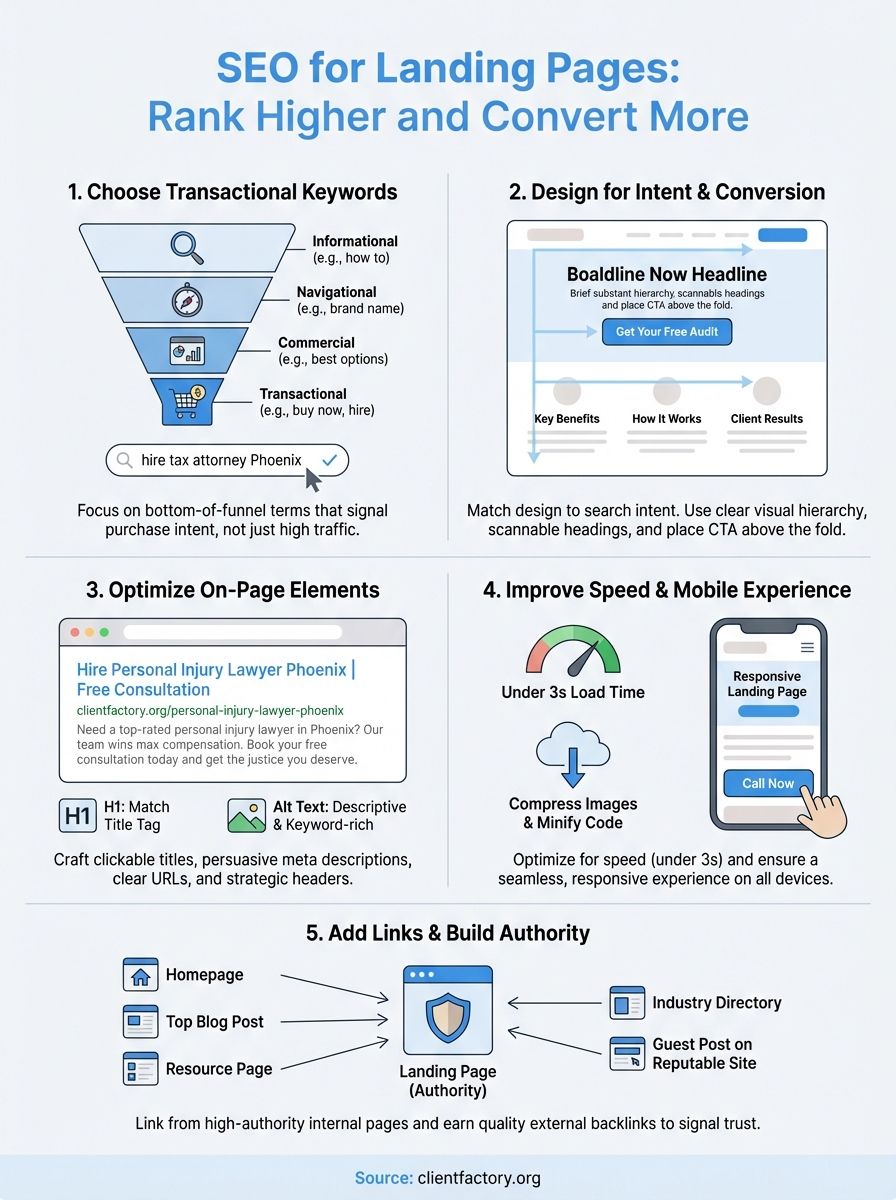
You now have a complete roadmap for implementing seo for landing pages that rank and convert. Start by targeting bottom-of-funnel keywords that attract ready buyers, then design your page to match search intent while maintaining a clear conversion path. Optimize your title tags, meta descriptions, and on-page elements to signal relevance to search engines. Speed up your page and ensure mobile visitors get the same quality experience as desktop users. Finally, build internal links from your strongest pages and earn backlinks that establish authority in your market.
The difference between landing pages that generate leads and those that waste traffic comes down to consistent execution of these five steps. Most businesses struggle with this balance because they lack the expertise to optimize for both search engines and conversions simultaneously. If you need help turning your landing pages into client acquisition machines, schedule a free funnel audit with Client Factory to identify exactly where your pages fall short and how to fix them.