
You need more clients. But cold calling feels like throwing darts in the dark. Email campaigns disappear into spam folders. Trade shows cost thousands with no guarantee of returns. Meanwhile your competition seems to land deals effortlessly. The problem isn’t your service or your pricing. It’s your lead generation strategy.
LinkedIn has 900 million professionals including the exact decision makers you want to reach. But most businesses treat it like a digital resume collector or spam people with terrible pitch messages. The real opportunity lies in building a systematic approach that combines profile optimization, targeted outreach, strategic content, and relationship building. Done right, LinkedIn becomes your most reliable source of qualified B2B leads.
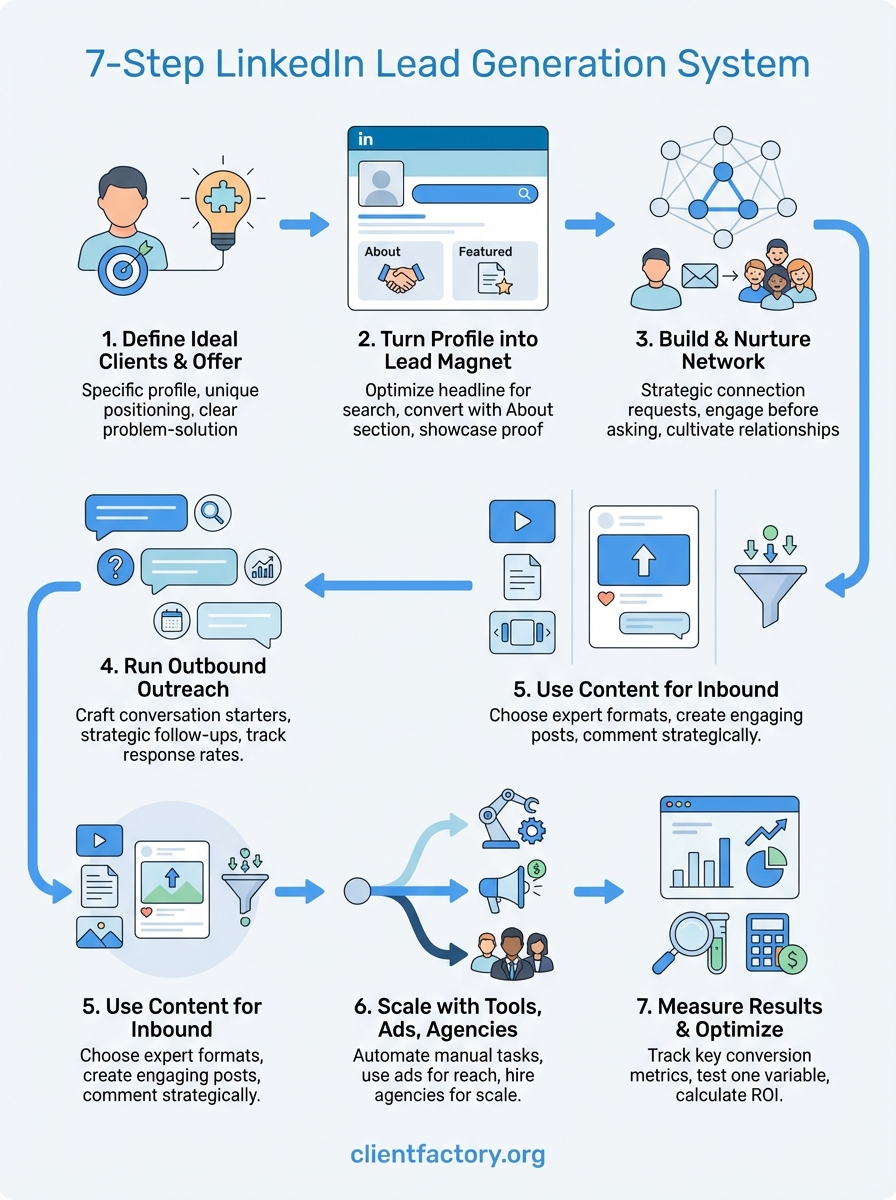
This guide walks you through seven steps to generate leads on LinkedIn. You’ll learn how to define your ideal client, optimize your profile for conversions, build a valuable network, run outreach that gets replies, create content that attracts inbound leads, choose the right tools or services, and measure what actually works. By the end, you’ll have a complete system you can implement immediately.
Understand how LinkedIn drives B2B leads
LinkedIn operates differently from other social platforms because professionals use it with business intent. They expect sales conversations, industry insights, and networking opportunities. This mindset shift means your outreach doesn’t feel intrusive when done correctly. Unlike Facebook or Instagram where people scroll for entertainment, LinkedIn users actively seek business relationships and career advancement. The platform gives you direct access to CFOs, VPs, and business owners who control purchasing decisions.
The three types of LinkedIn lead generation
You can generate leads on LinkedIn through three distinct approaches, and the best strategy combines all three. Outbound prospecting involves finding your ideal clients using search filters, then sending connection requests and messages. This method delivers the fastest results because you control who sees your message and when. Inbound content marketing attracts prospects to you through posts, articles, and comments that demonstrate expertise. People who engage with your content have already warmed up to your ideas. Paid advertising puts your offer directly in front of targeted audiences through Sponsored Content, Message Ads, or Lead Gen Forms. Each approach has different time requirements, costs, and conversion rates.

The most successful LinkedIn lead generation combines systematic outbound outreach with consistent content creation to build authority.
Why decision makers respond differently on LinkedIn
Decision makers ignore cold calls and delete sales emails without reading them. But they check LinkedIn messages because the platform signals professional credibility before you even start a conversation. Your profile shows mutual connections, shared experiences, and industry expertise. This context builds instant trust that phone numbers and email addresses can’t provide. Senior executives also use LinkedIn to research vendors before making purchasing decisions. When they find your profile after seeing your name mentioned in a proposal or referral, a complete and professional presence validates your legitimacy. The platform essentially pre-qualifies both parties before the first real conversation happens.
Your prospects spend time on LinkedIn daily because they need to stay informed about industry trends, monitor competitors, and maintain their professional networks. This daily habit means your message reaches them when they’re in a business mindset, not when they’re distracted by personal tasks or entertainment. The timing advantage alone increases response rates compared to other channels.
Step 1. Define your ideal clients and offer
Every failed LinkedIn lead generation campaign starts with the same mistake: trying to sell to everyone. You waste time connecting with people who can’t buy, don’t need your solution, or lack the budget to pay. Your message lands flat because it speaks to nobody specifically. Before you touch your profile or send a single message, you need crystal clarity on who you serve and what problem you solve. This foundation determines every decision you make on LinkedIn from search filters to message content to the posts you create.
Create a specific client profile
You need a detailed picture of your ideal client that goes beyond basic demographics. Start by identifying the exact job titles that have purchasing authority for your solution. A CFO makes different decisions than a VP of Operations, and your approach must reflect that difference. Write down the company size range you target, the industries you serve best, and the annual revenue that indicates they can afford your services. Geographic location matters if you only work with businesses in specific regions or time zones.
Next, define the specific problems your ideal clients face that your service solves. Document the symptoms they experience, the language they use to describe their challenges, and the business impact of leaving those problems unsolved. This research forms the foundation of every message you send and every piece of content you create. You find this information by reviewing past client conversations, reading industry forums, and analyzing questions prospects ask during sales calls.
Use this template to document your ideal client profile:
Job titles: [List 3-5 specific titles]
Company size: [Employee count range]
Industries: [Top 3 industries you serve]
Annual revenue: [Revenue range]
Key problems: [3 specific challenges they face]
Deal breakers: [What makes someone a bad fit]
Clarify your unique positioning
Your offer must solve a specific problem for a specific person in a specific way. Generic positioning like "we help businesses grow" tells prospects nothing about why they should choose you over competitors. Instead, articulate the exact transformation you deliver and the method you use to achieve it. Client Factory focuses on converting clicks into clients for service businesses and law firms through AI-powered, data-driven strategies. That specificity immediately tells the right people whether the service matches their needs.
The clearer your positioning, the easier every other step becomes because you know exactly what message will resonate with your ideal clients.
Test your positioning by stating it out loud to someone unfamiliar with your business. They should understand who you help, what problem you solve, and how you’re different within 10 seconds. If they ask clarifying questions or look confused, you need simpler language and sharper focus. Write your positioning statement and use it consistently across your profile, messages, and content.
Step 2. Turn your profile into a lead magnet
Your LinkedIn profile either builds trust or destroys it within three seconds. When prospects check you out after receiving your connection request or seeing your content, they make instant judgments about your credibility and relevance. A weak profile kills opportunities before conversations start. Most profiles read like boring resumes that list job duties and responsibilities. Instead, your profile should function as a sales page that demonstrates expertise, communicates your value proposition, and gives prospects clear reasons to engage. Every section needs strategic optimization from your headline to your featured content to your experience descriptions.
Optimize your headline for search and credibility
Your headline appears next to every comment, post, and message you send on LinkedIn. This 220-character space determines whether people click your profile or scroll past it. The default headline shows your current job title and company name, which wastes valuable real estate. Replace it with a headline that includes your target audience, the problem you solve, and a credibility indicator. This structure helps you appear in searches while communicating value immediately.

Use this template to craft your headline:
I help [target audience] [achieve specific result] through [your unique method] | [credibility indicator]
Example: "I help service businesses convert clicks into clients through AI-powered marketing funnels | 500+ clients served"
Test different headline variations by monitoring your profile views and connection acceptance rates. The headline impacts linkedin lead generation because it determines who finds you in searches and whether they want to connect. Include relevant keywords that your ideal clients use when searching for solutions, but avoid keyword stuffing that sounds robotic. Your headline should read naturally while incorporating terms like "client acquisition," "demand generation," or industry-specific language your prospects understand.
Write an About section that converts
Your About section needs to hook readers immediately because most people decide within the first two sentences whether to keep reading. Skip the autobiography about where you went to school or how you started your career. Open with the specific problem you solve for your target audience, then explain your unique approach. Use short paragraphs, bullet points, and clear language that speaks directly to reader pain points.
Structure your About section in this order:
- Opening hook: State the problem your ideal clients face
- Your solution: Explain your unique approach in 2-3 sentences
- Key benefits: List 3-5 specific outcomes clients achieve
- Social proof: Include metrics, testimonials, or notable clients
- Call to action: Tell readers exactly what to do next
End with a specific call to action that guides prospects to the next step. This might be visiting your website, scheduling a call, or downloading a resource. Make the action easy and relevant to where they are in the buying journey. Someone viewing your profile for the first time likely isn’t ready to buy, but they might download a guide or join your email list.
A profile optimized for conversions doesn’t list what you’ve done. It shows prospects what you can do for them.
Showcase proof and credibility signals
LinkedIn gives you multiple sections to demonstrate expertise beyond your headline and About section. Your Featured section should display your best content, case studies, or client results rather than random articles. Pin posts that generated high engagement, testimonials from satisfied clients, or lead magnets that capture contact information. This section appears prominently on your profile and reinforces your positioning.
Fill out your Experience section with results-focused descriptions rather than job duties. Quantify achievements with specific numbers like revenue generated, clients served, or problems solved. Each role should demonstrate how you delivered value similar to what prospects need. Recommendations from past clients carry significant weight, so actively request them from satisfied customers. Include specific projects in your Projects section and relevant certifications that build authority in your field.
Step 3. Build and nurture a high value network
Your LinkedIn network directly impacts your lead generation results. A network full of random connections produces zero opportunities, while a targeted network of 500 ideal clients and referral partners creates consistent deal flow. Most people accept every connection request they receive or randomly connect with strangers. This scattershot approach fills your feed with irrelevant content and dilutes your ability to reach the right people. Instead, you need a strategic system for growing your network with people who either need your services or can introduce you to those who do.
Connect with your ideal clients strategically
Send 20 to 30 connection requests per day to people who match your ideal client profile. Use LinkedIn’s search filters to find prospects by job title, company size, industry, and location. Sales Navigator provides more advanced filtering options that let you target specific seniority levels, company growth signals, and recent job changes. When you find someone who fits your criteria, review their profile to confirm they match your target before sending a request.
Always personalize your connection request message with a specific reason for connecting. Generic requests get ignored or rejected at much higher rates than personalized ones. Reference something specific from their profile like a shared connection, recent post, or mutual interest. Keep your message under 200 characters and avoid pitching your services immediately.
Use this connection request template:
Hi [Name], I noticed [specific detail about them]. I connect with [job title/industry] professionals in my network. Looking forward to connecting.
Your acceptance rate tells you whether your targeting and messaging work effectively. Aim for a 40% or higher acceptance rate by continuously refining who you target and how you personalize requests. Track which industries and job titles accept most frequently, then adjust your targeting accordingly.
Engage before you ask for anything
Requesting a meeting immediately after connecting destroys trust and marks you as a spammer. Wait at least one week before sending any sales message to new connections. During this waiting period, engage with their content by liking posts, leaving thoughtful comments, and sharing their articles. This engagement keeps you visible while building familiarity without being pushy.
Comment on posts from your target prospects even before connecting with them. Thoughtful comments that add value to the conversation position you as an expert and make connection requests more likely to get accepted. Your comment should provide additional insight, ask a relevant question, or share a related experience. Avoid generic responses like "Great post!" that add nothing to the discussion.
Building relationships through consistent engagement converts cold prospects into warm leads who actually respond when you eventually reach out.
Turn connections into relationships
Schedule time each week to nurture your existing network rather than only focusing on new connections. Send value-first messages to connections who haven’t engaged recently by sharing a relevant article, congratulating them on a new role, or introducing them to someone beneficial. These touches keep relationships warm without asking for anything in return.
Create a simple system to track your network nurturing efforts. Segment your connections into categories like hot prospects, current clients, referral partners, and past clients. Set reminders to reach out to each segment monthly with relevant content or check-ins. You can use a spreadsheet or CRM to manage this process, ensuring no valuable relationships go cold due to neglect. Successful linkedin lead generation requires consistent relationship building, not just one-time outreach blasts.
Step 4. Run outbound outreach that gets replies
Most LinkedIn outreach fails because people immediately pitch their services like pushy salespeople. You need a different approach that starts conversations instead of triggering instant rejection. Your first message should focus entirely on the prospect, not your company or product. The goal is to get a reply, not close a deal in the first interaction. This step-by-step process shows you how to craft outreach sequences that generate consistent response rates above 30%.
Craft messages that start conversations
Your first message determines whether prospects engage or ignore you. Start with a specific observation about their business that shows you researched them individually rather than sending mass messages. Reference a recent LinkedIn post they published, a company announcement, a shared connection, or a challenge common in their industry. This personalized opening proves you invested time understanding their situation.

Keep your initial message under 100 words and focus on one clear point. Ask a single relevant question that invites them to share their experience or opinion. Questions about their current approach, recent changes, or future goals work better than yes/no questions that kill conversations. Never mention your services, include links, or ask for a meeting in this first message.
Use this proven message template:
Hi [Name],

I saw [specific observation about them/their company].

Most [their role] I speak with struggle with [specific challenge].

Are you experiencing [symptom of that challenge]?

[Your Name]
Example message:
Hi Sarah,

I noticed your company just expanded to three new markets this quarter.

Most VPs of Sales I speak with struggle to maintain lead quality when scaling quickly across regions.

Are you finding it harder to keep your pipeline filled with qualified prospects?

Mark
Send strategic follow-up sequences
Your first message gets ignored 60% to 70% of the time even when perfectly crafted. Follow-ups dramatically increase your total response rate without being annoying when done correctly. Wait three to four business days between each message and limit yourself to three total follow-ups. Each message should provide new value rather than repeating your initial question.
Structure your follow-up sequence to add different types of value in each message. Your second message can share a relevant insight or statistic related to their challenge. The third message might reference a case study or result you achieved for a similar company. Your final follow-up acknowledges they’re likely busy and offers an easy out while leaving the door open.
Follow-up message framework:
Message 1 (Day 0): Ask relevant question about their challenge
Message 2 (Day 3-4): Share insight/data related to their situation
Message 3 (Day 7-8): Provide case study or social proof
Message 4 (Day 11-12): Acknowledge timing, offer to reconnect later
The best linkedin lead generation comes from persistent but value-focused follow-ups that educate prospects rather than pressure them.
Track and optimize your response rates
You cannot improve what you don’t measure. Create a simple tracking spreadsheet that records every outreach campaign with metrics like connection acceptance rate, first message response rate, follow-up response rate, and meetings booked. Track these numbers weekly to identify patterns in what works and what fails. Different industries, job titles, and message styles produce different results.
Test one variable at a time to isolate what drives better performance. Try different opening lines, question types, or follow-up timing while keeping other elements constant. When you discover a message that generates 40% response rates compared to your baseline 25%, document exactly what made it work. Successful outreach requires continuous testing because what works today might stop working next month as prospects see similar messages from competitors.
Monitor your metrics across different segments of your target audience. You might find that CFOs respond better to data-driven messages while CMOs prefer creative approaches. Adjust your templates based on these insights rather than using the same message for everyone. Set a goal to send at least 100 messages per week to generate enough data for meaningful optimization.
Step 5. Use LinkedIn content to attract inbound leads
Publishing strategic content positions you as an authority and attracts prospects who come to you already interested. Consistent posting generates visibility with thousands of professionals in your target market without sending a single cold message. When prospects see your expertise demonstrated publicly through valuable posts, they trust you before the first conversation starts. Content-driven linkedin lead generation builds a pipeline of warm leads who reach out to you instead of requiring outbound outreach. This approach requires more time upfront but delivers compounding returns as your content library grows and your audience expands.
Choose content formats that showcase expertise
LinkedIn supports multiple content types, and different formats serve different purposes in your lead generation strategy. Short text posts (under 1,300 characters) generate the highest engagement rates because they’re quick to consume and easy to share. Use these for quick insights, questions to your audience, or commentary on industry trends. Longer articles (over 1,000 words) establish deep expertise and perform well in search results, making them ideal for educational content that addresses specific problems your prospects face.
Video content gets 5x more engagement than text-only posts, though it requires more production effort. Record simple videos sharing client success stories, explaining complex concepts, or giving quick tips related to your service. Carousel posts that combine multiple images with text work exceptionally well for step-by-step processes, frameworks, or data visualizations. Document posts (PDFs) let you share lead magnets directly on LinkedIn, capturing email addresses in exchange for valuable resources like checklists, templates, or guides.
Focus your initial content efforts on two formats you can produce consistently rather than trying to master everything at once. Test each format for 30 days while tracking engagement metrics to identify what resonates most with your target audience.
Create posts that generate engagement and leads
Your post structure determines whether people stop scrolling or keep moving. Open with a hook that addresses a specific pain point your ideal clients experience in the first sentence. This immediately signals relevance to your target audience. Follow with 3 to 5 short paragraphs that provide actionable value, then end with a question or call to action that encourages comments.
Use this proven post template:
[Hook: State a surprising fact or common problem]

[Context: Explain why this matters]

[Value: Share 3-5 specific insights/steps]

[Proof: Add results or example if relevant]

[Engagement: Ask a question related to the topic]
Post during business hours when your target audience actively uses LinkedIn, typically Tuesday through Thursday between 8 AM and 10 AM or 12 PM and 2 PM in their time zone. Consistency matters more than frequency, so commit to a sustainable schedule like three posts per week rather than posting daily for two weeks then disappearing for a month.
Content that teaches something specific and actionable generates more leads than content that simply promotes your services.
Comment strategically to expand reach
Your comments on other people’s posts expose you to thousands of prospects beyond your existing network. When you leave valuable comments on posts from industry influencers or target clients, their entire audience sees your name and profile. This visibility drives profile views and connection requests from qualified prospects who discover you through thoughtful commentary.
Add substantial value in every comment rather than posting generic praise. Share a relevant experience, provide an additional perspective, or ask an insightful question that advances the conversation. Comments between 20 and 50 words perform best because they’re long enough to demonstrate expertise but short enough for people to read quickly. Target posts from people who already have large engaged audiences in your target market.
Set aside 15 minutes daily specifically for strategic commenting. Find 5 to 10 relevant posts and leave thoughtful comments that position you as an expert. Track which posts you comment on and monitor whether those comments drive profile views or connection requests. This data helps you identify which topics and influencers provide the best exposure to your ideal clients.
Step 6. Decide when to use tools, ads, or agencies
You can handle linkedin lead generation manually when starting out, but scaling requires deciding which tasks to automate, advertise, or outsource. Each option carries different costs, time commitments, and results. Understanding when to invest in automation tools, paid advertising, or professional agencies prevents you from wasting money on solutions you don’t need yet or staying stuck doing everything yourself when growth demands leverage.
When manual outreach reaches capacity
Automation tools become worth the investment when you consistently send 100+ connection requests and messages weekly and can’t physically keep up with the volume. Tools like LinkedIn Sales Navigator help you find qualified prospects faster with advanced search filters that save hours compared to basic LinkedIn search. Message automation platforms send sequences on your behalf but risk account restrictions if you ignore LinkedIn’s daily limits and best practices.
Start with Sales Navigator before any automation because better targeting matters more than sending more messages. Premium features let you save leads, set alerts for job changes, and access additional contact information. Only add message automation after you’ve proven your manual outreach generates consistent replies and meetings, ensuring you scale what already works rather than amplifying ineffective outreach.
LinkedIn ads for faster but expensive reach
Paid advertising makes sense when you need immediate visibility or want to test new markets quickly without building organic reach first. LinkedIn ads cost significantly more than Facebook or Google ads, with average CPCs between $5 and $12, but reach decision makers other platforms can’t access. Lead Gen Forms perform best because they pre-fill prospect information and reduce friction in the conversion process.
Allocate at least $3,000 monthly to run meaningful LinkedIn ad tests because smaller budgets don’t generate enough data to optimize campaigns effectively. Ads work best for high-ticket services where a single client justifies the acquisition cost. Test ads only after you’ve validated your messaging through manual outreach so you know which value propositions resonate before spending thousands on promotion.
Hiring agencies when revenue justifies cost
Agencies that handle LinkedIn lead generation typically charge $3,000 to $10,000 monthly plus ad spend. This investment makes sense when your client lifetime value exceeds $25,000 and you lack internal resources to manage campaigns. Evaluate agencies based on their process, case studies in your industry, and whether they focus on building sustainable systems rather than just delivering short-term lead volume.
Agencies work best when you need expert execution immediately but don’t want to hire full-time staff while testing LinkedIn as a channel.
Maintain oversight even with agency partnerships by reviewing message templates, monitoring response rates, and ensuring they follow LinkedIn’s terms of service to protect your account. The right agency becomes an extension of your team, but you still need to provide strategic direction and qualify the leads they generate.
Step 7. Measure results and optimize
You waste time and money when you guess what works instead of measuring actual results. Tracking specific metrics reveals which activities generate leads and which drain resources without returns. Most people track vanity metrics like profile views or post impressions that don’t correlate with revenue. Instead, focus on conversion metrics that directly connect to your bottom line. Build a simple tracking system from day one so you can optimize your linkedin lead generation strategy based on real data rather than assumptions.
Track the metrics that matter
Monitor your conversion rates at each stage of your lead generation funnel to identify exactly where prospects drop off. Start with your connection acceptance rate, which should stay above 40% if your targeting and personalization work effectively. Track your message response rate separately for initial outreach and follow-ups, aiming for 25% to 35% combined response rates. Measure how many conversations convert to discovery calls, then track how many calls turn into qualified opportunities and closed deals.
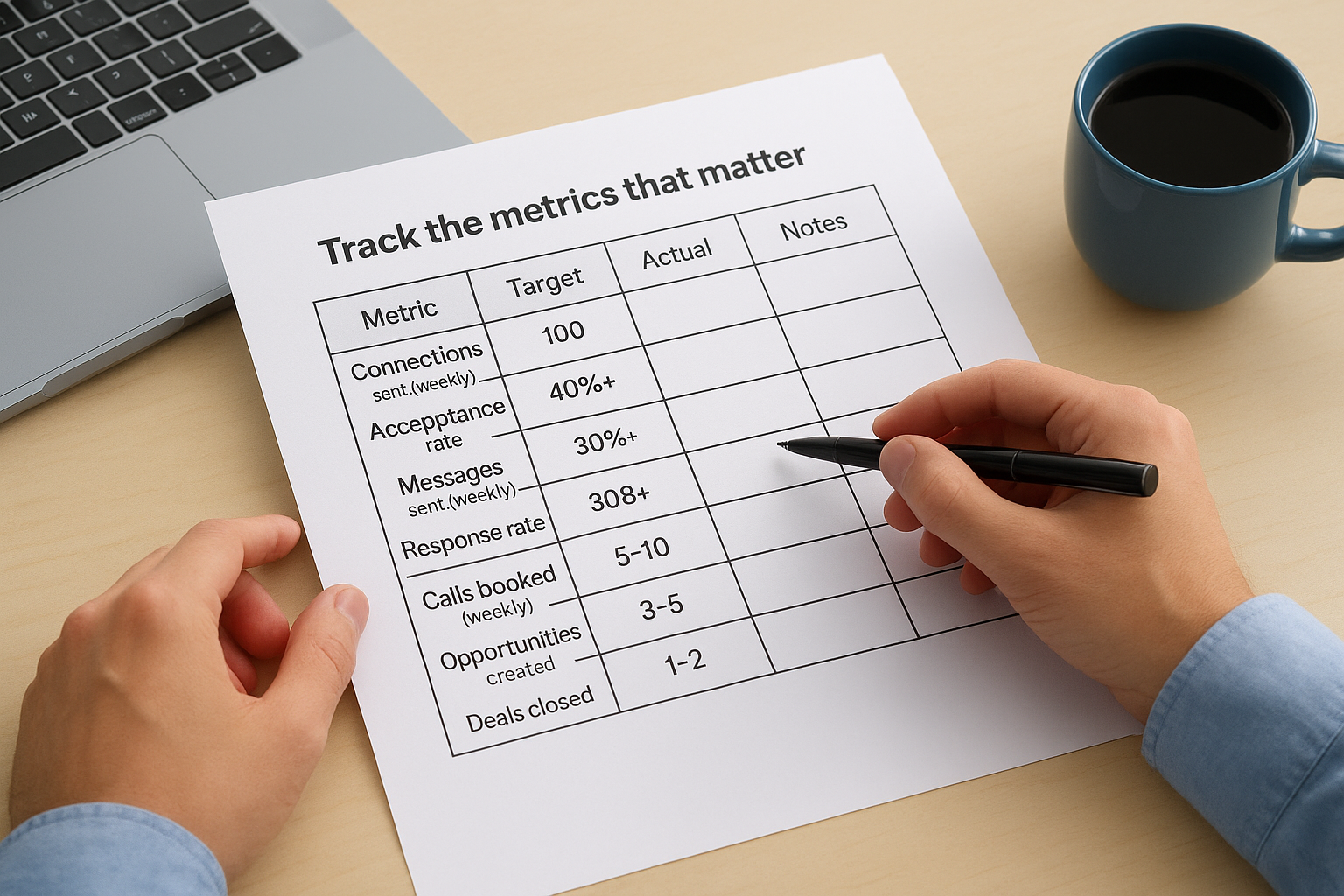
Create this simple tracking spreadsheet:
| Metric | Target | Actual | Notes |
|---|---|---|---|
| Connections sent (weekly) | 100 | ||
| Acceptance rate | 40%+ | ||
| Messages sent (weekly) | 100 | ||
| Response rate | 30%+ | ||
| Calls booked (weekly) | 5-10 | ||
| Opportunities created | 3-5 | ||
| Deals closed | 1-2 |
Update your metrics weekly to spot trends before they become problems. A sudden drop in acceptance rates signals your targeting shifted or your connection message stopped working. Declining response rates mean your outreach messages lost effectiveness or you’re contacting the wrong people.
Test one variable at a time
Changing multiple elements simultaneously makes it impossible to determine what actually improved your results. Pick one specific variable to test like your headline, opening message line, follow-up timing, or content posting schedule. Run the test for at least two weeks or 100 attempts to collect meaningful data, then compare results against your baseline performance.
Document every test with clear before and after metrics. Your testing log should record the exact change you made, the date range, sample size, and outcome. This documentation prevents you from repeating failed tests and helps you replicate successful ones across different campaigns or team members.
Systematic testing turns linkedin lead generation from guesswork into a predictable system that consistently improves over time.
Calculate your ROI
Divide your total LinkedIn costs by revenue generated to determine whether your investment pays off. Include tool subscriptions, ad spend, agency fees, and the hourly value of your time spent on the platform. Compare this cost per client to your lifetime customer value to ensure profitability. If you spend $2,000 monthly on LinkedIn activities and generate five new clients worth $10,000 each, your return justifies continued investment and potentially scaling up your efforts.
Wrap up and next steps
You now have a complete system for generating qualified leads on LinkedIn. Start with the fundamentals by defining your ideal client and optimizing your profile before launching any outreach. Build your network strategically with 20 to 30 connection requests daily, then run personalized outreach sequences that start conversations instead of pushing sales pitches. Create consistent content that demonstrates expertise and attracts inbound interest while you pursue outbound campaigns.
Pick one area to implement this week rather than trying everything simultaneously. Your linkedin lead generation results compound over time as your network grows, your content library expands, and your messaging improves through testing. Track your metrics weekly to identify what works and double down on those activities.
Need expert help turning these strategies into consistent client flow? Client Factory specializes in building systematic client acquisition funnels that convert LinkedIn connections into paying clients through data-driven campaigns and AI-powered optimization.